The Anniversary by Alex Finlay Summary, Characters and Themes
The Anniversary by Alex Finlay is a psychological thriller about two former classmates whose lives are shaped by violence committed on the same date across many years.
Jules Delaney survives a serial predator known as the May Day Killer, while Quinn Riley loses his mother, his freedom, and nearly every source of stability he once possessed. Their separate searches for truth gradually expose connections among missing women, an old murder, a wrongful conviction, and people hidden behind respectable public identities. Alex Finlay combines a long-running criminal investigation with a study of trauma, loyalty, obsession, and recovery, following the characters as they transform pain into action.
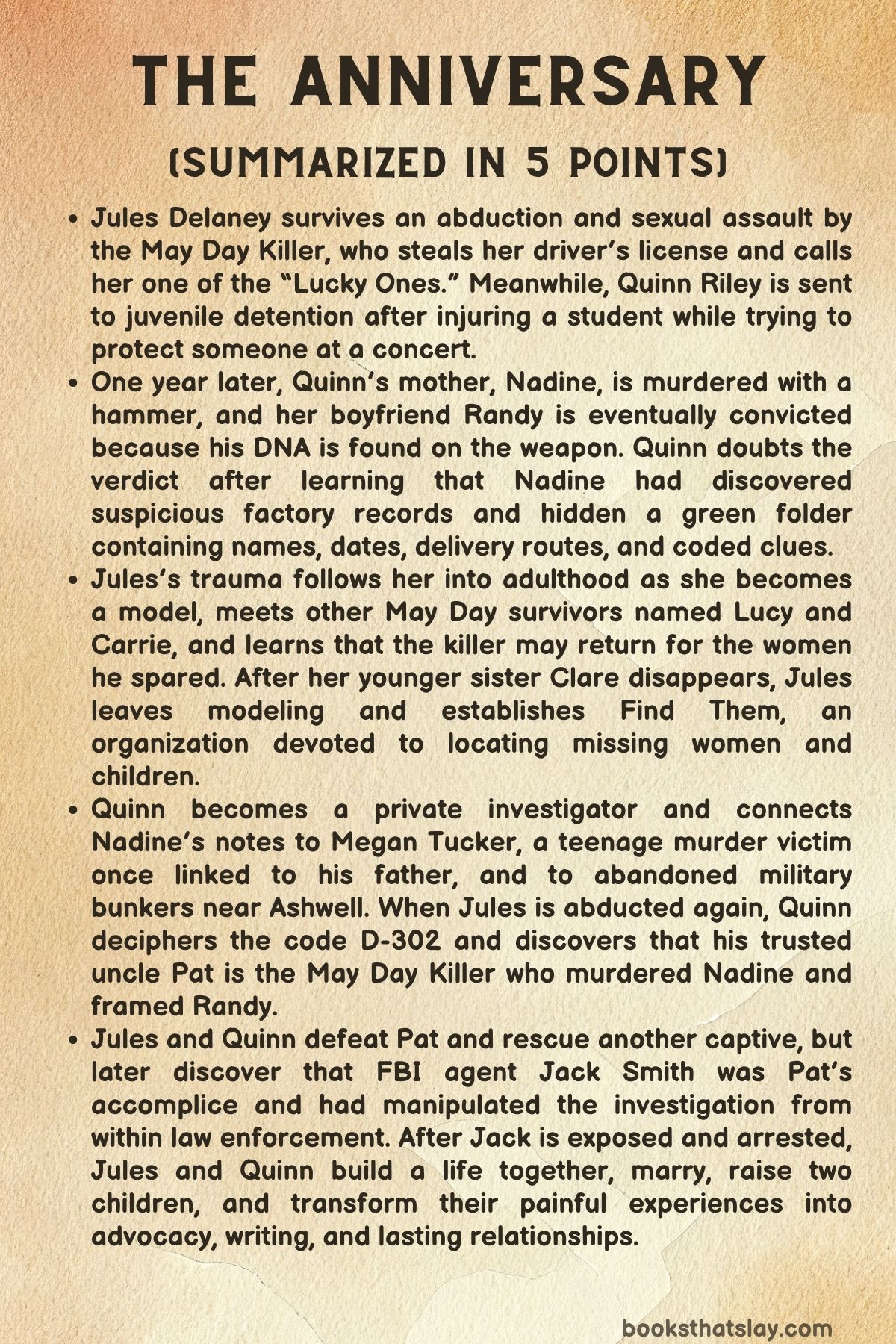
Summary
In 1992, seventeen-year-old Jules Delaney appears to have an enviable life in Monarch, Nebraska. She is beautiful, popular, and expected to follow a conventional path, but she feels uncertain about her future and secretly enjoys spending time with Quinn Riley, an intelligent classmate whose poverty keeps him outside her social circle.
Quinn dreams of leaving Monarch through education, yet he carries responsibilities far beyond his age. His father is dead, his younger brother George is disabled and nonverbal, and Quinn distrusts Randy Calhoon, the man dating his mother, Nadine.
Jules attends a grunge concert with her friends Miranda and Brad Paxton, whose drunken behavior causes her to leave early. After returning to Monarch and entering her parked car, she discovers a stranger hiding in the back seat.
The man abducts and rapes her, steals her driver’s license, threatens her family, and calls her one of the “Lucky Ones.” Jules survives, but terror, shame, and the fear that her attacker may return prevent her from reporting the crime.
At the same concert, Quinn intervenes when Brad is threatened by other students. Quinn punches one attacker, who falls and suffers a serious head injury, leading to Quinn’s arrest and confinement in juvenile detention.
On May 1 the following year, Nadine is murdered with a hammer near the factory where she works. Quinn is briefly released to attend her funeral, after which he joins the Army because his prospects for college and employment have vanished.
Before leaving, Quinn visits George in a group home and promises that they will someday live together again. He also encounters Jules during a final meeting with his counselor, Helen Yang, and immediately senses that the confident girl he once knew has changed.
Jules has turned to alcohol and reckless behavior to suppress memories of her assault. When another woman is found murdered, she fears that her silence allowed the May Day Killer to continue attacking others.
She finally writes an anonymous letter describing her abduction, the stolen license, the attacker’s manner, and his reference to the Lucky Ones. Meanwhile, Quinn learns that Nadine discovered suspicious information at work and kept it in a green folder she called her Red Flag file.
Searching the abandoned Riley home, Quinn fails to find the folder but discovers his father’s hammer concealed in the attic with blood and hair still attached. The weapon appears to connect someone close to the family with Nadine’s murder.
During his military service, Quinn is wounded in Somalia. His closest friend, Giuseppe, dies saving him after a fellow soldier named Sven deliberately leaves them exposed to an attack.
Quinn later travels to Italy to deliver Giuseppe’s final letter to his family. Giuseppe’s sister Alessia helps him speak honestly about the death, and their brief romance gives Quinn a temporary sense of belonging.
Jules becomes a model in Milan, where she discovers that glamour often hides exploitation. When she witnesses photographer Alastair Essex assaulting another model, Colette, Jules attacks him and rescues her, reclaiming some of the power taken from her.
The FBI traces Jules’s anonymous letter and introduces her to two other survivors, Lucy and Carrie. Agent Jack Smith believes the May Day Killer deliberately released several women and may eventually return to eliminate them.
Randy is charged with Nadine’s murder after his DNA and her blood are found on the hammer. Quinn testifies at the trial, but Randy’s defense suggests that Nadine was killed because she uncovered criminal activity at the factory.
The jury convicts Randy, yet Quinn is troubled by missing evidence and the exclusion of testimony from Nadine’s colleague, Ms. Glomm. Holly, George’s compassionate caregiver and a law student, helps Quinn understand that investigators may have withheld information supporting an alternative suspect.
Holly remembers seeing a green folder among George’s belongings. Quinn and Holly recover it from the group home and find Nadine’s notes containing names, dates, delivery routes, the word “Megan,” the word “Pearl,” and the code “D-302.”
At the same time, Jules and Lucy leave FBI protection and begin attacking convicted sexual offenders. Their vigilantism gives them a temporary sense of control, but it nearly ends in disaster when one man overpowers them.
The FBI then reports that Jules’s younger sister, Clare, has disappeared. Jules believes the May Day Killer may have taken her as punishment or as part of his continuing ritual.
Over the following years, Quinn becomes a private investigator. His patience, intelligence, and ability to notice minor details make him effective, although his empathy sometimes causes him to place compassion above professional results.
Jules leaves modeling and continues searching for Clare. She suspects her former school counselor Trent Vanderman because Clare accused him of inappropriate conduct and because he has connections to several women linked with May Day.
Vanderman denies involvement and explains that Clare developed an obsessive crush on him and secretly left suggestive photographs in his office. Jules realizes that he may have behaved irresponsibly in other areas of his life but is not the serial predator she seeks.
Quinn investigates Megan Tucker, whose name appeared in Nadine’s file. Megan was raped and murdered as a teenager, and Quinn’s father, Rick, was once arrested because he had been among the last people seen with her.
A photograph reveals that Megan wore pearl earrings later possessed by Nadine. Quinn understands that “Pearl” referred not to Nadine’s supervisor Kenny Pearl but to jewelry connecting his parents to Megan’s unsolved death.
Retired sheriff Colton Rupert tells Quinn that Megan’s murder may have involved two offenders. One person committed the physical violence, while another sat in a closet and watched.
Rupert suspected John Smith, a charming foster child known for spying on teenage girls, but he was unable to prove John’s involvement. Quinn becomes consumed by the case, and Holly eventually leaves because he repeatedly chooses the investigation over their relationship.
Quinn’s attention also turns to the disappearance of Minnie Agbayani, a child taken outside her parents’ flower shop. A non-prescription eyeglass lens found at the scene leads him to Keith Cratch, a one-eyed former prisoner employed through a church reentry program.
Quinn travels to the remote farm of Reverend and Mrs. Agness, who once employed Cratch. There he discovers that Minnie is alive and has been raised by the couple as their adopted daughter.
When Reverend Agness fires at him, Quinn drives while hiding below the dashboard and accidentally strikes him with the car. Minnie is recovered and reunited with her parents, giving both Quinn and Jules proof that even a seemingly hopeless missing-person case can be solved.
Jules and Quinn reconnect at the hospital after Minnie’s rescue. Quinn admits that during juvenile detention and military service, he wrote unsent letters to Jules because the memory of their friendship helped him endure isolation and grief.
Their relationship grows as Quinn becomes part of the community Jules has created through Find Them, the nonprofit she established with Lucy and Carrie. The organization investigates neglected cases involving missing women and children, including victims whose disappearances received little public attention.
At a fundraising gala, Holly unexpectedly returns and asks Quinn to move to Chicago with her. Quinn realizes that although he cares for Holly, he is in love with Jules.
Before Jules and Quinn can speak openly, Jules hears a familiar laugh and the sound of a spinning coin. She recognizes the May Day Killer among the people she trusts, and he abducts her from the event.
Quinn studies Nadine’s notes and recognizes that the May Day crimes align with old factory delivery routes. Jules’s description of her original captivity leads him to the abandoned ammunition bunkers at the Sioux Ordnance Depot, where the code D-302 identifies a specific structure.
Inside the bunker, Jules discovers another abducted woman. The killer returns, imprisons them together, and spreads gasoline through the structure so that he can burn the victims and destroy the evidence.
Quinn reaches the bunker and confronts Uncle Pat, the man who acted as his protector after his father’s death. Pat admits that he is the May Day Killer and that he murdered Nadine after she discovered his crimes.
Pat also claims that Rick watched during Megan Tucker’s assault, suggesting that the corruption within Quinn’s family began long before Nadine’s death. Quinn and Jules overpower Pat, free the other captive, and trap him inside the gasoline-soaked cell.
Jules uses Pat’s coin-toss ritual against him before igniting the fuel. Although killing him ends the immediate threat, the act leaves Quinn struggling with betrayal, grief, and uncertainty about his father.
Quinn leaves America and eventually attacks Sven in revenge for Giuseppe’s death, but violence fails to bring him peace. Jules travels to Italy, tells Quinn that she loves him, and persuades him to return home.
A year later, Jules and Quinn visit Megan’s grave and learn that another man regularly visited both Megan and Tanya Smith, who died on May 1, 1967. Tanya’s sister reveals that her son John watched from a closet while a client murdered her after using a coin toss to determine her fate.
The adult John is FBI agent Jack Smith. He was Pat’s accomplice, used his position to control the investigation, helped select the Lucky Ones, and kept the stolen licenses as trophies.
Jules, Quinn, Lucy, Carrie, and law enforcement officers arrange a confrontation at a diner. Jack confesses while undercover officers record him, and he is arrested.
Ten years later, Jules and Quinn are married and have two children named George Giuseppe and Clare. Quinn has become a successful novelist, Jules remains devoted to finding the missing, Randy has been exonerated, and the survivors have created lasting relationships from experiences that once isolated them.
Characters
Jules Delaney
Jules begins The Anniversary as a socially confident teenager whose beauty gives her status but does not provide a clear identity. She is attracted to Quinn because he speaks to her without treating her as a prize, yet she initially lacks the independence to acknowledge their friendship publicly.
Her abduction destroys her sense of safety and changes how she experiences her body, relationships, and surroundings. She responds through silence, alcohol, reckless behavior, and constant vigilance because admitting the truth would require her to confront shame she wrongly believes belongs to her.
Jules’s decision to write the anonymous letter represents her first attempt to transform fear into responsibility. Although she is not ready to identify herself, she understands that withholding information may leave other women in danger.
Her modeling career places her in another environment where men use authority, money, and professional access to violate boundaries. By defending Colette from Alastair Essex, Jules acts in the way she wishes someone could have acted for her, and the confrontation proves that she is no longer entirely controlled by helplessness.
Her partnership with Lucy temporarily sends her toward violence rather than recovery. Attacking offenders gives Jules immediate relief, but the experience also shows that transferring rage onto symbolic targets cannot resolve the original trauma.
Clare’s disappearance turns Jules’s private suffering into a permanent mission. Find Them becomes both a practical organization and an expression of her refusal to let missing women be reduced to photographs, statistics, or forgotten investigations.
During her second confrontation with the May Day Killer, Jules demonstrates how much she has changed. She uses her concealed pepper spray, returns to the bunker despite having an opportunity to flee, frees another captive, and participates directly in defeating Pat.
Her final confrontation with Jack shows greater control than her confrontation with Pat. Instead of acting alone, she works with friends and law enforcement officers, obtains a confession, and allows a public arrest to expose the offender.
Jules’s eventual relationship with Quinn is important because it is based on mutual knowledge rather than rescue. He does not erase her trauma, and she does not cure his grief; they create a life in which both can be known without being defined solely by what was done to them.
Quinn Riley
Quinn is introduced as a disciplined, thoughtful teenager forced into an adult role by poverty and family instability. His work at Burger Hut, care for George, respect for customers, and devotion to his late father’s moral example reveal a strong sense of responsibility.
That responsibility can also become impulsive and destructive. Quinn attacks a student to protect Brad and later confronts Randy over George’s bruises, showing that his protective instincts often move faster than his judgment.
Juvenile detention destroys Quinn’s planned future, while Nadine’s murder removes the person around whom his remaining family life was organized. Joining the Army gives him structure, but it also exposes him to further violence and adds survivor’s guilt to his existing grief.
Giuseppe’s death becomes one of Quinn’s deepest wounds because it confirms his fear that anyone who protects him will suffer. His later attack on Sven shows that he still confuses punishment with resolution, even after years of investigating how violence spreads through families.
Quinn’s greatest strength is his ability to notice what others overlook. He recognizes the significance of the green folder, Megan’s earrings, Minnie’s missing eyeglass lens, the Agness farm’s school bus, the factory delivery routes, and the code identifying bunker D-302.
His investigative talent is inseparable from his emotional persistence. He refuses to accept Randy’s conviction simply because the evidence appears conclusive, and he continues searching after police, prosecutors, and relatives have decided the case is closed.
That persistence frequently becomes obsession. Quinn neglects Holly, avoids discussing his military trauma, misses important commitments, and risks turning unresolved cases into permanent substitutes for an ordinary life.
His discovery that Pat is the killer attacks the foundation of his personal history. Pat was his uncle, protector, substitute father, and connection to Nadine, making the betrayal more psychologically damaging than the exposure of an unknown criminal could have been.
Quinn’s later career as a novelist completes the aspiration he carried as a bookish teenager. Writing allows him to organize memory without being trapped inside investigation, while his marriage and children demonstrate that connection has finally replaced isolation.
Uncle Pat
Uncle Pat initially appears to be one of the few dependable adults in Quinn’s life. He intervenes during the confrontation with Randy, provides Quinn with a concert ticket, shares memories of Rick, supports him after Nadine’s death, and later helps create meaningful experiences for George.
This apparent warmth makes Pat the most devastating betrayal in The Anniversary. His generosity is not entirely false, but it exists beside his capacity for sexual violence, manipulation, murder, and long-term deception.
Pat uses his position within the family to remain close to evidence and potential investigators. He knows the Riley home, understands the factory routes, can conceal the murder weapon, and has access to Quinn’s trust.
His murder of Nadine is especially cruel because she is his sister. When she discovers the connection among delivery schedules, missing women, Megan’s earrings, and bunker D-302, Pat chooses self-preservation over family loyalty.
Pat also depends on ritual to make his crimes feel controlled. The May 1 date, the coin toss, the division between victims who die and women declared lucky, and the preservation of stolen identification cards turn murder into a private system.
His partnership with Jack allows him to believe that responsibility is shared and therefore diluted. Yet Pat remains fully accountable for his decisions, including the choice to continue killing across decades while playing the role of a loving uncle.
Even after being defeated, he attempts to hurt Quinn and Jules by revealing information about Rick and taunting Jules about Clare. His final weapon is psychological, showing that control matters to him as much as physical violence.
Jack Smith, Also Known as John Smith
Jack Smith presents himself as the patient FBI agent committed to finding the May Day Killer. He brings survivors together, studies their similarities, arranges protection, and appears to understand the long-term effects of trauma.
His real identity as John Smith transforms those actions into calculated surveillance. By controlling the investigation, Jack can learn what the survivors remember, determine which clues threaten him, and influence how law enforcement resources are used.
John’s childhood explains the origin of his fixation without excusing it. He watched from a closet while his mother, Tanya, was murdered after a coin toss, and that experience shaped his association among women, death, spectatorship, and chance.
Unlike Pat, Jack prefers observation and intellectual control. The chair inside Megan’s closet, his history of spying on girls, and his position within the FBI all reflect a desire to watch while appearing detached from the violence.
The Lucky Ones resemble Tanya, suggesting that Jack repeatedly recreates his mother’s image through other women. Sparing selected victims does not show mercy; it allows him to preserve living reminders of the original trauma and continue influencing their lives.
His professional success demonstrates how intelligence and respectability can protect a predator. Jack does not hide outside the investigation but places himself at its center, where his knowledge appears useful rather than suspicious.
His defeat occurs because the survivors compare experiences and refuse to remain dependent on his interpretation. Once Jules, Lucy, Carrie, and Quinn combine their knowledge, Jack loses the informational advantage that protected him for years.
Lucy
Lucy responds to trauma through anger, sarcasm, alcohol, and confrontation. Her hostile manner protects a more vulnerable person whose education, confidence, and imagined future collapsed after the May Day attack.
Her acceptance to Dartmouth shows that she once possessed a clear path forward. When she cannot function at college, she experiences the loss not only of safety but also of the person she expected to become.
Lucy’s attacks on convicted sexual offenders allow her to replace helplessness with physical dominance. The relief is temporary, however, and her increasing dependence on violence results in imprisonment and public notoriety.
Despite her recklessness, Lucy is fiercely loyal. She protects Jules by refusing to identify her as a participant in the assaults, remains attentive to the danger of May 1, and later helps operate Find Them.
Her friendship with Jules and Carrie gradually gives her a role that does not depend on punishment. At the nonprofit, Lucy can direct her anger toward advocacy, organization, and practical support for missing people.
Lucy also becomes capable of healthier intimacy. Her relationship with Connor indicates that she is learning to recognize gentleness as strength rather than mistaking danger for excitement.
During the confrontation with Jack, Lucy’s presence remains intimidating, but her violence is contained within a coordinated plan. This change shows that she has not lost her forceful nature; she has learned to place it within a community that can guide and restrain it.
Carrie
Carrie initially appears sheltered, religious, and emotionally dependent on her family. Her faith provides comfort, yet the controlling influence of Pastor Jim and the church also limits her independence.
Among the survivors, Carrie is the least confrontational, but she often expresses fears that the others avoid saying aloud. Her question about whether the killer will eventually return identifies the central threat facing the Lucky Ones.
Carrie’s difference from Jules and Lucy demonstrates that trauma does not produce one predictable response. She does not rely on alcohol or physical aggression, but she still lives within fear and requires the safety of familiar structures.
Her work at Find Them gradually strengthens her confidence. Research gives her a practical role, while contact with neglected cases expands her world beyond the protection offered by her family and church.
Carrie also becomes a bridge between the nonprofit and Pastor Jim’s financial resources. By arranging his visit, she demonstrates growing agency and uses her family connection to support work that has meaning beyond religious approval.
Her loyalty is most visible in the agreement that none of the survivors will remain alone on May 1. Carrie becomes part of a chosen family in which protection is mutual rather than imposed from above.
Holly
Holly first appears as George’s compassionate caregiver, willing to bend institutional rules so that Quinn can visit his brother. Her kindness is practical rather than sentimental, and she understands that George and Quinn both deserve dignity.
Her decision to study law reflects her desire to advocate for vulnerable children. She helps Quinn interpret the evidence excluded from Randy’s trial and recognizes that Ms. Glomm’s testimony could have changed the legal proceedings.
Holly offers Quinn stability, intelligence, affection, and a possible future outside his family’s tragedies. Their relationship is genuine, but Quinn repeatedly treats it as something that will remain available regardless of how little emotional attention he gives it.
Her departure is an act of self-respect rather than punishment. Holly understands that love cannot survive when one person refuses communication and continually gives unresolved mysteries priority over the relationship.
When she returns years later, she acknowledges her own mistake in leaving without allowing a final conversation. Her offer to build a life with Quinn is sincere, making his decision to choose Jules emotionally difficult rather than obvious.
Holly’s role shows that a good relationship can still fail because of timing and emotional unreadiness. She is not presented as an obstacle or rival but as someone who deserves a partner capable of being fully present.
George Riley
George’s disability and inability to communicate verbally make him vulnerable to neglect, misunderstanding, and possible abuse. Quinn’s devotion to him reveals the tenderness beneath Quinn’s defensive behavior.
George also becomes an unintentional guardian of the truth. Whether Nadine places the green folder with him or he carries it away himself, his collection of objects preserves evidence that adults and investigators failed to protect.
His group home introduces Quinn to Holly and becomes one of the few places where Quinn can express grief without maintaining a hardened public identity. Reading to George allows Quinn to continue a family relationship that does not depend on conversation.
The secret trip to the zoo gives George an experience shaped by affection rather than institutional rules. His eventual death deepens Quinn’s grief but also encourages him to reconsider how long he can postpone living while searching for answers.
Quinn later names his son George Giuseppe, joining the memories of his brother and fallen friend. The name shows that George remains part of the family future rather than only a symbol of loss.
Nadine Riley
Nadine is initially seen through Quinn’s anger at her relationship with Randy. Her silence during the confrontation over George disappoints Quinn, and his final harsh words become a permanent source of guilt after her death.
The later investigation reveals a far more courageous woman. Nadine notices patterns within factory records, connects delivery routes with missing women, recognizes Megan’s earrings, and records the location connected to the crimes.
Her Red Flag file demonstrates intelligence, discipline, and awareness of danger. Hiding it among George’s belongings suggests that she understood both the seriousness of the evidence and the possibility that someone close to her might search the house.
Nadine’s murder is not a random act but an attempt to prevent exposure. Her research continues guiding Quinn years after her death, making her an active force within the investigation.
She also complicates Quinn’s early judgment of her. The mother he believed had become passive was secretly confronting evidence of a serial predator, including the possibility that the crimes involved her own brother and husband.
Rick Riley
Rick exists largely through Quinn’s idealized memories. Quinn treats his father’s conduct as a moral standard, repeatedly asking what Rick would have done when deciding how to behave.
The discovery that Rick was suspected in Megan Tucker’s murder threatens this ideal. Pat claims that Rick watched the assault, while earlier accounts describe him as merely comforting Megan after she was humiliated.
Because Pat is a manipulative killer, his accusation cannot be accepted without question. Nevertheless, the possibility forces Quinn to recognize that love for a parent does not guarantee complete knowledge of that parent’s past.
Rick’s hammer becomes a symbol of this uncertainty. It is an ordinary family object transformed into a murder weapon and then used to frame Randy, showing how memories can be contaminated by later crimes.
Jules eventually restores Rick’s Timex watch and gives it to Quinn. Her gesture encourages him to preserve genuine love without allowing Pat’s actions or accusations to control every memory of his father.
Clare Delaney
Clare is introduced through Jules’s protective concern for her younger sister. Her teenage drinking, rebellion, and school conflicts remind Jules of the vulnerability she possessed before her own abduction.
Clare’s crush on Vanderman and conflict with Amy create a misleading trail. Her yearbook accusations encourage Jules to suspect the counselor, demonstrating how adolescent jealousy can be interpreted differently when viewed through fear and grief.
Her disappearance becomes the central loss shaping Jules’s adult life. Without a body, confession, or reliable witness, Clare remains suspended between hope and mourning.
Pat’s statement that Clare lost the coin toss confirms her death, but the truth does not end Jules’s attachment to her. Clare’s image remains on the Find Them wall, and Jules later gives her daughter Clare’s name.
Through that naming, Clare becomes part of the family Jules builds rather than a memory controlled by the killer. Her disappearance also motivates an organization that helps many other families receive support.
Randy Calhoon
Randy initially appears threatening because Quinn suspects that he bruised George. His rough manner, conflict with Quinn, and presence in Nadine’s life make him an easy target for suspicion.
The evidence against him appears overwhelming once his DNA is found on the hammer. The prosecution uses science and Quinn’s emotional testimony to transform unresolved circumstances into an apparently simple case.
Randy’s conviction exposes the danger of interpreting accurate evidence without examining how it arrived at the scene. His DNA is real, but Pat uses familiarity with the family and the house to place the weapon where investigators will find it.
The trial also shows how social reputation influences justice. Randy lacks wealth, status, and a polished public image, making the prosecution’s narrative easier for jurors to accept.
His eventual exoneration restores his freedom but cannot return the years he lost. His presence at Quinn’s later book event suggests a degree of reconciliation and recognition that both men were manipulated by the same offender.
Giuseppe
Giuseppe is Quinn’s closest friend during military service and represents companionship during a period dominated by danger. His humor, pride in Recanati, love of poetry, and affection for his family make him a vivid presence rather than merely a fallen soldier.
His willingness to confront Sven during the attempted assault of a Somali woman shows moral courage. Giuseppe understands the risks of challenging another soldier but refuses to treat military membership as protection from accountability.
He later sacrifices himself to save Quinn, reinforcing Quinn’s belief that people who care for him are destined to suffer. Quinn’s guilt is intensified because Giuseppe dies while protecting him from an attack caused by Sven’s revenge.
Delivering Giuseppe’s letter allows Quinn to confront the family affected by his survival. The visit also shows that honoring the dead requires truthful engagement with the people who loved them.
Quinn names his son George Giuseppe, linking his brother and friend as two people whose lives shaped his understanding of loyalty. The name converts survivor’s guilt into remembrance.
Alessia
Alessia welcomes Quinn into Giuseppe’s family when he is prepared to deliver the letter and leave immediately. Her invitation prevents him from treating the task as a completed obligation and requires him to participate in the family’s grief.
She insists on learning the exact circumstances of her brother’s death. This demand reflects emotional courage because she prefers painful truth to a protective account that would keep Giuseppe distant.
Her attraction to Quinn grows from shared mourning and honesty. Their relationship offers warmth and demonstrates that Quinn can still connect with another person after violence.
The relationship ends because Quinn must return to Nebraska for George and Randy’s trial. Alessia therefore represents a possible life shaped by beauty, family, and Italy, but also a life Quinn is not yet ready to choose.
Megan Tucker
Megan is the first known victim linking the major investigations. Her neglected grave and the killer’s preserved copy of her driver’s license establish that she remains important to the offenders long after her death.
During life, Megan was a vulnerable teenager from a troubled family who was mocked at a party. Her isolation made it easier for later rumors to replace careful investigation.
Her murder introduces the partnership between the active attacker and the watcher. The chair placed inside the closet becomes crucial evidence that the crime involved different forms of participation.
Megan’s pearl earrings connect her death to Nadine’s investigation. The jewelry transforms a family photograph into evidence and reveals that Nadine had recognized a link between the past and the May Day crimes.
Visiting Megan’s grave eventually leads Jules and Quinn to Tanya Smith and Jack’s true identity. Megan therefore remains central to solving crimes committed years after her own murder.
Minnie Agbayani
Minnie is abducted as a child and raised by the Agnesses under the belief that her biological parents are dead. Her physical safety during captivity does not make the abduction less serious because her identity, family, and personal history are deliberately stolen.
Her case differs from the May Day murders, but it reinforces the novel’s concern with missing people who remain alive beyond the point when hope usually fades. Quinn’s discovery proves that time does not eliminate the value of continued investigation.
Minnie’s recovery is emotionally complicated because she has developed an attachment to Mrs. Agness. The Find Them psychologist prepares her parents for a reunion that cannot instantly restore the relationship taken from them.
Her courage becomes the focus of Quinn’s gala speech. By honoring Minnie rather than presenting himself as the hero, Quinn recognizes that recovered victims must be treated as people rather than trophies of successful investigators.
Reverend Agness
Reverend Agness presents himself as a religious man committed to rehabilitating former prisoners. His church program and respectable community standing allow him to appear generous and morally responsible.
His involvement in Minnie’s abduction reveals the self-interest beneath that image. He and his wife use Keith Cratch to obtain a child after experiencing miscarriages, treating their desire for parenthood as more important than Minnie’s family.
Agness also fails to report Cratch’s sexual behavior toward a Sunday-school girl. His decision protects the reputation of the church while exposing other children to danger.
When Quinn discovers Minnie, Agness responds with lethal violence. The shotgun attack confirms that his public morality has always depended on keeping his private wrongdoing hidden.
His death beneath Quinn’s car is accidental, but it results directly from his decision to fire at an investigator. He becomes another example of a respected man whose status discourages scrutiny.
Mrs. Agness
Mrs. Agness participates in arranging Minnie’s abduction and raises the child as her own. Her affection for Minnie may be genuine, but it exists within a relationship created through deception and the destruction of another family.
Her history of miscarriages explains her desperation without justifying her actions. The novel distinguishes between understanding emotional motivation and removing responsibility.
By telling the community that Minnie was adopted internationally, Mrs. Agness builds a complete false identity around the child. Every ordinary act of parenting therefore depends on an ongoing crime.
Minnie’s possible attachment to her makes the reunion with her biological parents more difficult. Mrs. Agness’s role shows that an offender can provide care and still cause severe psychological and familial harm.
Trent Vanderman
Vanderman first appears as Jules’s handsome school counselor. He recognizes that she has abilities beyond her appearance and encourages her to consider journalism, but his awareness of her flirtation also creates uncertainty about his boundaries.
Years later, his wealth, access to teenage girls, and possession of questionable photographs make him appear connected to the May Day crimes. Clare’s yearbook accusations strengthen Jules’s suspicion.
The confrontation in his vacation home reveals that Clare secretly placed photographs in his office and became jealous of Amy. Vanderman’s account does not make every rumor about him irrelevant, but it clears him of the serial murders and Clare’s disappearance.
His role demonstrates how a plausible suspect can absorb attention because he resembles the kind of offender investigators expect. Jules’s fixation on him is understandable, yet it also shows how trauma can cause scattered connections to appear conclusive.
Brad Paxton
Brad is immature, entitled, and insensitive to Jules’s boundaries. His pranks, drunken conduct, and pressure on the Ferris wheel demonstrate that he treats discomfort as entertainment and consent as negotiable.
Quinn nevertheless protects Brad at the concert because he associates him with Jules and follows his father’s example of defending others. That decision changes Quinn’s life, while Brad avoids the consequences.
Brad’s later effort to contact Jules appears threatening because it occurs while she is being used as bait. The FBI’s interception reveals that he is not May Day but remains unable to understand why his presence might frighten her.
He functions as a contrast to the central killers. Brad is not a serial predator, yet his casual disrespect exists on the same broader spectrum of entitlement that teaches men to dismiss women’s fear.
Gabe
Gabe is one of the few men in Jules’s modeling world who responds to vulnerability without demanding anything in return. He supports Jules and Colette after the assault by Alastair Essex and provides a safe environment in which they can recover.
His kindness helps Jules understand that respectful masculinity is possible even within an exploitative industry. He does not pressure Colette to report or question Jules’s reaction.
Jules later remembers that Gabe’s support protected her career after she struck Essex. Although he is not part of her later life, his intervention contributes to her ability to continue functioning rather than being professionally isolated.
Colette
Colette is a young model assaulted by a powerful photographer. Her fear of reporting him reflects the professional vulnerability of women whose employment depends on men with reputations, money, and industry influence.
Her situation mirrors Jules’s earlier silence after May Day. By recognizing Colette’s terror, Jules understands that shame and fear of retaliation can prevent victims from seeking justice even when the crime is clear.
Colette’s rescue gives Jules an opportunity to act in solidarity rather than remain trapped within her own memories. She also reminds readers that institutional exploitation often survives because victims are made to believe they will lose more than the offender.
Toby
Toby begins as an inexperienced Burger Hut employee whom Quinn patiently trains. Quinn teaches him that customers deserve dignity regardless of their manners or income, passing on the moral lessons he received from Rick.
By the following year, Toby has become a capable manager who continues following Quinn’s example. His growth shows that Quinn’s influence on others can be constructive despite his reputation for violence.
Toby also provides crucial evidence by remembering Nadine speaking with a well-dressed man near the factory. His statement challenges the robbery theory and supports the possibility that her murder was planned.
Helen Yang
Helen Yang helps Quinn survive juvenile detention by encouraging him to write letters when he cannot speak openly. The exercise gives him a private method for addressing grief, anger, guilt, and longing.
Quinn writes to his parents, George, Jules, the killer, and the injured student. Although most letters remain unsent, they reveal that writing becomes his earliest means of emotional survival.
Helen’s influence continues into Quinn’s later life as a novelist. She helps establish the connection between language and recovery long before Quinn is capable of building a career around writing.
Ms. Glomm
Ms. Glomm preserves Nadine’s credibility when the official investigation fails to do so. She remembers Nadine’s concern about company records and the missing Red Flag file.
Her evidence could have supported Randy’s alternative-suspect defense, but police do not present her testimony at trial. This omission shows how investigators can produce an unjust result by ignoring evidence rather than falsifying it.
By speaking with Quinn, Ms. Glomm gives him the first clear reason to search for the folder. Her memory begins the process that eventually exposes Pat and frees Randy.
Kenny Pearl
Kenny Pearl serves as an early false lead because his surname appears to match the word in Nadine’s notes. His hostility toward Quinn makes him seem suspicious, but his anger partly reflects years of being accused without evidence.
Pearl redirects Quinn toward Megan Tucker and challenges the idealized image of Rick. Although his comments are incomplete and deliberately provocative, they force Quinn to investigate his parents’ adolescence.
His role shows how a mistaken interpretation can still lead toward the truth. Quinn is wrong about the meaning of “Pearl,” but confronting Kenny helps him understand that the clue concerns Megan’s earrings.
Colton Rupert
Colton Rupert is a retired sheriff haunted by his failure to solve Megan Tucker’s murder. His abrasive manner hides a lasting commitment to the case and resentment toward the limitations of the original investigation.
He provides the theory that two offenders participated, distinguishing the physical attacker from the watcher hidden in the closet. This insight becomes essential to understanding Pat and Jack.
Rupert also functions as a warning for Quinn. His lifelong fixation demonstrates how an unsolved case can consume an investigator until the search for truth replaces every other part of life.
Pastor Jim
Pastor Jim leads the Church of the Heartland with polished charisma and considerable financial influence. His sermon connects religious giving with emotional reward, making Jules suspicious of how faith and fundraising are combined.
He exercises strong authority over Carrie, whose early identity is closely tied to the church. His approval has the power to validate or restrict her choices.
His later decision to support Find Them is beneficial, even though his motives may include reputation and influence. Through Carrie’s development, Pastor Jim becomes less a controlling center and more a resource she can approach on her own terms.
Jules’s Mother
Jules’s mother initially responds to her daughter’s changes without understanding their cause. She attributes Jules’s distress to anxiety about graduation and later encourages her to remain in modeling because the career appears glamorous and financially successful.
Her inability to recognize Jules’s trauma contributes to Jules’s isolation, but it does not arise from cruelty. Jules deliberately hides the truth because she fears the killer’s threats and believes disclosure will harm her family.
After Jules finally reveals the assault, her mother offers genuine comfort. Clare’s disappearance later damages her emotionally, leading to heavy drinking and strain within the marriage.
Her development shows how secrecy affects entire families. Once the truth is spoken, she cannot undo the years of distance, but she can begin responding to Jules as a survivor rather than as a difficult daughter.
Jules’s Father
Jules’s father is less involved in her early emotional life, but his reaction to her disclosure reveals deep love and grief. He cries when he learns that she was abducted and assaulted, recognizing how long she carried the experience alone.
Clare’s disappearance transforms him physically and emotionally. The neglected yard and tense household reflect a man whose ability to preserve ordinary family life has collapsed.
His later support for Jules and Find Them suggests that he remains connected to her mission. Like Jules’s mother, he becomes part of a family rebuilding itself after years of silence and loss.
Sven
Sven represents corruption within a military structure that should have protected both soldiers and civilians. After attempting to assault a Somali woman, he retaliates against Quinn and Giuseppe for intervening.
His decision to abandon them in dangerous territory causes Giuseppe’s death. The act combines cowardice, entitlement, and a willingness to use institutional power for personal revenge.
Quinn later tracks Sven down and beats him, believing punishment may resolve his guilt. The emptiness that follows demonstrates that revenge cannot restore Giuseppe or free Quinn from responsibility he has assigned to himself.
Themes
Trauma, Memory, and Survival
Trauma in The Anniversary does not remain confined to the moment of violence. It changes how Jules, Quinn, Lucy, Carrie, and other survivors understand time, relationships, physical spaces, and their own identities.
May 1 becomes a recurring emotional boundary rather than an ordinary date. Jules plans where she will be, who will accompany her, what weapons she will carry, and how she will respond if the killer returns.
Quinn’s memories operate differently but are equally controlling. His guilt over Nadine, George, Giuseppe, and the injured concertgoer causes him to revisit past events through investigation, nightmares, physical training, and unsent letters.
The characters also demonstrate contrasting survival strategies. Jules initially drinks and avoids disclosure, Lucy seeks physical retaliation, Carrie depends on religion and family, while Quinn uses work and obsession to avoid emotional exposure.
None of these methods produces complete recovery because survival requires more than remaining alive. Jules begins changing when she speaks, protects others, and builds Find Them, while Quinn improves when he allows relationships and writing to exist beside investigation.
Memory can preserve love as well as pain. Quinn carries Giuseppe through stories of Italy, Jules preserves Clare through advocacy, and their children’s names transform private grief into family history.
The novel therefore treats healing as an ongoing ability to remember without surrendering control of the present.
Justice, Revenge, and Moral Compromise
The story repeatedly separates legal justice from emotional satisfaction. Randy is convicted through genuine DNA evidence, but the prosecution’s certainty hides the manipulation that placed the weapon inside the Riley home.
Quinn’s doubts demonstrate that scientific evidence still requires interpretation. Facts can be accurate while the narrative built around them remains false.
Official systems fail in several ways. Police overlook Ms. Glomm, the judge limits Randy’s defense, Jack controls the May Day investigation from inside the FBI, and religious leaders conceal dangerous conduct to protect their reputations.
These failures make personal retaliation attractive. Lucy attacks convicted offenders, Jules joins her, Quinn beats Sven, and Jules and Quinn leave Pat to die inside the burning bunker.
Each act offers an immediate sense of power, yet none produces uncomplicated peace. Lucy is imprisoned, Quinn feels empty after attacking Sven, and Pat’s death leaves unanswered questions about Rick and Jack.
The arrest of Jack provides a different model. Jules and her allies coordinate evidence, obtain a confession, and expose him publicly, allowing institutional authority to act after the truth has been protected from manipulation.
The contrast does not erase the emotional appeal of revenge. It shows that punishment carried out in rage may stop an offender but cannot rebuild the parts of a survivor’s life that violence damaged.
Justice becomes meaningful when it combines accountability, truth, exoneration, support for victims, and correction of the stories used to hide wrongdoing.
Family, Trust, and Betrayal
Family provides the characters with their strongest reasons to endure, but it also creates opportunities for manipulation. Quinn protects George, idealizes Rick, depends on Nadine, and treats Pat as a substitute father.
Pat exploits that trust more effectively than a stranger could. His access to the family home allows him to plant the hammer, his relationship with Nadine helps him understand her investigation, and his role in Quinn’s life prevents suspicion.
The betrayal becomes more severe because Pat’s affection may contain genuine elements. He gives Quinn a concert ticket, supports him after loss, and helps take George to the zoo, yet those actions exist beside murder and long-term abuse.
Jules’s family experiences a different form of damage through silence. Her refusal to disclose the assault prevents her parents from understanding her behavior, while Clare’s disappearance fills the household with grief and unspoken blame.
Disclosure does not restore what was lost, but it allows the Delaneys to replace confusion with shared knowledge. Jules’s parents can finally support her without interpreting trauma as rebellion or ingratitude.
Chosen family becomes equally important. Jules, Lucy, and Carrie protect one another on May 1, while Quinn gradually enters their circle and experiences companionship without the secrecy that defined his childhood.
The final family created by Jules and Quinn honors George, Giuseppe, and Clare without allowing their deaths to determine every future decision. Trust is rebuilt through truth, mutual recognition, and the freedom to acknowledge that loved people can possess histories that are difficult to understand.
Visibility, Power, and the Forgotten Missing
Missing people receive unequal levels of public attention, and the novel repeatedly questions whose disappearance is treated as urgent. Jules fills the Find Them office with cases involving women and children who were ignored because of race, poverty, occupation, geography, or family background.
The May Day Killer benefits from this inequality. He moves across states and decades, using trucking routes and isolated locations while investigators fail to recognize the complete pattern.
Megan Tucker’s troubled family background makes her easier to dismiss, while Minnie’s disappearance remains unresolved until Quinn gives renewed attention to an overlooked physical clue. Clare’s case also demonstrates how uncertainty can prevent a family from receiving clear answers or closure.
Predators often maintain power by controlling what others see. Pat hides behind family loyalty, Jack hides behind federal authority, Vanderman’s wealth discourages scrutiny, and the Agnesses hide abduction beneath religion and a false adoption story.
Jules’s development reverses this control. As a model, she is constantly looked at while rarely being understood, but through Find Them she decides which people and cases will be made visible.
Quinn also learns that observation carries moral responsibility. His investigative skill matters because he looks beyond official conclusions, yet the watcher represented by Jack proves that attention without empathy can become another form of violation.
Visibility becomes protective when it restores names, relationships, and histories to those treated as evidence or statistics.