The Divorce by Freida McFadden Summary, Characters and Themes
The Divorce by Freida McFadden is a domestic psychological thriller about a marriage that becomes a ruthless struggle over money, reputation, parenthood, and survival. Naomi Roth believes she has built a secure life with her wealthy husband, Jeremy, and their young son, Teddy, until Jeremy abruptly removes her from their home and demands a divorce.
As Naomi fights to preserve her family, suspicious incidents convince her that Jeremy’s new girlfriend is trying to destroy her. Yet every character is hiding something, and the truth about Teddy’s identity transforms an ugly separation into a deadly conflict involving kidnapping, manipulation, attempted murder, and secrets maintained for years.
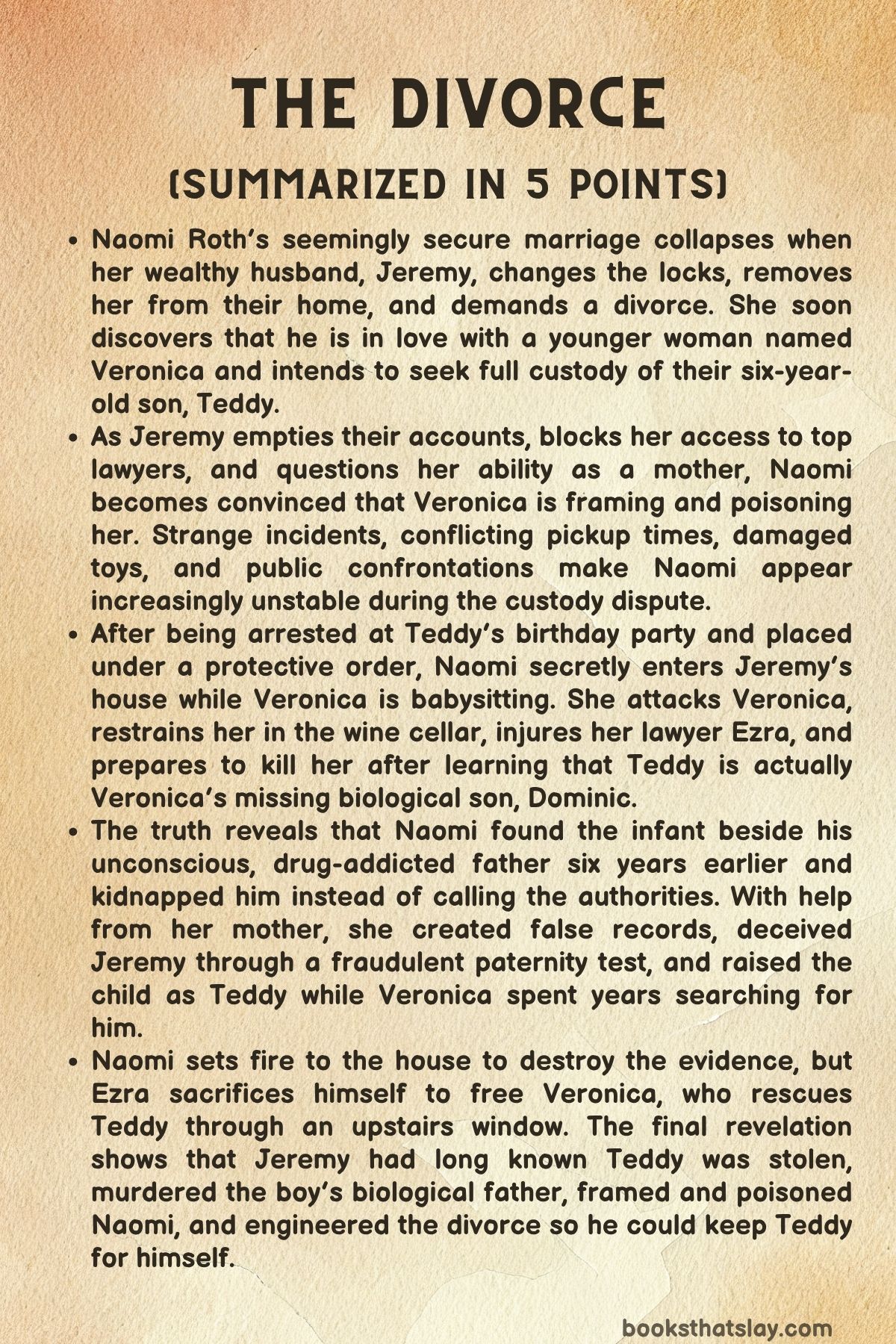
Summary
Naomi Roth returns home with her six-year-old son, Teddy, after his karate lesson and discovers that the garage door will not open and her key no longer fits the front door. Her husband, Jeremy, is unexpectedly home from his hedge-fund job, but instead of explaining the new locks, he sends Teddy upstairs and tells Naomi that they need to talk.
Jeremy initially claims that he has planned a surprise renovation of their house. He says Naomi should temporarily move into the apartment formerly occupied by his deceased parents while he remains with Teddy and prepares the house for construction.
Although Naomi is troubled that Jeremy has already packed several suitcases for her, she accepts his explanation and drives to the neglected apartment. Once there, she notices that he has packed winter clothes, professional books, bedding, and enough possessions for a lengthy absence, making his claim about a brief renovation increasingly difficult to believe.
The following day, Teddy reveals that Jeremy never mentioned any renovation or helped him pack. When Jeremy arrives at the apartment without Teddy’s belongings, he uses the family’s emergency phrase to send the child into another room and finally admits that the renovation was a lie.
Jeremy tells Naomi that he wants a divorce and has been unhappy for years. He refuses counseling, insists that his lawyer will handle the process, and reminds her that both the house and the apartment legally belong to him.
Naomi cannot accept that the marriage is over. She believes Jeremy must be experiencing a temporary crisis and agrees that Teddy can continue sleeping at the house, partly because the boy is uncomfortable in unfamiliar surroundings and partly because she hopes regular contact with Jeremy will allow her to change his mind.
Legal notices begin arriving almost immediately, proving that Jeremy planned the separation well in advance. Naomi refuses to hire a lawyer because doing so would make the divorce feel permanent, while her mother, Lorraine, warns her that Jeremy probably has another woman.
Naomi initially rejects the suggestion, but Jeremy soon removes most of the money from their joint account and cancels her access to his credit cards. He tells her to return to work and become financially independent, leaving her unable to purchase even simple items for Teddy without asking for assistance.
One evening, Naomi drives to the family home and notices an unfamiliar car outside. From the shadows, she watches Jeremy kiss a beautiful twenty-eight-year-old woman named Veronica, confirming that he has been having an affair and lied when he denied it.
Jeremy admits that he loves Veronica and intends to introduce her to Teddy. Naomi notices that Veronica does not appear to look at Jeremy with the same affection, so she convinces herself that the younger woman is manipulating him for money or some hidden purpose.
The divorce becomes public when Naomi is served legal papers in front of other parents at Teddy’s school. Her former friends, Ashlyn and Cheryl, begin avoiding her, while Cora Janzen, a divorced mother whom the group previously mocked, becomes Naomi’s only reliable social companion.
Cora urges Naomi to protect herself legally and recommends a successful attorney named Stefanie Gorman. Naomi discovers, however, that Jeremy has already retained Stefanie and several other respected divorce lawyers solely to prevent them from representing her.
Stefanie refers Naomi to Ezra Fletcher, a disorganized-looking lawyer with a cluttered office and an unconventional manner. Despite his appearance, Ezra quickly identifies weaknesses in the prenuptial agreement and recognizes that Jeremy has emptied the accounts, manipulated Naomi into leaving the house, and attempted to restrict her access to legal representation.
Meanwhile, Naomi follows Veronica through a supermarket. Veronica calmly declares that she expects to become part of Teddy’s family and makes a threatening remark that Naomi interprets as a warning against interfering with her relationship with Jeremy.
Using Veronica’s license plate and information obtained through Cora’s police-officer boyfriend, Naomi learns that her full name is Veronica Chesson. A background search reveals a past heroin-possession charge, and a former housekeeper claims Veronica once pursued a wealthy married employer and may have caused his wife to fall down the stairs.
Naomi presents this information to Jeremy, but he already knows about Veronica’s addiction history and insists that she has been sober for years. He accuses Naomi of stalking Veronica and refuses to believe that she poses any danger.
Strange incidents begin occurring in Naomi’s apartment. Doors appear to have been left open, knives move from their usual places, and Naomi becomes violently ill after drinking homemade kombucha with an unusual taste.
Jeremy later discovers a stuffed elephant that Veronica gave Teddy stabbed with a kitchen knife and covered with red liquid. Naomi denies destroying it and notices that most of the tablets from a bottle of Tylenol have disappeared, leading her to believe Veronica entered the apartment, poisoned the kombucha, and planted the mutilated toy.
During mediation, Jeremy demands full custody of Teddy and portrays Naomi as chronically late, unstable, and neglectful. He cites disputed pickup times, the damaged elephant, threatening calls allegedly made to Veronica, and Naomi’s emotional reactions as evidence that Teddy should live entirely with him.
Ezra proves that Jeremy temporarily emptied the joint account and challenges the prenuptial agreement, but Naomi damages her position by publicly accusing Veronica of poisoning her without evidence. Ezra warns her that Jeremy is trying to make her appear delusional and that every unproven accusation strengthens his case.
Naomi becomes increasingly isolated as Jeremy and Veronica take control of Teddy’s birthday celebration. Although Jeremy tells her not to attend, conflicting information about the party’s ending time leads Naomi to arrive while the celebration is still underway.
Veronica publicly invites Naomi to remain, but Naomi drinks several glasses of wine and grows upset when she sees Cora at the party. Jeremy then accuses Naomi of destroying an expensive robot car that Veronica purchased for Teddy.
Naomi refuses to leave before the birthday cake is served, so Jeremy calls the police. When an officer attempts to escort her away, Naomi pulls back, causes him to lose his balance, and is arrested for trespassing and obstructing an officer in front of Teddy and the assembled guests.
Ezra secures Naomi’s release, but Jeremy obtains a temporary protective order preventing her from approaching him or Teddy. When Naomi explains her poisoning theory and her belief that Veronica intends to harm Teddy, Ezra reacts with concern and tells her that the accusation sounds irrational.
Naomi later learns that Jeremy is traveling to Boston and that Veronica will be alone with Teddy. Ignoring the court order, she goes to the house, lies that Jeremy asked her to collect Teddy, and carries one of the child’s rocks as an excuse for entering.
When Veronica attempts to telephone Jeremy, Naomi panics and strikes her in the head with the rock. She then uses Veronica’s fingerprint to unlock her phone, sends Jeremy reassuring messages, binds Veronica with duct tape, and drags her into the windowless wine cellar.
Naomi cuts off Veronica’s hair and considers disfiguring her face so Jeremy will no longer find her attractive. After reading Veronica’s messages, she also discovers that Veronica is pregnant, making her believe that beauty alone may no longer determine Jeremy’s commitment.
Ezra follows Naomi to the house after finding her absent from the apartment. When he hears Veronica screaming from the cellar and attempts to investigate, Naomi pushes him down the stairs, leaving him seriously injured.
Veronica then reveals that Teddy is actually her missing biological son. Six years earlier, she gave birth to a boy named Dominic while struggling to recover from heroin addiction with her boyfriend, Clay Barkley.
Clay relapsed and took the infant for a drive, only to return without him after passing out at a rest area. Because Dominic had been born at home and lacked official records, the police treated Veronica and Clay as unreliable addicts instead of immediately searching for the child.
Years later, Veronica’s friend Lola discovered that Naomi’s mother had issued a suspicious birth certificate for a baby named Theodore shortly after Dominic disappeared. Veronica traced Jeremy, observed Teddy, and became convinced that the boy might be her son because of his resemblance to Clay.
Veronica initially approached Jeremy to investigate Teddy, but their friendship developed into a genuine romantic relationship. Jeremy claimed that a paternity test proved Teddy was his son and described Naomi as unstable, causing Veronica to doubt her suspicions until she secretly obtained a sample of Teddy’s DNA.
At Teddy’s birthday party, Veronica received confirmation that she was his biological mother. She also witnessed Naomi deliberately smashing the robot car, proving that Naomi had lied about being framed in that particular incident.
Naomi finally admits how Teddy came into her life. While visiting Lorraine in St. Louis, she found Clay unconscious at a rest area with drugs nearby and a screaming newborn in the back seat.
Unable to conceive because of severe endometriosis, Naomi took the infant instead of contacting the authorities. Lorraine created a fraudulent birth certificate, and Naomi selected Jeremy, a successful former boyfriend, as the child’s father.
When Jeremy demanded a paternity test, Naomi secretly replaced Teddy’s cheek sample with one taken from Jeremy’s father. Because Jeremy and his father shared DNA, the laboratory incorrectly confirmed a parent-child relationship, convincing Jeremy to marry Naomi and raise Teddy as his own.
Realizing that Veronica can expose the kidnapping and reclaim Teddy, Naomi decides to kill her. She smashes a bottle of alcohol in the cellar, plans to burn the house, and imagines rescuing Teddy so she can appear heroic and regain Jeremy’s love.
Ezra regains consciousness before Naomi lights the fire. He attacks her with a heavy bottle, frees Veronica, and sends her upstairs to save Teddy while he remains trapped in the cellar with severe injuries.
Teddy has locked himself inside his bedroom because Naomi used the family’s emergency phrase. Veronica cannot persuade him to open the door until she tells him that she is his mother.
Veronica leads Teddy through the bedroom window and onto the roof as flames consume the house. Naomi awakens in the cellar but cannot escape, while Ezra dies after sacrificing himself to protect Veronica and Teddy.
Jeremy returns from Boston and thanks Veronica for saving the child. Veronica decides to reveal Teddy’s biological identity without destroying his bond with Jeremy, whom she recognizes as the only father he has ever known.
The final revelation shows that Jeremy had known for years that Teddy was not biologically his. Clay once confronted him with evidence that Naomi had taken the baby, after which Jeremy secretly repeated the DNA test and arranged for Clay to die from an apparent overdose.
Jeremy engineered much of Naomi’s apparent instability during the divorce. He deliberately gave her incorrect pickup times, pressured Rosita, mutilated the elephant, poisoned Naomi’s kombucha with Tylenol, and planned to kill her after obtaining custody.
Naomi’s breakdown and death remove the only person who knew the full truth about Teddy’s origins. Jeremy remains with Veronica and Teddy, secretly satisfied that his plan succeeded and fully prepared to eliminate anyone who threatens his possession of the boy.
Characters
Naomi Roth
In The Divorce, Naomi initially presents herself as a devoted wife and mother whose peaceful life is destroyed without warning. Her shock, financial vulnerability, social humiliation, and fear of losing Teddy make her early desperation understandable, especially because Jeremy is deliberately manipulating events to weaken her credibility.
Naomi’s greatest weakness is her refusal to distinguish love from ownership. She does not merely want Teddy to be safe or happy; she believes that being his mother gives her the right to control who may approach him and what truths he may learn.
Her narration is deeply unreliable because she interprets nearly every event in the manner that best protects her self-image. Even after admitting that she kidnapped an infant, forged his identity, deceived Jeremy, assaulted Veronica, and attempted murder, she continues describing herself as Teddy’s rescuer.
Naomi is capable of real tenderness toward Teddy, but that affection exists beside selfishness, possessiveness, and violence. Her belief that material comfort justifies taking a child from his biological mother reveals her tendency to turn personal desire into moral certainty.
Her decline is not caused solely by madness or jealousy. Jeremy’s gaslighting, Veronica’s relationship with him, the custody battle, the loss of financial security, and public rejection all contribute to her emotional collapse, but Naomi repeatedly chooses escalation when withdrawal or honesty might have limited the damage.
By the end, she is willing to kill Veronica, Ezra, and eventually Lola to preserve the family identity she created through deception. Her final hope that Veronica will save Teddy suggests that some maternal concern remains, but it arrives only after Naomi has destroyed nearly everything around her.
Jeremy Roth
The Divorce ultimately reveals Jeremy as its most patient and calculating antagonist. For much of the story, he appears to be an unfaithful husband using wealth and legal power to abandon his wife, yet the final revelation shows that the divorce was part of a much older campaign to control Teddy.
Jeremy’s love for the boy is genuine, but it is inseparable from possession. Once he learns that Teddy is not biologically his, he does not report the kidnapping or attempt to locate the child’s family because he believes his emotional attachment gives him the right to keep him.
His decision to arrange Clay’s death proves that he crossed the boundary into calculated murder years before Naomi’s breakdown. Unlike Naomi, whose violence is emotional and impulsive, Jeremy plans carefully, waits for advantageous moments, and protects himself through legal preparation and social respectability.
During the divorce, he changes locks, empties accounts, retains multiple lawyers, pressures Rosita, provides false pickup times, destroys the elephant, and poisons Naomi. Each action is designed to produce a believable portrait of an unstable woman rather than to create one obvious act of aggression that could be traced back to him.
Jeremy’s greatest advantage is his ability to appear reasonable. His wealth, professional success, calm behavior, and devotion to Teddy allow him to manipulate lawyers, mediators, police officers, teachers, and friends while Naomi’s visible distress makes her easier to condemn.
His relationship with Veronica contains affection, but it is built on lies. He allows her to believe that he recently discovered Naomi’s instability, never admitting that he knew Teddy was stolen, murdered Clay, and attempted to kill Naomi.
The ending leaves Jeremy victorious but morally exposed to the reader. He has eliminated two people connected to Teddy’s origins and remains ready to act again, making his calm domestic future more threatening than the openly violent fire that precedes it.
Veronica Chesson
Veronica first appears through Naomi’s hostile perspective as a beautiful younger woman who has targeted a wealthy married man. Her calmness, past addiction, damaged car, secretive behavior, and relationship with Jeremy allow Naomi to construct an image of her as a manipulative predator.
The shift to Veronica’s perspective reveals a woman shaped by abuse, poverty, addiction, and the loss of her newborn child. Although she made serious mistakes in her youth, she became sober after Dominic’s birth and spent years searching for him despite police indifference and the absence of official records.
Her decision to approach Jeremy is partly investigative and partly opportunistic. She uses her appearance and arranges repeated meetings to gain access to him, but her affection for Jeremy gradually becomes sincere rather than remaining a strategy.
Veronica’s relationship with Teddy is emotionally complicated even before she confirms his identity. She feels drawn to him because of his resemblance to Clay, gives him Dominic’s elephant, and tries to create a bond while believing that the biological connection may be impossible.
Once the DNA test confirms that Teddy is Dominic, her actions are guided by maternal urgency. She delays revealing the truth during the birthday party because she does not want to traumatize him publicly, demonstrating more concern for his emotional stability than Naomi assumes.
Veronica is not presented as flawless. She participates in an affair, secretly obtains Teddy’s DNA, asks him to keep the test hidden, and trusts Jeremy’s description of Naomi without independently questioning his motives.
Nevertheless, her conduct during the fire establishes her courage and devotion. She refuses to flee, risks her life repeatedly, persuades Teddy to leave the burning room, and chooses to preserve his relationship with Jeremy even after learning that Jeremy is not his biological father.
Her tragedy is that she believes the danger has ended. She recovers her son but remains unaware that the man beside her murdered Clay and engineered Naomi’s destruction, leaving her new family dependent on another dangerous form of deception.
Teddy Roth, or Dominic Barkley
Teddy is the emotional center of the story, although he has little control over the conflict surrounding him. Naomi, Jeremy, and Veronica all claim to love him, yet each adult makes decisions that place him inside a struggle over identity, custody, and ownership.
As Teddy Roth, he is a cheerful six-year-old who admires Jeremy, depends on Naomi, enjoys rocks and toys, and struggles to understand why his parents no longer live together. His innocent statements often expose adult lies, such as Jeremy’s failure to explain the supposed renovation and the permanence of the separation.
As Dominic Barkley, he represents the life stolen from Veronica. His name, legal identity, family history, and understanding of his birth have all been constructed by Naomi and Lorraine without his knowledge.
Teddy’s affection for Naomi remains genuine even after her public arrest and increasingly frightening behavior. This attachment prevents the story from reducing motherhood to biology, because Naomi has raised him, comforted him, and occupied the maternal role throughout his conscious life.
His bond with Jeremy is equally powerful. Jeremy’s later crimes do not erase the fact that he has cared for Teddy daily, and Veronica correctly recognizes that suddenly removing him from the only father he knows would create another severe loss.
The emergency code illustrates Teddy’s trust in his parents and his vulnerability to their decisions. He remains locked in a burning bedroom because he has been taught that obedience will keep him safe, turning a protective family rule into a threat to his life.
Teddy’s future is deliberately uncertain. He survives with two adults who love him, but his identity will require careful explanation, and one of those adults remains a murderer whose idea of fatherhood is inseparable from control.
Ezra Fletcher
Ezra is introduced as an unconventional lawyer whose disordered office, wrinkled clothes, and chaotic paperwork conceal exceptional legal ability. He immediately recognizes the weaknesses in Naomi’s prenuptial agreement and understands that Jeremy is using money and procedure to overwhelm her.
His compassion distinguishes him from the other legal figures. He does not simply prepare Naomi’s case; he listens to her fears, reassures her about Teddy, brings her food, and encourages her to imagine a future beyond the marriage.
Ezra’s growing attraction to Naomi is sincere but restrained. His own failed marriage and desire for children make him sympathetic to her sense of losing an entire family structure rather than merely a spouse.
His major limitation is that he underestimates both Naomi and Jeremy. He recognizes Jeremy’s dishonest legal tactics but does not imagine the extent of his criminal manipulation, while his affection for Naomi makes him slow to accept how dangerous she has become.
When Naomi describes the suspected poisoning and Veronica’s alleged plot, Ezra dismisses the claims as irrational. His reaction is understandable because Naomi lacks evidence, yet the final revelation proves that she was correct about being poisoned, though wrong about the person responsible.
Ezra’s death completes his moral development. After discovering Veronica’s captivity and Naomi’s intentions, he risks his life, disables Naomi, frees Veronica, and orders her to save Teddy rather than trying to secure his own escape.
He dies not as Naomi’s attorney or potential partner but as the person who prevents her from committing murder. His sacrifice ensures that Veronica and Teddy survive, making him one of the few adults who places the child’s safety above personal possession or advantage.
Cora Janzen
Cora begins as an object of gossip among the school mothers because of her divorce. Naomi initially views her with pity and discomfort, fearing that separation will reduce her to the same socially excluded position.
Once Naomi is served publicly, Cora becomes the only parent who offers genuine companionship. Her experience has taught her that emotional denial can leave a divorcing spouse financially and legally defenseless, so she urges Naomi to obtain representation and prepare for a custody battle.
Cora is perceptive about Jeremy’s tactics. She recognizes that he is changing verbal pickup times, reframing Naomi’s confusion as irresponsibility, and using Teddy as leverage in a financial dispute.
Her advice is sometimes too combative because she encourages Naomi to view the divorce as warfare. However, she does not support violence or stalking and cannot anticipate how Naomi will transform ordinary encouragement into justification for extreme behavior.
The birthday party creates a temporary break between them when Cora brings Zack despite sympathizing with Naomi’s exclusion. Cora’s choice reflects a conflict between supporting her friend and protecting her son from social isolation, but Naomi interprets it as a personal betrayal.
Cora represents a healthier path Naomi might have followed. She has endured divorce, rebuilt her independence, and formed new relationships without destroying her former spouse or attempting to control every part of her child’s life.
Lorraine Paxson
Lorraine is Naomi’s mother and an important source of her daughter’s beliefs about marriage, men, and survival. Her three divorces have made her cynical, suspicious, and convinced that women must remove rivals before those rivals destroy them.
Her involvement in Teddy’s kidnapping is not passive. Instead of insisting that Naomi contact the police after finding an infant, Lorraine purchases supplies, invents a legal identity, issues a fraudulent birth certificate, and encourages Naomi to name Jeremy as the father.
Lorraine treats the baby as an opportunity to secure Naomi’s future with a wealthy man. Her actions combine maternal loyalty with serious moral corruption, because she places her daughter’s desire for motherhood above Veronica’s rights and the child’s true identity.
Her later advice to get rid of Veronica carries a darker meaning once her history is known. She does not explicitly order murder, but she reinforces Naomi’s belief that eliminating people is an acceptable method of protecting family interests.
Lorraine also helps explain Naomi’s habit of converting wrongdoing into rescue. Both women believe that providing Teddy with wealth and stability cancels the crime of taking him, allowing them to regard themselves as benefactors rather than kidnappers.
Clay Barkley
Clay is Veronica’s former boyfriend and Dominic’s biological father. His addiction begins after an injury and develops into heroin dependence, leaving him unable to maintain the responsibility required of a parent.
He appears hopeful after Dominic’s birth and promises to remain sober, marry Veronica, and build a stable family. His relapse only weeks later destroys that possibility and leads directly to the infant being left unattended at the rest area.
Clay’s actions are reckless, but he does not intentionally abandon his son. Drug use leaves him unconscious and confused, after which Naomi takes the baby and interprets his condition as proof that neither parent deserves the child.
Years later, Clay apparently discovers Naomi’s connection to the disappearance and confronts Jeremy. This attempt to reveal the truth results in Jeremy arranging his death through an apparent overdose.
Clay therefore occupies two positions in the story: he is the irresponsible parent whose failure creates the opportunity for the kidnapping, and he is also a victim whose addiction allows others to dismiss his rights and disguise his murder.
Rosita
Rosita is the longtime babysitter who has helped care for Teddy and understands Naomi’s genuine involvement in his daily life. When Naomi asks whether she considers her an unfit mother, Rosita immediately denies it.
Her refusal to become involved in the custody dispute is driven by financial fear rather than disloyalty. She needs her employment to support her own family and knows that Jeremy controls her continued access to that income.
Jeremy’s pressure on Rosita shows how economic power shapes the divorce. Even people who know Naomi well can be silenced when telling the truth threatens their livelihood.
Rosita’s position also weakens Jeremy’s claim that Naomi depended excessively on paid childcare. Her presence reflects the family’s wealth and Jeremy’s demanding career as much as it reflects Naomi’s parenting choices.
Lola
Lola is Veronica’s loyal friend and one of the few people who believes her account of Dominic’s birth and disappearance. She helps deliver the baby at home, witnesses Veronica’s commitment to sobriety, and remains connected to her throughout the following years.
Her access to records allows her to discover the suspicious birth certificate issued by Lorraine. Without Lola’s persistence, Veronica would never have identified Teddy or found the family raising him.
Lola serves as an external keeper of the truth. Naomi recognizes this danger when she reads Veronica’s messages and begins considering how to eliminate Lola after the fire.
Her survival means that the evidence of Teddy’s identity does not depend entirely on Veronica’s testimony. Even if Veronica had died, Lola could still have connected Naomi, Lorraine, the false birth certificate, and the missing infant.
Leonard Hardwick
Leonard Hardwick is Jeremy’s primary divorce lawyer and the professional instrument through which Jeremy begins his legal attack. He acts quickly, serves papers, defends the prenuptial agreement, and advances Jeremy’s demand for custody.
Hardwick is aggressive but not fully informed. He appears unaware of Veronica’s drug history and is forced to respond when Ezra produces proof that Jeremy temporarily emptied the accounts.
His role illustrates the difference between representing a dishonest client and knowingly participating in criminal conduct. Hardwick supports Jeremy’s legal strategy, but the novel provides no indication that he knows about the poisoning, gaslighting, kidnapping, or murders.
Stefanie Gorman
Stefanie is a highly respected divorce lawyer and Ezra’s former wife. She cannot represent Naomi because Jeremy has deliberately retained her, but she immediately understands the purpose behind his conduct and condemns it.
Her recommendation of Ezra becomes one of the most important choices in the story. She recognizes that his appearance may be unconventional while trusting his intelligence, determination, and willingness to challenge more polished opponents.
Stefanie’s past marriage to Ezra also adds emotional depth to his character. Their divorce resulted from incompatible expectations about children rather than cruelty, showing that a marriage can end honestly without either spouse attempting to destroy the other.
Ashlyn and Cheryl
Ashlyn and Cheryl represent the judgmental social environment surrounding Naomi. Before the divorce becomes public, they admire her marriage, praise Jeremy, and participate with her in gossiping about Cora.
After Naomi is served, they withdraw rather than offering support. Their discomfort reveals how quickly social approval can disappear when a woman no longer fits the image of marital success.
They are not responsible for Naomi’s actions, but their rejection intensifies her shame and isolation. Naomi’s fear of becoming a subject of gossip contributes to her refusal to accept the divorce and her determination to preserve appearances long after the marriage has become dangerous.
Officer Grenell
Officer Grenell responds when Veronica reports Dominic missing. Instead of treating the disappearance as an urgent emergency, he focuses on Veronica and Clay’s addiction histories, the home birth, and the absence of official documents.
His suspicion is partly understandable because Clay is intoxicated and Dominic has no birth certificate. Nevertheless, his dismissive attitude delays meaningful attention and reinforces Veronica’s belief that poverty and addiction have made her child less important to the authorities.
Grenell represents institutional prejudice rather than personal villainy. By failing to look beyond the parents’ appearance and history, he helps create the conditions in which Naomi can raise the stolen child for years without detection.
Themes
Possession Disguised as Love
Love repeatedly becomes a justification for control, concealment, and violence. Naomi, Jeremy, and Veronica all claim Teddy as central to their lives, but the moral value of that love depends on whether they can respect his needs and identity rather than treating him as something to possess.
Naomi believes that raising Teddy and providing him with financial comfort gives her a permanent right to him. She interprets kidnapping as rescue, fraud as protection, and murder as a reasonable response to anyone capable of exposing the truth.
Jeremy’s love is colder but equally possessive. After discovering that Teddy is not biologically his, he chooses murder and manipulation rather than risk losing the child, treating fatherhood as ownership that must be defended against biological parents, legal authorities, and even the woman he married.
In The Divorce, affection becomes dangerous when the lover refuses to recognize another person’s autonomy. Naomi wants Teddy to remain her son regardless of his origins, while Jeremy wants him regardless of the crimes required to preserve the relationship.
Veronica offers a partial contrast because she ultimately accepts that Jeremy remains Teddy’s father in an emotional and practical sense. Although she wants to reclaim her place as his mother, she does not plan to erase the bond he has formed with the man who raised him.
The story therefore does not argue that biological connection automatically outweighs lived parenthood. Instead, it distinguishes love that protects a child’s emotional world from love that destroys others to maintain exclusive control.
Motherhood, Biology, and Moral Claim
The conflict between Naomi and Veronica raises difficult questions about what creates a mother. Naomi has performed the daily work of parenting for six years, while Veronica gave birth to Teddy, loved him immediately, became sober for him, and searched for him after he disappeared.
Naomi relies on nurture as her moral defense. She believes Teddy’s comfortable upbringing, education, home, and relationship with Jeremy prove that taking him was beneficial, especially when compared with the poverty and addiction surrounding his birth.
That reasoning ignores the fact that she denied Veronica the opportunity to recover and parent her own child. Naomi judged an unconscious man and an absent mother without knowing the circumstances, then made an irreversible decision based largely on her own infertility and desire for a baby.
Veronica’s biological connection is powerful, but the story does not present blood as the only meaningful bond. Teddy loves Naomi because she has been his mother throughout his life, and he loves Jeremy despite having no biological relationship with him.
The strongest expression of motherhood occurs during the fire. Veronica does not demand recognition before acting, nor does she use Teddy’s identity to punish Jeremy; she risks her life, follows his emotional needs, and accepts that his existing attachments must be preserved.
Motherhood is therefore measured through responsibility rather than possession alone. Biology creates a legitimate claim that was stolen from Veronica, but everyday care also creates bonds that cannot be dismissed without harming the child.
Gaslighting and Unreliable Perception
The narrative repeatedly forces the reader to question whether Naomi is being manipulated or losing touch with reality. Missing knives, changed pickup times, poisoned kombucha, damaged toys, threatening calls, and contradictory conversations can all be interpreted as evidence of a conspiracy or symptoms of paranoia.
Naomi’s unreliability is genuine. She lies about the kidnapping, makes anonymous threats, destroys the robot car, follows Veronica, violates a protective order, and consistently minimizes her own aggression.
At the same time, Jeremy deliberately creates situations that make her doubt her memory and encourage others to question her sanity. He provides one pickup time and later claims another, plants evidence, pressures witnesses, and poisons her while ensuring that every accusation she makes sounds increasingly unreasonable.
This combination makes the manipulation especially effective. Jeremy does not invent Naomi’s instability from nothing; he provokes, directs, and documents behavior that already exists, allowing real misconduct to conceal his manufactured evidence.
The shifting viewpoints demonstrate how perspective controls moral judgment. Through Naomi’s eyes, Veronica appears predatory and Jeremy seems manipulated, while Veronica’s history reveals that many of Naomi’s conclusions are false.
The final revelation then changes the meaning of earlier events again by confirming that Naomi was correct about being poisoned and framed but wrong about the culprit. Truth survives beneath several layers of deception, and no single viewpoint provides a complete moral picture.
Social Judgment, Power, and Legal Warfare
The divorce proceedings show how wealth, reputation, and institutional authority influence which version of reality becomes believable. Jeremy’s professional success and calm manner give him immediate credibility, while Naomi’s financial dependence and emotional reactions make her vulnerable to being portrayed as unstable.
He uses money strategically by changing the locks, removing funds, retaining multiple lawyers, controlling the family home, and offering Naomi cash in exchange for accepting reduced custody. These tactics demonstrate that legal conflict can be shaped long before a judge hears the facts.
Naomi’s social environment deepens the imbalance. Ashlyn and Cheryl admire her when she appears happily married but avoid her once the divorce becomes public, confirming that her status within the group depends on maintaining a successful domestic image.
Cora’s experience offers a more realistic understanding of separation. She recognizes that emotional hope will not protect Naomi from legal consequences and encourages her to secure representation, challenge the prenuptial agreement, and document Jeremy’s conduct.
Institutional judgment also affects Veronica. Police initially dismiss the disappearance of her infant because she is poor, exhausted, unmarried, and connected to drugs, allowing a child to remain missing because his parents do not appear respectable.
The novel shows that institutions are not automatically unjust, but they often depend on appearances, records, and controlled behavior. Jeremy succeeds because he understands those expectations, while Naomi and Veronica repeatedly suffer because their distress is treated as proof that their claims lack credibility.