Midnight on the Celestial Summary, Characters and Themes
Midnight on the Celestial by Julia Alexandra is a fantasy novel about power, punishment, family legacy, and the cost of being born into a world that fears its own magic. The story follows Roe Damarcus, an eighteen-year-old resurrector from a famous Morphic family, after a failed trial sends her to the Celestial, a magical cruise ship where failed Morphics are promised a second chance.
What first appears to be a path toward redemption soon reveals a darker system of control, extraction, and secrets. Roe’s journey becomes a fight not only for her own future, but for every Morphic trapped by fear and ambition.
Summary
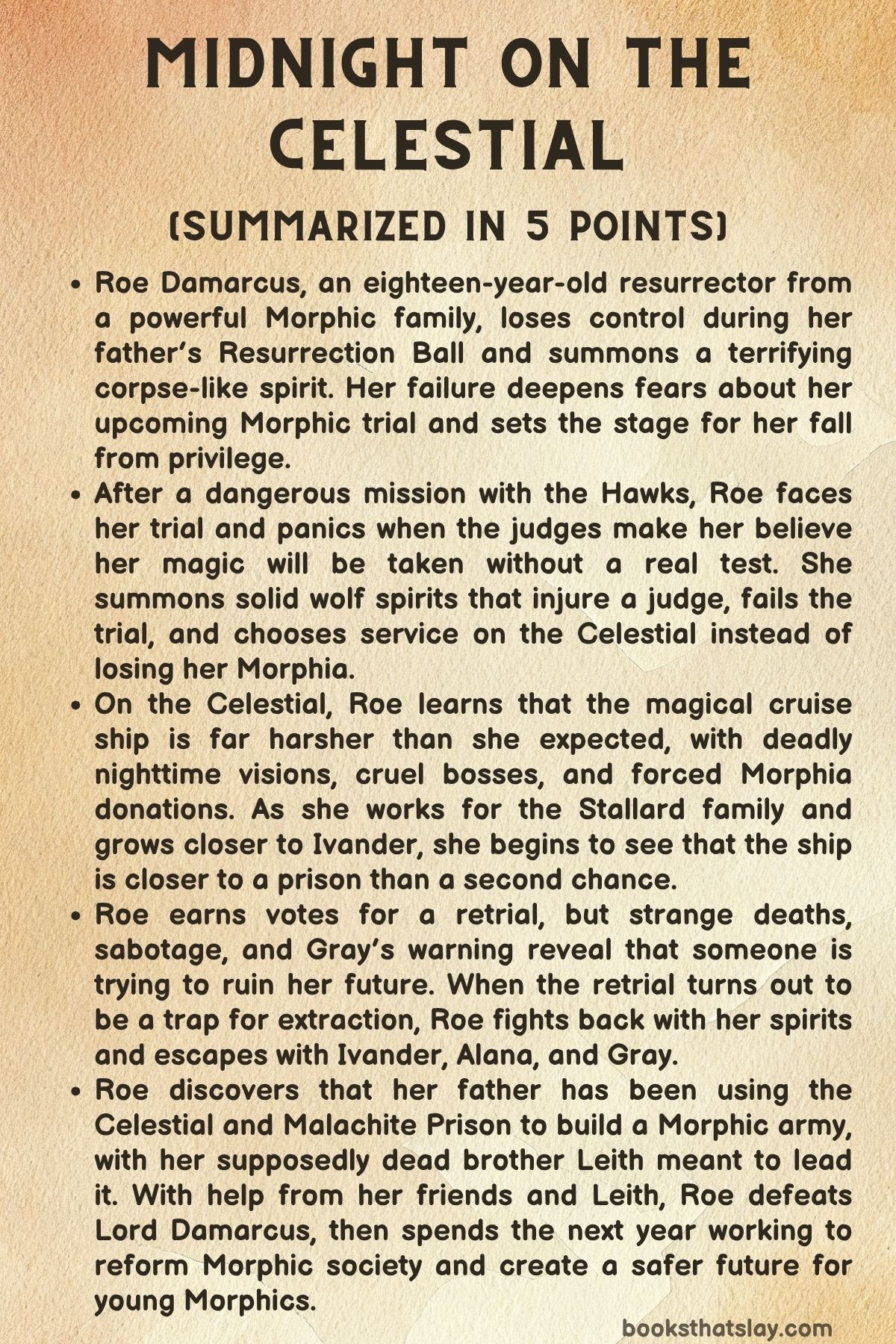
Roe Damarcus is eighteen, powerful, and under more pressure than she knows how to carry. She belongs to one of the most respected Morphic families in Tamarynth, and her gift as a resurrector should make her a source of pride.
At her father Lord Cyrion Damarcus’s annual Resurrection Ball, she is expected to impress wealthy guests by summoning spirits that look elegant, controlled, and lifelike. Instead, her fear about her approaching Morphic trial overwhelms her.
The spirit she calls forth is not graceful or comforting. It appears as a decaying, corpse-like woman, horrifying the room and shaking the confidence of everyone who already expects her to represent the Damarcus name perfectly.
The incident leaves Roe afraid that she is losing control of her gift. The next day, she joins the Hawks, the hunters responsible for capturing rogue Morphics, on a mission.
During the pursuit of a fugitive mender, Roe uses her power in a creative way by summoning the spirit-image of a fallen tree to help stop him. The mission succeeds, but the prisoner attacks her, and Roe is left shaken by how little separates her from people branded as dangerous.
She begins to see that Morphic society is built on fear: fear of failure, fear of uncontrolled magic, and fear of anyone who does not fit its rules.
Her father warns her that if she fails her Morphic trial, she must not choose punishment on the Celestial. The ship is known as a place where failed Morphics serve wealthy passengers and, in theory, earn a chance at retrial.
Roe does not fully understand why her father fears that option so much, but his warning adds to her dread. When the trial begins, the judges create an illusion that makes Roe believe they are about to extract her Morphia without properly testing her.
In panic and anger, she summons solid wolf spirits, and the wolves injure one of the judges. The illusion disappears, revealing that her reaction was the true test.
Roe has failed.
The judges prepare to strip Roe of her magic, but she refuses to accept that fate. Instead, she asks to serve on the Celestial.
Her family is furious, and her father tries to stop her, but Roe escapes Damarcus Estate with help from Lysandra, the mother of Roe’s dead brother, Leith. Gray, a Hawk who once loved Leith, catches up with her but lets her go when he realizes she is determined to reach the ship.
At Windmere Port, Roe boards the Celestial, believing that hard work may win her a second chance.
Life on the Celestial is harsher than she expects. Roe learns that only a small number of staff members receive retrials each year, and those chances depend heavily on votes, favor, and influence.
She meets Ivander Harpyrian, a shifter performer assigned to guide her, along with other staff members such as Alana, Isla, Niko, and Zora. Each of them has a different Morphic ability, and each has been marked by failure in a society that treats failure as shame.
Roe’s family name follows her onto the ship, and not everyone welcomes her. Ivander resents the possibility that her status could help her receive votes others have worked longer to earn.
Roe is assigned as concierge to the Stallard family, including Vance, Asralyn, and their children Sage and Ezra. At first, she struggles with the demands of service and makes mistakes that remind her how unprepared she is for this new life.
The Celestial’s beauty hides its cruelty. Staff members must donate Morphia every day, and the ship becomes dangerous at night.
Raw magic moves through its halls, creating visions, monsters, and deadly illusions. The bosses who control the staff punish failure harshly and use fear to keep everyone obedient.
As Roe spends more time on the ship, she begins to understand that the Celestial is not a place of rehabilitation. It is a prison dressed as an opportunity.
Ivander teaches her how to survive the ship’s rules and dangers, and their relationship changes as they begin to trust each other. Roe also starts to see the other staff not as rivals, but as people trapped in the same unjust system.
Her confidence grows when she saves guests during a dangerous magical malfunction, earning respect from the Stallards. She also learns that Asralyn is grieving the loss of a daughter, and through patience and service, Roe earns the family’s support.
At the mid-cruise ball, Gray appears with a warning. He believes someone may be trying to ruin Roe’s chance at a retrial.
Soon after, a girl named Elayne dies under mysterious circumstances. Roe tries to summon Elayne’s spirit, but she cannot reach her.
This failure unsettles Roe because it echoes another painful absence: she has never been able to summon the spirit of her brother Leith, whom everyone believes is dead. The bosses use Elayne’s death to blame Roe and threaten extraction, but Asralyn helps protect her.
Roe begins to suspect that the ship’s secrets run much deeper than cruelty and unfair rules.
When retrial spots are announced, Roe wins one alongside Alana and others. For a brief moment, it seems as if the system may still offer justice.
That hope vanishes when the retrial is revealed as a trap. The chosen staff members are not being given a second chance; they are being prepared for extraction.
Roe fights back with the spirits she can summon, killing several of the bosses who have controlled and harmed the staff. With help from Gray, Roe, Ivander, Alana, and others escape the Celestial.
Once onshore, they discover crates of Morphia being loaded into a carriage marked with the Damarcus family sigil. The discovery pulls Roe back to the one place she wanted to escape: her father’s estate.
There, she confronts Lord Damarcus and learns the truth. He has been using Malachite Prison and the Celestial to gather Morphia and build an army of controlled Morphics.
His plans are not only political but personal. Leith, Roe’s brother, is alive, and Lord Damarcus intends him to become the general of this army.
Roe, Ivander, Alana, and Gray are captured and imprisoned in Malachite. The prison is another part of the same cruel machine, built to break Morphics and turn their powers into weapons.
Eliza frees them and leads them to Leith, whose survival changes everything Roe thought she knew about her family, her grief, and her gift. Leith has not become the obedient weapon their father wanted.
Instead, he has resisted Lord Damarcus and helped prisoners regain control of themselves.
When Lord Damarcus arrives to awaken his army, Roe faces the full weight of her family’s legacy. She uses her connection to the spirit world in a way she never has before, opening the veil and calling spirits to disrupt her father’s control.
The battle is dangerous and costly. Ivander nearly dies, but he is saved through crafted wings, giving him another chance to live and fight beside the others.
Roe defeats her father, but she chooses not to kill him. Gray cuffs Lord Damarcus, ending his immediate threat and proving that justice does not have to mirror cruelty.
One year later, Roe is no longer the frightened girl who failed a trial and ran toward the Celestial in desperation. She is helping reform Morphic society and working to change the systems that harmed so many people.
She builds a school where young Morphics can learn to understand and control their powers safely instead of being punished for fear, mistakes, or difference. Her bond with Ivander remains important in her life, and her connection to Leith reshapes the meaning of family after years of grief and lies.
Roe carries the Damarcus name forward, but she refuses to preserve the legacy her father created. Instead, she builds a new one based on protection, choice, and the belief that magic should never be used as a cage.
Characters
In Midnight on the Celestial, Julia Alexandra builds the character world around power, inheritance, punishment, and the question of whether a person is defined by the system that raised them or by the choices they make against it.
Roe Damarcus
Roe Damarcus is the central character of the book, and her journey is built around fear, shame, rebellion, and self-discovery. At the beginning, she is an eighteen-year-old resurrector burdened by the expectations of the Damarcus name.
She belongs to a powerful Morphic family, so her failure is not treated as a private weakness but as a public disgrace. Roe’s early mistakes show that her power is deeply tied to her emotions.
When she loses control at the Resurrection Ball and later during her Morphic trial, the problem is not that she lacks ability, but that she has never been given the safety or freedom to understand her gift properly. Her resurrection magic is frightening because it exposes the truth beneath polished appearances: decay, death, fear, and pain cannot simply be dressed up for wealthy guests.
Roe’s decision to serve on the Celestial rather than lose her Morphia marks the first major act of independence in her life. She refuses the future chosen for her by judges, family, and tradition.
On the ship, she changes from a sheltered noble daughter into someone who understands the cruelty of the Morphic world from the inside. Her work as concierge forces her to serve others, make mistakes, earn trust, and survive humiliation.
Through this, Roe becomes more compassionate and more aware of how privilege has protected her from realities that other failed Morphics have faced for years.
Her bond with Ivander, Alana, Gray, and the other staff members helps her understand that her identity is not limited to being Lord Damarcus’s daughter. Roe’s greatest strength is not simply her ability to summon spirits, but her refusal to accept injustice once she sees it clearly.
By the end, she does not defeat her father by becoming exactly like him. She opens the veil, uses her power in a larger and more meaningful way, and chooses reform over revenge.
Roe’s final role as a builder of a safer Morphic future shows that her true legacy is not the old Damarcus name, but the new purpose she gives it.
Lord Cyrion Damarcus
Lord Cyrion Damarcus is the main force of control and corruption in the book. As Roe’s father, he represents family authority, social power, and the dangerous belief that greatness justifies cruelty.
At first, he appears strict and protective, especially when he warns Roe not to choose punishment on the Celestial. However, this warning is not rooted in tenderness alone.
It also reveals that he knows more about the ship’s true nature than he admits. His concern for Roe is twisted by his desire to control her future and preserve the power of his family.
Cyrion’s secret use of Malachite Prison and the Celestial exposes him as a man who sees people as tools. Failed Morphics, prisoners, and even his own children become pieces in his larger plan to build a Morphic army.
His ambition is not just political; it is deeply personal. He wants to shape the future according to his own vision and believes he has the right to decide who is useful, who is disposable, and who deserves power.
This makes him frightening because he does not think of himself as merely cruel. He sees himself as necessary.
His relationship with Roe is especially important because he is both her father and her enemy. He has helped create her fear of failure, yet he also underestimates her moral strength.
Cyrion’s greatest mistake is believing that bloodline and authority will matter more to Roe than conscience. When Roe defeats him without killing him, the moment becomes morally significant.
She refuses to inherit his brutality, proving that she can end his control without copying his methods.
Leith Damarcus
Leith Damarcus is one of the most emotionally important characters in the story because his absence shapes Roe long before his return changes the plot. Roe believes him to be dead, and her inability to summon his spirit becomes a quiet wound in her identity as a resurrector.
Since she can bring back spirit-images of others but not Leith, his absence suggests that grief does not always obey magical rules. He represents love, loss, and the unanswered questions that haunt Roe’s family.
When Leith is revealed to be alive, the meaning of his character changes dramatically. He is not simply a lost brother but a survivor of Cyrion’s schemes.
His intended role as the general of Cyrion’s army shows how completely Lord Damarcus is willing to use his own child for power. Yet Leith’s resistance proves that he is not a passive victim.
He has been helping prisoners regain control, which makes him a hidden figure of rebellion within the very system meant to weaponize him.
Leith also serves as a mirror to Roe. Both siblings are shaped by their father’s ambition, but both choose resistance in different ways.
His survival gives Roe emotional closure, but it also expands her understanding of how deeply the corruption runs. Leith’s character shows that the Damarcus legacy has been damaged, but not destroyed, because both he and Roe still choose protection over domination.
Ivander Harpyrian
Ivander Harpyrian is a shifter performer and one of the most important characters in Roe’s transformation. When Roe first meets him, he is assigned to guide her on the Celestial, but their relationship begins with tension.
He resents her because her family name gives her advantages that other staff members do not have. This resentment is understandable, because Ivander has lived within the ship’s cruelty and knows how unfair the retrial system truly is.
To him, Roe initially looks like another privileged person who may be rewarded while others continue suffering.
As the story develops, Ivander becomes both a guide and a challenge to Roe. He teaches her how to survive the ship’s dangers, especially the nightmarish effects of raw Morphia.
His knowledge is practical, but it is also emotional. He understands fear, punishment, and the need to hide pain behind performance.
His shifter identity also fits his character symbolically, because he knows how to adapt in order to survive, yet he is searching for a self that does not have to constantly perform for others.
Ivander’s growing closeness with Roe is important because it is based on earned trust rather than instant admiration. He sees her change, and she sees the vulnerability beneath his guarded exterior.
His near-death near the end raises the emotional stakes of the final conflict, while his survival through crafted wings connects him to the larger theme of remaking broken lives. Ivander is not merely Roe’s companion; he is one of the people who helps her understand what freedom should actually mean.
Gray
Gray is a Hawk and Leith’s former lover, making him a character caught between duty, grief, loyalty, and conscience. As a hunter of rogue Morphics, he belongs to the official system of control, yet his actions show that he is not blindly loyal to it.
When he lets Roe flee after realizing she is going to the Celestial, he chooses compassion over enforcement. This decision reveals that Gray’s moral instincts are stronger than his professional obligations.
His connection to Leith gives him emotional depth. Gray is not only protecting Roe because she is in danger; he is also connected to the Damarcus family through love and loss.
His warning at the mid-cruise ball shows that he continues to watch over Roe and suspects that larger forces are working against her. He becomes a bridge between the outside world and the trapped world of the ship.
By helping Roe and the others escape and later cuffing Lord Damarcus, Gray completes a quiet but important arc. He moves from being part of the system that hunts Morphics to helping expose and stop one of its greatest abusers.
His character shows that redemption can come through action, especially when a person chooses justice over obedience.
Alana
Alana is one of the Celestial staff members and becomes one of Roe’s important allies. Her presence helps show that the ship is filled with people who are more than their failed trials.
Like the other staff, she is trapped inside a system that claims to offer second chances but actually thrives on punishment and exploitation. Alana’s survival on the ship reflects resilience, but also the exhaustion of someone forced to keep giving pieces of herself to a cruel structure.
Her importance grows when she wins a retrial spot alongside Roe, only for the retrial to be revealed as a setup for extraction. This betrayal affects Alana’s character strongly because it proves that hope itself has been used as a method of control.
She is not simply disappointed; she is forced to recognize that the system never intended to be fair. Her escape with Roe shows her courage and her willingness to fight for a life beyond the ship.
Alana’s role in the group also strengthens the book’s focus on community. Roe cannot bring down the system alone.
Alana represents the many failed Morphics whose lives have been reduced to labor, votes, and magical donations. Through her, the story reminds readers that reform is not only about Roe’s personal freedom, but about freeing everyone trapped by the same injustice.
Isla
Isla is one of the staff members Roe meets on the Celestial, and her character helps widen the view of life aboard the ship. Even if she is not described as centrally as Roe or Ivander, her presence matters because she belongs to the community of failed Morphics who have been pushed into service.
Isla helps show that the ship’s cruelty is not limited to one person’s experience. It is a shared condition that affects many young Morphics with different gifts and different histories.
As part of the staff, Isla represents adaptation under pressure. The workers on the Celestial must learn its rules, survive its nighttime dangers, donate Morphia, and endure the authority of bosses who treat them as resources.
Isla’s role contributes to the sense that the ship is a living prison disguised as an elegant magical cruise. Her character helps make the staff feel like a real social world rather than a background setting.
Isla also helps contrast Roe’s early privilege with the lives of those who have already been trapped by the system. Through characters like Isla, Roe learns that her suffering is part of something much larger.
Isla’s importance lies in how she helps create the moral environment that pushes Roe toward rebellion.
Niko
Niko is another staff member on the Celestial, and his character contributes to the book’s portrayal of failed Morphics as varied, human, and deserving of dignity. He is part of the group that shows Roe what life after failure truly looks like.
Before boarding the ship, Roe fears becoming a failed Morphic because of shame and punishment. After meeting people like Niko, she begins to understand that failure is not a moral defect.
It is often a label used by powerful institutions to control young people whose magic does not fit their expectations.
Niko’s presence also strengthens the idea of found community. The Celestial is designed to make staff compete for votes and retrial spots, which should divide them.
Yet the relationships among Roe, Ivander, Alana, Isla, Niko, and Zora show that connection can survive even in a place built on desperation. Niko helps represent the ordinary courage required to keep living under unfair conditions.
As part of the staff, Niko also reflects the cost of Morphic society’s obsession with usefulness. The system values Morphics only when their powers can be controlled, displayed, harvested, or weaponized.
Niko’s character, like the others, pushes against that belief simply by being more than the role assigned to him.
Zora
Zora is one of the Celestial staff members who helps establish the ship as a place filled with distinct Morphic lives rather than nameless workers. Her character adds to the sense that Roe has entered a hidden world where each person carries a different gift, wound, and survival strategy.
Zora’s presence among the staff reinforces the idea that the ship’s system is not rehabilitative, despite what society may claim. It is built on control, competition, and extraction.
Zora also contributes to Roe’s education. Roe arrives with fear and uncertainty, but she gradually learns by watching the people around her.
Staff members like Zora reveal the emotional reality of being trapped in a system that offers hope only to manipulate it. The staff’s daily Morphia donations and constant danger show that they are being drained physically and magically, and Zora is part of that larger suffering.
Her importance is therefore collective as well as individual. Zora helps represent the many failed Morphics whose stories might otherwise remain unseen.
Through her and the other staff members, Roe’s fight becomes less personal and more political. The struggle is not only about one girl earning a retrial; it is about exposing a world that has normalized abuse.
Lysandra
Lysandra is Leith’s mother and a crucial helper in Roe’s escape from Damarcus Estate. Her role may be brief compared with Roe’s, but it is deeply meaningful because she acts from love, grief, and courage.
By helping Roe flee, Lysandra opposes Lord Damarcus’s control from within the family’s own circle. She understands enough about the danger Roe faces to help her choose a different path.
Lysandra’s connection to Leith gives her actions emotional weight. She has already suffered because of the Damarcus family’s secrets and power, and her support of Roe suggests that she does not want another young person destroyed by the same system.
Her character represents a quieter form of resistance, one based not on battle but on protection.
She also helps show that not all adults in the story are corrupt or passive. While many authority figures use fear to control young Morphics, Lysandra uses her position to help Roe move toward freedom.
Her courage is understated, but without it Roe may never have reached the Celestial and uncovered the truth.
Vance Stallard
Vance Stallard is part of the wealthy guest world aboard the Celestial, and his role helps show the class divide between passengers and staff. As a member of the Stallard family, he benefits from the ship’s luxury without initially understanding the full cost paid by the workers.
His presence helps emphasize how elegant surfaces can hide exploitation. The guests enjoy service, entertainment, and magical wonder while the staff endure punishment, danger, and the draining of their Morphia.
Vance’s importance lies partly in how Roe must learn to serve him and his family. Her position as concierge forces her to navigate humility, responsibility, and social pressure.
Through the Stallards, Roe begins to understand service not as a noble performance but as difficult labor shaped by unequal power. Vance’s family also becomes important because their votes can influence Roe’s future.
As Roe earns the family’s trust, Vance becomes part of the changing relationship between guest and staff. His character helps show how people inside comfortable systems may not immediately see injustice, but their choices still matter.
By trusting Roe, the Stallards become part of her chance at survival, even though the larger system remains corrupt.
Asralyn Stallard
Asralyn Stallard is one of the most emotionally layered members of the guest world. Her grief over losing a daughter gives her a quiet connection to Roe’s powers and to the book’s larger themes of death, memory, and longing.
Unlike guests who may see Morphic gifts only as entertainment or service, Asralyn has personal pain that makes the presence of resurrection magic more meaningful and more difficult.
Her relationship with Roe develops through trust. At first, Roe is simply a staff member assigned to serve the family, but over time Asralyn begins to see her humanity.
This becomes especially important when Roe is blamed after Elayne’s death and threatened with extraction. Asralyn’s decision to help protect Roe shows moral courage.
She uses her influence not merely for comfort but to defend someone vulnerable.
Asralyn’s character also complicates the portrayal of the wealthy passengers. She is privileged, but she is not heartless.
Her grief allows her to recognize suffering in others, and her support becomes part of Roe’s survival. She represents the possibility that those who benefit from a system can still choose to resist its cruelty once they truly see it.
Sage Stallard
Sage Stallard is one of the Stallard children and helps reveal Roe’s softer, more responsible side. Serving the children requires Roe to move beyond her own fear and embarrassment.
Sage’s presence gives Roe a chance to practice care in a setting where she is still learning how to be dependable. Through interactions with the Stallard children, Roe is not only trying to win votes; she is learning how to earn trust.
Sage also represents innocence within the luxury of the Celestial. As a child passenger, Sage is protected from much of the ship’s darker reality.
This contrast makes the setting more unsettling. While children experience the ship as magical and exciting, the staff know that the same ship becomes deadly and nightmarish after dark.
Sage’s presence therefore highlights the difference between appearance and truth.
In Roe’s arc, Sage helps bring out her growth from a frightened failed Morphic into someone capable of protecting others. Roe’s increasing care for the family shows that she is not defined by the mistakes that caused her trial failure.
She is capable of patience, responsibility, and emotional connection.
Ezra Stallard
Ezra Stallard, like Sage, is important because he belongs to the family Roe serves and helps shape her development as concierge. His presence gives Roe daily responsibilities that are ordinary compared with the magical dangers around her, but those responsibilities matter because they teach her steadiness.
Roe must learn to manage tasks, emotions, and expectations in a way she has never had to before.
Ezra also strengthens the contrast between the passengers’ experience and the staff’s suffering. To the Stallard children, the Celestial may seem like a place of wonder.
To Roe and the other workers, it is a place of fear, exhaustion, and hidden violence. Ezra’s innocence helps make that contrast more powerful because it shows how thoroughly the ship’s beauty conceals its cruelty.
Through Ezra, the book also shows Roe’s capacity for care. Her relationship with the Stallard family becomes one of the ways she proves, both to others and to herself, that she is more than a failed trial.
She can protect, serve, and connect with people in sincere ways.
Elayne
Elayne is a mysterious and tragic figure whose death deepens the danger surrounding Roe. Her death is especially important because Roe cannot summon her spirit, just as she cannot summon Leith’s.
This failure creates fear, suspicion, and confusion. Since Roe’s identity is tied to resurrection, being unable to summon someone after death shakes her confidence and makes others doubt her.
Elayne’s role is also connected to the hidden corruption of the Celestial. Her death is not only a personal tragedy; it becomes part of the larger pattern of manipulation and danger aboard the ship.
The bosses use the situation to blame Roe and move toward extracting her, which shows how easily truth can be twisted by those in power. Elayne becomes a symbol of the victims whose stories are controlled after they can no longer speak for themselves.
Even though Elayne is not present for long, her character has a strong effect on the plot and atmosphere. Her death reveals that the ship’s dangers are not random accidents.
Something darker is happening beneath the official promise of retrials, and Elayne’s fate helps push Roe closer to uncovering it.
Eliza
Eliza plays a vital role in the later part of the story by freeing Roe, Ivander, Alana, and Gray from Malachite and leading them to Leith. Her character represents courage within a place designed to crush resistance.
Malachite Prison is connected to Lord Damarcus’s secret army, so Eliza’s decision to help the prisoners is dangerous and morally significant.
Eliza’s importance comes from her willingness to act when action matters most. She is not just a helper who appears conveniently; she represents the hidden resistance inside oppressive systems.
Her knowledge and bravery allow Roe and the others to reach Leith and confront the deeper truth behind Cyrion’s plans. Without Eliza, the final movement against Lord Damarcus would be much harder.
Her character also expands the story beyond Roe’s personal perspective. Eliza shows that many people have been living under or near this corruption, and some have chosen to resist in whatever ways they can.
She adds to the idea that change is collective, built by many acts of courage rather than one heroic moment alone.
Themes
Power, Control, and Corruption
Power in Midnight on the Celestial is shown as something that becomes dangerous when it is controlled by people who value authority more than justice. Roe’s father represents a society where Morphic ability is treated as a tool for status, obedience, and punishment rather than as a gift that needs guidance.
The Celestial appears to offer failed Morphics a second chance, but it is actually part of a larger system that traps, drains, and exploits them. This shows how powerful institutions can hide cruelty behind respectable language.
Roe slowly realizes that the rules she was taught to respect are not always moral. Her father’s secret plan to build a Morphic army reveals the full danger of unchecked ambition.
By refusing to kill him in the end, Roe rejects his version of power. She proves that real strength is not domination, but restraint, responsibility, and the courage to change a broken system.
Fear of Failure and Self-Doubt
Roe’s journey is shaped by the fear that she is not good enough to control her gift. From the Resurrection Ball to the Morphic trial, her mistakes are public, humiliating, and dangerous, making her believe that failure might define her entire future.
This fear becomes even stronger because her family name carries expectations. She is not only afraid of losing her magic; she is afraid of disappointing everyone and becoming someone society sees as broken.
On the Celestial, Roe continues to make mistakes, but failure begins to teach her rather than destroy her. She learns survival, patience, and empathy through hardship.
Her growth shows that failure is not the opposite of ability. It can become the beginning of maturity when a person is allowed to learn from it.
Roe’s final choices prove that she is not weak because she failed once; she becomes stronger because she refuses to let failure decide her worth.
Identity, Legacy, and Choice
Roe is born into the Damarcus legacy, but much of her story is about deciding what that legacy should mean. At first, her family name gives her status, pressure, and suspicion.
People expect her either to succeed because of her bloodline or to be dangerous because of it. Her father wants her to fit into his vision of power, while Roe gradually learns that inheritance does not have to become destiny.
The discovery that Leith is alive deepens this conflict because it shows how far Lord Damarcus is willing to go to control his children and shape them into weapons. Roe’s identity becomes stronger when she stops trying to satisfy her father’s expectations and starts acting from her own moral judgment.
By creating a school for young Morphics, she transforms the meaning of her family name. She does not erase the past, but she chooses to build a better future from it.
Friendship, Trust, and Collective Resistance
Roe’s survival depends not only on her own power, but on the relationships she builds with others who have also been hurt by the system. Ivander, Alana, Gray, Eliza, Leith, and the other staff members reveal that trust can grow even in places designed to create fear and competition.
At first, the Celestial pushes people against each other because only a few can earn retrials, making friendship seem like a risk. Yet Roe’s connection with the others helps her understand the truth about the ship and gives her the strength to resist it.
Ivander teaches her how to survive, Alana stands beside her, Gray protects her at key moments, and Leith helps prisoners regain control. Their resistance matters because no single person can defeat such a large system alone.
The theme shows that healing and rebellion both require community. Trust becomes a form of power that is stronger than fear, secrecy, and isolation.