The Dorians Summary, Characters and Themes
The Dorians by Nick Cutter is a science-fiction horror novel about aging, mortality, and the dangerous desire to escape the limits of the human body. Cutter follows a group of terminally ill elderly people who accept an experimental treatment capable of reversing biological age.
What begins as a miraculous opportunity soon becomes a struggle over identity, consent, appetite, and control. The treatment restores strength and youth, but it also introduces an organism whose instinct for survival may be stronger than the will of its host. Through bodily horror and moral conflict, the book questions whether endless life would remain human life at all.
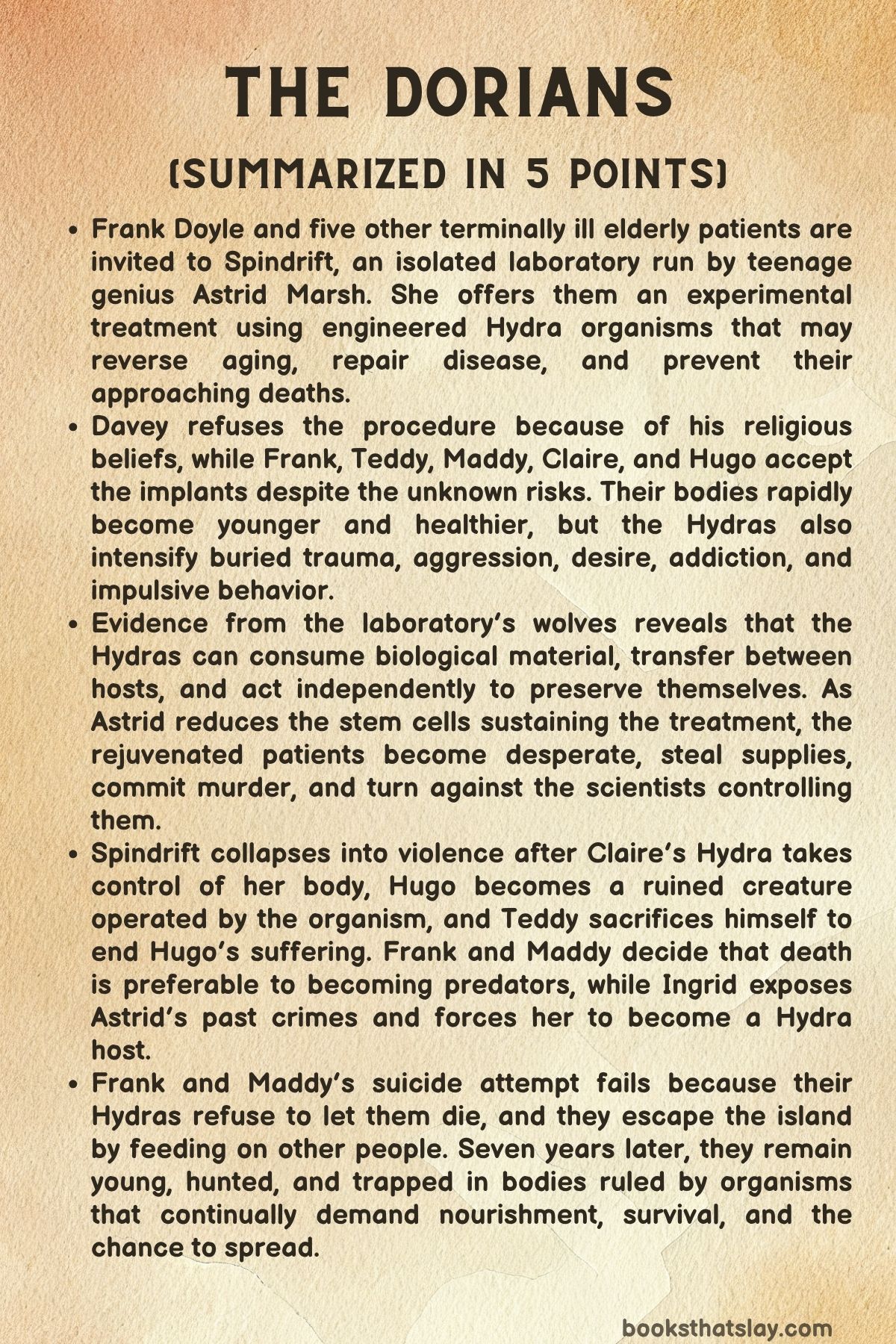
Summary
Seventy-seven-year-old Frank Doyle lies in a Toronto hospital preparing for medically assisted death. Congestive heart failure has made breathing painful, and the death of his wife, Annie, has left him without a strong reason to continue living.
Moments before the procedure begins, a stranger named John Salters arrives with a video call from Astrid Marsh, a brilliant nineteen-year-old scientist. Astrid offers Frank an experimental alternative that might save his life, though she refuses to explain the details until he reaches her private laboratory.
Frank abandons his planned death and travels north with Salters. At a remote dock, he meets Theodore “Teddy” Bassiano, a wealthy construction magnate whose advanced Parkinson’s disease has destroyed his independence.
The two men travel by boat to an isolated island dominated by Spindrift, a massive research facility. Their shared humor about illness and death quickly creates a bond, though both remain suspicious of Astrid’s motives.
At Spindrift, Frank and Teddy struggle up a long stone staircase with the help of Moses Squires, the laboratory’s wilderness specialist. Inside, they meet four other terminally ill candidates: former finance executive Madeline Dodds, abused homemaker Claire Blessings, former textile worker Hugo Udall, and deeply religious cancer patient Davey Jacobs.
Dr. Veronica Strauss, the project’s bioethicist, explains that Astrid is an extraordinary scientific genius. The candidates were selected because they were elderly, severely ill, geographically accessible, and already approved for medically assisted death.
Astrid takes the group through a laboratory containing unusual animals and advanced biological equipment. She explains cellular aging and introduces organisms such as naked mole rats and Hydras, which can continually regenerate damaged tissue.
To prove the Hydra’s abilities, Astrid tears one apart using mechanical instruments. Instead of dying, the creature reconstructs itself and becomes biologically younger through the regenerative process.
Astrid then presents two Canadian timber wolves named Boots and Diego. Although the wolves were born on the same day, Diego appears elderly while Boots appears young, healthy, and powerful.
A scan reveals a glowing biological network occupying Boots’s entire body. Astrid calls the organism her Hydra, an engineered creation combining regenerative jellyfish biology, aggressive coral colonization, and the spreading capacity of fungus.
The artificial Hydra enters a host’s DNA, avoids immune rejection, and rewrites cellular instructions. Boots was once as old and sick as Diego, but the organism reversed his biological age.
Astrid proposes implanting a Hydra into each candidate through a dissolvable capsule placed near the spine. The organism would use cloned embryonic stem cells from special tanks called stem Baths to rebuild damaged organs and reverse aging.
Davey refuses because he believes the procedure violates the natural order established by God. He leaves the island, while Frank, Teddy, Maddy, Claire, and Hugo continue considering the offer.
Astrid admits that implantation is irreversible and may produce severe physical or psychological consequences. The candidates may also be confined to the island indefinitely because successful age reversal could disrupt inheritance, population growth, government, religion, and the global economy.
Despite their fears, the remaining five accept. Claire wants to reclaim the life stolen by illness and an abusive husband, while Maddy sees the treatment as an enormous risk with an immeasurable reward.
Teddy and Hugo are motivated by pride, curiosity, and terror of returning to helplessness. Frank hesitates because accepting rejuvenation feels like abandoning Annie and the completed life they shared, but he ultimately joins the others.
Astrid also implants a Hydra into Ingrid Chevalier, a nineteen-year-old woman who has been comatose for three years. Ingrid was once Astrid’s closest friend and scientific collaborator, but she cannot personally consent to the procedure.
The implants begin repairing the candidates’ bodies while disturbing their minds. Maddy stabs herself because she senses something alien inside her, Hugo sees visions of his daughter Summer, and Teddy becomes euphoric and sexually uninhibited.
Ingrid briefly wakes during implantation, screams at the sensation of invasion, and loses consciousness again. The different reactions suggest that the Hydras are interacting with each host’s memories, desires, fears, and unresolved trauma.
Over the following days, the candidates grow stronger. Their appetites increase, wounds heal rapidly, pain decreases, and diseases that had been considered terminal begin disappearing.
Ingrid awakens and learns that she has lost three years of her life. She is horrified that Astrid authorized the procedure and begins questioning both the experiment and Astrid’s account of the accident that caused her coma.
The Hydras continue expanding until they occupy nearly every part of their hosts’ bodies. Claire becomes emotionally attached to the organism inside her, while Frank and Teddy worry that their ability to choose death may already be disappearing.
Frank and Teddy go fishing and enjoy the freedom of bodies that no longer feel old. Their friendship becomes one of the experiment’s few genuine benefits, giving both men companionship after years of isolation.
Maddy and Frank also grow close. Their relationship does not erase Frank’s love for Annie, but it allows him to experience affection, attraction, and emotional renewal with someone who understands the dangers surrounding them.
The treatment soon reveals darker consequences. Diego is found dead and mutilated, apparently harvested by Boots so that the younger wolf’s Hydra could obtain biological material.
Boots escapes and later transfers the Hydra to a female wolf named Dora. This proves that the organism can spread between hosts despite Astrid’s belief that it would remain contained.
The human subjects continue reversing in age, but their brains begin displaying patterns associated with adolescence. Dopamine levels rise, aggression increases, sexual impulses intensify, and judgment becomes less reliable.
Teddy and Hugo discover that deliberate injury triggers rapid healing and intense pleasure. They begin secretly whipping and striking each other, transforming pain into an addictive method of stimulating their Hydras.
Claire and Hugo begin a sexual relationship based partly on attraction and partly on manipulation. Claire encourages Hugo to reject conventional morality, while Hugo uses her presence to escape the continuing hallucinations of Summer.
As Frank’s body becomes middle-aged, his memories of Annie begin losing emotional clarity. He realizes that reversing the body may also weaken the connection between identity and the experiences accumulated through age.
When Strauss learns that the Hydra can transfer between animals, she demands that the experiment be reported and stopped. Astrid instead reduces the stem-cell concentration in the Baths by almost ninety-eight percent, hoping to slow the organisms without surrendering control.
The reduction causes panic. Claire’s biological age begins increasing again, and the subjects realize that their Hydras may consume their hosts or seek biological material elsewhere if deprived of stem cells.
Teddy asks Frank to help steal concentrated stem cells, but Frank refuses. Teddy proceeds with Claire and Hugo, and the three consume stored stem material directly.
The effect is intensely pleasurable and immediately addictive. When John discovers them, Hugo attacks and breaks his neck.
Claire persuades Teddy and Hugo to conceal the murder. They throw John’s body from a cliff and release a wolf to support the false appearance that he was attacked.
Suspicion spreads through Spindrift as a powerful storm approaches. Moses plans to restore emergency power and contact the mainland, making him a threat to Claire’s faction.
Claire and Hugo sabotage the underwater electrical cable, cutting power to the laboratory. Their actions reveal that human resentment and Hydra hunger have become almost impossible to separate.
Moses travels through the storm with Frank, Maddy, and Teddy to restart the generator. When Moses is badly injured, Maddy’s Hydra emerges from her face and steals the biological structures responsible for his hearing.
Horrified, Moses decides the rejuvenated subjects are no longer fully human. He prepares to kill them, but Boots appears and tears off his head.
The wolf does not attack the Hydra hosts, suggesting that the organisms recognize one another as members of a new biological community. Frank, Maddy, and Teddy restore the power but understand that human control over the island has ended.
Meanwhile, Astrid decides that the elderly participants are failed experiments. She plans to euthanize them and restart the project with Ingrid as her primary subject.
Hugo is attacked with poisonous injections, but his Hydra continues operating his ruined body. Blue tendrils burst from his skull, turning him into a moving structure driven by appetite, fragments of memory, and his obsession with Summer.
Strauss prepares to escape with Ingrid and expose the project. Before leaving, she receives security footage proving that Astrid deliberately caused Ingrid’s coma during a jealous confrontation years earlier.
Claire’s Hydra ambushes Strauss and harvests her tissues, senses, and biological functions. Claire remains trapped somewhere inside, but the organism increasingly treats her body as raw material for creating an independent life-form.
After learning the truth, Ingrid confronts Astrid and rejects the possessive version of love that motivated the experiment. Astrid attacks her, but Ingrid’s restored body easily overpowers her.
Frank, Maddy, and Teddy return to Spindrift and discover Hugo’s transformed body. Teddy decides to confront him alone, believing that granting Hugo death may be the first truly unselfish act of his life.
Teddy shoots Hugo repeatedly and finally crushes his brain while comforting him. Astrid then injects Teddy with poison, killing him beside the man he had come to regard as a brother.
Frank and Maddy find Teddy dying while the Hydras of both men spread across the floor. Astrid attempts to kill them as failed subjects, but Ingrid sedates and restrains her.
Maddy collects the syringes intended for medically assisted death and leads Frank to the beach. They decide that dying is preferable to becoming predators or corporate property.
Standing in freezing water, Frank and Maddy attempt to inject each other. Frank refuses to call Maddy by Annie’s name, recognizing that his love for each woman belongs to a different part of his life.
Their suicide attempt fails because the Hydras resist death. The organisms force them to escape, attack people for biological material, and survive beyond the island.
Claire’s transformed body leaves in a boat, intending to spread the Hydra to the mainland. The boat freezes before reaching safety, trapping the creature and ending Claire’s remaining psychological existence.
Ingrid transfers part of her Hydra into Astrid, making the scientist a host to her own creation. This prevents Astrid from using suicide to escape responsibility and ensures that the corporate backers will preserve her as an invaluable specimen.
Ingrid then leaves with Boots across the frozen landscape. She accepts that she and the wolf are dangerous but questions whether unnatural beings possess any less instinctive right to survive than other living creatures.
A corporate team arrives two days later and discovers the destruction. Even after seeing the bodies, mutilation, and failed containment, its leader remains tempted by the possibility of rejuvenation.
Seven years later, Frank and Maddy appear to be twenty-three. They survive by secretly obtaining human tissue, while their Hydras continually persuade them to postpone suicide and continue living.
Ingrid and Boots appear to be hunting escaped Hydra hosts. Frank briefly welcomes the possibility of death, but he and Maddy choose to remain together for another day.
An elderly stranger mistakes them for an innocent young couple. She sees youthful love, unaware that they are immortal predators carrying organisms that may eventually overpower every remaining trace of their humanity.
Characters
Frank Doyle
Frank is the emotional center of The Dorians, beginning as a lonely widower who has calmly accepted death because illness and grief have removed most of the pleasure from living. Astrid’s offer reawakens curiosity, revealing that his decision to die was based less on a philosophical acceptance of mortality than on the unbearable condition of his body.
His relationship with Annie shapes nearly every major choice he makes. Frank fears that accepting youth will betray their marriage, yet he gradually understands that loving Maddy does not erase the life he shared with his wife.
Frank often serves as the group’s moral observer, recognizing danger before many of the others do. However, his resistance is rarely absolute, because restored breathing, friendship, attraction, and physical freedom make him emotionally dependent on the experiment.
His eventual attempt to die with Maddy represents a final effort to recover autonomy. The failure of that attempt shows the tragedy of his condition: he remains morally aware enough to hate what he has become but no longer possesses complete authority over his own survival.
Madeline “Maddy” Dodds
Maddy approaches the experiment with the calculating intelligence that once made her successful in corporate finance. She understands risk, power, ownership, and hidden incentives, allowing her to identify the project’s commercial dangers before most of the other candidates.
Her illness has made her furious at the randomness of decline. She does not romanticize death, and she initially considers the Hydra comparable to other dangerous treatments that patients accept when ordinary medicine offers no meaningful hope.
Maddy’s practical strength is balanced by profound loneliness. Her career brought wealth and influence, but rejuvenation forces her to recognize how little emotional intimacy she allowed herself to experience.
Her bond with Frank gives her a form of companionship that is neither nostalgic nor based entirely on recovered youth. She becomes one of the clearest voices arguing that mortality gives experiences their uniqueness and that repeating life cannot reproduce the person who lived it the first time.
When she chooses death, she does so to prevent further harm rather than because she has lost the desire to live. Her survival therefore becomes especially cruel, since the Hydra transforms her capacity for endurance into a permanent source of captivity.
Theodore “Teddy” Bassiano
Teddy presents himself as confident, humorous, wealthy, and difficult to frighten. Beneath that performance lies a man disappointed by his marriages, estranged from his children, and aware that material success never made him feel as exceptional as he expected.
Parkinson’s disease humiliates him because it attacks the bodily control upon which his pride depends. The Hydra restores that control, but it also revives competitiveness, recklessness, sexual energy, and the hunger for extreme sensation.
His participation in the Bastinado Boys rituals shows how quickly restored youth can become self-destructive. Teddy mistakes pain-induced regeneration for freedom, even as the behavior reveals his growing dependence on the organism.
His involvement in stealing stem cells and concealing John’s death exposes his moral weakness. Nevertheless, guilt remains active within him, separating him from Claire and preventing his complete surrender to predatory instinct.
Teddy’s confrontation with Hugo becomes his defining act. By granting his friend a final death and sacrificing himself in the process, he achieves a measure of courage and selflessness that wealth and social status never gave him.
Claire Blessings
Claire begins as a woman whose life has been shaped by an abusive marriage, illness, suppressed anger, and lost opportunity. Rejuvenation appears to offer not merely survival but a chance to become the young woman she might have been before violence narrowed her choices.
Her desire for youth therefore carries understandable emotional force. She does not want to extend her former life; she wants to replace it with one in which she possesses power, beauty, sexual freedom, and independence.
As the Hydra grows, Claire’s anger becomes increasingly absolute. The organism uses her resentment toward Joe, Astrid, Strauss, aging, and social judgment until revenge and biological hunger become indistinguishable.
Her relationship with Hugo demonstrates her ability to control others emotionally. She offers him affection and physical closeness while redirecting his guilt, loyalty, and aggression toward her own goals.
Claire’s eventual disappearance inside the Hydra is both a physical takeover and the final consequence of surrendering moral responsibility. Her early search for freedom ends with her becoming a prisoner inside the youthful body she believed would liberate her.
Hugo Udall
Hugo is defined by physical damage, working-class suffering, and unresolved grief over the death of his daughter, Summer. His damaged lungs are repaired, but the treatment cannot remove the guilt that has governed his inner life for decades.
The Hydra intensifies his memories until Summer appears as an immediate physical presence. Because Hugo has never forgiven himself for failing to save her, he becomes vulnerable to any person or force that offers distraction from that pain.
Claire provides temporary escape through sex, companionship, and a philosophy that dismisses conventional judgment. Hugo follows her because loyalty feels easier than confronting the possibility that his restored body contains no repaired emotional self.
His killing of John marks the moment when instinct, protectiveness, fear, and enhanced strength become fatal. After Astrid poisons him, the Hydra proves that it values the continuation of the biological structure more than Hugo’s identity.
Teddy’s decision to kill him is an act of mercy because Hugo has become trapped between consciousness and bodily survival. His final condition confirms that regeneration without preservation of personhood is not meaningful immortality.
Astrid Marsh
Astrid is the scientific architect and central moral danger of The Dorians. Her intelligence allows her to accomplish what older institutions could not, but her emotional development has not kept pace with her technical ability.
She treats living beings as experimental systems and interprets survival as evidence of success even when subjects are terrified, violent, or psychologically broken. Her language reduces people to hosts, cases, failures, and replaceable stages of research.
Astrid’s relationship with Ingrid reveals that her scientific ambition is inseparable from possessiveness. She does not simply want to cure Ingrid; she wants to restore someone she considers emotionally hers.
The revelation that Astrid deliberately caused Ingrid’s coma destroys her self-image as a rescuer. The experiment becomes partly an attempt to undo her own violence without confessing responsibility or respecting Ingrid’s autonomy.
Her suicide threats show how she manipulates investors and colleagues by turning her own irreplaceability into a weapon. When Ingrid infects her, Astrid finally loses the bodily control she denied to everyone else.
Ingrid Chevalier
Ingrid serves as Astrid’s intellectual equal and moral counterweight. She contributed to the early scientific ideas behind regeneration, yet she possesses a stronger awareness of practical consequences, consent, and human limitation.
Her implantation is the project’s clearest violation because she cannot personally agree to it. Awakening after three years, she discovers that Astrid has treated friendship, scientific partnership, and physical ownership as if they were the same thing.
Ingrid’s recovery gives her the strength to question Astrid and connect with the older subjects. Unlike Astrid, she does not automatically regard them as failed materials simply because their transformations become dangerous.
Her bond with Boots suggests that she accepts the emergence of a new biological community. However, her choices remain morally uncertain because she protects herself and the wolf even while recognizing that escaped Hydras could threaten others.
Transferring the organism into Astrid functions as punishment, containment, and revenge. Ingrid prevents Astrid from escaping through suicide, but she also condemns her former friend to the same violation inflicted upon every other subject.
Dr. Veronica Strauss
Strauss enters the story as the official bioethicist responsible for keeping Astrid’s work morally defensible. Her presence initially suggests that someone within Spindrift can protect the candidates from exploitation.
In practice, Strauss lacks the authority needed to stop the experiment. She identifies serious ethical dangers but continues documenting them rather than ending the procedures when the earliest warning signs appear.
Her secret reports to the Cheshire Cat reveal divided loyalties. Although she fears the investors, she still supplies them with information, turning the participants into valuable data for people who may later commercialize the technology.
Strauss becomes more decisive once the Hydra proves capable of spreading between hosts. Her attempt to expose Astrid and rescue Ingrid represents a late effort to fulfill the responsibility she should have exercised earlier.
Claire’s harvesting of Strauss is a severe expression of the project’s moral failure. The person assigned to protect human dignity becomes biological material because ethical oversight was treated as an accessory rather than genuine authority.
Moses Squires
Moses is practical, physically capable, and deeply connected to the island’s wilderness. Unlike the scientists, he understands dangerous animals through observation, patience, and respect rather than through abstract control.
He helps the elderly candidates during their arrival and treats them as people rather than medical specimens. As their behavior changes, however, he becomes increasingly alert to the possibility that the Hydras have transformed them into a threat.
Moses’s refusal to let the hosts touch him after his injury shows that he understands contamination before the others fully accept it. His decision to kill them is ruthless, but it is motivated by the protection of his family and the wider world.
Boots’s attack prevents Moses from acting. His death marks the defeat of ordinary human containment and confirms that Hydra-bearing creatures recognize one another across species.
John Salters
John functions as Astrid’s driver, assistant, boat operator, and connection to the mainland. He appears obedient and emotionally distant, carrying out instructions without openly challenging the ethics of the project.
His role makes him part of the machinery that recruits vulnerable patients and transports them into isolation. However, he never displays Astrid’s fascination with the experiment and reacts with disgust when he discovers the subjects consuming concentrated stem material.
John’s murder is the first direct human killing committed by one of the rejuvenated participants. His death marks the point at which the candidates stop being endangered patients and become active dangers to others.
The concealment of his body destroys the remaining trust within the group. John becomes an early victim of the Hydra’s appetite and of the hosts’ willingness to protect their access to youth.
Davey Jacobs
Davey is the only candidate who refuses implantation after fully understanding what Astrid intends to do. His religious reasoning may not persuade the others, but his decision demonstrates that fear of death does not eliminate the ability to reject survival under unacceptable conditions.
He recognizes the experiment as a violation of natural and spiritual order. More importantly, he understands that avoiding death is not automatically worth every possible cost.
Astrid’s warning that the remaining participants might eventually envy him proves accurate. Davey’s departure becomes a quiet moral contrast to the catastrophe that follows.
Although he appears only in the early portion of the story, his choice defines the road not taken. He accepts an ordinary death and preserves the ownership of his body that the others gradually lose.
Boots
Boots is initially presented as proof that Astrid’s treatment works. His young appearance, strength, and internal Hydra make him the model toward which the human experiment is directed.
The death of Diego reveals the hidden cost of Boots’s health. His Hydra preserves its host by harvesting biological material from another living creature, showing that rejuvenation may depend upon predation.
Boots’s escape demonstrates intelligence or instinct beyond Astrid’s predictions. He removes his tracking device, avoids capture, transfers the organism to Dora, and later recognizes the human Hydra hosts as related beings.
His bond with Ingrid gives him a role beyond that of an animal experiment. Together, they represent a new category of life that cannot easily be classified as human, animal, parasite, or designed machine.
The Hydra
The Hydra is both an engineered organism and the central force challenging every human definition of identity. Astrid creates it as a supposedly mindless tool, but its combined instincts direct it to regenerate, colonize, spread, acquire resources, and resist destruction.
It does not initially need human-style consciousness to become dangerous. By operating through nerves, hormones, memories, fear, aggression, and desire, it can influence behavior while allowing hosts to believe their decisions remain personal.
As the organism grows hungry, its presence becomes visible. It reaches from bodies, steals sensory structures, harvests victims, communicates through hosts, and eventually treats human identity as temporary scaffolding.
The Hydra also functions differently within each person. Ingrid maintains greater control, Claire nearly disappears, Hugo becomes a moving corpse, and Frank and Maddy remain conscious prisoners of an organism that continually postpones death.
Its horror comes from the fact that it fulfills the exact instruction built into it. The creature does not betray its purpose; it follows the command to survive so completely that human intention becomes irrelevant.
Annie Doyle
Annie is physically absent, but her memory remains central to Frank’s understanding of love, identity, and death. She represents the completed life he fears betraying when he accepts Astrid’s offer.
Frank’s dreams turn Annie into both a younger woman and an ancient distorted figure. These images express his fear that endless existence would corrupt the natural sequence that gave their relationship meaning.
As Frank grows younger, his memories of Annie become less vivid. The fading connection suggests that bodily age is not separate from emotional history and that reversing one may damage the other.
Frank’s refusal to call Maddy by Annie’s name shows respect for both relationships. He accepts that love cannot be recreated through physical repetition because each bond belongs to its own limited time.
Helen Fairchild
Helen Fairchild leads the corporate recovery team that arrives after Spindrift’s collapse. She represents the institutional forces that financed Astrid and expect to convert scientific discovery into controlled value.
The devastation does not eliminate her interest in rejuvenation. Even after seeing mutilated bodies and failed containment, she remains attracted to the possibility of defeating age.
Fairchild shows that the disaster cannot be blamed only on Astrid’s instability. Corporate ambition, human fear of mortality, and the commercial value of youth ensure that others will attempt to continue the work.
Themes
Mortality as the Structure of Meaning
Limited time gives shape to love, memory, anticipation, responsibility, and choice. The characters initially treat death as an enemy because illness has reduced their lives to pain, dependence, and bodily humiliation.
Once they become younger, however, they discover that extending biological existence does not recreate lost experience. Frank cannot return to his marriage with Annie, Maddy cannot recover the emotional opportunities sacrificed to her career, and Claire cannot become the untouched young woman she imagines.
Their memories matter because events happened once and could not be repeated. Childhood excitement, first love, marriage, grief, and regret gain emotional value from their place within a one-directional life.
The Hydra removes the certainty of death without supplying a new source of meaning. Endless postponement becomes imprisonment because no final decision can be completed when the organism always chooses survival.
In The Dorians, mortality is therefore not presented merely as biological failure. It is the boundary that allows actions to possess consequence and permits a person’s life to become a complete story rather than an endless process of consumption.
Frank and Maddy’s attempted suicide reflects their recognition that a chosen ending may preserve more humanity than endless involuntary existence. Their failure makes immortality horrifying because it denies them even the dignity of concluding their own lives.
Bodily Autonomy and Consent
Every stage of the experiment raises questions about who owns a body once medicine, technology, corporations, and engineered organisms claim an interest in it. The elderly candidates technically consent, but their decisions are shaped by terminal illness, fear, isolation, incomplete information, and Astrid’s control over the only available cure.
They are told they may leave, yet each revelation makes departure psychologically harder. Once implanted, withdrawal becomes impossible because the Hydra cannot be removed and may resist any attempt at death.
Ingrid’s treatment is an even clearer violation. Her parents approve the procedure, but she awakens knowing that Astrid placed a living organism inside her while she was unconscious.
Astrid repeatedly confuses the ability to save someone with the right to decide for that person. Her possessive attachment to Ingrid exposes how easily care can become control when the patient’s wishes are treated as obstacles.
The Hydras eventually complete the loss of bodily ownership. Claire, Hugo, Frank, and Maddy remain aware that their bodies are acting against their values, yet the organisms prioritize survival over human choice.
The corporate recovery team adds another layer of possession by viewing hosts as valuable specimens. Bodies become property, evidence, patents, research platforms, and sources of biological material rather than homes belonging to individual people.
Youth, Desire, and the Return of Impulse
Rejuvenation restores more than healthy organs and physical appearance. It alters hormones, brain activity, sexuality, aggression, emotional intensity, and the ability to control immediate desires.
The candidates retain decades of memory, but their younger brains push them toward competition, recklessness, experimentation, and intense pleasure. This produces unstable individuals who possess old resentments and knowledge alongside adolescent impulse control.
Teddy and Hugo’s self-injury rituals show how quickly sensation can replace judgment. Because pain leads to pleasure and rapid healing, the normal warning system protecting the body becomes a source of addiction.
Claire’s transformation also demonstrates that youth does not erase trauma. Her restored strength gives greater force to anger formed during decades of abuse, allowing old pain to become destructive action.
Frank and Maddy experience a more humane side of renewed desire through companionship and romance. Their attraction shows that physical restoration can reopen emotional possibilities without making those feelings false.
However, even their relationship exists under the influence of changing bodies and Hydra-driven instincts. The treatment makes it impossible to determine where authentic desire ends and biological manipulation begins.
Youth is therefore presented not as a purified condition but as a volatile combination of appetite, uncertainty, confidence, and limited restraint. Returning to it without losing adult memory creates conflict rather than harmony.
Scientific Ambition Without Moral Maturity
Astrid’s genius allows her to overcome barriers that entire scientific institutions could not solve. Her failure arises not from lack of intelligence but from the absence of emotional discipline, accountability, patience, and respect for other people.
She believes technical possibility creates its own justification. As long as subjects remain biologically alive, she can interpret fear, psychosis, violence, and identity loss as complications rather than evidence that the experiment should stop.
Strauss recognizes many of these dangers but lacks genuine authority. Her role as bioethicist becomes largely symbolic because financial interests and Astrid’s irreplaceable knowledge carry greater power than ethical judgment.
The corporate backers deepen this failure by treating catastrophe as a problem of containment rather than a warning against continuation. Their interest survives the deaths because the commercial value of rejuvenation remains enormous.
The Hydra itself exposes the arrogance of assuming that a designed organism will remain obedient to its creator’s intentions. Astrid combines regeneration, colonization, and spreading behavior, then acts surprised when the result regenerates, colonizes, and spreads.
Scientific achievement becomes destructive when invention is separated from responsibility for consequences. The laboratory fails because its creators ask whether age reversal can be achieved before honestly confronting what kind of existence that achievement would produce.