Until Death by Mary Berman Summary, Characters and Themes
Until Death by Mary Berman is a psychological and supernatural horror novel about caregiving, marriage, memory, and the danger of surrendering personal choice in exchange for security.
The story follows Ophelia, a struggling writer and college instructor whose life is consumed by her mother’s worsening dementia. When the charming Luke di Cascia offers practical help and emotional comfort, he appears to provide the stability she desperately needs. Their rapid relationship leads Ophelia toward a wedding at his family’s unsettling vineyard, where devotion, obligation, and sacrifice have disturbing meanings. The novel examines what happens when care becomes control and love begins to resemble captivity.
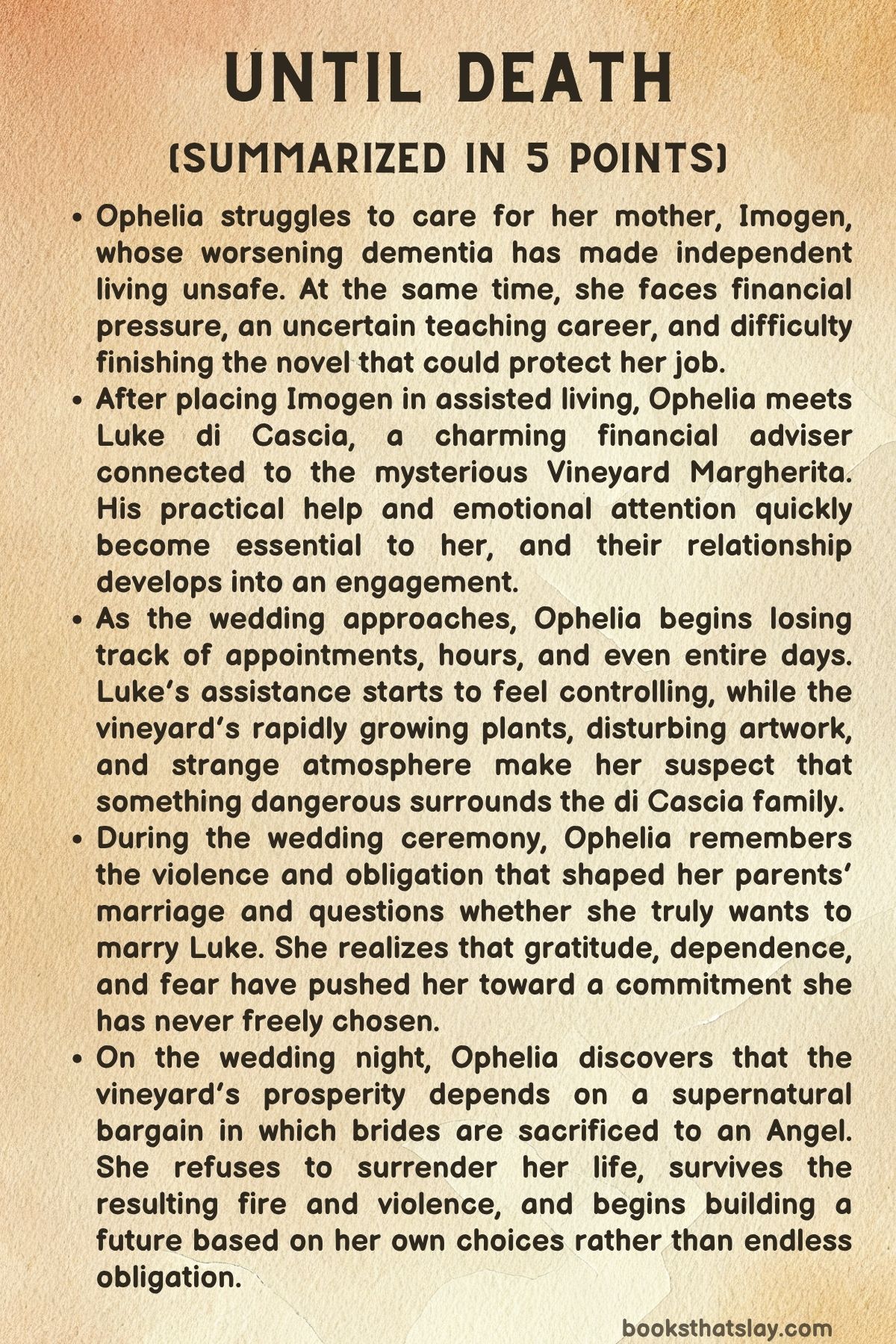
Summary
Ophelia has spent months imagining the death of her mother, Imogen, but those fantasies do not arise from simple hatred. They are the desperate thoughts of a woman whose entire life has become organized around managing another person’s decline.
Imogen is losing her memory, wandering at night, and becoming increasingly incapable of living alone. After the police find her outside in a confused state, Ophelia accepts that temporary solutions are no longer enough and places her on a waiting list for assisted living.
The decision fills Ophelia with guilt because her feelings toward her mother are complicated by years of resentment, responsibility, and unresolved family pain. Her father is dead, her writing career has stalled, and her teaching position may disappear unless she finishes and successfully places her novel.
Moving Imogen into Happy Endings Assisted Living is therefore both a practical necessity and an attempt at separation. Ophelia hopes that professional care will allow her to reclaim enough time and energy to save her career, yet the facility immediately feels inadequate.
Susie, the director, is polite and efficient, but she quietly warns that Happy Endings may not be capable of handling Imogen’s needs forever. The beige rooms and restrained atmosphere leave Ophelia wondering whether she has found care for her mother or merely postponed another crisis.
After leaving the facility, Ophelia drives through the outskirts of Lancaster and arrives at the Vineyard Margherita. The property stands on land that was once wooded and now functions as an elaborate wedding venue filled with carved decorations, flowers, vines, and religious imagery.
There she meets Mitchell, a sculptor and handyman who works for the vineyard’s owners, the di Cascia family. He leads her toward his studio by the river, a place that awakens memories of her father and gives the unfamiliar landscape an emotional pull.
Mitchell’s sculptures depict scenes of violence taken from religion and mythology. Icarus falls, Judith holds the severed head of Holofernes, and David confronts Goliath, making the artwork seem less celebratory than threatening.
He explains that the vineyard chapel is neither Catholic nor consecrated, despite its appearance. The carvings were commissioned to replace works associated with a chapel once owned by the di Cascia family in Italy.
Rita di Cascia arrives and welcomes Ophelia with a mixture of warmth, formality, and concealed severity. Her manner suggests that Ophelia’s arrival has greater significance than an accidental visit, although Ophelia cannot yet understand why.
At the same time, Ophelia must deal with the financial realities of her mother’s condition. Questions involving Medicaid, Medicare, debt, insurance, retirement accounts, and assisted-living costs make it clear that Imogen’s care could consume whatever limited resources remain.
Her professional life is also becoming unstable. She misses or struggles through faculty obligations while knowing that her unfinished novel and poor record may cost her the teaching job on which she depends.
During this period, she meets Luke di Cascia, who is handling financial matters connected to Imogen. He appears polished, capable, youthful, and attractive, and his calm approach contrasts sharply with Ophelia’s panic.
Luke informs her that Imogen’s finances are in serious trouble and that selling the condominium may produce less money than Ophelia expects. His honesty frightens her, but his manner also makes her feel protected rather than judged.
Their professional meeting quickly becomes personal when Luke asks her out. A drink turns into dinner, and Ophelia allows herself to accept his attention at a moment when nearly every other part of her life feels unmanageable.
The following morning, she wakes naked and hungover in her mother’s bed, uncertain about parts of the previous evening. Luke has brought her home, cleaned her stained blouse, and taken care of her without apparently demanding anything in return.
Ophelia misses another work obligation, but Luke’s presence reduces her immediate sense of disaster. His kindness offers something she has lacked for years: the feeling that another person can notice what needs to be done and simply do it.
Luke soon becomes a regular part of her life. He cooks, drives her to stores, helps pack Imogen’s possessions, manages practical tasks, and makes elder care seem less impossible.
Their relationship becomes intimate with unusual speed because romance and assistance are almost indistinguishable. Ophelia begins to believe that Luke is creating the space she needs to work, although she is also becoming dependent on his labor, money, judgment, and emotional reassurance.
A plant taken from the vineyard grows in the condominium window as the relationship develops. Its growth quietly links Ophelia’s domestic life to the vineyard, suggesting that the property’s influence is spreading into spaces she considers her own.
The first major conflict comes when Ophelia discovers that Luke has discarded boxes of Imogen’s belongings that she had carefully saved. Although the objects may appear useless to him, they represent memories, decisions, and responsibilities that Ophelia believes belong to her.
She races through the vineyard searching for Luke, furious that he has acted without permission. What previously appeared strange but beautiful now seems overgrown, confusing, and hostile.
Mitchell finds her in distress and tries to calm her. His presence offers a different form of support from Luke’s because he helps her regain control rather than making choices on her behalf.
The incident forces Ophelia to recognize that Luke’s usefulness contains an element of authority. His habit of solving problems can easily become a habit of deciding which things, memories, and relationships are worth preserving.
As summer continues, Ophelia’s sense of time deteriorates. She misses appointments, arrives late, loses hours, and becomes uncertain about the order in which events have happened.
Her friend Hildy is preparing for her own wedding celebrations, including a bachelorette party, but Ophelia can no longer participate reliably. What should be an opportunity for friendship instead shows how far she has become separated from ordinary routines.
Hildy moves toward marriage with anticipation and certainty, while Ophelia remains caught between her mother’s worsening condition, professional failure, and dependence on Luke. The difference between them becomes increasingly important as Ophelia’s own wedding approaches.
When Ophelia returns to Lancaster after one of these periods of confusion, the vineyard seems altered. Reflective tape, scarecrows, damaged animals, dense vines, and unfamiliar protective measures suggest that the land is either defending itself or containing something dangerous.
Her relationship with Luke also changes. She still needs his help, but his care increasingly feels like supervision, and his confidence about their future leaves less room for her uncertainty.
Soon Ophelia begins losing track not only of hours but of entire days. Wedding plans advance even though she cannot clearly remember agreeing to many of the decisions shaping the ceremony.
The vineyard becomes more elaborate as the season progresses. Flowers multiply, vines thicken, decorations accumulate, and preparations seem to continue according to a schedule that does not depend on Ophelia’s consent.
Luke and Rita influence the food, clothing, guest list, flowers, decorations, and family expectations. Whenever Ophelia tries to assert her preferences, her choices are redirected through the di Cascias’ traditions and the vineyard’s established procedures.
Meanwhile, Imogen’s dementia grows more severe. Ophelia must deal with medication, bathing, hygiene, confusion, and moments when her mother no longer recognizes her.
The strain makes it increasingly difficult for Ophelia to determine whether her suspicions are justified. Exhaustion, grief, alcohol, the vineyard’s influence, and the possible inheritance of her mother’s illness all become potential explanations for her disorientation.
Luke’s assistance remains genuine enough to complicate the danger. He does not behave like a simple villain because he cooks, organizes, comforts, and repeatedly prevents Ophelia’s life from collapsing.
However, every service also binds her more closely to him. The easier he makes survival, the harder it becomes for her to imagine refusing the future he and his family are constructing.
By late summer, the wedding has become a full-time administrative burden. Vendor calls, financial decisions, tastings, fittings, floral plans, seating arrangements, and family demands leave Ophelia with almost no private space.
She tries to preserve some control by challenging Rita’s choices and insisting that the celebration should reflect her own taste. Yet even her resistance occurs inside a system designed and financed by the di Cascia family.
The rehearsal dinner confirms how fully she has been absorbed into their world. Luke, Rita, Gianlorenzo, Imogen, and numerous unfamiliar relatives surround her, while the formal atmosphere makes her feel more observed than welcomed.
Instead of functioning as a celebration, the dinner feels like the final stage of an arrangement that has already been completed without her. Ophelia senses that she is being moved toward a future whose terms she has never been allowed to examine.
On the wedding day, disorder briefly interrupts the family’s controlled preparations. Ophelia suffers a sprained ankle, arrives late, and struggles through the required transformation of hair, makeup, dress, and ceremony.
Imogen experiences a rare moment of clarity and calls her daughter by name. The moment is precious because it reminds Ophelia of the person her mother once was, but it also intensifies the pressure to protect her at any cost.
Hildy arrives and confronts Ophelia with a direct question about the marriage. She asks her to consider whether she is marrying Luke because she loves him or because dependence, fear, exhaustion, and obligation have made refusal seem impossible.
Ophelia recognizes that Hildy possesses a certainty about Usman that she does not feel about Luke. She may be grateful to Luke, attached to him, and frightened of losing him, but none of those emotions necessarily equal free consent.
The ceremony begins inside the chapel amid incense, music, religious imagery, and unfamiliar guests. Imogen walks Ophelia down the aisle, placing mother and daughter at the center of a ritual neither fully understands.
Luke says that he accepts the marriage without hesitation. When Ophelia is expected to answer, however, the moment opens memories of her parents’ violent and damaging relationship.
She remembers how love in her family was connected to endurance, injury, dependence, and the expectation that one person should absorb another person’s pain. Her years of caring for Imogen have repeated that pattern by teaching her that devotion requires the destruction of her own needs.
Ophelia finally understands that Luke’s care can be sincere while the structure surrounding it remains dangerous. A person may offer real comfort and still participate in a system that removes another person’s choices.
The horror becomes explicit during the wedding night. Ophelia learns that the vineyard’s beauty and prosperity depend on a long-standing supernatural agreement involving an Angel and the sacrifice of brides.
Women have disappeared for generations because the di Cascia family has treated their deaths as necessary payments. The wedding venue is not merely a business but an apparatus designed to select, prepare, and consume women while disguising violence as romance and tradition.
Rita explains the history of the bargain and the role Ophelia has been chosen to play. Imogen’s decline was accelerated so that Ophelia would become exhausted, isolated, financially vulnerable, and willing to accept Luke’s rescue.
The plan depends on making sacrifice appear voluntary. Ophelia is supposed to believe that surrendering herself will protect her mother, preserve the family, and justify every act of care she has received.
She refuses that reasoning. She recognizes that she is not morally required to die simply because other people have organized their lives around her obedience.
Her refusal leads to fire, violence, the vineyard’s basement, and a desperate struggle for survival. The carefully maintained wedding fantasy collapses, exposing the venue as a place where ritual, murder, and family loyalty have operated together.
Ophelia survives and later tells her story from a hospital. The police interpret the vineyard as a murder cult, an explanation that captures the human crimes even if it cannot fully account for the supernatural force behind them.
Mitchell and Hildy remain with her, demonstrating forms of loyalty that do not require possession or sacrifice. Imogen is still alive, although her condition remains severe and cannot be restored by Ophelia’s survival.
For the first time, Ophelia openly states that she said no. The statement is simple, but it represents a complete rejection of the belief that her value depends on how much suffering she can endure for others.
She considers remaining in Lancaster and discovers the possibility of a new creative-writing opportunity. Her career, family, and future remain uncertain, but uncertainty now belongs to her rather than to a system that has already selected her fate.
Characters
Ophelia
At the center of Until Death, Ophelia is an exhausted daughter, blocked writer, insecure instructor, and reluctant bride whose identity has been almost entirely consumed by responsibility. Her violent fantasies about Imogen’s death reveal not cruelty but the frightening emotional consequences of caring for someone while feeling trapped, resentful, and ashamed of that resentment.
Ophelia measures her worth through endurance. She believes she must care for her mother, rescue her career, complete her novel, preserve family possessions, attend social obligations, and remain grateful to anyone who helps her, even when fulfilling all these expectations leaves no room for an independent self.
Her stalled writing is especially significant because it represents more than professional failure. Writing is the activity through which she might create a life shaped by her own imagination, yet she cannot finish her novel while constantly responding to emergencies created by other people.
Her relationship with Luke develops at the precise moment when she is least capable of making a free decision. He does not simply attract her romantically; he becomes the person who cooks, drives, organizes, pays, comforts, and turns unbearable responsibilities into manageable tasks.
This dependence makes Ophelia’s eventual suspicion emotionally difficult. Rejecting Luke means risking the return of chaos, and she must determine whether temporary safety is worth the gradual surrender of her authority over her home, mother, possessions, wedding, and future.
Her worsening confusion also places her in terrifying proximity to Imogen. Every forgotten appointment or misplaced day raises the possibility that she is inheriting her mother’s illness, which makes it easier for others to dismiss her fears and harder for her to trust herself.
Ophelia’s final refusal is therefore both a physical act of survival and a recovery of judgment. She accepts that she cannot save everyone, repay every debt, or prove her love by disappearing, and she chooses an uncertain life over a secure form of destruction.
Imogen
Imogen is both a vulnerable mother suffering from dementia and a source of deep emotional conflict in her daughter’s life. Her illness reduces her ability to communicate, remember, and make decisions, but her condition does not erase the difficult history that existed between mother and daughter before the decline began.
Through Imogen, the book presents dementia as a transformation that affects an entire family. She wanders, forgets Ophelia, requires help with basic hygiene, and occasionally returns through brief moments of lucidity that make her continuing disappearance even more painful.
Her presence creates an impossible emotional demand for Ophelia. The daughter must grieve someone who is still alive while also managing the financial, physical, and administrative burdens produced by the illness.
Imogen’s condition also becomes a tool used by the di Cascia system. Her decline is deliberately accelerated so that Ophelia will become more desperate for practical help and more willing to accept a marriage presented as rescue.
This manipulation does not reduce Imogen to a plot device because her fragmented identity remains central to the emotional stakes. When she recognizes Ophelia on the wedding day, the moment reminds both women that a relationship exists beneath the illness, even though memory can no longer sustain it consistently.
Imogen also represents the danger of confusing love with endless self-erasure. Ophelia’s decision not to sacrifice herself does not mean she stops caring for her mother; it means she rejects the claim that genuine care requires the caregiver’s destruction.
Luke di Cascia
Luke is one of the most unsettling figures in Until Death because his affection and usefulness cannot be dismissed as completely false. He is attentive, competent, financially informed, domestically capable, and sensitive to the immediate pressures that leave Ophelia overwhelmed.
He enters her life through Imogen’s financial crisis, giving him access to the exact information needed to understand Ophelia’s vulnerability. He knows that she is frightened about money, employment, housing, elder care, and professional failure, and he presents himself as the solution to all of these problems.
Luke’s helpfulness gradually becomes a form of control. Throwing away Imogen’s belongings demonstrates that he feels entitled to decide what should remain in Ophelia’s life, while his influence over the wedding suggests that he views her consent as something that can be produced through comfort and momentum.
His most disturbing quality is that he may believe he is loving her. The story does not require him to feel nothing; instead, it shows how affection can coexist with entitlement, family loyalty, manipulation, and participation in violence.
Luke has inherited a system in which women’s sacrifices are treated as necessary for collective stability. Rather than questioning that arrangement, he helps prepare Ophelia to enter it, allowing tradition to define what he is permitted to demand from the woman he claims to love.
His immediate certainty during the ceremony contrasts with Ophelia’s hesitation. He has no reason to doubt because the marriage preserves his family, confirms his role, and costs him far less than it costs her.
Luke ultimately represents care without respect for autonomy. He can wash a blouse, cook a meal, solve a financial problem, and still participate in a structure that treats another person’s body and future as family property.
Rita di Cascia
Rita combines hospitality, authority, tradition, and menace. From her first appearance at the vineyard, she behaves as though Ophelia has entered a space governed by rules that Rita understands but will not yet explain.
Her warmth is not necessarily an act, but it is conditional. She welcomes Ophelia because the younger woman has a designated function within the vineyard’s future, and her generosity becomes inseparable from the expectation of obedience.
Rita controls the wedding through choices involving food, flowers, clothing, decoration, guests, seating, and ritual. Each individual decision appears minor, yet together they remove Ophelia from the process until the bride becomes the least powerful person in her own ceremony.
As the keeper of the di Cascia bargain, Rita protects violence by describing it as heritage and necessity. She has accepted a moral system in which the survival or prosperity of the family justifies the disappearance of women.
Her explanation on the wedding night reveals that she does not view herself as a senseless murderer. She understands sacrifice as an inherited responsibility, which makes her more frightening because she can discuss cruelty in the language of duty, preservation, and love.
Rita also reflects a generational form of female complicity. Although she exists within a patriarchal family structure, she has gained authority by administering the same system that consumes other women.
Her relationship with Ophelia therefore carries a distorted maternal quality. She prepares the bride to join the family, but the promised inclusion is actually a method of erasure.
Mitchell
Mitchell is connected to the vineyard without being fully absorbed into the di Cascia family’s emotional logic. His work fills the property with images of falling bodies, severed heads, battles, sacrifice, and death, turning the venue’s art into an unintentional warning.
He introduces Ophelia to the physical and symbolic world of the vineyard. The river studio, carved figures, chapel details, and history he describes encourage her curiosity while also exposing the violence beneath the property’s romantic surface.
Unlike Luke, Mitchell helps Ophelia without immediately taking control. When he finds her distressed after the disappearance of Imogen’s boxes, he attempts to ground her rather than telling her what she should think or feel.
His artistic position is important because he creates objects commissioned by powerful people while remaining capable of recognizing meanings they might prefer to conceal. The carvings preserve stories in which pride, desire, faith, and violence lead to destruction, reflecting the vineyard’s hidden reality.
Mitchell’s continued presence after the catastrophe indicates that his concern for Ophelia is not based on possession. He stands beside her in the hospital and aftermath without demanding that survival bind her to him.
He therefore functions as a contrast to Luke. Both men provide forms of assistance, but Mitchell’s support leaves Ophelia’s decisions intact.
Hildy
Hildy represents ordinary friendship, social continuity, and a life progressing beyond the isolated crisis that consumes Ophelia. Her bachelorette party and wedding plans initially appear to add pressure, but they also provide an important standard against which Ophelia can measure her own emotional condition.
She becomes frustrated when Ophelia misses appointments and behaves unreliably. This frustration does not make her uncaring; it reflects the difficulty of understanding a friend whose disorientation has become too serious to explain as simple lateness or stress.
Hildy gradually moves from annoyance to concern. She recognizes that Ophelia’s behavior is not merely inconsiderate and eventually interrupts the wedding preparations to ask the question no one in the di Cascia family wants raised.
Her comparison between her love for Usman and Ophelia’s feelings for Luke is crucial. Hildy does not argue that marriage must be perfect, but she insists that gratitude, pressure, and fear are not substitutes for genuine willingness.
By remaining beside Ophelia after the fire, Hildy proves that her friendship can survive missed events, confusion, and difficult truths. Her loyalty does not require Ophelia to be useful, cheerful, organized, or obedient.
Usman
Usman has a limited direct role, but his relationship with Hildy provides an important contrast to Ophelia’s engagement. Hildy’s certainty about marrying him reveals what mutual commitment looks like when it is not primarily produced by crisis and dependency.
He represents the possibility that marriage itself is not the enemy. The danger lies in a union structured around unequal knowledge, hidden obligations, manufactured vulnerability, and the expectation that one person must surrender more than the other.
Because Usman remains outside the supernatural conflict, he also helps preserve the connection between Hildy and ordinary life. His presence reminds Ophelia that weddings can be chosen celebrations rather than ritualized forms of capture.
Gianlorenzo di Cascia
Gianlorenzo appears as part of the di Cascia family’s formal presence during the rehearsal dinner. Although the available events reveal less about his individual motives, his position reinforces the weight of the family structure surrounding Ophelia.
He contributes to the sense that the wedding is not simply a private commitment between Luke and Ophelia. It is an event controlled by an established family whose relatives, traditions, resources, and expectations already dominate the occasion.
His relative silence may itself be meaningful. Systems of exploitation do not survive only because of dramatic leaders such as Rita; they also depend on family members who participate, accept benefits, attend rituals, or decline to challenge what has been normalized.
Susie
Susie, the director of Happy Endings Assisted Living, introduces Ophelia to the limitations of institutional care. Her manner is polite but restrained, and she avoids promising that the facility can meet Imogen’s needs indefinitely.
She represents a practical reality that neither romance nor supernatural horror can erase. Dementia care requires money, staffing, specialized knowledge, and long-term planning, and even a professionally managed facility may prove insufficient.
Susie’s warning contributes to Ophelia’s vulnerability because it removes the hope that placing Imogen in assisted living will permanently solve the problem. The possibility of another forced transition remains in the background, making Luke’s offer of stability even more attractive.
Unlike the di Cascias, however, Susie does not disguise limitations as devotion. Her honesty may be discouraging, but it preserves Ophelia’s ability to make informed choices.
Ophelia’s Father
Although Ophelia’s father is dead before the main events, his absence shapes her emotional life. Places near the river and vineyard awaken memories of him, revealing how grief can attach itself to landscapes and unexpected encounters.
His marriage to Imogen also becomes part of Ophelia’s reckoning during the ceremony. Memories of violence and damage teach her that marriage has historically meant endurance and obligation rather than mutual safety.
The father’s legacy helps explain why Ophelia is vulnerable to Luke’s care. Having witnessed or inherited a model of love connected to suffering, she struggles to identify the point at which support becomes control.
His influence is therefore psychological rather than active. Ophelia must reject not only the vineyard’s demands but also the family history that has trained her to view sacrifice as an ordinary part of intimacy.
The Angel
The Angel is the supernatural power behind the vineyard’s prosperity and sacrificial system. Its presence transforms the di Cascias’ actions from isolated murders into a continuing agreement between human ambition and an inhuman force.
The entity does not merely demand victims; it creates a moral structure in which families convince themselves that victims are necessary. This arrangement allows human participants to blame tradition, survival, or supernatural law instead of accepting responsibility for their decisions.
The Angel’s connection to brides gives the horror a gendered form. Women are prepared through courtship, ceremony, beauty, and promises of belonging, only to discover that marriage is the method through which they have been selected for consumption.
Its power also appears connected to growth, abundance, flowers, vines, and the vineyard’s unnatural vitality. Beauty becomes frightening because every flourishing surface suggests nourishment drawn from concealed death.
Ophelia defeats the Angel’s logic before she defeats its physical threat. By refusing to accept that sacrifice is inevitable, she breaks the belief system on which the bargain depends.
Themes
Care as Control
Until Death examines how assistance can gradually become authority when the person receiving help is exhausted, isolated, and financially vulnerable. Luke’s cooking, driving, organizing, cleaning, and planning give Ophelia immediate relief, yet every task he assumes reduces the number of decisions she makes for herself.
The danger does not come from kindness alone but from kindness offered without respect for boundaries. Luke throws away Imogen’s possessions, influences Ophelia’s finances, directs wedding preparations, and assumes that solving a problem gives him the right to define what the solution should be.
Ophelia’s situation makes resistance unusually difficult. Refusing Luke’s help would mean confronting unpaid bills, institutional care, professional failure, household labor, and emotional exhaustion without support.
The story therefore avoids presenting dependence as a personal weakness. Ophelia becomes dependent because the demands placed on her are greater than one person can reasonably manage, while the available systems of elder care and employment provide little security.
Mitchell and Hildy demonstrate healthier alternatives. They intervene when necessary, but their support is intended to restore Ophelia’s judgment rather than replace it.
The distinction between care and control ultimately depends on whether the vulnerable person retains the right to disagree. Luke’s care requires movement toward the future he has chosen, while genuine support allows Ophelia to choose a future that may exclude the people helping her.
Marriage, Obligation, and Inherited Violence
Marriage is presented as an institution carrying memories far older than the couple standing at the altar. Ophelia cannot respond to Luke’s vows without remembering her parents’ damaged relationship and the lessons it taught her about endurance.
Her hesitation emerges because the ceremony asks her to repeat a familiar structure. She is expected to accept that love involves surrender, that commitment requires silence, and that a wife proves devotion by placing the needs of others above her own survival.
The di Cascia family intensifies this structure through tradition. Their weddings appear elegant, religious, and communal, but the rituals conceal a history in which brides are treated as resources required to preserve the family.
Rita protects this arrangement by translating murder into duty. Luke participates by translating control into care, while the assembled relatives give the process the appearance of social approval.
Hildy and Usman provide a necessary contrast by showing that marriage can arise from mutual certainty rather than coercion. Their relationship prevents the novel from suggesting that all commitment is destructive.
The central question is whether a vow has moral meaning when one person lacks full knowledge or feels unable to refuse. Ophelia’s silence at the altar becomes more honest than Luke’s confident acceptance because her hesitation recognizes the unequal cost hidden inside the ceremony.
Dementia, Memory, and Unstable Reality
Imogen’s dementia creates a constant fear that identity can disappear before the body does. Her wandering, confusion, dependence, and failure to recognize Ophelia force her daughter to grieve in fragments rather than through a single, final loss.
Brief moments of lucidity become emotionally powerful because they cannot be preserved. When Imogen calls Ophelia by name on the wedding day, recognition feels like a temporary return from a place neither woman can control.
Ophelia’s own disorientation makes the theme more complex. She loses appointments, days, and confidence in her perceptions, creating the possibility that she is repeating her mother’s decline.
This uncertainty allows external manipulation to become more effective. A person who cannot trust her memory is more likely to defer to someone who appears organized, certain, and calm.
The vineyard deepens the instability by changing in ways that are difficult to verify. Vines grow rapidly, familiar roads appear altered, animals behave strangely, and time seems to move according to the property’s own rhythm.
Memory also carries inherited emotional truth. Even when Ophelia cannot organize the present, memories of her parents’ marriage help her recognize the danger of repeating their patterns.
The story ultimately separates uncertainty from powerlessness. Ophelia may never possess perfect knowledge of everything that happened, but she does not need complete certainty to refuse a situation that feels destructive.
Sacrifice, Female Autonomy, and Saying No
The vineyard survives by teaching women that their destruction serves a greater good. Brides are selected, prepared, celebrated, and consumed within a ritual that makes violence appear beautiful, meaningful, and necessary.
Ophelia has already been trained for this role through caregiving. Long before the supernatural sacrifice is revealed, she has sacrificed time, work, sleep, money, creativity, friendships, and emotional stability for her mother.
The di Cascias exploit that training by presenting death as the final extension of responsibilities she already accepts. If she believes a good daughter must give everything to Imogen, it becomes easier to convince her that a good wife or grateful recipient of care should also surrender her life.
Rita’s account of tradition attempts to remove personal responsibility. The sacrifice is treated as something inherited from previous generations rather than a choice repeatedly renewed by living participants.
Ophelia’s refusal breaks this pattern by rejecting the idea that suffering becomes moral simply because it benefits many people. She accepts that others may experience loss, inconvenience, instability, or grief as a result of her decision to survive.
Saying no does not provide an easy victory. Her mother remains ill, the vineyard burns, people die, and the future remains uncertain.
Nevertheless, her survival establishes that autonomy includes the right to disappoint others. Ophelia finally understands that she can love, care, grieve, and remain connected to people without allowing those relationships to consume her existence.