When Sparks Fly Summary, Characters and Themes
When Sparks Fly by Monica Murphy is a contemporary small-town romance about a privileged young woman whose public heartbreak and disastrous mistake force her to rebuild her life. Rachel Henderson arrives in Foxglove Bay expecting only a temporary escape, but an accidental house fire introduces her to Wyatt McKinney, a guarded fire captain and devoted single father.
Their strong attraction develops alongside Rachel’s search for independence and Wyatt’s struggle to trust someone after abandonment. Through work, friendship, family, danger, and separation, the novel examines what happens when two people stop allowing fear and social expectations to determine their futures.
Summary
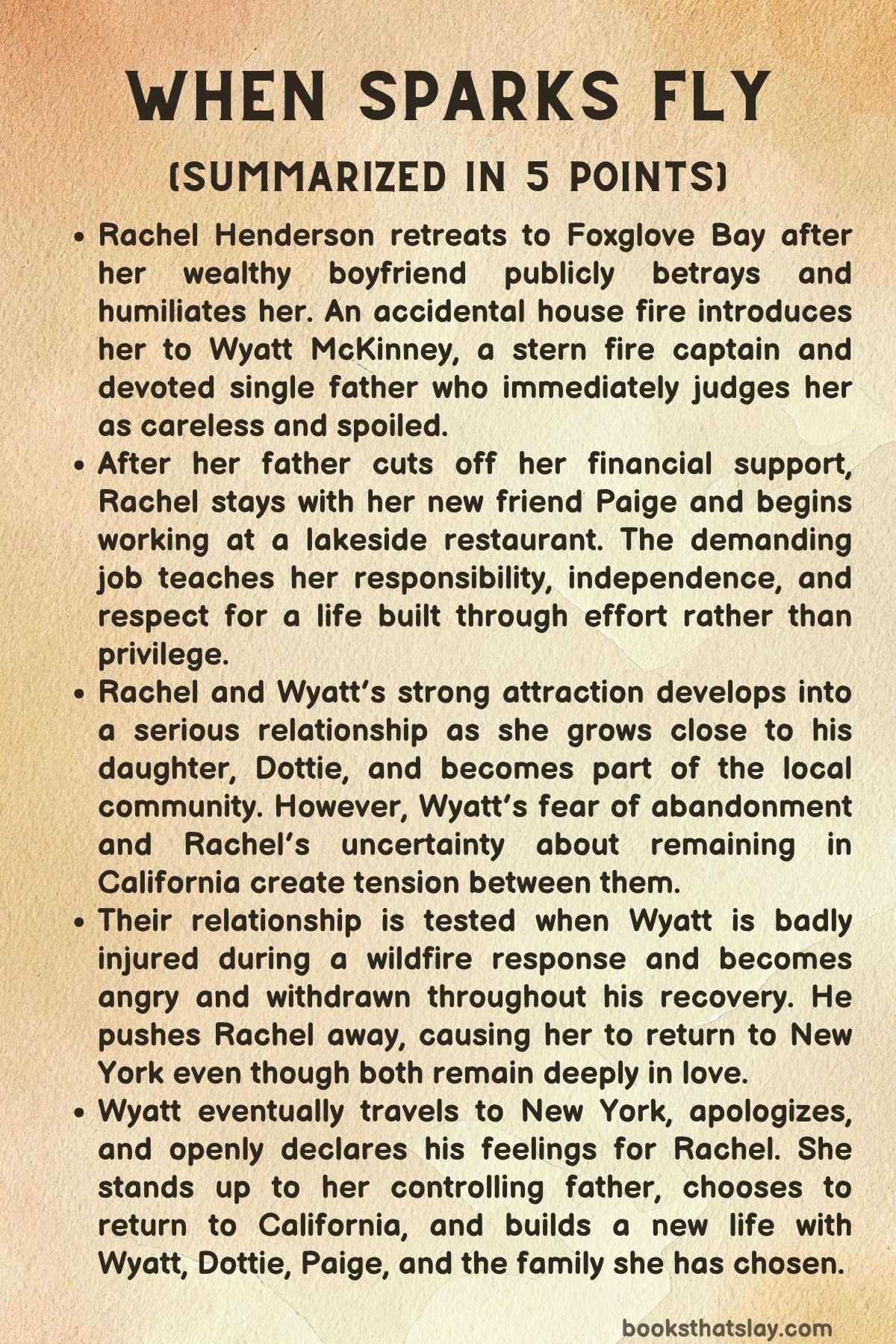
Rachel Henderson spends Memorial Day weekend in the Hamptons while Edmund Davies, her wealthy British boyfriend of three months, claims to be working in London. Their romance began with extravagant trips, expensive gifts, and promises of a glamorous future, but Rachel discovers photographs proving that Edmund has returned to his former girlfriend, Lady Emmaline.
Humiliated and furious, Rachel sends Edmund the photograph, calls him a liar, and blocks him before he can explain. His later response to reporters—pretending not even to recognize Rachel’s name—turns her private heartbreak into a public scandal and strengthens her belief that love brings nothing but trouble.
Two weeks later, Rachel retreats to her family’s vacation home in Foxglove Bay, California, hoping to avoid the gossip surrounding her breakup. While attempting to create a luxurious spa afternoon, she hears a dating podcast discussing Edmund’s betrayal, becomes distracted, and accidentally knocks a candle into the curtains.
The flames spread quickly through the upper floor, forcing Rachel to flee wearing only a silk robe and facial mask. When firefighters arrive, she disobeys their instructions and runs back inside to rescue an inherited crocodile Birkin bag, prompting fire captain Wyatt McKinney to carry her out over his shoulder.
Rachel and Wyatt immediately clash because he considers her reckless, spoiled, and dangerously attached to material possessions. Rachel resents his condescending manner, but both feel a strong physical attraction beneath their argument.
The fire leaves the house uninhabitable, and Rachel’s father responds with criticism rather than comfort. Determined not to return to New York and face renewed humiliation, Rachel decides to remain in California and handle the consequences herself.
At the Thistlemark Hotel, Rachel learns that every room is booked for the summer. A friendly employee named Paige offers Rachel the spare bedroom in her condominium, even though the two women have only just met.
Rachel is surprised by Paige’s trust and generosity, qualities she rarely encounters in her status-conscious social circle. As they clean the cluttered room together, Paige admits that she accumulated credit-card debt while buying clothes in an unsuccessful attempt to attract Nate McKinney, Wyatt’s younger brother.
Rachel admires Paige for working several jobs to correct her financial mistakes. The comparison makes Rachel recognize how completely she has depended on her parents to rescue her whenever she makes a poor decision.
Meanwhile, Wyatt focuses almost entirely on his work and his six-year-old daughter, Dottie. Dottie’s mother, Cheryl, disappeared years earlier after showing little interest in parenting, leaving Wyatt afraid that any woman he trusts will eventually abandon him and his child.
Wyatt’s brother Nate convinces him to visit the Snowline Saloon, where Rachel and Paige are already drinking. Rachel jokingly calls Wyatt “Captain Grumpy Pants,” while Paige becomes nervous around Nate, the man she has loved for years.
As the evening continues, Rachel becomes intoxicated and offers to pay the group’s bill. Her credit cards are declined because her father has canceled them, and Wyatt quietly covers the expense, leaving Rachel embarrassed but determined not to collapse under another humiliation.
Rachel arranges for Nate and Paige to share a ride, then deliberately remains alone with Wyatt. Their attraction quickly becomes physical, and they have sex in the back seat of Rachel’s rental car after Wyatt insists on using protection.
Although the encounter is exciting, Wyatt describes it as a one-night stand and leaves soon afterward. Rachel drives back to Paige’s condominium crying, unsettled by the contrast between their intense intimacy and Wyatt’s emotional distance.
The next morning, Rachel’s father confirms that he has cut her off financially and expects her to begin supporting herself. Paige invites Rachel to remain as a rent-paying roommate and helps her apply for a summer job at Mitchell’s Landing, a busy lakeside restaurant.
Rachel begins by scooping ice cream, a task she initially assumes will be easy. She soon learns that customer-service work demands physical endurance, patience, speed, and the ability to remain calm while customers and teenage coworkers criticize her.
Rather than quitting, Rachel continues practicing until she improves. The work gives her a sense of accomplishment that expensive possessions and glamorous social events never provided.
Wyatt later arrives at Mitchell’s with Dottie and is surprised to find Rachel working behind the counter. Rachel charms Dottie by giving her extra bubblegum ice cream, while Wyatt begins reconsidering his belief that Rachel is merely a helpless rich woman passing through town.
Wyatt and Rachel continue encountering each other through Paige and Nate. When Wyatt invites the women to join the brothers at the Snowline, he and Rachel openly acknowledge their attraction and the fact that both carry emotional wounds from former relationships.
Rachel worries that Wyatt may be repeating Edmund’s manipulative behavior, but Wyatt’s confusion about the idea of love bombing reassures her. Their second attempt at intimacy is interrupted when Nate pounds on the bathroom door, leaving both frustrated and uncertain about what their repeated encounters mean.
Wyatt researches Rachel online and learns how publicly Edmund betrayed her. Understanding the scale of her humiliation makes him more sympathetic to her decision to escape New York, although he still worries that she will eventually leave California.
A childcare problem gives Wyatt a reason to bring Rachel closer to his life. When his parents leave on a cruise, he asks Paige and Rachel to help care for Dottie during his work shifts.
Rachel advances from scooping ice cream to operating Mitchell’s order window. The new responsibility frightens her, but she succeeds and begins forming genuine relationships with her coworkers, customers, and the larger Foxglove Bay community.
Wyatt eventually asks Rachel on a proper dinner date. During the evening, he explains that Cheryl became increasingly unhappy after Dottie’s birth, spent more time using drugs and partying, and finally disappeared from their lives.
Rachel responds with compassion rather than judgment. She sees that Wyatt’s guarded nature comes from betrayal, responsibility, and the fear that another woman will make Dottie feel unwanted.
Wyatt asks Rachel what she plans to do when summer ends. Because he does not casually introduce women into Dottie’s life, he needs to know whether Rachel sees their relationship as temporary or potentially lasting.
Rachel cannot give him a definite answer, but she explains that she no longer recognizes the dependent woman who arrived in California. Her job, friendship with Paige, growing affection for Dottie, and feelings for Wyatt have made her want a life defined by her own choices.
After dinner, Wyatt brings Rachel to the home he renovated with help from his family. Their physical relationship becomes more intimate because it follows emotional honesty rather than alcohol, anger, or an assumption that they will never see each other again.
On the Fourth of July, Wyatt admits to Nate that he is falling in love with Rachel. He introduces her to his extended family, whose warmth gives Rachel a glimpse of the belonging she has rarely experienced in her own home.
Wyatt’s mother privately questions Rachel about her intentions, hoping to protect her son from another abandonment. Rachel remains unable to promise that she will stay permanently, and the conversation leaves her anxious about the damage her uncertainty may cause.
At the same gathering, Paige is devastated when Nate treats her coldly. Rachel realizes that her attempt to manipulate Nate into action by claiming Paige was losing interest has only intensified his fear and worsened their relationship.
The conflict damages Rachel and Paige’s friendship. Paige accuses Rachel of interfering in something she does not understand, and Rachel recognizes that good intentions do not excuse dishonesty or manipulation.
Rachel continues caring for Dottie and visits Wyatt at the fire station. Watching Wyatt with his crew shows her how seriously he takes leadership, while his tenderness with Dottie confirms that fatherhood is central to his identity.
A month later, Rachel and Paige have repaired their friendship, and Rachel is working more than forty hours each week. She pays rent, arranges transportation, manages her expenses, and becomes increasingly aware of how difficult it is for ordinary workers to survive on modest wages.
Rachel and Wyatt are openly affectionate, but both avoid discussing what will happen when summer ends. Rachel loves him, Dottie, Paige, and Foxglove Bay, yet she remains afraid to choose California permanently and confront her parents.
During an exhausting wildfire response, Wyatt and his crew hike into dangerous mountain terrain to contain a lightning-caused fire. A dead tree collapses and pins Wyatt beneath it, leaving him severely injured and unable to move.
Nate calls Rachel, and she joins him and Paige near the rescue site. Faced with the possibility that Wyatt may die, Rachel finally understands that her uncertainty has prevented both of them from openly acknowledging the future they want.
Wyatt is rescued and transported to the hospital with a serious head wound and a badly broken leg. Rachel stays beside him, admits that she cannot bear losing him, and prepares to support him through rehabilitation.
Wyatt initially accepts her comfort, but fear and helplessness soon turn into anger. Unable to work, care for Dottie independently, or control his recovery, he lashes out at nurses, relatives, and Rachel.
When Rachel mentions the possibility of returning to New York to deal with her family, Wyatt interprets it as another abandonment. He tells her that he does not need her and claims that she does not truly want to remain with him, causing Rachel to leave without arguing.
An infection further complicates Wyatt’s recovery and extends his time in hospitals and rehabilitation. Nate eventually confronts him, explaining that physical pain does not justify driving away everyone who loves him.
Nate reveals that Rachel has continued asking about Wyatt but is afraid to approach him while he remains hostile. Wyatt realizes that recovery requires accepting help, confronting his fear, and taking responsibility for the cruel things he said.
By November, Rachel has returned to New York, where her parents once again parade her through fundraisers and introduce her to wealthy unmarried men. She feels trapped by their desire to control her choices and deeply misses the independent life she created in California.
During a formal event, Rachel sees Wyatt standing across the room. Rather than waiting for Nate to tell her he is ready, Wyatt has flown across the country to find her and apologize in person.
They openly declare their love, and Rachel agrees to return to California with him. She uses the money she earned herself and decides that Foxglove Bay, rather than her parents’ privileged social world, is where she truly belongs.
Before leaving, Rachel and Wyatt meet her parents for breakfast. Rachel’s father belittles her restaurant work and questions Wyatt’s worth because he is a working-class single father without great wealth.
Rachel finally defends herself, Wyatt, and the life she has chosen. She tells her father that she is returning to California regardless of his approval, proving that she no longer needs his money or permission to direct her future.
At Thanksgiving, Rachel, Wyatt, Dottie, Paige, Scarlett, and Tate gather in Los Angeles. Rachel’s old friendship with Scarlett now exists comfortably beside the chosen family she found in Foxglove Bay.
News that Lady Emmaline has left Edmund gives Rachel a small sense of satisfaction, but his fate no longer matters to her. She recognizes that love, friendship, meaningful work, independence, and belonging have replaced the status and luxury she once mistook for happiness.
Characters
Rachel Henderson
Rachel is the central figure in When Sparks Fly, and her development is driven by the collapse of the identity she has inherited from her wealthy family. At the beginning, she measures security through money, romantic status, social approval, designer possessions, and access to glamorous spaces.
Her relationship with Edmund reveals how vulnerable she is to appearances. She accepts his excessive attention as evidence of love because she has been raised in an environment where gifts, influence, and reputation often replace emotional honesty.
Edmund’s betrayal wounds her pride as much as her heart. His refusal to acknowledge her publicly confirms Rachel’s fear that she has value only when someone powerful chooses to display her.
The accidental fire becomes the physical consequence of her carelessness, but it also removes the protection that has prevented her from growing. Once the house is damaged and her credit cards are canceled, she can no longer escape responsibility through money or parental intervention.
Rachel’s decision to remain in California is initially motivated by embarrassment. Over time, however, it becomes a deliberate attempt to determine whether she can survive without the advantages that have shaped every previous choice.
Her work at Mitchell’s is central to her transformation. She begins with little practical ability, struggles with basic tasks, and discovers that customer-service work requires far more skill and endurance than she expected.
Rachel does not become independent because she suddenly loses her love of comfort or luxury. She becomes independent because she learns that competence, effort, and earned income create a form of confidence that inherited wealth never gave her.
Her friendship with Paige also exposes both her generosity and her flaws. Rachel genuinely wants Paige to be happy, but her attempt to manipulate Nate shows that she remains accustomed to acting impulsively and assuming that she understands what other people need.
When Paige confronts her, Rachel accepts responsibility rather than dismissing her friend’s anger. This response demonstrates that her growth includes emotional accountability as well as financial responsibility.
Rachel’s relationship with Dottie reveals her nurturing side. She does not treat the child as an obstacle to romance, and her willingness to cook, play, supervise, and listen allows her to imagine a family life based on participation rather than appearance.
Her uncertainty about remaining in Foxglove Bay is not simple indecision. Choosing Wyatt means rejecting the future her parents designed, accepting a less luxurious lifestyle, and admitting that the most meaningful part of her life began with a humiliating mistake.
Rachel’s final confrontation with her father completes her development. She no longer needs him to approve of her partner, validate her work, or finance her decisions, because she has learned that adulthood requires choosing consequences as well as desires.
Wyatt McKinney
Wyatt is the guarded romantic hero of When Sparks Fly, but his emotional distance is closely connected to responsibility rather than indifference. His identity is built around protecting other people as a firefighter, father, brother, son, and captain.
He initially judges Rachel through the worst details of their first meeting. Seeing her risk her life for a designer handbag confirms his belief that she is privileged, careless, and unlikely to understand the consequences of her actions.
Wyatt’s judgment also protects him from acknowledging how strongly he is attracted to her. By reducing Rachel to a temporary tourist, he can pursue physical intimacy without admitting that she may possess the power to hurt him.
Cheryl’s abandonment shapes nearly every romantic decision Wyatt makes. He fears not only being left himself but also allowing Dottie to become attached to someone who might later decide that motherhood and small-town life are too restrictive.
His devotion to Dottie is sincere and admirable, but it sometimes becomes a defensive argument against emotional risk. Wyatt tells himself that avoiding commitment protects his daughter, even when his fear is also protecting him from vulnerability.
Rachel challenges his assumptions because she responds positively to Dottie, accepts his modest home, respects his profession, and works hard to change her own life. Each action makes it harder for Wyatt to dismiss her as someone who will leave the moment life becomes inconvenient.
His jealousy toward Nate and his eagerness to include Rachel in childcare reveal his feelings before he admits them. Although he claims to want something casual, he repeatedly creates opportunities for Rachel to become part of his routines and family.
Wyatt’s openness during their dinner date marks an important emotional step. Discussing Cheryl forces him to revisit shame, anger, guilt, and the fear that he somehow failed to create a home worth staying for.
His injury exposes the weakness beneath his self-image as a capable protector. Being unable to walk normally, work, or care for Dottie makes him feel useless, and he responds by attacking the people whose help reminds him of his dependence.
When he pushes Rachel away, Wyatt recreates the abandonment he fears. Rather than waiting to be rejected, he rejects her first, convincing himself that controlling the separation will make it less painful.
Nate’s confrontation helps Wyatt recognize that suffering does not remove personal responsibility. His eventual decision to travel to New York shows that he has stopped demanding certainty from Rachel while refusing to risk anything himself.
Wyatt’s final development lies in accepting love as a partnership rather than a threat to his control. He allows Rachel to see his injured body, emotional regret, financial limitations, and imperfect family history without assuming that these realities make him unworthy.
Paige
Paige is Rachel’s first genuine connection in Foxglove Bay and one of the strongest examples of generosity in the novel. She offers a room to a near stranger because she recognizes Rachel’s distress and trusts her own judgment about people.
Her financial problems make her a useful contrast to Rachel. Paige has accumulated debt through impulsive spending, but unlike Rachel, she cannot depend on wealthy parents and therefore works several jobs to repair the damage herself.
Paige’s feelings for Nate reveal a long pattern of waiting for someone who refuses to make a clear choice. She understands that Nate cares about her, yet his repeated avoidance leaves her feeling unseen and emotionally inadequate.
Her willingness to help care for Dottie shows her close connection to the McKinney family. She is not merely interested in Nate; she already belongs to the community and has built relationships through reliability, kindness, and years of shared history.
Paige’s conflict with Rachel gives her greater depth than that of a supportive best friend who exists only to assist the heroine. She refuses to excuse Rachel’s lie simply because it was motivated by affection, and she establishes a clear boundary against further interference.
Her eventual forgiveness is equally important. Paige does not pretend that the mistake caused no harm, but she recognizes Rachel’s sincere remorse and chooses to preserve a friendship that has become meaningful to both women.
Paige helps Rachel understand that belonging is created through daily acts rather than inherited status. Her home, jobs, relationships, and imperfect finances represent a life that is difficult but emotionally genuine.
Nate McKinney
Nate is outgoing, humorous, and apparently less burdened than Wyatt, but his confidence hides a deep fear of commitment. He believes that beginning a serious relationship with Paige will eventually result in hurting her and losing the respect of the community that loves her.
His reasoning appears considerate, but it allows him to avoid making a vulnerable choice. By deciding in advance that he will fail, Nate never has to test whether he is capable of loyalty, growth, or lasting partnership.
Nate’s past with Paige shows that his feelings are not new. Their earlier kiss and brief attempt at romance ended because he assumed distance would destroy them, establishing his habit of leaving emotionally before circumstances can force a painful decision.
His coldness at the Fourth of July celebration is particularly damaging because he responds to the possibility of Paige losing interest with punishment rather than honesty. Instead of admitting jealousy, he behaves as though rejecting her first will restore his control.
Nate nevertheless plays an essential role in Wyatt’s recovery. He understands his brother’s defensive habits because he witnessed the damage Cheryl caused, but he also refuses to let that history excuse Wyatt’s cruelty.
His confrontation with Wyatt demonstrates a directness he struggles to apply to his own romantic life. Nate can identify fear and self-sabotage in his brother more easily than he can confront the same qualities in himself.
Dottie McKinney
Dottie is Wyatt’s six-year-old daughter and the emotional center of his life. Her existence raises the stakes of every romantic decision because Wyatt is not choosing only for himself.
She is cheerful, observant, affectionate, and comfortable within the large McKinney family. Her enthusiasm for ice cream, boating, swimming, visiting the fire station, and spending time with cousins gives the book a sense of ordinary family happiness.
Dottie accepts Rachel naturally because Rachel treats her with attention rather than performance. Their connection develops through small experiences such as ordering colorful ice cream, preparing meals, visiting Wyatt’s workplace, and sharing daily routines.
Her reaction to Wyatt’s hospital behavior is especially revealing. When his anger makes her uncomfortable, it shows that his suffering is affecting the person he most wants to protect.
Dottie also functions as a test of Rachel’s intentions. Rachel’s love for Wyatt becomes inseparable from her willingness to make a place for his daughter, and she never asks him to choose romance over fatherhood.
Through Dottie, Rachel begins imagining a family based on warmth, responsibility, and mutual involvement. The child represents both Wyatt’s greatest vulnerability and the future Rachel eventually chooses.
Cheryl
Cheryl is absent from the present-day action, yet her choices continue to shape Wyatt and Dottie. She became pregnant when she and Wyatt were young, and while Wyatt accepted fatherhood, Cheryl increasingly experienced motherhood as a form of confinement.
Her unhappiness led to partying, drug use, conflict, and emotional withdrawal. Wyatt sometimes tries to understand the desperation behind her behavior, but her decision to abandon Dottie remains impossible for him to forgive.
Cheryl is not presented only as a romantic rival because Wyatt no longer desires her. Her significance lies in the fear she created: the belief that any woman who feels restricted will eventually walk away.
Rachel briefly considers what psychological distress may have contributed to Cheryl’s actions. This does not excuse the abandonment, but it prevents Cheryl from becoming a completely one-dimensional villain.
Her absence also explains Wyatt’s need for control. Because Cheryl left without providing closure, Wyatt attempts to demand certainty from Rachel before he has fully offered emotional security himself.
Edmund Davies
Edmund represents the glamorous but emotionally empty life Rachel initially mistakes for fulfillment. His private flights, gifts, social connections, and promises create the illusion of devotion while allowing him to control the pace and appearance of their relationship.
His behavior follows a pattern of intense early attention followed by distance. Rachel later recognizes that his affection was designed to impress and overwhelm rather than establish mutual trust.
Edmund’s betrayal is cruel because it is both personal and public. Returning to Lady Emmaline hurts Rachel, but pretending not to know her compounds the injury by treating their entire relationship as disposable.
He serves as a contrast to Wyatt. Edmund possesses money, refinement, and status but avoids honesty, while Wyatt possesses fewer material advantages and gradually offers Rachel responsibility, loyalty, family, and emotional truth.
By the conclusion, Edmund’s misfortune provides mild satisfaction but no longer controls Rachel’s self-image. Her ability to hear news about him without questioning her own worth proves that she has moved beyond the world he represents.
Howard Henderson
Howard, Rachel’s father, believes harsh consequences will force his daughter to become responsible. His frustration is not entirely unfounded because Rachel has spent years depending on him to solve problems and finance a life without clear direction.
However, his treatment of Rachel often moves beyond discipline into contempt. He mocks her abilities, assumes she will fail, and repeatedly speaks as though her mistakes reveal a permanent defect in her character.
Canceling Rachel’s credit cards becomes the action that forces her to seek employment. Although this indirectly contributes to her growth, Howard later refuses to acknowledge that she has succeeded under the conditions he created.
His rejection of Wyatt exposes the social values beneath his criticism. Howard is less concerned with Wyatt’s character than with his income, profession, family history, and inability to maintain the lifestyle he considers appropriate for Rachel.
Howard also views his daughter as part of his public and business identity. His attempts to introduce her to wealthy men suggest that he sees marriage as another means of preserving family influence.
Rachel’s confrontation with him is therefore necessary. She cannot fully claim adulthood while continuing to seek approval from a father who respects social position more readily than courage, work, or emotional integrity.
Rachel’s Mother
Rachel’s mother is more sympathetic than Howard but rarely challenges him decisively. She offers comfort, urges Rachel to return home, and attempts to soften her husband’s criticism, yet she remains part of the environment that has kept Rachel dependent.
Her affection is real, but it is shaped by the same privileged world Rachel ultimately rejects. She appears more willing than Howard to accept Wyatt, especially after noticing his appearance and Rachel’s obvious attachment to him.
Even so, she does not actively protect Rachel from Howard’s dismissive treatment. Her passivity demonstrates how kindness without firm opposition can still support an unhealthy family system.
Scarlett
Scarlett is Rachel’s longtime best friend and a link to the life Rachel lived before Foxglove Bay. Although she is engaged to the famous singer Tate Ramsey and exists comfortably within a glamorous world, she offers Rachel genuine loyalty rather than social judgment.
Her travels limit her physical presence during Rachel’s crisis, but she remains emotionally available through calls. Scarlett listens to Rachel’s experiences, supports her relationship with Wyatt, and welcomes the new people in Rachel’s life.
Scarlett’s friendship also proves that Rachel does not have to reject every part of her former world. Healthy relationships can survive her transformation because true friends do not require her to remain dependent or perform a particular social role.
Tate Ramsey
Tate is a famous musician and Scarlett’s fiancé, but his celebrity is less important than his warmth. His friendliness toward Dottie allows Rachel’s old and new worlds to meet without conflict.
The excitement Paige and others feel around him also reminds Rachel how unusual her former social environment was. Rachel’s casual connection to fame initially reinforces the distance between her and Wyatt, but Tate’s ordinary behavior helps reduce that divide.
At Thanksgiving, Tate’s easy interaction with Dottie contributes to the sense that Rachel’s chosen family can include people from different backgrounds. He represents privilege without the arrogance displayed by Edmund or Howard.
Wyatt’s Mother
Wyatt’s mother is loving, outspoken, and deeply protective of her family. She and her husband provide consistent support after Cheryl leaves, helping Wyatt raise Dottie without making him feel that his daughter is a burden.
Her questioning of Rachel may feel intrusive, but it comes from witnessing the damage abandonment caused. She wants reassurance that Rachel understands how seriously Wyatt loves once he allows himself to become attached.
She also recognizes Nate’s foolishness regarding Paige and openly criticizes his refusal to value a good partner. Her humor prevents her protectiveness from becoming entirely severe.
Most importantly, she encourages Wyatt to travel to New York. By supporting the impulsive journey, she shows that protecting her son does not mean protecting him from every emotional risk.
Suzanne
Suzanne is a firefighter under Wyatt’s command and part of his professional family. She treats Rachel after the house fire and later appears socially with her girlfriend, Kayla.
Her presence demonstrates that Wyatt’s crew members share trust beyond emergency calls. During the wildfire response, Suzanne warns Wyatt to be careful, showing that his position as captain does not make him invulnerable or exempt from concern.
She also represents the communal nature of Foxglove Bay. Rachel’s interactions with Suzanne help her move from being the careless outsider who caused a fire to someone accepted within the town’s social network.
Themes
Independence and the Creation of Identity
Rachel’s financial privilege has protected her from immediate consequences, but it has also prevented her from discovering what she can accomplish. In When Sparks Fly, independence is presented not as isolation but as the ability to make choices, accept their costs, and contribute meaningfully to one’s own life.
The house fire exposes Rachel’s carelessness, while her father’s decision to cancel her credit cards removes the system that usually shields her. For the first time, she must arrange housing, find employment, manage transportation, pay rent, and control her spending.
Her work at Mitchell’s changes her because it gives her measurable evidence of improvement. Every difficult shift, completed order, and earned paycheck challenges the belief that she is incapable of functioning without her parents.
Financial independence also produces moral awareness. Rachel begins noticing how hard people work for limited wages, how easily small expenses become serious burdens, and how different Paige’s life is from her own sheltered experience.
The theme reaches its conclusion when Rachel confronts Howard and returns to California using her own money. She does not merely choose Wyatt over her father; she chooses the identity she has created over the decorative role her family assigned to her.
Trust After Betrayal
Rachel and Wyatt enter their relationship carrying different forms of betrayal. Rachel has been deceived, replaced, and publicly denied by Edmund, while Wyatt has been left to raise Dottie after Cheryl abandoned both of them.
Their attraction develops quickly, but trust develops through repeated tests. Rachel worries that Wyatt’s attention may be another temporary performance, and Wyatt worries that Rachel’s affection will disappear once small-town life becomes inconvenient.
Both respond to fear by seeking control. Rachel asks Wyatt to define their encounters before he is emotionally prepared, while Wyatt demands clarity about her future before Rachel has fully understood what she wants.
Wyatt’s injury intensifies their worst habits. Feeling powerless, he assumes Rachel will abandon him and drives her away before she can choose to stay.
Rachel’s departure appears to confirm his fear, yet it also protects her from accepting cruelty as proof of love. Their eventual reconciliation becomes possible only when Wyatt accepts responsibility and Rachel makes a clear decision without being pressured.
Trust is therefore not restored through passion alone. It grows when both characters reveal uncomfortable truths, apologize for damaging choices, and act in ways that support their declarations.
Chosen Family and Belonging
Rachel’s wealthy upbringing provides comfort but little emotional security. Her father judges her usefulness, her social circle turns private pain into gossip, and her romantic relationships are influenced by reputation and status.
Foxglove Bay offers a different model of belonging. Paige opens her home without demanding proof of Rachel’s importance, the McKinneys support one another through childcare and crisis, and Wyatt’s fire crew operates as a family built through trust and shared responsibility.
Rachel initially envies how easily Paige is recognized and welcomed throughout town. As she works at Mitchell’s, cares for Dottie, repairs her friendship, and becomes connected to Wyatt’s family, she earns a place in the community through presence rather than inheritance.
Dottie plays a central role in this theme because loving Wyatt requires embracing the responsibilities already attached to his life. Rachel does not become part of the family by impressing the adults; she becomes part of it by showing patience, reliability, and affection toward a child.
The Thanksgiving gathering unites Scarlett and Tate with Paige, Wyatt, and Dottie. Rachel’s final sense of home comes from seeing that chosen family does not erase her past but allows the healthiest parts of her old and new lives to exist together.
Vulnerability, Control, and Recovery
Wyatt’s physical strength and professional authority allow him to define himself as the person who rescues others. The wildfire accident destroys that certainty by placing him in the position of the injured person who must wait, depend on others, and accept limits.
His anger during recovery is partly caused by pain, but it is also a reaction to lost control. Without his job, mobility, and ability to care for Dottie independently, Wyatt feels that the qualities making him valuable have disappeared.
Rather than admit fear, he becomes hostile. His behavior demonstrates how easily vulnerability can turn into cruelty when a person treats dependence as humiliation.
Rachel faces a related struggle in emotional form. She avoids deciding where she belongs because making a permanent choice means accepting that she could lose the people and life she values.
Their separation allows both to confront these patterns. Wyatt learns that accepting care does not make him weak, while Rachel learns that preserving every possible escape prevents her from building a lasting home.
Recovery is therefore both physical and emotional. Wyatt’s scar, continued pain, and changed body remain part of him, but Rachel’s acceptance proves that love does not require the restoration of a flawless former self.
Their reunion succeeds because neither person returns unchanged. They choose one another with full knowledge of fear, injury, social differences, family obligations, and the work required to remain together.