A Magic So Deadly Summary, Characters and Themes
A Magic So Deadly by Vasilisa Drake is a dark fantasy romance about bodily autonomy, inherited prejudice, political power, and the uncertain boundary between protection and control. Samara Koisemi, raised to fear vampires, is forcibly transformed into one by Raphael, the vampire king she once tried to poison.
Her new existence becomes even more dangerous when she discovers that she is also the necromancer, a witch capable of commanding the undead. As Samara struggles with hunger, desire, resentment, and responsibility, she must decide whether vampires are truly her enemies, whether Raphael can be trusted, and what kind of power she intends to become. It’s the second book in the Kingdom of Dark Magic series and the sequel to A Bargain So Bloody.
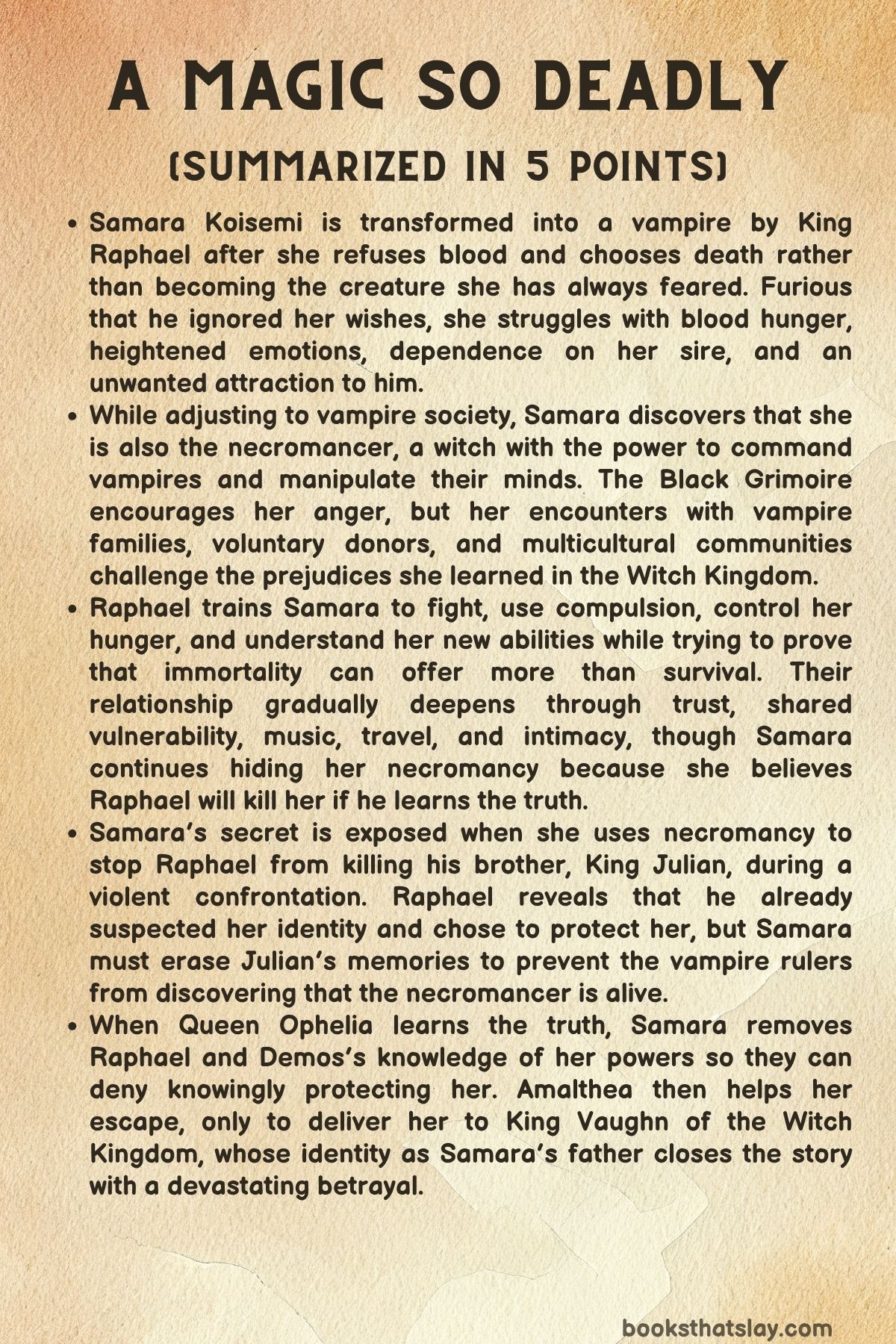
Summary
Samara Koisemi begins her new existence imprisoned in a copper-barred cell while an incomplete vampire transformation slowly kills her. Raphael was poisoned while turning her and has remained unconscious for nearly a month, leaving Samara trapped between humanity and immortality as she refuses every offering of blood.
She would rather die than become one of the creatures she has feared since childhood. Her mother was executed through the use of a deliberately starved vampire, and Samara has always understood vampirism through that memory of hunger, brutality, and helplessness.
Amalthea, Samara’s closest friend and an oracle, tries to persuade her to feed. Samara refuses even when Amalthea offers her own blood because she fears losing control and killing her, yet the intensity of her thirst forces her to recognize that the starving vampire who killed her mother was also a victim whose reason had been destroyed.
Raphael finally awakens and reaches Samara when she is close to true death. Ignoring her demand to be allowed to die, he offers his own blood, commands her to drink, and completes her transformation.
The feeding restores Samara’s strength and sharpens every sense, but the relief turns to horror when Raphael calls her a vampire. She attacks him in fury, accusing him of taking away her right to choose death, while Raphael accepts her blows and admits that he does not regret saving her.
Samara must now live with the restrictions of a fledgling. She cannot tolerate sunlight, cannot deliberately lie, needs blood regularly, and is bound to Raphael so strongly that moving too far from him causes unbearable pain.
Ordinary donor blood tastes rancid to her, while Raphael’s blood is irresistible. He explains that vampirism has not created her attraction to him but has removed the emotional barriers she previously used to suppress loneliness, desire, anger, and her need for affection.
Her political position is equally unstable. Demos, Raphael’s commander and oldest companion, remembers Samara’s participation in the plot to poison Raphael and considers her a continuing threat, while Raphael publicly declares that she remains under his protection.
Unable to lie, Samara explains how Titus, the Witch King’s spymaster, manipulated her after her arrival in Damerel. He encouraged her distrust of the donor system, arranged attacks, murdered a donor in a manner resembling her mother’s execution, and convinced her that poisoning Raphael was the only way to force change.
Samara eventually refused to complete Titus’s plan, but the damage was already done. She and Raphael are forced to acknowledge their mutual betrayals: she conspired against him, while he transformed her against her stated wishes.
As Samara adjusts to her new body, she secretly retrieves the Black Grimoire. The book identifies her as the necromancer, a witch blessed by the death goddess Anagenni with authority over blood, bone, souls, spirits, and the undead.
The grimoire burns Samara because she is now a vampire, yet it also awakens powerful anger within her. She begins believing that her necromancy could correct the imbalance between witches and vampires, though she does not yet recognize how strongly the emotions stored within the book are influencing her judgment.
Raphael begins training Samara to fight with her enhanced speed and strength. His lessons expose her pride and uncontrolled anger, but they also teach her to analyze opponents, conceal intentions, and accept that rejecting her vampire nature will not make it disappear.
Samara asks Amalthea to introduce her to ordinary vampire society. At a private club, she finds vampires gambling, laughing, flirting, raising families, and behaving with a warmth that conflicts with everything she was taught.
Raphael later shows her a district where vampire families have adopted void children abandoned by witches who considered them shameful or useless. These discoveries do not excuse his decision to turn her, but they force Samara to confront the cruelty of the Witch Kingdom and the limits of her inherited beliefs.
Samara finally tells Amalthea that she is the necromancer. Amalthea promises to help and theorizes that the Black Grimoire contains the hatred and desperation of earlier witches, meaning Samara’s violent impulses may not represent her true desires.
At the ball celebrating her transformation, Samara tries to establish herself as an independent political figure. However, her worsening thirst, emotional dependence on Raphael, and inability to remain far from him reveal how incomplete that independence remains.
Amalthea secretly leaves Damerel after receiving visions of countless decomposing bodies spread across the continent. Believing the future is connected to Samara’s emergence, she travels north to search for an object associated with a previous necromancer.
Meanwhile, Samara finally chooses to feed directly from Raphael again. The experience is controlled rather than desperate, and their attraction becomes openly physical, although her resentment over the transformation continues to complicate every moment of trust.
Raphael receives an invitation from Julian, ruler of the Southern Vampire Kingdom, and takes Samara to Limanos. During the journey, he teaches her to ride, protects her while she sleeps, and treats her need for care as something that does not diminish her strength.
In Limanos, Samara discovers a multicultural city where vampires, witches, fae, shape-changers, and humans interact through diplomacy, commerce, art, and entertainment. The world proves far larger and more cooperative than the isolated Witch Kingdom led her to believe.
Raphael proposes a bargain: for two weeks, Samara must live honestly as a vampire by drinking the blood she truly wants, practicing compulsion, and exploring her abilities. In return, he will help her end the fledgling bond.
Her lessons in thralling disturb her because they reveal how easily a vampire can enter and alter another person’s mind. Even when a human actress named Flo agrees to participate, Samara objects when Raphael removes the woman’s memories without obtaining separate consent.
At diplomatic gatherings, Samara meets witches and other supernatural figures who already work beyond the Witch King’s restrictions. She begins imagining that her necromancy could create equality and political safeguards rather than becoming an instrument of revenge.
Raphael also introduces her to music, arranges flute lessons with a musician named Ansel, and gives her opportunities to experience pleasure unrelated to survival. These acts make immortality appear less like a sentence and more like a life containing learning, travel, creativity, and companionship.
The peace is disrupted when Sir Ferro, a witch metallurgist secretly connected to the Witch Kingdom, isolates and captures Samara. He restrains her with cursed copper and demands the location of the Black Grimoire.
Samara escapes by using Ferro’s own enchanted tools against him. During the struggle, she drains and kills him, leaving her terrified that taking a life came too naturally and proves she has become a monster.
Raphael refuses to offer false reassurance. He tells her that Ferro intended to kill her, that she stopped when the threat ended, and that her grief separates survival from cruelty.
Wanting to reclaim ownership of her changed body, Samara receives a tattoo representing survival. She also burns a written declaration that she is a powerless void and replaces it with the truth that she is a vampire, a witch, and a survivor.
Her relationship with Raphael deepens beside the ocean, where he teaches her to swim and gives her the freedom to express desire without shame. Samara willingly feeds from him and accepts that she wants Raphael himself rather than merely the blood or security he provides.
Raphael eventually reveals that only Samara can end the fledgling bond. Her body has restricted her movements because she repeatedly refused to meet its basic needs, and the bond will disappear once she trusts herself to feed, defend herself, use compulsion, and awaken when necessary.
Samara feels manipulated because Raphael designed their bargain to lead her through those steps. Although she now wants a future with him, she still plans to leave because she believes he will kill her when he discovers she is the necromancer.
At the final masquerade, King Julian deliberately provokes Raphael by dancing closely with Samara and questioning their relationship. Raphael attacks his fellow king with such fury that Samara fears he will cause a political catastrophe.
When Raphael ignores her pleas to stop, Samara instinctively uses her necromancy. Her command freezes him instantly, revealing that she possesses absolute authority over vampires.
Samara flees, convinced that Raphael will execute her. He follows and reveals that he had already recognized signs of her power but chose to protect her while waiting for her to trust him.
Their confrontation releases months of resentment and fear. Raphael insists that knowing she is the necromancer has not changed his feelings, while Samara finally accepts that his loyalty to her may exceed his loyalty to vampire tradition.
Julian soon discovers the truth as well. It is also revealed that he and Raphael are brothers whose resemblance, rivalry, and damaged affection have shaped their political relationship.
To prevent Julian from exposing her, Samara deliberately enters his mind and removes his memories of her identity, the fight, and the evidence he uncovered. She is disturbed by how easily she can rewrite a king’s thoughts, but the altered memories allow the group to maintain a temporary peace.
In the north, Amalthea’s search ends in failure when Queen Ophelia captures and compels her. Ophelia demands to know whether Raphael killed the necromancer, and Amalthea’s inability to safely lie confirms that Samara remains alive.
Amalthea escapes and returns with news that the vampire monarchs may arrive at any moment. To protect Raphael and Demos from execution for knowingly harboring the necromancer, she proposes that Samara erase all knowledge of her identity from their minds.
Demos agrees first. Samara then faces Raphael, who accepts the loss of his memories because it may save her life and tells her that he loves Samara Koisemi, a truth he believes will remain even after everything else is taken.
Samara removes Raphael’s knowledge of her necromancy and commands him not to search for her until Amalthea sends word. She then escapes with Amalthea using a transport card taken from Sir Ferro.
The card carries them to a polished copper throne, where Amalthea kneels before King Vaughn the Storm-blooded. Samara realizes that her trusted friend has delivered her directly to the ruler of the Witch Kingdom.
King Vaughn praises Amalthea’s loyalty and looks upon Samara with contempt. Samara raises her eyes to the man who has hunted the necromancer and addresses him by the final truth concealed throughout the story: he is her father.
Characters
Samara Koisemi
At the center of A Magic So Deadly, Samara is shaped by conflicts that refuse to fit into simple moral categories. She is simultaneously a vampire and the necromancer, the daughter of the Witch King and the fledgling of a vampire king, a survivor desperate for independence and a young woman who has never been allowed to experience genuine safety.
Her hatred of vampires begins in childhood after her mother is killed by a starved vampire used as an execution tool. That experience teaches Samara to associate vampirism with uncontrolled appetite, political terror, and the destruction of innocent lives.
Becoming a vampire forces her to experience hunger from the other side. She learns that starvation can erase reason, that some vampires form loving families, and that many donors participate for complicated personal reasons rather than through simple coercion.
Samara’s greatest struggle concerns control over her own body and future. Raphael saves her by violating her wish to die, while the fledgling bond, blood hunger, political expectations, and necromancer inheritance repeatedly threaten to define her without her consent.
Her growth does not require her to excuse these violations. Instead, she learns to distinguish accepting her present body from approving of how it was created, allowing her to feed, train, love, and seek pleasure without surrendering the right to remain angry.
Her necromancy introduces a second danger: the temptation to answer domination with domination. The Black Grimoire encourages rage and absolute solutions, but Samara gradually develops a more thoughtful vision based on safeguards, representation, consent, and equality.
She is intelligent, suspicious, emotionally intense, and capable of severe mistakes. Her decision to alter Julian, Demos, and Raphael’s memories shows that survival can push her toward the very violations she condemns, leaving her moral development unfinished and deeply complicated.
Raphael
Within A Magic So Deadly, Raphael represents both the security Samara has always wanted and the authority she has every reason to distrust. He is a powerful vampire king capable of great patience, tenderness, calculation, possessiveness, and violence.
His decision to transform Samara defines their relationship. Raphael understands that he denied her the dignity of choosing death, yet he cannot regret saving her because allowing her to disappear was emotionally impossible for him.
Raphael does not treat his wrongdoing as a misunderstanding that Samara should quickly forgive. He accepts her anger, expects reconciliation to take years, and repeatedly attempts to give her practical independence through combat training, political education, and exposure to the larger world.
At the same time, his methods remain manipulative. He conceals the true nature of the fledgling bond, constructs bargains designed to guide Samara toward the choices he prefers, and sometimes assumes that protection gives him the right to decide what information she receives.
His care becomes most convincing when he restrains himself. He guards Samara without forcing himself into her bed, allows her to endure the tattoo she has chosen, does not exploit her vulnerability while she feeds, and accepts the possibility that she may leave after gaining freedom.
Raphael’s devotion is inseparable from danger. His attack on Julian shows that love can strip away his political judgment, while his willingness to become monstrous toward Samara’s enemies reveals how easily protection can become destructive retaliation.
His decision to accept the erasure of his memories demonstrates the depth of his love. He gives up knowledge, control, and the ability to pursue Samara because her survival matters more to him than possessing either her presence or her secret.
Amalthea
Amalthea is Samara’s closest friend, an oracle of the goddess Eka, and one of the most consequential figures in the story. She offers affection, magical knowledge, political insight, and emotional support when Samara feels isolated from both witches and vampires.
Her loyalty initially appears unquestionable. She offers Samara her own blood, accepts the revelation of her necromancy, researches safer ways to understand the power, and risks entering Queen Ophelia’s kingdom while concealing information that could lead to execution.
Amalthea’s prophetic visions place her under extreme pressure. She repeatedly sees a continent filled with corpses and cannot determine whether Samara will cause the catastrophe, prevent it, or be blamed for events created by others.
Her methods become increasingly secretive as the danger grows. She leaves without a proper farewell, hides the full purpose of her journey from Demos and Samara, and decides that controlling information is necessary for everyone’s safety.
The final revelation transforms the meaning of her choices. By delivering Samara to King Vaughn and receiving his praise for her loyalty, Amalthea appears to have served the Witch King while presenting herself as Samara’s ally.
Her betrayal may still contain motives not yet revealed, especially because her visions showed catastrophic death and because she deliberately withheld the escape destination. Nevertheless, the conclusion establishes that Samara’s deepest friendship has been shaped by secrecy, divided loyalty, and calculated deception.
Iademos “Demos”
Demos is Raphael’s commander, oldest companion, and one of the most disciplined vampires in the novel. His primary loyalty is to Raphael, and almost every judgment he makes about Samara is influenced by the fact that she helped poison his king.
His suspicion is not irrational. Samara concealed dangerous alliances, attempted political violence, and continues hiding information, so Demos views her requests for privacy and independence as possible opportunities for betrayal.
However, his protective instincts often become controlling. He speaks for Samara, restricts her movements, rejects strangers on her behalf, and assumes that loyalty to Raphael gives him authority over her choices.
Demos is also capable of compromise and emotional complexity. He escorts Samara to the library, helps her after Ferro’s attack, and gradually begins rebuilding the friendship that might have existed before Titus’s scheme.
His relationship with Amalthea reveals a softer side beneath his severity. Their arguments contain affection, fear, and mutual frustration, with Demos repeatedly attempting to protect her while Amalthea resists being treated as incapable.
By agreeing to have his memories altered, Demos places Raphael’s survival and the kingdom’s security above his distrust of Samara. The decision shows that duty, rather than personal comfort, remains the central force governing his life.
King Julian
Julian is the ruler of the Southern Vampire Kingdom and Raphael’s estranged brother. He uses flirtation, humor, political questions, and deliberate provocation to gather information while concealing how carefully he observes everyone around him.
His resemblance to Raphael emphasizes their shared origin, but their personalities differ in important ways. Julian appears more theatrical and impulsively provocative, while Raphael is usually more restrained and strategic.
Julian’s interest in Samara is partly political. He recognizes that Raphael’s attachment to a newly turned fledgling is unusual and tests whether she represents a weakness, secret alliance, or threat to vampire society.
His provocation at the masquerade nearly produces disaster. By approaching Samara in a deliberately intimate manner, he triggers Raphael’s violent jealousy and creates the circumstances in which Samara’s necromancy is exposed.
Once Julian understands what she is, he responds according to vampire tradition and believes she represents a threat that should be eliminated. His reaction reveals how deeply the historical conflict between vampires and necromancers has shaped the rulers’ understanding of duty.
The midnight dinner after his memories are altered presents him more sympathetically. Beneath the rivalry and hostility is a lonely brother who still wants Raphael’s attention and remains connected to him through shared habits, stories, and affection neither ruler openly acknowledges.
King Vaughn the Storm-Blooded
King Vaughn rules the Witch Kingdom and is revealed in the final scene to be Samara’s father. Throughout the story, his influence is felt through isolationist policies, persecution, political secrecy, and agents operating beyond his borders.
He has built a society that encourages witches to fear vampires while ignoring or concealing the Witch Kingdom’s own cruelties. Void children are abandoned, oracles are threatened, and unsanctioned cooperation with other species is treated as disloyalty.
Vaughn’s connection to Titus and Sir Ferro suggests that he relies on spies, manipulation, enchanted restraints, and indirect violence. His agents seek the Black Grimoire and appear willing to capture or kill Samara to recover it.
The revelation of his fatherhood changes the political conflict into a personal one. Samara is not merely a witch who escaped his kingdom but a daughter whose identity, abilities, and upbringing may have been shaped by decisions he made long before the story began.
His contempt at the conclusion suggests that family ties will not automatically inspire mercy. Instead, Vaughn appears prepared to judge Samara as a failed subject, dangerous magical asset, or enemy despite their blood relationship.
Titus
Titus is the Witch King’s spymaster and the principal architect of Samara’s betrayal of Raphael. He identifies her fear, anger, grief, and political dissatisfaction, then manipulates each emotion until she believes cooperation with him is an act of resistance.
He does not merely present arguments. Titus arranges violence, encourages investigations, influences servants, and murders a donor in a way that deliberately resembles the execution of Samara’s mother.
By recreating her trauma, he prevents her from evaluating events calmly. His strategy depends on making every vampire practice appear connected to the worst moment of her childhood.
Titus represents political manipulation at its most personal. He understands that controlling a person’s interpretation of events can be more effective than controlling the events themselves.
Although he dies before much of the action begins, his influence remains active. Information he transmitted may have directed Ferro, alerted King Vaughn to the grimoire, and contributed to the continent-wide crisis surrounding the necromancer.
Queen Ophelia
Queen Ophelia rules the Northern Vampire Kingdom from the isolated city of Ioni. She is controlled, observant, politically experienced, and immediately suspicious of unusual activity surrounding Raphael and his newly turned fledgling.
Unlike Julian, Ophelia does not rely heavily on humor or theatrical provocation. She watches Amalthea, restricts her access, uses members of her court to control her movements, and waits until she possesses enough information to ask the question that matters.
Her compulsion of Amalthea demonstrates the authority of an ancient vampire ruler. By demanding a direct yes-or-no answer about the necromancer’s survival, she strips away most opportunities for evasive phrasing.
Ophelia views the necromancer through the traditional fear shared by vampire monarchs. From her perspective, Raphael’s decision to protect and immortalize such a witch is not merely personal disobedience but a betrayal of their kind and history.
Her actions force the final crisis even though she never directly confronts Samara. Once she learns enough to alert the other rulers, secrecy collapses and Samara must sacrifice Raphael and Demos’s memories to keep them alive.
Quinn
Quinn is Queen Ophelia’s consort and an important extension of her authority. His calm behavior makes his capture of Amalthea more unsettling because he never needs to display obvious aggression.
When Amalthea attempts to redirect him through charm and flirtation, Quinn makes it clear that he understands her tactics. He escorts her away from the route she intended to search and delivers her to Ophelia without allowing an opportunity for escape.
Quinn’s role demonstrates how effectively the northern court controls visitors. He appears courteous, yet every movement serves the queen’s surveillance and security.
Dyna
Dyna accompanies Amalthea during the journey north as a protector and chaperone. She does not possess Amalthea’s complete knowledge, but her loyalty and practical presence allow the oracle to travel through dangerous territory.
Her constant proximity also limits Amalthea’s ability to investigate secretly. Because Dyna watches her movements and may report irregular activity, Amalthea must maintain both a diplomatic performance and a hidden search.
Dyna represents loyal service complicated by incomplete information. She protects Amalthea without realizing that the mission could expose Samara, Raphael, and the entire kingdom to execution.
Sir Ferro
Sir Ferro initially appears to be a successful witch metallurgist whose international work proves that cooperation between witches and vampires already exists. His knowledge and independence make him seem like evidence that the Witch King’s restrictions can be quietly resisted.
The private meeting with Samara exposes him as an agent connected to the Witch Kingdom. He uses enchanted cards, illusions, cursed copper, and magical barriers to isolate and restrain her.
Ferro’s attack is carefully planned, but he underestimates Samara’s intelligence and survival instincts. She turns one of his tools against him, escapes the restraints, and kills him while defending herself.
His death becomes a major turning point because it confirms that the Black Grimoire is being actively hunted. It also forces Samara to confront the psychological consequences of taking a life with her new vampire abilities.
Pythia
Pythia is an oracle Samara encounters in the Limanos library. Her prophetic style differs from Amalthea’s, but her warning closely matches Amalthea’s visions of widespread death.
After touching Samara, Pythia predicts that she may be hanged and that millions of dead people will be laid at her feet. The wording remains uncertain because it does not reveal whether Samara will cause the deaths, fail to prevent them, or simply receive the blame.
Pythia expands the story’s conflict from a private struggle into a continental threat. Her prophecy confirms that Samara’s choices will affect far more than her relationship with Raphael or the balance between two kingdoms.
Lady Kayara
Lady Kayara is a northern noblewoman whom Amalthea entertains as part of her diplomatic cover. Her appetite for stories, amusement, outings, and long social evenings gives Amalthea access to court while also consuming the time needed for her investigation.
Kayara appears socially engaged rather than overtly threatening. However, her place near Queen Ophelia means that every interaction carries the possibility of observation or accidental exposure.
Through Kayara, Amalthea learns how courtly entertainment can function as both opportunity and confinement. Social access does not equal freedom when every conversation occurs within a ruler’s sphere of influence.
Aella
Aella is a diplomat who helps Samara understand the political meaning of Raphael’s behavior. She explains that being sired by a monarch and publicly included in diplomatic affairs communicates status far beyond ordinary responsibility for a fledgling.
Her observations force Samara to recognize that other courts already interpret her bond with Raphael as serious and politically significant. This makes Samara’s planned departure more dangerous because her choices could be read as statements about alliances, loyalty, and conflict.
Aella also provides hints about King Vaughn’s activities. Although she appears only briefly, she helps connect Samara’s personal fears to the broader political attention gathering around her.
Lady Jaen
Lady Jaen is one of the influential figures Samara meets in Limanos. Her presence contributes to Samara’s introduction to a society where supernatural beings interact through diplomacy, trade, art, and shared institutions.
She helps Samara move beyond the limited worldview created by isolation in the Witch Kingdom. Through figures such as Jaen, Samara begins seeing political relationships as complex networks rather than permanent divisions between enemies.
Ansel
Ansel is the flutist whose performance captures Samara’s attention. Raphael later arranges for him to provide private lessons, giving Samara an opportunity to pursue something that offers no immediate advantage in survival or politics.
His role is important because music becomes evidence that Samara can build a life based on curiosity and pleasure. Learning the flute allows her to imagine immortality as time for growth rather than an endless continuation of fear.
Flo
Flo is a human actress who agrees to participate in Samara’s first practical lesson in vampire compulsion. Her involvement allows Samara to practice under controlled conditions, but the experience exposes serious questions about the boundaries of consent.
Raphael removes Flo’s memories after the lesson, arguing that secrecy is part of the arrangement. Samara objects because agreeing to be compelled does not necessarily mean agreeing to have personal memories rewritten.
Flo therefore becomes an example of how a seemingly consensual agreement can contain unequal power. Her experience influences Samara’s later concern about how necromancy and thralling should be ethically limited.
Talo
Talo is a donor whom Samara interviews at a blood den. His answers show that donors may seek payment, protection, pleasure, refuge, or eventual transformation rather than entering every arrangement through force.
He helps Samara recognize that the donor system cannot be judged through a single explanation. Exploitation remains possible, but individual participants possess different motives and degrees of agency.
Talo also gives Samara a safer opportunity to practice compulsion. Through him, she learns that a command can affect one part of a person’s behavior without entirely erasing personality, emotion, or independent thought.
Larissa
Larissa is a Nightsworn guard who teaches Samara how to care for her horse. A casual touch causes Samara to experience a violent burst of rage that leads her to injure Larissa’s wrist.
Larissa responds with restraint and attributes the incident to fledgling instability. Her forgiveness prevents the situation from escalating, while Samara’s reaction provides further evidence that the Black Grimoire’s emotions continue influencing her even when the book is far away.
Josephine
Josephine is a seamstress who previously suffered because of court politics. When Samara encounters her while preparing for the transformation ball, she makes certain that Josephine is safe and offers her more secure work at the castle.
The interaction gives Samara one of her first opportunities to use her new status constructively. Rather than treating political influence only as a threat, she discovers that authority can also protect vulnerable people.
Gaston
Gaston receives Raphael’s party when they arrive at the Southern Vampire King’s palace. He performs a practical court function by arranging their rooms and integrating the visitors into Julian’s household.
His arrangements require Samara and Raphael to share a chamber because of the fledgling bond. This forced proximity creates several important moments in which Raphael must decide whether to exploit closeness or respect Samara’s fear and boundaries.
Samara’s Mother
Samara’s mother shapes the story despite appearing mainly through memory. She raised Samara under strict expectations and taught her that emotional expression, unusual attachments, and visible grief were forms of weakness.
Her execution by a starved vampire becomes the foundation of Samara’s hatred. However, Samara’s later understanding of blood hunger forces her to separate the creature that killed her mother from the ruler who deliberately created the conditions for the execution.
Her treatment of Samara’s childhood grief also reveals a lack of emotional safety within their relationship. When Samara mourned a kitten and kept its bones, her mother dismissed the attachment and removed them, reinforcing the belief that love and loss should remain hidden.
Eka
Eka is the goddess associated with Amalthea’s prophetic abilities. She sends visions of decomposing bodies and continent-wide death, warning that the future is moving toward catastrophe.
Her guidance is powerful but incomplete. Amalthea sees what may happen without receiving clear instructions about which choices will prevent it, leaving her to interpret the visions through fear, loyalty, and political calculation.
Eka’s silence regarding the solution contributes to Amalthea’s secrecy. The oracle must decide whether protecting Samara, finding the relic, or delivering her to Vaughn offers the best chance of preventing mass death.
Anagenni
Anagenni is the death goddess who granted the necromancer dominion over blood, bone, souls, spirits, and the undead. Her blessing is the source of the magical power that makes Samara both valuable to witches and terrifying to vampire rulers.
The surviving objects connected to earlier necromancers suggest that Anagenni’s power can remain embedded in books and relics. This enduring influence allows past conflicts, emotions, and intentions to shape the choices of later generations.
Anagenni’s legacy carries no simple moral alignment. Her magic can restrain violent vampires, defend witches, erase memories, or establish total control, making its ethical meaning dependent on the person who uses it.
Themes
Bodily Autonomy and the Meaning of Consent
Samara’s transformation begins with a violation that cannot be erased by Raphael’s love or good intentions. He saves her from death, but he does so after she has clearly refused immortality, forcing her to inhabit a body with needs, restrictions, and desires she did not choose.
A Magic So Deadly repeatedly asks whether a beneficial outcome can justify removing another person’s control. Raphael believes life was worth preserving at any cost, while Samara insists that survival imposed without consent can still be a profound injury.
The same question appears in blood feeding, thralling, memory alteration, political protection, and the fledgling bond. Flo agrees to participate in a compulsion exercise, yet Samara recognizes that this permission may not include the removal of her memories.
Samara later violates Julian, Demos, and Raphael’s minds because the alternative may be imprisonment or death. Her actions demonstrate that understanding the importance of consent does not guarantee that a person can preserve it under extreme pressure.
The novel distinguishes between accepting a changed reality and approving of the act that created it. Samara gradually embraces blood, strength, desire, and immortality without surrendering her right to condemn Raphael’s original choice.
Her tattoo becomes an act of reclamation because the pain is selected rather than imposed. By choosing what happens to her body, Samara begins defining herself through agency rather than through the decisions made by kings, parents, spies, gods, or magical bonds.
Prejudice, Inherited Hatred, and Moral Complexity
Samara enters vampire society carrying beliefs formed through trauma, isolation, and deliberate political teaching. Because a vampire killed her mother, she interprets all vampire hunger as cruelty and every donor arrangement as exploitation.
Her transformation gives her direct knowledge of bloodlust. She understands that a starving vampire can lose reason and that the creature used in her mother’s execution was tortured into becoming an instrument of someone else’s violence.
Damerel and Limanos expose her to families, children, voluntary donors, artists, guards, merchants, and diplomats. These experiences do not prove that vampires are harmless, but they show that an entire species cannot be judged through its worst rulers and practices.
The Witch Kingdom’s treatment of void children and oracles reveals that the society Samara considered morally superior is also capable of abandonment, persecution, secrecy, and abuse. Fear of vampires has allowed witches to overlook the violence committed within their own borders.
The Black Grimoire attempts to preserve older hatred by magnifying anger and encouraging absolute conclusions. Samara’s challenge is to learn from historical injustice without allowing inherited rage to dictate new forms of oppression.
Her changing perspective does not end in passive tolerance. She continues criticizing memory alteration, donor exploitation, forced transformation, and supernatural control, but she evaluates actions individually rather than assuming moral goodness or evil from species alone.
Power, Control, and Political Responsibility
Almost every major relationship in the story contains an imbalance of power. Raphael is Samara’s sire and king, Vaughn is her father and ruler, Amalthea possesses knowledge of possible futures, and Samara can command the minds of vampires.
Power often presents itself as protection. Raphael restricts information because he believes Samara will make safer choices under his guidance, Demos controls her movements to protect the king, and Amalthea conceals her mission because she believes secrecy may prevent catastrophe.
The intentions behind these actions do not remove their consequences. Protection becomes dangerous when powerful figures assume that their judgment automatically outweighs another person’s right to decide.
Samara initially imagines necromancy as a tool that will force vampires into obedience and correct an unequal world. Exposure to vampire society makes her realize that replacing one dominant group with another would continue the same pattern of fear and control.
She gradually develops a political purpose based on negotiation, safeguards, and representation. Her power could allow witches to approach vampire rulers as equals, but only if she refuses the temptation to make obedience the foundation of peace.
The altered memories of Julian, Demos, and Raphael reveal how difficult ethical restraint becomes during a crisis. Samara uses her abilities to preserve lives, yet the ease with which she enters their minds shows that even defensive power requires limits, accountability, and constant self-examination.
Identity, Survival, and the Possibility of Choice
Samara has spent most of her life accepting identities imposed by others. She has been called a powerless void, a political tool, Raphael’s Chosen, a fledgling, a monster, the necromancer, and finally the daughter of King Vaughn.
Her first response is to reject every identity associated with vampirism. She drinks blood that disgusts her, denies her attraction to Raphael, hides beneath furniture, and treats every bodily need as evidence that she is becoming something evil.
Survival eventually requires a more flexible understanding of self. Feeding does not erase her values, enjoying strength does not excuse her transformation, and loving Raphael does not require forgetting the harm he caused.
Music, travel, friendship, intimacy, and political purpose give immortality meaning beyond continued existence. For someone whose life has always focused on escaping the next danger, the ability to want something becomes a radical form of freedom.
The survivor tattoo marks her decision to define herself through endurance without reducing herself to suffering. She acknowledges that she is a vampire and witch while refusing to let either identity determine every moral choice.
The final encounter with Vaughn threatens this developing self-definition. By addressing him as her father, Samara confronts an identity hidden from her, but the future will depend on whether she accepts his version of who she is or continues creating a life based on her own choices.