Beach Thriller by Jamie Day Summary, Characters and Themes
Beach Thriller by Jamie Day is a mystery novel about buried crimes, fractured families, and the dangerous consequences of returning to a place determined to protect its secrets. Novelist Holly Sinclair comes back to the seaside town of Beauport eighteen years after the fire that supposedly killed her sister, Anna.
Holly’s search for answers becomes connected to Jade Jensen, a runaway teenager whose unexplained ties to Beauport lead both women toward the powerful Carmichael family. Combining family drama, psychological suspense, corporate corruption, and an investigation into a suspicious death, the story examines how lies created for survival can continue harming people long after the original danger has passed.
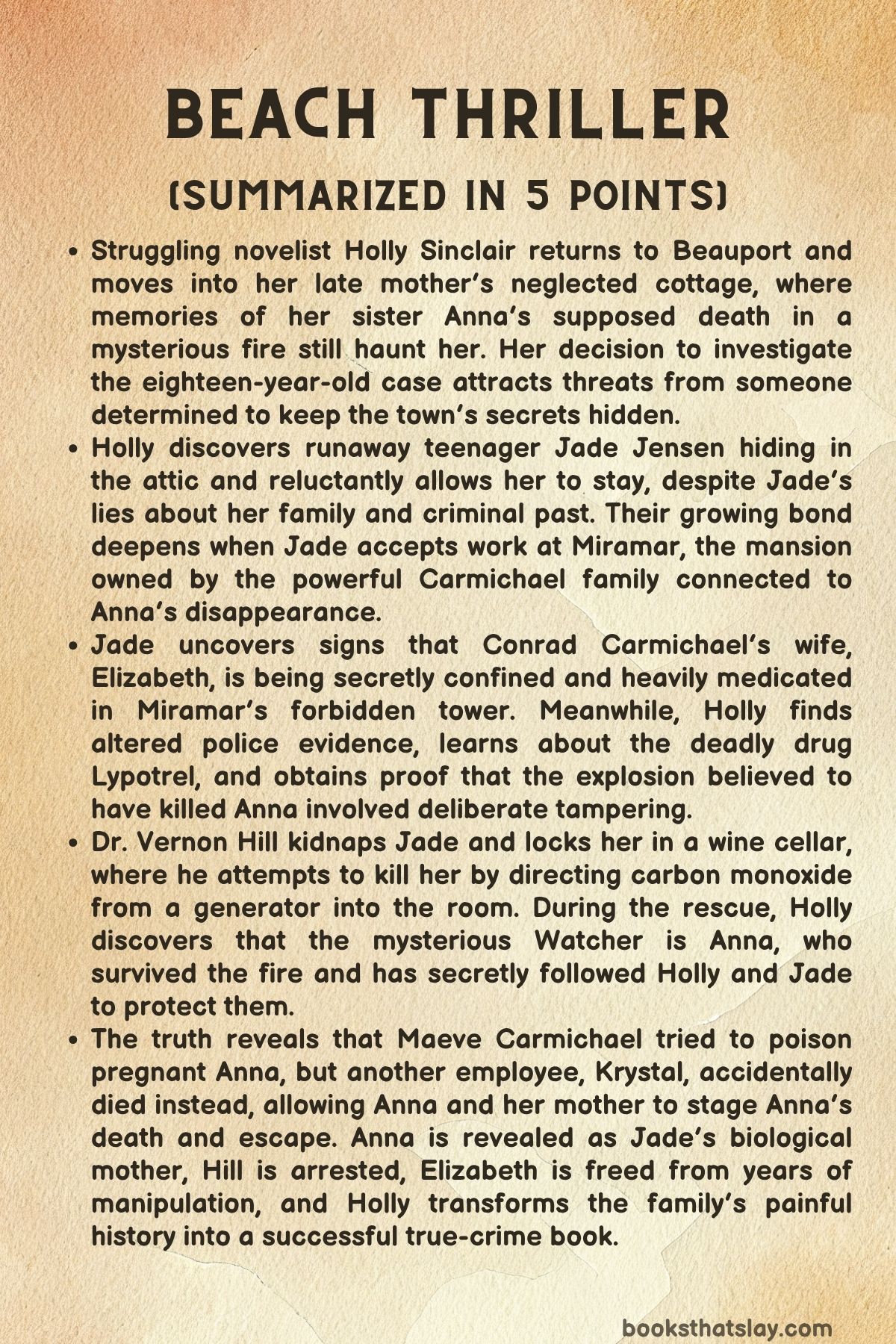
Summary
Forty-year-old novelist Holly Sinclair returns to Beauport, Massachusetts, after losing her Brooklyn apartment and watching her writing career decline. The oceanfront cottage where she spent her childhood summers is now neglected, but it is the only home she can afford following the death of her mother, Carol.
The cottage carries painful memories of Holly’s older sister, Anna, who was believed to have died eighteen years earlier in an explosion at a guesthouse belonging to the wealthy Carmichael family. Although investigators never determined whether the fire was accidental or deliberate, Holly has always believed Anna was murdered.
Holly also carries personal guilt because she was supposed to accompany Anna to the Carmichael estate that night. She stayed behind after receiving a telephone call from her boyfriend, Max, and has spent years wondering whether her presence might have changed what happened.
Soon after arriving, Holly hears unexplained movements in the attic. Her mother once claimed that Anna’s spirit remained in the cottage, and Holly briefly fears that her own grief is producing the same hallucinations and confusion that troubled Carol during her final years.
Serena, a local psychic who was once close to Carol, conducts a séance in the cottage. Speaking in a voice that resembles Anna’s, she warns Holly that returning to Beauport has placed her in danger.
The attic noises are eventually revealed to have a human source. Holly discovers seventeen-year-old Jade Jensen hiding among the boxes and old furniture after secretly living in the empty cottage for nearly two weeks.
Jade claims that her parents were killed by a drunk driver and that she escaped from an abusive aunt. She admits to previous trouble with the law, including juvenile detention, but insists that she has come to Beauport because she wants to live near the ocean until she turns eighteen.
While hiding upstairs, Jade found Holly’s unfinished manuscript, Beach Thriller. The novel was written when Holly was twenty-two and presents fictionalized versions of Anna, Holly, Conrad Carmichael, Elizabeth Ward, Maeve Carmichael, and the events surrounding the summer before the fire.
The manuscript begins at the Carmichaels’ Barefoot Beach Ball, where Holly and Anna worked as caterers. Anna met Conrad Carmichael, the handsome son of the family, even though the party was being held to celebrate his engagement to Elizabeth Ward.
Anna was immediately attracted to Conrad, while Maeve treated her as insignificant household staff. Baxter Ward, Elizabeth’s powerful father, also behaved inappropriately toward Anna, revealing the exploitation and social inequality beneath the family’s elegant appearance.
Holly initially calls the police after finding Jade. Jade sees the approaching patrol car and escapes through a window, but Holly later finds her sheltering beneath the pier and promises not to involve the authorities again.
The officer who responds is Tom Walker, a policeman Holly remembers from her youth. Walker dismisses her suspicions concerning Anna’s death, insists the explosion was accidental, and advises Holly to sell the cottage and leave Beauport.
Holly allows Jade to remain in the cottage under certain conditions. Their relationship gradually becomes domestic and affectionate, although Jade continues stealing small items and concealing the real reason she came to town.
Jade’s parents are alive, and the necklace she wears is the true reason for her journey. The pendant contains a jade stone, bears the words “Beauport, MA,” and was found hidden among her parents’ belongings.
After Jade attempts to steal toiletries from a store, Conrad Carmichael intervenes, pays for the products, and offers her temporary employment at Miramar, his family’s Gothic seaside mansion. Holly is alarmed because Conrad was involved with Anna, but Jade accepts the position.
At Miramar, Jade meets the controlling Maeve, the quiet butler Sidney, the nervous housekeeper Rose, and Dr. Vernon Hill, the family physician. Conrad warns Jade that she must never enter the mansion’s tower or interfere in private family matters.
Jade soon notices that Rose secretly enters the tower and that the same piano music repeatedly comes from above. Conrad also follows a strict routine at sunrise and sunset, leaving Jade convinced that someone is being hidden there.
Meanwhile, Holly becomes attracted to Ethan Marsh, the handyman repairing her cottage. He is considerate and supportive, but his familiarity with the Carmichaels makes Holly uncertain whether she can fully trust him.
Holly also meets Allen Spellman, the lawyer responsible for her mother’s estate and the cottage trust. He claims that probate delays are preventing Holly from receiving the money and offers her a personal loan, which she accepts because she cannot pay for the repairs.
As Holly rereads her manuscript, she remembers how Anna and Conrad began a secret affair. Conrad complained that Maeve and the Ward family controlled his future, while Anna encouraged him to abandon wealth and choose an independent life.
The relationship became increasingly dangerous because Conrad was still committed to Elizabeth. Anna believed love would free him, but Conrad’s promises remained dependent on money, secrecy, and the approval of people he claimed to resent.
Jade becomes suspicious when she discovers an old photograph proving that Holly worked at the original Barefoot Beach Ball. Holly had minimized her direct connection to Miramar, just as Jade had lied about her parents.
Their mutual deceptions produce an argument, but both eventually tell part of the truth. Jade explains her father’s drinking, her mother’s failure to protect her, her criminal record, and her fear that honesty would cause Holly to reject her.
Holly admits that the unfinished novel is based on real events. She explains that Anna went to the Miramar guesthouse intending to end her affair with Conrad shortly before the building exploded.
Several people had possible motives. Elizabeth resented Anna, Maeve wanted to protect Conrad’s marriage, Baxter had harassed her, and Conrad risked losing his family’s wealth if the affair became public.
Holly begins receiving threats. Someone sends her a burned copy of one of her published novels with a warning ordering her to leave Beauport, and an unidentified observer known as the Watcher repeatedly follows her movements.
The Watcher enters the cottage and steals the only surviving paper copy of Holly’s unfinished manuscript. The theft proves that someone believes the story contains information capable of exposing the past.
Holly gains access to Anna’s old evidence file and discovers serious inconsistencies. The original gas-company report appears to have been replaced, Conrad’s statements contain contradictions, and a bottle of a medication called Lypotrel was supposedly recovered from the fire scene but is now missing.
Gail Provost, the real estate agent trying to sell Holly’s cottage, explains that Lypotrel was connected to a scandal involving Ward Pharmaceuticals. The drug caused deaths, and company research was manipulated to conceal its dangers.
Elizabeth Ward was publicly blamed for altering the studies. Holly begins to suspect that the pharmaceutical scandal, Anna’s death, and the Carmichaels’ protected status are connected.
Jade follows Conrad at sunset and sees him carry a weak, pale woman from the tower. She realizes the woman is Elizabeth, who has been kept isolated, heavily medicated, and unable to care for herself.
When Conrad is away, Jade uses stolen keys to enter the tower. Elizabeth appears confused and hopeless, surrounded by prescription bottles, photographs, and medication that keeps her dependent.
Jade photographs the evidence, but Conrad catches her hiding beneath Elizabeth’s bed. He angrily confronts her, although he insists he loves his wife and claims that Dr. Hill prescribed everything she takes.
Before Jade can contact Holly or the police, someone attacks her from behind. As she loses consciousness, she notices that the attacker is wearing a black-faced vintage watch with a gold mesh band, identical to one Conrad owns.
Jade awakens imprisoned in Miramar’s underground wine cellar. With no food, water, telephone, or clear route of escape, she assumes Conrad abducted her and begins preparing to defend herself.
At the same time, Holly discovers Allen Spellman dead in his office from an apparent self-inflicted gunshot wound. Police reveal that he had stolen money from his clients, meaning the cottage trust has been emptied.
Spellman’s death removes a possible source of information about Anna’s missing evidence. It also leaves Holly financially ruined and uncertain whether he was merely an embezzler or had helped suppress information about the fire.
Ethan obtains the original gas-company report, which states that markings around the guesthouse valve indicated possible tampering. The document provides the first strong evidence that the explosion was deliberately caused.
When Jade does not return, Holly reports her missing, but police assume she has run away again. Holly becomes convinced that she is being held at Miramar and plans to search the mansion during Maeve’s revived Barefoot Beach Ball.
Holly enters the party with Ethan, Gail, and Serena. While Gail and Serena distract Conrad, Holly and Ethan search the mansion, focusing on the tower and the private rooms connected to Elizabeth.
In the cellar, Jade’s situation becomes deadly when someone places a tube from a generator through the barred window. Carbon monoxide begins filling the enclosed room while the party’s music and machinery conceal her screams.
Jade uses her hoodie to block part of the tube, breaking her wrist during the effort. Weak from dehydration, a head injury, alcohol, and carbon-monoxide exposure, she arms herself with a broken wine bottle and waits for her attacker to return.
The Watcher secretly enters the tower and moves toward the cellar. When the door opens, Jade assumes the approaching woman intends to kill her and stabs her before losing consciousness.
Meanwhile, Ethan forces open the tower entrance, and Conrad attacks him. Their fight moves through the mansion and onto the beach, where the police arrest Conrad in front of the party guests.
A busker named Ned notices that the generator near the tower is not supplying electricity. He sees the exhaust tube running toward a basement window and warns Holly that it may be pumping poison underground.
Holly and Ethan race into the cellar and find Jade unconscious beside another wounded woman. As Holly carries the stranger into the fresh air, she recognizes the face of the sister she believed had been dead for eighteen years.
The woman is Anna. She is older and injured but unmistakably alive, proving that the body recovered from the guesthouse never belonged to her.
Jade regains consciousness outside and sees Dr. Hill wearing the same black-faced watch she noticed during her abduction. Baxter Ward owned duplicates of his favorite possessions, and both Conrad and Hill had acquired matching watches.
Jade publicly identifies Hill as her kidnapper. He attempts to escape, but Conrad trips him while still handcuffed, allowing Holly to tackle him into the fountain and stab him in the leg before the police arrest him.
Maeve disappears during the confusion. Sidney discovers an empty bottle of Lypotrel, a final letter, and a message stating that she has gone swimming, although her body is never recovered.
Maeve’s confession reveals that Anna became pregnant during her affair with Conrad. Fearing that the pregnancy would destroy Conrad’s marriage and the financial partnership protecting Miramar, Maeve prepared chocolates injected with Lypotrel and intended Anna to eat them.
Instead, Krystal, another young employee, secretly sheltered in the guesthouse and consumed the poisoned chocolates. Maeve believed Anna died in the later explosion and helped suppress the original report showing evidence of tampering.
The letter also reveals that Baxter Ward and Dr. Hill manipulated the Lypotrel research. When Elizabeth uncovered the truth, they convinced her that she had altered the studies and used medication to keep her confused enough to accept responsibility.
Maeve recognized Jade’s necklace and physical resemblance to Conrad. She realized that Jade was the child Anna secretly carried during their affair and apologized for the suffering caused by her obsession with money, status, and family reputation.
Anna explains that she survived the night of the fire because she found Krystal’s body inside the guesthouse. Carol believed the Carmichaels would murder Anna or frame her, so she exchanged Anna’s clothing with Krystal’s and deliberately set the fire to make the body impossible to identify.
Anna escaped Beauport with financial help from Carol. Her life later included addiction, homelessness, an overdose, recovery, and work as a nursing assistant at the memory-care facility where Carol spent her final years.
Without revealing herself to Holly, Anna cared for their mother. When Holly returned to Beauport, Anna followed her and became the Watcher, believing that secret observation was the only way to protect her.
Anna also recognized Jade as her daughter after seeing the necklace. Years earlier, she had secretly given birth in the cottage attic while Carol assisted her, after which Carol left the infant at a Safe Haven location with instructions that she be named Jade and receive Conrad’s necklace.
Anna and Holly forgive each other for the choices that separated them. Holly returns Anna’s claddagh ring and asks her to help finish the book that began before the fire.
Three months later, Holly presents Dan with a completed true-crime manuscript reconstructing the Beauport case. The book combines her old romantic story with the facts uncovered by Holly, Jade, Anna, Ethan, Gail, Serena, and Ned.
The following summer, Holly, Anna, Jade, and Chester live together in the restored cottage. Jade calls Anna “Mom,” studies for her GED, and hopes to become a writer, while Holly’s book receives a major publishing advance and attracts interest from filmmakers.
Elizabeth improves after being taken off Hill’s drugs, and Conrad plans to end their marriage fairly while rebuilding his relationships with Anna and Jade. Dr. Hill admits attempting to kill Jade, Walker faces accusations from multiple women, Miramar is sold, and Anna receives probation for concealing Krystal’s death.
Although Holly’s family has finally regained a measure of peace, Maeve’s missing body leaves uncertainty behind. Jade’s final sense that someone may still be watching suggests that Beauport has not surrendered every secret.
Characters
Holly Sinclair
Holly is the emotional and investigative center of Beach Thriller. At the beginning of the book, she is a struggling novelist whose financial problems, professional disappointment, grief, and guilt have left her without a clear sense of direction.
Her return to Beauport forces her to confront the night Anna disappeared and the belief that she failed her sister. Writing becomes both an investigative method and a form of emotional recovery because reconstructing Anna’s relationship with Conrad helps Holly identify details she overlooked as a younger woman.
Holly’s strongest quality is her refusal to abandon people. She searches for Jade after the teenager escapes, continues sheltering her after discovering her lies, and risks entering Miramar because she understands that Jade’s disappearance is not voluntary.
Her weaknesses include impulsiveness, mistrust, and a habit of imagining the worst about anyone connected to the Carmichaels. Nevertheless, these qualities arise from genuine danger rather than simple paranoia, and she gradually learns to balance suspicion with trust.
By the conclusion, Holly has transformed private pain into public truth. Recovering Anna, forming a family with Jade, accepting Ethan’s support, and completing her manuscript allow her to reclaim both her personal identity and her writing career.
Jade Jensen
Jade is one of the most resourceful and emotionally guarded figures in Beach Thriller. Her lies, thefts, criminal history, and instinctive distrust of authority initially make her appear unreliable, but they are survival mechanisms developed in an unstable and abusive home.
She invents the story about her parents’ deaths because she believes sympathy is safer than honesty. Her fear that Holly will reject the truth shows how little experience she has with adults who offer care without demanding manipulation or obedience.
Jade’s curiosity drives much of the investigation. She recognizes the connection between Holly’s manuscript and Miramar, studies Maeve’s reactions, enters the tower, photographs Elizabeth’s medication, and continues searching despite repeated warnings.
Her recklessness places her in severe danger, yet her physical and psychological endurance enables her to resist Hill’s murder attempt. Blocking the exhaust tube while injured demonstrates that her strongest instinct is no longer escape but survival for the sake of the relationships she has formed.
Discovering that Anna and Conrad are her biological parents gives Jade the history she came to Beauport seeking. More importantly, she learns that biology alone does not create belonging, since her deepest sense of family develops through Holly’s patience, protection, and willingness to forgive.
Anna Sinclair
Anna initially exists as a memory shaped by Holly’s grief, guilt, and unfinished manuscript. She is remembered as romantic, impulsive, ambitious, and eager to escape the limitations of her ordinary life through Conrad.
Her attraction to Conrad is sincere, but it also reflects her desire to cross the social boundary separating Miramar’s residents from its employees. She believes his dissatisfaction with wealth means he will choose her, underestimating how strongly he remains controlled by his family.
Anna’s pregnancy turns the affair from a private rebellion into a threat to the Carmichael-Ward alliance. Her disappearance after Krystal’s death is presented as an act of self-preservation, but it causes severe suffering for Holly and Carol.
Her later life reveals both decline and recovery. Addiction, homelessness, and an overdose show the psychological cost of living under a false identity, while her eventual sobriety and nursing work demonstrate resilience and a desire to repair some of the harm she caused.
As the Watcher, Anna behaves in morally complicated ways. She threatens Holly and steals the manuscript, yet she ultimately risks her life to save Jade, proving that fear has not destroyed her loyalty to her sister or daughter.
Conrad Carmichael
Conrad is presented through several competing versions of his identity. To young Anna, he is a romantic figure trapped by family expectations, while to Holly he is a possible murderer whose promises contributed to her sister’s death.
His love for Anna appears genuine, but sincerity does not excuse his deception. He allows her to believe they can build a life together while remaining financially and legally tied to Elizabeth.
Conrad’s treatment of Elizabeth is equally ambiguous. He cares for her gently and brings her outside to see the sunrise and sunset, yet he accepts Dr. Hill’s medical authority and keeps her isolated in the tower rather than seeking an independent evaluation.
His anger toward Jade after discovering her intrusion makes him appear capable of violence, which allows Hill to use him as a convenient suspect. However, Conrad did not abduct Jade, and his willingness to trip Hill during the escape contributes directly to the doctor’s capture.
The discovery that Jade is his daughter forces Conrad to confront the consequences of the affair he once treated as a private romance. His decision to support Elizabeth fairly and rebuild relationships with Anna and Jade suggests accountability, although it cannot erase the damage caused by years of secrecy.
Maeve Carmichael
Maeve is the principal architect of the tragedy surrounding both families. Her devotion to Miramar, wealth, social position, and the Carmichael name is so extreme that she treats other people’s lives as acceptable sacrifices.
She sees Anna not as a young woman carrying her grandchild but as a threat to Conrad’s marriage and the financial agreement with the Wards. Her decision to poison Anna with Lypotrel reveals calculated cruelty, even though Krystal becomes the unintended victim.
Maeve’s personality is controlling, proud, theatrical, and often verbally abusive. She measures people by usefulness and status, but her treatment of Jade occasionally reveals a buried capacity for affection, especially after she suspects the girl is her granddaughter.
Her confession is not a complete act of redemption because it arrives only when illness and exposure make continued concealment impossible. Even so, she finally accepts responsibility for suppressing evidence, protecting Hill, enabling Elizabeth’s abuse, and placing wealth above human life.
Her disappearance into the ocean preserves the control she values throughout the story. By choosing her own ending and leaving no body, Maeve avoids facing public judgment while creating one final uncertainty for everyone she harmed.
Dr. Vernon Hill
Dr. Hill hides predatory behavior beneath eccentric clothing, professional authority, and a reassuring manner. His position gives him access to medication, vulnerable patients, confidential information, and a community inclined to trust him.
He helps Baxter manipulate the Lypotrel research and later assists in making Elizabeth believe she caused the scandal. By controlling her prescriptions, he keeps her confused, dependent, and unable to challenge the people responsible.
Hill also informs Maeve of Anna’s pregnancy, making him directly involved in the chain of events leading to the poisoning plan. His medical knowledge repeatedly becomes a weapon rather than a means of care.
His attempt to murder Jade with carbon monoxide shows that he remains willing to kill to protect himself. He carefully constructs the scene so her death could be dismissed as the result of theft, alcohol, or accidental confinement.
The matching watch provides an effective symbol of misdirection. Hill benefits from Conrad’s suspicious conduct and allows Jade to blame the wrong man until she recognizes the object on his wrist and publicly identifies him.
Elizabeth Ward
Elizabeth first appears through Holly’s youthful manuscript as Anna’s elegant and jealous rival. She represents the privileged world Anna wants to enter, and her engagement to Conrad seems to make her an obvious suspect in the fire.
The later truth radically changes this interpretation. Elizabeth discovered that Baxter and Hill had manipulated research concerning Lypotrel, but they protected themselves by convincing her that she had falsified the studies.
Years of medication, isolation, and psychological control reduce her to a fragile woman who believes she deserves punishment. Her confinement in the tower is both physical and mental because she cannot distinguish her own memories from the false history imposed on her.
Elizabeth’s condition also exposes the limits of Conrad’s love. Although he cares for her tenderly, he fails to recognize that his loyalty to Hill and the family’s private arrangements are prolonging her abuse.
Her improvement after receiving independent treatment restores her dignity. Learning that she did not cause the Lypotrel deaths allows her to begin rebuilding an identity separate from shame and manipulation.
Ethan Marsh
Ethan initially functions as a possible romantic interest and suspect. His attractiveness, patience, construction skills, and familiarity with Holly’s novels make him appealing, but his undisclosed work for the Carmichaels gives Holly reason to question his motives.
He responds to her suspicion with evidence rather than resentment. Obtaining the original gas-company report provides the first concrete confirmation that the Miramar explosion involved deliberate tampering.
Ethan’s practical abilities become essential during the search for Jade. His knowledge of Miramar, old locks, structural layouts, and service entrances allows him to help Holly reach the tower and cellar.
His role also represents a healthier form of partnership than the relationship between Anna and Conrad. Ethan does not offer Holly fantasies of escape; instead, he supports her investigation, shares danger, respects her choices, and helps rebuild the cottage.
His former marriage and daughter Scarlet show that he has a life beyond the romance. Holly’s acceptance of those responsibilities reflects her growing ability to trust a complicated but honest person.
Carol Sinclair
Carol is absent from the present action, but her decisions shape nearly every major event. She loves both daughters fiercely and believes that the Carmichaels’ wealth and influence make ordinary legal protection impossible.
After Anna discovers Krystal’s body, Carol creates the plan to exchange the women’s clothing and burn the guesthouse. The scheme saves Anna from immediate danger but condemns Holly to eighteen years of grief and confusion.
Carol also helps Anna deliver Jade in the cottage attic and places the infant at a Safe Haven location. Her request that the baby retain the name Jade and receive Conrad’s necklace preserves a connection to her biological family.
Her refusal to sell the cottage reflects more than irrational attachment. The house contains the evidence, memories, and hidden history of Anna’s survival, even though Carol cannot explain that truth to Holly.
Her later cognitive decline makes it impossible to know how much of her behavior comes from illness, guilt, or the burden of secrecy. Anna’s decision to care for her anonymously adds tenderness to a relationship shaped by painful choices.
Tom Walker
Walker represents institutional corruption and the misuse of authority. He repeatedly discourages Holly from investigating Anna’s death, treats her concerns as emotional instability, and advises her to leave town.
Anna later reveals that Walker attempted to coerce her sexually in exchange for dropping theft allegations. His conduct shows how vulnerable young women can be pressured when police officers control whether they are punished or protected.
His hostility toward Holly may be motivated by fear that reopening the case will expose his own behavior. Even when he is not directly responsible for the fire, his silence helps maintain the system that protects powerful men and families.
Walker’s eventual exposure occurs because Anna’s testimony encourages other women to speak. The accusations against him demonstrate that abusive authority often depends on victims believing they are alone.
Serena
Serena combines theatrical spirituality with genuine loyalty and unresolved secrecy. Her séance warning appears supernatural, but it also reflects her awareness that Holly’s return has disturbed dangerous people.
She provides companionship, food, information, and practical assistance during the search for Jade. Her willingness to enter Miramar and distract Conrad shows that she is more than an eccentric figure used for atmosphere.
However, Serena recognizes Jade’s necklace and initially conceals what she knows. Her hesitation suggests that fear and old promises have limited her honesty, even when openness might protect Holly and Jade.
Her relationship with Carol gives her emotional access to the Sinclair family’s history. She serves as a bridge between Beauport’s public gossip and its private grief, helping Holly while also illustrating how well-meaning people can preserve harmful secrets.
Gail Provost
Gail initially appears opportunistic because she is eager to sell Holly’s valuable property and treats the damaged cottage as a promising listing. Her energetic manner and constant attention to real estate can make her seem insensitive to Holly’s grief.
As the investigation develops, Gail proves useful, loyal, and courageous. Her knowledge of Beauport’s residents, property transactions, corporate history, and scandals provides information Holly could not easily obtain elsewhere.
She explains the Ward Pharmaceuticals controversy and helps identify Walker’s history of misconduct. She also joins the plan to search Miramar, despite having no obligation to place herself in danger.
Gail represents the social network of a small town, where professional ambition and personal knowledge overlap. Although she enjoys gossip, she ultimately uses that knowledge to help expose wrongdoing rather than protect status.
Allen Spellman
Spellman presents himself as a trusted family lawyer and sympathetic friend. His offer to lend Holly money appears generous, especially when she believes probate rules are delaying access to the cottage trust.
The truth reveals that his friendliness is part of a larger deception. He has stolen client money and uses personal loans to prevent victims from realizing that their funds are missing.
His earlier career in law enforcement raises the possibility that he also had access to Anna’s evidence. The disappearance of documents and physical items makes Holly suspect that his corruption extended beyond financial crimes.
His death prevents a complete explanation of his role. Spellman therefore remains an example of how respectable institutions can hide private misconduct until the person responsible is no longer available to answer questions.
Ned
Ned hides behind the identity of a shabby boardwalk busker whose songs and manipulative collection habits make him appear comic or suspicious. His repeated presence near Holly causes her to wonder whether he is involved in the threats.
He is eventually revealed as Sidney’s son and one of the few people who helped Anna before the fire. Ned protected her from Walker’s coercion and warned her that Conrad was already legally married to Elizabeth.
His observations remain valuable years later. By noticing that the generator at Miramar has no electrical connection, he identifies the carbon-monoxide attack and gives Holly the clue that leads to Jade’s rescue.
Ned’s character shows how unreliable social appearances can be. The apparently insignificant street performer understands more about Beauport than many of its wealthy or officially respected residents.
Krystal
Krystal is the largely forgotten victim whose death made Anna’s disappearance possible. She is a worker with little social power, and her presence in the guesthouse is overlooked by the people focused on the Carmichael scandal.
Maeve’s poisoned chocolates were intended for Anna, but Krystal eats them instead. Her accidental death demonstrates how plans created by the powerful often destroy people who were never part of the original conflict.
Carol and Anna use Krystal’s body to stage Anna’s death, adding another moral burden to their escape. Although the decision saves Anna, it deprives Krystal’s family of the truth for eighteen years.
The revelation that Rose is Krystal’s sister restores her identity as more than an unidentified body. Support from Krystal’s family during Anna’s sentencing suggests recognition of the desperate circumstances without denying the harm caused by concealment.
Sidney
Sidney is a quiet observer who has spent years serving the Carmichael household. His position requires obedience, emotional restraint, and an ability to remain unnoticed while witnessing the family’s private conduct.
He understands the mansion’s routines and secrets but rarely interferes directly. His silence may reflect loyalty, fear, dependence, or the belief that speaking would not overcome the Carmichaels’ influence.
Sidney nevertheless provides subtle assistance when the crisis reaches its peak. He directs Holly toward the tower and later helps search for Maeve after her disappearance.
His connection to Ned also shows that resistance to Miramar existed within the staff and their families. Sidney’s reserved behavior contrasts with Ned’s more active intervention, but both possess knowledge that eventually helps uncover the truth.
Themes
Secrets as Protection and Harm
Secrets begin as methods of survival but gradually become sources of suffering in Beach Thriller. Carol conceals Anna’s survival because she believes the Carmichaels will kill her or frame her for Krystal’s death, and that decision succeeds in removing Anna from immediate danger.
The same secret leaves Holly grieving for eighteen years, contributes to Carol’s emotional decline, prevents Krystal’s family from learning the truth, and forces Anna to live without her sister or daughter. Protection therefore carries a cost that continues long after the original threat has passed.
Other characters follow the same pattern. Conrad hides Elizabeth because he believes private care protects her, while Hill uses that isolation to continue drugging her. Jade lies about her parents because she fears rejection, but the lie nearly destroys the first safe relationship she has formed.
Maeve, Walker, Spellman, Baxter, and Hill conceal wrongdoing to preserve status, money, and freedom. Their secrets are not protective in any moral sense, yet they use the language of necessity to justify their actions.
The novel shows that secrecy becomes especially destructive when one person decides what others are allowed to know. Genuine protection requires honesty, consent, and accountability rather than control disguised as care.
Family, Belonging, and Chosen Bonds
Biological relationships repeatedly fail to provide safety. Jade’s adoptive parents conceal her necklace, her father drinks and behaves abusively, and her mother does not protect her, leaving Jade convinced that family is another source of danger.
Holly becomes the first adult to offer Jade care without demanding perfection. She provides food, clothing, shelter, boundaries, and forgiveness, gradually creating a bond that survives lies, anger, and fear.
Anna’s return complicates the meaning of motherhood. She is Jade’s biological mother, but she did not raise her and initially watches from a distance rather than revealing herself. Their connection must be built through truth and future choices rather than assumed through blood.
Holly and Anna also have to rebuild sisterhood after eighteen years of absence. Their forgiveness does not erase the consequences of Anna’s disappearance, but it allows them to stop defining their relationship entirely through guilt.
The restored cottage becomes the physical symbol of chosen family. Holly, Anna, Jade, Chester, Ethan, and Scarlet create a household based on mutual support rather than status, obligation, or financial alliance.
Belonging is therefore presented as something people construct through consistent care. Family becomes meaningful when its members remain present, accept responsibility, and make room for one another’s damaged histories.
Wealth, Power, and Institutional Corruption
Miramar represents a social system designed to protect wealth at the expense of vulnerable people. Maeve’s determination to preserve the estate influences Conrad’s marriage, Anna’s attempted murder, the suppression of evidence, and the treatment of anyone considered socially disposable.
The partnership between the Carmichaels and Wards turns marriage into a financial arrangement. Conrad and Elizabeth’s public relationship protects business interests, while Anna is treated as a threat because her pregnancy could destabilize that alliance.
Ward Pharmaceuticals expands this corruption beyond one household. Baxter and Hill manipulate scientific research, blame Elizabeth for their actions, and rely on money, medical authority, and family influence to control the public account.
Local institutions also fail. Walker abuses his police power, evidence disappears, Spellman steals from clients, and Holly is repeatedly treated as irrational when she challenges official conclusions.
Krystal’s fate demonstrates the human cost of this hierarchy. She dies because of a weapon intended for someone else, and her identity remains hidden because working-class women are easier to erase than wealthy families are to investigate.
The exposure of the crimes requires cooperation among people with limited formal authority. Holly’s writing, Jade’s photographs, Ethan’s report, Gail’s knowledge, Ned’s observations, and Anna’s testimony collectively challenge a system that no single person could defeat alone.
Guilt, Forgiveness, and Redemption
Guilt influences nearly every important decision in the story. Holly believes she might have saved Anna by accompanying her to Miramar, while Anna feels responsible for allowing Holly and Carol to mourn her for years.
Carol’s rescue plan saves one daughter but causes lasting damage to the other. Conrad feels guilt over Anna and Elizabeth, Elizabeth believes she caused deaths she did not cause, and Jade feels ashamed of the lies and crimes she used to survive.
The novel distinguishes productive remorse from self-punishment. Elizabeth’s guilt is manufactured to control her, while Holly’s guilt keeps her trapped in an event she could not have predicted or prevented.
Redemption becomes possible only when characters accept truth and responsibility. Anna returns, risks her life for Jade, and agrees to explain the past. Jade admits her lies, follows Holly’s rules, and chooses to build rather than abandon relationships.
Conrad begins acknowledging the harm caused by his deception and passivity. Even Maeve’s confession provides information that helps restore Jade’s identity and clear Elizabeth, although her suicide prevents full accountability.
Forgiveness is not presented as forgetting or excusing harm. Holly and Anna forgive one another because both recognize the fear and love behind their mistakes, while Hill, Walker, and others still face consequences for deliberate abuse.
The ending suggests that redemption is an ongoing practice. The characters cannot change what happened at Miramar, but they can decide whether the truth becomes another weapon or the foundation of a more honest life.