Chase Me If You Can Summary, Characters and Themes
Chase Me If You Can by Heather Frances is a contemporary romance about two rival storm photographers whose forced partnership changes their careers, their understanding of family, and the way they view each other.
Sloane Michaels is disciplined, cautious, and determined to become the first woman featured on the cover of Nature Shots magazine, while Wes Talbot has built his reputation through talent, charm, and dangerous choices. Their contest rivalry soon becomes inseparable from their growing attraction. Against tornadoes, lightning, damaged towns, professional sexism, and painful family histories, they learn that love requires more than desire. It demands respect, accountability, trust, and the courage to accept care.
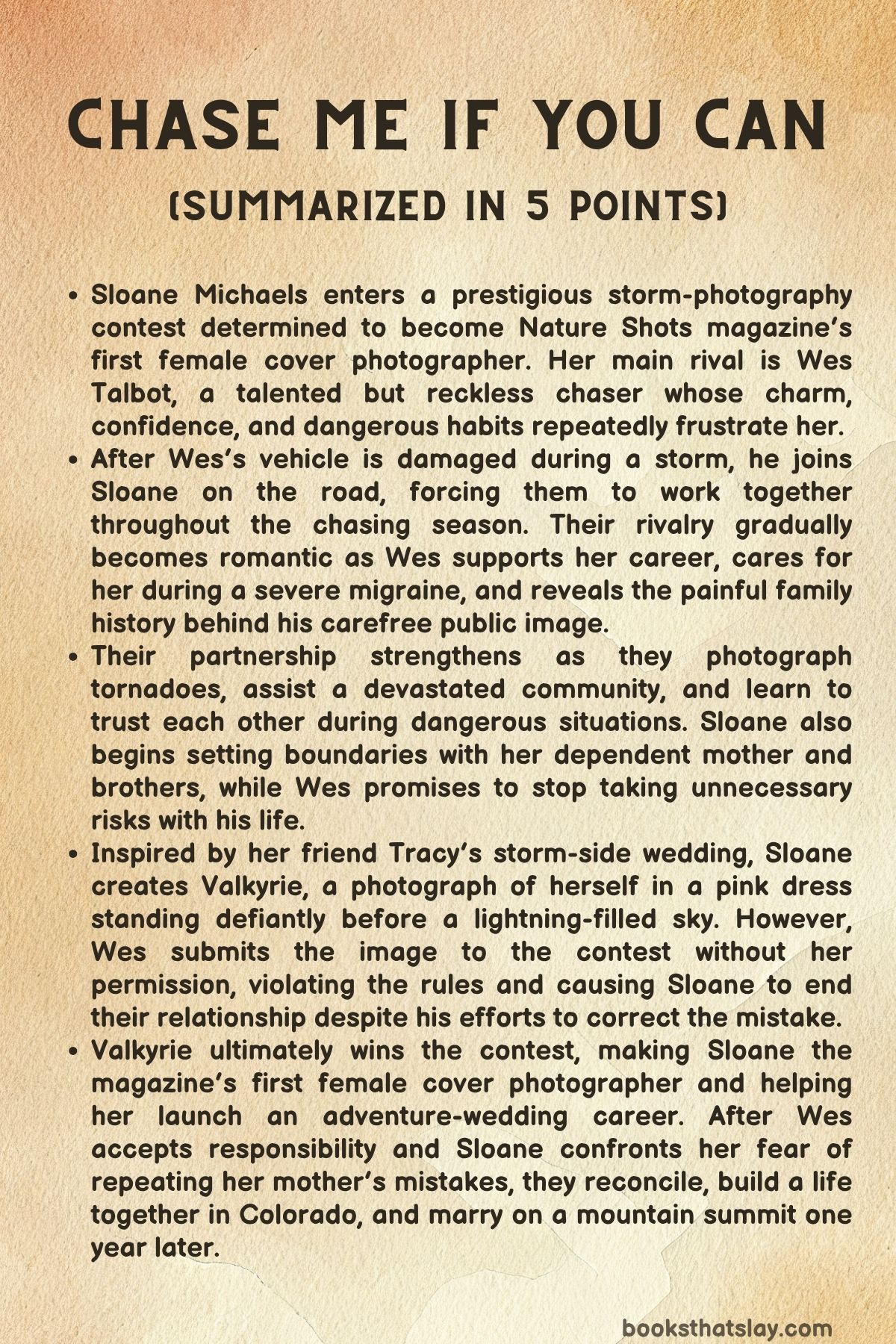
Summary
Sloane Michaels is photographing an expensive wedding in Houston when she sees Wes Talbot among the guests. Known throughout the storm-chasing community as “Wild Wes,” he is an accomplished adventure photographer whose confidence, fame, and reckless behavior have irritated her for years.
Their familiar argument begins when Wes mocks her lens and jokes about her wedding work. Sloane considers him arrogant, but her frustration is complicated by an attraction she has never completely managed to dismiss.
Both photographers have been invited to participate in a Nature Shots magazine contest. Fifty photographers will submit one image from the coming storm season, and the winning photograph will appear on the magazine’s cover.
The entries will be judged anonymously and must communicate an emotional story without artificial manipulation. Only five contestants are women, and the magazine has never selected a female cover photographer, making the competition especially important to Sloane.
Before beginning her six-week storm-chasing season, Sloane attempts to transfer responsibility for their mother to her younger brothers, Eric and Sam. Although both men are adults, they remain accustomed to Sloane handling every family crisis.
Sloane has spent much of her life acting as a parent because their mother depends on her emotionally and practically. Leaving home therefore feels like both professional freedom and an act of resistance against the role she was forced to accept.
At a gas station in West Texas, two men patronize and harass Sloane, assuming that she must be accompanying a boyfriend. Their behavior changes only when Wes appears, reinforcing the sexism Sloane regularly faces within the chasing community.
She refuses to let Wes speak for her, but later discovers that he secretly embarrassed the men by writing an insulting message on their dusty vehicle. His response is childish but loyal, showing that his concern for her exists beneath their constant competition.
Sloane reunites with her closest friend, Tracy, and Tracy’s fiancé, Matt. The group begins following severe storms across the plains, searching for images worthy of the contest.
Sloane and Wes repeatedly choose the same locations because their photographic instincts are remarkably similar. At an abandoned farmhouse covered in pink flowers, they work comfortably beside each other, capturing the contrast between fragile life and destruction.
Their temporary cooperation is challenged when Wes drives directly into the dangerous rotating portion of a storm. He emerges laughing, convinced that his knowledge and experience justify the risk.
Sloane is furious because she understands that expertise cannot remove every danger. Her reaction reveals that she already cares about his survival more than she wants to admit.
At Mae’s Donuts in Kansas, Sloane discovers another side of Wes. After a tornado destroyed Mae’s former food truck, he used his huge social-media following to promote her new shop and bring customers from across the region.
The gesture was generous and received little public attention from Wes himself. Sloane begins questioning whether his irresponsible public image conceals a more considerate man.
During another chase, Wes moves too close to a powerful storm. His SUV is struck by a violent downdraft, shattering several windows and leaving him bleeding from multiple cuts.
Sloane cleans his injuries, but Wes reacts sharply when she insists that he needs medical help. He tells her that he is not her responsibility and that she cannot fix him, exposing emotional pain beneath his casual attitude.
Because his vehicle cannot be repaired immediately, Sloane brings him to her Colorado home. Her brother Eric inspects the damage and explains that replacement windows will take several days to arrive.
Sloane and Wes risk missing important storms unless they travel together. She therefore allows him to ride in her vehicle, although she establishes strict rules about safety, navigation, expenses, and equipment.
Their arrangement quickly becomes more comfortable than expected. Wes respects the organization of her vehicle, pays for fuel, assists with navigation, and proves capable of being a thoughtful traveling companion.
At a truck stop, an aggressive woman refuses to accept Wes’s lack of interest. He asks Sloane to pretend to be his girlfriend, and when the woman insults Sloane, Wes announces that they are together.
He warns Sloane before kissing her, but the performance rapidly becomes genuine. Both are shaken by the intensity of the moment, even though they later pretend that it meant nothing.
As the journey continues, Wes supports Sloane’s photography rather than trying to outshine her. He praises her successful lightning photograph, recommends her wedding business to potential clients, and listens seriously when she discusses her artistic goals.
They exchange teasing photographs, share music, eat together, and spend inactive days visiting places such as the Carlsbad bat caves. Their partnership begins resembling a relationship long before either gives it a name.
Conflict returns whenever Wes chooses danger unnecessarily. During one chase, he drives toward hail, flooding, and poor visibility despite Sloane’s warnings.
When the road becomes impassable, he finally turns around. Sloane uses her navigational knowledge to guide them toward a safer view, demonstrating that their best results come through cooperation rather than competition.
They later photograph a double rainbow beneath mammatus clouds and wild daisies. Although the image is beautiful, Sloane feels that it lacks the emotional power required for the contest.
Wes encourages her instead of dismissing her uncertainty. His support becomes more important as she begins recognizing how frequently male photographers question her qualifications, comment on her body, or respect her only when they assume she belongs to him.
Their emotional closeness increases when Sloane receives another unreasonable call from her mother. Wes witnesses how thoroughly her family expects her to solve every problem, although Sloane hides her exhaustion behind humor.
When Sloane develops a severe migraine, she insists on continuing toward another storm. Wes refuses because her condition would make chasing unsafe.
After she becomes violently ill, he abandons the storm, books a hotel, gathers medicine and food, blocks all light from the room, and stays with her. Sloane allows herself to rest against him, experiencing the unfamiliar relief of being cared for without conditions.
The following morning, their emotional intimacy becomes physical. Wes asks Sloane to state what she wants clearly, ensuring that she is comfortable and willing.
Their encounter changes the relationship permanently. Sloane sees that Wes can be gentle, attentive, and emotionally present, while Wes makes it clear that his interest in her is deeper than temporary attraction.
Sloane eventually tells him about the sexism she experiences among storm chasers. Wes apologizes for any way his fame or presence has strengthened the assumption that she needs a man’s approval.
He assures her that she belongs because of her own talent. His response matters because he supports her authority rather than positioning himself as her rescuer.
During another tornado chase, fallen power lines nearly trap them. Sloane spots the danger and warns Wes in time, allowing him to escape.
Although Wes initially jokes about the incident, his trembling hand exposes his fear. He apologizes and promises to become more careful, acknowledging that his decisions affect both of them.
Their growing commitment becomes clearer when Wes offers to finish the rest of Sloane’s season beside her. He wants their partnership to continue even after his vehicle is repaired.
Before they can discuss the future further, a dangerous storm moves toward a populated town. Sloane, Wes, Tracy, Matt, and the other chasers abandon their competitive priorities and prepare to help the affected community.
After the tornado strikes, Sloane and Wes enter the damaged town carrying water, medical supplies, tools, and chainsaws. They help residents clear debris and search dangerous areas.
The devastation forces Sloane to confront the moral tension within storm photography. An image that appears beautiful to a photographer may record the worst moment of someone else’s life.
Wes works tirelessly and remains deeply concerned whenever he and Sloane become separated. That night, neither wants to be alone, and they share a hotel room.
Wes tells Sloane that their relationship cannot be casual for him. They become fully intimate, and Sloane accepts that her own feelings are no longer limited to attraction.
Their happiness is threatened by the approaching end of her season and her continuing family responsibilities. Wes encourages her to create genuine boundaries with Eric, Sam, and their mother.
He reveals that he understands her situation because he once tried to protect his mother from his cruel father. His mother denied the severity of the problem, leaving Wes unable to repair a family whose members refused to acknowledge the truth.
Sloane calls her brothers and refuses to manage the household from a distance. Eric and Sam initially resist, but they eventually accept responsibility for the lawn, the homeowners’ association, and their mother’s demands.
The conversation becomes an important act of self-respect. For once, Sloane chooses her own life without immediately rescuing everyone else.
Wes later explains the meaning of his tattoos. Several were acts of rebellion against his controlling father, while the large bird across his chest represents freedom from the rigid expectations imposed on him.
His honesty helps Sloane recognize that both of them use confidence and humor to conceal emotional wounds. Their public relationship becomes increasingly serious as they hold hands openly and plan their future together.
Tracy and Matt decide to hold a spontaneous storm-chaser wedding. Sloane agrees to photograph the ceremony, with Wes assisting her.
After returning briefly to Colorado for equipment and Wes’s repaired vehicle, Sloane admits that her mother’s unstable relationships have made her afraid of trusting her own judgment. She worries that forgiving warning signs could eventually make her repeat the same destructive pattern.
Wes assures her that she is not her mother. He also promises to stop adding unnecessary danger to storm chasing because he now imagines a future that includes Sloane.
During their journey to the wedding, they discuss how their love of storms began. Both remember weather as a source of freedom, wonder, and comfort during childhood.
Tracy and Matt marry beside a field beneath a dramatic sky. A lightning bolt appears behind their first kiss, giving Sloane an emotionally powerful wedding photograph.
The newlyweds then continue chasing the storm. A tornado forms far from any town while lightning and a rainbow appear nearby, allowing Sloane to capture the rare combination she has always imagined.
Another idea emerges when she sees Tracy standing in her pink dress before the storm. Sloane decides to photograph herself as a woman facing severe weather, combining femininity, strength, danger, and beauty.
Wes helps her build the composition even though he still needs his own contest entry. Using a tripod, remote control, and timed exposures, Sloane remains the photographer while also standing inside the frame.
The final image shows her in a pink dress before the storm as lightning flashes in the distance. Wes calls the image Valkyrie, seeing in it the power that Sloane has often felt pressured to hide.
When the season ends, Wes repairs a broken step at Sloane’s house before returning to Houston. The practical gesture symbolizes his desire to care for her without controlling her.
They begin a long-distance relationship, but Sloane soon faces a major confrontation with her mother. Her mother criticizes her appearance, career, relationship, and decision not to have children, even suggesting that she should use Wes’s wealth to secure her future.
Sloane finally states that she already sacrificed her childhood raising Eric and Sam. She demands that her mother seek therapy and refuses to continue serving as an emotional target.
Wes arrives early and comforts her. However, a new conflict arises when he insists that Valkyrie is stronger than Sloane’s tornado, lightning, and rainbow photograph.
Sloane fears that the openly feminine image will be judged unfairly and chooses the safer landscape photograph. She also refuses Wes’s offer of financial assistance and reminds him that the contest entry is her decision.
Without her permission, Wes submits Valkyrie under Sloane’s name, believing he is giving the judges an opportunity to consider both images. He fails to read the rule limiting each participant to one submission.
Sloane receives notice that she may be disqualified. Although Wes contacts the magazine and corrects the mistake, she ends their relationship because he ignored an explicit boundary.
The incident activates Sloane’s deepest fear. She believes that forgiving him might begin the cycle of excuses, apologies, and repeated harm she observed in her mother’s relationships.
Nature Shots allows Sloane to choose either image before the deadline. She realizes that her original selection came from fear rather than artistic conviction and keeps Valkyrie in the competition.
Sloane ignores Wes while building her adventure-wedding business. Tracy later tells her that Wes has withdrawn from friends, lost weight, and taken full responsibility for his actions.
Eric and Sam also remind Sloane that he corrected his mistake, respected her silence, and had consistently demonstrated care. They argue that one serious failure does not automatically make him equivalent to the manipulative men from their mother’s past.
The contest results are announced, with Tracy finishing third, Wes second, and Sloane first. Valkyrie makes her the first female cover photographer in the magazine’s history.
At the Los Angeles gala, Wes uses his speech to praise Sloane’s talent rather than promoting himself. Sloane presents her photograph as an image of femininity, destruction, beauty, anger, and the ferocity women are often expected to conceal.
Wes privately accepts responsibility for violating her decision. He also reveals that his father had threatened him during the original contest call and continued treating photography as an unworthy career.
A new tattoo along Wes’s spine marks the coordinates where Sloane treated his injuries after his vehicle was damaged. For him, that roadside became the place where he realized that she represented home.
Wes declares his love, and Sloane admits that she loves him. She apologizes for allowing fear to end the relationship without giving them a chance to communicate.
One year later, Sloane has developed a successful adventure-wedding career. She and Wes live together in Colorado, combining travel, photography, and storm chasing.
Her family has also changed. Therapy has improved her relationship with her mother, Eric and Sam now accept responsibility, and Wes’s mother has left his father after finally confronting his cruelty.
Sloane and Wes hike to a mountain summit for their wedding. Beneath her watch, Sloane carries a tattoo of the coordinates where they will marry, mirroring the way Wes records the places that define his life.
When Wes turns and sees her in a pale blush wedding gown, his expression becomes the first treasured image of their marriage. Their relationship has transformed competition into partnership and danger into a shared life built on trust, accountability, freedom, and love.
Characters
Sloane Michaels
Sloane Michaels is the central character of Chase Me If You Can, and her emotional development is closely connected to her struggle for professional recognition. She is an accomplished wedding and storm photographer, but the male-dominated chasing community frequently treats her as though her success must depend on a man.
Her ambition to win the Nature Shots contest is therefore about more than publicity. She wants her work to be judged as serious art and hopes to become the magazine’s first female cover photographer.
Sloane is disciplined, organized, and highly attentive to safety. These qualities make her an excellent storm chaser, yet they also originate in a childhood during which she was forced to become responsible far too early.
Her mother relied on her to raise Eric and Sam, solve household problems, and regulate the family’s emotions. As a result, Sloane associates personal value with usefulness and finds it difficult to accept care without feeling weak, guilty, or indebted.
Her relationship with Wes challenges these habits. She initially sees him as reckless and privileged, but his patience during her migraine shows her that receiving help does not make her incapable.
Sloane’s greatest internal conflict concerns trust. Her mother’s history of unstable relationships has taught her to fear that forgiveness may lead to repeated betrayal, causing her to end the relationship after Wes submits Valkyrie without permission.
Her decision is understandable because Wes violates an explicit boundary, but it also reveals how quickly fear can become emotional withdrawal. By the end, Sloane learns to distinguish accountability from manipulation and a serious mistake from a permanent pattern of abuse.
Her winning photograph represents the identity she finally accepts. She no longer believes that femininity undermines strength or that she must hide emotional intensity to be respected.
Wes Talbot
Wes Talbot begins Chase Me If You Can as a charming, wealthy, highly talented photographer whose recklessness has become central to his public identity. His “Wild Wes” reputation allows him to appear fearless, entertaining, and untouched by consequences.
Beneath that image, however, Wes is observant, generous, loyal, and deeply affected by rejection. His support of Mae’s business, his recommendations of Sloane’s wedding photography, and his assistance after the tornado reveal a man who cares about people without always seeking recognition.
Wes’s dangerous behavior is partly an attempt to define himself against his father. Growing up beneath rigid expectations about masculinity, wealth, and success taught him that approval would always be conditional.
His tattoos record acts of freedom and emotional milestones. The bird across his chest represents independence, while the coordinates on his spine mark the moment he began to see Sloane as home.
Wes treats Sloane’s talent with genuine respect. He proudly promotes her work, listens when she describes professional sexism, and encourages her to submit the image that most clearly expresses her artistic identity.
Nevertheless, his decision to submit Valkyrie without permission is a serious failure. His intention is supportive, but he assumes that his judgment should replace Sloane’s clearly stated choice, temporarily repeating the controlling behavior he claims to reject.
His response to the consequences demonstrates growth. He corrects the contest problem, accepts responsibility without blaming Sloane, gives her space, and does not demand forgiveness.
By the conclusion, Wes has also changed his relationship with risk. Love gives him a reason to stop treating survival as a private matter because his decisions now affect a shared future.
Tracy
Tracy is Sloane’s closest friend and one of the most stable sources of support in the story. She understands Sloane’s ambition, family burdens, defensive habits, and attraction to Wes before Sloane is prepared to acknowledge many of them herself.
Rather than forcing Sloane toward a particular decision, Tracy offers observations and allows her to reach conclusions independently. She repeatedly suggests that Wes is more compassionate than his public image, but she does not dismiss Sloane’s concerns about his recklessness.
Her relationship with Matt provides a contrast to Sloane’s fear of commitment. Tracy and Matt communicate openly, support each other’s interests, and create a wedding based on personal meaning rather than social expectations.
Tracy’s storm-side ceremony becomes essential to Sloane’s professional transformation. The photographs demonstrate that adventure weddings can combine emotional intimacy with the natural environments Sloane loves.
Tracy also acts as a bridge between Sloane and Wes after their separation. By describing Wes’s withdrawal and long-standing feelings, she gives Sloane information without demanding that she forgive him.
Her third-place finish in the Nature Shots contest confirms that she is not merely a companion in Sloane’s career. She is a skilled photographer in her own right and part of the community of women challenging unequal professional standards.
Matt
Matt is Tracy’s fiancé and later husband, as well as one of Wes’s closest friends. His easy humor contributes to the welcoming atmosphere of the chasing community, particularly during the playful competitions and long periods of waiting between storms.
Although Matt receives less individual attention than Sloane or Wes, his behavior consistently reflects loyalty and emotional steadiness. He supports Tracy’s career, accepts her unconventional wedding plans, and treats the ceremony as a celebration of their shared life rather than a performance for others.
His decision to marry beside a storm shows that he understands what the weather means to Tracy. Instead of demanding a traditional setting, he participates in a ceremony shaped by their friendships, profession, and love of the plains.
Matt also provides Sloane with indirect insight into Wes. His knowledge that Wes has talked about her for years helps establish that Wes’s feelings did not begin merely because they were forced to travel together.
As a supporting character, Matt represents uncomplicated partnership. His relationship with Tracy demonstrates that commitment does not have to erase individuality or require one person to carry the entire emotional burden.
Sloane’s Mother
Sloane’s mother is a difficult and emotionally damaging presence whose dependency has shaped Sloane’s entire personality. She repeatedly treats ordinary inconveniences as emergencies and expects Sloane to solve problems that she could manage herself or assign to Eric and Sam.
Her behavior forced Sloane into a parental role during childhood. Instead of being allowed to develop freely, Sloane became responsible for her brothers, household problems, and her mother’s emotional instability.
She also criticizes Sloane’s appearance, clothing, profession, relationship, and decision not to have children. Her suggestion that Sloane should use Wes’s wealth or become pregnant to secure him reveals a deeply unhealthy understanding of intimacy.
This character is not presented simply as malicious. Her behavior appears connected to insecurity, dependency, and years of unstable relationships, but those difficulties do not excuse the harm she causes.
Sloane’s confrontation with her is therefore a major act of growth. She refuses to continue accepting emotional attacks and requires her mother to seek professional help.
The epilogue suggests improvement rather than an unrealistic transformation. Therapy and stronger boundaries allow the family relationship to continue, but Sloane no longer sacrifices her own life to maintain it.
Eric Michaels
Eric is one of Sloane’s younger brothers and initially participates in the family pattern that places responsibility on her. Although capable of repairing vehicles and managing practical tasks, he allows Sloane to remain the default organizer because her intervention makes his life easier.
His inspection of Wes’s damaged SUV demonstrates that he is competent and dependable when he chooses to act. His problem is not inability but habit.
Eric also functions as a protective brother. He questions why Sloane is helping a man she has repeatedly criticized, showing concern about her judgment and emotional safety.
When Sloane finally establishes boundaries, Eric initially resists but eventually arranges the necessary lawn care. His cooperation proves that the family does not collapse when Sloane stops managing everything.
Later, Eric encourages her to speak with Wes rather than allowing fear to make the decision for her. He recognizes that Wes’s actions differ from the manipulative behavior associated with their mother’s former partners.
By the end, Eric has grown into a more responsible family member. His presence at Sloane’s mountain wedding reflects a healthier sibling relationship based on shared effort rather than dependence.
Sam Michaels
Sam is Sloane’s other younger brother and shares Eric’s early tendency to expect their sister to manage the family. He has grown up within a structure where Sloane’s competence allows everyone else to avoid difficult responsibilities.
His initial excuses during the boundary-setting conversation demonstrate how deeply established the pattern has become. He assumes that Sloane will eventually give in because she has always done so before.
Sloane’s refusal forces Sam to act. He agrees to contact the homeowners’ association and handle matters that previously would have been transferred to her.
Despite his dependence, Sam clearly loves his sister. His casual reference to Wes as her boyfriend shows that he recognizes the seriousness of their relationship before Sloane and Wes formally define it.
After the breakup, Sam joins Eric in encouraging Sloane to evaluate Wes as an individual rather than through the lens of their mother’s past. His advice supports her without denying that Wes made a real mistake.
Sam’s development is quieter than Sloane’s, but it remains important. He learns that loving his sister requires reducing her burden instead of merely appreciating everything she does.
Wes’s Mother
Wes’s mother is largely understood through his memories, but her choices have a major influence on his emotional life. When Wes was younger, he repeatedly tried to protect her from his father’s cruelty.
She responded by minimizing or denying the seriousness of the situation. Her refusal to confront the truth left Wes trapped between loyalty, anger, and helplessness.
This experience taught him that caring about someone does not give him the power to rescue them. It also explains why he immediately recognizes the destructive pattern between Sloane and her mother.
Wes’s frustration with Sloane’s repeated attempts to fix her family comes from personal experience rather than judgment. He knows that constant intervention can protect others from the consequences that might finally force them to change.
Her eventual decision to file for divorce is therefore significant. After learning that her husband had threatened to have Wes arrested if he returned to the ranch, she finally stops pretending that the family conflict can be ignored.
Her change does not erase the damage caused by years of denial. It does, however, show that confronting reality can begin even after a long period of fear and avoidance.
Wes’s Father
Wes’s father represents control, conditional approval, and the destructive use of family power. He rejects photography as an improper career and expects Wes to conform to his ideas about masculinity, status, and success.
His wealth gives him additional methods of control. The threat to have Wes arrested if he returns to the family ranch shows that disagreement has become punishment and emotional separation.
Wes’s public confidence can be understood partly as a reaction to this treatment. By becoming famous as an adventure photographer, he creates an identity entirely outside his father’s approval.
His recklessness also reflects the damage of this conflict. Taking extreme risks allows Wes to prove that no one can control him, but it sometimes turns rebellion into self-destruction.
The father never receives a redemptive transformation. Instead, the consequences of his cruelty include separation from his son and divorce from his wife.
His character also provides an important contrast with Wes’s eventual relationship with Sloane. Wes must learn that supporting someone does not mean overruling them, particularly when he submits Valkyrie without permission.
Mae
Mae is the owner of the Kansas doughnut shop that becomes a gathering place for storm chasers. Although she occupies a small role, her history reveals an important aspect of Wes’s character.
After a tornado destroyed her former food truck, Wes used his online audience to promote her replacement business. The attention brought visitors from across the region and helped Mae rebuild her livelihood.
Mae therefore represents the communities that remain after storm chasers leave. Her experience reminds the photographers that severe weather is not merely a visual opportunity but an event with lasting human consequences.
Wes’s gift of a bright pink cowboy hat and his continuing friendship with her show his capacity for practical generosity. He does not simply photograph destruction; he uses his influence to support someone affected by it.
For Sloane, Mae becomes evidence that her original judgment of Wes is incomplete. His kindness toward Mae is one of the first clear signs that the man behind the public performance is more compassionate than she assumed.
Themes
Trust, Boundaries, and Accountability
Trust develops through repeated acts of respect rather than through attraction alone. In Chase Me If You Can, Sloane and Wes become emotionally close because they share work, danger, private fears, physical intimacy, and moments of genuine care.
Wes earns trust when he protects Sloane’s rest during her migraine, values her photography, listens to her experiences with sexism, and changes his driving after recognizing that his risks affect her. These actions demonstrate that safety can be emotional as well as physical.
The submission of Valkyrie becomes a major test because good intentions do not erase violated boundaries. Wes believes the image deserves recognition, but Sloane has explicitly decided to submit another photograph.
By acting without permission, he temporarily treats his judgment as more important than her authority over her own career. The mistake is especially painful because Sloane has spent much of her life having other people define what she should do.
Accountability distinguishes Wes from the harmful partners Sloane remembers from her mother’s life. He corrects the problem, accepts the breakup, gives Sloane space, and never argues that his love should automatically earn forgiveness.
Sloane must also accept responsibility for her response. Protecting herself is reasonable, but refusing communication indefinitely allows past fear to control a present relationship.
Their reconciliation becomes possible only when both acknowledge their failures. Trust is restored not by pretending that the violation was insignificant, but by discussing it honestly and agreeing to communicate before fear or certainty turns into unilateral action.
Gender, Professional Recognition, and Self-Expression
Sloane’s career is shaped by an environment that frequently treats male talent as natural and female talent as questionable. Other chasers assume that she needs a boyfriend’s assistance, comment on her clothing, and associate her legitimacy with Wes’s fame.
The Nature Shots contest reflects the same imbalance. Only five of the fifty invited photographers are women, and no woman has previously received the cover.
Sloane initially believes that success requires presenting herself in a form that male judges will consider neutral and professional. She therefore chooses the technically extraordinary tornado, lightning, and rainbow photograph instead of Valkyrie.
The landscape image is impressive, but it allows her to remain invisible behind the camera. Valkyrie places her female body, pink dress, ambition, anger, and strength directly within the composition.
Her fear that femininity will weaken the image demonstrates how thoroughly professional sexism has influenced her artistic judgment. She assumes that appearing feminine may cause viewers to dismiss her skill.
Keeping Valkyrie in the competition becomes an act of self-recognition. Sloane stops asking which image appears safest and chooses the one that communicates her fullest creative identity.
The winning photograph rejects the idea that femininity and power are opposites. Its subject does not become strong by abandoning beauty, emotion, or softness.
Sloane’s victory matters because she is not accepted through imitation of male expectations. She succeeds by creating an image that directly expresses the qualities those expectations taught her to conceal.
Family Responsibility and the Right to Choose Oneself
Both Sloane and Wes have been shaped by families that turned love into obligation. Sloane was required to raise her brothers and manage her mother’s needs, while Wes attempted to protect his mother from a cruel husband who refused to respect his son’s choices.
These experiences teach both characters to take responsibility for situations they cannot fully control. Sloane believes that refusing a request makes her selfish, and Wes once believed that he could save his mother by confronting his father for her.
The story distinguishes caring for someone from carrying their entire life. Sloane’s constant intervention allows Eric, Sam, and her mother to avoid responsibility because they know she will eventually solve every problem.
Wes helps her understand that boundaries are not abandonment. When Sloane refuses to handle the lawn and homeowners’ association, her brothers complain but ultimately complete the tasks themselves.
Her confrontation with her mother is even more important. Sloane finally names the childhood that was taken from her, states that she does not want children, and rejects the belief that her value depends on marriage, motherhood, or emotional sacrifice.
The family’s later improvement occurs because Sloane stops protecting everyone from discomfort. Therapy, divided responsibilities, and clearer limits create relationships that are more honest.
Wes faces a similar truth when he accepts separation from his father. He can love his mother without returning to a home where his own dignity and safety are threatened.
Choosing oneself is therefore not presented as selfishness. It becomes the condition that allows love to exist without resentment, control, or permanent exhaustion.
Danger, Beauty, and the Ethics of Storm Chasing
Storms create extraordinary images, but their beauty cannot be separated from the destruction they cause. Sloane and Wes experience severe weather as freedom, creative inspiration, professional purpose, and a source of almost spiritual wonder.
At the same time, every tornado carries the possibility of injury, death, displacement, and permanent loss. The damaged town forces the photographers to face the human cost behind the scenes they hope to capture.
Sloane recognizes that the photograph of a lifetime may record another person’s worst day. This realization does not make storm photography inherently wrong, but it demands humility and ethical awareness.
The chasers demonstrate that awareness by reporting dangerous conditions, carrying supplies, clearing debris, and helping residents. Their cameras do not excuse them from responsibility toward the people living beneath the storms.
Wes’s recklessness complicates the theme because he sometimes turns natural danger into personal entertainment. His early choices suggest that skill can make him immune to consequences, even when he risks the lives of others.
His development requires accepting that courage is not the same as unnecessary exposure. After Sloane becomes part of his future, survival can no longer be treated as a private gamble.
The final photographs balance beauty with respect. Tracy and Matt’s wedding occurs near a tornado that threatens no town, while Valkyrie emphasizes the human response to danger rather than presenting destruction as spectacle.
Storms remain uncontrollable, powerful, and visually magnificent. The characters mature by learning to admire that power without forgetting the lives beneath it.