Dearly Departed Summary, Characters and Themes
Dearly Departed by Chip Pons is a paranormal romance about mortality, grief, belonging and the courage required to choose an uncertain future.
Chip Pons reimagines Hades as Hayden Harlow, a withdrawn funeral director living in Stonevale after surrendering most of his divine power. His controlled existence begins changing when he meets Levi Wilder, an optimistic florist whose warmth conceals unresolved family sorrow. Their romance brings together death and growth, order and disorder, shadow and sunlight. Through friendship, community and emotional honesty, the novel argues that a meaningful life is not measured by authority or immortality but by the relationships a person willingly builds.
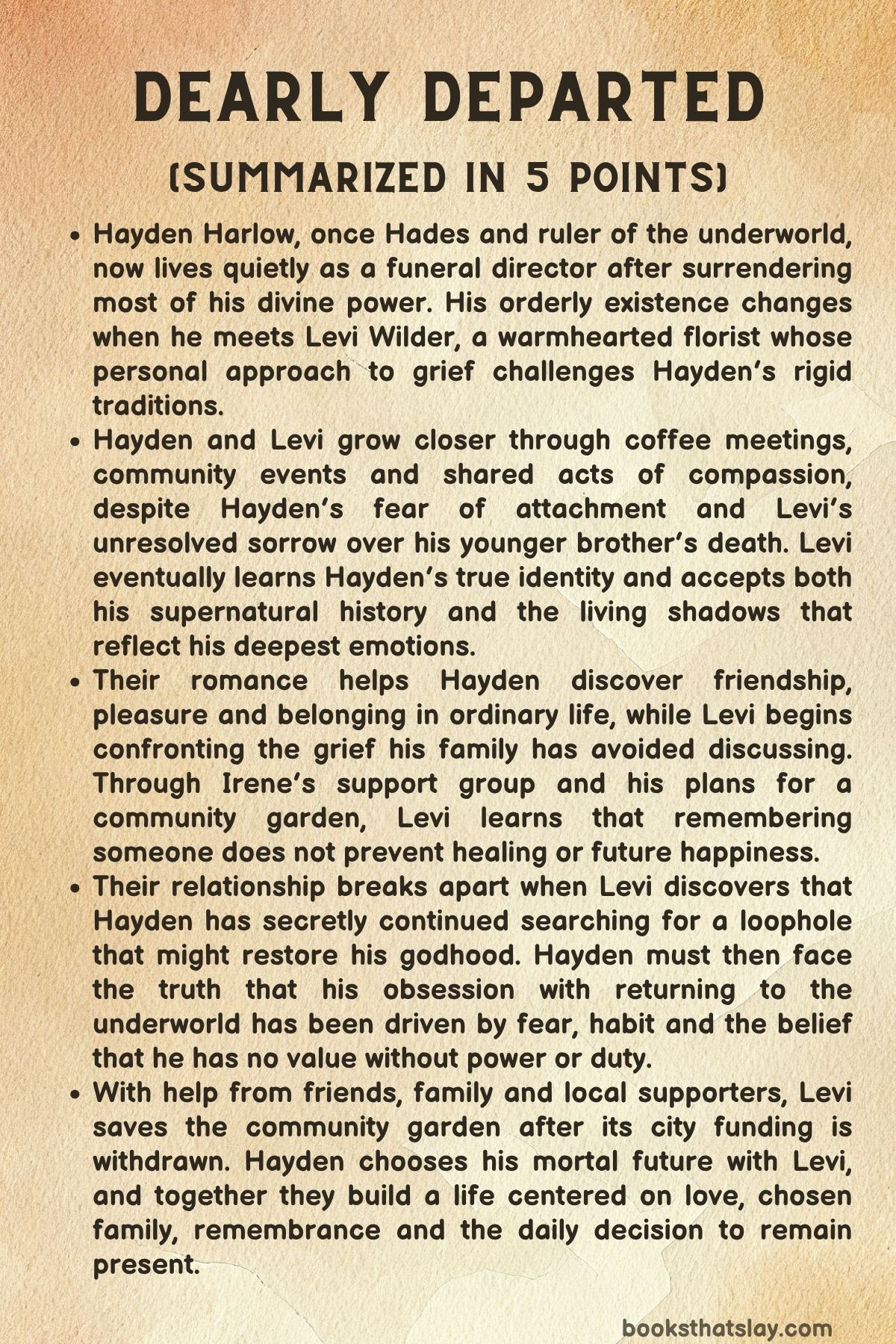
Summary
Hayden Harlow runs Harlow and Sons Funeral Home in Stonevale, New Jersey, where he maintains a quiet, carefully ordered existence. The residents know him as an intensely private funeral director, but Hayden is actually Hades, the former ruler of the underworld, who gave up most of his power under the Immortal Retirement Act and has spent centuries regretting the decision.
His routine is disrupted when Full Bloom, a local flower shop, sends sunflowers to Ruth Masterson’s funeral instead of the traditional lilies Hayden requested. Full Bloom’s owner, Levi Wilder, explains that Ruth regularly bought sunflowers because they reminded her of her mother, leading to an argument between Hayden’s belief in structure and Levi’s conviction that funerals should reflect the individual being remembered.
Although Hayden disapproves of Levi’s impulsive decision, he is unsettled by the florist’s warmth, confidence and ability to recognize the person behind his severe manner. Levi is equally fascinated by Hayden, whose loneliness and mystery attract him even as he attempts to dismiss his interest as temporary curiosity.
Levi manages Full Bloom while developing plans for a community garden intended to give Stonevale residents a place to grow food, rest and heal. Beneath his cheerful public identity, however, he carries deep grief over the death of his younger brother and resentment toward parents who responded to the loss by refusing to discuss it.
Hoping to repair their first encounter, Levi leaves Hayden a white lily and an apology note. Hayden preserves the flower because it was chosen specifically for him rather than for a deceased client, and the simple gesture exposes how starved he has become for personal attention and affection.
Hayden continues visiting Constance, Lorraine and Agnes, the three Fates who now work at city hall, because he believes the Immortal Retirement Act may contain a loophole capable of restoring his former position. The Fates repeatedly suggest that his search is preventing him from accepting his present life, but Hayden remains convinced that returning to the underworld would restore his purpose and repair the emptiness he has felt since retirement.
Levi invites Hayden for coffee, and their conversation reveals how differently they understand life and death. Hayden sees death as predictable and believes grieving people need order, while Levi sees flowers and gardens as reminders that beauty and sorrow can exist together.
During their meeting, Hayden notices the spirit of a recently deceased woman, but he cannot explain his distraction without exposing his true identity. Levi senses that Hayden is concealing something unusual, especially after noticing disturbances in the shadows surrounding him, yet his curiosity increases rather than frightening him away.
Their connection develops through trivia nights, messages, coffee deliveries and flirtatious conversations. Hayden gradually enters Levi’s social circle, which includes Levi’s best friend Dominic, Dominic’s husband Elijah and Naomi Kapoor, the capable intern hired to help manage Full Bloom and the community garden.
At first, Hayden struggles with the teasing and attention he receives from Stonevale’s residents because his isolation has not always been voluntary. Levi recognizes that Hayden’s sternness protects genuine loneliness and begins defending him when others turn his discomfort into a joke.
Hayden’s supernatural awareness becomes harder to conceal when a bride named Emily grieves because her late father cannot attend her wedding. Hayden sees the father’s spirit holding a daisy and suggests that Levi add daisies to the bridal bouquet, giving Emily a way to feel that her father remains present.
Levi realizes that Hayden possesses knowledge he cannot logically explain. Hayden, meanwhile, becomes deeply affected by Levi’s ability to include grief within moments of celebration instead of treating sadness as something that must be hidden or quickly overcome.
At an anti-Valentine’s Day party, Constance appears disguised as a tarot reader and gives Hayden a reading involving Death, the Tower and Judgment. Her interpretation suggests that Hayden’s defenses are collapsing and that he must eventually choose between the identity he lost and the life now forming around him.
Furious that Constance has approached his secret in front of Levi, Hayden leaves the party. Levi follows him home and sees Hayden’s shadows moving independently, forcing Hayden to reveal that he was once Hades and that he can still perceive spirits.
Hayden expects Levi to respond with terror or disgust, but Levi refuses to leave. Although shocked by the revelation, he recognizes that Hayden’s divine history does not erase the compassion, fear and vulnerability he has already witnessed.
Hayden explains the Immortal Retirement Act and tells Levi that his brothers also abandoned their former positions. Zeus now lives as Zane and works as a mayor, while Poseidon has become Porter and maintains a life connected to the sea.
However, Hayden conceals the fact that he is still searching for a way to reverse the agreement. He fears Levi will believe that Stonevale and their developing relationship are only temporary parts of a life he ultimately plans to leave.
Their emotional honesty leads to their first kiss in a secluded old library. When Hayden’s shadows emerge, Levi calls them beautiful, easing Hayden’s fear that the remnants of his supernatural identity make him unworthy of ordinary intimacy.
Hayden becomes more involved in Stonevale, joining Levi at a soup competition, dancing at Franny’s and publicly holding his hand. These apparently minor experiences reveal that Hayden can find satisfaction in friendship, laughter and shared routines rather than in authority over the dead.
Their physical relationship also becomes an important expression of trust. Levi accepts Hayden’s shadows and supernatural power without treating him as either a monster or a distant object of worship, while Hayden learns that surrendering control voluntarily can be a source of intimacy rather than weakness.
Levi eventually attends a funeral conducted by Hayden and sees the depth of care behind his work. Hayden does not merely manage death; he supports frightened families, preserves the dignity of the deceased and provides structure when grief has made ordinary life feel impossible.
After an emotionally difficult funeral, Levi takes Hayden home and cares for him. Hayden initially panics at how much he needs Levi, but they later discuss exclusivity and acknowledge that their connection has become more significant than either expected.
Hayden nevertheless continues visiting the Fates and collecting documents related to the supposed loophole. His inability to disclose this search creates a growing contradiction: he wants a future with Levi but continues protecting a plan that could remove him from that future.
Levi’s parents arrive for a visit, forcing him to confront the role he has performed within his family since his brother’s death. His parents expect him to remain cheerful and dependable because discussing their shared grief would require everyone to admit how deeply the loss damaged them.
Hayden supports Levi during the visit without demanding explanations or taking control of the situation. His presence allows Levi to feel chosen and protected, strengthening their relationship and showing Hayden that companionship can provide a purpose as meaningful as duty.
At a Small Business Association dinner, Levi gains support for the community garden from Delilah Greene, a local nursery owner. Hayden becomes jealous when he sees Ezra, Levi’s former casual partner, interacting comfortably with him, and he admits that he fears he can never belong naturally in Levi’s ordinary future.
Levi assures Hayden that his relationship with Ezra is over and that his feelings for Hayden are serious. Hayden confesses that needing another person terrifies him because every mortal relationship he formed in the past eventually ended in death.
The anniversary of Levi’s brother’s death soon leaves Levi emotionally overwhelmed. Hayden remains beside him without offering easy solutions, explaining that grief has no fixed timetable and that continuing to suffer does not mean Levi has failed to move forward.
Hayden encourages Levi to attend Irene’s grief-support group. There, Levi finally speaks openly about his brother and recognizes that his community garden is partly an attempt to transform private sorrow into a living space where others can remember, create and recover.
Their relationship deepens further when Hayden shares the Helm of Hades, one of the most powerful objects remaining from his former existence. By allowing Levi to see and experience this guarded part of him, Hayden begins accepting that his divine past and mortal present do not have to cancel each other out.
Soon afterward, Hayden’s brothers unexpectedly arrive. Zane is loud, humorous and energetic, while Porter is quieter and more serious, but both explain that the Fates contacted them because Hayden might have discovered a way to reverse the Immortal Retirement Act.
Hayden resents them for rebuilding their lives while leaving him to struggle alone. Levi encourages the brothers to share a meal with his chosen family, creating an evening in which former gods and ordinary Stonevale residents begin forming a surprisingly natural community.
The reconciliation remains incomplete, but Hayden sees that Zane and Porter did not entirely abandon their former identities. They found new ways to express the qualities that once defined them, suggesting that Hayden might also honor his past without returning to the underworld.
Just as Hayden’s family relationships begin improving, the city abruptly withdraws the promised funding for Levi’s community garden. Levi goes to city hall demanding answers and discovers that the Fates are responsible for both the funding problem and Hayden’s centuries-long belief that he might regain his godhood.
Levi learns that Hayden has continued searching for a loophole without telling him. He interprets the secrecy as evidence that Hayden has never truly chosen their relationship and may have been preparing to leave Stonevale whenever an opportunity to regain power appeared.
Hayden’s shadows abandon him and surround Levi, revealing that they function as expressions of Hayden’s deepest emotions and have already chosen the man he loves. Yet Hayden remains unable to explain his desires clearly enough, and Levi ends their relationship because he cannot continue waiting while Hayden decides which life matters more.
Levi responds to the loss of both Hayden and the city funding by working relentlessly. Naomi, Dominic, Elijah, local sponsors and community volunteers help develop a new plan that does not depend entirely on government support.
He also confronts his mother about the silence surrounding his brother’s death. She admits that the family avoided the subject because they did not know how to survive the pain, and her willingness to attend Irene’s support group begins repairing the distance between them.
Hayden withdraws into the funeral home, convinced that he has lost the one relationship that made his mortal existence meaningful. Zane, Porter and Irene challenge his belief that isolation is a form of protection, arguing that his refusal to choose is simply another way of allowing fear to control him.
Porter apologizes for abandoning Hayden after retirement and explains that building a future with Levi would not betray Hayden’s former responsibilities. The Fates finally reveal that there was never a loophole and that they allowed Hayden to continue believing in one because he was not yet prepared to release the past.
Hayden realizes that the purpose he has sought cannot be restored by returning to an old position. His work, friendships, family and love for Levi have already created a new form of meaning, but accepting it requires him to choose a mortal future that remains vulnerable to change and loss.
Stonevale’s community garden reaches its groundbreaking ceremony through collective support. Levi describes it as a place for growing food, teaching skills, resting, remembering and proving that people can choose one another even when institutions fail them.
Hayden appears carrying a white lily and a sunflower. In the greenhouse, he apologizes for his secrecy and admits that he pursued the loophole because duty was the only form of worth he understood, while loving Levi required him to choose something simply because it brought him happiness.
Levi tells Hayden that he does not have to earn his right to exist by being useful or powerful. Hayden declares his love and chooses the shared life they can build in Stonevale, allowing the greenhouse to become a symbol of growth arising from both sunlight and shadow.
Six months later, Full Bloom and the community garden are thriving. Hayden teaches children about gardening, maintains contact with Zane and Porter, participates in Sunday dinners and welcomes plants, friends and disorder into his formerly austere home.
Levi creates a memorial area in the garden surrounded by lilies and sunflowers, offering the community a place where grief and joy can remain together. Hayden finally understands that forever does not require endless divine life; it can exist in love, memory, chosen family and the ordinary days two people continue choosing together.
Characters
Hayden Harlow
Hayden Harlow is the central figure of Dearly Departed, introduced as a funeral director whose severe professionalism conceals his identity as the retired god Hades. His controlled speech, orderly home and attachment to funeral traditions reveal a man attempting to compensate for the loss of the underworld, where his authority once provided a clear place in the universe.
His emotional distance is rooted less in arrogance than in repeated abandonment and grief. After centuries of watching mortals die and seeing his brothers create new lives without him, Hayden concludes that isolation is safer than attachment, even though that protection gradually becomes a prison.
His work at the funeral home shows that he has retained the most compassionate part of his former role. He handles the dead with dignity, understands the confusion of mourning families and offers stability without making grief seem shameful.
Levi challenges Hayden’s belief that worth must come from power, duty or usefulness. Through coffee dates, community events, intimacy and conflict, Hayden learns to accept pleasure, companionship and vulnerability as legitimate reasons for choosing a life.
His search for the loophole is his greatest moral failure because he withholds information that directly affects Levi’s future. The secrecy is not malicious, but it demonstrates how easily fear can turn self-protection into dishonesty.
By the end, Hayden no longer divides himself into the god he was and the mortal he has become. He accepts his shadows, history, funeral work, friendships and love for Levi as parts of one identity, choosing a finite and uncertain future because it is genuinely his.
Levi Wilder
Within Dearly Departed, Levi Wilder represents warmth, growth and emotional generosity, but his optimism is not evidence of a painless life. He manages Full Bloom, develops the community garden and constantly cares for others because activity and usefulness help him avoid facing the death of his younger brother.
Levi initially appears to be Hayden’s opposite. He welcomes disorder, prefers personal meaning to rigid tradition and believes flowers should reflect the individuality of the deceased rather than simply follow expectations.
His decision to replace Ruth Masterson’s lilies with sunflowers demonstrates both his sensitivity and his impulsiveness. He understands the emotional significance of the flowers, but he initially overlooks the importance of consulting the people responsible for the funeral.
Levi’s strongest quality is his ability to see Hayden as a person rather than as a supernatural legend. He accepts Hayden’s shadows and divine history while still holding him accountable for ordinary failures involving trust, communication and commitment.
His relationship with Hayden also forces him to confront his own secrecy. Although he encourages Hayden to reveal difficult truths, Levi initially hides the approaching anniversary of his brother’s death and continues presenting himself as the cheerful person everyone expects.
The support group and community garden allow Levi to redefine healing as shared work rather than permanent happiness. His final reconciliation with Hayden is possible because he refuses to accept a love built on uncertainty while remaining willing to forgive genuine change.
Irene Beaumont
Irene Beaumont is Hayden’s longtime assistant and one of the clearest examples of the relationships he has taken for granted. She has worked beside him for forty years, understands his moods with remarkable accuracy and recognizes his attraction to Levi before Hayden can comfortably admit it.
Her humor prevents the funeral home from becoming emotionally oppressive. She teases Hayden, competes fiercely in Stonevale’s soup contest and participates actively in community life, revealing that closeness to death does not require a person to become detached from living.
As the leader of the grief-support group, Irene demonstrates a mature understanding of mourning. She does not promise that sorrow will disappear, but she gives people language, companionship and permission to discuss experiences their families may avoid.
Irene also challenges Hayden more directly than most characters. She explains that emotional distance is not always an act of kindness and that refusing support can hurt both the isolated person and those who want to care for him.
Her developing friendship with Hayden shows that relationships can remain incomplete even after decades of proximity. Once Hayden begins asking about her family and interests, their connection changes from professional loyalty into a more balanced and openly affectionate bond.
Dominic
Dominic is Levi’s best friend and a central member of his chosen family. His teasing personality brings humor into tense situations, but his jokes are supported by close attention to Levi’s emotional state.
He quickly identifies Levi’s attraction to Hayden and encourages him to pursue something more meaningful than his casual arrangement with Ezra. Dominic’s confidence helps Levi admit what he wants before he is fully prepared to say it directly.
During Levi’s family visit and later breakup, Dominic provides practical and emotional support. He does not demand complete explanations about Hayden’s supernatural identity, allowing Levi to preserve Hayden’s secret while still receiving comfort.
Dominic also contributes to the community garden campaign, showing that his friendship is active rather than merely conversational. His presence reinforces the idea that chosen family is built through repeated acts of participation, honesty and reliability.
Elijah
Elijah, Dominic’s husband, combines humor with calm competence. He adapts quickly to supernatural revelations, family tension and community emergencies, rarely allowing surprise to prevent him from helping.
His involvement in interviewing Naomi shows that Levi trusts his judgment in both personal and professional matters. Elijah recognizes the pressures Levi places on himself and often works with Dominic to ensure that their friend is not left carrying every burden alone.
He also helps normalize Hayden’s entrance into Levi’s social group. Rather than treating the former god as dangerous or untouchable, Elijah includes him in jokes, errands, meals and ordinary disagreements.
This casual acceptance is significant for Hayden, who is accustomed to either fear or distance. Elijah demonstrates that belonging often begins when extraordinary differences are acknowledged without being allowed to dominate every interaction.
Naomi Kapoor
Naomi Kapoor enters the story as a business student with an environmental science minor, but she quickly becomes essential to both Full Bloom and the community garden. Her organizational ability balances Levi’s creativity, enthusiasm and tendency to overextend himself.
She manages schedules, paperwork, permits and grant applications, giving Levi the practical support necessary to turn his idea into a sustainable project. When the city withdraws its funding, Naomi refuses to treat the decision as final and immediately begins constructing alternative plans.
Her loyalty is expressed through competence rather than emotional speeches. She notices what must be done, organizes people and creates systems that continue helping Full Bloom after her internship.
Naomi’s contribution also protects Levi from the belief that he must accomplish everything alone. She becomes part of the wider community that transforms the garden from one man’s private dream into a shared civic achievement.
Ezra
Ezra is Levi’s soil supplier, longtime friend and former casual partner. Their relationship is affectionate and familiar, but it lacks the emotional commitment Levi increasingly wants.
He is not presented as cruel, manipulative or jealous. Instead, Ezra represents a comfortable arrangement that once suited Levi because it provided physical closeness without requiring him to expose his grief or risk deep dependence.
Levi’s decision to end their casual intimacy reflects his changing understanding of relationships. Hayden’s jealousy toward Ezra also exposes Hayden’s insecurity about belonging in Levi’s life, although Ezra himself does little to justify suspicion.
Because Ezra remains a friend and professional contact, the story avoids treating former partners as enemies. His role shows that a relationship can stop being romantic or sexual without becoming meaningless.
Constance
Constance is the most visibly active of the three Fates. Her appearance as a tarot reader at the anti-Valentine’s Day party forces Hayden to confront the connection between his hidden identity, emotional defenses and growing love for Levi.
Her methods are intrusive because she approaches dangerous truths in a public setting. Hayden’s anger is justified, since her reading risks exposing information he has not consented to share.
However, Constance does not control Hayden’s final choices. Her function is to place uncomfortable realities in front of him, especially the fact that his current life cannot remain emotionally temporary once he has allowed another person to become important.
She embodies the tension between fate and free will. She can identify patterns and consequences, but Hayden must still decide whether he will interpret change as loss or possibility.
Lorraine
Lorraine approaches Hayden with greater seriousness and restraint than Constance. Her warning at the business dinner emphasizes that genuine vulnerability creates lasting consequences and cannot simply be reversed when fear becomes inconvenient.
She also acts as a link between Hayden and his brothers. By allowing Zane and Porter to learn about his continuing search, she helps force a family confrontation that Hayden has avoided for decades.
Her behavior can appear manipulative because she withholds explanations and influences events indirectly. Yet her interventions repeatedly push Hayden toward relationships and decisions that he has been unwilling to face voluntarily.
Lorraine represents the recognition that avoidance is itself a choice. Her warnings remind Hayden that refusing to decide does not suspend time or protect other people from the consequences of his uncertainty.
Agnes
Agnes is the least individually prominent of the Fates, but her presence completes their collective authority. Together, the three women understand that Hayden’s obsession with the Immortal Retirement Act is psychological rather than legal.
Agnes contributes to the refusal to give Hayden the simple instructions he repeatedly demands. The Fates understand that an externally imposed answer would allow him to avoid taking responsibility for his own desires.
Her role supports the novel’s view that destiny is not merely a fixed destination. It can also be a process through which a person is confronted with the emotional truth behind the choices he continues postponing.
Zane
Zane, formerly Zeus, responds to mortal retirement by becoming a mayor. His energetic personality, humor and desire to dominate attention preserve recognizable aspects of his former divine identity even though his authority now operates within an ordinary political structure.
His arrival at Hayden’s apartment initially appears insensitive because he treats a painful reunion almost like entertainment. Humor is Zane’s defense against guilt, discomfort and the knowledge that he abandoned his brother during a difficult transition.
Zane’s new life demonstrates that surrendering godhood did not require him to erase himself. He redirected his leadership and charisma into a modern role, offering Hayden an example of adaptation rather than total reinvention.
Although he is less emotionally direct than Porter, Zane cares about Hayden and does not want their separation to become permanent. His participation in dinners and later family contact suggests that reconciliation can begin before every past injury has been fully resolved.
Porter
Porter, formerly Poseidon, is quieter and more reflective than Zane. His mortal life remains connected to the ocean, showing that he has preserved the emotional center of his former identity without attempting to recover absolute power.
He understands Hayden’s resentment more clearly because he is willing to admit that he and Zane failed him. Porter does not excuse their absence by claiming that Hayden should have adjusted more easily.
His apology becomes one of the decisive moments in Hayden’s development. By explaining that loving Levi would not betray the underworld, Porter helps separate Hayden’s sense of responsibility from his habit of self-denial.
Porter represents mature accountability. He cannot undo decades of absence, but he can name the harm, accept responsibility and remain present while a damaged relationship is slowly rebuilt.
Levi’s Mother
Levi’s mother loves her son, but her affection is shaped by avoidance. She expects him to remain cheerful and dependable because acknowledging his distress would force her to face her own unresolved grief.
Her interest in rituals and healing language does not initially translate into honest emotional communication. She can discuss wellness in general terms while remaining unable to speak directly about the child she lost.
Her eventual conversation with Levi reveals that the family’s silence was not caused by indifference. She avoided the subject because she did not know how to survive the pain and mistakenly believed that refusing to name it would protect everyone.
By apologizing and attending Irene’s support group, she begins changing from a parent who depends on Levi’s performance into one willing to share responsibility for the family’s healing. Her development shows that harmful patterns can emerge from fear even within loving families.
Levi’s Father
Levi’s father is quieter and less confrontational than Levi’s mother. His tendency to become distracted by birds suggests a habit of retreating from emotionally difficult situations into safer subjects.
He participates in the family’s refusal to discuss the younger son’s death. Although he does not pressure Levi as openly as his wife does, his passivity still leaves Levi responsible for maintaining stability.
His later participation in family gatherings suggests gradual improvement rather than a dramatic transformation. He begins becoming more reliably present as the family learns to discuss grief instead of organizing its entire identity around avoiding it.
Levi’s Younger Brother
Levi’s younger brother never appears alive within the main narrative, yet his absence influences nearly every major choice Levi makes. His death explains Levi’s constant activity, fear of sudden disappearance and determination to create spaces where life can continue growing after loss.
Because the family refuses to speak openly about him, Levi carries both grief and the burden of protecting everyone else from it. The brother therefore becomes associated not only with sorrow but also with silence and emotional isolation.
The community garden transforms his memory into something shared and constructive. Rather than treating remembrance as permanent sadness, Levi creates a place where people can mourn, rest, grow food and experience joy without believing that happiness erases the dead.
Marjorie and Edmond Caldwell
Marjorie Caldwell appears while arranging the funeral of her husband, Edmond. Her rejection of conventional lilies reflects the influence Levi’s ideas have begun having on Hayden, who now understands that personal remembrance may offer more comfort than strict tradition.
Edmond remains near Marjorie as a spirit, allowing Hayden to witness the strength of their marriage. Hayden’s promise to care for Marjorie demonstrates that his service to the dead is inseparable from his responsibility toward the living.
Together, the Caldwells help Levi recognize the depth of Hayden’s compassion. Their funeral also exhausts Hayden emotionally, creating the moment when he finally permits Levi to care for him.
Emily and Her Father
Emily is a bride grieving because her father cannot attend her wedding. Her distress shows how loss remains present even during celebrations and how happiness can intensify awareness of the person who is missing.
Her father’s spirit appears holding a daisy, which Hayden notices and quietly incorporates into Levi’s floral design. The resulting bouquet does not remove Emily’s sadness, but it allows remembrance to become part of the wedding rather than an interruption to it.
Their brief story establishes one of the central ideas behind Hayden and Levi’s developing partnership. Hayden can perceive the dead, while Levi can translate memory into a living form that offers comfort.
Delilah Greene
Delilah Greene operates a nursery and becomes an important supporter of the community garden. She responds to Levi’s belief that growth can emerge from loss, indicating that the project’s emotional purpose is as persuasive as its practical benefits.
Her support helps the garden survive after the city withdraws funding. Delilah represents the local business owners and residents who choose to invest in a project because they recognize its value to the wider community.
Ruth Masterson
Ruth Masterson dies before the main story begins, but her weekly purchase of sunflowers initiates Hayden and Levi’s relationship. Her preference becomes the subject of their first argument about whether funerals should prioritize tradition or personal identity.
The sunflowers associated with Ruth later become symbols of Levi’s warmth, loyalty and persistence. Her memory therefore continues influencing Hayden long after her funeral, showing how even an absent person can affect the lives of strangers through the details that made her unique.
Seby
Seby, Hayden’s gray cat, reveals the domestic side of a man who tries to present himself as completely self-contained. The cat’s presence softens Hayden’s apartment and indicates that he has always possessed some capacity for companionship, even when he refuses to acknowledge his loneliness.
Seby also becomes part of the household’s transformation. By the end, the once-quiet home is filled with plants, friends, family and regular dinners, and Seby’s reluctant acceptance of the company mirrors Hayden’s own adjustment to belonging.
Tripp
Tripp joins Full Bloom after Naomi’s internship and appears in the later stage of the story. His employment demonstrates that the shop has grown strong enough to support additional staff and that Levi no longer has to manage every responsibility personally.
Dominic and Elijah’s obvious interest in visiting him also preserves the playful social atmosphere surrounding Full Bloom. Tripp’s presence suggests that the community will continue expanding beyond the central romance.
Themes
Grief as an Ongoing Relationship
Grief in Dearly Departed is not presented as a condition that disappears once enough time has passed. It changes shape, enters celebrations, influences habits and remains connected to the love a person still feels for someone who has died.
Hayden encounters sorrow professionally through grieving families and spiritually through the dead who remain near the living. His experience teaches him that structure can help people survive immediate confusion, but Levi shows him that structure alone cannot express the individuality of every loss.
Levi’s family demonstrates the damage caused when grief is treated as something too dangerous to discuss. Their silence does not protect them; it isolates each person and forces Levi to perform happiness while privately carrying anger, guilt and longing.
The support group provides an alternative model. People are not required to recover on a schedule, and speaking about the dead is treated as an act of connection rather than evidence that someone has failed to move forward.
The community garden becomes the fullest expression of this understanding. It creates a physical place where remembrance and new life can exist together, allowing grief to become part of continuing life without being erased or romanticized.
Identity Beyond Power and Usefulness
Hayden believes his worth came from ruling the underworld. Once that position disappears, he experiences ordinary inconvenience, limited influence and anonymity as evidence that the world no longer needs him.
His obsession with the loophole reflects a deeper inability to imagine identity without duty. Returning to godhood would not simply restore power; it would allow him to avoid answering who he is when no cosmic responsibility defines him.
Levi suffers from a related problem in a more ordinary form. He makes himself useful to his shop, friends, parents and community because constant service protects him from confronting his own needs.
Their relationship challenges both men to accept that love is not a reward for being indispensable. Hayden does not have to command the dead to deserve companionship, while Levi does not have to remain permanently cheerful and helpful to deserve care.
Zane and Porter further demonstrate that identity can survive major transformation. They preserve qualities associated with their former roles while building lives suited to the present, proving that change does not require complete rejection of the past.
Vulnerability, Secrecy and Trust
Both Hayden and Levi desire emotional closeness while hiding truths they fear will make that closeness impossible. Hayden conceals his divine identity and later his continuing search for the loophole, while Levi conceals the depth of his grief and the importance of his brother’s death.
Their secrets are not equally damaging. Levi’s silence mainly prevents others from supporting him, whereas Hayden’s search concerns a possible future that directly affects the person building a relationship with him.
The difference explains why Levi can accept Hayden’s supernatural identity but cannot accept being excluded from his decisions. Trust does not require a person to reveal every thought immediately, but it does require honesty about choices that determine whether a shared future is real.
Physical intimacy repeatedly reflects this emotional process. Hayden allows his shadows and power to become visible, while Levi accepts care and comfort during periods when he cannot maintain his usual confidence.
Their reconciliation succeeds only after Hayden stops asking Levi to trust feelings that remain unsupported by a decision. Declaring love becomes meaningful because Hayden also chooses the mortal life in which that love can continue.
Chosen Family and Community
Stonevale gradually becomes the home Hayden does not realize he is seeking. Trivia nights, parties, contests, dinners, gardening and friendships provide forms of belonging that contrast with the grandeur and isolation of his former kingdom.
Dominic, Elijah, Naomi and Irene demonstrate that family can be created through reliability rather than blood. They offer humor, practical assistance, emotional honesty and continued presence without requiring either Hayden or Levi to become simpler versions of themselves.
The former gods also receive an opportunity to rebuild their family. Zane and Porter cannot erase their abandonment of Hayden, but apology and renewed contact allow the brothers to imagine a relationship not controlled entirely by past failure.
The community garden extends chosen family beyond a private circle. When official funding disappears, residents, businesses and volunteers decide that the project still deserves to exist and collectively provide what the city withdrew.
This communal response confirms that belonging is not passive acceptance. It is an active choice expressed through labor, attention, accountability and the willingness to remain present when another person’s life becomes difficult.