Drive by Kate Stewart Summary, Characters and Themes
Drive by Kate Stewart is a contemporary romance centered on Stella Emerson, an ambitious music journalist whose life is shaped by two profoundly different loves.
Moving between her early years in Austin and a reflective journey in adulthood, the novel examines passion, emotional timing, artistic ambition, and the lasting power of music. Reid Crowne represents intensity, danger, and unfinished history, while Nate Butler offers steadiness, partnership, and security. Stella’s struggle is not simply about choosing between them; it is about understanding who she is when neither man defines her direction. It’s the first book in the Bittersweet Symphony duet.
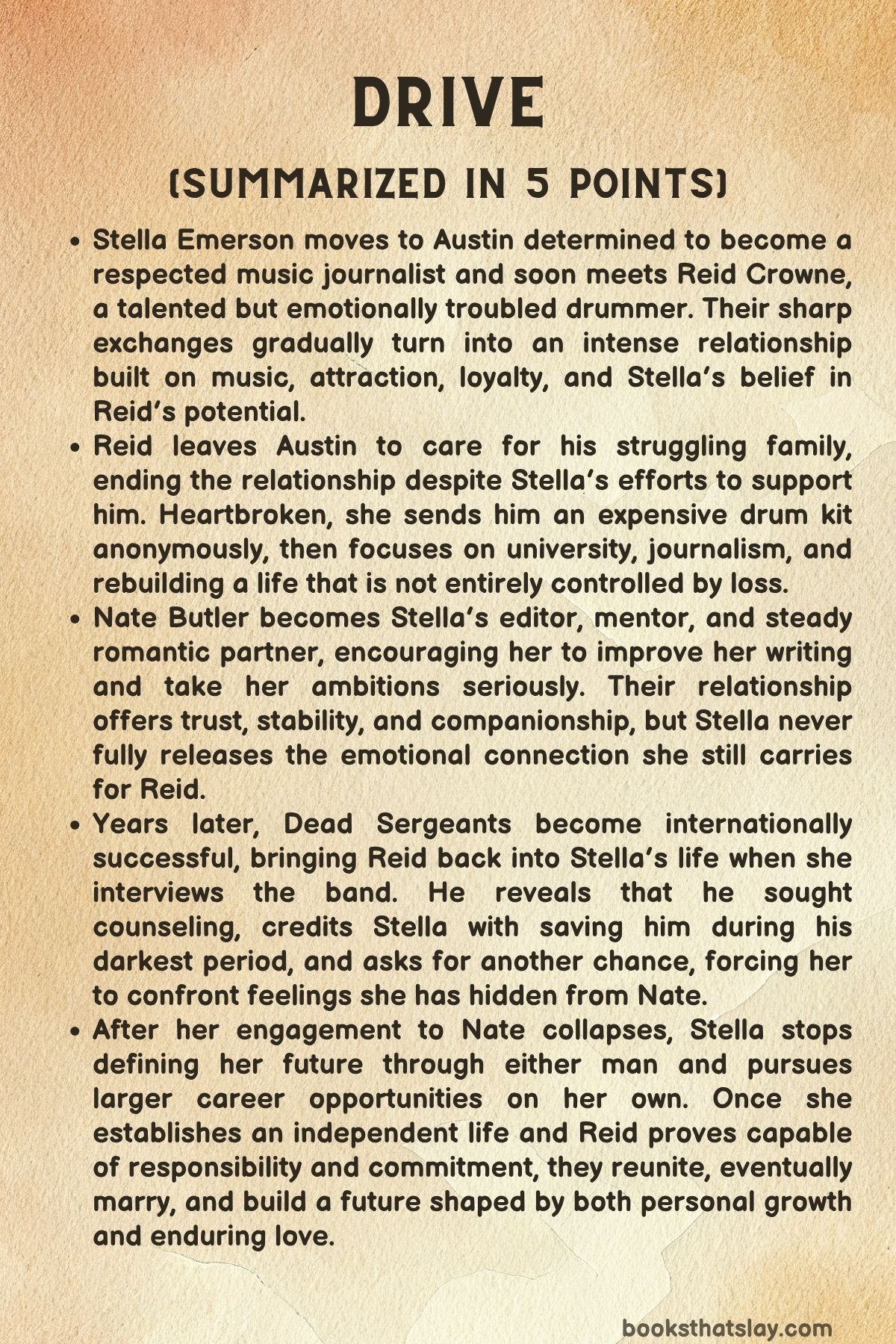
Summary
Years after the relationships that transformed her life, Stella Emerson is a successful music journalist and podcast host. An exclusive interview with famous rapper Titan has become the greatest achievement of her career, yet her celebration is disrupted when her best friend Lexi reveals that one of Stella’s former loves has married someone else.
At an airport, a familiar song awakens memories Stella believed she had resolved. Instead of taking her flight, she rents a car and begins a long drive home, listening to an old playlist that carries her through the defining moments of her youth.
In 2005, nineteen-year-old Stella moves temporarily into the Austin apartment of her older sister Paige and Paige’s boyfriend, Neil. Stella has recently been ignored by Dylan, the lead singer of a Dallas band she followed for months, and she feels embarrassed that her devotion to music made her behave more like a groupie than the journalist she hopes to become.
At Paige’s apartment, she meets Reid Crowne, Paige’s closest friend. Reid is a tattooed musician with a broken arm, a sarcastic personality, and an apparent talent for irritating Stella, who has sworn off musicians and relationships.
Their early conversations consist of insults, challenges, and competitive humor. Reid repeatedly calls her “little sister,” while Stella pretends to find him completely undesirable, even though both become increasingly attentive to one another.
Stella is determined to enter the University of Texas journalism program and begin writing professionally. She forces her way into a meeting with Nate Butler, the twenty-six-year-old owner and editor of Austin Speak, a financially struggling local newspaper.
Nate admires Stella’s talent but refuses to hire an inexperienced nineteen-year-old who cannot legally enter many music venues. After a second encounter, he proposes that she spend several months attending performances, studying Austin’s music culture, and producing columns that he may eventually purchase.
Nate also asks Stella on a date, but she declines because she is not ready for another romantic complication. Their professional connection nevertheless becomes an important part of her development.
Stella finds work at El Plato Cantina, where Paige and Reid are employed. She gradually learns that Reid is struggling financially after a vehicle accident and the collapse of his relationship with Lia, his longtime girlfriend.
When Paige sends Stella to deliver soup to Reid, she discovers that his apartment is almost empty and that he is facing eviction. Reid is humiliated when she cleans his kitchen, but Stella also notices that his cast prevents him from properly washing his hair.
She persuades him to let her help, creating their first truly intimate moment. Although Reid later rejects money she secretly leaves for his rent, the hostility between them has already begun turning into concern.
Stella soon discovers that Reid is the drummer for Dead Sergeants, a local band fronted by Ben, the musician who has become interested in Lexi. After attending a rehearsal, Stella recognizes that Reid’s drumming gives the group its emotional force and becomes convinced that they are capable of professional success.
When Dylan performs in Austin, Stella asks Reid to pretend to be interested in her so that Dylan will become jealous. Their staged kiss immediately becomes genuine, revealing an attraction neither can dismiss.
Their relationship remains complicated by Reid’s history with Lia and by Paige’s belief that he behaved irresponsibly during the accident. Stella learns that Reid may have been drinking and may have allowed Lia to be blamed, although later information suggests that Lia grabbed the steering wheel and that the truth was more complicated than Paige understood.
Reid initially resists becoming involved with Stella because he fears hurting her. However, after discovering private writing in which Stella admits her attraction, he responds directly on the page before kissing her.
Stella later watches him perform with Dead Sergeants and sees the full extent of his ability. After the concert, they become physically intimate, and Stella understands that what exists between them is far more serious than either intended.
When Paige discovers their secret relationship, she feels betrayed by both her sister and her best friend. She orders Stella to leave, forcing Stella to move into Reid’s nearly empty apartment.
The following weeks are intensely happy. Stella encourages Reid’s ambitions, while he admits that her kindness during his injury gave him something he badly needed.
Their love is nevertheless marked by his jealousy, pessimism, secrecy, and emotional withdrawal. Reid writes songs about abandonment, rage, and despair but struggles to discuss those feelings openly.
Stella reads his private notebooks and discovers how deeply he has suffered. Although she apologizes for violating his privacy, she cannot forget the suicidal thoughts and destructive impulses contained in his writing.
Reid eventually reveals that his father’s poor health and alcoholism have created a family crisis. He has lost his apartment, sold his drums, left his job, and decided to return to Nacogdoches to help his parents.
Stella begs him to remain in Austin and offers to share her new apartment, but Reid refuses to become another person she must support. He leaves despite her declaration that she belongs with him, promising only that he will not abandon music.
Soon afterward, Stella wins the expensive drum kit Reid once admired. Although selling it would solve many of her own financial problems, she arranges for Ben to deliver it anonymously because she believes Reid needs music more than she needs the money.
Stella then begins rebuilding her life. She enrolls at the university, continues writing, and eventually earns a position at Austin Speak.
Nate becomes her editor, mentor, and increasingly close companion. He challenges her to stop producing emotionally cautious work and encourages her to express stronger judgments, ask difficult questions, and take professional risks.
At a music festival, Stella sees Reid with another woman and becomes overwhelmed. Nate quietly supports her without demanding an explanation, offering a form of care that feels calm and dependable.
When Reid later discovers that Stella gave him the drums, he calls her while drunk. Their conversation reveals that both remain emotionally attached, but the presence of a woman near Reid convinces Stella that he has moved on.
As Stella spends more time with Nate, she recognizes his patience, intelligence, and openness. He tells her that he does not want a temporary encounter; he wants an ordinary shared life containing affection, disagreement, work, humor, and companionship.
Stella eventually chooses to begin a relationship with him. Their connection develops through mutual respect and emotional safety, offering a striking contrast to the unpredictability of her bond with Reid.
Dead Sergeants soon secure a recording contract, confirming Stella’s early confidence in their talent. Reid later visits her after entering rehabilitation and counseling, explaining that he wants to avoid repeating his parents’ destructive patterns.
He thanks Stella for changing his life and helping him believe in his abilities. Although they kiss, he leaves without offering a definite future, and Stella remains with Nate.
Three years later, Stella has completed her degree, developed a respected podcast, and helped Austin Speak become successful. She and Nate live together in a stable relationship, but she has never told him the full story of Reid.
When Dead Sergeants become internationally famous, Stella is assigned to interview them. Reid has changed physically and emotionally, yet their attraction returns immediately.
He challenges Stella for abandoning the travel and major interviewing opportunities she once wanted. He believes she has made herself smaller to remain comfortably inside Nate’s world, an accusation Stella resents but cannot entirely reject.
At Paige and Neil’s wedding celebration, Reid tells Stella that he spent years in counseling and worked to become someone capable of deserving her. He reveals that the night she washed his hair, he had been close to ending his life and that her unexpected kindness gave him a reason to continue.
Reid asks her to leave Nate and travel with Dead Sergeants. Stella refuses because she genuinely loves Nate and cannot forget that Reid repeatedly abandoned her.
Paige and Stella finally repair their damaged relationship. Paige apologizes for treating Stella as though she could not understand her own choices, while Stella acknowledges that Reid still has the power to disturb the life she has created.
Eight months later, Stella and Nate are engaged. During a celebration at Emo’s, Dead Sergeants unexpectedly perform, and Reid sings a song about the woman who saved him.
Overcome by the music and their history, Stella releases Nate’s hand and moves toward Reid. She kisses him, but Reid then sees her engagement ring and realizes she has continued building a future with Nate.
Reid feels that Stella has allowed him to hope while never intending to choose him. He ends their connection, telling her that the woman he loved is gone.
Nate soon discovers the truth about Stella’s history with Reid. Stella admits that she has never stopped loving Reid, although her love for Nate is equally genuine.
Nate leaves because Stella denied him the opportunity to understand the emotional conflict inside their relationship. Lexi then tells Stella that she must stop defining her life through the choice between two men and spend time pursuing the ambitions she has neglected.
Stella completes her master’s degree, repairs her relationship with Paige, and begins developing an identity independent of both men. She acknowledges that she wants to expand her podcast, travel, and become a major music interviewer.
She eventually meets Nate again and learns that he has continued supporting her career from a distance. During the same period, Reid calls from Indonesia and tells her that he will always love her but will respect whatever independent decision she makes.
Stella accepts a professional opportunity in Seattle and returns Nate’s engagement ring. She later reconnects with Reid, but only after establishing her own career and learning to make choices without allowing romantic security or romantic intensity to control her.
In the present, her long drive finally ends at the home she shares with Reid. He welcomes her as Mrs. Crowne, revealing that they are married.
Stella reflects that loving Nate and Reid was not evidence of dishonesty. Nate held an essential part of her heart and helped her develop stability and professional confidence, while Reid remained connected to the deepest and most uncontrolled part of her identity.
She wishes Nate happiness in his new marriage and embraces the life she has built with Reid. Every loss, separation, mistake, and song has contributed to the person she has become and to the love she ultimately chooses.
Characters
Stella Emerson
Stella Emerson is the emotional and narrative center of Drive, and her development is shaped by the conflict between passionate attachment and personal independence. At nineteen, she is impulsive, outspoken, fearless, and convinced that determination can overcome almost any obstacle.
Her devotion to music defines her long before she becomes a professional journalist. Although she cannot play an instrument, she possesses an instinctive ability to recognize talent, understand emotional performance, and communicate why music matters.
Stella’s strongest quality is her refusal to remain passive when she sees potential or injustice. She confronts Nate for an opportunity, defends Reid against a disrespectful customer, supports Dead Sergeants before the band becomes successful, and sacrifices an expensive prize to preserve Reid’s future as a musician.
That same intensity frequently causes her to ignore boundaries. She interferes in Reid’s finances, reads his notebooks, conceals their relationship from Paige, and avoids telling Nate about the most important romantic history of her life.
Her love for Reid is immediate, consuming, and connected to the most restless part of her personality. Her love for Nate is no less sincere, but it grows through safety, companionship, intellectual respect, and shared professional achievement.
Stella’s central mistake is believing that she must choose a man before she has fully chosen herself. Her eventual maturity comes from pursuing her career independently, accepting responsibility for her own fear, and recognizing that loving two people does not remove her obligation to act honestly.
Reid Crowne
Reid Crowne is the most emotionally troubled figure in Drive, carrying the effects of poverty, family addiction, abandonment, guilt, and long-standing self-hatred. His sarcasm and confidence function as defenses against the shame he feels about his circumstances and emotional instability.
Music is both Reid’s greatest talent and his primary means of survival. He can transform anger, loneliness, and memories of neglect into songs, but he initially cannot communicate those feelings directly to the people who love him.
His relationship with Stella begins through conflict because her optimism threatens the pessimistic identity he has constructed. She sees ability and value in him at a time when he sees himself as damaged, burdensome, and likely to fail.
Reid repeatedly mistakes self-removal for sacrifice. He leaves Stella because he believes she should not have to rescue him, but he makes the decision without allowing her to participate, turning his fear of dependency into another form of abandonment.
His jealousy and emotional withdrawal also reveal how strongly he associates love with danger. Whenever he feels exposed, he attacks, retreats, or assumes that rejection is inevitable.
Counseling becomes essential to his development because professional success alone cannot repair the injuries created by his childhood. By the time he asks Stella for another chance, he has begun taking responsibility for his behavior rather than treating pain as an excuse.
Reid’s eventual marriage to Stella does not erase the damage they caused each other. It represents a relationship begun again after both have developed identities strong enough to withstand the intensity between them.
Nate Butler
Nate Butler is an editor, entrepreneur, mentor, partner, and one of the most emotionally mature people in the novel. He recognizes Stella’s talent early but refuses to offer empty encouragement, insisting that ambition must be supported by discipline, knowledge, and consistent effort.
His creation of Austin Speak reflects his own refusal to wait for established institutions to give him permission to succeed. This makes him an ideal professional guide for Stella, since he understands both her impatience and the practical demands she initially underestimates.
Nate offers stability without becoming dull or emotionally detached. He is witty, sexually confident, intellectually curious, and capable of challenging Stella without humiliating her.
Unlike Reid, Nate openly explains his fears, ambitions, and formative experiences. He can discuss dyslexia, lost dreams, journalism, and commitment without turning vulnerability into conflict.
His relationship with Stella is genuine and significant rather than a temporary obstacle separating her from Reid. Nate gives her security, professional partnership, friendship, and an example of love expressed through consistency.
However, their stability gradually allows Stella to avoid questioning whether she has reduced her ambitions to preserve their shared life. Nate does not intentionally restrict her, but the structure surrounding their relationship makes it easier for her to remain in a familiar professional environment.
When he learns about Reid, Nate’s anger comes primarily from Stella’s lack of honesty. He understands that he entered an emotional competition without being told it existed, and he refuses to build a marriage on incomplete knowledge.
Even after leaving, he supports Stella’s career and helps her obtain opportunities. His final actions demonstrate that mature love can continue as respect and goodwill after a romantic relationship has ended.
Paige Emerson
Paige is Stella’s protective older sister and one of the strongest sources of both support and conflict in the story. She gives Stella a place to live, helps her establish herself in Austin, and tries to guide her away from decisions she believes will cause lasting harm.
Her opposition to Reid is rooted in loyalty rather than simple dislike. Paige knows more about his history, family problems, accident, and unstable relationship with Lia, so she believes she is protecting Stella from dangers that Stella’s attraction prevents her from seeing.
However, Paige’s protectiveness becomes controlling. She discusses Stella’s private affairs with Reid, assumes the authority to define which relationships are acceptable, and throws her sister out when Stella refuses to follow her warnings.
The separation between them demonstrates how love can become damaging when concern is not accompanied by respect. Paige sees Stella as a younger sister who needs supervision, while Stella demands recognition as an adult who must be permitted to make and survive her own mistakes.
Paige eventually accepts that Stella’s relationship with Reid was not a foolish phase. Her apology restores their bond because she promises to trust Stella’s judgment rather than trying to manage her life.
Her marriage to Neil also creates the setting in which unresolved conflicts finally surface. By revealing past information, confronting guilt, and speaking honestly, Paige helps Stella understand that reconciliation requires more than affection; it requires a willingness to change established family roles.
Lexi
Lexi is Stella’s closest friend, companion, and most direct source of uncomfortable truth. Their shared dream of moving to Austin represents a desire for independence, adventure, professional identity, and freedom from the limitations of their earlier lives.
Lexi participates in Stella’s reckless early behavior, particularly during their intoxicated birthday celebration. However, she gradually becomes the person most capable of recognizing the emotional patterns Stella refuses to admit.
Her relationship with Ben parallels parts of Stella’s romantic experience. She becomes involved with a musician whose career eventually creates distance, and their relationship collapses after betrayal and retaliation.
Rather than remain defined by that failure, Lexi returns to school, develops a styling career, and creates an independent online presence. Her recovery demonstrates another route toward rebuilding after romantic damage.
Lexi’s most important contribution comes when Nate leaves. She refuses to tell Stella that one man is obviously right and instead points out that Stella has delayed her own ambitions while concentrating on romantic certainty.
By recommending a year without either relationship, Lexi helps Stella understand that independence is not merely living alone. It requires making professional and emotional decisions without using another person as the organizing principle of one’s identity.
Ben
Ben is the charismatic lead singer of Dead Sergeants and an important link between Stella, Reid, Lexi, and the music industry. He initially appears as a confident performer pursuing Lexi, but his role expands as the band and its relationships become more complicated.
Ben recognizes Stella’s understanding of music and accepts her belief in the group’s potential. He also provides information that complicates the story surrounding Reid and Lia’s accident, suggesting that Reid’s guilt has prevented him from defending himself fully.
His friendship with Reid is imperfect but enduring. When Stella sends the drum kit anonymously, Ben agrees to protect her identity and to help ensure that Reid does not abandon music.
Ben also becomes a witness to the emotional consequences of Reid’s choices. He understands that Reid made a serious mistake by leaving Stella and occasionally attempts to move them toward honesty.
His relationship with Lexi is damaged by success, distance, betrayal, and public retaliation. Their failure shows that artistic achievement does not solve personal problems and may magnify insecurity when trust is already weak.
Lia
Lia is Reid’s former girlfriend and a figure initially viewed through Stella’s jealousy. Her familiarity with Reid, shared history, and connection to the accident make her appear threatening before Stella understands the complexity of their relationship.
Lia and Reid have spent years separating and returning to each other. Their repeated reunions suggest a bond maintained partly by familiarity, guilt, loneliness, and an inability to accept final endings.
She is not simply the woman who abandoned Reid. Lia has also been hurt by his emotional instability and refuses to remain available whenever he feels damaged or alone.
The accident represents the destructive peak of their relationship. Although accounts differ regarding who caused the crash and who accepted blame, the event demonstrates how thoroughly their connection had become shaped by alcohol, resentment, fear, and mutual damage.
Lia’s decision to end the cycle creates the emotional space in which Reid begins noticing Stella. Her role therefore demonstrates that leaving can sometimes be the most responsible choice available, even when both people continue to care.
Neil
Neil is Paige’s boyfriend and later husband, functioning as a calm presence within the more volatile relationships surrounding him. He offers Stella practical support when Paige orders her to leave, showing concern without directly challenging Paige during an emotionally intense confrontation.
His restraint distinguishes him from characters who attempt to control situations through anger or dramatic gestures. Neil generally respects the emotional boundaries of the sisters while remaining dependable when assistance is needed.
His marriage to Paige also symbolizes stability achieved through patience and commitment. The wedding gathering brings Stella, Reid, Paige, Nate, and other family members into the same environment, forcing long-suppressed conflicts into the open.
Although Neil is not central to Stella’s romantic struggle, his quiet consistency provides a useful contrast to the uncertainty surrounding Reid and the professional intensity surrounding Nate. He represents a relationship built less on emotional crisis and more on durable companionship.
Dylan
Dylan is Stella’s early romantic disappointment and represents her immature understanding of relationships with musicians. She follows his band, invests emotionally in his attention, and feels humiliated when he ignores and effectively abandons her.
Her involvement with Dylan damages her confidence because it makes her question whether her love of music has reduced her to a groupie. She worries that others will see her enthusiasm as obsession rather than as the beginning of a serious professional identity.
When Dylan performs in Austin, Stella initially plans to prove that she no longer cares. Asking Reid to kiss her begins as an attempt to make Dylan jealous, showing that she has not yet fully escaped the need for his validation.
However, Stella ultimately refuses Dylan’s request for a private conversation and leaves with Reid. This decision closes her first romantic disappointment while opening a much more consequential relationship.
Dylan’s importance is therefore symbolic rather than sustained. He represents the period when Stella confuses proximity to musicians with participation in the music world she hopes to understand professionally.
JJ, or Jon Jon
JJ is an experienced writer at Austin Speak who initially doubts Stella’s ability. His skepticism forces her to defend her place through effort rather than relying only on Nate’s approval.
Their professional relationship changes when Stella proves that her enthusiasm is supported by observation, knowledge, and a willingness to work. Attending performances together allows competition to become respect.
JJ helps Stella move from aspiring writer to functioning journalist. Through collaboration, criticism, and shared musical discussion, he becomes part of the professional community she must learn to navigate.
His presence also prevents Nate from being Stella’s only connection to journalism. This matters because her career must eventually become larger than her romantic relationship with the newspaper’s owner.
Rye and Adam
Rye and Adam are guitarist and bassist in Dead Sergeants, contributing to the band’s sound and to the sense of shared history surrounding Reid. They welcome Stella into rehearsals and allow her to observe the creative process before the group achieves professional success.
Their presence helps Stella understand that a band is a collective rather than a single charismatic performer. Although Reid’s drumming transforms the group, its achievement depends on the coordination, loyalty, and persistence of all its members.
They also witness the long emotional connection between Stella and Reid. Their familiarity with that history gives their later interactions with Stella a warmth that contrasts with the formal atmosphere of the reunion interview.
Rye becomes particularly relevant near Stella and Reid’s eventual reunion, since Reid stays nearby while Stella establishes her life in Seattle. The band members therefore remain part of Reid’s chosen family as his personal and professional life changes.
Stella’s Parents
Stella’s parents provide the emotional foundation from which her confidence grows. Their childhood video shows affection, humor, and an early belief that their daughter will accomplish something significant.
Her father’s response when she breaks her grandmother’s clock while dancing is especially influential. Instead of punishing her, he tells her to continue dancing, teaching her that mistakes do not have to destroy joy or self-expression.
This unconditional support helps explain Stella’s courage when approaching Nate, defending her opinions, and imagining a major career. She has grown up believing that failure is survivable and that enthusiasm should not be treated as shameful.
Her parents are also protective, particularly after learning about Reid. Stella’s father recognizes the dangerous emotional effect Reid has on her, but his warning is less controlling than Paige’s because he ultimately leaves the decision to Stella.
Themes
Love, Timing, and Emotional Choice
Love is presented as genuine even when it does not lead to permanence. Stella’s relationships with Reid and Nate are both meaningful, and Drive refuses to reduce one man to a mistake simply because she ultimately marries the other.
Reid reaches Stella through shared intensity, music, conflict, and recognition of the parts of herself that resist safety. Nate reaches her through friendship, professional respect, patience, openness, and the ordinary reliability necessary for a stable life.
The central difficulty is timing rather than a simple difference in the depth of feeling. Reid and Stella meet when he is overwhelmed by family responsibility, guilt, poverty, and emotional damage, while she is still learning how easily loyalty can become rescue.
Nate enters her life when she needs steadiness and a structure in which her professional identity can grow. Their love is real, but it develops before Stella has confronted the continuing emotional power of her relationship with Reid.
The story therefore separates love from readiness. A person may love deeply and still be incapable of building a healthy future at a particular moment.
Stella’s final choice becomes possible only after she stops demanding that romance provide an immediate answer. She chooses Reid after establishing her own career, while Reid returns after counseling has taught him greater accountability.
Music, Memory, and Emotional Language
Music operates as memory, confession, prediction, and emotional evidence. Songs preserve moments Stella cannot dismiss, allowing the past to return with a force stronger than ordinary recollection.
Her long drive is structured by a playlist that connects particular songs to people, choices, separations, and versions of herself. Listening becomes a deliberate act of confrontation because every track asks her to acknowledge feelings she once tried to simplify.
Reid relies on music because ordinary conversation leaves him exposed. His lyrics reveal abandonment, suicidal thinking, anger, devotion, and fear long before he can communicate those experiences directly.
Stella’s gift is different but equally connected to music. She cannot perform well, yet she can hear what makes an artist distinctive and translate that experience into language.
Her journalism becomes an extension of listening. When her writing grows emotionally cautious, Nate recognizes that she has stopped allowing music to affect her honestly.
Dead Sergeants’ success validates Stella’s instinct, but the band’s songs also continue carrying private meanings into public spaces. A performance heard by thousands may still function as a message meant for one person.
Music therefore prevents complete emotional concealment. It records what the characters cannot say, returns when they try to forget, and preserves love after circumstances have changed.
Ambition and the Construction of Identity
Stella begins with a clear ambition but an incomplete understanding of what achieving it requires. She loves music, attends concerts, and believes passionately in her opinions, yet she initially lacks experience, discipline, and professional credibility.
Nate challenges her to turn enthusiasm into sustained work. His criticism teaches her that talent must be supported by research, courage, consistency, and the willingness to publish judgments that may attract disagreement.
Reid also influences her professional development, though in a less direct manner. Her ability to recognize his talent and Dead Sergeants’ potential confirms that her musical instincts are valuable.
However, both relationships eventually interfere with her independence. She becomes preoccupied with rescuing Reid and later settles comfortably into a life built around Nate and Austin Speak.
Neither man intentionally destroys her ambition. The greater danger comes from Stella using romance to avoid the uncertainty of pursuing larger opportunities.
Her decision to complete her education, expand her podcast, travel, and accept work in Seattle marks the point at which ambition becomes part of her identity rather than merely a youthful promise.
Professional independence also makes mature love possible. Once she knows that she can support herself emotionally and creatively, choosing Reid no longer means surrendering her future to his career or instability.
Rescue, Responsibility, and Personal Change
Stella repeatedly expresses love through rescue. She cleans Reid’s apartment, washes his hair, helps with rent, protects him publicly, encourages his band, sends him expensive drums, and tries to convince him that his life has value.
These actions often arise from generosity, but they also blur the distinction between support and responsibility. Stella sometimes assumes that loving Reid gives her the authority or ability to solve problems he has not chosen to confront.
Reid reacts by treating dependency as humiliation. He rejects assistance, hides crises, makes major decisions alone, and leaves before Stella can participate in the choice.
His behavior appears sacrificial because he claims he does not want to burden her, yet it allows him to control the terms of abandonment. By deciding what Stella can endure, he denies her emotional agency.
The story gradually establishes that rescue cannot replace recovery. Stella’s love interrupts Reid’s despair and strengthens his faith in his talent, but affection alone cannot repair childhood trauma, guilt, destructive habits, or suicidal thinking.
Reid must seek counseling and take responsibility for changing the patterns he inherited. Stella must learn that another person’s healing cannot become the purpose of her own life.
Their later relationship becomes possible because support is no longer confused with salvation. They return to each other as adults responsible for their own choices rather than as a wounded man and the woman determined to save him.