Green City Wars Summary, Characters and Themes
Green City Wars by Adrian Tchaikovsky is a science-fiction novel set beneath Neuwien-Grunstadt, an environmentally advanced human city secretly maintained by genetically enhanced animals known as Gehirner.
These animals possess language, technical knowledge, political institutions, and complex societies, yet their intelligence depends on Plangent, a neurological supplement controlled by employers and powerful factions. Through the investigation of Skotch, an augmented raccoon facing the loss of his own mind, the book examines economic dependence, corporate ownership, scientific freedom, social inequality, and the price of political change. Its detective framework gradually expands into a struggle over whether intelligence should remain a privilege granted by those in power.
Summary
Skotch is a genetically augmented raccoon living in the concealed passages beneath Neuwien-Grunstadt. He is experiencing the first symptoms of Plangent deprivation, a condition that will gradually strip away his enhanced intelligence, speech, and self-awareness unless he secures more doses.
Once employed by the American corporation Uzco, Skotch now works as an independent investigator. His freedom is limited because Uzco and similar organisations control the neurological supplement on which Gehirner animals depend.
While seeking employment, Skotch learns from Iggy and Uwe that the Graycoat and Redcoat squirrel armies are preparing for another territorial war. He also discovers that Uzco has begun searching for him, and company enforcers Fitch and Maria soon take him to the animal operations beneath Uzco Towers.
There, Skotch meets Benson, an elderly snapping turtle who manages the corporation’s augmented workforce. Benson hires him to locate Doctor Meece, a mouse scientist who has escaped from the Farm Projects and entered territory contested by the Graycoats and Redcoats.
Benson claims that Meece is a defective employee who must be returned before he causes trouble. Skotch doubts the explanation, but Benson offers him immediate Plangent, additional doses after the assignment, company credit, and a geneware update.
Unable to risk losing his mind, Skotch accepts. He understands that Uzco has used his biological dependence to force him back into service.
Skotch begins by visiting Sly, a disabled military fox who trains ordinary dogs to gather information in human districts. Sly agrees to search for Meece and warns that several powerful factions are already pursuing the mouse.
Skotch then encounters Szerky, a stoatweasel working for the Country Clubs and Farm Projects. She offers greater rewards if he delivers Meece to her employers and hints that the mouse may possess knowledge connected to toxins, biological mutations, or dangerous agricultural research.
The interference convinces Skotch that Benson has concealed the real reason for the search. He decides to find Meece before choosing whether the scientist should be returned to anyone.
A lead takes him into Graycoat-controlled territory, where he encounters Ripper, a former Uzco employee who distrusts him. He is protected by Springer, a scarred Graycoat quartermaster whose life he once saved.
Springer confirms that something unusual has happened among the mouse workers behind the restaurant Franz-Ferdinand’s. She guides Skotch through the military checkpoints, although she warns that a Redcoat assault is expected.
Inside the restaurant’s service chambers, Skotch discovers a concealed laboratory filled with unfamiliar chemicals. Before he can investigate properly, Redcoats attack, turning the kitchens and maintenance passages into a battlefield.
Skotch sees Meece attempting to escape with a satchel, while Szerky enters the fighting to capture or kill him. Springer attacks Szerky and is struck by stingers fired from the stoatweasel’s weaponised bee gun.
Springer dies beside Skotch. Meece escapes but is taken by members of the Maulers, an anarchist group whose armed representative Fischer prevents Skotch from following.
Shaken by Springer’s death, Skotch seeks help at the Chapel, a sanctuary run by Saint Frances. She is a human nun who knowingly violates the law known as Rule One by communicating with, feeding, treating, and protecting Gehirner animals.
At the Chapel, Skotch meets Lulu, a pigeon employed by the human novelist Schreiber. She records stories for him and becomes determined to follow Skotch’s investigation, despite his repeated attempts to discourage her.
Before Skotch can meet the Maulers, he and Lulu are captured by rats and taken before Mother Murnau. She is an ancient criminal leader whose authority rests on family loyalty, political influence, and an understanding of how little protection rats and mice receive under the existing system.
Murnau wants Meece alive and believes his knowledge may improve the position of vulnerable animals. She warns Skotch that deciding who deserves the scientist will be more difficult than simply completing Benson’s assignment.
After being released, Skotch returns home and finds Fitch dead in his nook. Uzco uses the discovery to take him back to Benson, who changes the instructions and says that Meece may now be delivered dead or alive.
Maria, enraged by Fitch’s death, is ordered to accompany Skotch. He separates himself from her at the Chapel and travels with Fischer and Lulu into Madparrot Alley, where the Maulers live among unstable augmented parrots.
The Maulers reject corporations, armies, guilds, and the forced economic dependence created by Plangent. They explain that Meece came to them voluntarily because he wanted freedom rather than another employer.
Skotch is finally allowed to question Meece. The scientist denies intending to poison the city but refuses to reveal his objective, saying only that he must complete work more important than his remaining life.
Their conversation is interrupted by Tybelle, a highly modified cat associated with Mother Murnau. She attacks the Maulers, drives Meece into the human districts, and pursues him with exceptional speed and strength.
Skotch helps Meece escape and tells him about a private hiding place unknown to the competing factions. In doing so, he openly betrays Uzco and risks losing access to the Plangent keeping him intelligent.
Searching for more information, Skotch visits the Baron of Waste Sector Three, an enormous frog who governs an amphibian settlement. The Baron knows Meece as a brilliant scientist who improved water reclamation systems and worked with independent researchers.
She believes he has discovered something capable of transforming Gehirner society. She asks Skotch whether fear of dangerous knowledge justifies returning a gifted individual to those who treat him as property.
Skotch then learns that Graycoats have attacked Sly and destroyed his dog network. Sly dies from his wounds after warning that the forces behind the hunt extend far beyond ordinary gang rivalry.
Ripper and the Graycoats capture Skotch and Lulu, while Szerky reveals that the Country Clubs paid for the assault. The prisoners are taken to the Separation Plant, where dead Gehirner are dismantled and recycled into food.
At the plant, representatives of Uzco, the farms, the Graycoats, and organised rat society demand Meece’s location. Skotch refuses to surrender him because no faction will explain the discovery or promise that the scientist will remain alive.
The captors prepare to kill Skotch, but a Redcoat assault interrupts the execution. Skotch and Lulu attempt to escape through the machinery as Graycoats, Redcoats, crows, gangsters, and corporate representatives fight around them.
Lulu is badly wounded and loses the use of one wing. Redcoat officer Hansard Brass-Shirt takes both fugitives prisoner and provides just enough medical care and Plangent to preserve their usefulness.
Before the Redcoats can sell Skotch to the highest bidder, Nimoy of Ratlabs purchases his custody. Skotch awakens in Rootspace One, where independent rat scientists conduct research beyond direct human or corporate supervision.
Nimoy explains that Meece was created through accelerated learning experiments. A replication error expanded his neural system throughout his body, turning him into a scientific genius with cognitive abilities far beyond those intended by his creators.
Ratlabs claims that it wants Meece’s work for the common good, but Skotch discovers that its scientists are cooperating with Mother Murnau. Fearing that Meece will merely be transferred from one controlling institution to another, he escapes while carrying the injured Lulu.
To reach the Chapel, Skotch breaks Rule One by boarding a human tram. Tybelle intercepts them afterward but allows them to continue because she considers attacking an exhausted raccoon and wounded pigeon unsatisfying.
At the Chapel, Skotch places Lulu in Saint Frances’s care and arranges to meet Benson and Shojen on neutral ground. Benson admits that Meece threatens the existing order, while Shojen privately warns Skotch not to trust HengZeico any more than Uzco.
Maria then reveals that Benson accepted compensation from the Country Clubs for Fitch’s death. Realising that Uzco regards its employees as replaceable assets, she begins to abandon her loyalty to the company.
Skotch contacts Meece and refuses to help further until he learns the truth. Once the scientist explains his discovery, Skotch is initially horrified by its political consequences but eventually decides that the work must be released rather than hidden.
He retrieves Meece from a secret compartment inside the shell of Ikelos, a military tortoise who died long ago. Skotch had concealed the death so he could continue using the tortoise’s secure equipment and reputation as protection.
Szerky follows Skotch and opens the hiding place, only to find that Meece has already escaped. Tybelle appears and pretends that she may have eaten the mouse, but Meece is actually disguised among her followers.
Skotch and Meece flee toward the Chapel while Graycoat and Redcoat forces attempt to capture them. Rats loyal to Mother Murnau create an escape route, but Eddi is killed while covering their retreat.
At the Chapel, supporters from Ratlabs, the Maulers, organised rat families, amphibian communities, and other groups gather around Meece. Redcoat and Graycoat armies surround the sanctuary under shared orders from the Country Clubs.
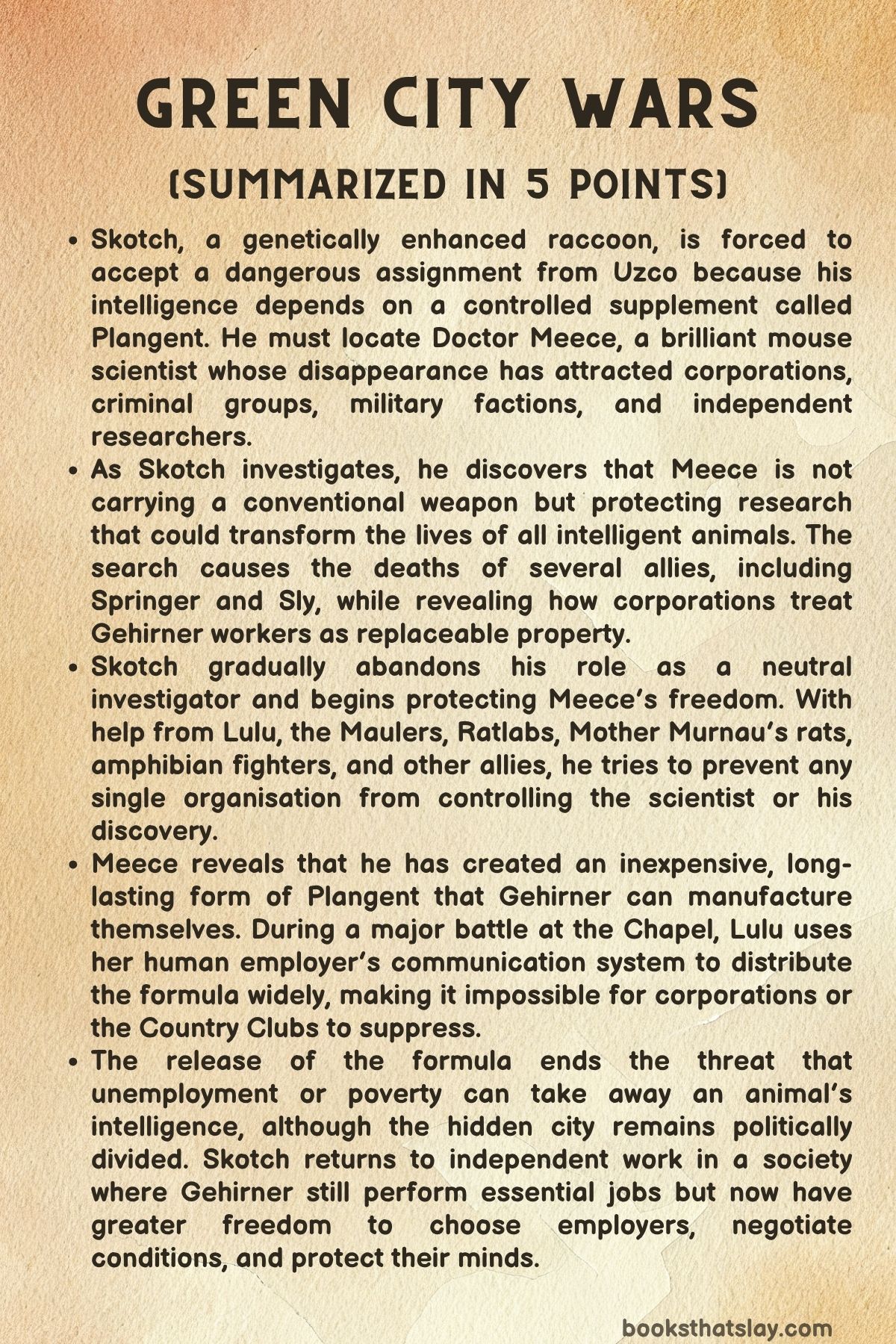
Meece finally reveals that he has discovered a cheap method by which Gehirner can manufacture their own long-lasting Plangent. The formula could end the system that allows corporations, farms, guilds, and armies to control intelligent animals by threatening the loss of their minds.
Szerky attacks the Chapel after arranging for Saint Frances to be removed. Although the defenders are badly outnumbered, amphibians strike from the water, Ratlabs uses specialised technology, and Mauler fighters exploit the hostility between the two squirrel armies.
The Redcoat-Graycoat alliance eventually collapses when each side believes the other has betrayed it. In the resulting confusion, Maria attacks Szerky to avenge Fitch but is killed by the faster stoatweasel.
Meece completes the formula but cannot transmit it because Benson has blocked communications. Lulu shields him with her wounded body as Szerky approaches to kill them.
The arrival of Schreiber, Lulu’s human employer, immediately stops the battle because the animals are conditioned to obey Rule One. Lulu speaks to him as a professional reporter and uses his unrestricted human equipment to transmit the formula to multiple independent networks.
The discovery can no longer be destroyed, hidden, or monopolised. Skotch considers killing Szerky for the deaths she caused but ultimately orders her to leave, after which Tybelle kills her.
In the period that follows, known as the Changes, Plangent production spreads throughout the city. Employers can no longer control workers by threatening them with intellectual collapse, yet the city’s services continue to operate because Gehirner still value work, community, and purpose.
Skotch begins receiving better independent assignments and is treated with greater respect by both HengZeico and Uzco. He ends the story with the knowledge that poverty or temporary unemployment can no longer take away his ability to think, speak, and remain himself.
Characters
Skotch
Skotch is the central character and moral centre of Green City Wars. His dependence on Plangent places him in an immediate physical and psychological crisis, making his investigation inseparable from the system of control he gradually begins to question.
At first, he presents himself as a practical freelancer who avoids political commitments and survives by dealing with rival companies, armies, criminals, and guilds. His supposed neutrality is partly self-protection, because open rebellion could leave him without work, shelter, medication, or legal protection.
His pursuit of Meece forces him to confront the limits of that neutrality. Springer, Sly, Eddi, Maria, and others die because institutions are willing to sacrifice individuals in order to protect their economic interests.
Skotch’s strongest quality is his refusal to accept a convenient answer once he suspects deception. He continues investigating even when Benson, Szerky, Mother Murnau, Ratlabs, and the squirrel armies all offer him reasons to surrender Meece.
His moral development becomes clearest when he stops viewing Meece as the object of an assignment. He begins to recognise the mouse as a person whose intelligence, work, and freedom cannot legitimately belong to an employer.
Skotch is not presented as a flawless revolutionary. He fears that freely available Plangent might collapse the economic system, and his first instinct is often to preserve stability rather than challenge injustice.
His eventual support for Meece’s formula therefore carries weight because it results from experience rather than ideology. He comes to believe that a society dependent on forced obedience is already unstable, even when its streets remain clean and its machinery continues operating.
His mercy toward Szerky also distinguishes him from several other characters. Although he has every reason to kill her, he refuses to let vengeance determine his final decision, even though Tybelle immediately makes a different choice.
Doctor Meece
Doctor Meece is the fugitive scientist whose disappearance drives the entire conflict. Physically fragile and nearing the end of his short mouse lifespan, he possesses an intellect created by accelerated learning experiments and expanded by a mutation that transformed his whole body into part of his cognitive system.
His genius makes him valuable to every faction, but that value rarely produces respect for his autonomy. Uzco, the Country Clubs, Ratlabs, the Rattenkönige, and the Maulers all view him through different political interests, even when they claim to support his freedom.
Meece’s secrecy initially makes him difficult to trust. He refuses to explain his work because he knows that premature disclosure would allow powerful institutions to suppress, steal, or weaponise it.
His discovery of independently produced Plangent changes the political meaning of intelligence within Green City Wars. Instead of accepting intelligence as a service rented from employers, he treats it as a condition that should belong permanently to the individual.
Meece is not motivated by personal advancement. He understands that his remaining life is short and is willing to risk it so that later generations will not experience the same dependence.
His work represents scientific knowledge used against structural coercion rather than for commercial advantage. By ensuring that the formula is distributed to multiple networks, he prevents any single group from becoming the new controller of Gehirner intelligence.
Lulu
Lulu is an augmented pigeon who works as a researcher and reporter for the human novelist Schreiber. Her curiosity initially irritates Skotch, but her persistence gradually becomes essential to the investigation and to the survival of Meece’s discovery.
She refuses to accept that danger is a sufficient reason to remain uninformed. Even after witnessing violence, capture, death, and political manipulation, she continues recording events because she believes that hidden lives must be documented.
Lulu’s injured wing marks a major change in her circumstances. Flight is central to her independence, yet she does not allow the possibility of permanent disability to reduce her sense of professional purpose.
Her relationship with Schreiber becomes especially important at the climax. By speaking to him as an employee rather than behaving like a pet, she challenges the human assumption that enhanced animals are merely tools or curiosities.
Lulu ultimately performs the act that makes Meece’s victory permanent. She uses Schreiber’s communication technology to transmit the formula beyond the reach of Benson, Szerky, and the Country Clubs.
Her courage differs from Skotch’s physical endurance or Tybelle’s predatory strength. Lulu’s power comes from information, communication, observation, and the conviction that a story can alter the conditions under which others live.
Szerky
Szerky is the principal direct antagonist and the most ruthless representative of the Country Clubs. As a stoatweasel enforcer, she combines exceptional physical ability with absolute commitment to the institutions that employ her.
She treats Meece as stolen property and sees anyone protecting him as an obstacle to be threatened, purchased, or killed. Her weaponised bees demonstrate how scientific knowledge has already been turned into a specialised instrument of intimidation.
Szerky is responsible for the chain of violence that kills Springer, Sly, Fitch, Maria, Eddi, and many others, either directly or through forces hired by the Country Clubs. She manipulates the Graycoats and Redcoats with money, proving that ideological enemies can be temporarily united by economic pressure.
Her most revealing quality is her inability to imagine loyalty outside hierarchy. She assumes that every individual ultimately belongs to an employer, army, species group, or patron.
Szerky’s violence is not uncontrolled anger but disciplined enforcement. That makes her more dangerous because she regards cruelty as a reasonable tool for maintaining order.
Her death at Tybelle’s hands ends her immediate threat, but the institutions that empowered her remain. She therefore represents not only individual brutality but also the larger system that rewards brutality when it protects ownership and dependence.
Benson
Benson is an elderly snapping turtle who directs Uzco’s animal operations from a motorised tank. His slow physical movements contrast with his sharp political judgement and his ability to control others through contracts, information, company credit, and access to Plangent.
He understands Skotch’s vulnerabilities from the beginning. Rather than openly threatening him, Benson offers medicine, technical updates, and employment, turning survival into a transaction that appears voluntary.
Benson frequently presents corporate interest as practical necessity. He claims that Uzco provides order, work, and stability, while avoiding the fact that the company’s authority depends on its ability to withdraw intelligence from disobedient workers.
His handling of Fitch’s death exposes the limits of corporate loyalty. By accepting compensation from the Country Clubs, he reduces a dead employee to an account that can be financially settled.
Benson is adaptable rather than fanatical. Once Meece’s formula becomes public, he does not collapse or continue an unwinnable war; he concludes that Uzco will find new ways to operate under changed conditions.
This adaptability makes him morally ambiguous. He is capable of recognising reality and even respecting Skotch’s abilities, but he never fully rejects the assumption that relationships are governed by ownership, leverage, and profit.
Maria
Maria begins as an Uzco enforcer and Fitch’s loyal partner. She distrusts Skotch, regards him as a former employee who has forgotten his obligations, and initially accepts Benson’s description of the corporation as the source of order and protection.
Fitch’s murder changes her relationship with the company. Her grief becomes anger when she learns that Benson accepted compensation from the Country Clubs rather than seeking meaningful justice.
Maria gradually realises that the loyalty demanded by Uzco is not returned to its workers. The company expects obedience and sacrifice but treats individual lives as replaceable expenses.
Her decision to join the Chapel defenders is therefore both personal and political. She wants revenge against Szerky, yet she is also rejecting the employer that tried to control her response to Fitch’s death.
Maria’s final attack on Szerky is courageous but driven by rage. She dies before achieving revenge, showing how personal resistance can be overwhelmed when it lacks the collective strategy that Meece’s supporters are attempting to build.
Saint Frances
Saint Frances is the human nun who operates the Chapel as a sanctuary. She openly violates Rule One by speaking to Gehirner, providing medical treatment, arranging meetings, and recognising their intelligence.
Her importance comes from the protection created by her human status. Factions that routinely murder one another hesitate to violate a space associated with a human, revealing that the safety of augmented animals still depends on human recognition.
Saint Frances does not attempt to rule the community she protects. She acts as a mediator and provider, allowing rival groups to meet without requiring them to share her beliefs.
Her removal before the battle demonstrates how fragile sanctuary can be when it rests on one person’s presence. Szerky’s influence over the religious order shows that even charitable institutions can be manipulated by political and economic pressure.
Although Saint Frances is absent during the final conflict, her earlier decision to contact Schreiber indirectly enables the formula’s transmission. Her compassion produces practical consequences beyond immediate relief.
Mother Murnau
Mother Murnau is an ancient Rattenkönig whose failing body is sustained by machinery. She rules through family loyalty, criminal power, ritual authority, and the fear attached to generations of organised rat society.
She is threatening, manipulative, and willing to use Tybelle as an instrument of violence. However, her desire to control Meece is connected to a genuine understanding of how rats and mice are exploited because of their short lives and weak legal position.
Murnau believes collective power is necessary because official institutions do not protect vulnerable species. Her criminal organisation becomes an alternative government for animals excluded from corporate and guild structures.
Her motives remain mixed. She wants Meece’s discovery to improve the condition of rats, but she also expects the knowledge to strengthen her own authority.
Murnau therefore represents the tension between community defence and political domination. She opposes corporate oppression while reproducing some of its methods, including secrecy, coercion, and control over individuals.
Tybelle
Tybelle is a highly enhanced cat associated with Mother Murnau. She presents herself as a human-owned pet, and that apparent connection gives her unusual freedom because other Gehirner fear provoking the human world.
She is graceful, intelligent, physically dominant, and openly predatory. Her pursuit of Skotch is partly professional and partly recreational, since she treats dangerous opponents as sources of entertainment.
Despite her cruelty, Tybelle repeatedly acts according to a personal code. She refuses to kill Skotch and Lulu when they are too weak to offer meaningful resistance, and she protects Meece by hiding him among her followers.
Her actions are never purely selfless. She enjoys fear, cultivates worship, and takes pleasure in reminding others that she may hunt them later.
At the climax, Tybelle fights in defence of Meece and kills Szerky after Skotch chooses mercy. She represents a form of power that resists institutional discipline but remains morally unpredictable.
Springer
Springer is a Graycoat quartermaster and former Uzco worker. Her scarred body reflects the dangers of military life, while her position shows that she has earned authority within the squirrel army.
She assists Skotch because he once saved her from a fire. Although she insists that helping him will settle their debt, her actions suggest a deeper respect that survives political separation.
Springer does not blindly trust Skotch, especially because of his history with Uzco. She nevertheless guides him through Graycoat territory and protects him when Szerky attacks.
Her death from the bee weapon gives the investigation its first major personal cost. It also destroys Skotch’s remaining hope that he can move through the conflict without taking a moral position.
Sly
Sly is a disabled fox who lost his front legs while detecting explosives for the British military. His mechanical limbs and intelligence network reveal both the sophistication of Gehirner technology and the neglect experienced by former service animals.
He survives by training ordinary dogs to beg in human districts while carrying cameras and microphones. This arrangement allows him to gather information in places where enhanced animals cannot safely travel.
Sly is practical, suspicious, and aware of the risks involved in Skotch’s case. He agrees to help after an old debt is settled, but his willingness also reflects professional pride and personal loyalty.
The destruction of his dogs is especially cruel because they are both his workforce and his community. His death confirms that the Country Clubs are willing to eliminate entire networks to protect their control over Meece’s knowledge.
Fischer
Fischer is a heavily armed toad and prominent member of the Maulers. He initially blocks Skotch from following Meece because the anarchists believe that the doctor has chosen their protection voluntarily.
Fischer distrusts corporations, guilds, armies, and any arrangement that disguises ownership as employment. His suspicion of Skotch is therefore reasonable, since Skotch begins the investigation as a paid agent of Uzco.
He gradually recognises that Skotch is prepared to risk himself for Meece’s autonomy. Fischer permits him to speak with the scientist and later helps defend the Chapel.
Fischer represents organised resistance built around voluntary association. Unlike Benson or Murnau, he does not claim that collective security requires permanent control over those being protected.
Nimoy
Nimoy is a cybernetically modified rat and a leading representative of Ratlabs. He provides Skotch with Plangent, installs new geneware without permission, and explains the biological basis of Meece’s extraordinary intelligence.
His scientific knowledge is extensive, and he genuinely believes that research should improve Gehirner society. Ratlabs itself demonstrates that animals can create advanced technology outside human corporations.
However, Nimoy’s certainty in his own good intentions makes him dangerous. He treats invasive procedures and political alliances as acceptable when they serve what he defines as collective progress.
His cooperation with Mother Murnau confirms Skotch’s fear that Meece may be transferred into another form of captivity. Nimoy represents benevolent control, in which freedom is restricted not for profit but for a supposedly superior social objective.
Shojen
Shojen is a tanuki associated with HengZeico and one of Skotch’s more reliable contacts. He understands corporate politics and is careful not to create disputes that could threaten his own position.
He offers Skotch indirect support rather than dramatic intervention. When HengZeico publicly claims it would protect Meece, Shojen privately warns that the corporation should not be trusted.
His divided behaviour reflects the compromises required of intelligent animals working inside powerful institutions. He must repeat official positions while preserving enough personal independence to give honest advice.
After the Changes, Shojen’s quiet satisfaction shows that he welcomes the weakening of Plangent control even while continuing to represent his employer.
The Baron of Waste Sector Three
The Baron is an enormous frog who governs the amphibian community of Gasthofmund. Her authority rests on the essential water-reclamation work performed by the Wasservolk, even though land-dwelling factions often treat them with contempt.
She knew Meece through his scientific work and recognises that his escape is motivated by discovery rather than destruction. Her defence of him is based on respect for intellectual freedom and opposition to enslavement.
The Baron asks Skotch one of the book’s central moral questions: whether fear of possible misuse justifies returning a brilliant individual to those who own and exploit him.
Her amphibian fighters later provide crucial military support at the Chapel. She therefore combines ethical judgement with practical willingness to defend the principles she expresses.
Eddi
Eddi is a rat connected to Mother Murnau’s organisation. He explains to Skotch that organised rat power emerged because short-lived and vulnerable animals could not rely on official systems to protect them.
His argument complicates Skotch’s view of the Rattenkönige as simple criminals. Eddi shows that criminal structures can become systems of mutual defence when legitimate institutions exclude entire communities.
He later helps Meece’s group escape and is killed while covering their retreat. His death demonstrates that loyalty within Murnau’s organisation is not based only on fear or financial reward.
Wizzo
Wizzo is a militant rat and committed member of the Maulers. He speaks openly against guilds, corporations, military hierarchies, and the dependence created by controlled Plangent.
His political beliefs are uncompromising, but they are supported by his willingness to take personal risks. During the battle at the Chapel, he is mortally wounded and detonates his remaining explosives among the attacking Graycoats.
Wizzo’s death reflects both the courage and destructiveness of revolutionary resistance. He refuses capture, but his final act also shows how systems of coercion can push individuals toward extreme sacrifice.
Hansard Brass-Shirt
Hansard Brass-Shirt is an elaborately dressed Redcoat officer who captures Skotch and Lulu after the Separation Plant battle. He is intelligent enough to recognise Skotch’s political value and practical enough to preserve Lulu’s life.
His willingness to provide medical treatment does not arise from compassion alone. He views prisoners, information, and Plangent as assets that can be exchanged for strategic advantage.
Brass-Shirt represents the military economy surrounding the conflict. Like the Graycoats, the Redcoats speak in terms of loyalty and territory but remain willing to work for the Country Clubs when sufficient payment is offered.
Ripper
Ripper, formerly known as Ripley, is a hostile Graycoat veteran who remembers Skotch from their time at Uzco. She views him as a possible spy and interprets his independence as a form of betrayal.
Her aggression reflects the bitterness of former corporate workers who have turned military service into a new identity. She believes survival requires loyalty to one side and cannot easily understand Skotch’s refusal to belong permanently to any faction.
Ripper repeatedly pursues Skotch and nearly kills him at the Separation Plant. Her death from a Redcoat projectile shows how individual hostility becomes insignificant once larger armies begin destroying one another.
Fitch
Fitch is an Uzco enforcer and Maria’s partner. He helps return Skotch to the company at the beginning of the investigation and appears to accept Benson’s authority without serious resistance.
His murder in Skotch’s nook remains partly mysterious, but its political function is clear. The death gives Uzco an excuse to seize Skotch and increases Maria’s determination to complete the assignment.
Benson’s later acceptance of compensation reveals that Fitch’s loyalty was not valued as highly as he may have believed. His fate becomes one of the clearest examples of the difference between corporate promises of belonging and the economic calculation applied to dead workers.
Iggy
Iggy is a rat who sells coffee in Rootspace Central 38. His early warning about the Graycoat and Redcoat conflict helps establish the atmosphere of instability surrounding Skotch’s investigation.
Although his role is small, Iggy represents the ordinary service workers who sustain the hidden animal economy. Characters such as him depend on access to territory, customers, security, and Plangent without possessing the power to influence the conflicts that threaten those resources.
Uwe
Uwe is a heavily modified pigeon who trades information. He warns Skotch that Uzco has begun looking for him, giving the raccoon an opportunity to seek alternative work before the corporation takes control of the situation.
His secure equipment later allows Skotch to communicate with Meece. Uwe represents the informal networks through which Gehirner exchange information outside official corporate channels.
Ikelos
Ikelos is an old military tortoise whose supposedly occupied nook contains advanced communications equipment. For much of the story, other animals believe he is hibernating and protected by dangerous military countermeasures.
The later revelation that he died long ago exposes Skotch’s resourcefulness and moral uncertainty. Skotch concealed the death, rented the space, used the equipment, and turned the empty shell into a secret refuge.
Ikelos remains important even in death because the reputation attached to his body provides protection that Skotch could never obtain through legal means. His shell becomes a literal example of how authority may continue operating after the individual behind it has disappeared.
Sister Craw
Sister Craw is a member of the Separatist faith who works at the Separation Plant. She believes that an intelligent animal possesses an essence that must be released before the body is recycled.
Her religious explanation attempts to give dignity to a system that processes the dead into food. For Skotch, however, spiritual language offers little comfort when he is about to be killed and mechanically dismantled.
Sister Craw illustrates how belief can humanise an oppressive institution without changing its material function. She does not create the recycling system, but her presence helps make it culturally acceptable.
Schreiber
Schreiber is a human novelist who employs Lulu to collect stories. For most of the book, he remains outside the hidden Gehirner world and may not fully understand the intelligence of the animals working around him.
His arrival at the Chapel instantly changes the battle because Rule One forces the combatants to hide or submit in the presence of a human. This reaction reveals the overwhelming authority humans possess even when they are unaware of it.
Schreiber treats the injured Lulu gently and provides access to unrestricted communication technology. His equipment allows her to transmit Meece’s formula, although the decision and purpose belong to Lulu rather than to him.
Tekki
Tekki is one of the defenders who fights during the assault on the Chapel. The limited information about Tekki’s personal history keeps the character in the background, but participation in the battle identifies Tekki with the coalition protecting Meece’s work.
Tekki represents the numerous ordinary supporters whose actions make political change possible. The successful defence does not depend only on famous leaders or brilliant scientists but on individuals willing to stand beside them.
Loui
Loui is connected to Mother Murnau and appears in discussions between Ratlabs and the organised rat families. The character helps reveal the alliance developing between scientific and criminal powers.
Although Loui does not receive an extended individual story, the presence of such representatives shows that Murnau’s influence operates through negotiation as well as intimidation. Her organisation is capable of building partnerships that extend far beyond its own territory.
Themes
Intelligence, Dependence, and Personal Freedom
The central conflict arises from the fact that Gehirner intelligence is chemically dependent on Plangent. Speech, memory, professional skill, self-awareness, and social identity can all be taken away when an employer or institution refuses to provide the supplement.
This dependence turns intelligence into a conditional privilege rather than an inherent part of the individual. Animals may technically choose where to work, but refusal can lead to cognitive collapse, making most employment agreements forms of coercion disguised as contracts.
Skotch experiences this injustice personally. Benson does not need to imprison him at the beginning because the offer of Plangent is enough to make refusal almost impossible.
Meece’s formula changes the political structure of Green City Wars by allowing animals to produce long-lasting Plangent independently. The discovery does more than improve medicine; it removes the threat that unemployment, poverty, or disobedience will erase a person’s mind.
The aftermath proves that freedom does not automatically destroy social cooperation. Gehirner continue maintaining the city, conducting research, processing waste, trading information, and providing services, but they can demand fairer treatment and leave abusive employers.
The theme therefore separates meaningful work from forced labour. The animals do not reject responsibility when coercion is removed; instead, they gain the ability to connect work with choice, dignity, and collective purpose.
Ownership, Employment, and Institutional Power
Nearly every major faction claims some form of ownership over individuals. Uzco calls Skotch a former employee but behaves as though his origin, geneware, and need for Plangent give the company permanent authority over him.
The Country Clubs treat Meece’s escape as theft because they define his intelligence and research as products created by the Farm Projects. His wishes become irrelevant once his body and knowledge are classified as institutional property.
Even organisations opposing the corporations reproduce parts of this logic. Mother Murnau wants Meece for the protection of rats, while Ratlabs believes that scientific progress justifies controlling where he works and how his discoveries are used.
The Maulers come closest to rejecting ownership completely by insisting that Meece must decide whether he remains with them. Their position is politically disruptive because it places consent above efficiency, security, profit, and species loyalty.
The book also shows that institutions value individuals differently depending on their usefulness. Fitch’s death can be financially settled, Skotch receives medicine only when needed for an assignment, and Lulu is protected partly because her connection to a human creates political risk.
Power survives by presenting these arrangements as natural. Corporations speak of opportunity, armies speak of loyalty, criminal families speak of protection, and scientists speak of collective progress, yet each language can conceal control over vulnerable lives.
Knowledge as Liberation and Threat
Meece’s research inspires fear because knowledge can alter the relationships supporting the entire hidden city. Benson, Szerky, Ratlabs, the Maulers, and Mother Murnau understand that the Plangent formula is more powerful than an ordinary weapon because it changes who controls intelligence.
Scientific discovery is therefore never separated from politics. A formula may be chemically neutral, but its ownership, distribution, and accessibility determine whether it strengthens existing authority or weakens it.
Skotch initially fears that uncontrolled Plangent will create chaos. His concern reflects the belief that workers perform necessary tasks only because deprivation forces them to obey.
Experience gradually persuades him that knowledge should not be suppressed merely because freedom creates uncertainty. The existing stability has already produced war, murder, exploitation, and the routine recycling of unwanted bodies.
Meece protects the discovery through secrecy until it can be distributed widely. He recognises that giving the formula to one apparently benevolent institution would simply create a new monopoly.
Lulu’s transmission of the research completes this argument. Once the knowledge reaches multiple networks, it becomes difficult to destroy, purchase, censor, or convert into exclusive property.
The book presents information as most liberating when no single authority can control access. Open distribution becomes a defence against both commercial exploitation and political manipulation.
Solidarity Across Divided Communities
The hidden city is fragmented by species, employer, territory, ideology, and social function. Graycoats fight Redcoats, rats distrust cats, land animals dismiss amphibians, corporations compete with guilds, and anarchists reject nearly every organised institution.
These divisions make the population easier to control. The Country Clubs successfully hire both squirrel armies because each side values payment and territorial advantage more than the freedom of a mouse scientist.
The defence of the Chapel becomes possible only when different communities recognise a shared interest. Maulers, Ratlabs scientists, Rattenkönig agents, amphibian fighters, former corporate workers, cultists, and independent animals cooperate despite serious disagreements.
Their alliance is neither pure nor permanent. Mother Murnau still wants influence, Nimoy remains controlling, Tybelle remains dangerous, and the Maulers continue distrusting hierarchical organisations.
Solidarity does not require the disappearance of these conflicts. It requires a temporary recognition that no group can secure lasting freedom while the system of intellectual dependence remains intact.
The deaths of Springer, Sly, Eddi, Wizzo, and Maria also reveal the cost of delayed cooperation. Each character is isolated by military loyalty, professional duty, species politics, or personal revenge before becoming part of a wider resistance.
The eventual Changes result not from one heroic faction but from combined action. Scientific knowledge, investigative persistence, military defence, human access, journalism, community networks, and individual sacrifice all contribute to the transformation.