It Could Have Been Her Summary, Characters and Themes
It Could Have Been Her by Lisa Jewell is a psychological mystery about hidden crimes, damaged families, coercive relationships, and the long consequences of silence.
The story follows Jane Trevally, a fifty-five-year-old woman whose discovery of a lost dog leads her back to Thornwood, a Hampstead house where she narrowly escaped a dangerous encounter many years earlier. What begins as an informal search for a missing young woman gradually exposes captivity, murder, false identities, and generational abuse. Alongside the mystery, the book examines Jane’s uncertainty about aging, family, purpose, and whether she can build a new life after decades of defining herself through other people.
Summary
In June 2005, a young sound engineer named Claire Connolly accidentally enters the garden of Thornwood while trying to rescue a trapped cat. The isolated Hampstead house belongs to Allen and Annie Black, who live there with their children, Jessamine and Jasper.
Allen welcomes Claire with polished charm and persuades her to remain for food, despite Annie’s visible unease. Claire accepts because she often changes plans without warning, unaware that nobody knows where she is and that Thornwood is far more dangerous than it appears.
More than twenty years later, Jane Trevally lives at Rosebery Hall, the deteriorating Dorset estate she inherited from her troubled parents. She loves the house as the final connection to her family, yet its maintenance is becoming impossible, and she has begun wondering whether preserving it is preventing her from moving forward.
While walking her dogs, Jane discovers a muddy West Highland terrier wandering near the woods. The dog is identified as Hugo Tucker, whose registered address is Thornwood in the Vale of Health, Hampstead, so Jane decides to return him while visiting her stepson Dexter in London.
As Jane and Dexter approach Thornwood, Jane recognizes it as the house where she experienced a terrifying encounter in 2000. Shortly after leaving her first husband, she had met an older man named Allen in a bar, accepted his invitation to discuss possible work, and followed him home while drunk and emotionally vulnerable.
Inside Thornwood, Allen had pressured Jane to drink a martini and grabbed her when she tried to leave. His wife, Annie, intervened by mentioning that the children were awake, allowing Jane to escape through the gate and run toward Hampstead.
The man who now answers the door is not Allen but Stuart Tucker, a scruffy middle-aged man who recognizes Hugo and says the dog disappeared several days earlier. Jane lies that she found Hugo near Brighton because she does not want Stuart to know that the animal travelled all the way to Dorset.
Soon afterward, Jane learns that a young woman calling herself Rose White rented an annex near Rosebery Hall and then disappeared. Rose left behind her luggage, food, clothing, and possessions, while Hugo apparently escaped into the surrounding countryside.
Jane and Dexter return to Thornwood to tell Stuart, but he denies knowing anyone named Rose and becomes visibly uncomfortable when they mention police involvement. Jane briefly sees a thin, damaged-looking woman inside the house and suspects she is Annie’s daughter Jessamine, Stuart’s partner and Hugo’s registered owner.
Rather than dismissing the mystery, Jane decides to investigate. Encouraged by her former husband Tony and supported by Dexter, she begins imagining a new career as a private investigator, something that would give her independence beyond Rosebery Hall, failed marriages, and inherited responsibilities.
Jane examines Rose’s annex and notices inconsistencies in the young woman’s identity. Rose claimed to be studying for examinations, but there are no books, notes, or educational materials, while some of the clothing appears deliberately chosen to support a disguise.
In the woods near Rosebery, Jane finds a school hoodie bearing the initials DB. She traces the logo to an academy near Hampstead and gradually learns that Rose White is actually Daisy Black, Jessamine’s daughter and Stuart’s stepdaughter.
Jane’s inquiries reveal that Daisy grew up in Thornwood under disturbing circumstances. Neighbors remember her as isolated and withdrawn, while Stuart, rather than Jessamine, appears to have handled most of her daily care.
As Jane researches Jessamine, she learns that the woman once pursued acting and appeared in a small film. Former colleagues describe her as beautiful, talented, intense, demanding, and emotionally unstable, suggesting that she attempted to create a life outside Thornwood but never escaped its psychological influence.
The history of Thornwood emerges through accounts from Allen, Annie, Jessamine, Jasper, Claire, Stuart, and Daisy. Allen grew up longing for a traditional domestic household, yet his idea of family depended on women performing every practical and emotional service for him.
After Annie’s mother died, Allen refused to accept that Annie might have to clean, cook, or resume a sexual relationship with him. He began bringing vulnerable women into Thornwood under the label of au pairs, promising them employment while expecting domestic labor, childcare, and sexual obedience.
Sandra, one of Allen’s former sex workers, was the first woman placed in this role. Later women, including Naomi de Santo and several others, faced increasing restrictions and were eventually confined in hidden rooms beneath the house.
Annie understood much of what Allen was doing but protected the household instead of the victims. She occasionally intervened, as she did when Allen attempted to detain Jane, yet her larger pattern was one of silence, denial, and participation.
Jessamine and Jasper grew up watching the exploitation become part of ordinary family life. Jessamine learned to conceal fear and imitate her father’s controlling behavior, while Jasper developed disturbing sexual impulses that he separated from himself through Patch, a clown persona associated with tricks, masks, white gloves, and humiliation.
Claire’s accidental arrival in 2005 revived Allen’s interest in keeping a young woman at Thornwood. He drugged her, prevented her from leaving, and eventually confined her beneath his study, where she remained for nearly a year.
Jasper formed a complicated attachment to Claire and tried to show that he wanted to help her. Although he had previously watched and participated in the degradation of other captive women, Claire’s suffering finally pushed him to act against Allen.
He stole a knife and took it to Claire, hoping she could use it to escape. When Jasper later returned to the underground rooms, he found Allen dead from a knife wound, Claire dead nearby, Jessamine holding Claire’s newborn baby, and Annie preparing to help conceal what had happened.
Jessamine claimed that Claire had killed Allen and then needed to be stopped, but the truth was that Jessamine killed Claire after Allen’s death. Claire’s baby was raised as Daisy, while Jessamine pretended that the child had been conceived during an affair with a married businessman named Harvey Moor.
Jasper left Thornwood and trained as a clown, eventually joining Martello’s Circus. His departure did not end his disturbing behavior, as he later followed and sexually terrorized a woman named Avril Christmas while wearing a clown mask.
Years afterward, Stuart entered the Black family’s life after noticing Jessamine drinking alone in a Hampstead pub. A recovering alcoholic himself, he recognized her addiction and approached her with the belief that he could understand, rescue, and reform her.
Stuart moved into Thornwood and gradually became responsible for cooking, cleaning, caring for Hugo, supporting Daisy, managing Annie’s routines, and controlling Jessamine’s drinking. His desire to help made him increasingly vulnerable to Jessamine’s manipulation.
Whenever Stuart attempted to leave, Jessamine threatened self-harm, created medical emergencies, or directed her anger toward him. After Stuart spent a day with his daughter Blaise, Jessamine attacked him, damaged his ear, locked him in an attic room, and used threats against herself and Daisy to ensure his return.
During the pandemic, Detective Inspector Sara Brooks revisited Claire’s disappearance and questioned the household. Daisy experienced an immediate emotional reaction to Claire’s photograph, while Annie’s terror at the possibility of a full search convinced Stuart that the property contained physical evidence.
Stuart later discovered a photograph showing a woman restrained in shackles. He confronted Jessamine and Annie, but he did not contact the police because he feared destabilizing the household and believed remaining silent would protect Daisy.
Daisy eventually learned that a DNA test proved Harvey was not her biological father. Her doubts about Jessamine’s motherhood intensified, and she began secretly investigating Claire, Jasper, and Thornwood’s past.
When Daisy discovered that Jasper was performing with Martello’s Circus near Little Belmont, she disguised herself as Rose White, rented the annex, and brought Hugo with her. She watched the circus before confronting Jasper and asking whether Claire was her biological mother.
Jasper admitted that Claire had been inside Thornwood but urged Daisy to question Jessamine. When Daisy accused him of abandoning the victims and leaving Stuart inside an abusive household, Jasper panicked, attacked her in the woods, and attempted to strangle her.
Daisy escaped after striking him and fled through the woods, becoming separated from Hugo. She called Stuart, who collected her and secretly returned her to Thornwood without informing Helen, Jane, or the police.
Jane independently follows the circus connection and learns that Jasper disappeared immediately after the performance near Little Belmont. She searches his caravan, finds his mask, obtains information about his former therapist, and confirms his history of frightening women.
After confronting Stuart with the evidence, Jane persuades him to admit that Daisy has returned. He invites her into Thornwood, where Jane finally meets the frightened young woman she has been seeking.
Daisy explains her search for Jasper and admits that she returned home to confront Annie about Claire. During the confrontation, Annie died after being pushed or falling down the stairs, and Stuart helped move her body into the same outbuilding where women may once have been restrained.
Jessamine initially supports the concealment but changes course after Jane discovers Annie’s body. She tells Stuart to call the police and announces that Thornwood contains the remains of multiple women connected to Allen’s false au-pair arrangements.
Investigators uncover a trapdoor beneath Annie’s study leading to underground rooms containing beds, personal belongings, evidence of captivity, and human remains. The house is finally exposed as the site of a prolonged system of imprisonment, rape, exploitation, and murder.
Jessamine tells the police that Allen committed the sexual crimes and that Annie later killed Allen and Claire before giving Claire’s baby to her. Jane immediately doubts this account because Jessamine appears liberated by Annie’s death and seems to be placing the worst responsibility upon people who can no longer contradict her.
Stuart leaves Thornwood with Hugo and begins confronting how his years of silence protected the household rather than its victims. Although he was abused and controlled by Jessamine, he recognizes that his unwillingness to act allowed evidence to remain hidden and Daisy to remain trapped.
Daisy learns that Claire was her biological mother and separates herself emotionally from Jessamine. She refuses to accept that Jessamine’s childhood trauma excuses her later violence, manipulation, and concealment.
Six months later, Jasper’s body is found in the woods near Little Belmont. The full circumstances of his death remain uncertain, but his disappearance from the circus occurred immediately after Daisy’s confrontation with him.
The final revelation comes from Jasper’s therapy session years earlier. His recovered memory confirms that Claire killed Allen while attempting to escape, but Jessamine killed Claire, took her baby, and helped Annie hide the bodies and preserve the family’s lies.
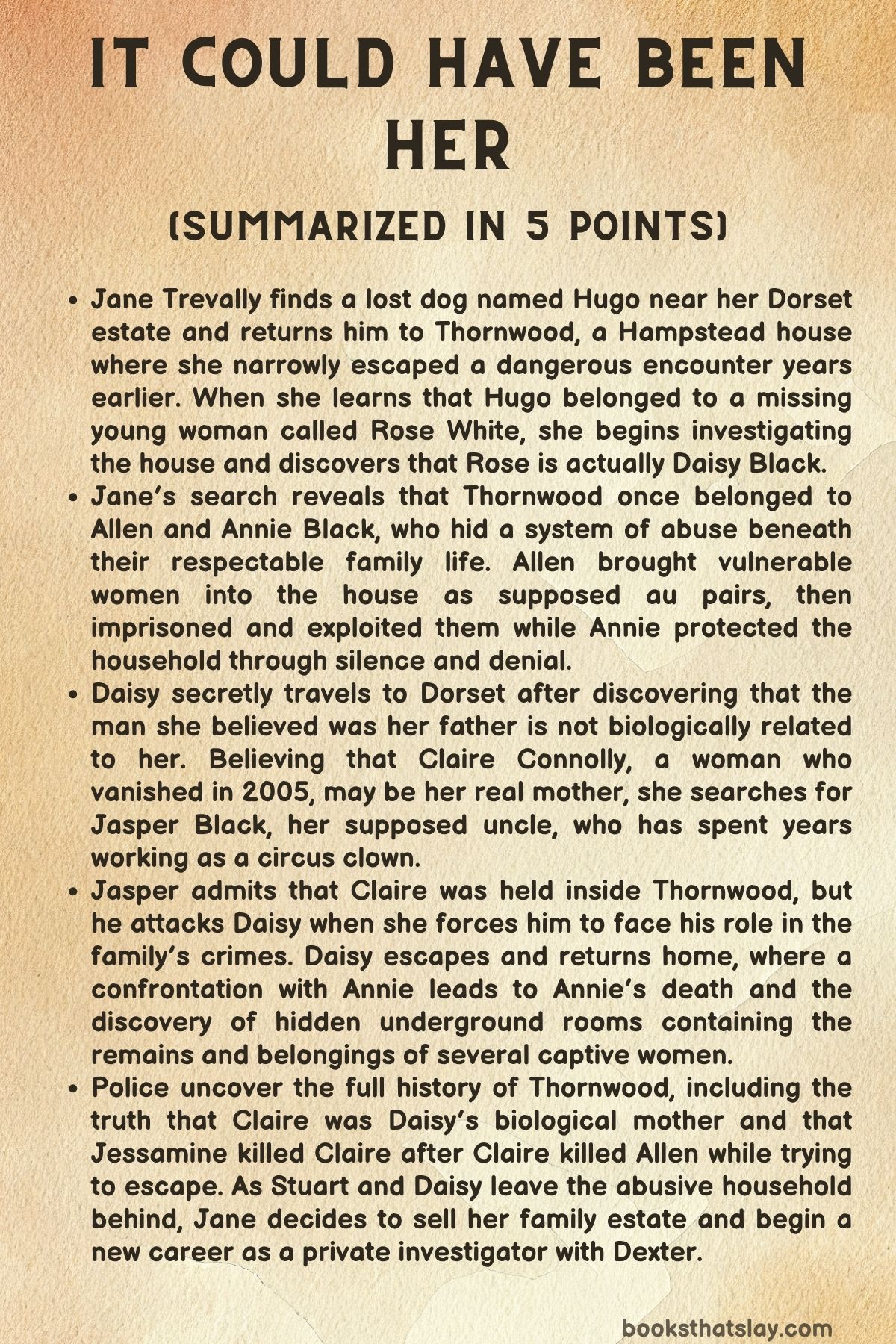
Jane, meanwhile, decides to sell Rosebery Hall and establish an investigative agency with Dexter. Their chosen name, Trevally and Son, recognizes the genuine parent-child bond they formed and gives Jane a future built on purpose, family, and her ability to notice what others prefer not to see.
Characters
Jane Trevally
Jane is the central investigator and emotional anchor of It Could Have Been Her. At fifty-five, she is intelligent, socially confident, compassionate, impulsive, and unusually skilled at encouraging strangers to share private information, yet she has spent much of her life believing she lacks a proper career or independent identity.
Her determination to find Daisy is partly motivated by concern for a missing young woman and partly by the unresolved terror of her own visit to Thornwood. By investigating the house, she symbolically returns to the moment when Annie saved her and asks what might have happened had she remained inside.
Jane’s bright appearance, humor, confidence, and sociability conceal a childhood shaped by alcoholic parents, emotional neglect, and premature responsibility. Her investigation allows her to understand that she has always possessed courage and intuition, even when she defined herself mainly as a wife, stepmother, animal lover, or caretaker.
Her decision to sell Rosebery Hall marks an important emotional change. She learns that preserving a decaying building is not the same as preserving the people she loved, and that family can survive through memories, chosen relationships, and new forms of purpose.
Dexter
Dexter is Jane’s favorite stepson, investigative partner, and most dependable source of emotional support. He believes in Jane’s abilities before she fully believes in them herself and treats her proposed career as a serious ambition rather than an eccentric distraction.
His intelligence, patience, and easy conversational manner make him valuable during interviews. He also provides Jane with moral clarity when she becomes emotionally overwhelmed, particularly when he insists that the evidence from Thornwood must be reported to the police.
Dexter’s greatest importance lies in the way he redefines Jane’s understanding of motherhood. By telling her that she helped rescue and raise her stepchildren, he challenges her fear that she failed to create a meaningful family because she never had biological children.
The proposed agency name, Trevally and Son, confirms that their relationship is not dependent on marriage, blood, or legal labels. Dexter represents chosen loyalty and shows Jane that the family she fears losing has already become permanent.
Stuart Tucker
Stuart is a compassionate but deeply compromised man whose desire to rescue others becomes the source of his captivity. As a recovering alcoholic, he recognizes Jessamine’s addiction almost immediately and believes his understanding of dependency gives him the ability to save her.
His early behavior toward Jessamine is intrusive because he watches her routine, follows her, and inserts himself into her life without invitation. Nevertheless, his actions originate more from loneliness, attraction, and a savior complex than from an intention to control her.
Once Stuart enters Thornwood, he becomes the practical foundation of the household. He cooks, cleans, cares for Hugo, supports Daisy, manages Annie, and attempts to regulate Jessamine, gradually sacrificing his friendships, family relationships, freedom, and safety.
Jessamine uses self-harm, guilt, threats, physical violence, confinement, and concern for Daisy to control him. Stuart understands that he is being abused but repeatedly interprets endurance as loyalty, making him an example of how coercive relationships can trap people who believe they are choosing to remain.
His silence regarding the captive woman’s photograph and Claire’s disappearance creates genuine moral responsibility. Stuart did not create Thornwood’s crimes, but his determination to manage the situation privately allowed the truth to remain hidden.
Daisy Black
Daisy is the biological daughter of Claire Connolly and the child around whom the surviving members of Thornwood construct their most important lie. Raised as Jessamine’s daughter, she grows up feeling that the official stories about her father, mother, uncle, and family history do not fit together.
Her isolation makes her observant, resourceful, and distrustful of adults. She learns to read Jessamine’s moods, protect Stuart from manipulation, and search for information without drawing attention to herself.
Creating the identity of Rose White demonstrates Daisy’s intelligence and determination. She changes her appearance, rents an annex with cash, studies the circus, and approaches Jasper because the adults who raised her refuse to answer her questions.
Daisy’s confrontation with Jasper is both brave and dangerously unprepared. She expects information from him but instead encounters a traumatized and sexually disturbed man whose first response to exposure is physical violence.
Her refusal to forgive Jessamine simply because Jessamine suffered as a child demonstrates strong moral independence. Daisy understands that victimhood may explain later behavior but cannot automatically excuse abuse, murder, manipulation, or concealment.
Jessamine Black
Jessamine is the most morally disturbing figure in It Could Have Been Her because she occupies the roles of victim, witness, abuser, killer, false mother, and unreliable narrator. She grows up in a house where her father exploits women and her mother protects the family system, leaving her with a damaged understanding of love, power, responsibility, and survival.
As a young woman, Jessamine is charismatic, talented, needy, ambitious, and emotionally unstable. Her attempt to become an actress suggests a desire to create another identity, but her psychological connection to Thornwood remains stronger than her ability to leave.
Her relationship with Stuart repeats the controlling patterns established by Allen. She isolates him, depends on his labor, threatens self-harm, sabotages his outside relationships, physically attacks him, confines him, and then presents herself as vulnerable enough to require his forgiveness.
Jessamine’s decision to raise Claire’s baby as her own contains both possession and concealment. Daisy gives her the family identity she wanted, but Jessamine denies the child knowledge of Claire, her biological father, and the violence surrounding her birth.
The final revelation shows that Jessamine killed Claire after Claire killed Allen. Her later accusation against Annie is not merely a defensive lie but an attempt to control the moral meaning of Thornwood even after the physical evidence has been discovered.
Jasper Black
Jasper is a psychologically fractured character shaped by exposure to sexual exploitation, authoritarian control, secrecy, and violence. As a child, he sees captive women as objects within his father’s household and later develops sexual responses to their humiliation.
Patch the Clown functions as a separate identity through which Jasper expresses urges he cannot accept as his own. The mask, gloves, tricks, ropes, and performances allow him to transform shame and aggression into an apparently playful role.
Jasper is neither entirely passive nor entirely innocent. He frightens and sexually violates women, including Avril Christmas, and he later attacks Daisy when she forces him to confront his past.
At the same time, his relationship with Claire produces the first serious challenge to his loyalty toward Allen. By giving Claire a knife, Jasper helps create the possibility of escape, even though he acts too late to save her.
His greatest failure is leaving Daisy behind after witnessing Jessamine’s murder of Claire. Jasper escapes Thornwood physically, but secrecy, shame, and Patch follow him into adulthood, preventing genuine recovery.
Annie Black
Annie is an enabler whose passivity gradually becomes active participation. She begins her relationship with Allen as a teenager and interprets his dominance as protection, allowing him to control practical decisions while she remains dependent on him and her mother.
After losing her mother, Annie accepts the arrival of vulnerable young women because their labor allows her to avoid domestic responsibility and sexual intimacy. She understands that Allen is using them, yet she convinces herself that preserving the household is more important than questioning their freedom.
Annie occasionally acts against Allen, most notably when she helps Jane escape. These moments show that she recognizes danger clearly, making her wider inaction more serious rather than less.
Her protection of the underground rooms, captive women, murders, and false account of Daisy’s birth places her beyond simple fear or weakness. By the end, she has spent decades maintaining a system in which appearances, routine, and family loyalty matter more than human life.
Allen Black
Allen is the creator of Thornwood’s system of exploitation. His polished manners, expensive gifts, domestic ideals, and controlled voice allow him to present himself as a devoted husband and father while treating women as sources of labor, sexual access, and obedience.
He targets women who are financially vulnerable, isolated, intoxicated, or dependent. Employment language gives his actions a respectable surface, but the arrangements become imprisonment once the women resist or threaten the household.
Allen’s understanding of love is based on possession. Annie must remain protected from unpleasant work, the children must preserve family appearances, and the so-called au pairs must satisfy every need without possessing ambitions of their own.
His ability to maintain normal routines above the underground rooms demonstrates his capacity for compartmentalization. Thornwood becomes an external expression of his mind: comfortable and respectable at the surface, violent and dehumanizing beneath it.
Claire Connolly
Claire is independent, sociable, talented, curious, and optimistic about building a career in sound engineering. Her spontaneity and habit of changing plans allow her to enjoy freedom, but they also mean that nobody immediately knows where to search when she disappears.
Her treatment at Thornwood differs initially from that of the other captive women because she retains more of her personality and participates in family life. This apparent privilege is another form of control, designed to make captivity appear temporary and resistance seem more dangerous.
Claire remains alert to opportunities for escape and correctly senses that Allen can harm anyone who challenges him. Her eventual use of Jasper’s knife against Allen represents a desperate act of self-preservation after nearly a year of imprisonment.
Her murder by Jessamine makes her the central lost figure of the story. Although Claire dies before Daisy can know her, her image awakens Daisy’s suspicion and begins the search that ultimately exposes Thornwood.
Tony
Tony is Jane’s second former husband and remains one of her most generous friends. His willingness to give Jane access to his London townhouse demonstrates trust and allows her to develop an independent base while conducting the investigation.
Unlike people who might dismiss Jane’s ambitions because of her age or unconventional history, Tony immediately recognizes her intelligence and encourages her to pursue private investigation. His support helps transform a passing idea into a believable future.
Tony also represents a relationship that has survived divorce without bitterness. Through him, the book shows that emotional bonds can change form without becoming meaningless.
Hugo
Hugo is the accidental link between Rosebery Hall and Thornwood. His appearance near Jane’s estate brings her back to the house she escaped and gives her a practical reason to begin asking questions.
His loyalty connects Jane, Stuart, Daisy, and the wider mystery. Hugo’s separation from Daisy also reveals the seriousness of her encounter with Jasper, since she would never willingly abandon him.
Hugo often reacts more honestly than the people around him. His recognition of places and individuals repeatedly challenges the lies spoken by human characters.
Detective Inspector Sara Brooks
Sara Brooks represents the official investigation that comes close to exposing Thornwood during the pandemic. Her decision to revisit Claire’s disappearance shows persistence and an awareness that the original inquiry may have accepted convenient explanations too quickly.
She notices Daisy’s reaction to Claire’s photograph and understands that the child’s presence at Thornwood raises questions about the family’s history. Her proposed search terrifies Annie because it threatens the physical structure of concealment.
Although Brooks does not immediately uncover the underground rooms, her visit changes Daisy and Stuart. She plants the doubts that eventually lead them to search the house and question Claire’s relationship to Daisy.
Dr. Anthony Twist
Dr. Twist is Jasper’s therapist and one of the few people who understands the psychological division represented by Patch. His professional confidentiality prevents him from freely helping Jane, yet his guarded reactions confirm that Jasper’s history includes severe trauma and potential danger.
During therapy, he guides Jasper back to the night of Allen and Claire’s deaths. This recovered memory provides the final correction to Jessamine’s false account and reveals that Jasper has carried knowledge of the murders for years.
Dr. Twist’s work demonstrates that hidden memories do not disappear simply because a family refuses to discuss them. They survive in altered behavior, repeated violence, symbolic identities, and fractured self-understanding.
Blaise Tucker
Blaise is Stuart’s daughter and a reminder of the life he abandoned while serving Jessamine’s needs. Her independent life in Australia contrasts sharply with the isolation and emotional stagnation of Thornwood.
When Stuart finally explains his relationship, Blaise recognizes the abuse immediately and begs him not to return. Her perspective shows how abnormal his situation has become, even though constant exposure has trained him to treat it as manageable.
Stuart’s decision to return to Thornwood after their dinner demonstrates both his entrapment and his loyalty to Daisy. Blaise represents the possibility of freedom, family reconciliation, and a life beyond compulsory rescue.
Harvey Moor
Harvey functions mainly as a convenient false father for Daisy. His affair with Jessamine gives the household a believable explanation for the child’s existence and allows Jessamine to avoid questions about Claire.
His DNA test destroys the story Jessamine has maintained for years. By withdrawing afterward, he unintentionally forces Stuart and Daisy to confront the possibility that her entire identity is based on deception.
Natasha de Large
Natasha provides Jane with insight into Jessamine’s brief acting career. She remembers Jessamine as talented and magnetic but also difficult, needy, and burdened by emotions she would not explain.
Her observations help Jane understand that Jessamine once possessed the ability to create a public identity separate from Thornwood. They also show that the damage produced by the house was visible to outsiders, even when they could not identify its cause.
Oliver Bloom
Oliver is Jessamine’s former co-star and lover. His revelation that Jessamine claimed she could not have children introduces the possibility that Daisy is not her biological daughter.
His dismissive description of Jessamine reflects his limited understanding of her circumstances, but his information becomes important because it challenges the central family narrative. Through Oliver, Jane learns that Jessamine gave different versions of herself to different people.
Tobias Wilson
Tobias is Tony’s former security consultant and a retired senior police officer. He helps Jane obtain reliable information about Claire’s disappearance, the previous investigation, and the family’s official statements.
His warnings provide a practical counterbalance to Jane’s impulsiveness. He accepts that her suspicions have substance while reminding her that curiosity does not make Thornwood safe.
Helen Yaxley
Helen rents the annex to Daisy under the false name Rose White. Her concern about the abandoned belongings and Hugo helps Jane recognize that the disappearance cannot reasonably be treated as a voluntary departure.
Helen is not trained as an investigator, but her careful memory of Rose’s behavior supplies essential information. By allowing Jane to examine the annex, she gives the inquiry its first physical setting outside Thornwood.
Hester
Hester is the local vet who identifies Hugo through his microchip and later informs Jane that the dog belonged to the missing renter. Her communication turns an act of animal rescue into the beginning of a missing-person investigation.
She also demonstrates the value of ordinary professional responsibility. Without her attempt to trace Hugo’s ownership, Jane might never have returned to Thornwood.
Bill Newsome
Bill is an elderly neighbor who remembers Jane’s parents and her younger self. His recollection of Jane as confident and determined challenges her private memory of being frightened, neglected, and emotionally damaged.
He also reports seeing Rose in the area and helps Jane identify the route Daisy used. His memories connect Jane’s adolescence with Daisy’s isolation and encourage Jane to recognize strengths she has long underestimated.
Spencer and George
Spencer and George provide valuable local knowledge about Daisy’s childhood and the atmosphere surrounding Thornwood. George remembers Daisy as increasingly withdrawn, particularly after the pandemic, while Spencer recalls the house as a place marked by unhappiness.
Their accounts complicate Jane’s early suspicion of Stuart. They identify him as Daisy’s most reliable caregiver, forcing Jane to distinguish between a trapped, compromised protector and the more dangerous members of the Black family.
Stella Madden
Stella rented a room to Jasper after he left Thornwood to attend clown school. She initially found him quiet and polite but later noticed increasingly secretive and disturbing behavior.
Her suspicion that Jasper committed the masked assault in the park shows that Patch remained active beyond the family home. The forwarded letter from Dr. Twist also gives Jane the clue that leads toward Jasper’s therapy and recovered memory.
Avril Christmas
Avril is the woman Jasper terrorized while wearing a clown mask. Her account proves that his sexual aggression was not limited to memories or fantasies connected to Thornwood.
Although Jasper does not physically injure her, the attack causes lasting psychological harm. Avril’s fear demonstrates how an act that may appear brief or nonviolent to the offender can permanently alter a victim’s sense of safety.
Naomi de Santo and the Other Captive Women
Naomi is one of the women brought to Thornwood under false promises of employment. Her resistance exposes the difference between Allen’s respectable language and the coercive conditions he intends to impose.
The other women named by Jessamine represent lives reduced to household secrets. Their disappearance shows how easily vulnerable people can be erased when employers, families, neighbors, and authorities accept convenient explanations.
These women are essential even though much of their individual history remains unknown. The limited information about them reflects the system’s deepest cruelty: Thornwood did not merely imprison their bodies but attempted to remove their identities.
Sandra
Sandra begins as one of Allen’s regular sex workers and voluntarily enters Thornwood to perform domestic and sexual labor. Her arrangement creates the model Allen later uses to exploit women who do not possess the same understanding or freedom.
Her informal manner briefly gives Jessamine an alternative model of femininity and household life. Annie’s violent reaction to Sandra’s influence reveals how strongly the family depends on rigid appearances.
Vivienne Rich
Vivienne is Annie’s mother and the original owner of Thornwood. Her domestic labor allows Allen and Annie to maintain the comfortable household both idealize.
After her death, the practical work she performed becomes the excuse for introducing Sandra and later the captive women. Vivienne is not responsible for Allen’s crimes, but her absence exposes how dependent the family’s apparent harmony was on another woman’s unpaid service.
Morea, Steve, and Dave
Morea and Jasper’s fellow performers describe his life at Martello’s Circus. They remember him as talented, isolated, childlike, and committed to Patch even outside performances.
Their information shows that Jasper never built meaningful relationships during almost twenty years with the circus. His carefully organized departure after meeting Daisy indicates planning, fear, and a desire to escape accountability once again.
Themes
Silence as Participation
In It Could Have Been Her, silence is not presented as neutral. Annie, Stuart, Jasper, Jessamine, neighbors, former colleagues, and investigators all possess fragments of information, yet the crimes survive because nobody combines those fragments or accepts the personal cost of acting upon them.
Annie understands that Allen is exploiting women and occasionally prevents immediate harm, but she continues protecting the household. Her limited acts of resistance cannot erase the years she spends maintaining routines above rooms where women are imprisoned.
Stuart’s silence operates differently because he is manipulated, physically abused, and afraid for Daisy. Nevertheless, once he discovers the photograph of a shackled woman, his decision to avoid the police allows the family’s concealment to continue.
Jasper leaves Thornwood with direct knowledge of Claire’s death and Daisy’s identity. His trauma explains his flight, but his refusal to speak leaves a child in the care of the woman who murdered her mother.
The story therefore separates explanation from absolution. Fear, dependency, shame, addiction, and trauma may clarify why people remain silent, yet silence still protects offenders more effectively than victims.
Coercive Control and the Illusion of Choice
Several relationships appear voluntary at first but gradually reveal systems of control. Allen offers employment, Stuart offers help, Jessamine offers intimacy, and Thornwood offers shelter, yet each apparent choice becomes more limited once the vulnerable person enters the relationship.
Allen targets women who need work, money, housing, or emotional reassurance. His victims may initially agree to enter the house, but consent to employment or hospitality does not become consent to sexual access, confinement, or forced labor.
Stuart also enters Thornwood voluntarily. His entrapment develops through guilt, emotional dependency, concern for Daisy, threats of self-harm, damaged outside relationships, physical assault, and the belief that leaving would make him responsible for disaster.
Jessamine repeats Allen’s methods while presenting herself as the vulnerable party. She creates situations in which Stuart technically can leave, but every exit is connected to the threatened injury of someone he loves.
The book shows that captivity does not always depend on locked doors. A person can remain physically capable of leaving while fear, responsibility, isolation, financial need, shame, or manipulation make departure feel impossible.
Inherited Trauma and Repeated Abuse
Thornwood passes damage from one generation to the next. Allen grows up in an unstable home and responds by creating a rigid domestic ideal in which he controls every source of discomfort.
Jessamine and Jasper grow up surrounded by exploitation and learn that violence can coexist with meals, gifts, jokes, family photographs, and polite conversation. Neither child develops a healthy understanding of consent, accountability, intimacy, or protection.
Jasper divides himself into separate identities, allowing Patch to carry impulses he cannot accept. Jessamine becomes controlling, manipulative, and violent, repeating her father’s methods while claiming that her suffering sets her apart from him.
Daisy represents the possibility of interrupting this inheritance. She experiences neglect, secrecy, and instability, yet she refuses to accept the family’s explanations or excuse Jessamine solely because Jessamine was also abused.
The story does not suggest that trauma automatically produces cruelty. Instead, it shows that unexamined trauma, protected by secrecy and reinforced by power, can become a structure through which abuse is repeated and justified.
Identity, Reinvention, and Chosen Family
Many characters create alternative identities to survive or escape. Daisy becomes Rose White, Jasper becomes Patch, Jane hides insecurity behind confidence and glamour, Jessamine performs different versions of herself, and Stuart adopts the identity of rescuer.
Some reinventions create freedom, while others create further concealment. Daisy’s disguise allows her to search for the truth, but Patch allows Jasper to avoid responsibility for his actions.
Jane’s transformation is healthier because it does not require denying her past. She accepts that she is frightened, aging, uncertain, and attached to Rosebery Hall, yet she also recognizes her intelligence, courage, investigative ability, and capacity for change.
Her relationship with Dexter is central to this development. Jane once believed that not having biological children meant she failed to create a family, but Dexter and her other stepchildren prove that care, loyalty, and shared history can be stronger than blood.
Stuart and Daisy also move toward chosen family after leaving Thornwood. Their future depends not on preserving the Black household but on forming relationships in which safety does not require obedience, secrecy, or emotional submission.