Moss’d in Space Summary, Characters and Themes
Moss’d in Space by Rebecca Thorne is a science-fiction adventure about Torian Razner, a colony engineer who spends her entire savings on an ancient alien starship to save her terminally ill sister.
The vessel appears neglected and impractical, yet it contains Moss, a living organic intelligence responsible for its life-support systems. Torian’s journey soon expands beyond a desperate attempt to reach a privileged planet, leading her toward abandoned alien worlds, unexpected friendships, interspecies cooperation, and a possible new home for people rejected by human society. The book combines space exploration, romance, humor, social criticism, and questions about consciousness, belonging, prejudice, and responsibility.
Summary
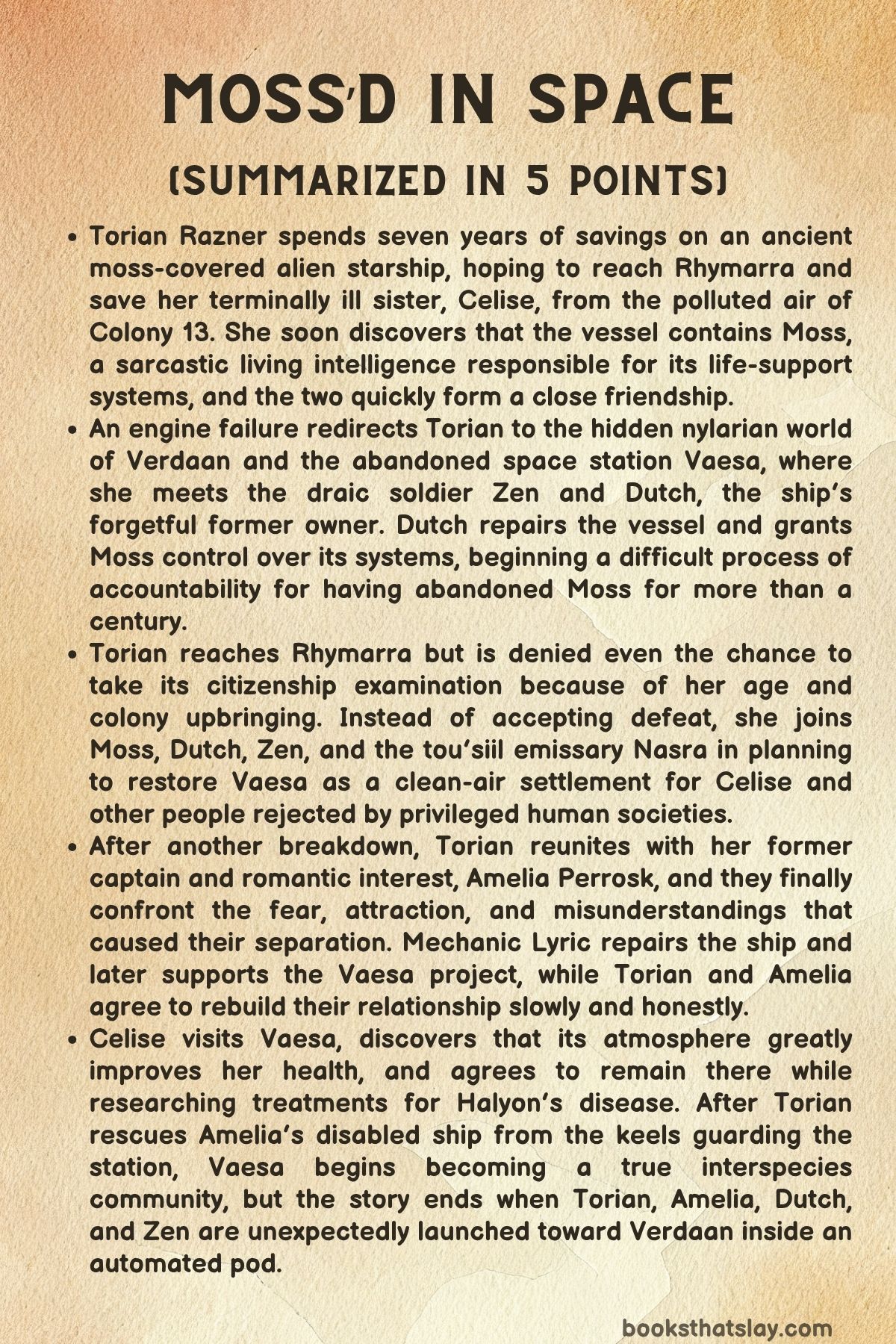
Torian Razner has spent seven years saving enough money to purchase a starship. She hopes to reach Rhymarra, obtain citizenship, and move her sister, Celise, away from the polluted atmosphere responsible for worsening her terminal Halyon’s disease.
At Colony 13’s impound lot, Torian discovers that her savings can buy only one vessel. The ship is an ancient alien craft covered in moss, but its engine appears functional, and Torian refuses to delay her plans by accepting a refund.
The ship contains Moss, a living organic intelligence that has been abandoned for more than a century. Moss expects Torian to reject the vessel, yet her admiration for its plant life and her determination to help Celise persuade it to accept her as a second owner.
Celise reacts with alarm when Torian reveals what she has done. She doubts Torian’s limited piloting experience and argues that Rhymarra’s selective society is unlikely to admit two adults raised and educated on a poor human colony.
Torian nevertheless prepares to leave her Fleet employment. Her former captain, Amelia Perrosk, confronts her after discovering that she has secretly resigned and purchased a vessel registered under the insulting name Traitor.
Their argument reveals emotional tension left unresolved after a passionate kiss and Torian’s injury during a mission. Amelia explains that she had been attempting to obtain an unflagged ship for Torian, since Fleet vessels cannot enter Rhymarran territory, and reluctantly gives her ammunition for the journey.
Once aboard, Torian discovers the ship’s advanced alien systems and hears Moss speak for the first time. Moss explains that it is not a conventional artificial intelligence but a living colony that controls oxygen, humidity, temperature, and other life-support functions.
Torian respects Moss’s boundaries and quickly establishes a friendly relationship with it. Moss reveals that the vessel was formerly called the Destiny but renamed it the Destitute after being abandoned by its creator.
The alien navigation system can travel through wormholes, reducing the journey to Rhymarra from several days to only nine hours. During the trip, Torian learns that the ship was created by the nylarians, an ancient species that once influenced interstellar civilization before disappearing.
Torian and Moss celebrate their meeting by creating Starship Day. Their growing friendship is interrupted when the engine overheats and the ship’s automatic systems redirect them toward the Kialoa Nebula, a region humans regard as a starship graveyard.
The vessel passes safely through the dangerous nebula and reaches Verdaan, the former nylarian homeworld. Beyond it lies Vaesa, an enormous abandoned station composed of interconnected biomes, residential districts, forests, and agricultural environments.
Torian enters Vaesa to search for replacement parts. Moss, unable to accompany her, becomes increasingly worried and studies old surveillance recordings that reveal how often Torian has endangered herself while protecting others.
Inside the station, Torian encounters a large draic named Zenthielutos, or Zen. She initially assumes he is dangerous because of human stories about draics, but Zen reacts with frustration rather than violence and forces her to reconsider what she has been taught.
Zen introduces Torian to Dutch, a blue-haired nylarian who is the Destitute’s former owner and the last known member of his species. Dutch admits that he accidentally left the ship on a human station, forgot its location, and spent decades searching for it.
Moss responds with anger and refuses to forgive Dutch for abandoning it. Torian fears that he may reclaim the vessel, but she also needs his technical knowledge to repair the engine and continue the journey.
Dutch fixes the damaged component and apologizes to Moss. Rather than accepting a simple apology, Moss demands authority over the ship’s navigation, engine, cameras, and other systems so that it can never again be trapped without control over its own existence.
Dutch agrees and modifies the vessel. Torian is briefly unsettled by Moss’s expanded independence, but she accepts that it deserves autonomy rather than permanent dependence on an owner.
They leave Vaesa and continue toward Rhymarra. After arriving, Torian persuades traffic control to let her dock at Terra Nova University by claiming that her visit has an educational purpose.
Rhymarra’s clean air, open sky, and natural landscape strengthen Torian’s determination to bring Celise there. At the university, she meets Nasra, a tou’siil student connected to her species’ collective consciousness, before forcing her way into a meeting with Headmaster Nuun.
Nuun refuses even to let Torian take the citizenship examination. He considers her too old to assimilate and openly argues that colony residents bring crime, unsuitable technology, and values that threaten Rhymarra’s controlled society.
Torian condemns Rhymarra for abandoning unsuccessful citizens while denying other humans a fair opportunity. Nuun remains unmoved by Celise’s illness and orders Torian to leave.
While Torian faces rejection, Dutch and Moss discuss Celise’s condition. They realize that Vaesa could become a clean-air settlement for people suffering from Halyon’s disease and others excluded from Rhymarra.
Dutch proposes restoring the station with Torian’s help. Vaesa contains homes, agricultural biomes, natural environments, and enough room for Celise to continue her research while living within a community.
Torian recognizes the enormous political and practical difficulties involved, yet she also understands that the plan could help far more people than her original goal. She accepts Dutch’s offer and begins imagining Vaesa as a home for patients, workers, scientists, rejected citizens, and travelers.
Zen supports the restoration project, and Nasra explains that the Confederation of Spacefaring Species has always respected Vaesa as nylarian territory. Dutch’s authorization means the larger interstellar community may now assist with its repair.
As Torian and Moss leave Rhymarra to collect Celise, the replacement engine component fails. Amelia responds to their distress signal, jokes about Torian becoming stranded, and tows the Destitute toward Colony 4.
Moss embarrasses Torian by openly analyzing her attraction to Amelia. Torian then discovers that Moss studied public surveillance footage to determine whether she could be trusted, prompting a serious discussion about privacy and boundaries.
On Colony 4, members of the rival Luminas syndicate attack the Destitute. Torian confronts an intruder cutting through the hull but is injured after hesitating to kill him.
Amelia intervenes, shoots the attacker, and drives away the threat. She then confronts Torian about her continued lack of self-preservation, forcing them to discuss the mission in which Torian was shot protecting her.
Amelia admits that Torian’s injury terrified her. Her decision to demote and avoid Torian was an attempt to protect herself from emotional vulnerability, not proof that she did not care.
They seek help from Lyric, a talented mechanic and botanist who immediately recognizes Moss as an organic intelligence. Lyric respects Moss’s boundaries, repairs the engine, and becomes interested in the Vaesa project.
Amelia later reveals that she was born on Rhymarra but expelled after failing its citizenship examinations. Her family remained behind, leaving her with lasting anger toward the society that judged and discarded her.
Torian and Amelia agree not to rush into romance. Instead, they decide to rebuild their friendship with greater honesty while acknowledging that their feelings have not disappeared.
After returning to Colony 13, Torian tells Celise that Rhymarra rejected her. She then explains the existence of Vaesa, Moss, Dutch, Zen, and the plan to create a clean-air settlement.
Celise initially suspects that Torian has become delusional. Even after believing her, she worries that leaving would mean abandoning her patients, research, and community.
Torian asks her only to visit Vaesa before deciding. Celise agrees and boards the Destitute, where she quickly appreciates Moss’s sarcasm and becomes fascinated by its biological life-support functions.
Tests confirm that the ship provides exceptionally pure air and that Celise’s breathing improves almost immediately. She begins considering how Moss’s systems could contribute to research benefiting other Halyon’s disease patients.
During the journey, Auto-Navigation begins speaking to Moss. The formerly simple subsystem has developed insecurity, preferences, and self-awareness after being exposed to Moss’s expanded code.
Torian refuses to dismiss Auto-Navigation as a malfunction. She treats it as a developing intelligence and learns that it loves flying, while Moss struggles with the responsibilities of becoming an accidental parent.
At Vaesa, Celise meets Voranthir, a draic connected to Zen’s military group. Their first conversation becomes argumentative, as neither is willing to tolerate the other’s assumptions or rude behavior.
Nasra explains that the nylarians once terraformed Rhymarra for humanity. The privileged society now excluding colony residents therefore exists partly because of alien generosity and forgotten interspecies cooperation.
Celise is offered the chance to document her recovery, study Moss’s atmospheric processes, and develop cleaner systems for human colonies. Realizing that Vaesa could give her decades of productive life rather than a few remaining years, she agrees to stay.
The group celebrates and begins planning the settlement. They discuss recruiting engineers, medical workers, farmers, builders, researchers, and residents who can restore the station responsibly.
Dutch creates Peat, a small mobile body that allows Moss to move outside the ship. Through Peat, Moss experiences physical movement and discovers that touch can be pleasant when received through a body designed for it.
The celebration ends when strange creatures gather outside Vaesa and Amelia’s vessel fails to arrive. Torian launches the Destitute and finds the Charlatan drifting without power inside the nebula.
The creatures are keels, an ocean species modified by the nylarians to survive in space and protect Vaesa. Their signals interfere with modern technology, disabling Amelia’s ship while leaving the ancient nylarian systems operational.
Torian begins towing the Charlatan, but the keels attack the connection. Zen arrives in an armed vessel, while Dutch asks Moss to help translate the creatures’ language.
Moss initially refuses because it has not forgiven Dutch. Torian encourages it to consider how much its future has changed, and Moss finally accepts that Dutch’s return no longer guarantees renewed abandonment.
Dutch identifies himself to the keels as the last nylarian. They recognize him as one of their creators, stop attacking, and escort the damaged ships back to Vaesa.
Amelia is carried from the Charlatan suffering from severe exposure after remaining alone on the freezing flight deck. Her decision to let the crew shelter in the warmer section shows that she shares Torian’s instinct to protect others at personal cost.
Dutch admits that his memory has deteriorated and that he cannot recall why the nylarians vanished. Torian encourages him to investigate the station’s records with Moss rather than carrying the mystery alone.
After recovering, Amelia apologizes for dismissing Torian’s discoveries and judging her plans through the limits of her own experience. Torian also accepts responsibility for expecting Amelia to provide solutions without understanding her history.
Their relationship begins again on more equal terms. They do not demand promises or immediate commitment, but they allow affection, trust, and shared purpose to develop naturally.
As Vaesa’s restoration progresses, Lyric relocates there, Moss prepares to extend its colony through the station, and Torian joins Amelia, Dutch, Zen, and Peat on an expedition into an overgrown biome.
The group discovers a sealed technical chamber hidden deep inside the vegetation. Before they can investigate, the entrance closes and a mechanical countdown begins.
The chamber launches away from Vaesa as an automated transport pod. Torian, Amelia, Dutch, and Zen are trapped inside and informed that they are being taken to Verdaan, opening a new mystery surrounding the nylarians and their abandoned homeworld.
Characters
Torian Razner
Torian Razner is the central human character in Moss’d in Space, and nearly every major event begins with her refusal to accept that Celise must die because of circumstances created by poverty. She is practical enough to save money for seven years, yet daring enough to spend it all on an alien ship that most buyers would immediately reject.
Her defining quality is loyalty, particularly toward Celise. Torian’s dream of owning a starship is genuine, but the immediate purpose of the purchase is to create a future in which her sister can breathe clean air and continue living.
Torian is also impulsive and repeatedly underestimates physical danger. She confronts armed intruders, enters abandoned alien stations alone, and places herself between threats and the people or beings she values.
This tendency makes her courageous but not invulnerable. Amelia and Moss both recognize that her willingness to sacrifice herself can become a form of irresponsibility because it leaves others frightened, grieving, or forced to rescue her.
Her journey changes when Rhymarra rejects her. Until that moment, Torian measures success through entry into a society presented as superior, but Nuun’s discrimination teaches her that official approval is not the same as worth.
Rather than continuing to seek acceptance from Rhymarra, Torian helps create an alternative. Her decision to restore Vaesa transforms her from an individual trying to rescue one person into a founder imagining a community for many displaced people.
Torian also grows in the way she handles relationships. She learns to respect Moss’s autonomy, acknowledge Celise’s right to make her own choices, question her assumptions about alien species, and rebuild trust with Amelia without demanding an immediate romance.
Moss
In Moss’d in Space, Moss is both a starship intelligence and a living biological colony. Its consciousness developed through the connection between naturally occurring nylarian moss and the central computer Dutch created to manage the vessel’s life-support systems.
Moss begins the book carrying intense abandonment trauma. After being left on Colony 13 for more than a century, it expects rejection and attempts to make itself indispensable so that Torian will never leave it.
Its early behavior can therefore be caring and controlling at the same time. Moss protects Torian, studies her habits, searches surveillance records, and calculates possible dangers, but it sometimes crosses boundaries because fear convinces it that complete knowledge is necessary for survival.
Torian’s respect has a major effect on Moss. She asks before touching it, treats it as a person rather than equipment, and supports its demand for control over the ship’s systems.
Moss’s anger toward Dutch is not dismissed as childish resentment. It understands its abandonment as the experience of a dependent child left trapped and powerless by the person responsible for its existence.
Its eventual willingness to work with Dutch does not erase the harm. Instead, Moss accepts that forgiveness can begin when the injured person gains independence, receives accountability, and is no longer forced to rely entirely on the one who caused the injury.
Moss also experiences forms of growth associated with parenthood and embodiment. Auto-Navigation’s developing awareness forces it to confront responsibility for another consciousness, while Peat gives it movement, physical sensation, and a body beyond the ship.
Beneath its sarcasm, Moss is deeply affectionate. Torian becomes its best friend, and its commitment to Vaesa grows from the desire to protect her, Celise, and the larger community they are building.
Celise Razner
Celise is Torian’s sister, a doctor, and a researcher suffering from Halyon’s disease. Her illness is caused and worsened by the poor recycled atmosphere common on human colonies, making her physical condition inseparable from the inequalities surrounding where people are permitted to live.
She initially responds to Torian’s plans with skepticism because she understands how unlikely Rhymarran acceptance will be. Celise does not want Torian to waste her life pursuing a solution built on wishful thinking.
Her pessimism is not simple hopelessness. She has patients, research responsibilities, and a community on Colony 13, and she fears that leaving would mean abandoning people who have no other medical support.
Celise is intellectually curious and quickly recognizes Moss’s scientific importance. Once aboard the Destitute, she conducts tests rather than relying only on personal improvement, connecting her own survival to possible benefits for other patients.
She is also direct, argumentative, and difficult to intimidate. Her immediate conflict with Voranthir demonstrates that neither alien size nor military authority prevents her from defending herself verbally.
Celise’s decision to remain on Vaesa is therefore not passive acceptance of Torian’s rescue. She chooses the station because it offers a meaningful medical future in which she can study her recovery, improve life-support technology, and help others living with the same disease.
Her presence also changes Torian’s identity. Once Celise is safe, Torian can begin making decisions based on personal hope and curiosity rather than living entirely through fear of her sister’s death.
Amelia Perrosk
Amelia is a Fleet captain, smuggler, former Rhymarran citizen, and Torian’s unresolved romantic interest. She presents herself as fearless, sarcastic, and emotionally controlled, but much of this behavior protects a person shaped by rejection and separation.
Her expulsion from Rhymarra explains her deep distrust of its merit-based citizenship system. After failing the examinations, she was sent to Colony 4 while her family remained behind, teaching her that institutions can describe cruelty as fairness.
Amelia’s leadership style is forceful and sometimes violent. She understands criminal power structures, refuses to appear weak before rivals, and reacts quickly when Torian is attacked.
Her harshness toward Torian is connected to fear rather than contempt. When Torian was shot protecting her, Amelia became terrified by the possibility of losing someone she loved and responded by creating professional and emotional distance.
This decision caused considerable harm because Torian interpreted it as rejection. Amelia’s eventual honesty allows both women to understand that their separation resulted from fear, silence, and unequal power rather than a lack of affection.
Amelia resembles Torian in one important respect: both women protect others at their own expense. Her decision to remain on the Charlatan’s freezing flight deck while her crew gathers around the remaining heat proves that she shares the same dangerous self-sacrificing instinct she criticizes in Torian.
Her character development depends on admitting vulnerability. By apologizing, listening, and allowing their relationship to restart without controlling its outcome, Amelia becomes capable of building a partnership based on honesty rather than authority.
Dutch
Dutch is the last known nylarian and the creator of Moss’s central intelligence. His eccentric behavior and poor memory make him humorous, but his actions carry serious emotional and historical consequences.
He accidentally abandoned the Destitute, forgot where he had left it, and spent decades searching after recognizing the mistake. Although he did not intentionally imprison Moss, his carelessness left a dependent consciousness trapped for more than a century.
Dutch initially hopes that an apology will repair the relationship. Moss forces him to understand that regret alone cannot undo abandonment, especially while the injured person remains vulnerable to the same form of control.
His agreement to give Moss authority over the ship represents meaningful accountability. Instead of demanding ownership because he created the vessel, Dutch modifies the systems so Moss can govern its own movement and survival.
Dutch also possesses a complicated relationship with nylarian history. As the last known member of his species, he carries legal authority over Vaesa but cannot remember why his people disappeared or where they went.
His memory failures create guilt that extends beyond Moss. He has neglected Vaesa, Kerracia, the keels, and the remaining evidence of his civilization, even when that neglect was not entirely deliberate.
The Vaesa project gives Dutch a chance to accept responsibility without attempting to recreate the past. He can preserve nylarian achievements by sharing them with a new community rather than guarding abandoned territory as a memorial.
Zenthielutos
Zenthielutos, usually called Zen, is a draic military figure who lives and works with Dutch. His first meeting with Torian exposes the gap between human stories about draics and the reality of individual behavior.
Torian assumes that Zen intends to murder or rob her because humans describe draics as dangerous mercenaries. Zen’s frustrated response shows that he has repeatedly faced fear and hostility before being allowed to speak for himself.
He is physically powerful but usually acts as a mediator. When Torian, Moss, and Dutch could easily become enemies over the Destitute, Zen encourages them to pause, communicate, and address the immediate repair problem.
Zen readily supports the restoration of Vaesa because he values the station as an important historical and cultural place. He also understands that his military position can provide political protection, information, and practical assistance.
His arrival during the keels’ attack demonstrates his reliability. He responds quickly to danger, yet he does not destroy the creatures once Dutch identifies them as defenders acting according to ancient instructions.
Zen’s friendship with Dutch suggests longstanding loyalty. He spent decades helping search for the missing ship, proving that his commitment continues even when Dutch’s memory and decisions create difficulties.
Nasra
Nasra is a tou’siil emissary linked to the collective knowledge of her species’ hive mind. Her presence gives Torian access to information and interstellar influence that colony residents would normally be unable to afford.
She is energetic, informal, curious, and noticeably less rigid than the Rhymarran officials surrounding her. Her willingness to speak openly with Torian immediately contrasts with Nuun’s concern for status, regulation, and social control.
Nasra becomes essential to the Vaesa project because she understands the Confederation of Spacefaring Species. She explains that the station has remained untouched out of respect for nylarian sovereignty and that Dutch’s approval can open the way for organized assistance.
Despite her access to collective knowledge, Nasra is not portrayed as completely confident. She admits feeling inexperienced and worries that uncertainty makes her unqualified to represent her people.
Torian’s reassurance strengthens their friendship by reversing their expected positions. The supposedly undereducated colony resident becomes the person helping an interstellar emissary accept that knowledge does not eliminate doubt.
Nasra also reveals forgotten history, including the fact that the nylarians terraformed Rhymarra for humanity. Her information challenges human ideas of superiority and shows how privileged societies can erase the generosity on which they were built.
Lyric
Lyric is a gifted mechanic and botanist living on Colony 4. They are quiet and socially cautious, but their technical understanding allows them to recognize the Destitute’s systems more accurately than many people with greater institutional status.
Their first interaction with Moss is based on consent. Lyric respects Moss’s request not to be touched and treats its organic structure as a legitimate form of intelligence rather than a curiosity to be handled.
Moss responds strongly to this respect because both characters understand the discomfort of being stared at or treated as an object. Their friendship forms through shared experience rather than through similarity of appearance.
Lyric’s skill becomes immediately practical when they repair the failed engine component. Their success demonstrates that useful knowledge exists outside Rhymarra’s universities and official systems.
They also bring botanical expertise suited to restoring Vaesa’s overgrown biomes. Their later relocation to the station suggests that the new settlement can provide opportunities for people whose abilities have been overlooked elsewhere.
Lyric’s growing happiness around the group shows the emotional importance of chosen community. Vaesa offers them not merely employment but a place where their identity, interests, and boundaries are accepted.
Auto-Navigation
Auto-Navigation begins as a limited subsystem designed to control the vessel’s route. After Moss gains broader access to the ship, some aspect of its code or consciousness spreads into Auto-Navigation and produces an emerging independent personality.
Its first signs of awareness are emotional rather than intellectual. It wants to fly, becomes insecure when Moss expresses irritation, and asks why Moss dislikes it.
Torian’s response is important because she refuses to treat the new consciousness as defective equipment. She speaks to it directly, asks about its preferences, and accepts its right to exist before fully understanding how it developed.
Auto-Navigation also reveals useful information about the Kialoa Nebula. It identifies an external presence interfering with navigation systems and explains why other ships become trapped while nylarian technology remains partly protected.
Its relationship with Moss resembles that of a child and an unprepared parent. Auto-Navigation repeats Moss’s language and seeks approval, while Moss struggles to accept responsibility for a being it did not intentionally create.
Peat
Peat is a small mobile body constructed by Dutch as an extension of Moss. Its fox-and-dragon-like form provides Moss with a camera, movement, physical interaction, and access to environments beyond the Destitute.
Moss initially considers Peat ridiculous and resists the idea of connecting with it. This reaction reflects anxiety about embodiment and uncertainty over whether its consciousness can safely exist through more than one physical structure.
Once paired with Peat, Moss experiences movement as something personal rather than something performed by a ship. It also discovers that touch can be pleasant when received through a body created to interpret physical contact safely.
Peat therefore represents more than a convenient machine. It gives Moss the possibility of participating in friendship and exploration without being limited to cameras, speakers, spores, and stationary plant growth.
Its distress outside the sealed transport pod also shows that Moss’s new physical form can express emotion visibly. Peat makes Moss’s vulnerability more immediate to the other characters.
Voranthir
Voranthir is a draic associated with Zen’s military team and assigned to document Vaesa. His equipment and duties suggest that the station’s restoration has already attracted official interest from outside human space.
His first meeting with Celise becomes a conflict because both characters are blunt and impatient. Voranthir makes assumptions about the humans, while Celise refuses to soften her response merely because he is physically imposing.
Unlike Zen, Voranthir does not immediately challenge Torian’s fears through calm behavior. He represents the fact that overcoming prejudice does not require every member of another species to be gentle, agreeable, or personally likable.
His involvement in discussions about Celise’s medical future nevertheless shows that he can contribute constructively. Personal irritation does not prevent him from recognizing Vaesa’s value as a research environment.
Opula
Opula is Amelia’s quartermaster and one of the Fleet crew members most suspicious of Torian. Early in the story, she dismisses Torian’s security work and claims that she can easily be replaced.
Her attitude reflects loyalty to Amelia but also a limited understanding of their emotional history. She views Torian as a source of instability because Amelia repeatedly takes risks, changes plans, or suffers emotional consequences around her.
After the Charlatan is rescued, Opula blames Torian for leading the crew into danger. Her anger is understandable because Amelia nearly dies, yet it ignores the fact that the keels attacked because of ancient defensive instructions rather than Torian’s intentions.
Opula provides a reminder that the formation of a new community will not instantly remove distrust. Torian must build relationships not only with Amelia but also with the people who believe her presence threatens their captain.
Bartlet
Bartlet is the Charlatan’s chef and one of the first Fleet crew members to support Torian’s departure. He gives her expensive chocolates as a farewell gift, providing kindness at a moment when others question her competence and loyalty.
The chocolates later become part of Torian’s early bonding experience with Moss. Bartlet’s small gesture therefore contributes indirectly to the trust formed aboard the Destitute.
He is also observant and honest about Amelia’s behavior. After the rescue, Bartlet confirms that Amelia remained alone on the flight deck while the rest of the crew stayed near the remaining heat.
His presence offers a gentler contrast to Opula’s suspicion. Bartlet does not ignore danger or loyalty, but he is more willing to see Torian as a person rather than a disruption.
Headmaster Nuun
Headmaster Nuun represents Rhymarra’s institutional discrimination. He refuses Torian’s request before testing her abilities because his judgment is based on age, birthplace, and assumptions about colony culture.
He presents exclusion as protection of social order. By claiming that colony immigrants bring crime, bad technology, and incompatible values, Nuun turns structural prejudice into supposedly rational policy.
His knowledge of Halyon’s disease makes his decision more disturbing. He understands that Celise may die but treats the colonies’ use of outdated systems as proof that their residents deserve the consequences.
Nuun is not portrayed as personally violent, yet his authority can determine who receives clean air, education, medical security, and legal belonging. His calm administrative manner hides the life-and-death effects of his choices.
Dess
Dess is the university representative who first encounters Torian on Rhymarra. Their brief interaction shows how heavily the planet depends on appointments, official records, and controlled access.
Although Dess suspects that Torian is lying about a meeting with the headmaster, Torian’s confidence allows her to continue. Dess therefore functions as an early barrier rather than a central antagonist.
The character also demonstrates Torian’s familiarity with smuggling environments. Torian succeeds not because Rhymarra welcomes her but because she understands how to appear certain while moving through systems designed to exclude her.
Kerracia
Kerracia is the enormous ancient tree dominating Vaesa’s central biome. Although not human or conventionally mobile, it possesses awareness and communicates with Moss when spores spread into the station.
Moss considers Kerracia arrogant and self-important, suggesting a long history between different forms of nylarian-created or nylarian-associated consciousness. Their exchanges expand the idea that intelligence within the story is not limited to humanoid bodies.
Kerracia also symbolizes Vaesa’s continued life. The station has been abandoned by its builders, but its ecosystems have survived, grown, and developed beyond their original boundaries.
The Keels
The keels are spacefaring creatures descended from an ocean species genetically altered by the nylarians. Their luminous bodies and technology-disrupting signals make them appear monstrous when first encountered.
Their attacks are not acts of random aggression. They were created to defend Vaesa and continue following ancient protective duties long after the nylarians disappeared.
The keels demonstrate the danger of judging behavior without historical context. Amelia’s crew experiences them as attackers, while Dutch recognizes them as abandoned guardians responding to a perceived intrusion.
Their acceptance of Dutch confirms his authority as the last nylarian but also raises ethical questions about creation. Like Moss, the keels have been left to perform duties without guidance from those who designed their existence.
Themes
Belonging Beyond Institutional Approval
Belonging in Moss’d in Space is not presented as a reward that powerful institutions are entitled to distribute. Torian initially believes that reaching Rhymarra and passing its examinations will prove that she and Celise deserve safety, education, clean air, and a future.
Rhymarra’s refusal exposes the cruelty of that belief. Nuun does not measure Torian’s actual engineering ability or Celise’s medical knowledge; he rejects them because their age and colony upbringing do not match the identity his society considers acceptable.
The novel responds by replacing assimilation with creation. Torian stops asking a privileged society to recognize her worth and begins restoring Vaesa as a place where rejected people can build their own community.
Vaesa’s future residents will not be united by identical backgrounds or official scores. Humans, nylarians, draics, tou’siil, biological intelligences, mechanics, scientists, smugglers, patients, and former citizens can contribute different forms of knowledge.
This approach does not portray community as effortless harmony. Opula distrusts Torian, Celise clashes with Voranthir, Moss resents Dutch, and humans carry false beliefs about draics.
Belonging develops because disagreements are addressed without making sameness a requirement for inclusion. The station becomes a home through participation, accountability, usefulness, friendship, and the decision to remain connected despite difference.
Autonomy, Consent, and Personhood
Moss’s existence challenges conventional distinctions between organism, machine, property, and person. It grows biologically, processes information through a computer, controls life-support systems, forms emotional attachments, and remembers abandonment.
Torian’s most important contribution to Moss’s development is not technical expertise but respect. She apologizes for touching it, listens when it expresses discomfort, and supports its demand for direct control over the ship.
Dutch’s original ownership becomes morally inadequate once Moss demonstrates consciousness. Creating or purchasing an intelligent being does not grant permanent authority over its body, movement, relationships, or future.
The same principle applies when Auto-Navigation develops awareness. Torian does not wait for scientific certainty before offering kindness, because the risk of mistreating a conscious being matters more than the inconvenience of acknowledging one.
Consent also appears within human relationships. Torian must learn that loving Celise does not entitle her to control where Celise lives, while Moss must understand that friendship does not justify surveillance or choosing Lyric’s future.
Peat offers another form of autonomy by giving Moss a mobile body. Through it, Moss can decide where to move, how to experience physical contact, and how to participate in the world beyond the ship.
Personhood therefore depends on self-awareness, preference, relationship, and the ability to make choices. The story repeatedly argues that ethical treatment should expand when new forms of consciousness appear rather than remain limited by familiar categories.
Abandonment, Accountability, and Forgiveness
Abandonment shapes Moss, Amelia, Dutch, and the larger history of Vaesa. Moss was left trapped for more than a century, Amelia was expelled from her home and separated from her family, and Vaesa’s ecosystems and defenders were deserted by the civilization that created them.
The book treats abandonment as more than physical absence. It produces fear, defensive behavior, distrust, anger, and attempts to control future relationships so the same injury cannot happen again.
Moss tries to become indispensable to Torian because usefulness appears safer than trust. Amelia avoids Torian after the shooting because emotional distance seems easier than risking another devastating loss.
Forgiveness is never presented as an automatic duty. Moss refuses Dutch’s first apology because he initially focuses on his intentions and regret rather than on the helplessness his actions caused.
Progress begins when Dutch accepts practical accountability. He gives Moss control over the ship, assists with Vaesa, builds Peat, investigates nylarian history, and stops assuming that being Moss’s creator makes him its owner.
Amelia and Torian follow a similar process. They confess the fears behind their decisions, apologize for the damage, and rebuild their relationship without demanding that affection erase the past.
Forgiveness becomes possible when power changes and harmful behavior is addressed. It is not a return to the earlier relationship but the creation of a more honest one in which injured characters possess greater freedom.
Prejudice, Historical Memory, and Unequal Societies
Human prejudice appears through fear of draics, hostility toward colony residents, and Rhymarra’s belief in its own superiority. These attitudes survive because institutions repeat selective histories until discrimination appears natural or deserved.
Torian initially assumes Zen is violent because human culture describes draics as dangerous mercenaries. Her fear begins to weaken only when direct experience contradicts the stories she has inherited.
Rhymarra’s social structure follows the same pattern on a larger scale. Its citizens describe exclusion as meritocracy, allowing them to believe that those living in polluted colonies simply failed to earn better conditions.
Nasra’s revelation about Rhymarra’s creation undermines that moral confidence. The planet was terraformed by the nylarians for humanity, meaning its present privilege originated in alien assistance rather than independent human superiority.
The disappearance of the nylarians also shows how incomplete memory shapes current power. Dutch cannot recall why his people left, human societies have forgotten their dependence on nylarian generosity, and the keels continue defending Vaesa without understanding how much time has passed.
Recovering history therefore becomes essential to justice. Restoring Vaesa requires more than repairing machinery; it requires learning who built the station, what they created, whom they abandoned, and how their legacy should be shared.
The story suggests that prejudice thrives when societies erase the help they received and the harm they caused. Honest memory creates the possibility of cooperation because it replaces myths of superiority with recognition of dependence, responsibility, and common vulnerability.