Muñeca by Cynthia Gómez Summary, Characters and Themes
Muñeca by Cynthia Gomez is a historical fantasy novel about Natalia “Nati” Fuentes, a queer Mexican American woman with a powerful but troubled connection to magic.
Set primarily in 1968, the story combines romance, social injustice, family conflict, and supernatural danger as Nati attempts to free Violeta Miramontes from a spell that has imprisoned her inside her motionless body for six years. The novel examines the responsibilities attached to power and the difference between helping someone and controlling them. It also presents queer community, consent, music, and chosen family as forces capable of restoring dignity to people whom society has ignored or silenced.
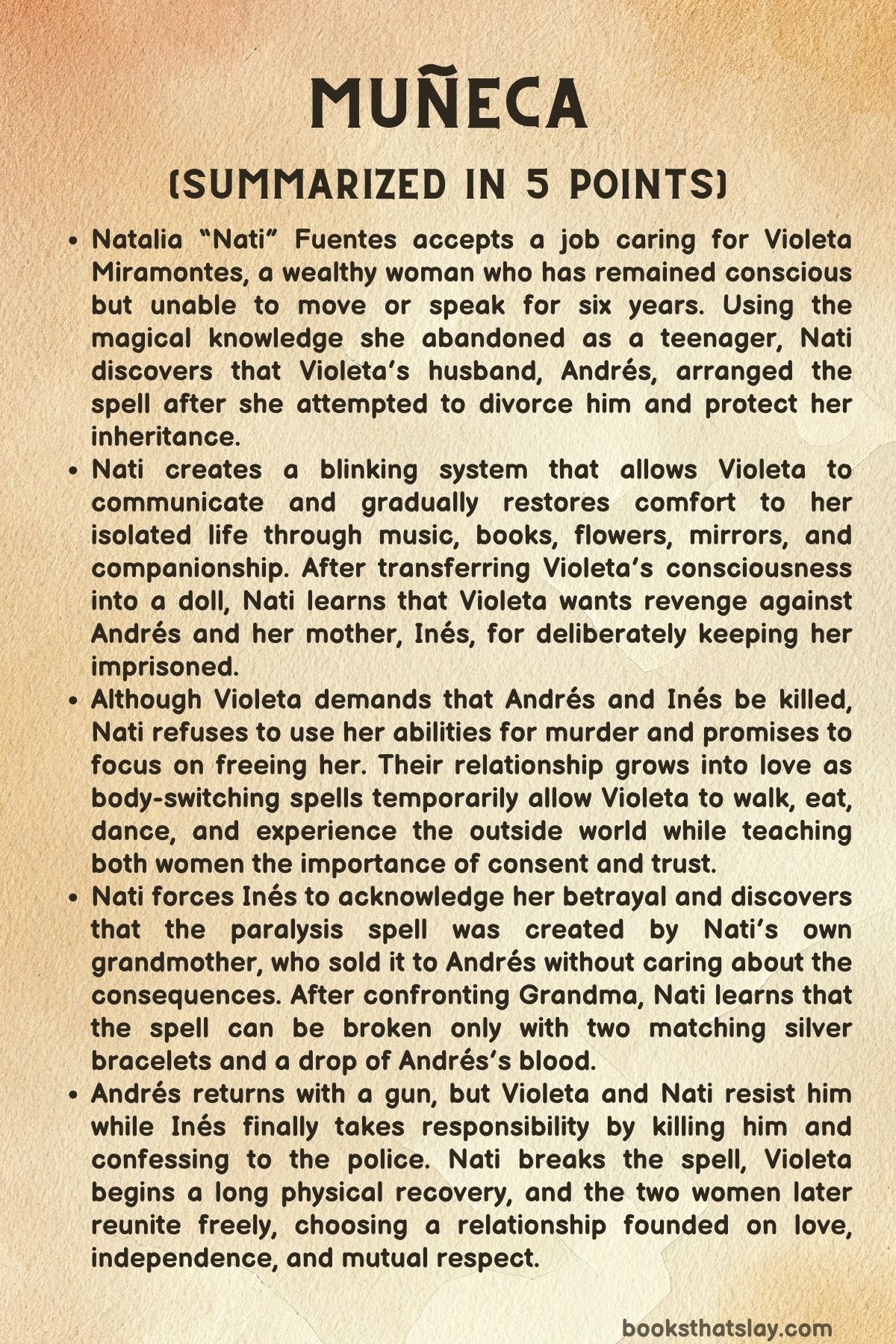
Summary
Natalia “Nati” Fuentes grows up under the guidance of her mother, Jovita, who teaches her that some people will refuse to recognize her worth because of her race, class, and gender. Jovita urges her daughter to discover her talents and use them in ways that benefit others rather than allowing anger to control her.
As a child, Nati steals small objects from wealthy households, particularly when their owners treat her and her mother as inferior. After she takes an embroidered handkerchief from the Miramontes family, Jovita punishes her but understands that the theft comes partly from Nati’s resentment toward injustice and her need for intellectual challenge.
Jovita directs Nati toward mathematics, where she proves exceptionally gifted. Nati later builds a stable career at a bank, although the ordinary life she creates conceals another ability she has tried to abandon.
Nati possesses magical talent inherited through her family. Her grandmother once trained her in spells, enchanted objects, blood-bound containers, dreams, bodily transformations, and other dangerous forms of magic.
Unlike Jovita, Grandma cares little about the moral consequences of her actions. She teaches Nati to focus on what power allows her to accomplish, even when her methods involve cruelty, manipulation, or death.
As Nati matures, she also struggles to understand her attraction to women. Meeting Doris, her supervisor at the bank, introduces her to a private community of queer women of color who love one another openly and support those rejected by their families.
Nati eventually moves into Doris’s apartment and becomes part of a chosen family that includes Lupe and several other women. Their home offers music, food, friendship, political discussion, and protection from the hostility surrounding them.
In May 1968, Nati returns to the fading Miramontes mansion to interview for a position as the live-in caregiver of Violeta Miramontes. She remembers visiting the house as a child while Jovita worked there as a servant, but Violeta’s mother, Inés, does not recognize her.
Inés explains that Violeta became completely immobile and unable to speak shortly after returning from her honeymoon six years earlier. Doctors have repeatedly examined her, yet none has found a physical explanation for her condition.
The mansion’s neglected rooms reflect the family’s declining fortune. Inés appears distracted and heavily medicated, while her racist comments reveal that she still sees former servants and civil-rights protesters as threats to the social order she values.
Violeta has been placed in a joyless room with almost nothing to stimulate or comfort her. Her family treats her as though she has ceased to be a person because she cannot manage the household, participate in society, or provide an heir.
Nati quickly notices that Violeta’s eyes follow her movements. Once they are alone, she tells Violeta that she believes she is conscious, remembers her from childhood, and suspects that someone has deliberately trapped her.
Using roses, water, and a magical test taught by her grandmother, Nati confirms that Violeta’s condition is supernatural. The roses die when exposed to the magic surrounding her, proving that the paralysis is the result of a spell rather than illness.
Nati initially views Violeta’s rescue as a profitable opportunity. She imagines receiving a portion of the Miramontes fortune and using it to travel, but Doris questions whether a woman who cannot move or speak can freely agree to such a bargain.
Violeta’s husband, Andrés Guzmán de Torrijos, soon reveals himself as a threatening presence. He behaves suggestively toward Nati, mentions that previous caregivers never remained long, and places her in a small bedroom between Violeta’s room and his study.
After he leaves, Nati develops a blinking system that allows Violeta to answer yes-or-no questions. Violeta confirms that Andrés is dangerous, that she has deliberately concealed her awareness, and that Inés cannot be trusted.
Nati accepts the caregiving position and retrieves the magical supplies she hid eleven years earlier in a black Mother’s Cookies tin. The container includes spell instructions, enchanted thread, pieces of jewelry, a finger bone, and other objects associated with her childhood training.
She suspects that a silver bracelet given to Violeta by Andrés contains the paralysis spell. Because magic placed in jewelry can continue affecting its target even after the object is damaged or removed, Nati knows she must understand the original ritual before reversing it.
While preparing, Nati improves Violeta’s daily life. She hangs mirrors around the room, brings in flowers, provides a clock and calendar, plays records, and lets Violeta feel the vibrations of Aretha Franklin’s music through the record player.
She also reads forbidden and politically charged material to her, hiding The Autobiography of Malcolm X inside a more acceptable novel whenever anyone approaches. These acts restore some pleasure and intellectual freedom to a woman who has been denied both for years.
Nati reconstructs the probable elements of the spell and attempts to reverse their meanings. She plays “Paper Doll” backward, melts a frozen wedding photograph, opens a used mousetrap, and removes the bracelet after performing a series of symbolic reversals.
The ritual fails, and Violeta remains unable to move or speak. Nati realizes that the bracelet on Violeta’s wrist is only one part of a more complicated enchantment.
To discover the missing element, Nati creates a magical dream using crushed violets, threads from Violeta’s nightgown, and the damp wedding photograph. In the dream, identical bracelets appear on Nati and Violeta, joined by an emerald-green connection.
The dream also transforms Nati’s arms into stiff plastic doll limbs. This image gives her the idea of transferring Violeta’s consciousness temporarily into a doll, allowing her to communicate more fully.
Nati carefully explains the dangerous ritual and requests Violeta’s permission before proceeding. She remains conscious that nearly everyone else has touched, moved, examined, and controlled Violeta’s body without asking what she wants.
The spell succeeds, and Violeta enters a blond childhood doll. Although she still cannot speak, she uses a Ouija board to prove her identity and communicate complete thoughts for the first time in six years.
Her first demand is not for escape but revenge. She instructs Nati to kill Andrés and Inés, revealing the depth of the rage she has developed during her imprisonment.
Violeta explains that Andrés married her because she would inherit valuable land at the age of twenty-one. After discovering his affairs and fraudulent attempts to obtain loans against her property, she removed him from her will and filed for divorce.
The morning after presenting him with the divorce papers, she awoke unable to move or speak. Andrés later admitted that he had purchased the spell, and he kept her alive because he still needed access to her property.
Inés noticed Violeta’s attempts to communicate but chose to ignore them. Her desire to preserve the family estate, social position, and public respectability proved stronger than her willingness to defend her daughter.
Although Nati remembers a lethal shivering spell taught by Grandma, she refuses to commit murder. She promises to free Violeta but insists that rescue cannot require her to abandon the values Jovita gave her.
Before leaving on a trip, Andrés enters Violeta’s room wearing a silver chain around his neck. Nati notices that an identical bracelet hangs from it, confirming that the two pieces of jewelry are magically connected.
Nati decides to steal the second bracelet by placing Andrés under a sleeping spell. While waiting for his return, she and Violeta continue communicating through the doll, Scrabble tiles, music, and magical experiences that briefly restore sensation and pleasure.
Their emotional relationship deepens as Nati speaks about Jovita’s factory work, political organizing, courage, and death from cancer. Violeta comforts her, and Nati realizes that her desire to help has become inseparable from love.
Nati develops a body-switching spell that can temporarily place each woman’s consciousness inside the other’s body. Before performing it, she repeatedly requests Violeta’s consent to continue, touch her face, and kiss her.
The ritual allows Violeta to stand, move, eat, touch flowers, walk through the garden, and experience the physical world using Nati’s body. Although she briefly considers escaping or attacking Inés, she returns voluntarily because leaving would imprison Nati in her motionless form.
Nati later admits that she lied about the spell having a strict time limit. She invented the limit to test whether Violeta would return by choice, and Violeta’s decision proves that their growing trust is mutual.
With Doris’s reluctant assistance, Violeta switches bodies with Nati again and spends a night at Sweet’s Ballroom. She dances, smokes marijuana, listens to music, and experiences both the freedom of movement and the racial harassment Nati regularly faces.
Doris warns Violeta not to treat Nati as another resource for the wealthy Miramontes family to exploit. Violeta insists that she loves Nati and wants a future in which neither woman is trapped, used, or forced to surrender her autonomy.
The body-switching spells begin causing severe headaches and physical pain for Nati. Even so, she turns her attention toward Inés, whose cooperation may be necessary to uncover the complete history of the enchantment.
Nati enchants the Miramontes silver tea service so that Inés hears the suffering of the people whose labor and deaths made the family’s wealth possible. In front of her guests and Dr. Levin, Inés begins speaking about colonial mines, violence, and the voices hidden within the silver.
Nati then creates nightmares that force Inés to confront the consequences of abandoning Violeta. She uses the threat of continuing visions to make Inés acknowledge that her daughter is conscious and assist in exposing Andrés.
Inés finally confesses that she discovered Violeta’s blinking years earlier. Other caregivers also became suspicious, but Andrés removed them before they could intervene and used financial control, medication, and the threat of psychiatric confinement to silence Inés.
Searching Andrés’s study, Inés finds the original instructions for the paralysis spell. Nati immediately recognizes the handwriting as Grandma’s and realizes that the danger she tried to leave behind has shaped Violeta’s imprisonment.
Nati returns to Grandma’s apartment with the doll containing Violeta’s consciousness. Grandma admits selling the spell to Andrés and shows no remorse for the six years of suffering it caused.
When Grandma refuses to help, Nati summons thousands of spiders that cover the apartment and bind her in place. The display proves that Nati’s talent has surpassed Grandma’s, but she refuses to injure or kill her.
Grandma reveals that Andrés exchanged the magical roles of the matching bracelets, making an ordinary reversal ineffective. Breaking the spell requires both bracelets and a drop of blood from Andrés, the person who commissioned and activated the enchantment.
Nati returns to the mansion, where Andrés is already waiting with a gun. He plans to portray her as an unstable servant who attempted theft or murder, knowing that his wealth, race, and gender will make his version of events more believable.
Violeta attacks his ankle while inhabiting the doll, allowing Nati to seize the gun. Nati summons shadow creatures and releases a magically stored scream, but the unstable forces begin expressing years of anger that she can barely control.
Inés awakens and questions whether Nati truly loves Violeta. Nati answers that loving her means wanting what is best for her, even if Violeta later decides to build a life that does not include Nati.
Inés sends Nati away and confronts Andrés herself. She kills him, gives Nati the bloodstained bracelet, and confesses to the police so that the two younger women will not be blamed.
With Andrés’s blood and both bracelets, Nati completes the reversal. Violeta finally moves and speaks, and the first word she says is Nati’s name.
Violeta enters an expensive rehabilitation facility, where she slowly regains control of her body. She learns to walk with crutches and later a cane while rediscovering the significance of ordinary decisions involving food, music, clothing, and movement.
She inherits Andrés’s wealth, sells the mansion and land, and sends Nati a large payment for rescuing her. Nati leaves the check uncashed because she fears being changed by the same wealth that corrupted the Miramontes family.
Nati returns to her life with Doris, Lupe, and their friends. She places the magical cookie tin openly on her dresser, accepting that magic is part of her identity and deciding to use it according to the ethical principles Jovita taught her.
Violeta eventually arrives at the apartment wearing a burgundy dress and walking with a cane. She has rented a nearby home and asks whether Nati will accept her despite the uncertainty surrounding her recovery and future.
Nati asks permission before kissing her. Their first kiss while each occupies her own body confirms that freedom, consent, and love will define the new life they begin together.
Characters
Natalia “Nati” Fuentes
At the center of Muñeca, Nati is an intelligent, resourceful, morally divided woman who has spent years hiding the most dangerous and creative part of herself. Her mathematical skill gives her an orderly professional identity, while her suppressed magical ability connects her to childhood fear, family history, anger, and temptation.
Nati’s early thefts reveal both resentment and a desire to challenge the authority of people who treat her and Jovita as invisible. She does not steal simply because she wants beautiful objects; she takes them from spaces where wealth has been built through exploitation and where servants are expected to remain silent.
Her central conflict concerns the proper use of power. Grandma teaches her that ability creates permission, while Jovita insists that every action must be judged by whom it helps, whom it harms, and whether it is truly necessary.
Nati’s rescue of Violeta forces her to test these competing philosophies. She lies, steals, manipulates dreams, frightens Inés, and uses threatening magic, but she repeatedly refuses murder and tries to limit the damage caused by her actions.
Her ethical awareness is especially visible in her treatment of Violeta’s body. Because Violeta has been touched and controlled without consent for years, Nati explains her actions, requests permission, and distinguishes between passive acceptance and active desire.
Nati is not morally perfect. She initially considers exploiting Violeta’s desperation for financial gain, tests her loyalty through a false time limit, and takes satisfaction in the power she exercises over Inés and Grandma.
These failures make her development more convincing because she must continually examine her motives. She gradually stops pretending that she is acting for money and admits that she is driven by love, responsibility, anger, and the desire to become fully herself.
Her relationship with magic ultimately becomes healthier because she neither rejects her talent nor surrenders to it. By the conclusion, she accepts that power can serve liberation when joined to consent, discipline, compassion, and moral restraint.
Violeta Miramontes
Within Muñeca, Violeta develops from an apparently passive patient into one of the novel’s most forceful and emotionally complex figures. Her physical stillness hides intelligence, rage, desire, humor, and a determination to regain control of a life stolen from her.
Six years of complete bodily imprisonment have understandably filled her with fury. She has watched Andrés exploit her property, her mother ignore her signals, caregivers come and go, and strangers handle her body while assuming she cannot understand them.
Her initial demand that Nati kill Andrés and Inés expresses the psychological consequences of prolonged helplessness. Revenge appears to be the only remaining form of agency available to her, especially after lawful attempts to escape her marriage led directly to the spell.
Violeta nevertheless proves capable of making difficult moral choices. During the body switch, she could escape in Nati’s body, but she returns because she refuses to purchase her own freedom by condemning Nati to the same prison.
Her growing love for Nati is not merely gratitude toward a rescuer. The nights of communication, shared music, trust, physical discovery, and emotional honesty allow Violeta to recognize desires that her upbringing never gave her the language to understand.
Experiencing the world through Nati’s body also broadens her social awareness. She encounters racialized harassment and begins to understand that Nati’s freedom has always been limited by dangers Violeta’s class and whiteness previously allowed her to overlook.
After the spell is broken, Violeta does not recover instantly. Her rehabilitation emphasizes that liberation is not a single event but a long process of rebuilding strength, confidence, judgment, and the ability to make ordinary choices.
Her final decision to return to Nati is therefore meaningful because it is made freely. She approaches the relationship not as a prisoner dependent on her caregiver but as a woman beginning to direct her own body, money, home, and future.
Doris
Doris represents chosen family, practical wisdom, and accountability. She introduces Nati to a queer community in which women of color can experience affection, celebration, safety, and mutual recognition beyond the restrictions of mainstream society.
Her support is never passive or unquestioning. When Nati first describes rescuing Violeta in exchange for money, Doris immediately identifies the imbalance of power and questions whether an immobilized woman can meaningfully negotiate such an arrangement.
Doris also recognizes the risks Nati tends to minimize. She worries about dangerous magic, the influence of the Miramontes family, the consequences of deceiving Andrés, and the possibility that Nati’s attraction to Violeta could cloud her judgment.
Her suspicion of Violeta reflects social experience rather than personal cruelty. As a wealthy white woman, Violeta belongs to the same class that employed, ignored, and exploited women such as Nati and Jovita.
At the ballroom, Doris tests Violeta’s intentions and warns her not to use Nati as a body, servant, resource, or temporary means of escape. Her questions require Violeta to consider whether she sees Nati as an equal person with needs and boundaries of her own.
Doris’s friendship gives Nati a moral and emotional foundation beyond her biological family. She provides the honest criticism that Jovita might have offered, while also respecting Nati’s adult choices and remaining present when those choices become dangerous.
Violeta’s Mother, Inés Miramontes
Inés is both a victim of patriarchal control and a person responsible for an unforgivable betrayal. Her fear, dependence, and social conditioning explain her actions, but they do not erase the suffering caused by her decision to abandon her conscious daughter.
She discovers Violeta’s blinking and finds evidence of the spell, yet she allows Andrés to convince others that Violeta lacks awareness. Financial dependence, medication, social pressure, and threats of institutionalization make resistance dangerous, but Inés ultimately chooses security over her daughter.
Her loyalty to the Miramontes estate reveals how completely family legacy has shaped her values. She treats land, wealth, reputation, and social position as sacred obligations even though those privileges were preserved through exploitation.
Inés also illustrates how a person can become complicit in oppression while believing herself powerless. Andrés controls her through money and medicine, but she still retains enough agency to ignore Violeta, dismiss caregivers, and protect the household’s public image.
Nati’s magical punishment forces her to hear voices connected to the suffering behind the family’s silver and wealth. The experience destroys her ability to maintain the comforting belief that her family’s status is honorable or innocent.
Her final killing of Andrés is not a simple redemption. It saves Nati and Violeta, provides the blood required to break the spell, and represents a late rejection of the man who controlled the household, but it cannot restore the six years she allowed him to steal.
Inés’s willingness to confess and accept punishment is the first fully responsible choice she makes. Violeta’s uncertain hope of one day forgiving her preserves the difference between understanding a person’s weakness and excusing its consequences.
Andrés Guzmán de Torrijos
Andrés is the principal human antagonist and an embodiment of entitlement, possession, and calculated abuse. He views marriage as a financial strategy and Violeta as a route to land, credit, wealth, and social legitimacy.
His treatment of Violeta is based on the belief that her autonomy matters only when it serves him. When she discovers his affairs, investigates his fraud, removes him from her will, and files for divorce, he answers not through reconciliation or legal argument but by eliminating her ability to act.
The paralysis spell transforms his beliefs about women into physical reality. Violeta becomes conscious but motionless, unable to contradict him, control her property, expose his crimes, or leave the marriage.
Andrés keeps her alive because he still needs her legal identity and inheritance. His cruelty is therefore joined to patience and calculation, making the abuse systematic rather than impulsive.
His suggestive behavior toward Nati shows that he also assumes working-class women can be intimidated, sexualized, and discredited. He expects his status to protect him if she accuses him, and he prepares to portray her as an unstable servant when she threatens his control.
Even his use of magic is transactional. He does not respect supernatural power or understand its ethical implications; he simply purchases a tool that allows him to dominate another person more completely.
His death at Inés’s hands ends the authority he maintained through money, fear, medicine, legal structures, and violence. It also exposes the weakness beneath his confidence, since his power depended on keeping everyone around him isolated and afraid.
Jovita Fuentes
Jovita is the moral foundation of Nati’s development. Although she dies before the central events, her teachings continue guiding Nati whenever magical ability, anger, fear, and revenge threaten to overwhelm her judgment.
She understands that her daughter’s childhood thefts are connected to discrimination and frustration. Rather than treating Nati as naturally dishonest, she redirects her energy toward mathematics and encourages her to develop talents that cannot easily be taken from her.
Jovita’s central lesson is that possessing an ability does not automatically justify using it. She teaches Nati to ask who will be helped, who may be harmed, and whether an action serves anything beyond pride or anger.
Her own life demonstrates these values. She works in factories, participates in labor organizing, survives exploitation, and uses careful observation to protect herself and others from more powerful people.
Jovita also recognizes Grandma’s destructive influence. Having been used during her own childhood as an assistant in dangerous spells, she understands that Grandma confuses freedom with domination and strength with a lack of restraint.
Her order that Nati discard the magical tin is an attempt to protect her, though it does not fully acknowledge how deeply magic belongs to Nati’s identity. Nati’s eventual decision to keep the tin openly represents an evolution of Jovita’s teaching rather than its rejection.
By using magic ethically instead of denying it completely, Nati combines her mother’s conscience with her own talent. Jovita’s influence therefore survives not as a strict set of prohibitions but as a method for making responsible choices.
Grandma
Grandma represents magical power without accountability. She is talented, fearless, intelligent, and socially defiant, but her refusal to consider the effects of her actions turns these strengths into sources of danger.
Her lessons fascinate Nati because they offer access to abilities hidden from ordinary society. At the same time, demonstrations such as forcing a spider to kill itself reveal how easily Grandma reduces living beings to objects for experimentation.
Grandma’s history complicates her cruelty. She appears to have endured abuse from her husband and may have killed him with the shivering spell after he repeatedly harmed his wife and daughters.
Her response to victimization, however, becomes a general philosophy of domination. Because she has been ignored and oppressed, she concludes that power should be used whenever it provides advantage or revenge.
She also uses her daughters and granddaughter as assistants without respecting their safety or consent. Her secrecy and manipulation reproduce the same controlling behavior she claims magic allows her to resist.
Selling the paralysis spell to Andrés is her greatest moral failure. She knowingly gives an abusive husband the ability to erase his wife’s physical autonomy and feels no responsibility for the suffering that follows.
During the confrontation with Nati, Grandma is more impressed by magical originality than ashamed of her actions. Even while bound by spiders, she admires Nati’s strength because she continues measuring worth primarily through power.
Nati defeats her most completely by refusing to kill her. This restraint proves that Nati has surpassed Grandma not only in magical ability but also in the moral understanding required to use it responsibly.
Lupe
Lupe is a supporting figure whose presence strengthens the novel’s portrait of queer chosen family. She helps make the apartment shared by Nati and Doris a place of warmth, food, political awareness, and practical care.
Her cooking and social invitations contrast with the isolation of the Miramontes mansion. The community surrounding her treats rejected women as people deserving shelter and companionship rather than as burdens or sources of shame.
Lupe also represents the life Nati risks by returning to magic. Nati understands that reckless choices could endanger not only herself but also the women who have trusted her and helped her build a secure home.
Although Lupe does not participate directly in the central magical confrontation, she remains part of the ethical world Nati is trying to protect. Her importance comes from showing that liberation is sustained through daily acts of generosity as well as dramatic acts of resistance.
Rosario
Rosario is one of the few permanent workers remaining in the declining Miramontes household. Her nervous response to Andrés’s footsteps demonstrates how thoroughly fear governs the mansion.
She and the other servants understand that Andrés can dismiss, threaten, or punish them with little resistance. Their hurried behavior provides Nati with early evidence that his danger extends beyond his treatment of Violeta.
Rosario’s position also reminds Nati of Jovita’s years of domestic labor. The Miramontes family depends on women whose work keeps the household functioning, yet it rarely treats those women as fully visible human beings.
Before confronting Andrés, Nati arranges payment for the servants and sends Rosario’s husband away. This decision shows that she has learned to consider the possible victims of her actions rather than pursuing her objective without regard for collateral harm.
Fernanda
Fernanda belongs to the small group of workers who continue maintaining the Miramontes mansion despite its decline. Like Rosario, she occupies a vulnerable position within a household controlled by money, fear, and social hierarchy.
Her limited presence reflects the invisibility imposed on domestic workers. The family relies on her labor, but its members do not offer her the authority or information required to challenge what is happening to Violeta.
Fernanda’s role also reinforces the contrast between the wealthy women of the mansion and the working-class women who serve them. Inés believes her family is protecting an important legacy, yet that legacy continues to depend on unequal relationships with women such as Fernanda.
Dr. Levin
Dr. Levin represents medical authority operating within patriarchal and class-based systems. Rather than acting as an independent investigator, he accepts the explanations offered by the powerful members of the Miramontes household.
His willingness to prescribe sedatives and consider psychiatric confinement gives Andrés another method of controlling Inés. Medical language allows coercion to appear respectable, private, and necessary.
Nati’s manipulation of him is morally uncomfortable because she uses the same system that has historically harmed women, particularly queer women and women who resisted social expectations. She recognizes this danger but decides that increasing pressure on Inés may be necessary to save Violeta.
Dr. Levin is not presented as magically or personally evil in the manner of Andrés. His significance lies in his failure to question the family’s version of events and his readiness to interpret female distress as evidence that the woman should lose even more control over her life.
Olivia
Olivia is Nati’s first significant female love and an important part of her emotional history. Although she does not participate in the central action, Nati’s memories of her help clarify the depth of her feelings for Violeta.
Remembering Olivia allows Nati to distinguish romantic love from sympathy, responsibility, and attraction. The comparison helps her understand that her attachment to Violeta is not merely the emotional intensity of a rescue.
Olivia also represents an earlier version of Nati’s queer identity, formed before her involvement with Violeta and before her return to magic. Her memory confirms that Nati’s love for women is a lasting part of herself rather than something created by the unusual circumstances inside the mansion.
Andrea
Andrea appears within the social world surrounding Nati and Doris and knows Nati well enough to recognize her expected behavior. During Violeta’s night in Nati’s body, Violeta must imitate Nati in order to prevent Andrea from discovering the magical exchange.
This situation emphasizes that a body alone does not create identity. Violeta must reproduce Nati’s gestures, speech, habits, and social relationships because the people in Nati’s community know her as more than a physical appearance.
Andrea’s presence therefore adds pressure to Violeta’s temporary freedom. It reminds her that using Nati’s body also means entering a life built through years of personal history, friendship, race, class, and shared experience.
Themes
Power, Responsibility, and Moral Choice
Power in Muñeca is never treated as morally neutral once it enters human relationships. Magic can heal, liberate, punish, frighten, manipulate, immobilize, or kill, and the person using it must accept responsibility for both the intended outcome and the consequences that follow.
Grandma treats magical ability as its own justification. Her central question is whether an action can be performed, while Jovita teaches Nati to consider whether it should be performed and who may suffer because of it.
Nati’s development depends on learning that ethical action cannot be reduced to harmlessness. Freeing Violeta requires deception, theft, threats, psychological pressure, and supernatural force, meaning that Nati cannot preserve complete innocence while opposing Andrés.
The important distinction lies in purpose, restraint, consent, and accountability. Nati frightens Inés but does not destroy her mind, binds Grandma but releases her unharmed, and prepares to immobilize Andrés rather than kill him.
Her refusal to commit murder does not come from weakness or a lack of anger. It comes from the recognition that revenge can reproduce the same logic used by abusers, in which superior power becomes permission to control another life.
The conclusion does not demand that Nati abandon magic. Instead, she accepts her talent and commits herself to using it consciously, showing that responsible power requires continual self-examination rather than either total rejection or unrestricted use.
Bodily Autonomy and Consent
Violeta’s paralysis turns the denial of bodily autonomy into a literal prison. She remains fully conscious while Andrés, Inés, doctors, nurses, and caregivers make decisions about her body without explanation or permission.
Andrés’s spell is an extreme form of marital control. He removes Violeta’s ability to speak, refuse, leave, manage her property, expose his crimes, or decide who may touch her.
Nati challenges this pattern through repeated acts of consent. She explains spells before performing them, creates a communication system, asks permission to touch Violeta, and distinguishes between allowing a kiss and actively wanting one.
These questions are especially important because Violeta depends on Nati for communication and freedom. Nati understands that affection does not erase the power imbalance between a mobile caregiver and a woman unable to move.
The body-switching ritual expands the theme by allowing each woman to experience embodiment from another position. Violeta gains movement but also encounters the racialized attention directed at Nati, while Nati experiences the confinement of Violeta’s unresponsive body.
After her rescue, Violeta’s recovery centers on ordinary choices rather than dramatic displays of independence. Selecting food, music, clothing, routes through a hallway, and a place to live becomes part of reclaiming ownership over herself.
The final kiss matters because both women are free, physically present, informed, and able to choose. Their relationship can begin fully only when care is no longer dependent on imprisonment.
Race, Class, Wealth, and Inherited Exploitation
The Miramontes family’s wealth is presented as the result of historical and continuing exploitation. Its mansion, land, silver, social influence, and servants represent a system in which privilege depends on making the labor and suffering of others invisible.
Nati remembers being overlooked while accompanying Jovita to the mansion. Inés’s failure to recognize her years later confirms that the family barely noticed the people who cleaned its rooms, handled its possessions, and maintained its comfort.
Nati’s childhood thefts respond to this injustice in an immature but revealing manner. Taking objects becomes a way of challenging the assumption that wealthy families have an unquestionable right to possessions created through unequal systems.
The enchanted silver tea service forces Inés to hear voices connected to colonial mining and death. This punishment strips away the idea that inherited objects are merely beautiful and exposes the violence concealed within respectable family history.
Violeta initially benefits from racial and class privilege even while suffering under patriarchal control. Her experience in Nati’s body teaches her that freedom is shaped differently by skin color, economic position, and the way strangers interpret a woman’s presence.
Doris’s suspicion of Violeta is therefore justified by collective experience. She knows that affection does not automatically erase social inequality and demands evidence that Violeta will not reproduce her family’s habit of using working-class women.
Nati’s hesitation to cash the inheritance check shows her awareness that money can create new forms of dependence and corruption. The novel does not declare wealth inherently evil, but it requires its characters to confront where wealth came from, whom it harmed, and how it will be used.
Queer Community, Chosen Family, and Liberation
Nati’s queer community offers a model of belonging based on recognition rather than blood, property, marriage, or social respectability. Doris, Lupe, and their friends create spaces where women rejected by relatives can find shelter, food, music, affection, and safety.
This community helps Nati understand herself before she returns to magic. Seeing women of color openly loving one another quiets the unnamed restlessness she has carried through adolescence and gives her a language for desires society has taught her to suppress.
The warmth of the apartment contrasts with the Miramontes mansion. The mansion is large but emotionally empty, while the smaller shared home is alive with relationships built through voluntary care.
Violeta has never been given the same opportunity to understand her sexuality. Her attraction to female school friends remained buried beneath expectations of marriage, wealth, family reputation, and obedience.
Her relationship with Nati allows those feelings to become conscious. Music, letters, dancing, conversation, humor, and shared risk help her discover that love between women can offer a future beyond the role chosen for her.
Chosen family does not mean unquestioning approval. Doris challenges Nati’s motives, questions Violeta’s privilege, and insists that love must include responsibility, honesty, and respect for the other person’s independence.
By returning to Nati only after establishing her own home and beginning her physical recovery, Violeta enters the relationship through choice rather than dependence. Their union represents liberation not because love magically resolves every difficulty, but because it creates a space where each woman can remain fully visible, autonomous, and free.