Paper Rings Summary, Characters and Themes | Brittanee Nicole
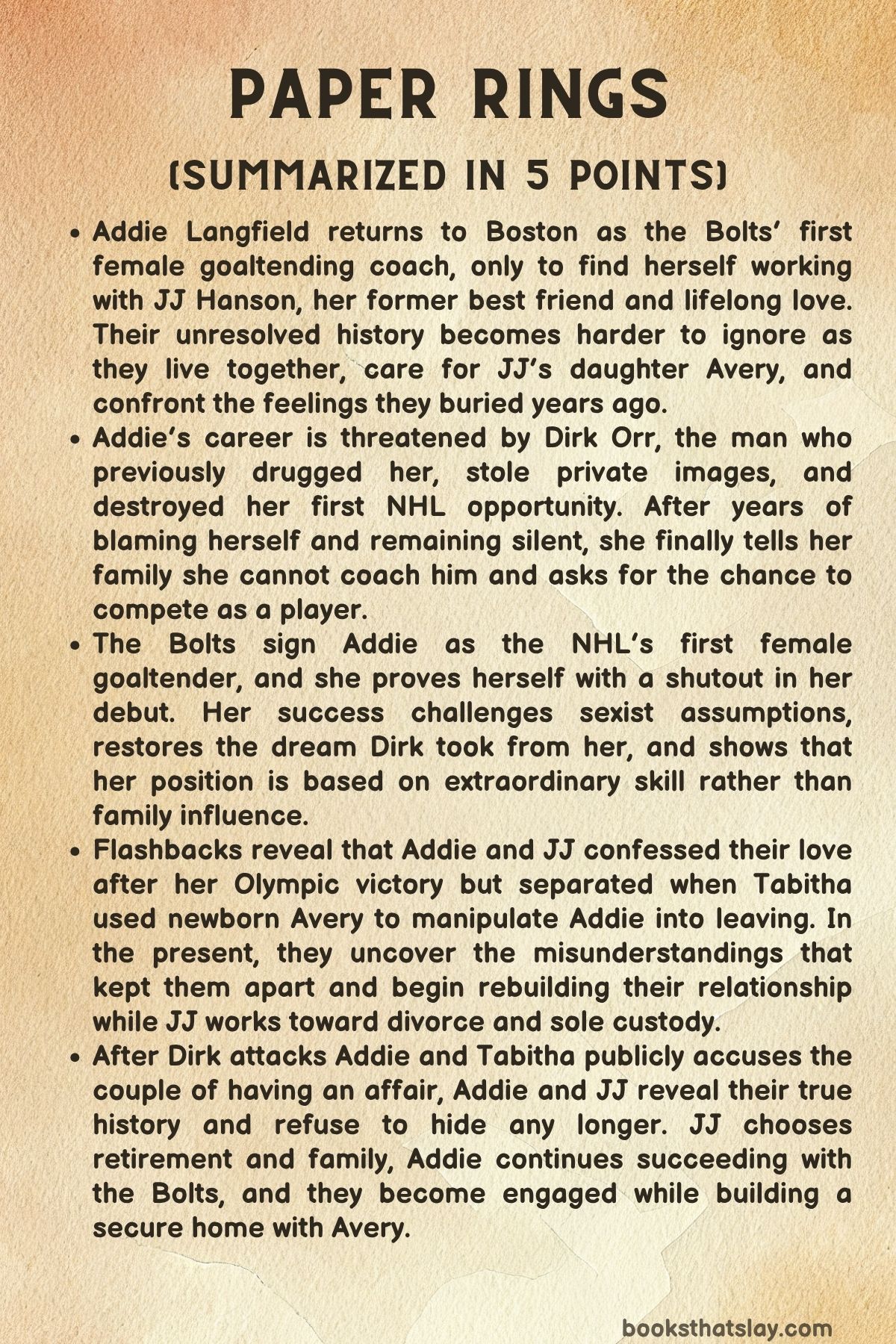
Paper Rings by Brittanee Nicole is a contemporary sports romance centered on ambition, friendship, family, and second chances. Adeline “Addie” Langfield has spent her life fighting for recognition in professional hockey, while Jonathan “JJ” Hanson has become the celebrated goaltender she was once expected to surpass.
Their lifelong bond is shaped by competition, devotion, missed confessions, painful misunderstandings, and sacrifices made for the people they love. Alongside the romance, the book examines sexism in professional sports, parental abandonment, trauma, public judgment, and the importance of choosing one’s own future. This is the first book of The New Romantics series.
Summary
At fourteen, Addie Langfield attends an elite hockey camp as the only female goaltender among twenty selected players. She refuses to be discouraged by boys who believe that girls do not belong in goalie gear, while her childhood friend and greatest rival, JJ Hanson, openly believes she will someday become the greatest goaltender in NHL history.
Their friendship is built on competition, mutual understanding, and a grounding game called “two truths and a lie.” When Dirk Orr makes a crude remark about Addie, JJ punches him, beginning a long history of trying to protect her even when she wants to defend herself.
Years later, twenty-six-year-old Addie returns to her family’s crowded Boston brownstone after accepting a position as the Boston Bolts’ first female goaltending coach. The appointment is historic, but it also reminds her that she once expected to enter the NHL as a player rather than as a member of the coaching staff.
Living in the brownstone places her under the same roof as JJ and his four-year-old daughter, Avery. JJ was once Addie’s closest friend and the only man she loved, but their relationship ended after a painful misunderstanding connected to Avery’s birth and Addie’s lost NHL opportunity.
JJ is now one of professional hockey’s greatest goaltenders, yet he believes much of his success belongs to Addie. Her determination and technical knowledge pushed him throughout childhood, and he remains convinced that she would have surpassed him if the league had given her a fair chance.
His private life is far less successful. He is legally married to Avery’s mother, Tabitha, although their marriage was based on financial arrangements rather than love, and Tabitha has abandoned both JJ and their daughter while refusing to cooperate with the divorce.
Addie’s first day with the Bolts becomes more difficult when she discovers that Dirk has joined the organization. His presence triggers memories of an incident that destroyed her chance to join the NHL years earlier, although she refuses to explain the complete history to JJ, her family, or the team.
Dirk resents Addie’s authority and repeatedly attempts to provoke her. When he deliberately shoots a puck toward her while she is unprotected, injuring her hand, JJ attacks him and must be restrained by his teammates.
Although JJ believes he is defending Addie, Brooks Langfield explains that his behavior weakens her professional authority. By acting as though she needs a man to protect her, he encourages others to view her as JJ’s romantic interest rather than as a qualified coach.
Addie insists that she must discipline Dirk herself and prove that her position is based on ability. During practice, she steps into the goal to demonstrate technique and easily stops shots from elite NHL players, leaving the team amazed by her instincts, speed, and skill.
The experience awakens the dream she attempted to bury. Coaching gives her a place in professional hockey, but standing in the crease reminds her that she still wants to compete and that her playing career ended because of fear and humiliation rather than a loss of talent.
Meanwhile, living together forces Addie and JJ to confront their continuing attraction. Accidental bedroom and bathroom encounters, family dinners, private rooftop conversations, and their shared love for Avery gradually restore the closeness they once possessed.
Avery becomes an important connection between them. Addie teaches her to skate, comforts her after nightmares, and promises that being brave does not mean pretending to feel no fear.
Avery openly loves Addie and treats her as part of her family. Through the child, Addie begins to reconsider her belief that she wants no role in motherhood, realizing that she does not need to give birth to become a dependable parental figure.
Flashbacks reveal how Addie and JJ’s relationship developed. As teenagers, Addie supported JJ while his mother underwent cancer treatment, offering him safety in the Langfield home when he felt frightened and displaced.
JJ repeatedly came close to confessing his love, including during a private prom-night dance, but fear of losing their friendship kept him silent. Addie also loved him, yet she believed he saw her only as a fellow athlete and trusted companion.
When Addie made the United States Olympic team, JJ celebrated her success as though it were his own. After she won a gold medal and attracted interest from the Vegas Vices, he appeared in the arena wearing her jersey, and they finally kissed publicly.
That night, they admitted they had loved each other for years and began imagining a future together. Their happiness lasted only until Tabitha called and revealed that she had given birth to JJ’s daughter without previously telling him about the pregnancy.
Addie accompanied JJ to the hospital and immediately felt affection for the newborn Avery. Tabitha then privately threatened to prevent JJ from having a relationship with his daughter unless Addie removed herself from his life.
Because Addie’s biological father had abandoned her, she could not risk becoming the reason Avery lost a loving parent. She lied to JJ, claimed that she did not want motherhood, and ended their relationship without revealing Tabitha’s threat.
Soon afterward, JJ travelled to Vegas hoping to reconcile with Addie. He found Dirk leaving her hotel room and saw Addie looking frightened and disoriented, but he assumed she had chosen Dirk after rejecting him.
The truth was that Dirk had drugged Addie’s drink, stolen her phone, copied private images from a recording she had made with JJ, and displayed those images throughout the locker room. Addie withdrew from the NHL opportunity because she felt violated, ashamed, and unable to explain what had happened.
In the present, Addie attempts to move forward by agreeing to participate in New Romantics, a dating feature organized by her friend Savannah. Her first date is with Scott, an attractive and considerate man who represents the uncomplicated relationship she believes she should want.
JJ and several members of the Langfield family secretly observe the date from the same restaurant. When Addie confronts JJ, he admits that he cannot tolerate watching her build a life with another man, and their suppressed feelings lead to a passionate encounter.
Addie immediately worries about the consequences because she is still JJ’s coach and he is legally married. She fears that public knowledge of their relationship would destroy her credibility and allow people to claim that she earned her position through personal influence.
Their professional situation changes when Sidney Howe is injured and the Bolts need another goaltender. Rather than accepting Dirk as Sidney’s replacement, Addie finally tells Gavin and Brooks that she cannot coach him and asks for the opportunity to play.
Her family believes her without demanding every painful detail. Brooks moves into the coaching position, Jarred Kane receives a place on the roster, and Addie signs a multimillion-dollar contract to become the NHL’s first female goaltender.
JJ responds with complete pride rather than jealousy. Addie is no longer his coach, removing one ethical obstacle, but his unfinished divorce still forces them to keep their renewed relationship private.
Addie makes her debut wearing Brooks’s retired number thirteen. She earns a shutout, answers sexist questions from the press without apology, and proves that she belongs in the league because of her performance rather than her family name or gender.
She and JJ quietly begin building a relationship while maintaining the appearance of ordinary teammates. Addie invites him to become the anonymous participant in her dating feature, allowing them to experience planned dates without revealing his identity.
Their growing partnership includes nightly calls with Avery, private hotel-room conversations, and honest discussions about parenthood. JJ explains his fear that his demanding career makes him an inadequate father, while Addie assures him that family is created by people who repeatedly return.
The conflict with Dirk reaches its most dangerous point during a family holiday skate. He corners Addie, pins her against a wall, and places his hands around her throat while blaming her for ending his professional future.
JJ intervenes, and Dirk finally admits that he drugged Addie, removed some of her clothing, stole the private images, and used them to humiliate her. JJ nearly kills him in a violent rage before Gavin stops him.
Rather than hiding after the attack, Addie publicly takes JJ’s hand and leaves the arena beside him. She understands that secrecy has allowed shame and fear to control too much of her life, and she refuses to treat loving JJ as another fact that must remain concealed.
Dirk soon dies after being struck by a vehicle. Addie suspects that JJ used his Uncle Frank’s criminal connections to arrange the death, but she chooses not to question him directly.
Their public appearance creates another crisis when Tabitha tells the press that JJ has conducted a years-long affair with Addie. The accusations threaten Addie’s career and allow Tabitha to present herself as a betrayed wife despite the true nature of the marriage.
Beckett initially orders JJ to leave the brownstone and end the relationship until his divorce is complete. Addie rejects the idea that other people should once again make decisions for her and insists that JJ protected, supported, and genuinely loved her.
JJ offers to surrender the money involved in the prenuptial agreement, secure sole custody of Avery, and retire after the season. He no longer sees retirement as a loss because hockey is no longer the only source of meaning in his life.
Savannah uses Jolie magazine and the New Romantics feature to publish Addie and JJ’s history from both perspectives. By explaining their childhood bond, Olympic reunion, separation, and renewed commitment, they regain control of the public narrative.
Tabitha accepts a financial settlement and grants JJ sole custody of Avery. Addie fully accepts that Avery belongs in her future, while JJ prepares to finish his final professional season and become a more present father.
After another shutout, Addie asks JJ for a public kiss from her “fiancé,” effectively proposing to him. She tells him that wealth, fame, and status do not matter because she would marry him with nothing more than a paper ring.
JJ joins her on the ice and uses “two truths and a lie” to propose in return. For the first time, all his declarations are true: Addie is his best friend, his favorite person, and the greatest goaltender he has ever faced.
One month later, Addie, JJ, and Avery celebrate as a united family during Avery’s Halloween-themed birthday party. Addie continues succeeding with the Bolts, JJ enjoys his final season, and Avery proudly describes the three of them as her dream team.
At bedtime, Avery asks them to tell the story of how they fell in love. JJ begins with the first day he watched Addie play and recognized the legendary goaltender she would become, completing a story built from rivalry, endurance, forgiveness, and the decision to keep choosing one another.
Characters
Adeline “Addie” Langfield
Addie is the central force of Paper Rings, combining exceptional athletic ability with determination, loyalty, and a deep need to prove that she deserves every opportunity she receives. Her identity has been shaped by years of sexism, family expectations, professional rejection, and the belief that she must remain strong without depending on anyone.
Her greatest strength is her refusal to abandon her ambitions completely. Even after Dirk destroys her first NHL opportunity, she continues playing professionally, studies athletic performance, develops coaching methods, and eventually returns to the league through another position.
Addie’s independence is also connected to her trauma. She often treats silence as control, believing that refusing to disclose her pain protects her from pity, public judgment, and the possibility that others will make decisions on her behalf.
Her relationship with JJ reveals both her capacity for lasting love and her fear of being abandoned. She loves him from childhood onward, yet his marriage to Tabitha and his failure to understand what happened in Vegas convince her that trusting him can lead to devastating loss.
Avery changes Addie’s understanding of family and motherhood. Addie does not suddenly develop a desire for pregnancy or a conventional family structure, but she realizes that she wants to guide Avery, witness her milestones, and provide the consistency she once needed from her biological father.
Her decision to return to the crease represents more than a professional achievement. It is an act of self-restoration through which she stops allowing Dirk’s actions, public prejudice, and her own shame to determine the limits of her future.
Jonathan “JJ” Hanson
Within Paper Rings, JJ is both Addie’s romantic partner and her closest athletic equal. He is talented, emotionally devoted, protective, jealous, impulsive, and deeply aware that the professional success he received might have belonged to Addie under fairer circumstances.
JJ’s love for Addie is never limited to attraction. He respects her talent, credits her with improving his game, supports her Olympic success, and celebrates her NHL contract without feeling threatened by the possibility that she may surpass him.
His greatest flaw is his tendency to act before listening. He punches Dirk as a teenager, attacks him during practice, misjudges the situation in Vegas, interferes with Addie’s date, and later uses dangerous family connections after Dirk’s assault.
These actions grow from loyalty, but they frequently undermine Addie’s agency. JJ must learn that loving her does not give him permission to fight every battle in her place or decide what justice should look like without consulting her.
Fatherhood brings out his gentleness and responsibility. His devotion to Avery is immediate, and he willingly reorganizes his career, living arrangements, finances, and eventual retirement around giving her stability.
JJ’s development involves separating love from possession and protection from control. By the end, he is prepared to support Addie’s career, retire without resentment, prioritize Avery, and build a partnership founded on open choice rather than secrecy, jealousy, or fear.
Avery Hanson
Avery is JJ and Tabitha’s daughter and the emotional center of the family that develops around Addie. Although she is young, she understands abandonment, emotional uncertainty, and the difference between adults who make promises and those who consistently remain.
Her innocence allows her to identify truths that the adults avoid. She openly asks whether Addie loves JJ, notices the bond between them, and describes herself, her father, and Addie as a dream team long before they publicly acknowledge their relationship.
Avery also helps Addie reconsider her assumptions about motherhood. Through skating lessons, bedtime comfort, shared traditions, and ordinary affection, she gives Addie the opportunity to become a parent through repeated presence rather than biology.
Her relationship with JJ shows his strongest qualities. He is patient with her fear, makes himself look foolish to help her feel safe, and never treats his career as more important than her emotional wellbeing.
Tabitha
Tabitha functions as one of the novel’s main antagonists, although her power comes through manipulation rather than physical force. Her relationship with JJ is transactional, and she uses their marriage, financial agreement, and daughter as tools for securing control.
Her most damaging action is threatening to limit JJ’s access to Avery unless Addie ends their relationship. By recognizing Addie’s history of paternal abandonment, Tabitha chooses the exact pressure that will force her to sacrifice her happiness.
Tabitha also harms Avery through absence and inconsistent communication. She ignores calls, disappears for long periods, and leaves JJ to manage the emotional consequences of repeatedly explaining why Avery’s mother is unavailable.
Her public accusations demonstrate her willingness to distort events for money and sympathy. However, the final custody settlement limits her influence and forces her to accept responsibility if she continues disappointing Avery.
Dirk Orr
Dirk represents misogyny, entitlement, humiliation, and retaliatory violence. From adolescence onward, he resents Addie because her talent challenges his belief that male players should automatically receive authority and opportunity.
His cruelty escalates from crude remarks to calculated abuse. He drugs Addie, removes part of her clothing, accesses her private phone, steals intimate images, and publicly displays them to drive her away from NHL consideration.
Dirk relies on Addie’s shame and fear of disbelief. He understands that she may blame herself, worry about professional consequences, and remain silent rather than risk being judged by an institution dominated by men.
His later attack reveals that he considers Addie responsible for the consequences of his own actions. Instead of accepting that his career has failed because of his conduct, he attempts to punish her for refusing to remain silent and powerless.
Beckett Langfield
Beckett is Addie’s adoptive father and the moral center of the Langfield household. He defines parenthood not through biology but through the daily decision to remain present, provide safety, and accept children without conditions.
His influence is especially important because Addie’s biological father surrendered his parental rights. Beckett cannot erase that wound, but he repeatedly assures Addie that Drake’s departure reflected Drake’s failure rather than any deficiency in her.
Beckett is loving without being blindly permissive. He supports Addie’s career, welcomes JJ into the family during difficult periods, investigates Scott, and challenges JJ when his behavior threatens Addie’s reputation.
His initial attempt to separate Addie and JJ after the scandal shows his protective instincts becoming overly controlling. He eventually corrects himself by recognizing that protecting Addie must not involve taking away her right to choose.
Brooks Langfield
Brooks is Addie’s mentor, uncle, and one of the people most responsible for developing her confidence as a goaltender. His legendary NHL career gives him authority, but he uses that authority to create opportunities for Addie rather than keeping professional hockey closed to her.
He refuses to treat her coaching appointment as ceremonial. When JJ attacks Dirk, Brooks explains that Addie’s authority will survive only if she is allowed to handle professional conflicts according to her own judgment.
Brooks also recognizes that Addie belongs in the crease. He supports her contract negotiations, moves into the coaching position, and allows her to wear his retired number thirteen.
Giving her his number is both a personal and professional declaration. It announces that he sees her not as an imitation of him but as the rightful continuation of the standard he established.
Gavin
Gavin is the Bolts’ head coach and an important source of professional validation for Addie. He presents her to the players as an accomplished coach whose authority is supported by Olympic success, technical knowledge, and years of experience.
After watching Addie demonstrate her skill, Gavin states directly that she should be playing rather than coaching. His response forces her to recognize that her NHL dream remains possible.
Gavin’s support becomes even more significant after Dirk’s attack. He stops JJ from killing Dirk, reassures Addie that trauma does not make her weak, and refuses to blame her for not reporting the earlier abuse.
Aiden
Aiden is a Bolts player who becomes a steady and encouraging presence around Addie. He respects her authority as a coach and later welcomes her as a teammate without treating her historic position as a publicity stunt.
His comments about second chances encourage Addie to consider that damaged relationships and interrupted careers can be repaired through deliberate action. He also participates in the family’s concern for her without attempting to control her decisions.
Aiden’s role demonstrates the importance of male colleagues who respond to a woman’s professional presence with respect rather than resentment. His acceptance helps normalize Addie’s place within the team.
Sidney Howe
Sidney is an experienced Bolts goaltender who treats Addie respectfully from their first meeting. Unlike Dirk, he does not interpret her authority as an insult to his masculinity or professional status.
He quickly recognizes that Addie still possesses the ability to compete at the NHL level. His agreement with JJ strengthens the argument that her talent is obvious to knowledgeable players and not merely praised by family members.
Sidney’s injury creates the practical opening that allows Addie to move from coaching to playing. Although the accident removes him from the season, his earlier respect helps establish a supportive goaltending group.
Jarred Kane
Jarred is an AHL prospect who joins the Bolts during the roster changes following Sidney’s injury. He approaches Addie with enthusiasm and sees her experience as something he can learn from rather than as a threat.
His willingness to develop beside Addie and JJ contrasts with Dirk’s hostile competitiveness. Jarred represents a younger generation of players capable of accepting a woman as both an authority figure and an elite teammate.
Savannah
Savannah is one of Addie’s closest friends and a major influence on how Addie’s public story is presented. She encourages Addie to participate in the New Romantics feature because she believes dating may help her move beyond years of emotional isolation.
Savannah initially knows little about the true history between Addie and JJ, but her magazine project eventually becomes the means through which they reclaim their public narrative. Instead of allowing Tabitha to define them, she publishes their experiences from both perspectives.
Her friendship combines teasing, ambition, loyalty, and practical support. She wants Addie to embrace romance, but she also celebrates her historic professional achievements and protects her when scandal threatens her reputation.
Josie
Josie is part of Addie’s closest circle of female friends. She provides companionship, humor, and emotional observation during a period when Addie is attempting to hide her attraction to JJ.
She quickly notices the tension between them and understands that Addie’s anger is connected to unresolved love. Josie’s presence gives Addie a social identity outside hockey and the Langfield household.
Although her role is smaller than Savannah’s, she contributes to the network of women who prevent Addie from facing every personal crisis alone. Her concern is direct but not judgmental.
Vivi
Vivi is Addie’s younger cousin and another member of the crowded brownstone household. She feels uncertain about her future after leaving college and worries that she has disappointed her father.
Addie responds to Vivi with empathy because she understands the pressure of failing to follow the path others expected. Their relationship allows Addie to offer the acceptance she often struggles to give herself.
Vivi’s developing connection with Brayden creates a parallel secret romance. Like Addie, she is hesitant to expose her relationship before she understands what it means and whether it can survive family scrutiny.
Brayden
Brayden is JJ’s teammate, friend, and occasional voice of practical reason. He reminds JJ that Addie is his coach and that JJ’s marriage prevents him from claiming authority over her dating life.
His advice exposes JJ’s hypocrisy and forces him to confront the consequences of his choices. At the same time, Brayden eventually becomes involved in his own secret relationship with Vivi, creating a humorous contrast between what he advises and how he behaves.
He is also protective of Addie in the locker room and helps ensure that players respect her privacy. His acceptance supports her transition from coach to teammate.
Finn
Finn is a devoted member of the Langfield household whose affection for Hope is visible long before either openly defines the relationship. He regularly helps care for her children and turns domestic disorder into moments of joy.
His presence reinforces the book’s idea that family is created through action. He does not need a formal title to behave like a dependable partner or parental figure.
Finn also serves as a humorous mirror for JJ. Both men love women they are afraid to approach honestly, and each recognizes the other’s hesitation before acknowledging his own.
Hope
Hope is a mother living within the Langfield family’s supportive household. She is carrying the emotional and practical consequences of an absent husband while trying to provide stability for her daughters.
Her relationship with Finn develops through daily care rather than dramatic declarations. The patience between them offers a quieter version of love built through responsibility, trust, and shared domestic life.
Hope also contributes to the family environment that helps Addie understand parenting as a collective experience. Her openness allows Addie to seek advice and learn that no parent manages fear or uncertainty alone.
Winnie
Winnie is Addie’s sister and one of the reasons Addie returns to the family brownstone. She is raising twin sons and depends upon the larger household for practical and emotional support.
Her presence contributes to the home’s constant disorder, but that disorder is accompanied by affection and security. Winnie’s family demonstrates how the Langfields absorb people during periods of difficulty rather than demanding that everyone remain independently self-sufficient.
Scott
Scott is selected as Addie’s first official date for the New Romantics feature. He is attractive, humorous, considerate, and accepting when she admits that she has almost no normal dating experience.
He represents a genuinely reasonable alternative to JJ. His kindness makes clear that Addie does not choose JJ simply because no other good man is available; she chooses him because their connection cannot be reproduced through compatibility alone.
Scott is also treated unfairly when Addie and JJ act on their feelings during the date. Addie’s guilt afterward shows that she recognizes his decency and understands that unresolved love can cause innocent people to be hurt.
Ryan Hobbs
Ryan is the new assistant goaltending coach who previously worked with Addie during the Olympics. He knows her as an accomplished athlete and greets her with confidence, familiarity, and mild flirtation.
His presence triggers JJ’s jealousy, but Ryan himself is not presented as malicious. He functions as another reminder that Addie has professional relationships and romantic possibilities that exist independently of JJ.
Savannah’s interest in using him for the dating feature also increases the pressure surrounding Addie and JJ’s secrecy. Ryan therefore becomes less a rival than a test of whether JJ can trust Addie’s choice.
Cat Hanson
Cat is JJ’s mother and an affectionate supporter of Addie’s professional achievements. Her earlier cancer treatment explains why teenage JJ temporarily moved into the Langfield home and why Addie became such an important source of safety for him.
As an adult, Cat supports JJ with Avery and helps care for her during road trips. She also encourages Jolie magazine to celebrate Addie’s NHL debut, showing pride in the woman who has remained central to her son’s life.
JJ’s Father
JJ’s father is a loving and emotionally supportive parent. When Cat undergoes cancer treatment, he makes the difficult decision to place JJ with the Langfields so that his son can continue school and hockey without carrying the full burden of the illness.
He later encourages JJ to pursue happiness rather than treating parenthood as a reason to deny himself love. His advice helps JJ understand that being devoted to Avery does not require permanent emotional isolation.
He also confronts JJ about involving criminal connections in Dirk’s death. This warning shows that his support has moral boundaries and that he recognizes the danger in JJ’s extreme protective instincts.
Drake
Drake is Addie’s biological father, although his importance comes primarily through his absence. His decision to surrender his parental rights leaves Addie with a lasting fear that she was somehow responsible for not being chosen.
That fear influences her response to Tabitha’s threat and makes it impossible for her to risk Avery growing up without JJ. It also contributes to her reluctance to trust romantic love, because abandonment feels like an outcome that can arrive without warning.
Beckett’s reassurance eventually helps Addie separate Drake’s failure from her own worth. She understands that one person’s departure does not cancel the love repeatedly demonstrated by those who stayed.
Cade and Noah Langfield
Cade and Noah are members of the Langfield family involved with the Bolts organization. Their positions contribute to Addie’s concern that outsiders will dismiss her appointment as the result of family favoritism.
However, the family does not simply hand her an unearned career. They recognize her qualifications, negotiate according to her professional value, and create opportunities only after she demonstrates that she can meet NHL standards.
Their support represents the positive use of influence. Instead of preserving established barriers, they use their positions to ensure that talent previously excluded from the league receives a fair evaluation.
Uncle Frank
Frank is connected to the more dangerous side of JJ’s extended family. JJ contacts him after Dirk attacks Addie, implying that Frank has the power to arrange consequences beyond the reach of ordinary professional or legal systems.
His involvement introduces moral uncertainty into the resolution of Dirk’s threat. Dirk’s death provides safety and relief, but it also suggests that JJ has crossed a boundary that cannot easily be reversed or publicly defended.
Theo
Theo is a member of the extended family whose football career provides another setting for the Langfields to gather. His game becomes the location where Addie’s signing with the Bolts is publicly announced.
Although his personal role is limited, Theo contributes to the broader picture of a family whose members pursue demanding athletic careers while remaining closely involved in one another’s lives.
Liv
Liv is part of Beckett’s personal history and is mentioned when he advises JJ about hesitation. Beckett explains that waiting only a few seconds once cost him years with her, using his own regret to warn JJ against remaining silent about Addie.
Her indirect influence helps JJ understand that timing matters and that fear can become a decision with permanent consequences. Through Beckett and Liv’s experience, he sees a possible version of his future if he continues avoiding emotional risk.
Gracie and the Other Children
Gracie, Winnie’s twins, Hope’s daughters, and the other children fill the brownstone with confusion, humor, and constant movement. Their misunderstandings, games, questions, and emotional honesty prevent the adults from controlling every situation.
They also reveal the strength of the household. The children are surrounded by many adults who feed them, comfort them, attend their events, and assume responsibility whenever a parent is absent.
Their presence gives Addie and JJ repeated opportunities to observe each other as caregivers. These ordinary domestic moments help them imagine a future based not only on romance and hockey but also on shared family life.
Themes
Being Chosen and the Meaning of Family
The desire to be chosen shapes nearly every important relationship in Paper Rings. Addie’s biological father surrendered his parental rights, Avery’s mother repeatedly disappears, and several children in the Langfield household live with the consequences of adults who failed to remain dependable.
These experiences create a distinction between biological connection and active parenthood. Beckett becomes Addie’s true father because he repeatedly shows up, protects her, supports her ambitions, and assures her that her place in the family is permanent.
Addie initially believes that Tabitha’s threat leaves her with only one moral choice. Since she cannot tolerate becoming the reason Avery loses JJ, she abandons her own relationship and allows the child’s needs to take priority over her happiness.
Over time, she realizes that joining Avery’s life does not mean replacing Tabitha or accepting a conventional maternal role. It means attending skating lessons, answering calls, offering comfort, and returning whenever the child fears she may disappear.
JJ undergoes a similar change when he understands that fatherhood does not require him to surrender every personal desire. He can prioritize Avery while also loving Addie and building a family in which responsibility is shared.
The final dream team is therefore created through repeated decisions rather than blood alone. Addie, JJ, and Avery become a family because each openly claims the others and continues choosing them after fear, scandal, professional pressure, and past abandonment make that choice difficult.
Ambition, Gender, and Claiming Professional Space
Addie’s career exposes the barriers facing a woman attempting to enter a male-dominated sport. From childhood, she must respond to boys who treat her presence as an intrusion, while adult critics question whether her family connections rather than her qualifications earned her professional position.
Even ordinary facilities reveal structural exclusion. Locker rooms, showers, team traditions, and workplace assumptions were designed around male players, forcing Addie to adapt to environments that never anticipated a woman occupying equal space.
Her appointment as a coach is historic, but it is not the dream she originally pursued. Standing behind the bench gives her authority, yet returning to the goal reminds her that she accepted a substitute partly because trauma convinced her that playing was no longer possible.
Dirk’s hostility grows from the fact that Addie threatens his sense of entitlement. Her skill proves that gender does not guarantee superiority, so he attempts to remove her through humiliation when he cannot defeat her fairly.
Addie’s NHL debut becomes meaningful because she refuses to rely solely on symbolism. She understands the importance of being first, but she wants her saves, shutouts, discipline, and technical knowledge to determine how she is judged.
Wearing Brooks’s number thirteen connects her to hockey tradition while changing who is permitted to inherit that tradition. Her success does not ask the league to lower its standards; it demonstrates that the standards were previously applied within an unnecessarily restricted field of candidates.
Silence, Misunderstanding, and the Cost of Fear
Addie and JJ lose years together because both repeatedly replace honest communication with assumptions. Their love is visible through shared rituals, jealousy, professional support, and emotional dependence, yet neither speaks clearly until circumstances have already created serious complications.
JJ fears that confessing his feelings will destroy their friendship. Addie fears that asking for more will reveal that she misunderstood his attention and will leave her humiliated.
Their separation after Avery’s birth is caused by a concealed threat rather than a loss of love. Addie lies because she believes silence will protect Avery, while JJ interprets her rejection as proof that he never mattered enough.
The Vegas incident deepens the damage. Addie is traumatized and unable to explain what Dirk has done, while JJ reacts to what he sees without listening to the frightened woman standing before him.
Silence gives Dirk power because he depends upon Addie blaming herself and expecting disbelief. It also gives Tabitha control because Addie does not tell JJ that his access to Avery was used as leverage.
Healing begins when the characters stop treating avoidance as protection. Addie tells the Bolts that she cannot coach Dirk, JJ confesses his love without demanding an immediate answer, and they eventually publish their shared history before Tabitha can permanently define it.
Their recurring game of “two truths and a lie” reflects this development. What begins as a way of hiding serious feelings inside humor finally becomes the language through which they speak without deception and promise each other a permanent future.
Trauma, Agency, and Reclaiming the Self
Addie’s trauma affects her body, career, relationships, and sense of personal worth. Dirk’s actions do not end when she leaves Vegas; they survive through panic responses, lost confidence, avoidance, self-blame, and the belief that reporting him would expose her to further humiliation.
Her silence is not evidence of weakness. It is a survival response produced by fear, incomplete memory, professional vulnerability, and the knowledge that victims are often questioned more aggressively than perpetrators.
However, the coping strategies that initially help her survive eventually prevent her from reclaiming her ambitions. Remaining quiet allows Dirk to reappear in her workplace and forces her to confront the possibility of sacrificing another season for his comfort.
Addie’s recovery does not depend upon becoming fearless. It begins when she admits that she cannot coach Dirk, requests a playing contract, and trusts her family to respond without demanding that she justify every detail.
Returning to the goal transforms the site of her lost dream into the place where she restores her authority. Every save asserts that Dirk’s humiliation did not erase her skill or determine the ending of her career.
Her decision to take JJ’s hand publicly after the assault carries similar meaning. She refuses to hide because of what reporters, teammates, or Tabitha may say, choosing her own relationship instead of allowing shame to dictate another separation.
Agency ultimately means that Addie controls what she reveals, whom she loves, how she defines motherhood, and whether she continues playing. Her recovery is not presented as forgetting what happened but as building a life in which the person who harmed her no longer determines her choices.