People in Love Summary, Characters and Themes
People in Love by Claire Daverley is a contemporary novel about the difference between imagined love and the life two people consciously build together.
It follows Nora, an artist who becomes engaged to her dependable long-term partner, Robin, just as Bren, her childhood best friend and unresolved first love, returns after twelve years abroad. His arrival exposes secrets, misunderstandings and unspoken feelings that have shaped all three lives. Through family conflict, grief, illness and romantic uncertainty, the novel examines whether love is defined by intensity, history, freedom or the ordinary acts of commitment that allow relationships to endure.
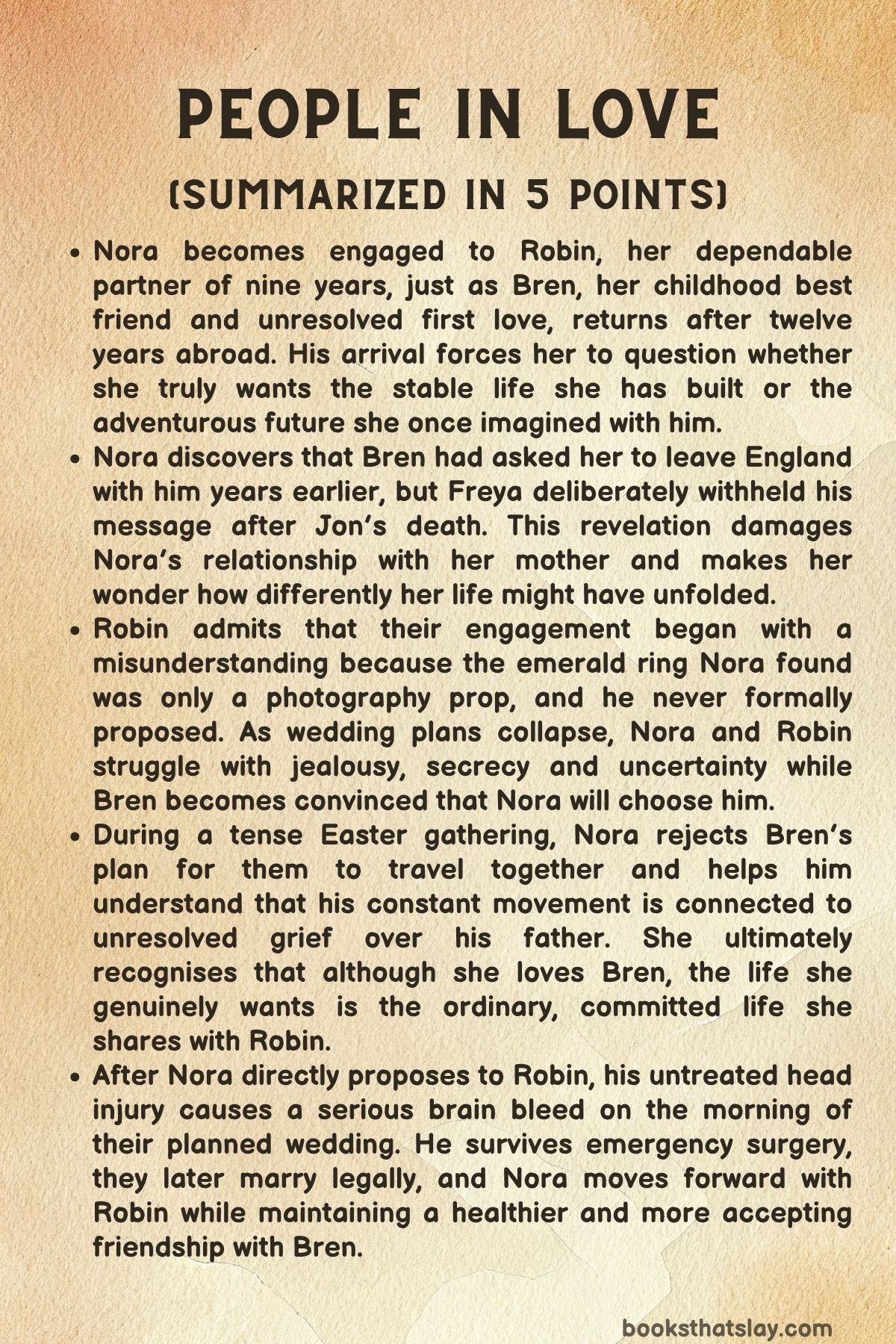
Summary
Nora is travelling home after accepting what she believes is a marriage proposal from Robin, her partner of nine years, when she receives an unexpected email from Bren, her childhood best friend. He has been living in New Zealand and writes casually about his surroundings, while Nora deliberately avoids telling him that she is engaged.
The proposal itself has happened unexpectedly. Nora found an emerald ring in Robin’s pocket during lunch and said yes three times before he could properly explain what was happening.
Although Nora and Robin have always claimed that marriage is unnecessary, the engagement quickly becomes meaningful to both of them. Robin begins imagining venues and celebrations, while Nora shares the news with Shay, her friend and business partner at the art café.
Nora’s mother, Freya, reacts with open disapproval because she regards marriage as restrictive. Josie, Bren’s mother and Freya’s neighbour, responds with genuine happiness, though she also asks whether Nora has heard from her absent son.
Robin proposes holding an engagement party at their flat. When he asks whether Bren should be invited, Nora initially pretends not to know where he is, but eventually sends him a handmade invitation without expecting him to attend.
The party makes Nora conscious of the imbalance between her life and Robin’s. His relatives and their mutual friends fill the flat, while Freya appears only briefly and refuses to stay.
Bren then arrives without warning. Nora is overwhelmed by seeing him after twelve years and spends much of the evening avoiding a reunion she has imagined many times.
After the guests leave, Nora and Bren confront each other in the kitchen. Their conversation becomes an argument about his sudden return, his years of silence and the emotional damage caused by his departure.
Nora briefly imagines that he might kiss her outside, but he only congratulates her and leaves. His return has reopened feelings that neither time nor distance has resolved.
Robin remains excited about the wedding and does not initially regard Bren as a threat. He trusts the life he and Nora have created and assumes that her distress comes from the difficulties of repairing an old friendship.
Bren returns to Josie’s house and finds his childhood room almost unchanged. His discomfort reveals how thoroughly he has avoided the past, especially the death of his father, Jon, and Josie’s struggles with mental illness.
Freya confronts Bren and warns him not to disturb Nora’s future. She accuses him of abandoning everyone when life became painful, while he denies that he returned because he is in love with Nora.
Bren visits Nora’s café, and they go swimming together at Hampstead Heath. Their teasing and shared memories temporarily restore their former closeness, but the hurt beneath their friendship remains present.
Shay warns Nora that Bren’s return is destabilising her. She reminds Nora that Robin has remained dependable for years, whereas Bren has repeatedly chosen absence.
Robin discovers a woodland wedding venue in Devon that offers discounted dates when another couple cancels. He becomes increasingly enthusiastic about arranging a small, unusual ceremony that reflects Nora’s tastes.
Nora invites Bren to dinner with Robin. Robin welcomes him warmly, while Bren privately judges the man Nora has chosen and reluctantly recognises that Robin is kind, perceptive and well suited to her.
When Robin mentions that they hope to marry before summer, Bren is shaken. He impulsively promises to remain in England long enough to attend the ceremony.
After dinner, Nora and Robin respond very differently to the approaching wedding. Robin sees it as the natural continuation of their settled life, while Nora becomes increasingly silent and uncertain.
Bren and Nora later speak through the night about their separation. When Nora says that she must shop for a wedding dress without her mother, Bren offers to accompany her as her best friend.
At the bridal shop, a dismissive assistant makes Nora feel inadequate for arriving without a traditional bridal group. Bren defends her and helps her choose a striking gold-toned vintage dress that reflects her unconventional personality.
Seeing Nora in the dress forces Bren to acknowledge that he does not want her to marry Robin. He begins to believe that the adventurous and creative future they once imagined still belongs to them.
While Nora is with Bren, Robin learns that the woodland venue has become available in six weeks. He immediately pays the deposit and sends Nora the date.
Robin then reflects on the truth about their engagement. The emerald ring was not intended for Nora but was an antique prop he had collected for a photography assignment and forgotten in his pocket.
When Nora found it and enthusiastically accepted a proposal he had not made, Robin chose not to correct her. He had always wanted to marry her and interpreted her happiness as permission to turn the misunderstanding into reality.
Bren reacts badly when he learns how soon the wedding will take place. Nora follows him to a restaurant and demands to know why he is behaving as though she has betrayed him.
Bren reveals that he believed Nora rejected him twelve years earlier. Before leaving England, he called Freya and asked her to tell Nora that he wanted her to come with him and that his feelings were romantic.
Nora never received the message. When she confronts Freya, she also reveals that she witnessed Freya having an affair with Jon shortly before his death.
Freya admits that she withheld Bren’s message because Jon had just died and she could not bear the possibility of Nora leaving as well. Nora feels that her mother secretly redirected her entire life and cuts off contact with her.
Robin asks whether Nora has romantic feelings for Bren. She insists that nothing happened between them, but she cannot deny that the lost possibility now matters.
Nora and Bren meet again during a storm. Bren apologises for leaving after the dress appointment and promises that he wants to repair their friendship rather than disappear again.
He discusses Jon’s death, his fear of inheriting Josie’s illness and his habit of travelling whenever emotional pain becomes difficult. Nora tells him that his message mattered, and their physical closeness crosses the boundaries of ordinary friendship.
Meanwhile, Robin falls from a ladder while cleaning the gutters. He strikes his head, elbow and ribs but focuses on the pain in his arm and does not seek medical help.
When Nora returns home with Bren, Robin experiences unfamiliar jealousy. He warns Bren that his inconsistency has repeatedly made Nora feel unimportant, but Nora defends Bren, increasing the tension between the three of them.
Bren later suggests that Nora should travel with him. He argues that she has settled for a smaller life than the one she once wanted, and Nora’s failure to reject him immediately gives him hope.
Nora and Robin visit the woodland venue, but she cannot commit to it. She tells the coordinator that they will not proceed, despite the money Robin has already spent.
Robin finally confesses the truth about the ring. Nora is shaken by the realisation that they have constructed an entire wedding around a question that was never actually asked.
They decide to postpone the registry-office ceremony. Although they continue sharing a home and expressing affection, laughter disappears and emotional distance grows between them.
Robin also develops headaches, exhaustion and disorientation. Both he and Nora interpret these symptoms as the result of stress, jealousy and relationship strain rather than the untreated head injury.
Josie arranges an Easter lunch involving Nora, Robin, Bren and Freya. She hopes that bringing everyone together will encourage honesty and reconciliation.
Nora has secretly been altering her vintage wedding dress. She embroiders it with quotations, jokes, dates and private memories from her relationship with Robin, intending to show that she doubts the public performance of a wedding rather than their love.
Bren misinterprets the abandoned venue as proof that Nora is leaving Robin. He buys two tickets to New Zealand and arrives at lunch convinced that she will choose him.
The gathering becomes increasingly hostile. Bren criticises the others for accepting limited lives, while Robin challenges Bren’s belief that constant movement is evidence of courage.
Bren announces that he has purchased plane tickets and accuses Nora of choosing convenience. Nora tells him that his travelling is an attempt to escape grief and that she cannot repair the emptiness created by Jon’s death.
Robin enters during the argument and assumes that Nora and Bren have betrayed him. He leaves before Nora can explain, and Bren initially prevents her from following.
Nora turns her anger on Bren and rejects his belief that their unfinished past gives him a claim over her present. She forces him to confront the connection between his romantic fixation and his unresolved mourning.
Bren finally speaks openly about losing Jon and breaks down. Nora comforts him, but she now understands that compassion, history and love do not necessarily mean that two people should build a future together.
Robin travels home in a state of worsening physical and emotional confusion. Familiar places become strange, memories lose their order and he struggles to perform basic actions.
Recognising that something is seriously wrong, he calls his brother, Goose. His speech and thinking are already deteriorating because of the pressure building inside his skull.
Nora encourages Bren to speak about Jon rather than continuing to avoid grief. When she returns to the cottages, Goose informs her that Robin has reached his flat in an exhausted and distressed condition.
Josie tells Nora that she knew about Jon and Freya’s affair. She describes marriage not as a perfect romance but as hundreds of ordinary choices made together.
Her words help Nora distinguish between the powerful possibility represented by Bren and the shared life she has created with Robin. Nora, Freya, Josie and Bren then scatter Jon’s ashes beneath an oak tree, allowing the family to begin releasing years of guilt and silence.
Bren admits that he bought the tickets to New Zealand. Through a personality exercise, Nora reveals that she values calmness, reliability and commitment in a partner, and Bren recognises that these qualities describe Robin.
Nora admits that she once wanted to discover what a relationship with Bren might have become. However, she also understands that she wants roots, while Bren has built his identity around movement.
Bren tells Nora that he loves her without asking her to change her decision. He accepts that their love can remain real without becoming a shared future.
Nora returns home determined to repair her relationship with Robin. She shows him the embroidered dress and explains that her late nights at the café were spent creating a record of their years together.
She tells Robin that she wants their ordinary life to continue into old age. Rather than accepting another assumed proposal, Nora directly asks him to marry her, and he agrees.
They plan to attend their registry-office appointment the following morning. During the night, Robin’s headache becomes severe, but the joy of their reconciliation prevents either of them from recognising the danger.
Robin leaves home to find witnesses and intends to consult a doctor or pharmacist. As he travels, he forgets his destination, loses his ability to recognise familiar places and eventually becomes unable to speak.
Nora waits outside the registry office in her embroidered dress. When Robin and the expected witnesses fail to appear, her excitement turns into fear.
A telephone call directs her to the hospital, where she learns that Robin has suffered a serious bleed on the brain. The symptoms everyone attributed to emotional distress were caused by the earlier fall.
Robin undergoes emergency surgery. Nora imagines being told that he has died, revealing with sudden clarity that Bren could never replace the life she fears losing.
The surgery is successful, although Robin’s condition remains serious. Bren abandons his flight and joins Nora at the hospital, helping her communicate with doctors and family members.
Robin wakes and reassures Nora. Later, they hold a blessing in the hospital chapel, with Bren as their witness, even though the ceremony is not yet legally binding.
A doctor tells Bren that Jon’s sudden cardiac arrest was almost certainly beyond his power to prevent. This knowledge releases him from the belief that he failed his father by leaving or by not acting quickly enough.
Nora and Bren acknowledge that under different circumstances they might have married. Nora makes clear that choosing Robin does not erase the importance of her bond with Bren.
Robin spends several weeks recovering at home. He and Nora treat the period as an indoor honeymoon filled with food, films, photographs and the support of their friends and relatives.
They later complete the legal marriage paperwork quietly. Robin reflects that life cannot be made safe from uncertainty, but his love for Nora and their decision to continue together remain clear.
Bren eventually travels to Scotland and begins climbing mountains in Jon’s honour. He plans to return for Christmas, suggesting that he no longer needs permanent disappearance to manage his emotions.
Nora continues caring for Robin while developing her own creative work. Freya and Josie remain involved in their daily lives, expressing affection through food, visits, advice and familiar routines.
Nora’s love for Bren remains part of her, but it no longer draws her away from the present. She puts aside his email when Robin calls her to dinner and returns to the ordinary life she has deliberately chosen.
Characters
Nora
Nora is the central consciousness of People in Love, and her conflict is not simply a choice between two men. She is trying to decide which version of herself is authentic: the independent young woman who imagined travelling with Bren or the adult who has created a stable, creative and affectionate life with Robin.
Her initial acceptance of the accidental proposal reveals both spontaneity and hidden desire. Although she has repeated Freya’s scepticism about marriage, her immediate happiness suggests that she wants commitment more than she has allowed herself to admit.
Nora often avoids direct communication when she fears the consequences of honesty. She conceals her engagement from Bren, hides the dress appointment from Shay and allows emotional intimacy with Bren to continue without fully explaining it to Robin.
These decisions do not make her deliberately cruel, but they show how uncertainty can become harmful when it remains unspoken. She wants time to understand herself, yet the people around her experience that delay as secrecy, rejection or betrayal.
Her relationship with Bren is rooted in childhood intimacy, lost possibility and a misunderstanding she never knew existed. Learning that he once asked her to leave with him makes her question whether her present life was freely chosen or quietly shaped by Freya’s interference.
Nora eventually recognises that a possible life can remain emotionally powerful without being the right life. Her love for Bren is genuine, but it is tied to adolescence, absence and the person she might have become.
Her love for Robin is grounded in shared routines, artistic work, private jokes and mutual care. By altering the wedding dress and proposing to him directly, she replaces assumption with conscious choice.
Nora’s growth lies in accepting that commitment does not destroy independence. She becomes more autonomous when she stops reacting to other people’s decisions and clearly states what she wants.
Robin
Robin represents constancy, domestic intimacy and the patient construction of a shared life. In People in Love, his devotion is shown less through dramatic declarations than through coffee in bed, creative planning, remembered details and his enthusiasm for the future he believes he and Nora both want.
His decision to allow the accidental proposal to stand is affectionate but ethically complicated. He genuinely wants to marry Nora, yet he avoids correcting her because he fears losing the happiness that appears in that moment.
This silence reflects Robin’s tendency to protect harmony rather than risk confrontation. He often accepts Nora’s explanations because trusting her feels safer than demanding answers that might threaten their relationship.
Robin initially responds to Bren with generosity. His jealousy emerges gradually, not because he is naturally possessive, but because Bren’s presence creates an emotional intimacy from which Robin feels excluded.
His criticism of Bren is partly defensive, yet it is also accurate. Robin understands that repeated disappearance has consequences, and he resents the ease with which Bren returns and expects access to Nora’s emotional life.
The untreated brain injury complicates the interpretation of Robin’s later behaviour. His headaches, irritability, confusion and altered perception appear to arise from romantic stress, but they are also symptoms of a serious medical condition.
This development prevents his emotional distress from being dismissed as simple jealousy. His body is failing while he is also confronting the possibility that the person he loves may choose someone else.
Robin’s near death clarifies the depth of Nora’s attachment to him, but his value is not created by the crisis. The hospital emergency only makes visible what their ordinary years have already established.
His final reflections show a mature acceptance of uncertainty. He cannot guarantee safety or predict the future, but he understands that commitment is meaningful precisely because it continues despite those limits.
Bren
Bren initially appears to represent freedom, adventure and an alternative future. His work abroad, outdoor lifestyle and refusal to remain in one place allow him to present himself as someone who has escaped conventional limitations.
Beneath that identity, however, is a man organised around avoidance. His travels began after Jon’s death and became a way to keep moving before grief, guilt or fear could catch up with him.
Bren romanticises his unfinished relationship with Nora because it offers an explanation for his unhappiness. He believes that if Freya had delivered his message, Nora would have left with him and his life would have developed differently.
This belief contains some truth, but it also allows him to avoid responsibility for his own decisions. Josie’s question about why he did not stay exposes the weakness in his long-held narrative of rejection.
Bren’s love for Nora is sincere, yet it is mixed with nostalgia, grief and entitlement. He often treats their past as evidence that they belong together, even though Nora has spent nine years building a life with someone else.
His purchase of the plane tickets shows how easily imagination replaces communication for him. Rather than asking Nora what she wants, he constructs a future and expects her to recognise it as the life she has secretly desired.
His behaviour at the Easter lunch reveals the selfishness hidden within his claims about freedom. He dismisses other people’s choices as fear or convenience because he cannot accept that stability may require a kind of courage he has never practised.
Bren changes when Nora separates his grief from their romantic history. Once he speaks directly about Jon, his confidence gives way to the frightened son who never learned how to mourn.
His decision to remain at the hospital, miss his flight and support Nora is an important moral turning point. For once, he does the right thing without receiving Nora as a reward.
By the end, Bren understands that loving someone does not create ownership over that person’s future. His journey towards Scotland suggests that movement may continue to be part of his life, but it no longer has to function only as escape.
Freya
Freya is intelligent, forceful and emotionally guarded. Her opposition to marriage appears ideological, but it is also shaped by personal guilt, fear and her complicated history with Jon.
She presents herself as someone who rejects restrictive institutions and conventional expectations. However, her decision to withhold Bren’s message reveals that she is willing to control another person’s freedom when she feels threatened by loss.
Freya’s fear after Jon’s death is understandable. She has lost the man with whom she was having an affair and cannot bear the thought of Nora leaving immediately afterwards.
Yet her pain does not excuse the choice she makes. By hiding Bren’s invitation, she denies Nora the right to decide her own future and allows both Nora and Bren to believe false versions of the past.
Her treatment of Nora’s engagement also reflects her difficulty separating her daughter’s needs from her own beliefs. She interprets Nora’s marriage through her personal distrust of commitment rather than considering what the relationship means to Nora.
Freya and Bren resemble each other in their avoidance of emotions they cannot control. Both use strong opinions and criticism to defend themselves against vulnerability.
Her eventual reconciliation with Nora begins when the truth is no longer hidden. Taking Nora’s hand while Jon’s ashes are scattered does not erase the betrayal, but it shows a willingness to remain present within its consequences.
Freya’s later enthusiasm for Nora and Robin’s marriage demonstrates that her resistance was never completely fixed. Robin’s illness forces her to see the relationship not as an institution but as a source of love, continuity and survival.
Josie
Josie is one of the quiet moral centres of the novel. Her history includes mental illness, bereavement, marital betrayal and prolonged separation from her son, yet she rarely uses her suffering to control other people.
Her relationship with Bren is affectionate but strained by twelve years of absence. She is delighted by his return, though she understands that genuine repair cannot be achieved through cheerful conversation or familiar meals alone.
Josie is more perceptive than Bren initially realises. She recognises that he has turned Nora’s supposed rejection into a story that excuses his refusal to remain close to anyone.
Her question about whether Bren’s greater failure was leaving rather than being left challenges the foundation of his identity. She does not deny his pain, but she refuses to let him transform pain into innocence.
Josie’s description of marriage as hundreds of ordinary decisions gives Nora a clearer definition of commitment. Her understanding is not idealistic because she knows about Jon’s affair and has lived with its consequences.
She distinguishes between the failure within her marriage and the entirety of the partnership. This allows Nora to understand that betrayal, complexity and imperfection do not automatically erase years of shared life.
Josie also waits to scatter Jon’s ashes until Bren is ready. Her patience shows that she has not preserved the ashes because she cannot move on, but because she understands that mourning is also relational.
When Bren finally calls her Mum and speaks honestly, Josie receives the moment without punishment. Her strength lies in creating space for truth while refusing to demand emotional performances from those she loves.
Jon
Jon is dead before the main action begins, but his influence remains active throughout the story. His death shapes Bren’s travels, Josie’s loneliness, Freya’s guilt and Nora’s understanding of her family’s past.
To Bren, Jon is both an idealised father and the source of unresolved guilt. Bren fears that leaving, failing to act or failing to notice something caused his father’s death.
This guilt becomes attached to his wider fear of mental illness and emotional collapse. By refusing to speak about Jon, Bren allows the loss to influence every decision without consciously examining it.
Jon’s affair with Freya complicates the image of him as a beloved husband and father. The revelation does not turn him into a simple villain, but it shows that the adults surrounding Nora and Bren had private lives that affected their children.
Josie’s response to the affair is especially significant. She does not deny the betrayal, yet she refuses to allow it to erase the partnership she and Jon shared.
The scattering of Jon’s ashes allows the living characters to stop preserving him as an unresolved problem. His memory becomes something they can carry without allowing it to dictate their futures.
Shay
Shay is Nora’s friend, business partner and practical observer. She provides a perspective that is less influenced by nostalgia than those of Nora, Bren or their families.
Her warning about Bren is based on behaviour rather than romantic possibility. She sees that his sudden return has disrupted Nora’s emotional balance and reminds her that Robin has consistently remained present.
Shay’s protectiveness can appear blunt, but it is grounded in close knowledge of Nora’s habits. She recognises when Nora is withholding information and understands that secrecy usually indicates unresolved conflict.
Her role at the café also reflects the independent life Nora has already created. The business is evidence that Nora’s life with Robin is not necessarily small, passive or creatively limited.
Shay does not determine Nora’s decision, nor does she reduce the situation to a simple contest between a good partner and a bad alternative. Instead, she represents the friend who values accountability and looks beyond dramatic emotion.
Goose
Goose serves as Robin’s dependable family connection during the medical crisis. When Robin becomes disoriented and unable to manage basic actions, Goose provides immediate safety without demanding a coherent explanation.
He also protects Robin emotionally after the Easter confrontation. His warning to Nora acknowledges that Robin needs rest and that their relationship has suffered serious damage.
Goose does not use the situation to attack Nora or Bren. His response remains practical, direct and focused on his brother’s wellbeing.
At the hospital, his presence prevents Nora from carrying the crisis alone. His ordinary conversation with Bren briefly reduces the pressure of the situation and shows how people create moments of normality during fear.
Although his role is limited, Goose demonstrates the importance of reliable family support. He responds when Robin reaches out, takes his condition seriously and remains present when the future is uncertain.
Jed
Jed is the coordinator of the woodland wedding venue and represents the practical machinery surrounding marriage. His role is not emotionally central, but the venue becomes a screen onto which Robin and Nora project different expectations.
For Robin, the cancellation date appears like a fortunate sign. It promises an affordable, unusual celebration and encourages him to move forward quickly.
For Nora, the venue eventually becomes evidence that the wedding has developed faster than her certainty. Its beauty cannot resolve the unspoken questions beneath the engagement.
Jed’s professional involvement contrasts with the deeply personal confusion surrounding the couple. Deposits, dates and arrangements continue to advance even while Nora and Robin have not directly agreed on what marriage means to them.
Lisa
Lisa appears briefly, but her encounter with Bren serves an important purpose. As a former schoolmate, she remembers the person he was before he transformed himself into a traveller who avoids permanent connections.
Her questions force Bren to confront how suddenly he disappeared after Jon’s death. She represents the wider community that witnessed his withdrawal but never received an explanation.
Bren’s inability to answer whether he is all right shows how fragile his adventurous identity has become. Faced with someone who knows his history, he cannot rely on stories about freedom or distant landscapes.
Lisa therefore functions as a mirror rather than a developed participant in the central conflict. Her presence reminds Bren that leaving did not erase the past or prevent other people from recognising his pain.
Themes
Love as a Repeated Choice
Romantic intensity repeatedly competes with the quieter value of daily commitment in People in Love. Bren offers history, possibility and the emotional force of a life that might have existed, while Robin represents the routines, compromises and shared memories of a relationship that has already survived nine years.
The book does not dismiss Nora’s bond with Bren as childish or false. Their love is genuine, but much of its power comes from interruption, absence and imagination, which protect it from the ordinary pressures that test long-term relationships.
Robin and Nora’s relationship appears less dramatic because it is familiar. Their love exists in meals, creative work, morning conversations, private jokes, familiar expressions and the practical knowledge they have acquired about each other.
Josie’s description of marriage as hundreds of ordinary choices gives language to the distinction Nora has been struggling to understand. Commitment is not presented as a single declaration that permanently settles all doubt, but as a pattern of actions repeatedly chosen.
The accidental proposal fails because it allows assumption to replace intention. Nora’s later proposal succeeds because she clearly names the life she wants and asks Robin to continue building it with her.
The hospital blessing and later legal ceremony further reduce the importance of spectacle. Marriage gains meaning not from the venue, dress or guests, but from the couple’s willingness to remain together through uncertainty.
Love is therefore measured not only by emotional intensity but by presence, responsibility and the ability to choose another person without denying the complexity of other attachments.
Grief, Avoidance and Emotional Healing
Bren’s constant movement is closely connected to his inability to mourn Jon. Travel gives him new landscapes, jobs and sensations, but it also prevents him from remaining still long enough to examine fear, guilt or helplessness.
He interprets his dissatisfaction as proof that Nora should have gone with him. This explanation is emotionally convenient because it turns a complicated life into the result of one lost message.
Nora gradually recognises that she cannot repair what Bren has refused to confront. His desire to take her to New Zealand is not only an expression of love but an attempt to use a relationship as protection against grief.
Freya also responds to loss through avoidance and control. After Jon’s death, she withholds Bren’s message because she cannot tolerate the possibility of losing Nora as well.
Her choice causes years of misunderstanding because unacknowledged grief becomes interference in another person’s life. Silence does not contain the damage; it transfers it.
Josie offers a different model of mourning. She keeps Jon’s ashes while waiting for Bren, yet she remains capable of acknowledging the affair, the pain in her marriage and the value of the life she shared with him.
The scattering of the ashes allows grief to become communal rather than private. Bren speaks about Jon, Freya faces her guilt, Nora begins forgiving her mother and Josie releases what she has patiently carried.
Healing does not require forgetting Jon or resolving every contradiction in his life. It begins when the characters stop treating pain as something that can be escaped, hidden or replaced.
Freedom, Stability and the Meaning of Courage
Bren equates freedom with movement and treats permanent attachment as surrender. Because he has travelled widely and accepted physically demanding work, he believes he has chosen a braver life than those who remain close to home.
This belief allows him to dismiss Nora and Robin’s existence as safe and limited. He assumes that Nora’s café, relationship and familiar surroundings prove that she has abandoned her younger ambitions.
The story challenges that judgment by showing that stability can require courage. Robin risks emotional vulnerability by investing in a shared future, while Nora builds a creative business, sustains friendships and eventually makes a clear commitment.
Remaining in one place also requires people to face the consequences of their actions. Bren’s travels have repeatedly allowed him to leave before relationships demand repair, accountability or emotional honesty.
Nora’s conflict is not a simple opposition between adventure and domestic life. She is attracted to Bren’s mobility because it represents a self she might have become, yet she also values the roots she has grown with Robin.
Her final choice does not mean that creativity, independence and marriage are incompatible. Instead, she rejects the idea that freedom must be proved through departure.
Bren’s decision to remain at the hospital is more courageous than many of his journeys because he stays without knowing what he will receive. His later travels may therefore become genuine exploration rather than an automatic response to pain.
Secrets, Assumptions and Failed Communication
Nearly every central conflict begins with something that is not clearly said. Freya hides Bren’s message, Robin fails to explain the ring, Nora conceals her engagement from Bren and Bren purchases plane tickets without asking whether she wants to leave.
These silences are often motivated by love or fear rather than cruelty. Freya wants to keep Nora close, Robin wants to preserve her happiness and Nora wants to avoid hurting the people she cares about.
Good intentions do not prevent damaging consequences. Each person replaces another character’s unknown response with an assumption, then acts as though that imagined response were certain.
The missing message allows Bren to believe that Nora rejected him. The accidental proposal allows Robin to believe that her excitement answers a question he never asked.
Nora’s emotional secrecy produces a similar effect. Because she does not fully explain her uncertainty, Robin interprets fragments of conversations and physical closeness as evidence of betrayal.
The medical crisis creates another form of misinterpretation. Robin’s headaches, confusion and irritability are treated as emotional reactions because everyone is focused on the romantic conflict.
Direct speech becomes a sign of growth. Nora tells Bren that she cannot save him, Bren admits that he loves her without demanding a future and Nora proposes to Robin in unmistakable language.
Communication does not remove pain, but it returns choice to the people affected. The novel shows that relationships become most dangerous when fear encourages people to decide on behalf of others.