Romantic Hero Summary, Characters and Themes
Romantic Hero by Kirsty Greenwood is a comic fantasy romance about Gertie Bickerstaff, a successful romance novelist whose faith in love collapses when her boyfriend leaves and her creativity disappears. Her life changes when River Oakley, the intimidating cowboy she wrote as a villain, suddenly appears in her London flat.
What begins as an impossible crisis becomes a sharp, funny examination of identity, grief, desire, artistic responsibility and emotional courage. Through Gertie and River’s unusual relationship, the novel questions whether love should complete a person or help them become more fully themselves, while celebrating romance as a serious source of joy, change and self-knowledge.
Summary
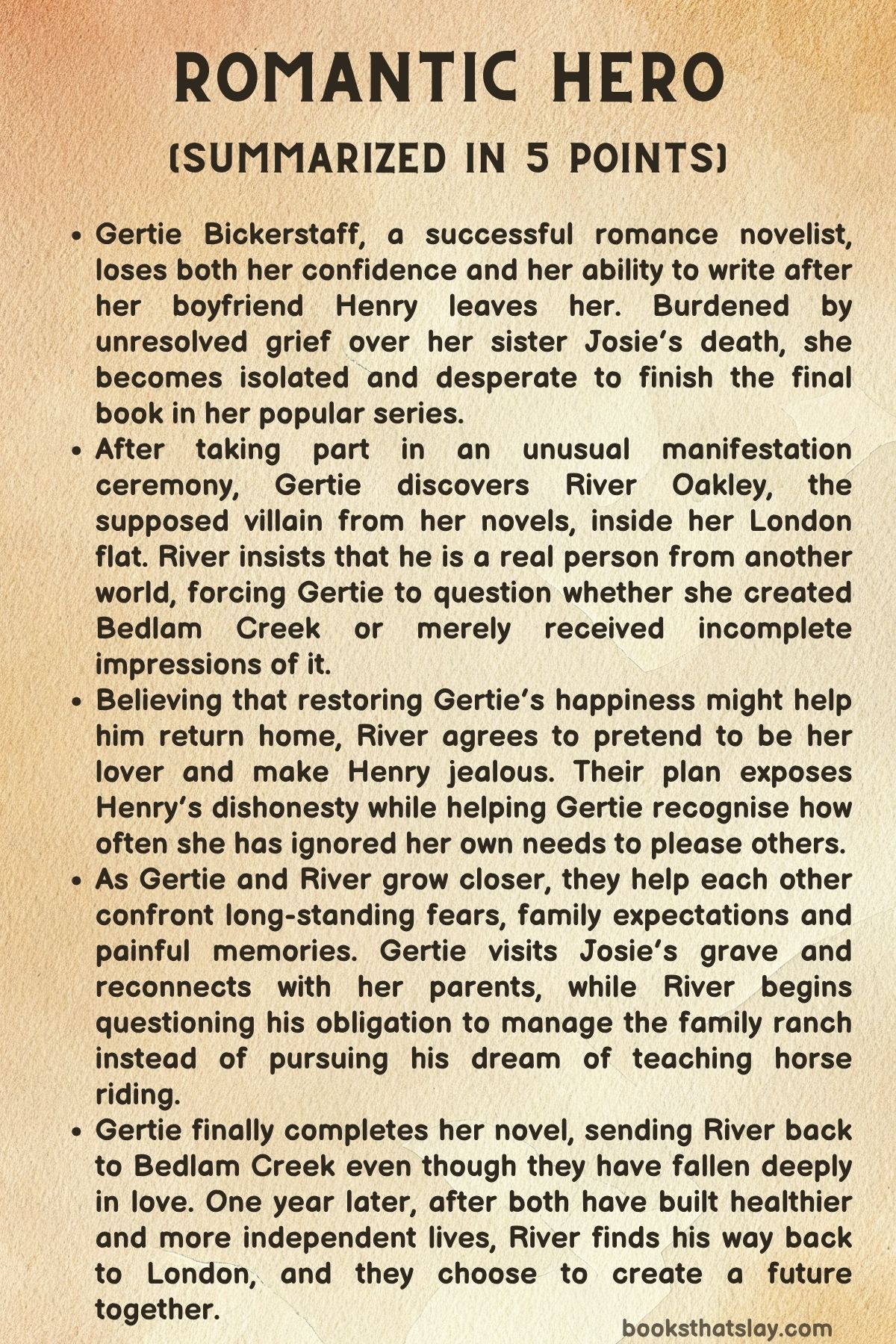
Gertie Bickerstaff once believed completely in romance, soulmates and happy endings. She built a successful career writing the Bedlam Creek series and shaped her private life around Henry Irving, her boyfriend of three and a half years, but her certainty collapses when Henry asks for a break and claims that their relationship no longer challenges him.
Four weeks later, Gertie is isolated, drinking too much and unable to write the final novel in her series. Her characters have gone silent in her imagination, her deadline is approaching, and she hides the severity of her writer’s block from her agent, Bridget, while avoiding friends, family and the grief she has never properly faced since the death of her older sister, Josie.
Her eccentric neighbour, Mrs Casablancas, refuses to let Gertie continue sinking into self-pity. After confronting her about the nightly crying she hears through the walls, she persuades Gertie to join an elaborate rooftop manifestation ceremony intended to restore her creativity.
Gertie secretly adds a second wish because she wants Henry back. She assumes the ceremony is harmless, but its consequences soon overturn everything she believes about fiction and reality.
The following day, after once again failing to enter the cemetery where Josie is buried, Gertie returns home and finds a shirtless cowboy in her locked flat. The stranger identifies himself as River Oakley, the handsome and feared rancher whom Gertie wrote as the villain of her Bedlam Creek novels.
River appears to know details about that world that Gertie never placed on the page. She first assumes he is an actor, a deranged admirer or a hallucination caused by stress and alcohol.
Mrs Casablancas can see him, however, and Bridget confirms that she did not arrange a prank. Gertie is therefore forced to accept that River may truly have crossed from another reality into London.
River is horrified to learn that Gertie considers him fictional and even more offended by the cruel, limited role she assigned him. As he reads the published novels, he disputes her interpretation of events and reveals a private life she never imagined.
He enjoys reading, carries a strong sense of responsibility toward his sister Cassidy and feels trapped by the duty of managing Oakley Ranch. His explanations suggest that Gertie may not have invented Bedlam Creek but instead received incomplete impressions of a real parallel world.
A failed attempt to send River home leads them to believe that Gertie’s wishes may be connected to his arrival. River proposes that he help her win Henry back, reasoning that restored happiness might revive her creativity and allow her to finish the novel.
Completing the book may be the only way to reopen the path to Bedlam Creek. River urgently needs to return before a land auction that could place his ranch and community in danger.
Gertie and River decide to pretend they are lovers during a birthday gathering attended by Henry and his literary friends. While preparing for the performance, River challenges Gertie’s habit of pleasing everyone at her own expense.
She begins to notice how often she accepted things she disliked, silenced her opinions and treated Henry’s comfort as more important than her own. Even small acts, such as asking for the correct drink at a pub, become signs that she is learning to express her needs.
At the gathering, River performs the role of devoted lover so convincingly that Henry becomes jealous. The plan also exposes parts of River that surprise Gertie because he is widely read, musically talented, socially confident, funny and far more thoughtful than the antagonist she believed she had created.
Gertie also begins defending herself more openly. When Henry dismisses romance fiction as inferior to serious literature, she publicly rejects his contempt and speaks with pride about the intelligence, hope and skill involved in writing love stories.
Her response earns admiration from the other guests. More importantly, Gertie discovers that disagreement does not automatically destroy affection or respect.
The possibility of winning Henry back ends when Gertie sees him kissing Marisol, a poet attending the celebration. She realises that Henry began another relationship before leaving and kept Gertie emotionally available because he enjoyed her dependable support.
River comforts Gertie as she finally explains the deeper source of her fear of anger. On the day Josie died, the sisters had their first serious argument, and Gertie has spent four years believing that her final harsh words somehow caused or permanently stained the loss.
Her guilt is the reason she avoids Josie’s grave, her parents and any conflict that might end in abandonment. By constantly trying to keep other people happy, she hopes to prevent another relationship from ending while someone is angry with her.
Back in London, Bridget reveals that River’s arrival may not be unique. She once represented another writer whose character crossed into the real world and believes certain novelists receive incomplete impressions from parallel realities.
In the previous case, the visitor returned only when the blocked author finished the story and typed “The End.” Since Gertie has written nothing and has only days remaining before her deadline, completing the novel becomes both a professional necessity and River’s only known route home.
Gertie and River create a practical plan to restore her creativity. He helps her seek new experiences, confront old pain and reconnect with physical life, while their growing friendship becomes increasingly intimate through shared meals, jokes, ordinary routines and moments of honesty.
Gertie teaches River to swim, helping him challenge a fear inherited from his mother. River then takes her to Josie’s grave, supports her through a panic attack and gives her the courage to apologise, grieve and imagine that Josie would want her to live boldly rather than punish herself forever.
When Henry later appears outside her building, he admits that he wants Gertie’s friendship and editorial help but not a relationship. Gertie finally recognises that he values what she does for him more than he values her as an equal person.
She throws his manuscript out of the window and expresses the anger she has spent years suppressing. Almost immediately, the sounds, characters and atmosphere of Bedlam Creek return to her mind.
As Gertie writes rapidly, her relationship with River becomes physical and emotionally serious. Their connection is based not only on attraction but on laughter, attention, practical care and direct communication.
Gertie experiences desire without reshaping herself to earn approval. River encourages her to ask openly for what she wants, while she helps him understand that accepting care does not make him weak.
River admits that he dreams of teaching horse riding rather than carrying the ranch alone. Gertie encourages him to question the duties imposed by his father and consider sharing responsibility with Cassidy.
At the same time, Gertie begins rebuilding an identity not defined by being someone’s sister, partner or helper. Their happiness is shadowed by the knowledge that completing the novel will send River home.
During a riding lesson, Gertie falls and fractures her ankle. At the hospital where Josie died, she calls her estranged parents and discovers that they have been waiting with love rather than blame.
They begin sharing memories of Josie and grieving together. The conversation allows Gertie to recover the ordinary, joyful memories of her sister that had been buried beneath guilt and trauma.
A conflict follows when River learns that Gertie concealed Cassidy’s plan to take control of the ranch and attend the land auction. He feels that she denied him a choice about his own life, while she argues that protecting her writing process was the only way to return him home.
Their argument demonstrates that loving someone does not justify withholding information from them. They reconcile as the manuscript nears completion and finally admit that they love each other.
River must return to protect Bedlam Creek, while Gertie refuses to abandon the new life she is building merely to follow another man. They choose a painful separation rather than asking either person to surrender a core part of themselves.
Gertie completes Cassidy and Ethan’s love story and types “The End.” Light and thunder fill the flat, and River disappears with Squish, Mrs Casablancas’s dog.
River leaves behind a letter explaining that he would have remained for Gertie but believed she needed the chance to become the leading figure in her own life. He calls her his hero and makes it clear that he returned home because he loved her, not because their relationship lacked importance.
One year later, Gertie is successful, socially connected, reconciled with her parents and committed to counselling. She visits Josie’s grave, maintains firm boundaries with Henry and forms a friendship with Marisol.
Gertie now understands that real romance is shown through daily support, courage and partnership rather than dependence. Although she still misses River, she has built a meaningful life that does not rely on his return.
During a trip to Texas, Gertie discovers Blue Egg Meadow and the cedar tree from River’s world. The discovery suggests that the location can connect their realities, so she leaves River a letter and later performs another rooftop ceremony with her friends.
When the storm ends without River appearing, Gertie fears the attempt has failed. The next morning, however, Squish arrives carrying a message from Cassidy, followed by River himself.
River explains that he gave Cassidy the ranch, opened a riding school and waited every day for a way back to Gertie. Reunited at last, they choose a shared life in London, not because either is incomplete alone, but because both have become capable of loving without disappearing inside the relationship.
Characters
Gertie Bickerstaff
Gertie is the emotional and creative centre of Romantic Hero, and her development is shaped by the gradual recovery of an identity she has repeatedly placed in other people’s hands. At the beginning, she defines herself through relationships: first as Josie’s quieter sister, then as Henry’s devoted partner and finally as the creator of characters whose silence leaves her feeling empty.
Her kindness is genuine, but it has become mixed with fear, guilt and a compulsive need to avoid conflict. She accepts unwanted drinks, neglects friendships, suppresses anger and adjusts her tastes because she believes that being easy to love will protect her from rejection.
Gertie’s writer’s block is therefore not simply a professional problem. It reflects her loss of confidence, unresolved grief and belief that she cannot function without someone else giving her emotional direction.
River’s presence challenges her to separate kindness from self-erasure. Through him, she learns that expressing desire, anger or disagreement does not make her selfish, and that personal boundaries are not acts of cruelty.
Her visit to Josie’s grave, confrontation with Henry and reconciliation with her parents represent different stages of emotional recovery. By the conclusion, she can love River deeply without giving up her own world, goals or newly independent identity.
River Oakley
River initially appears to be the powerful, threatening cowboy antagonist Gertie described in her novels, but Romantic Hero steadily reveals the distance between an outsider’s interpretation and a person’s complete reality. His physical confidence and provocative humour conceal a man governed by inherited duties, private fears and a strong need to protect the people who depend on him.
His reputation as a villain arises partly from his secrecy and partly from Gertie’s incomplete view of his conflict with Cassidy. What looks like controlling behaviour is connected to a promise he made to his father, although the book does not excuse the harm caused by his refusal to communicate openly.
River is observant about Gertie’s people-pleasing because he has constructed a similarly restrictive identity for himself. She hides inside obedience and politeness, while he hides inside toughness, sexual confidence and the belief that he must manage every burden alone.
His fear of water, love of reading, musical ability and dream of teaching riding reveal parts of himself that Bedlam Creek’s expectations have left little room to express. His choice to give Cassidy the ranch and establish a riding school shows that Gertie’s influence helps him pursue a life based on desire rather than duty.
Henry Irving
Henry represents emotional selfishness disguised as intellectual seriousness and calm reason. He presents his departure as a thoughtful response to an unstimulating relationship, but his later actions show that he expects Gertie to remain available as an editor, supporter and dependable alternative while he explores a relationship with Marisol.
His criticism of Gertie as unchallenging is especially dishonest because he has benefited from her reluctance to disagree with him. He accepted her sacrifices, allowed her to reshape her life around his needs and relied on her extensive assistance with his writing without fully acknowledging her contribution.
Henry’s contempt for romance fiction also exposes his insecurity and elitism. He treats his own literary ambitions as inherently important while dismissing the skill and cultural value involved in Gertie’s successful career.
He is not presented as a dramatic monster but as a recognisable form of unequal partner. His greatest failure is his inability to see Gertie as a person whose time, labour, opinions and emotional needs possess the same importance as his own.
Josie Bickerstaff
Josie is absent physically but remains one of the strongest forces in Gertie’s emotional life. Bold, energetic and confident, she encouraged her younger sister to give her ambitions more force and helped shape the creative courage that eventually produced the Bedlam Creek novels.
After Josie’s death, however, Gertie reduces their entire relationship to the argument that occurred before the accident. The memory of her final angry words overshadows years of love, humour and shared experience, turning Josie into both a lost sister and a symbol of Gertie’s supposed moral failure.
Gertie’s imagined sense of Josie’s response becomes essential to her healing. She gradually recognises that Josie would not want one argument to become a lifelong sentence of guilt and would probably reject Gertie’s repeated apologies.
Josie’s influence ultimately shifts from a source of punishment to a source of courage. Remembering her honestly allows Gertie to recover not only grief but also affection, humour and the desire to live with greater confidence.
Mrs Casablancas
Mrs Casablancas is the story’s comic catalyst, practical caretaker and unconventional source of wisdom. Her strange hats, dramatic ceremonies and openness about her personal wishes create much of the humour, yet her eccentricity never prevents her from seeing Gertie’s condition clearly.
She is the first person willing to confront Gertie about her destructive routines. Rather than offering endless sympathy, she recognises that Gertie’s isolation, drinking and avoidance have become dangerous and insists that she take some form of action.
Her manifestation ceremony accidentally opens the connection between worlds, making her partly responsible for River’s arrival. Despite the absurdity of her methods, her deeper belief that people must state what they want proves important throughout the book.
Mrs Casablancas also offers a model of reinvention. She has moved from a career in chemical engineering to a colourful creative life and refuses to treat age, embarrassment or social expectations as reasons to stop seeking pleasure and companionship.
Bridget
Bridget is Gertie’s literary agent, but her role extends beyond deadlines and professional pressure. She is direct, organised and understandably alarmed by Gertie’s failure to write, yet her frustration is balanced by genuine concern for Gertie’s safety and career.
Her previous experience with an author whose fictional character crossed into reality allows her to provide the explanation Gertie and River desperately need. She approaches the impossible with unusual practicality, combining theories about parallel universes with the immediate problem of completing a commercially important novel.
Bridget also sees Henry more accurately than Gertie does. Her distrust of him suggests that she has long recognised the imbalance in the relationship, even when Gertie refused to acknowledge it.
As an agent, she represents accountability rather than cruelty. She cannot remove the deadline or write the book for Gertie, but she remains present, looks for solutions and treats Gertie’s talent as something worth protecting.
Cassidy Oakley
Cassidy is River’s sister and the heroine of Gertie’s Bedlam Creek novels. Although most of her actions occur in the parallel world, her development has a major effect on River’s understanding of family, responsibility and control.
River believes that keeping Cassidy away from ranch management fulfils his father’s wishes and protects her from a difficult life. Cassidy’s successful leadership of the ranch proves that this protective intention has also prevented him from recognising her strength and right to choose.
Her response to River’s disappearance reveals that their conflict does not erase their bond. She misses him, searches for him and eventually demonstrates that she can manage the responsibilities he assumed belonged only to him.
By taking ownership of Oakley Ranch, Cassidy frees River from the duty that has defined him. Her growth allows the siblings to move toward a more equal relationship in which care is no longer expressed through secrecy and control.
Ethan Calhoun
Ethan is Cassidy’s romantic partner and the leading man of Gertie’s Bedlam Creek series. His first public proposal reflects a limited understanding of Cassidy because it places her under communal pressure instead of creating space for an honest personal decision.
His second proposal is more mature and private. Rather than asking Cassidy to fit into a fixed romantic ending, he promises to support her ambitions, face difficulties beside her and remain on her team.
This change reflects Gertie’s transformed understanding of romance. Love is no longer presented as rescue, possession or the completion of an incomplete woman, but as an agreement between two capable people to support one another.
Ethan is less fully developed than River because Gertie initially imagined him as an idealised hero. His role demonstrates that perfection can be emotionally flatter than contradiction, growth and the willingness to change.
Marisol Keats
Marisol first appears to represent the woman for whom Henry has rejected Gertie, but the book refuses to keep her trapped in the role of romantic rival. She is intelligent, socially confident and supportive of romance fiction, immediately treating Gertie’s work with more respect than Henry does.
Her relationship with Henry causes Gertie considerable pain, particularly because it began before Henry was honest about ending his previous relationship. However, Henry’s deception is his responsibility, and Gertie eventually stops directing her anger toward Marisol.
The later friendship between the two women shows Gertie’s increasing emotional maturity. Marisol also ends her relationship with Henry, suggesting that his need for admiration and support creates problems regardless of which woman occupies the role of partner.
By caring for the flowers at Josie’s grave while Gertie travels, Marisol becomes part of the supportive community Gertie once lacked. Her development rejects the idea that women connected to the same man must remain enemies.
Aled
Aled is the manager of Paddington Library and a gentle source of practical assistance. He helps Gertie and River locate material on writer’s block, creativity and parallel universes without treating their unusual behaviour with excessive judgement.
His warmth reminds Gertie of her father, quietly preparing her for the later decision to reconnect with her parents. He also becomes an unexpected friend to River, showing that the cowboy can form meaningful relationships outside the identities assigned to him in Bedlam Creek.
Aled’s most important contribution is his recognition that River is in love with Gertie. While the two central characters avoid naming their feelings, Aled sees the meaning behind River’s concern, domestic effort and constant attention.
His character represents the value of emotionally observant friendship. He does not solve the couple’s impossible situation, but he helps Gertie interpret what is already visible in River’s actions.
Jim Kellerman
Jim is Henry’s friend and the host of the country birthday gathering. His polished manners and hospitality place Gertie and River inside the social environment where their false relationship begins to feel real.
Although Jim is not intentionally cruel, Gertie suspects that he and the other guests knew about Henry and Marisol. This possibility illustrates how social politeness can protect deception when people prioritise avoiding discomfort over telling someone a painful truth.
Jim’s warm reception of River also helps challenge Gertie’s assumptions about class and social performance. River does not need Henry’s education, background or controlled manner to attract respect because his confidence and curiosity allow him to connect with people naturally.
Sir Otto Derberville
Sir Otto is a bookseller whose decision to establish dedicated romance sections gives Gertie an opportunity to defend her profession. His announcement validates the commercial and cultural importance of a genre that Henry dismisses.
He also responds positively to River’s intelligence during the literary quiz. His presence helps expose the narrowness of Henry’s belief that seriousness belongs only to a particular kind of education or fiction.
Sir Otto is less emotionally developed than the central characters, but he performs an important structural role. Through him, the book creates a public setting in which Gertie can stop apologising for her success and declare the value of the stories she writes.
Squish
Squish is Mrs Casablancas’s badly behaved but affectionate dog. His comic habits create disorder in Gertie’s flat, yet he also becomes an important source of companionship and a measure of River’s emotional transformation.
River initially mocks Squish as a ridiculous little creature. Over time, he walks him, trains him, protects him from traffic and becomes deeply attached to him despite pretending that such affection threatens his cowboy identity.
Squish’s decision to jump into River’s arms during the first crossing is both funny and meaningful. He links the two worlds, returns with Cassidy’s message and helps announce that River has found a way back to Gertie.
Gertie’s Parents
Gertie’s mother and father exist for much of the story as figures she avoids because speaking to them would require confronting the shared reality of Josie’s death. Her distance is not caused by their rejection but by her inability to witness their grief without strengthening her own guilt.
When Gertie finally calls from the hospital, they respond with immediate love and understanding. They have missed her, but they do not accuse her of abandoning them or demand explanations before offering comfort.
Their conversation restores the family’s shared ownership of Josie’s memory. By laughing about her pranks and ordinary behaviour, they help Gertie remember that Josie’s life was much larger than the accident that ended it.
River’s Father
River’s father remains powerful after his death because his expectations govern River’s choices. He taught River that duty, endurance and control were central to masculinity, then made him promise to prevent Cassidy from becoming tied to ranch life.
River interprets the promise as an absolute obligation, even when it damages his relationship with Cassidy and prevents him from pursuing his own dream. His father’s influence therefore represents the danger of treating inherited expectations as permanent moral laws.
Only after meeting Gertie does River begin questioning whether loyalty to the dead requires sacrificing the lives of the living. Giving the ranch to Cassidy marks his decision to honour his family without remaining imprisoned by his father’s definition of responsibility.
River’s Mother
River’s mother is remembered as both a source of tenderness and a source of fear. Her work teaching horse riding inspires River’s private ambition, showing that his preferred future is connected to one of the gentler parts of his childhood.
At the same time, her fear of deep water becomes River’s fear, and her warnings about protecting his heart contribute to his emotional defensiveness. Her difficult relationship with alcohol also shapes his memories and his reluctance to appear vulnerable.
River’s growth involves separating what he loved about his mother from the anxieties he inherited from her. Learning to swim and choosing to teach riding allow him to retain her positive influence without repeating every limitation she passed on.
Buddy McGinty
Buddy McGinty functions as a threat to Bedlam Creek rather than as a deeply explored personality. His interest in development and the land auction creates the urgent external reason River believes he must return home.
River’s fear that Buddy could manipulate Cassidy reveals his protective instincts but also his difficulty trusting her judgement. The threat Buddy represents therefore affects both the future of the community and the relationship between the Oakley siblings.
His presence gives practical weight to River’s responsibilities. Without the land auction, River’s return might appear to be based only on habit, but Buddy’s plans make clear that people and livelihoods could be affected by his absence.
Themes
Identity, Independence and Self-Worth
Gertie’s dependence on other people has shaped nearly every stage of her adult identity. She first understands herself as Josie’s quieter companion and later becomes so devoted to Henry that his departure feels like the loss of half her personality rather than the end of a relationship.
Romantic Hero distinguishes loving attachment from emotional disappearance. Gertie’s problem is not that she wants companionship, but that she has treated usefulness, obedience and constant availability as the conditions under which she deserves to be loved.
River faces a parallel struggle beneath a very different appearance. He seems fiercely independent, yet his life is controlled by his father’s expectations, his responsibility toward Cassidy and his belief that he must preserve a fixed image of toughness.
Their relationship helps each character identify the limits imposed by these constructed roles. Gertie learns to state her opinions, reconnect with friends and family, seek counselling and make decisions without waiting for a partner’s approval.
River learns that he can share responsibility, enjoy domestic comfort, express fear and pursue his dream of teaching riding. Their eventual reunion succeeds because both have already chosen lives that reflect their authentic desires.
The book therefore presents healthy love as a meeting between whole people rather than a cure for personal emptiness. Independence does not require emotional isolation, and commitment does not require surrendering the self.
Grief, Guilt and Emotional Avoidance
Josie’s death has frozen Gertie inside a single moment of anger. Instead of remembering the full relationship, she repeatedly returns to their final argument and interprets her harsh words as evidence that she failed her sister at the worst possible time.
This guilt affects far more than her ability to visit the cemetery. It explains her fear of conflict, her distance from her parents, her dependence on Henry and her determination to prevent anyone from leaving while angry with her.
Gertie’s avoidance initially offers temporary protection because she does not have to face the grave, the hospital or her parents’ sorrow. Over time, however, avoiding grief also blocks affection, memory, creativity and connection.
The visit to Josie’s grave does not remove the pain or provide a perfect moment of closure. Gertie speaks honestly, tolerates the emotional weight briefly and begins accepting that love can survive an argument, even when death prevents reconciliation.
Her later call to her parents widens the process of healing. By sharing funny memories, the family restores Josie as a complete person rather than allowing the accident to become the only event that defines her.
The story treats grief as something that must be carried rather than defeated. Recovery begins when Gertie stops using guilt as proof of love and permits herself to remember, laugh, create and form new relationships without feeling that happiness betrays her sister.
Love as Attention, Honesty and Daily Action
Grand declarations appear throughout the story, but the strongest evidence of love is found in ordinary behaviour. River cooks from Josie’s recipe book, learns to prepare Gertie’s tea, cares for her injury, notices what makes her uncomfortable and listens when she speaks about experiences she has hidden from everyone else.
Gertie supports River in equally practical ways. She teaches him to swim, encourages his dream of teaching riding, questions the beliefs that keep him trapped at the ranch and insists that he deserves care when he is injured.
These actions contrast sharply with Henry’s approach to love. Henry speaks calmly about compatibility and intellectual connection, yet expects Gertie to edit his work, manage his emotions and remain available while he avoids honesty about Marisol.
River and Gertie are not presented as flawless partners. Gertie withholds information about Cassidy, River sometimes uses arrogance to cover fear, and both attempt to minimise their feelings because they are afraid of the approaching separation.
Their conflict shows that good intentions cannot replace transparency. Love requires recognising the other person’s right to make informed choices, even when honesty may create disagreement or pain.
The final reunion carries meaning because both characters have demonstrated love through sacrifice without demanding self-erasure. They choose each other after learning that devotion should expand a life through support, courage and mutual recognition rather than reduce it through dependence.
Storytelling, Perspective and Creative Responsibility
River’s arrival forces Gertie to confront the difference between describing a person and fully knowing them. She has presented him as a villain because she observed only selected actions, interpreted his motives from Cassidy’s perspective and shaped those impressions to serve a romantic plot.
River’s private reality is far more complex. His secret hut is a reading place rather than a location for cruel plans, his conflict with Cassidy grows from a promise to their father, and his apparent hostility is connected to responsibility, fear and poor communication.
The parallel-universe explanation gives this question a fantastical form, but the underlying issue applies to ordinary storytelling. Writers choose which experiences receive attention, whose interpretation guides the reader and which qualities become a character’s defining features.
Gertie does not respond by pretending River has never caused harm. Instead, she learns to recognise the intentions, pressures and contradictions that make his choices understandable without automatically making them correct.
Her changing view of romance fiction is equally important. Henry treats the genre as artistically inferior, while Gertie comes to defend its ability to offer courage, pleasure, emotional knowledge and meaningful accounts of human connection.
Finishing Bedlam Creek requires more than recovering a commercial formula. Gertie must write from a deeper understanding of partnership, allowing Cassidy, Ethan and River to become people with choices rather than figures arranged around a predetermined ending.