Shadow Reaper Summary, Characters and Themes
Shadow Reaper by Lynette Noni is a young-adult fantasy novel set on Elverdine Isle, where magical obelisks protect the city of Aravell from lethal blackmist and children surrender most of their power through a ritual called Impartation.
The story follows seventeen-year-old hunter Viridia “Viri” Solace, whose mission to punish the reaper she blames for her parents’ deaths becomes entangled with missing children, forbidden alchemy, buried family secrets, and a dangerous celestial ritual. Combining mystery, action, romance, and moral conflict, the book questions everything Viri has been taught about magic, monsters, loyalty, justice, and the history of her supposedly protected home.
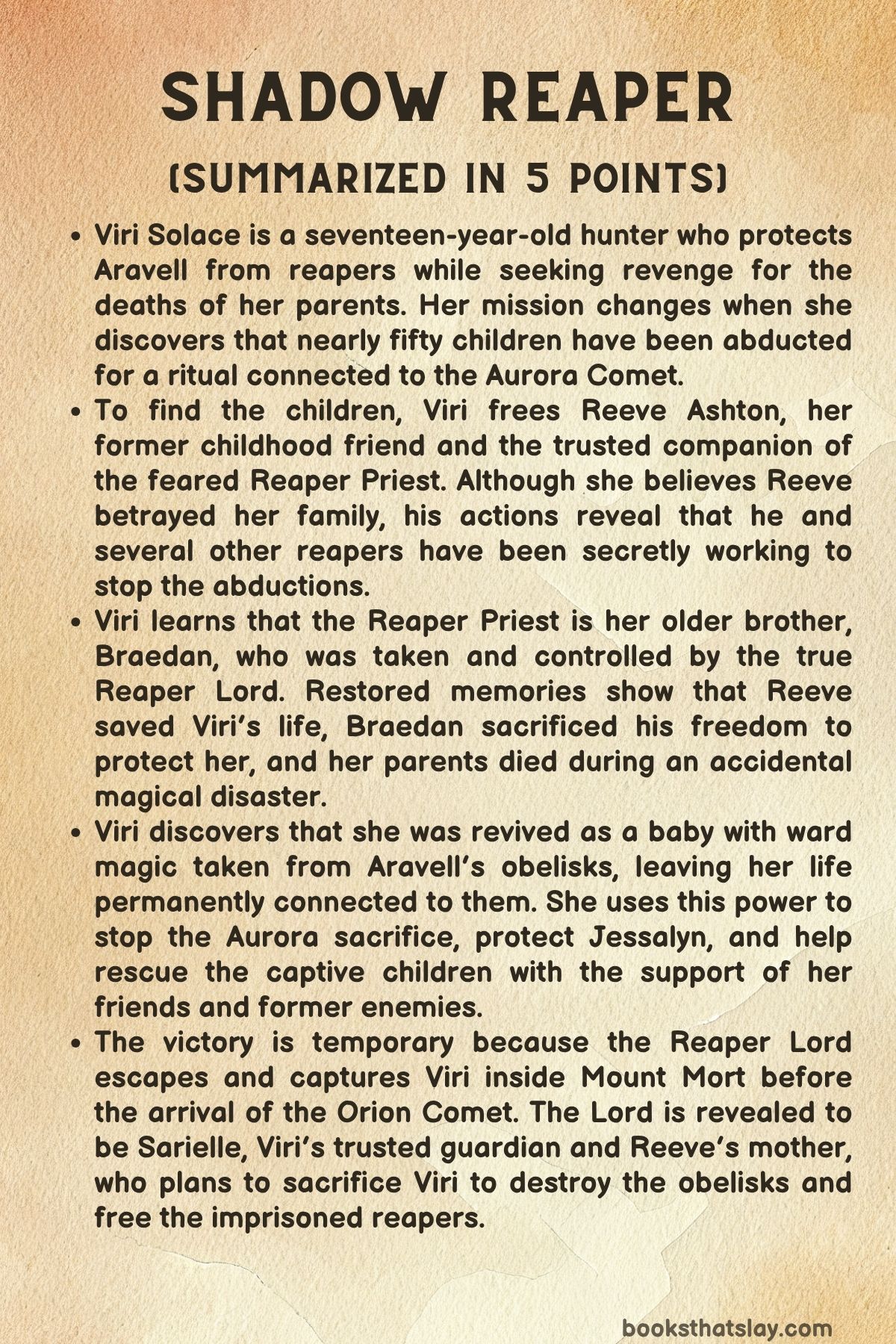
Summary
Seventeen-year-old Viridia “Viri” Solace works as a hunter in Aravell, a city protected from deadly blackmist by four magical obelisks. During a night patrol, she captures a reaper feeding on children and learns that the feared Reaper Priest has marked her for death, a threat that sharpens her determination to avenge the parents she believes he murdered seven years earlier.
Viri soon discovers that Reeve Ashton, the Priest’s right-hand man, has been captured and will speak only with her. Reeve was once her closest childhood friend, but he disappeared after her parents died, and Viri has spent years believing he chose their killer over her.
When she confronts him in the Underlock, Reeve refuses to reveal everything unless she helps him escape. Viri initially rejects the bargain, but her punishment assignment in the Nox archives leads her to nearly fifty unresolved cases involving missing children.
Her mentor, Meera Roth, takes the pattern seriously, while Nox Captain Darik Farrow remains suspicious of Viri and her family. At home, Viri finds comfort with her guardian Sarielle Starling, Sarielle’s daughter Wynter, Nox officer Soren Archer, and Soren’s younger sister Jessalyn, the people who became her family after her parents’ deaths.
Sarielle reveals rumors that the Reaper Priest is gathering children for the Aurora Comet, a rare celestial event whose power may be captured through magic, innocent hearts, and blood. Believing the children may be sacrificed, Viri decides that freeing Reeve is worth risking her career and reputation.
Using Wynter’s illegal alchemical creations, Viri enters the prison and releases Reeve, only to be discovered by Soren. Although furious, Soren helps them escape after learning what may happen to the children, and Reeve later knocks him unconscious to protect him from appearing complicit.
Reeve admits that he does not know the captives’ exact location, but he knows how to find the answers. Viri learns that her enchanted fillium cannot control him because both of them are immune to it, so she links them with nullicuffs that suppress magic and punish separation.
At a hidden apartment, Viri meets Reeve’s companions Sage, Jonas, and Ardin, all reapers who behave more like a loyal resistance group than predators. When they leave her behind during a rescue mission, she follows and discovers them fighting the reapers transporting abducted children.
The rescue saves eight children, but four are taken, and Reeve is struck by a poisoned grimblade while shielding Viri. His condition forces Viri to bring him to Wynter’s secret laboratory, where Wynter uses forbidden alchemy to remove the poison through the magical connection created by the nullicuffs.
During the treatment, Viri reveals that the Reaper Priest is Braedan Solace, her older brother. She remembers seeing him with blackened veins beside their dead parents and believes he killed them before leaving with the Reaper Lord, while Reeve followed willingly.
Reeve’s companions explain that they have actually been working against the Lord and trying to save the missing children. Reeve allowed himself to be captured because he needed Viri’s help, and his plan becomes more urgent when Soren arrives with news that Jessalyn is among the abducted children.
Reeve then explains that Braedan has escaped and intends to use an old magewish to kill the Reaper Lord. Because the Lord holds an immense quantity of unstable ellixen, his sudden death could destroy the obelisks, release catastrophic power, or awaken something hidden beneath Mount Mort.
Viri and Reeve break into Sarielle’s office to recover a blood-activated map and blackmist talismans once owned by Viri’s parents. During the search, Reeve reveals that he never underwent Impartation and still possesses enough ellixen to perform true magic, while Wynter may also have retained her power without knowing it.
Sarielle catches them but chooses to help, and Meera creates an escape route when guards arrive. Viri and Reeve cross the Mistwood, survive a Weeping Wraith, fall into an underground lake, and fight a tentacled creature before reaching Nevarnost Tower, the home of the mysterious Guardian.
Braedan is already there, prepared to make his wish, but Reeve and Viri convince him that killing the Lord could ruin the island. When Viri asks the Guardian for a wish of her own, he reveals that she used one seven years earlier to erase her memories of the day her parents died.
Viri demands the truth and learns that her own unstable power exploded during Impartation, killing her parents. Reeve siphoned the excess magic from her to save her life, making her the only person he has ever fed from, and Braedan surrendered himself to the Reaper Lord to protect her.
Before erasing her memory, Viri asked Reeve to follow Braedan and keep him safe. Reeve honored that promise for seven years, while Braedan endured torture and was forced to kill captive children whenever the Lord threatened Reeve, turning his title of Reaper Priest into evidence of enslavement rather than authority.
The Guardian also reveals that Viri died as an infant after contact with blackmist. Her father used a magewish to revive her with concentrated ward magic taken from the obelisks, making her life dependent on them and explaining why they reacted violently when she attempted Impartation.
Viri reunites with Braedan, accepts Reeve’s loyalty, and begins releasing years of misplaced hatred. Yet time has moved differently around the tower, and the Aurora Comet is only hours away, so she returns to Aravell before the others and follows her hunter’s mark into the cathedral where the children are held.
The Reaper Lord captures Viri, destroys her fillium, and explains that the approaching ritual has always involved her as a possible alternative. During the ceremony, fifty children are arranged beneath the comet’s light, with Jessalyn selected as the central sacrifice.
Viri reaches for the ward magic inside her, breaks her restraints, collapses the barriers surrounding the cathedral, and sends a magical call to Reeve. She protects Jessalyn with a shield, weakens the attacking reapers with Wynter’s alchemical powder, and fights until Reeve, Braedan, Sage, Ardin, Jonas, Wynter, Soren, Meera, and the combined hunters and Nox forces arrive.
The ritual fails, the children are rescued, and the Reaper Lord escapes. Soren reunites with Jessalyn, Viri confirms that her friends and brother survived, and Reeve promises that he will always find her, but an unseen attacker strikes before their reunion can become a lasting victory.
Viri awakens inside Mount Mort, restrained by magic that suppresses her abilities. The Lord explains that the Orion Comet offers a second chance because its ritual requires ellixen abyssus, the rare voidlike ward power within Viri, and destroying the obelisks through her sacrifice will free the reapers imprisoned beneath the mountain while killing her.
The final revelation overturns Viri’s remaining certainties. The Reaper Lord removes a magical disguise and is revealed as Sarielle, the guardian who raised Viri, monitored her power, and secretly controlled Braedan’s suffering, while Reeve is exposed as Sarielle’s supposedly dead son.
Sarielle has captured Braedan, Wynter, and the others, leaving Reeve free but bound by an order not to interfere. The story closes with Viri trapped between the woman she trusted as a mother, the hidden truth of Elverdine’s history, and the coming Orion ritual that may decide whether the island remains a prison or is destroyed in the attempt to free it.
Characters
Viridia “Viri” Solace
Viri is the emotional and moral center of Shadow Reaper, beginning as a disciplined hunter whose identity rests on a simple division between innocent people and monstrous reapers. Her grief has hardened into purpose, and she treats revenge against the Reaper Priest as both a personal duty and a way to give meaning to the deaths of her parents.
Her greatest strength is her refusal to ignore endangered children, even when helping them requires treason, cooperation with enemies, and the destruction of her own reputation. That courage is closely connected to impulsiveness, however, because she often acts before considering how her choices may endanger Soren, Wynter, Reeve, or the people attempting to protect her.
Viri’s development depends on her willingness to question inherited beliefs. As she learns that some reapers resist violence, that Braedan was a captive rather than a willing ruler, and that Reeve saved her instead of abandoning her, she must replace certainty with judgment and accept that a person’s nature cannot be reduced to a title.
Her recovered memories force her to face guilt more painful than hatred, since she discovers that her own uncontrolled magic caused the explosion that killed her parents. By accepting that the disaster was accidental and that her childhood mind chose forgetting as a means of survival, she begins building an identity based on truth rather than revenge.
Viri’s ward magic also reflects her character. It originates in protection, dependence, and sacrifice, and she becomes most powerful when defending Jessalyn and the other children rather than when pursuing punishment.
Reeve Ashton
Reeve is presented first through Viri’s anger, so his confidence, secrecy, and association with the Reaper Priest make him appear dangerous and untrustworthy. His habit of answering indirectly strengthens that impression, yet his actions repeatedly reveal a protective loyalty that his words conceal.
He is defined by a promise made in childhood: to follow Braedan, guard him, and help reunite the Solace children. That promise costs him seven years of freedom, safety, and Viri’s affection, but he keeps it without demanding recognition, which makes loyalty the clearest measure of his character.
Reeve’s status as a reaper complicates the moral system of the book because he has siphoned only once, from Viri, to save her life. His lack of addiction suggests that reaper hunger is affected by circumstance, magic, and choice, while his continuing refusal to feed demonstrates exceptional self-control.
His manipulative decisions remain genuine flaws. He arranges his own capture, withholds crucial information, renders Viri unconscious, and frequently decides what risks she should be allowed to take, revealing a protective instinct that can become controlling.
The romance between Reeve and Viri grows from shared history, anger, physical danger, and rediscovered trust. His tenderness never erases his capacity for violence, but it shows that gentleness and danger can exist in the same person without making either quality false.
Braedan Solace
Braedan initially exists in Viri’s memory as the brother who became the Reaper Priest and murdered their parents. The restored past changes him from a symbol of betrayal into a victim of coercion who surrendered himself to save his younger sister.
His years with the Reaper Lord expose the destructive power of love when an abuser turns it into leverage. Braedan is forced to siphon from captive children whenever Reeve is threatened, and repeated violence creates both addiction and guilt, leaving him responsible for terrible acts without making him freely cruel.
Braedan’s plan to kill the Lord with a magewish reveals courage, desperation, and damaged judgment. He wants to stop the sacrifices and end his captivity, but years of trauma have narrowed his thinking until immediate destruction appears more valuable than understanding the consequences.
His reunion with Viri allows him to be seen as a brother rather than a title. He accepts blame for the lives he took, yet Viri’s refusal to abandon him gives him the possibility of accountability without permanent condemnation.
Wynter Starling
Wynter is Viri’s closest female friend, adopted sister, and intellectual counterpart. Where Viri relies on combat training and instinct, Wynter relies on experimentation, curiosity, and knowledge that society has declared illegal.
Her alchemy is dangerous because it is still developing, but it repeatedly saves lives, proving that prohibited knowledge is not automatically immoral. Zingzest, healing salves, scarlet powder, and the treatment for Weeping Wraith poison make her laboratory one of the few places where official rules are less useful than creative understanding.
Wynter’s compassion is strongest when she treats Reeve despite being shocked by Viri’s actions. She asks difficult questions and demands honesty, but she does not withdraw love when Viri reveals Braedan’s identity, showing that loyalty can include confrontation rather than unquestioning approval.
The revelation that Wynter never truly underwent Impartation suggests that her life has also been shaped by Sarielle’s deception. Her unknown magical potential and her mother’s betrayal position her for a painful conflict between inherited identity and independent choice.
Soren Archer
Soren is a Nox officer whose loyalty is tested by Viri’s decision to free Reeve. He believes in law, order, and responsibility, yet he ultimately helps Viri escape because protecting fifty children matters more than preserving procedure.
His strongest motivation is his devotion to Jessalyn, whom he has raised since their parents abandoned them. This parental responsibility makes him mature and dependable, but it also leaves him vulnerable to fear and anger when Jessalyn is taken.
Soren’s hostility toward Reeve is reasonable rather than merely jealous, because Reeve is a powerful criminal who attacks him, conceals information, and has a history tied to Viri’s deepest wounds. His willingness to cooperate with Sage and ask Reeve for help nevertheless shows that he can place Jessalyn’s safety above pride.
He represents institutional goodness at its best: not blind obedience, but a belief that rules should protect people and may need to be challenged when they fail.
Jessalyn “Jessy” Archer
Jessalyn brings youth, warmth, and ordinary family affection into a story dominated by violence and secrecy. Her excitement about Impartation reflects how completely Aravell’s culture teaches children to view surrendering their magic as a safe and celebratory passage into adulthood.
Her abduction turns the missing-child crisis from a public emergency into a personal disaster for the central group. Because the readers have seen her joking during family night, her placement at the center of the Aurora ritual gives the danger a recognizable human face.
Jessy also displays resilience while imprisoned. She remains observant enough to explain how the children have been treated, responds to Viri’s arrival with trust, and survives without losing her capacity to reconnect with Soren after the rescue.
Sarielle Starling and the Reaper Lord
Sarielle is the central hidden antagonist of Shadow Reaper, and her power comes from the trust she has patiently built. As Viri’s guardian and Wynter’s mother, she appears protective, wise, and morally serious, even guiding Viri toward the decision to save the missing children regardless of personal cost.
The final revelation transforms many earlier acts without making her affection easy to classify. She may have cared for Viri in some capacity, but she also raised her as a resource to be monitored until her ward magic could be used, turning motherhood into surveillance and protection into possession.
As the Reaper Lord, Sarielle is strategic rather than reckless. She allows Reeve’s capture, Braedan’s escape, and the attempted magewish to proceed because she predicts that Viri will prevent her death, showing an ability to manipulate both enemies and loved ones through their strongest attachments.
Her goal of freeing the reapers imprisoned beneath Mount Mort gives her cause a political and historical basis. Yet her methods—torture, child abduction, coerced killing, memory control, and planned sacrifice—show how a legitimate grievance can become tyranny when one person treats every life as material for a larger objective.
The disclosure that Reeve is her son deepens her contradictions. She commands him, hides his identity, and assumes authority over his choices, suggesting that her idea of love is inseparable from control.
Meera Roth
Meera is Viri’s mentor and the commander of the Hunters’ Guild. Her damaged throat and magical speaking amulet make her a visible survivor of earlier violence, while the death of her fiancée, Istrid, connects her personally to the Solace family’s past.
Unlike Darik, Meera does not let grief turn into permanent prejudice. She trusts Viri’s instincts about the missing children, supports her investigation, and later attacks Nox guards to help her escape, proving that mentorship for her involves moral faith rather than simple discipline.
Meera also represents the possibility of living with trauma without surrendering fairness. Her pride after the cathedral battle confirms that she judges Viri by her choices and growth, not by the accusations surrounding her family.
Darik Farrow
Darik is the Nox captain and Istrid’s grieving father. He blames Viri’s parents for the mission in which Istrid died, and that unresolved anger shapes his suspicion toward Viri, Reeve, and any action that appears to disregard authority.
His severity is not wholly unjustified, since Viri repeatedly enters restricted areas, frees a dangerous prisoner, assaults officers, and conceals important information. Darik therefore functions as a reminder that heroic motives do not remove the practical consequences of reckless behavior.
Even so, his willingness to postpone interrogation after the children are rescued shows that he can recognize achievement despite personal resentment. He is rigid, wounded, and often unfair, but he is not portrayed as corrupt or indifferent to public safety.
Sage
Sage is one of Reeve’s most forceful allies and the character most openly hostile to Viri. Her anger comes from loyalty, especially after Reeve is poisoned while protecting Viri and four children are lost during the disrupted rescue.
She challenges Viri’s assumptions by openly acknowledging that she siphons ellixen from Jonas with his consent. This arrangement proves that reaper abilities can exist within negotiated trust rather than predation, although it also raises questions about dependence and unequal risk.
Sage’s sharpness protects a committed moral core. She has not killed for years, helps rescue abducted children, follows their trail with Soren, and repeatedly chooses resistance despite the danger posed by the Reaper Lord.
Jonas
Jonas is gentle, scholarly, and deliberately unlike the violent image Viri associates with reapers. His quiet manner, glasses, books, and affection for Walnut create an atmosphere of domestic normality within the resistance group.
His willingness to share ellixen with Sage demonstrates trust and consent, but it also suggests personal sacrifice. Jonas accepts physical vulnerability to help a friend function, revealing courage expressed through care rather than combat.
He also acts as a bridge between hostile groups. His calm explanations help Viri understand that siphoning does not always kill, and his easy cooperation with Wynter supports the growing alliance between hunters, mages, alchemists, and reapers.
Ardin
Ardin is the most controlled and reserved of Reeve’s companions. He is cautious around Viri but avoids Sage’s open hostility, making him a stabilizing presence during missions and disagreements.
His promise to return the rescued children to their families is confirmed by the fillium, giving Viri one of her earliest pieces of undeniable evidence that a reaper can be trustworthy. His reliability matters more than dramatic speeches because he consistently performs necessary work without demanding attention.
The Guardian
The Guardian occupies an uncertain position between helper, judge, and keeper of dangerous history. He controls access to magewishes, restores Viri’s memories, and explains the source of her life-sustaining magic, but magical restrictions prevent him from revealing everything he knows.
His decision to grant young Viri the wish to forget can be viewed as mercy, yet it also delays truth and allows false beliefs to shape seven years of her life. He therefore represents the moral uncertainty of protection that removes another person’s ability to understand and choose.
His connection to the Reaper Lord suggests that he bears some responsibility for the island’s crisis. Rather than solving the conflict himself, he tells Viri to trust her own magic and relationships, placing the burden of correction on a younger generation.
Jorth Solace
Jorth is Viri and Braedan’s father, remembered as a loving parent and capable hunter. His journey to the Guardian after infant Viri’s death shows extraordinary devotion, but his wish to revive her also creates the magical condition that later makes her vulnerable to the obelisks.
His greatest mistake is allowing Viri to undergo Impartation despite warnings. The choice appears rooted in fear of burnout and pressure to follow social expectations, showing how loving parents can cause harm when anxiety outweighs caution.
Amity Solace
Amity is Viri and Braedan’s mother and, like Jorth, treats Reeve as part of the family. Her warmth in Viri’s restored memories helps explain why the loss shattered all three children and why their surviving bonds remain centered on the family she helped create.
She shares responsibility for the decision to proceed with Viri’s Impartation, but the book does not reduce her to that failure. Her death becomes a lesson in the limits of good intentions and the lasting consequences of choices made under cultural pressure.
Betty
Betty, the elderly bakery owner, provides Reeve with a place of familiarity and acceptance. Her warm teasing allows Viri to see that Reeve has relationships outside criminal networks and can inspire ordinary affection rather than fear.
Her brief appearance also offers emotional relief. By treating Viri and Reeve as an embarrassed young couple, she recognizes their connection before either of them is prepared to name it.
Head Archivist Thornton
Thornton oversees the Nox archives and initially dismisses Viri’s concern about the missing-child reports. His complacency illustrates how institutional failure can hide danger even without direct conspiracy.
Whether he intentionally buried the files or simply failed to recognize their importance remains uncertain, but his response shows the risk of valuing routine classification over the instincts of someone who notices a disturbing pattern.
Kadmus Castro
Kadmus is a celestial mage whose historical journal records the foundations of Aravell’s magical order. His observations about the Hallow Stream, celestial events, the obelisks, and Tephryn’s work provide information that gradually exposes the official history as incomplete.
His personal conflict centers on devotion and emotional repression. By ending his relationship with Tephryn because he believes a Mage Priest must possess an undivided heart, he sacrifices human connection to an institution whose moral authority later becomes doubtful.
Kadmus also participates in plans involving Aurora and Orion, linking private denial with public ambition. His writings show how learned people can recognize instability while continuing to pursue power.
Tephryn Alemedes
Tephryn is a gifted alchemist whose work contributes to the creation of the obelisks and the magical systems governing Elverdine. Her presence demonstrates that alchemy once held central importance before becoming forbidden, strengthening the significance of Wynter’s secret practice.
Her relationship with Kadmus reveals the personal cost of rigid religious duty. Although the surviving material presents much of her through his perspective, her inventions continue to shape the island long after their relationship ends.
Anissa Solace
Anissa Solace appears in the historical record as the person who proposes using children’s surrendered ellixen to fuel the blackmist system. Her plan helps establish Impartation as a social institution and connects the Solace family name to the machinery of Elverdine’s hidden prison.
Her role complicates Viri’s inheritance. The family associated with hunters and protection is also tied to memory alteration, forced magical surrender, and the long deception imposed on the island’s population.
Istrid Farrow
Istrid is Darik’s daughter and Meera’s deceased fiancée. Although she appears through memory, her death continues to influence the relationship between the Hunters’ Guild, the Nox, and the Solace family.
She represents a future destroyed by failed coordination and unanswered blame. Meera’s grief becomes a source of empathy, while Darik’s becomes a source of suspicion, showing two different responses to the same loss.
Galen
Galen is Sarielle’s assistant at the Summit and serves as a practical obstacle during the search for the Solace family’s belongings. His presence emphasizes how thoroughly Sarielle’s public authority is protected by ordinary administrative systems.
Wynter and Jonas can distract him because he does not suspect the deeper conflict unfolding around his employer. He represents the many people who support an institution without understanding the secrets held at its center.
Judge Muriel
Judge Muriel is an elderly council member whose unexpected arrival nearly exposes Viri and Reeve inside Sarielle’s office. Her poor eyesight creates the circumstances for their impulsive kiss, allowing tension and attraction to surface during a dangerous mission.
She also provides a brief comic interruption within the larger conspiracy. Her mistaken belief that Reeve is Soren shows how easily appearances can be managed inside a government already shaped by concealment.
Walnut
Walnut is Jonas’s pet rabbit and a small but effective symbol of gentleness within the reapers’ hidden home. His presence challenges Viri’s expectation that every reaper environment must be threatening and helps make Jonas immediately appear caring and approachable.
Walnut also becomes part of the distraction used at the Summit, proving that even a minor companion can contribute to the group’s success.
Themes
Memory, Truth, and the Construction of Identity
Viri’s identity is built on a false memory: she believes Braedan murdered their parents and Reeve abandoned her, so she becomes a hunter whose purpose is to destroy the people connected to that loss. In Shadow Reaper, memory is therefore not merely a record of the past but a force that determines moral judgment, relationships, and the direction of an entire life.
The wish that erased Viri’s memories originally protects a terrified child from unbearable guilt. Over time, however, that protection becomes a prison because the missing truth allows hatred to replace understanding and prevents her from recognizing the sacrifices made by Braedan and Reeve.
Restoring the past does not instantly heal Viri, since truth brings responsibility, shame, and grief before it offers freedom. She must learn that remembering an event accurately is different from assigning blame fairly, especially when her childhood power caused an accident she neither intended nor understood.
The island’s altered public history expands this personal conflict into a social one. Aravell’s citizens accept Impartation, the blackmist, and the obelisks because collective memory has been managed, proving that a community can build its laws and values around a carefully maintained lie.
Truth becomes liberating only when characters face it without using it as another weapon. Viri’s growth begins when she accepts painful knowledge while refusing to let that knowledge reduce herself, Reeve, or Braedan to their worst moments.
Prejudice, Choice, and Moral Complexity
Hunters are trained to regard reapers as addicted killers whose existence is defined by stolen magic. Viri begins with this belief so deeply embedded that even clear acts of courage by Reeve, Sage, Jonas, and Ardin feel suspicious to her.
The resistance group gradually breaks apart that category. Jonas shares ellixen through consent, Sage has stopped killing, Ardin safely returns rescued children, and Reeve refuses to feed for seven years, demonstrating that dangerous abilities do not automatically determine moral character.
The story does not excuse every reaper by presenting sympathetic examples. Braedan has killed children, Reeve uses violence and manipulation, and Sage can be harsh, but their actions are examined through coercion, trauma, intention, restraint, and accountability rather than a single label.
Viri’s changing perspective requires more than discovering that some reapers are good. She must also recognize that respected institutions can cause harm, that hunters can act unjustly, and that people who appear protective may be responsible for the worst cruelty.
Moral judgment becomes an active responsibility rather than an inherited rule. The book argues that fairness requires attention to what a person chooses when alternatives exist, what pressures shape those choices, whether harm is acknowledged, and whether change is followed by action.
This theme gives the conflict its strongest ethical tension because Viri cannot protect others until she stops allowing social categories to think on her behalf.
Love, Loyalty, and Control
Love motivates nearly every major sacrifice, but it also provides the means through which characters are controlled. Reeve follows Braedan because of his promise to Viri, Braedan submits to the Reaper Lord to protect his sister, and Soren risks his position because Jessalyn’s safety matters more than obedience.
These loyalties create courage, yet they also expose vulnerabilities. The Reaper Lord tortures Braedan by threatening Reeve, predicts Viri’s decisions through her attachment to innocent children, and uses the language of protection to justify monitoring the girl she raises.
Sarielle’s betrayal shows the darkest version of possessive love. She acts as guardian and mother while secretly treating Viri’s body as a future magical resource, and her claim over Reeve suggests that she understands family bonds as forms of authority rather than mutual responsibility.
Reeve’s protectiveness occupies a more uncertain position because it is sincere but sometimes controlling. He saves Viri repeatedly, yet he also withholds information, makes plans for her, and incapacitates her when he believes he knows what is safest.
Healthy loyalty begins to emerge when characters trust one another without demanding ownership. Wynter challenges Viri but does not abandon her, Viri accepts Braedan without denying his guilt, and Soren works with Sage despite fear and resentment.
The story distinguishes love that supports another person’s agency from love that turns fear of loss into permission to command, deceive, or sacrifice them.
Power, Protection, and Institutional Deception
Aravell’s political order presents the obelisks, Impartation, hunters, and the Nox as parts of a protective system. The later revelations show that this safety depends on stolen magic, altered memory, hidden prisoners, and a history designed to prevent citizens from questioning the structure around them.
Protection is therefore never treated as morally pure simply because it prevents immediate danger. The obelisks keep blackmist away, but they also sustain a prison; Impartation may reduce burnout, but it takes children’s power and feeds a system they do not understand.
Sarielle’s plan exposes the opposite danger. Her desire to free the reapers beneath Mount Mort addresses a real injustice, yet she treats mass sacrifice and Viri’s death as acceptable costs, reproducing the same logic of exploitation she claims to oppose.
Viri’s ward magic offers a different model of power because it is strongest when used to shield rather than dominate. Her barriers protect Jessalyn, disrupt the ritual, and open the cathedral to allies, showing that power can create shared resistance instead of dependence on a single ruler.
Wynter’s forbidden alchemy also challenges institutional definitions of safety. Official law condemns her work, but her experiments heal Reeve, weaken attackers, and repeatedly succeed where sanctioned knowledge fails.
The conflict asks whether a system deserves loyalty merely because it offers stability. Real protection requires informed consent, truthful history, accountability, and the refusal to preserve one group’s security through another group’s captivity.