The Break-Up Retreat Summary, Characters and Themes
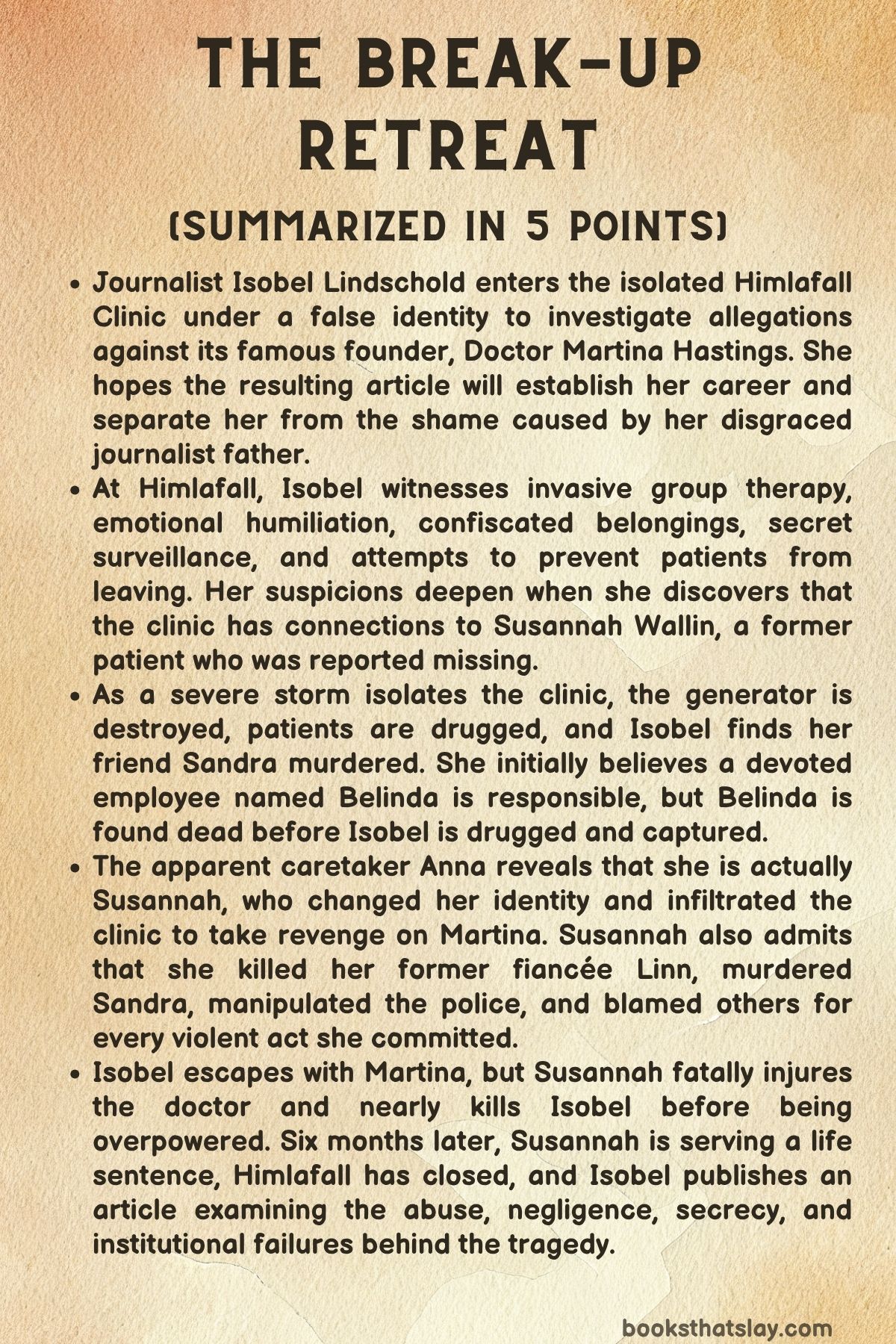
The Break-Up Retreat by Camilla Sten is a psychological thriller about ambition, manipulation, emotional abuse, and the dangerous authority people may surrender to charismatic experts. Journalist Isobel Lindschold enters an isolated Swedish clinic under a false identity, hoping to expose its celebrated founder and revive her unsuccessful career.
What begins as an undercover investigation soon becomes a fight for survival as Isobel encounters invasive therapy, secret surveillance, missing records, drugged patients, and a hidden connection to a missing woman. The book examines how therapeutic language can be used to control others, how victims and abusers construct competing versions of truth, and how personal responsibility defines genuine change.
Summary
Isobel Lindschold travels to the remote Himlafall Clinic using the invented surname Anderssen. She has created an imaginary former boyfriend named Kaveh, borrowed photographs from her best friend Armin, and built an online history that makes their fictional four-year relationship appear authentic.
Her purpose is not to recover from heartbreak but to investigate allegations against the clinic and its famous founder, Doctor Martina Hastings. Isobel believes that a successful exposé could establish her journalism career and separate her from the legacy of her father, a celebrated reporter whose reputation collapsed after decades of fabricated stories.
Himlafall appears peaceful when Isobel arrives, with white buildings, attractive cabins, a pond, and dense forest surrounding the property. Its beauty is accompanied by strict control: patients surrender their phones, follow a mandatory schedule, stay in cabins that cannot be locked from inside, and depend on clinic employees for access to nearly everything.
Isobel meets Martina and immediately understands the source of her influence. Martina is observant, elegant, reassuring, and skilled at finding emotional weaknesses, and she quickly moves beyond Isobel’s invented breakup to identify her genuine disappointment, loneliness, professional frustration, and fear of becoming like her father.
The other patients include Clara, a wealthy and enthusiastic young woman who strongly admires Martina; Katarina, a cautious lawyer burdened by an abusive childhood; Pernilla, an unhappy married woman whose confidence hides deep insecurity; and Leyla, a blunt and sceptical woman recovering from her relationship with Alexia. Isobel also meets employees Belinda, Anna, and Ellen, although she had expected her childhood friend Sandra to be working at the clinic.
During the welcome dinner, Isobel claims that a former patient named Susannah Wallin recommended Himlafall. Ellen reacts with visible alarm, while Belinda immediately tries to silence her, confirming that the clinic knows something significant about Susannah, who disappeared after receiving treatment there.
That night, someone pushes an anonymous warning beneath Isobel’s cabin door. The message orders her to leave, says there is nothing for her at Himlafall, and warns that she is already too late.
Rather than driving her away, the note convinces Isobel that her suspicions are justified. She records her observations, considers which employee might have access to a printer, and wonders whether the writer is threatening her, protecting her, or attempting to conceal a crime.
Martina’s group sessions soon reveal the troubling nature of the Hastings Method. Patients are forced to disclose intimate information, criticise one another, surrender their emotional boundaries, and accept Martina’s interpretation of their feelings even when they disagree with her.
Pernilla accuses Isobel of wanting the social appearance of marriage more than genuine love, an observation that feels accurate despite Kaveh being fictional. Martina rewards Pernilla’s cruelty as honesty, then keeps her behind after the session, leaving her shaken and without the wedding ring she had been wearing.
In an individual session, Martina asks about Isobel’s silver rose pendant and discovers its connection to her father. She argues that Isobel avoids emotional dependence because her father’s betrayal taught her that love creates the possibility of abandonment, and Isobel is disturbed by how closely the analysis resembles the truth.
Isobel secretly contacts Armin and admits that Martina’s methods are affecting her. During their call, Armin notices a figure outside Isobel’s window, and when Isobel runs after the watcher, someone follows her through the dark grounds and takes the hidden phone she drops during the pursuit.
The stolen device contains conversations with Armin and Sandra, potentially exposing the investigation. It also proves that Isobel’s fears are not merely the result of anxiety, exhaustion, or Martina’s psychological pressure.
Sandra eventually arrives and explains that Doctor Nina, a temporary clinician, once argued with Martina about a patient. Sandra suspects that the patient may have been Susannah and that Nina discovered something dangerous about either the woman or the clinic’s methods.
Isobel and Sandra decide to search for records. Sandra plans to occupy Martina in a private meeting while Isobel enters the main building, after which they will meet in the forest to exchange information.
Meanwhile, Martina’s treatment grows increasingly cruel. She exposes Leyla’s private history, provokes conflict between Clara and Pernilla, and pressures the patients to view humiliation and emotional collapse as evidence that the method is succeeding.
Isobel searches Martina’s office and finds that clinic employees have deliberately fabricated a knee injury in her records to prevent her from attending sessions with certain staff members. She also discovers an instruction to keep her away from Anna, suggesting that someone has become concerned about their growing trust.
When Isobel enters the forest for her meeting with Sandra, Sandra never arrives. Isobel hears a scream, becomes lost in the storm, and later confronts Clara, who has blood on her mouth and appears to have been moving secretly between the cabins.
Clara explains that she has developed a romantic and sexual relationship with Leyla. Her injury resulted from a fall while returning from Leyla’s cabin, but she has also realised that Isobel is behaving suspiciously and threatens to report her to Martina.
The next morning, Isobel decides the investigation has become too dangerous and asks to leave. Martina refuses to return her phone and car keys, claiming that Isobel is emotionally incapable of making a responsible decision and that leaving would repeat her supposed pattern of escaping intimacy.
A severe storm cuts the clinic off from the outside world. Isobel suspects that the weather is being used as another means of confinement, although the worsening rain makes the roads and surrounding forest genuinely dangerous.
Isobel’s recorder then reveals that people entered her cabin and searched her belongings while she was absent. Their recorded conversation mentions Susannah and confirms that the stolen phone, false medical instructions, and clinic surveillance are connected.
During another group session, Martina publicly exposes Katarina’s childhood abuse and mocks her pain until Katarina erupts in anger. Martina presents the outburst as a therapeutic success, but Katarina rejects her authority and states that treatment should not make patients feel unsafe.
Isobel finally tells the patients about Susannah, the watcher, the stolen phone, and the secret searches. Clara responds by exposing Isobel as a journalist who entered under a false identity and listened to their private disclosures while planning an article.
Martina appears genuinely shocked when she learns that Isobel’s room was searched. She also admits that confidential patient files have disappeared, suggesting that someone inside Himlafall is acting without her knowledge.
The electricity suddenly fails, and the backup generator does not activate. Isobel accompanies Martina to inspect it and finds that its casing has been smashed and its cable severed with an axe.
Martina reveals that the entrance gates are electrically operated and cannot be opened manually. The destroyed generator, failed landline, disabled signal booster, locked gates, and storm have left everyone trapped with the unknown saboteur.
Isobel and Martina enter the staff accommodation, hoping to find Sandra. A foul smell leads them to her bedroom, where Isobel discovers Sandra’s body beneath the blankets with the back of her skull crushed.
They escape through a window before the killer enters the room. Outside, Isobel is grabbed by Armin, who drove to the clinic after becoming alarmed by her sudden silence and left his car beyond the locked gates.
Armin helps Isobel recover from the shock of Sandra’s death. He explains that the road is wet but not flooded, proving that the clinic’s warnings about complete isolation were misleading and providing a possible route of escape.
Isobel refuses to leave without the patients and employees. She, Armin, and Martina begin moving between the cabins, where they find Clara unconscious after drinking tea that appears to have been drugged.
Anna arrives in a frightened and unsteady condition and claims that Belinda destroyed the generator, drugged the tea, attacked Sandra, and attempted to kill her near the pond. She urges Martina to confront Belinda, insisting that Belinda’s devotion to her might make her willing to surrender.
Near the pond, they find Belinda dead with her skull split open by the same axe used on the generator. As Isobel recognises that Anna’s story does not match the severity of the injury, Anna injects her with a fast-acting drug.
Isobel awakens restrained in Martina’s office, with Martina tied nearby. Anna admits that she arranged the sabotage and killings, stole Isobel’s phone, searched her room, and wanted the journalist to witness what would happen.
Anna then reveals that she is Susannah Wallin. She had changed her appearance, adopted a different manner, entered the clinic as an employee, and remained unrecognised because Himlafall’s rapid staff turnover and poor recruitment practices made infiltration easy.
Records written by Doctor Nina reveal that Susannah was not simply an abandoned woman suffering from heartbreak. She was controlling, manipulative, aggressive, and abusive toward her former fiancée, Linn, and Nina had refused to support Susannah’s belief that she was entitled to regain the relationship.
Susannah describes how she controlled, criticised, frightened, and physically hurt Linn while presenting herself as the injured partner. When Linn finally allowed her into the apartment to collect belongings, Susannah attacked her, causing Linn to strike her head and die.
Instead of accepting responsibility, Susannah hid Linn’s body, impersonated her through messages, and manipulated a police visit so that officers believed Susannah was alive at Linn’s home. The deception caused the missing-person case to be closed.
Susannah returned to Himlafall because she blamed Martina for failing to help her recover Linn and for allowing Nina to reject her. She stole patient files, sent threats in Martina’s name, infiltrated the clinic, and began constructing a revenge plan.
Sandra recognised Susannah and tried to protect Isobel, so Susannah murdered her. As with Linn’s death, Susannah describes Sandra’s killing as an accident and insists that other people’s actions forced her to respond violently.
Susannah plans to compel Martina to record a public confession accepting responsibility for everything that happened. Martina attempts to calm her by validating her pain, but the effort fails when a careless remark triggers another violent reaction.
Isobel breaks the office window with a heavy award and escapes with Martina. As they run toward the gate, Susannah throws a stone that strikes Martina in the head and leaves her fatally injured.
Susannah attacks Isobel, pins her to the ground, and begins choking her while demanding understanding and an apology. She continues portraying herself as the victim even as she attempts to kill another person.
Martina, still conscious, pushes one of the clinic’s decorative stones within Isobel’s reach. Isobel refuses Susannah’s demand that she accept responsibility for the attacker’s choices and strikes her unconscious with the stone.
Martina dies from her injury, while Isobel survives. Susannah is arrested and later receives a life sentence for the deaths connected to her actions, including Linn, Sandra, Belinda, Pernilla, and Martina.
Six months later, Himlafall has closed permanently. Clara, Leyla, and Katarina survive, while Isobel and Armin acknowledge their feelings for each other and attempt to build a relationship despite the psychological effects of the attack.
Isobel completes the investigative article she had hoped would establish her career. Instead of treating Susannah’s violence as a sudden and inexplicable transformation, she examines the abuse, ignored warnings, police failures, professional negligence, and institutional secrecy that allowed the situation to continue.
She publishes the article under the name Isobel Lindschold rather than reclaiming the surname associated with her father. By choosing her own identity, she no longer needs professional success to defend, correct, or continue his legacy.
Characters
Isobel Lindschold
At the centre of The Break-Up Retreat, Isobel is an ambitious journalist whose courage is inseparable from insecurity, stubbornness, and a need to prove herself. She enters Himlafall partly to protect vulnerable women and partly because she believes one important article could repair years of rejection and uncertainty.
Her investigation is complicated by her fear that she resembles her disgraced father. Both use deception in pursuit of a story, but Isobel gradually distinguishes herself through her willingness to acknowledge consequences, protect others, and accept that good intentions do not excuse reckless decisions.
Isobel’s false story also reveals truths she has avoided. Kaveh does not exist, but the emotional distance, fear of abandonment, desire for control, and habit of leaving before she can be rejected all belong to her.
Her development is completed when she stops measuring herself against her father’s reputation. Publishing under her real name represents a decision to build an identity through accountability rather than through inherited shame, borrowed courage, or public recognition.
Doctor Martina Hastings
Martina is a charismatic psychologist whose intelligence and perceptiveness make her both effective and dangerous. She can recognise hidden emotional patterns with remarkable speed, but she uses insight as authority, treating her conclusions as unquestionable truths rather than interpretations that patients may examine or reject.
Her Hastings Method removes boundaries under the claim that discomfort creates growth. She exposes confidential information, provokes conflict, humiliates patients, confiscates property, and treats resistance as proof that further intervention is necessary.
Martina is not responsible for Susannah’s violence, yet her clinic creates the conditions that allow it to expand. Poor oversight, rapid staff turnover, weak security, professional arrogance, and a culture centred on Martina’s personal authority make it possible for Susannah to infiltrate Himlafall and manipulate its systems.
The crisis also reveals qualities that do not fit a simple image of villainy. Martina helps Isobel through a panic response, attempts to calm Susannah, assists in rescuing the patients, and ultimately provides Isobel with the object that saves her life.
Susannah Wallin and Anna
Susannah is the central antagonist of The Break-Up Retreat, although she initially appears through two separate identities. As Susannah, she is a missing former patient associated with unexplained events; as Anna, she presents herself as an anxious, inexperienced caretaker who may be losing faith in Martina.
Her greatest skill is controlling how other people interpret her. She studies the language of therapy, adopts the appearance of vulnerability, encourages others to protect her, and changes her identity whenever an earlier version becomes inconvenient.
Susannah consistently denies responsibility for violence. Linn’s death, Sandra’s murder, Belinda’s killing, the drugging of the patients, and the attack on Martina are all described as consequences of other people’s betrayal, misunderstanding, or refusal to listen.
Her demand for recognition is not the same as a desire for truth. She wants Martina, Linn, Isobel, and everyone else to confirm the version of events in which she remains the injured party, and she becomes violent when they preserve their own independent judgment.
Armin
Armin is Isobel’s closest friend, practical supporter, and eventual romantic partner. He helps construct the fictional Kaveh identity, supplies photographs, rehearses details with Isobel, and remains available when the emotional strain of the investigation becomes difficult to manage.
Unlike Isobel, Armin does not confuse recklessness with bravery. He repeatedly warns her about danger, debt, legal exposure, and the possibility that ambition is weakening her judgment.
His arrival at Himlafall demonstrates loyalty expressed through action rather than performance. After Isobel stops communicating, he drives to the clinic, crosses the locked perimeter, helps her regulate her panic, and agrees to rescue the others even though immediate escape would be safer.
The eventual relationship between Armin and Isobel grows from mutual knowledge rather than fantasy. He sees her ambition, dishonesty, courage, fear, and emotional avoidance clearly, yet remains capable of challenging her rather than simply admiring her.
Sandra
Sandra is Isobel’s childhood friend, confidential source, and moral partner in the investigation. Her direct manner can appear abrasive, but it is connected to a strong sense of responsibility and a refusal to ignore harm once she recognises it.
She provides the first credible confirmation that Himlafall may be dangerous. Her observations of traumatised patients, heavy sedation, repeated treatment, financial sacrifice, and constant staff replacement transform Isobel’s interest into a serious investigation.
Sandra understands the risks more clearly than Isobel because she has a career, a daughter, and direct access to the clinic to lose. Even so, she returns to help because she believes allowing the institution to continue without scrutiny would be morally unacceptable.
Her murder changes the investigation from a professional ambition into a personal obligation for Isobel. Sandra’s death also exposes Susannah’s central pattern: anyone who threatens her preferred account of events becomes an enemy who can be blamed for provoking violence.
Belinda
Belinda initially appears to embody Himlafall’s polished atmosphere. She is cheerful, physically reassuring, sexually open, and skilled at presenting control as care.
Her conversations with Isobel demonstrate how therapeutic language can restrict freedom without sounding openly threatening. When Isobel approaches forbidden areas or questions clinic practices, Belinda interprets her behaviour as anxiety, unhealthy attachment, or an inability to tolerate uncomfortable emotions.
Belinda’s devotion to Martina makes her suspicious, but she is not the person controlling the investigation from the shadows. Her visible loyalty allows Susannah to use her as a believable false suspect.
Her death confirms how thoroughly Susannah manipulates appearances. Belinda’s commitment to an unethical institution contributes to the danger, but she is ultimately murdered and blamed for crimes she did not commit.
Leyla
Leyla is direct, observant, sarcastic, and resistant to the clinic’s culture of forced positivity. From the beginning, she questions whether Martina’s confrontational practices are legitimate and refuses to treat emotional discomfort as automatic evidence of improvement.
Her toughness functions partly as protection. Martina correctly recognises that Leyla uses anger and humour to conceal emotional need, but the accuracy of that observation does not justify exposing private information or pressuring her in front of the group.
Leyla’s relationship with Clara reveals her capacity for affection beneath her defensive manner. She protects Clara when she becomes unconscious, admits the truth about their secret connection, and participates in the rescue without allowing fear to prevent practical action.
She also provides one of the clearest moral judgments on the Hastings Method by identifying it as torture rather than transformation. Her bluntness becomes a form of resistance against a system that depends on patients doubting their own perceptions.
Clara
Clara is young, wealthy, enthusiastic, and strongly attached to Martina’s public image. She arrives prepared to view every uncomfortable experience as proof that the Hastings Method is powerful, making her the patient most invested in defending the clinic.
Her loyalty is partly intellectual but also emotional. Martina offers her a sense of purpose and belonging, and criticism of the clinic therefore feels like criticism of Clara’s judgment and identity.
Clara can be insensitive and self-righteous, particularly when she dismisses other patients’ distress as resistance to growth. However, she is also vulnerable to humiliation, eager for approval, and capable of genuine affection through her developing relationship with Leyla.
Her exposure of Isobel as a journalist is both an act of retaliation and a legitimate response to betrayal. Isobel has secretly entered a private therapeutic setting, and Clara’s anger shows that harmful institutions do not erase the ethical failures of those attempting to expose them.
Katarina
Katarina is a reserved intellectual-property lawyer who initially attempts to remain polite, controlled, and unnoticed. Her caution is connected to a childhood in which her adoptive parents controlled her body, restricted food, punished her through humiliation, and made acceptance dependent on obedience.
Martina interprets Katarina’s sadness as repressed anger and forces that interpretation upon her. By publicly revealing childhood abuse and mocking her responses, Martina recreates the same loss of control that shaped Katarina’s earlier life.
Katarina’s angry rejection of Martina is therefore not the success Martina claims it to be. It is an act of self-protection in which Katarina finally establishes that another person cannot define her emotions, shorten her name without permission, or demand access to her pain.
Her statement that therapy should not feel unsafe provides a simple standard against which the clinic fails. Katarina’s development is centred on recovering authority over her own experience.
Pernilla
Pernilla enters the clinic appearing wealthy, judgmental, unhappy, and emotionally closed. Her expensive wedding ring symbolises both social status and a marriage that has become central to her identity.
Under Martina’s direction, Pernilla attacks Isobel and Clara with observations designed to cause maximum pain. She initially experiences the release as honesty, but the temporary satisfaction is followed by shame, confusion, and regret.
The removal of her wedding ring shows Martina’s ability to transform symbolism into control. Although Martina later explains that the ring was stored for safety, Pernilla was pressured into surrendering it during a moment of emotional instability.
Pernilla’s later apology to Clara demonstrates that she retains the ability to examine her actions and accept responsibility. Her death from the drugged tea is especially tragic because it occurs just as she begins questioning Martina’s influence and repairing the harm she caused.
Linn
Linn first appears indirectly through online discussions about a controlling partner who uses therapeutic language to deny abuse. Her posts gradually reveal that she is not simply experiencing relationship conflict but attempting to escape a dangerous pattern of psychological and physical control.
Susannah criticises, frightens, and harms Linn while continually reversing their roles. By describing herself as misunderstood and abandoned, Susannah pressures Linn to defend the decision to leave rather than requiring the abuser to answer for her behaviour.
Linn’s decision to allow Susannah back into the apartment demonstrates the danger of hope, guilt, and social expectations surrounding reconciliation. She wants to believe that an apology or final conversation can provide closure, but Susannah treats access as permission to resume control.
Although Linn dies before the main action, her experiences provide the clearest evidence of Susannah’s established behaviour. Her story prevents Susannah’s crimes from being interpreted as a sudden response to Himlafall.
Doctor Nina
Doctor Nina is a temporary clinician whose professional judgment contrasts sharply with Martina’s methods. She recognises that Susannah is manipulating her treatment, presenting herself as a victim, and seeking professional confirmation that Linn should return to her.
Rather than supporting Susannah’s preferred account, Nina identifies abusive behaviour and refuses further treatment. This boundary makes her one of the few professionals who directly challenges Susannah before the later violence.
Nina also warns Martina about parasocial attachment, weak boundaries, and the risks created by the clinic’s methods. Her concerns show that the dangers at Himlafall were foreseeable rather than invisible.
Although Nina leaves before the main events, her records become crucial evidence. They expose Susannah’s earlier conduct and show that responsible intervention requires accepting that some clients may use therapeutic language to strengthen harmful behaviour rather than change it.
Ellen
Ellen temporarily replaces Sandra as physical therapist and reacts visibly when Isobel mentions Susannah. Her response provides Isobel with the first immediate confirmation that the missing woman has a real connection to Himlafall.
Ellen remains a minor figure because Isobel is deliberately prevented from gaining private access to her. The fabricated knee injury in Isobel’s file ensures that she cannot attend physical therapy and ask direct questions.
Her limited presence nevertheless contributes to the uncertainty surrounding the clinic. Isobel cannot determine whether Ellen is frightened, involved, loyal to Martina, or aware of Susannah’s disguised identity.
Ellen represents the fragmentary knowledge held by ordinary employees within a secretive institution. Staff members may recognise signs of danger without possessing enough information, authority, or confidence to explain what they have seen.
Max Wallin
Max is Susannah’s brother and the person whose online plea first draws Isobel toward the case. He believes his sister entered Himlafall after a breakup and became involved in something resembling a cult.
His interpretation is understandable but incomplete. He assumes that Susannah is primarily a vulnerable missing woman, unaware that she has constructed the disappearance herself after killing Linn.
Max’s concern demonstrates how effectively Susannah controls the people around her. By allowing her family to believe that the clinic caused her disappearance, she strengthens the narrative that she is a victim of outside forces.
His posts also show how incomplete information can shape public judgment. Himlafall deserves investigation, but its genuine misconduct initially hides the separate truth about Susannah’s abuse and criminal actions.
Isobel’s Father
Isobel’s father is a celebrated journalist whose courage once appeared heroic to his daughter. His later exposure as a habitual fabricator transforms that admiration into shame, distrust, and fear that dishonesty may be an inherited part of Isobel’s character.
His treatment of Isobel during childhood also shapes her emotional life. He responds to fear with impatience, treats vulnerability as weakness, and offers practical techniques without providing the reassurance she actually needs.
Isobel continues carrying his lessons even after rejecting his values. His advice about appearing confident helps her enter restricted spaces, while his professional disgrace motivates her to pursue evidence and recognition.
The difference between them becomes clear through responsibility. Her father protects himself when his lies are exposed, whereas Isobel eventually risks her career and safety to protect others and openly examines the ethical problems in her own investigation.
Isobel’s Mother
Isobel’s mother appears mainly through memories and warnings about journalism. She recognises that Isobel’s career ambitions are tied to unresolved feelings about her father and fears that entering the same profession will keep her trapped within his legacy.
Her caution can seem discouraging because Isobel hears it as doubt about her abilities. However, it reflects an understanding of how deeply the family was damaged by public scandal and personal betrayal.
She also represents the comfort Isobel was denied during childhood. When young Isobel experiences nightmares, her mother wants to reassure her, but her father prevents that response and insists that fear must be handled through discipline.
Although she remains outside the central action, Isobel’s mother helps explain why Martina’s maternal warmth affects Isobel so strongly. Isobel is responding not only to professional manipulation but also to an unmet desire for protection, acceptance, and permission to be vulnerable.
Themes
Therapeutic Authority and Coercive Control
The treatment programme in The Break-Up Retreat demonstrates how language associated with healing can become a system of domination. Martina rarely needs to issue openly threatening commands because she presents obedience as progress, resistance as illness, and discomfort as proof that the method is working.
Patients cannot easily object within this structure. When Isobel wants her keys, approaches a restricted building, questions a session, or asks to leave, clinic employees interpret each action as evidence of unhealthy attachment, avoidance, emotional instability, or fear of change.
This system removes the possibility of meaningful consent. A person can agree with Martina and be praised for accepting the truth, or disagree and be told that the disagreement confirms the diagnosis.
The group sessions extend that control by turning patients into instruments of one another’s humiliation. Martina encourages them to reveal secrets, make personal attacks, forgive immediately, and depend on her to restore the safety she has removed.
Susannah later copies the same method when she restrains Martina and conducts a forced therapy session. Her imitation shows that a technique based on unquestionable authority can be adopted by anyone who wants control, regardless of whether that person claims to be a doctor, patient, victim, or rescuer.
Responsibility, Blame, and Self-Deception
Responsibility separates characters who change from those who remain trapped within destructive patterns. Isobel, Pernilla, Katarina, and even Martina occasionally recognise that their choices have harmed other people, while Susannah constructs explanations that permanently place responsibility elsewhere.
Susannah’s violence is always described as a reaction. Linn refuses to listen, Sandra interferes, Belinda becomes useful as a suspect, Martina fails to provide the desired treatment, and Isobel refuses to offer understanding.
This reasoning allows Susannah to view herself as innocent even while planning, deceiving, drugging, restraining, and killing. Her demand for apologies is not an attempt to repair relationships but an effort to force other people to accept her version of reality.
Isobel faces a quieter form of the same temptation. She could describe her deception as fully justified by journalism, yet she eventually acknowledges that she invaded private sessions, endangered Sandra, and allowed ambition to influence her decisions.
The story therefore rejects the belief that suffering automatically makes a person morally correct. Pain may explain behaviour, but growth begins only when explanation is no longer used as an excuse for denying the freedom, dignity, or safety of others.
Identity, Reinvention, and Inherited Shame
Identity is repeatedly constructed, concealed, borrowed, and reclaimed. Isobel enters Himlafall as Isobel Anderssen, creates a fictional relationship, and performs the role of an emotionally devastated patient while trying to protect the person she believes herself to be.
Susannah’s reinvention is more dangerous. She changes her appearance, adopts the name Anna, modifies her voice and behaviour, and enters the institution that once treated her without being recognised.
The difference between them lies in purpose and accountability. Isobel’s false identity begins as a professional strategy and eventually forces her to confront the genuine fears hidden beneath it, while Susannah’s false identity protects her from responsibility and gives her access to new victims.
Isobel’s relationship with her surname adds another level to the theme. She initially considers reclaiming the family name damaged by her father, as though professional success could correct his failures and prove that she is his honest successor.
By publishing as Isobel Lindschold, she refuses to make her future a response to his reputation. Identity becomes something formed through present choices rather than inherited disgrace, public expectation, romantic approval, professional status, or a carefully maintained performance.
Journalism, Truth, and Ethical Courage
Isobel begins with a romantic idea of investigative journalism as the discovery of a major story that will finally prove her value. Her secrecy, borrowed money, fabricated identity, hidden equipment, and willingness to enter a dangerous institution show determination, but they also reveal how ambition can distort ethical judgment.
The investigation repeatedly forces her to ask whether exposing wrongdoing excuses deception. The patients reveal private experiences believing they are speaking within a therapeutic setting, while Isobel listens as both participant and reporter.
Her father’s career provides a warning about pursuing dramatic results without respecting truth or consequences. He presents himself as fearless, but his courage depends on fabricated evidence and collapses when accountability becomes unavoidable.
Isobel’s final article shows a more responsible form of journalism. She refuses to reduce the case to a sensational story about a woman who suddenly became violent, instead examining the history of abuse, ignored warnings, professional misconduct, failed policing, institutional secrecy, and social assumptions that allowed the deaths to occur.
Courage is therefore defined not merely as entering danger or publishing accusations. It requires evidence, self-examination, concern for those affected, and a willingness to present a complicated truth even when a simpler explanation would create a more dramatic story.