Storm of Secrets and Sorrow Summary, Characters and Themes
Storm of Secrets and Sorrow by Melissa K. Roehrich is a dark fantasy novel centered on Tessa, a young woman raised to believe she was a powerless Fae destined to serve the ruling Legacy.
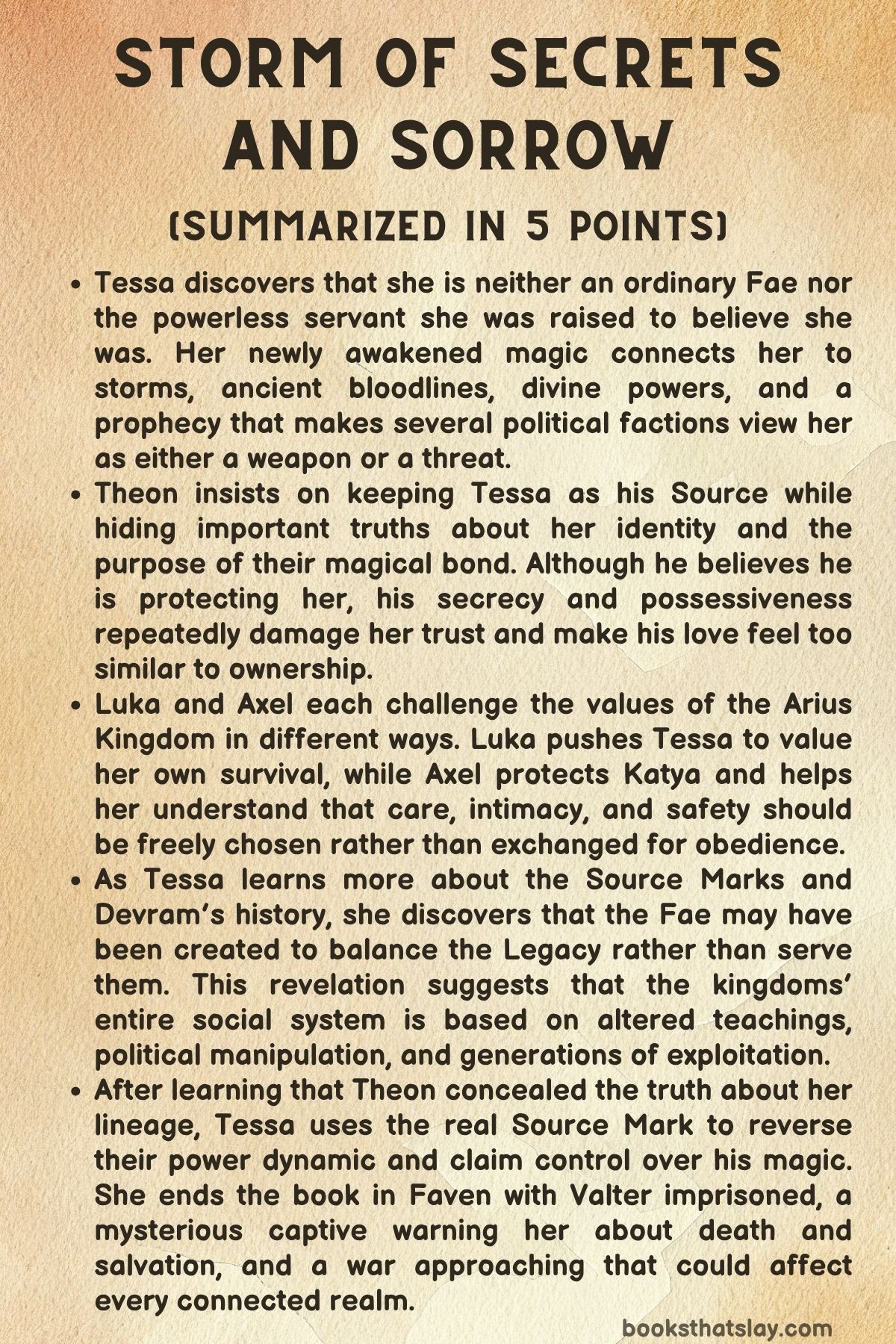
After her magic awakens, she learns that nearly everything she has been taught about her identity, her bonds, and the political order of Devram may be false. Surrounded by rulers, secret societies, gods, warriors, and supposed protectors, Tessa must decide whether she will continue accepting the future others have designed for her or use her immense power to create a new one. It’s the sequel to Rain of Shadows and Endings and the 2nd book of the Legacy series.
Summary
Two and a half years before the central events, Tessa lives at the Celeste Estate under Mother Cordelia’s cruel authority. She survives punishment, hunger, and confinement while forming friendships with Dex, Oralia, Brecken, Lange, and Corbin.
Her friends offer moments of companionship, but Tessa has already learned that security is temporary. During a magical assessment, she sees a troubling vision filled with underground passages, strange allies, black flames, shadows, and a violet-eyed woman who warns her about a sleeping power and an approaching war.
After her Emerging Ceremony, Tessa wakes in Theon’s townhouse and discovers that she is not an ordinary Fae. Her power resembles Achaz light, but it also controls rain, wind, lightning, and storms.
Theon has placed black suppression bands around her wrists because her abilities are unstable. Although Tessa shares a powerful attraction and magical connection with him, she refuses to accept his repeated claim that she belongs to him.
The Tribunal gathers to decide whether Tessa can legally remain Theon’s Source. The ruling families argue that a non-Fae cannot serve in that position and that death may be the only method of ending the bond.
Tessa chooses to remain with Theon temporarily, not because she trusts him, but because staying near him gives her access to political information and possible answers. The rulers grant Theon until the winter solstice to identify her lineage and require Tessa to spend time in Faven for testing.
Valter, Theon’s father and the ruling Lord of Arius, has already created his own plan. If Tessa proves to be a powerful Legacy, he intends to separate her from Theon, Match her with Luka, and use their future children to strengthen the Arius bloodline.
Theon is expected to take Katya as a replacement Source. Tessa is horrified that her body, magic, relationships, and future children are being discussed as political resources.
Valter attacks Theon when he resists, revealing how thoroughly he controls his sons through violence, blood supplies, magical restraints, and fear. Tessa begins to recognize that Theon’s desire for control partly comes from growing up beneath the authority of an even more controlling father.
Theon and Luka secretly take Tessa to a secluded riverbank and remove her bands. Her power bursts outward through golden light, wind, rain, and destructive energy, while Theon’s shadows and Luka’s black flames respond as though the three forms of magic belong together.
Members of the Augury attack them. The secret organization believes that Tessa and Theon together will fulfill an ancient Revelation Decree and destroy Devram.
Luka reveals his full dragon form and destroys the attackers. The confrontation confirms that Tessa’s existence is connected to a prophecy powerful people are prepared to kill her to prevent.
Tessa struggles with the emotional and physical consequences of her connection to Theon. Their magic craves contact, but she refuses to mistake magical need or desire for consent, trust, or ownership.
During combat training, Luka realizes that Tessa sometimes makes no effort to protect herself. He forces her to confront the possibility that she does not truly care whether she survives.
His accusation wounds her, but it also changes her. Until then, Tessa has allowed punishments, abandonment, and other people’s choices to determine the value of her life.
A new Mark deepens the bond between Tessa and Theon. Unlike a normal Source ritual, their light and darkness combine, and Theon gains access to her emotions.
Luka also appears to be connected to the bond, though none of them understands why. His presence calms Tessa, and separation from him creates discomfort similar to her separation from Theon.
Searching for answers, the group enters the Underground and meets the Witch Cienna. She reveals that the Everlasting War began before Devram existed and that Tessa may come from another world, forgotten bloodlines, or beings erased from history.
Cienna suggests that priestesses used glamours, assessments, Marks, and elixirs to conceal Tessa’s nature. She also confirms that others from beyond Devram are searching for her.
The group is later attacked by the Night Children, who have been persuaded that killing Tessa will free them from their curses. Their leader, Jagger, stabs her with a special dagger.
Tessa refuses to release the weapon until she knows her companions are still alive. Her decision shows that Luka’s challenge has affected her: she now wants to survive, but she does not want survival purchased through the deaths of everyone around her.
Gia saves Tessa while Theon and Axel investigate the rebellion. Axel’s work in the Underground reveals that his careless public image hides years of protecting people ignored by the ruling kingdoms.
Axel is also fighting a dangerous hunger for Fae blood. He fears becoming controlled by the Arius curse, especially as he grows closer to Katya.
Katya has been conditioned to believe that food, shelter, protection, sex, and blood must be exchanged for service. Axel repeatedly gives her choices without demanding payment, allowing her to experience kindness without obligation.
At the Samhain Feast, Tessa encounters Tristyn Blackheart, who clearly knows more about her identity than he admits. The suppression bands begin overwhelming her, causing a violent storm.
When the bands are removed, the Augury attacks again. Two strangers, Scarlett and Sorin, arrive through a tear between worlds and help defeat them.
Scarlett reveals that she is Tessa’s cousin and that Tessa’s father is Temural, god of the wild and untamed. Tessa carries divine blood connected to Arius, though her mother’s identity remains uncertain.
Scarlett also explains that a genuine Source bond requires only one Mark. The four-stage ritual practiced in Devram has therefore been misrepresented, and the earlier Marks may exist to create control, dependency, and access.
Tessa travels to Faven, where Rordan treats her with greater openness than Theon does. He teaches her that suppressing Chaos allows it to control her, while acknowledging it gives her the opportunity to direct it.
The lesson helps Tessa transform her relationship with her magic. Instead of treating her power as an enemy that must be chained, she begins viewing it as part of herself.
Her friendship with Dex continues to weaken. He claims to care about her, but his questions appear designed to collect information, and he repeatedly places laws, assignments, and his own judgment above her wishes.
While Tessa is away, Theon investigates her past and learns more about her divine lineage. He decides not to tell her, convincing himself that secrecy will protect her from political danger.
His silence repeats the central failure of their relationship. He wants Tessa to trust him while continuing to decide what information she deserves to know.
Back in Arius territory, old records reveal that the Fae may have been created to balance the power of the Legacy rather than serve them. The social system of ownership, Selection, Source service, and compulsory obedience appears to be a political corruption of the original divine order.
A Huntress named Auryon arrives and claims Temural sent her to protect and train Tessa. She teaches Tessa combat, ancient language, and fragments of history concerning gods, dragons, seraphs, forbidden bloodlines, and agreements between worlds.
When Tessa returns from Faven, she finds Felicity in Theon’s bedroom and believes Felicity is carrying his child. Although the pregnancy is not Theon’s, the encounter has been arranged to appear like a betrayal.
Luka refuses to take advantage of Tessa’s grief when she asks him to use physical intimacy to silence her thoughts. He holds her instead, proving that his desire does not completely overrule his respect for her choices.
Theon later explains the situation, but Tessa has heard too many truths only after discovering the corresponding lie. She begins withdrawing emotionally and prepares her own plans.
Tessa studies Markcraft, ancient history, and the behavior of those around her. She appears more cooperative while secretly learning how to reverse the systems used to control her.
Theon rescues Corbin and Lange from their estates at her request, but the act does not erase his secrecy. Luka also reveals that he can Travel between locations, a gift he concealed to prevent Valter from exploiting him.
Theon reacts violently to Luka’s secret while ignoring his own pattern of withholding information. Their conflict exposes the hypocrisy within their loyalty: everyone demands honesty while defending personal deception as necessary protection.
Axel and Katya confirm that the first three Source Marks are not genuine. The fourth Mark is the true bond, and it can operate in both directions rather than placing all authority in the hands of the Legacy.
Their discovery becomes dangerous when Valter attempts to claim Katya as Theon’s fire Source. Axel kills two attackers while helping her escape and sends her into hiding with Tristyn.
Valter captures Axel and tortures him for Katya’s location. Because Axel deliberately chose not to learn where she was hidden, he cannot betray her even under extreme pain.
Meanwhile, the Tribunal refuses to grant Tessa freedom. Rordan orders her confined at the Pantheon because her existence, power, and connection to prophecy may endanger the entire realm.
Masked members of the Augury remove her from confinement and take her to an amphitheater. Valter reveals that he has long been involved with the organization and that Rordan helped create it before later withdrawing.
Valter also tells Tessa that Theon discovered her maternal lineage weeks earlier and chose not to tell her. When Valter prepares to kill her, Tessa’s rage splits the earth and summons pale warriors carrying golden weapons.
These beings call themselves Hunters and obey her commands. They were created by Achaz to kill the descendants of Arius, which becomes especially dangerous because Tessa herself carries Arius blood.
Tessa orders the Hunters to attack the Augury while sparing Valter and Eviana. She wants Valter alive so he can witness the destruction of the system and bloodline he fought to preserve.
Tristyn and Auryon try to stop the Hunters. Their interference reveals further secrets: Tristyn has hidden knowledge concerning Tessa’s lineage, while Auryon belongs to an opposing order of Huntresses created to fight the Hunters.
Tessa refuses to surrender control to either of them. She announces her intention to dismantle the Legacy system, correct Devram’s imbalance, and punish those who used her.
She then goes to Theon and confronts him over his lies. Theon admits that he withheld her identity in the name of protection, but Tessa rejects the idea that love permits one person to control another’s knowledge, power, and future.
Using the Markcraft she secretly studied, Tessa draws the true final Source Mark. Because the connection works in both directions, she turns Theon’s own system against him and forces his magic to submit to hers.
Theon confesses that he loves her. Tessa tells him that his understanding of love has always been corrupted by possession, control, and entitlement.
She leaves him weakened and becomes established in Faven, where Valter is imprisoned. Following an underground passage from her visions, she finds a sapphire-eyed male who has been chained beneath the palace for more than twenty years.
The prisoner knows details about her parents and warns that the Achaz rulers will use her just as the Arius rulers did. He tells her that she stands between salvation and destruction, but that salvation has always required death.
Elsewhere, Tristyn, Cienna, Auryon, Gia, Katya, Razik, and Eliza begin preparing for the conflict ahead. They understand that Tessa carries the power of both beginnings and endings, a combination forbidden by the balance governing the connected worlds.
Theon and Luka discover that Axel is missing and begin preparing to recover him. Tessa now possesses the power to destroy Devram’s political order, but she remains surrounded by incomplete truths, competing protectors, divine agendas, and rulers who continue treating her as a solution to their own problems.
The conflict is therefore no longer limited to who controls Tessa or who governs Devram. Her survival, destruction, or final choice may determine whether balance is restored across the realms or whether Chaos gains control of them all.
Characters
Tessa
At the center of Storm of Secrets and Sorrow, Tessa is a survivor whose greatest struggle is not simply learning to control her magic but learning to believe that her life belongs to her. Years of punishment, deprivation, confinement, and emotional abandonment have taught her to expect pain whenever another person claims to care for her.
Her distrust is not irrational stubbornness. The people surrounding her regularly hide information, arrange her future, use her body as a political resource, and describe control as protection.
Tessa’s early willingness to die reveals the extent of her emotional exhaustion. She does not initially fight because survival seems meaningless when life consists of moving from one form of ownership to another.
Luka’s challenge forces her to reconsider this belief. Her later refusal to die becomes one of the most important signs of her growth, although her new commitment to survival gradually turns into a desire for revenge.
Her magic reflects her emotional condition. When suppressed, it becomes violent and unpredictable; when acknowledged, it becomes more precise and responsive.
This relationship suggests that Tessa cannot master herself by rejecting her anger, fear, desire, or grief. She gains control only when she accepts these feelings as parts of her experience and chooses how to act upon them.
Her final decision to reverse the Source bond is both an act of liberation and a troubling repetition of what was done to her. She proves that she is no longer powerless, but she uses control against Theon rather than creating a relationship free from control.
Tessa therefore ends the book as neither a traditional hero nor a villain. She is a wounded, powerful woman standing between justice and vengeance, with enough strength to rebuild a world or destroy it.
Theon
In Storm of Secrets and Sorrow, Theon is defined by the conflict between genuine attachment and an inherited belief in ownership. He cares for Tessa, fears losing her, and repeatedly risks political punishment to protect her, yet he rarely recognizes that protection without consent can become another form of imprisonment.
Theon has been raised by Valter to believe that information, people, and power must be controlled before they can be considered safe. His planning is therefore partly a survival response developed under an abusive father.
However, his history does not excuse his treatment of Tessa. He withholds the truth about her lineage, attempts to use magical bonds to access her emotions, and repeatedly demands that she declare herself his.
Theon often thinks that his intentions should matter more than the effects of his choices. Because he believes he is protecting Tessa, he struggles to understand why she experiences his secrecy as betrayal.
His feelings are real, but his understanding of love remains connected to possession. He wants Tessa to choose him while also arranging circumstances that make choosing anyone else nearly impossible.
The reversal of the Source bond forces him to experience the helplessness he has repeatedly imposed on her. By the end, he finally begins to see that his need to control every outcome has helped create the disaster he feared.
Luka
Luka is outwardly disciplined, loyal, and controlled, but his calm personality hides deep fears concerning his identity, power, and place within the Arius family. As Theon’s Guardian, he has built his life around service and protection, even when that loyalty requires silence.
His relationship with Tessa develops through conflict rather than immediate tenderness. He challenges her self-destructive behavior, refuses to continue training her until she values her survival, and often speaks to her with a bluntness that feels cruel.
The purpose behind his harshness becomes clearer as the story continues. Luka does not want Tessa merely kept alive by others; he wants her to decide that she deserves to live.
His refusal to use her grief for sexual advantage distinguishes him from characters who treat desire as permission. Although he wants her, he understands that consent offered during emotional collapse may not represent a free choice.
Luka’s hidden ability to Travel reveals that he has also lived under the threat of exploitation. His secrecy comes from knowing that Valter would turn any gift into a weapon for the kingdom.
His growing connection to Tessa creates tension between personal feeling and loyalty to Theon. By the end, Luka understands that true loyalty cannot require him to ignore the damage caused by the person he serves.
Axel
Axel initially appears charming, careless, and less burdened than Theon or Luka. Beneath this performance, he is managing political responsibilities in the Underground, protecting abandoned communities, and fighting a dangerous dependence on Fae blood.
His fear of the Arius curse shapes nearly every decision he makes. Axel believes that hunger and darkness will eventually overpower him, causing him to harm the people he loves.
Katya forces him to examine whether identity is determined by inheritance or repeated choice. She recognizes that his refusal to exploit her matters even when he considers those actions ordinary or insufficient.
Axel’s treatment of Katya contrasts sharply with the values of his family. He offers food, clothing, shelter, privacy, and affection without demanding sex, blood, or service in return.
Sending Katya away is his clearest act of love. He sacrifices his own happiness and deliberately refuses to learn her location so that torture cannot force him to betray her.
His imprisonment demonstrates Valter’s ability to use affection as a weakness. Even while physically broken, Axel finds strength in knowing that Katya remains beyond his father’s reach.
Katya
Katya represents the psychological consequences of the Fae system. She has been trained to believe that her body, blood, magic, time, and comfort exist for Legacy use.
Her discomfort with sitting at a table, sharing a bed, accepting clothing, or receiving food without payment shows how oppression survives through conditioning. Physical chains are not always necessary when people have been taught to police their own behavior.
Katya’s growth begins when Axel consistently gives her choices. She gradually understands that consent means more than the absence of physical force; it requires the freedom to refuse without punishment.
Her intelligence is equally important. Through translation and research, she uncovers the truth about the Source Marks and the original purpose of the Fae.
Katya does not exist only as Axel’s romantic interest. Her knowledge changes the political meaning of every Source bond in Devram and provides evidence that the entire social system rests on historical deception.
Her decision to accept danger rather than allow Axel to decide everything for her also demonstrates growing independence. She wants protection, but she refuses to exchange one form of control for another.
Valter
Valter is the clearest human source of cruelty in the book. He rules through physical violence, magical restraints, controlled blood supplies, political contracts, sexual exploitation, and fear.
He treats every relationship as a structure of ownership. His sons are heirs and weapons, Eviana is a source of power, Katya is a breeding and magical resource, and Tessa is a threat that must either be controlled or killed.
Valter understands dependence better than almost anyone. Rather than relying only on direct force, he creates conditions in which others need him for blood, safety, status, or survival.
His involvement with the Augury reveals that his political behavior is connected to a larger desire to preserve the existing order. He presents his actions as necessary for Devram, but his version of balance protects the authority of people like him.
Valter is frightening because he rarely considers himself cruel. He believes power gives him the right to decide whose suffering is acceptable.
Rordan Jove
Rordan presents himself as a more thoughtful and honest alternative to Valter and Theon. He gives Tessa information, encourages her curiosity, removes her restraints, and teaches her to control her power through acceptance rather than suppression.
His lessons are genuinely valuable. Tessa’s later ability to shape her magic instead of exploding comes directly from his guidance.
However, Rordan’s kindness does not prove that he has no agenda. He helped establish the Augury, participated in decisions concerning prophecy, and later confines Tessa beneath the authority of the Achaz Kingdom.
His honesty often makes him appear trustworthy because he admits difficult truths that Theon hides. Yet honest manipulation remains manipulation when a person is given information only to guide her toward a predetermined role.
Rordan represents a softer form of control. Unlike Valter, he rarely needs open brutality because he creates an environment in which cooperation feels voluntary.
Dex
Dex occupies a painful position in Tessa’s life because he was once one of the few people she trusted. His quiet acts of kindness at the Celeste Estate gave her food and comfort without obvious demands.
As they grow older, their friendship becomes strained by secrecy and divided loyalties. Dex believes he understands what is best for Tessa, but he often places assignments, political obligations, and his judgment above her stated wishes.
His criticism of Theon is frequently accurate, yet he fails to examine his own behavior with the same honesty. He condemns others for using Tessa while asking questions that appear designed to collect information for Rordan or the Achaz Kingdom.
Dex is not presented as openly malicious. His weakness is that he confuses concern with the right to interfere.
His relationship with Tessa shows how trust can be lost without a single dramatic betrayal. Repeated evasions, divided loyalties, and small decisions can gradually make an old friendship feel unsafe.
Auryon
Auryon is a Huntress sent by Temural to train and protect Tessa. She is highly skilled, knowledgeable about ancient conflicts, and capable of moving through battles with confidence that few Devram characters possess.
Her teaching gives Tessa practical tools rather than demanding passive obedience. She trains her in combat, survival, language, history, and the wider political meaning of her bloodline.
Auryon nevertheless participates in the same pattern of partial truth that damages Tessa’s other relationships. She explains only what she believes Tessa is ready to understand and remains bound by agreements involving gods and Fate.
Her claim to be Tessa’s rightful Guardian introduces another uncertainty. Protection may be her duty, but Tessa has learned that duty can easily become a reason to ignore consent.
Auryon’s opposition to the Hunters also reveals that her mission is larger than Tessa’s personal safety. She is protecting a balance between powers that may require choices Tessa would never freely accept.
Tristyn Blackheart
Tristyn is charming, informed, technologically powerful, and deliberately difficult to understand. His relaxed behavior around Tessa contrasts with the rigid authority of the Legacy, allowing him to earn her attention without immediately demanding obedience.
He possesses information about the Source Marks, the Underground, Tessa’s bloodline, the Hunters, and forces from other realms. His decision to reveal only fragments makes him useful but unreliable.
Tristyn’s greatest motivation appears connected to Lilura, the Witch for whom he named his company. His interest in Tessa is therefore both personal and strategic, since her power or bloodline may help him save someone he loves.
He assists Axel by hiding Katya and preserves dangerous historical material beyond ordinary reach. These actions show that he is willing to oppose Valter and the ruling order.
However, Tristyn also underestimates the emotional cost of secrecy. When Tessa discovers how much he knew, she sees his silence as another betrayal rather than careful planning.
Cienna
Cienna is a Witch who understands the Everlasting War, Fate, hidden bloodlines, and the movement between worlds. Her answers provide essential context, but she is limited by rules governing what she may reveal.
Her five-question condition reflects both caution and control. Information is valuable in Devram, and Cienna carefully determines how much each person receives.
She warns Axel about his blood curse and gives him emergency blood, demonstrating compassion beneath her secrecy. She also allows Katya to remain hidden, helping protect her from Valter.
Cienna recognizes that choices continually alter possible futures. This makes her less interested in offering simple prophecies than in warning others about the consequences of trying to force a particular outcome.
Her frustration with Tristyn suggests that she understands secrecy can become destructive. Even so, she remains part of a group that continues withholding information from Tessa.
Scarlett and Sorin
Scarlett and Sorin expand the scale of the story beyond Devram. Their arrival confirms the existence of multiple realms, World Walkers, divine agreements, and powers unknown to the ruling families.
Scarlett’s importance comes partly from being Tessa’s cousin. She provides the first direct confirmation that Tessa has living relatives and that Temural has been aware of her.
The revelation offers Tessa a form of belonging, but it also creates pain. Knowing that powerful family members existed while she suffered makes their delayed intervention feel like another abandonment.
Scarlett is confident and unwilling to respect Devram’s oppressive customs. Her immediate confusion over the four Source Marks helps expose the false religious system surrounding Fae service.
Sorin acts as her partner and equal rather than her owner or ruler. Their relationship provides a quiet contrast to the possessive bonds common in Devram.
Mother Cordelia
Mother Cordelia is responsible for much of Tessa’s early trauma. She uses hunger, darkness, confinement, humiliation, assessment rituals, and constant correction to enforce obedience.
Her cruelty is not merely personal discipline. Evidence suggests that she knew Tessa was unusual and may have participated in concealing her identity through altered records, glamours, elixirs, and controlled placements.
Cordelia therefore represents the institutional side of abuse. She does not act outside the social system; she performs the work that allows the system to continue.
Her authority also demonstrates how oppressed people can be trained and managed before they reach the ruling families. By the time the Fae are selected, many have already learned to accept mistreatment as duty.
Theon’s eventual dismissal of Cordelia removes one source of control, but it cannot erase the beliefs she placed inside Tessa.
Felicity
Felicity is Theon’s contracted Match and an important tool in Valter’s political planning. Her presence in Theon’s bedroom is arranged to make Tessa believe that Theon has betrayed her and fathered a child with someone else.
Although the pregnancy is not his, Felicity participates in creating the appearance of betrayal. She knows private details about Tessa’s time in Faven, making the encounter feel calculated rather than accidental.
Felicity’s role shows how political Matches reduce relationships to contracts, bloodlines, appearances, and strategic reproduction. She also exists within a system that limits her freedom, though she is more willing than Tessa to operate through its rules.
Her actions deepen the emotional distance between Tessa and Theon. More importantly, she demonstrates how easily secrecy allows other people to control the meaning of a situation.
Oralia, Brecken, Corbin and Lange
Oralia, Brecken, Corbin, and Lange represent Tessa’s connection to life before the Selection. Their shared experiences at the estates remind her that she once belonged to a small community formed through mutual hardship.
Oralia appears observant and involved in secrets surrounding Tessa’s assessments. Her knowledge suggests that even Tessa’s closest companions may have understood more about the danger around her than they admitted.
Brecken reveals how deeply the language of ownership has entered ordinary thinking. Even when he does not intend cruelty, his words repeat beliefs taught by the ruling system.
Corbin and Lange become more directly important after Theon removes them from their estates. Their loyalty rests primarily with Tessa rather than Arius authority.
Their knowledge of languages, kingdoms, and estate movements may help expose the wider effort to identify and hide unusually powerful Fae. They also remind Tessa that her choices can protect people beyond herself.
Eviana
Eviana is Valter’s Source and one of the clearest examples of what complete domination produces. Her magic and body are treated as resources belonging to Valter and the Arius Kingdom.
Hints about her past suggest that obedience was created through prolonged abuse rather than freely offered loyalty. Valter’s advisors may also have been permitted access to her before she became fully controlled.
Eviana participates in restraining Tessa during the attempted execution, placing her on the side of the oppressors. However, her actions occur within a relationship defined by dependence and fear.
She therefore cannot be understood only as Valter’s willing assistant. She is also a warning of what Tessa, Katya, or any other Source could become after years without meaningful choice.
Gia and the Underground Allies
Gia is a capable healer whose presence saves Tessa after Jagger’s attack. Her long-standing connection with Axel also reveals that he has maintained meaningful relationships outside the official Arius world.
Rayell distinguishes himself from other Night Children leaders by refusing to support Jagger’s plan. His decision shows that desperation does not remove individual responsibility.
Roan and Niylah assist during the amphitheater conflict, though their loyalties remain connected to larger political forces. Like many secondary figures, they help Tessa while also serving organizations with their own goals.
Razik Greybane and Eliza arrive from Scarlett’s world after an emergency signal. Their appearance confirms that the crisis has become serious enough to involve allies from beyond Devram.
Together, these characters show that resistance is spread across healers, fighters, Witches, hidden communities, and people from other realms. No single kingdom has complete control over the coming war.
The Tribunal Rulers
Lady Candra, Kyra Aithne, Rordan, Valter, and the other ruling Lords and Ladies represent a political system that values stability over individual freedom. Their debates about Tessa focus on legality, bloodlines, prophecy, magical advantage, and danger rather than her right to determine her own life.
Lady Candra’s suggestion that death could resolve the Source problem exposes the cold logic of the ruling class. A person may be killed when her existence creates an inconvenience for the established order.
Kyra’s insistence that Tessa speak for herself offers a small challenge to this thinking. However, allowing Tessa to answer one question does not give her meaningful control over the final decision.
The Tribunal may disagree about which kingdom should control her, but few members question whether anyone should control her at all. Their conflict concerns ownership and risk management rather than freedom.
Jagger and the Augury
Jagger is driven by the belief that killing Tessa will free the Night Children from their weaknesses and curses. His actions show how oppressed communities can be manipulated into attacking another vulnerable person when leaders promise that one death will solve their suffering.
The Augury operates through prophecy, secrecy, assassination, and fear. Its members believe that preventing Devram’s destruction justifies killing Tessa before she has chosen what to do with her power.
The organization also reveals the hypocrisy of the ruling families. Valter and Rordan helped create it while publicly participating in institutions that claimed to judge Tessa fairly.
Individual members surrender moral responsibility to the supposed certainty of prophecy. By treating one possible future as unavoidable, they help create the conditions that make it more likely.
Temural, Arius, Serafina, Achaz and the Divine Bloodlines
Temural is Tessa’s divine father, but his influence is defined by distance. He sends Scarlett and Auryon rather than appearing himself, leaving Tessa to question why a god who knew about her allowed her to suffer alone.
Arius and Serafina belong to the history of forbidden unions and divine betrayal. Their choices helped prolong an older war and produced bloodlines capable of disturbing the balance between worlds.
Achaz represents beginnings, light, creation, and the Hunters, while other bloodlines contribute darkness, endings, Witch gifts, weather, and Chaos to Tessa’s inheritance. Her power is dangerous because these forces were never supposed to exist together in one person.
These divine figures broaden the meaning of parenthood and responsibility. Biological connection does not automatically create care, protection, or loyalty.
Their ancient decisions continue shaping the lives of people who had no part in making them. Tessa must therefore decide whether she will remain another instrument of inherited conflict or reject the roles created by her ancestors.
Themes
Control, Ownership and Personal Freedom
In Storm of Secrets and Sorrow, control appears in political laws, magical bonds, family relationships, religious rituals, blood supplies, sexual expectations, and access to information. Nearly every powerful character claims that control is necessary for protection, stability, balance, or survival.
Tessa’s life demonstrates how such reasoning removes freedom one decision at a time. She is told where to live, whom to serve, whom to marry, which Marks to receive, when her power may be used, and whether she deserves to know her own identity.
Theon’s behavior makes this theme especially complex because his control is connected to real affection. He wants to keep Tessa alive, but he also assumes that protecting her gives him the right to make decisions on her behalf.
Valter represents control without emotional disguise, while Rordan offers a gentler version built through honesty, education, and apparent respect. Both men still position themselves as authorities entitled to direct Tessa’s future.
The reversed Source bond creates an intentional moral complication. Tessa escapes helplessness by forcing Theon to experience submission, but using another person’s methods does not automatically produce justice.
Her victory therefore raises a difficult question: can someone raised entirely within systems of domination imagine freedom without reproducing domination? Tessa has gained power over her life, but she has not yet created a model of power that respects everyone’s agency.
Truth, Secrecy and Betrayal
Information functions as a form of power throughout the story. Characters rarely lie without justification; instead, they withhold facts because they believe the truth is dangerous, incomplete, politically inconvenient, or emotionally overwhelming.
Theon’s secrecy causes the deepest personal damage. He believes he must fully understand Tessa’s lineage before telling her, but this decision denies her the right to participate in questions concerning her own existence.
Luka, Dex, Tristyn, Auryon, Cienna, Rordan, and Mother Cordelia also keep important knowledge from her. Their motives differ, yet the repeated result is that Tessa must discover her life through fragments controlled by other people.
Truth becomes valuable not only because it provides facts but because freely sharing it demonstrates respect. Rordan gains Tessa’s confidence partly because he answers questions directly, even when his wider intentions remain uncertain.
The novel also distinguishes secrecy used for survival from secrecy used for authority. Luka hides his Traveling power because disclosure would allow Valter to exploit him, while Theon hides Tessa’s lineage because he wants to manage the consequences himself.
Both characters fear danger, but only one secret concerns the speaker’s own body and gift. This difference explains why protection cannot justify every silence and why trust requires allowing others to make informed choices.
Balance and the Corruption of Social Order
Devram’s rulers describe their hierarchy as natural, sacred, and necessary. The Legacy command while the Fae serve, Sources provide power, Matches preserve bloodlines, and religious rituals give these arrangements divine authority.
Historical evidence gradually reveals that this order may be the opposite of its original purpose. The Fae appear to have been created to balance the Legacy and prevent powerful bloodlines from becoming uncontrollable.
Turning them into property removes the safeguard and concentrates authority in the hands of those most capable of abusing it. The imbalance threatening Devram is therefore not caused only by Tessa’s unusual birth; it has been developing through generations of exploitation.
The same problem appears across the connected realms. Forbidden divine unions, altered Fate, incomplete wars, and competing forces of beginnings and endings have created a system in which every attempt to restore order produces new instability.
Tessa embodies these contradictions because she carries blood associated with creation, destruction, light, darkness, life, death, and Chaos. Her existence challenges categories designed to keep power separated and manageable.
Restoring balance may require more than defeating a villain or completing a prophecy. It may require dismantling social, political, and magical institutions that have mistaken obedience for harmony.
Love, Loyalty and the Meaning of Choice
Love repeatedly becomes difficult to separate from possession, service, obligation, and fear. Theon believes he loves Tessa, but his desire to keep her often overrules his willingness to let her choose.
Luka’s relationship with her develops differently because he occasionally places her agency above his desire. His refusal to take advantage of her grief shows that wanting someone does not create entitlement to that person.
Axel and Katya provide the clearest example of intimacy built through repeated consent. Axel offers care without demanding repayment, and Katya gradually discovers that affection can exist without compulsory service.
Their relationship is not free from danger, but both characters attempt to let the other participate in difficult decisions. Katya challenges Axel when he tries to determine alone whether their relationship is worth the risk.
Loyalty is examined with equal care. Luka’s devotion to Theon, Dex’s obligations to Rordan, and Auryon’s duty to Temural all become harmful when loyalty requires silence about injustice.
Tessa’s deepest desire is not merely to be protected or loved. She wants someone to choose her as a person rather than as a Source, weapon, heir, prophecy, political advantage, or divine solution.
The story suggests that love becomes meaningful only when the person being loved remains free to refuse, leave, disagree, and possess knowledge of the choices being made. Without those conditions, devotion can become another language for control.