The Last Time We Drowned Summary, Characters and Themes
The Last Time We Drowned by Saratoga Schaefer is a psychological thriller about guilt, ambition, manipulation, and the dangerous distance between a public identity and a private self.
Twenty-four-year-old Charlie Engels accepts a lucrative job with a group of influencers living aboard a luxury yacht near a secluded Florida island, hoping to escape financial hardship and the painful death of her former best friend, Sage. Instead, Charlie enters an environment ruled by secrets, dependency, and carefully controlled appearances. As a hurricane isolates the yacht, disturbing clues about a missing influencer force Charlie to investigate the people around her while confronting a truth she has hidden from herself.
Summary
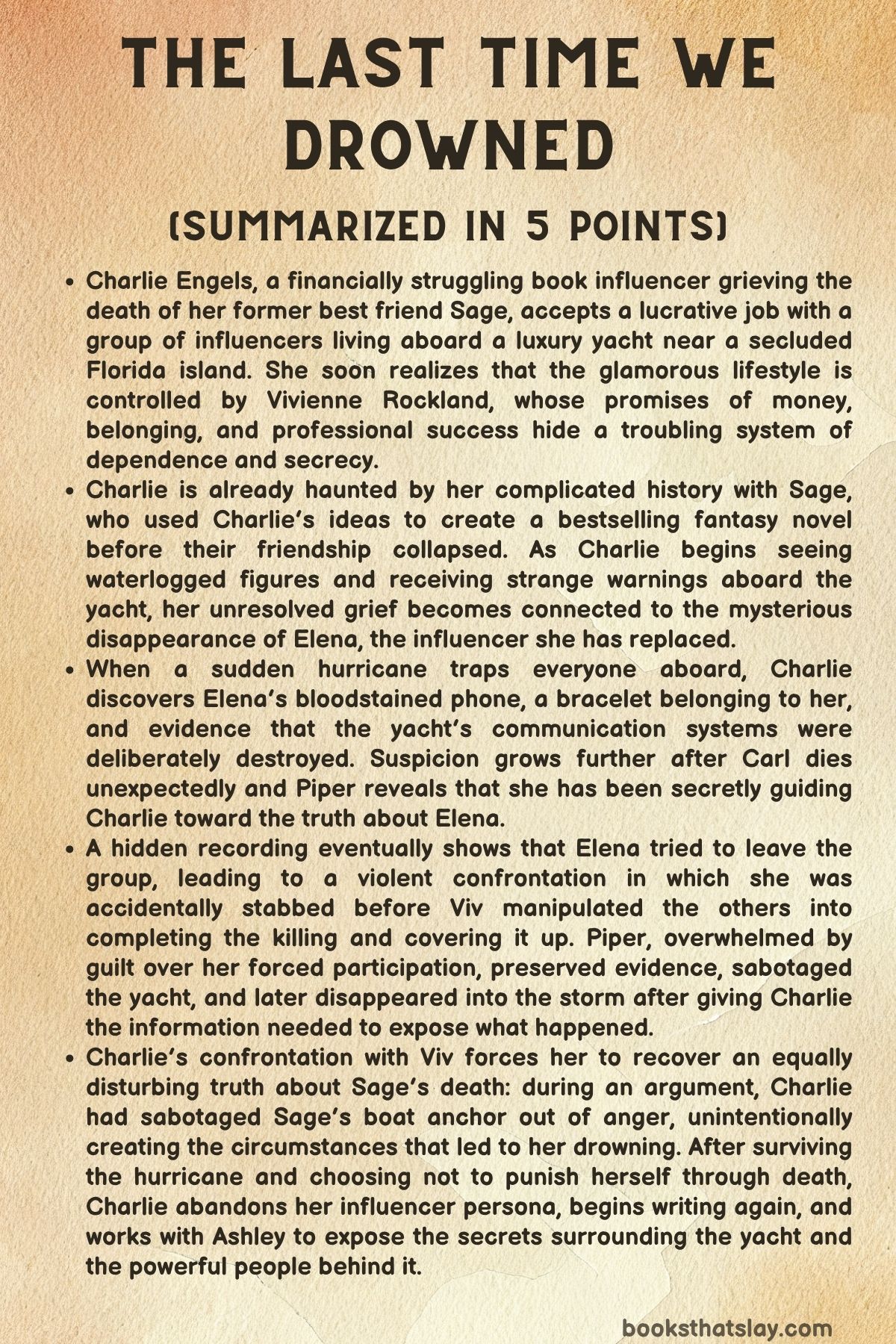
Twenty-four-year-old Charlie Engels arrives in the Florida Keys carrying grief, resentment, and serious financial problems. She has lost her ordinary jobs after the drowning death of Sage Tartnet, her former roommate and closest friend, and now survives largely through her book-focused social-media account, @ChaptersWithCharlie.
Her interview with influencer manager Vivienne “Viv” Rockland unexpectedly offers an escape. Viv runs a group of successful creators living aboard Empress, a luxurious stationary yacht near the private island of Ligia, and promises Charlie money, professional growth, housing support, and something even more tempting: a new family.
Charlie accepts despite feeling uneasy about the situation. The glamorous lifestyle is far removed from her own experience, but the money could rescue her from debt and eviction, while a change of environment might help her stop thinking about Sage.
Sage remains impossible to forget because her bestselling fantasy novel, “A Song of Scales and Salt,” was built from a story Charlie believes Sage stole from her. Charlie had conceived a mermaid-based fantasy inspired by an image she saw while swimming with Sage on Lake Michigan, then developed its characters, relationships, settings, and major events through conversations and notes.
Sage secretly transformed those ideas into a manuscript and sold it for a large advance. When Charlie confronted her, Sage argued that ideas did not belong to anyone and that Charlie probably would never have finished the novel herself.
The betrayal destroyed their friendship. Yet before their relationship could ever be repaired, Sage drowned in Lake Michigan, leaving Charlie trapped between grief for the person she loved and anger toward the person who had hurt her most.
Aboard Empress, Charlie meets the other women Viv has recruited. Fiona creates makeup content, twins Rachel and Ashley have been assigned nutrition and yoga brands, Piper is a fashion influencer with a troubled history as a competitive surfer, and Viv manages the entire operation with an authority that extends well beyond ordinary professional supervision.
Something immediately feels wrong. Charlie is replacing an influencer named Elena, but Viv refuses to discuss her in meaningful detail, while the other women react nervously whenever Elena is mentioned.
Piper behaves especially strangely. She drinks heavily, seems deeply unhappy, repeatedly hints that joining Empress was a terrible decision, and speaks as though the women have done something for which they deserve punishment.
Charlie also begins seeing disturbing images connected with water. She hears dripping where there should be none, smells salt in enclosed rooms, sees waterlogged figures in mirrors, and eventually finds three words appearing on her bathroom mirror: “Elena didn’t leave.”
At first she assumes grief and exhaustion are affecting her perception. Her fear of water has intensified since Sage’s death, and her own near-drowning during a swim with Piper appears to reinforce the possibility that her experiences are psychological rather than supernatural.
Meanwhile, Charlie begins learning how carefully constructed the Empress women really are. Rachel is the qualified yoga teacher, yet Viv assigned yoga content to Ashley because Ashley fit the image she wanted to sell, while Rachel was transformed into a nutrition personality.
Their financial circumstances also explain their obedience. The twins need money for their mother’s medical debts, Fiona remembers being close to homelessness before Viv rescued her career, and Piper joined after losing financial support from her father.
Charlie slowly recognizes that Viv seeks out vulnerable women and turns their desperation into loyalty. The language of family disguises an arrangement in which money, identity, appearance, food, and professional opportunities are tightly controlled.
Charlie herself becomes another example when Viv secretly records her confession about Sage. Charlie had finally told the women that Sage took the story she intended to call The Last Time We Drowned, but Viv turns the private revelation into promotional content without permission.
The video spreads rapidly online. Charlie gains followers, but she loses control over one of the most painful experiences of her life, and Viv dismisses her objections by arguing that controversy and vulnerability make her more valuable as an influencer.
At the same time, Piper quietly encourages Charlie to investigate Elena. She retrieves a golden cuff bracelet from the ocean floor and gives it to Charlie, then advises her to study Elena’s old social-media account.
A hurricane suddenly traps everyone aboard Empress. Their connection to the mainland disappears, and the yacht cannot safely leave its position, forcing Charlie, the influencers, billionaire yacht owner Trey Bardi, and Fiona’s boyfriend Carl Mumford to remain together as the storm grows more dangerous.
While searching the yacht’s hidden crew quarters for food, Charlie finds a smartphone under a bed. After charging it, she discovers that it belongs to Elena, and a dried reddish fingerprint on its case strongly suggests blood.
Charlie then finds an old photograph of Elena wearing the same golden bracelet Piper retrieved from the water. The evidence makes Viv’s claim that Elena simply quit and left increasingly difficult to believe.
The situation becomes more dangerous when the bridge is discovered completely sabotaged. Screens are smashed, communication equipment has been destroyed, and someone has intentionally removed their ability to call for help.
Suspicion spreads through the group. Charlie learns that everyone currently aboard was present around the time Elena supposedly disappeared, meaning nearly every person around her could know more than they admit.
Carl then dies unexpectedly. His earlier coughing, exhaustion, and breathing difficulties lead Charlie to believe he inhaled water during a swimming race and later died from complications caused by it, although others consider poisoning or murder.
Carl’s death also exposes more secrets. He had been sleeping with Ashley despite his relationship with Fiona, had apparently been involved with Elena as well, and had connections with Trey that helped secure opportunities for members of the group.
Charlie increasingly sees Empress as a place where professional relationships, romantic relationships, financial obligations, and personal loyalties have become dangerously inseparable. Even Trey wants Carl’s death handled privately rather than immediately involving law enforcement.
Piper eventually gives Charlie the first direct confirmation that Elena’s disappearance is connected to the group. She admits that she planted Elena’s phone for Charlie to find and placed the bracelet in the water so Charlie would discover it.
Piper also confesses to destroying the communications equipment. Convinced that everyone aboard deserves punishment for Elena’s death, she told the Coast Guard that Empress had already evacuated before disabling their remaining contact with the outside world.
Before Charlie can obtain the full truth, Piper gives her a phone passcode and tells her to search the top drawer beside her bed. Piper then jumps into the violent ocean and attempts to swim toward Ligia.
No safe rescue attempt can be made. Piper disappears beneath the water and is presumed dead, leaving Charlie devastated and more determined to follow the clues she deliberately left behind.
The group’s defenses soon begin collapsing. Fiona refers to three dead people when only Carl and Piper are publicly acknowledged, effectively confirming that Elena is also dead.
Using Piper’s instructions, Charlie finds Piper’s phone and opens a surviving video recorded weeks earlier. The footage finally shows what happened to Elena.
Elena had decided to leave Empress and accept another professional opportunity. Viv interpreted her departure not simply as a career decision but as a betrayal of the family she believed she had created.
A confrontation involving Viv, Piper, Fiona, Rachel, Ashley, and Elena became physical. Viv slapped Elena, Elena fought back, knives were drawn during the struggle, and Piper accidentally shoved Elena onto a knife held by Viv.
At that moment, Elena’s death might still have been treated as a terrible accident. Instead, Viv decided that police involvement would destroy their careers, expose their secrets, and cost them the financial security on which they depended.
Viv used each woman’s vulnerability against her. She reminded Fiona of poverty, the twins of their mother’s debts, and Piper of her emotional weaknesses before forcing Piper to participate in stabbing Elena again.
Viv then ordered Piper to dispose of Elena’s body in the ocean. She planned the cleaning, social-media cover story, and false explanation that Elena had simply chosen to leave.
Piper saved Elena’s bracelet and secretly preserved the video evidence. Her later drinking, reckless behavior, sabotage, and eventual death all grew from the guilt she carried after being manipulated into participating in Elena’s killing.
Charlie finishes watching the recording only to discover Viv standing behind her. Viv admits that she intentionally recruits people who are desperate enough to become dependent on her, and she explains that her obsession with family comes from a history of abandonment, instability, neglect, and exploitation.
Elena had once been Viv’s closest friend. When Elena tried to leave her again, Viv experienced it as another unbearable abandonment, turning her need for loyalty into violence.
Charlie notices that Piper’s phone briefly receives cellular service and secretly sends the murder video elsewhere while keeping Viv talking. Viv eventually realizes what Charlie has done, destroys the phones she can access, produces a gun, and forces Charlie onto a tender.
Viv plans to make Charlie another apparent casualty of the hurricane. Yet Charlie reveals that the recording was sent to Sage’s phone, a device she previously claimed had disappeared when Sage drowned.
That admission forces Charlie to confront her own hidden crime. Shortly before Sage died, Sage had contacted Charlie and offered her paid work ghostwriting the sequel to “A Song of Scales and Salt” because Sage did not know how to continue the story without Charlie’s ideas.
Charlie demanded public credit and recognition, but Sage again refused. Furious, Charlie stole Sage’s phone and loosened the connection between the anchor and its chain on Sage’s pontoon.
Charlie expected Sage to notice the damage. Instead, the intoxicated Sage apparently threw the disconnected anchor into the water, entered the lake, and then discovered that her boat was drifting away.
Sage drowned while trying to reach it. Charlie hid the stolen phone afterward and psychologically suppressed the extent of her responsibility, allowing herself to remember Sage’s death as a tragic accident rather than an accident made possible by Charlie’s deliberate act of revenge.
Viv uses the confession to argue that Charlie is no better than she is. Charlie recognizes that although she never intended to kill Sage, she did intend to hurt her, and avoiding that truth has shaped much of her grief.
Their confrontation ends when the tender strikes rocks and both women are thrown into the sea. Charlie finds herself alone in the storm, facing almost exactly the situation Sage faced before dying.
For a time, Charlie considers surrendering to the water. She believes death might be punishment for what she did, but she gradually understands that dying cannot repair the damage done to Sage, Elena, Piper, or Carl.
She also understands the drowned figures she has been seeing as manifestations of guilt and buried memory. When Empress suddenly lights up in the distance, Charlie chooses to survive and follows the light toward Ligia.
Rachel has illuminated the yacht after realizing Charlie is missing. The lights guide Charlie to the island, where she survives the night until the storm passes.
Authorities eventually arrive, and Elena’s body is recovered. Carl’s death is confirmed to have resulted from complications connected with inhaling water, Piper’s body is also found, and Viv remains missing.
Charlie does not tell investigators everything. She protects Rachel, Ashley, and Fiona from the full consequences of their involvement, conceals the surviving copy of Piper’s video, and says nothing about her responsibility for Sage’s death.
The unwanted video Viv posted about Sage has meanwhile made Charlie famous. Sage’s former agent offers to represent her and even suggests that she continue Sage’s successful series, but Charlie refuses to build her future on the same story that destroyed their friendship.
Instead, Charlie deletes @ChaptersWithCharlie and begins working with Ashley on an investigative book exposing Empress, Royal Yachts, and Trey. Piper has left additional evidence about the company, giving them material capable of challenging the powerful people behind the operation.
Rachel begins creating a life separate from Ashley, while Fiona leaves the influencer world and pursues special-effects makeup. Charlie begins writing seriously again, this time producing work that belongs to her.
Viv’s fate remains uncertain. A mysterious message later appears from an account that seems connected to her, suggesting she may have survived, and Charlie is left knowing that someone else may still carry the secret of Sage’s death.
The final uncertainty extends beyond Viv. Charlie again experiences the smell of salt and the sensation of someone near her while standing by the sea, leaving unresolved whether the strange occurrences were entirely psychological, connected to Viv, or evidence of something that cannot be rationally explained.
Characters
Charlie Engels
In The Last Time We Drowned, Charlie Engels is both the central investigator and one of the book’s most morally complicated figures. She initially appears to occupy the familiar position of a financially struggling outsider entering a wealthy, secretive environment, but the story gradually reveals that her understanding of herself is as carefully edited as the influencer personas she distrusts.
Charlie carries several conflicting identities at once. She is a victim of Sage’s betrayal, a grieving friend, an aspiring writer who has lost faith in her ability to create, an influencer performing an artificial personality, and eventually a woman who must admit that her own act of revenge contributed directly to Sage’s death.
Her anger toward Sage is justified by genuine betrayal. Sage used Charlie’s ideas, characters, plot development, and conversations to build a commercially successful novel, then dismissed Charlie’s creative contribution because Charlie had not completed a manuscript.
Yet Charlie’s moral position becomes more difficult once her suppressed memories return. Removing the anchor connection was not intended as murder, but it was a deliberate attempt to damage something belonging to Sage, and Charlie must finally accept that harmful intentions can create consequences far beyond what a person expects.
Her investigation of Elena therefore becomes an indirect investigation of herself. Charlie condemns Viv’s attempts to disguise responsibility, but she has also constructed a version of Sage’s death that allows her to avoid examining her own role.
The difference lies in what Charlie eventually chooses to do with that knowledge. She stops pretending to be completely innocent, rejects death as self-punishment, and chooses survival, creative independence, and a future built around her own writing rather than Sage’s career.
Charlie does not emerge as morally purified. She still withholds information from police and protects people involved in Elena’s death, showing that her relationship with truth remains complicated, but she ends the story far more willing to recognize uncomfortable realities than she was at the beginning.
Sage Tartnet
Sage Tartnet remains one of the most influential characters despite dying before the main events begin. Her relationship with Charlie shapes Charlie’s financial situation, creative paralysis, social-media identity, fear of water, feelings about friendship, and understanding of guilt.
Sage is neither reduced to a cruel thief nor transformed into an idealized dead friend. Charlie remembers ordinary domestic happiness with her, shared ambitions, creative conversations, lake trips, humor, affection, and the sense that their lives were once built around a common future.
That history makes Sage’s betrayal more destructive. She does not merely take an isolated concept from Charlie; she converts conversations born from intimacy into a professional opportunity and then uses money, completed authorship, and legal practicality to establish ownership.
Sage also understands Charlie’s insecurities well enough to attack them. Her claim that Charlie would probably never finish a novel hurts because Charlie already fears that it may be true, making Sage’s theft both a professional betrayal and a personal exploitation of Charlie’s self-doubt.
Her final offer of ghostwriting work continues the same pattern. Rather than acknowledge Charlie as the creative originator of the world she has commercialized, Sage attempts to purchase Charlie’s imagination while keeping public authorship for herself.
At the same time, Sage does not deserve what happens to her. Charlie’s eventual recognition of this distinction is essential because betrayal does not erase Sage’s humanity, and anger does not make the consequences of Charlie’s retaliation morally insignificant.
Sage therefore remains present as memory, accusation, grief, love, and unresolved responsibility. Charlie cannot become a writer again until she stops defining Sage only as the person who stole from her and acknowledges the full, contradictory relationship they shared.
Vivienne “Viv” Rockland
Within The Last Time We Drowned, Vivienne Rockland is the primary human force behind the atmosphere of control aboard Empress. She presents herself as a mentor who discovers overlooked women, gives them financial stability, improves their careers, and welcomes them into a supportive family.
Her generosity is real enough to make her dangerous. Fiona, Rachel, Ashley, Piper, and eventually Charlie receive opportunities that materially improve their lives, which means Viv does not need to control them through open threats at first; gratitude and economic dependence perform much of that work for her.
Viv understands vulnerability exceptionally well. She identifies the precise fear each woman carries and transforms that fear into a reason to remain loyal, whether the issue is poverty, medical debt, parental rejection, career insecurity, or emotional isolation.
Her definition of family is therefore conditional. Belonging is offered as long as the women accept the identities Viv assigns them, follow her professional instructions, manage their bodies according to her expectations, and avoid leaving the group.
Elena’s attempted departure exposes the destructive core of this system. Viv interprets independence as abandonment, and once Elena is accidentally injured, Viv chooses preservation of the group over preservation of Elena’s life.
Viv’s past explains the origins of her behavior without excusing it. Abandonment, homelessness, neglect, and exploitation taught her to associate security with possession, so she builds a substitute family in which leaving becomes an unforgivable act.
Her relationship with Charlie is especially revealing because she recognizes both Charlie’s vulnerability and her market value. She turns Charlie’s private trauma into content and later decides that Charlie’s life is disposable once Charlie can threaten the structure Viv has created.
Even so, Viv appears to retain some awareness of her own corruption. Charlie recognizes that Viv’s insistence that they are alike partly reflects Viv’s own buried disgust with what she has become, giving her character psychological depth without reducing her responsibility.
Piper
Piper is one of the book’s most tragic figures because much of her destructive behavior is eventually revealed as the result of unbearable guilt. Her alcoholism, hostility toward Viv, cryptic comments, recklessness, and apparent instability initially make her seem unpredictable, but those behaviors acquire a different meaning once Elena’s death is revealed.
Before Empress, Piper was a talented competitive surfer whose relationship with her father collapsed when she abandoned competition. Her search for financial and emotional validation makes her susceptible to Viv’s promise of reinvention.
Piper ultimately becomes the person most directly manipulated during Elena’s killing. Although Elena’s first injury occurs during a chaotic struggle, Viv places a weapon into Piper’s hand and forces a distraught, frightened woman into participating in the act that turns an accident into intentional killing.
Her later silence makes Piper complicit, but it also destroys her. She cannot comfortably accept Viv’s story that their actions protected the family, and instead begins creating indirect routes through which the truth might eventually escape.
Her clues to Charlie are carefully staged. She plants Elena’s phone, ensures Charlie can find the bracelet, directs her toward old social-media accounts, preserves video evidence, and finally leaves instructions that allow Charlie to locate it.
Destroying the bridge shows the darkest stage of Piper’s guilt. Rather than simply expose the others, she decides that everyone, including herself, deserves to die, turning remorse into collective punishment.
Her final jump into the hurricane is therefore both an escape and an act of self-destruction. Piper cannot imagine living with what she has done, but her preserved evidence ensures that her final contribution is not silence.
Fiona
Fiona initially appears warm, sociable, and deeply loyal to the group. Her background explains that loyalty because Viv found her when she was financially unstable and close to homelessness, then helped transform her makeup account into a successful career.
That history creates genuine gratitude but also prevents Fiona from recognizing when gratitude has become submission. Even when she observes controlling behavior, she repeatedly explains it as concern, discipline, or evidence that Viv knows what is best for everyone.
Her relationship with Carl similarly reveals how fear can encourage self-deception. Fiona loves him despite knowing that he sleeps with Ashley and other women, and she tolerates humiliation because losing the relationship feels more frightening than admitting what it has become.
Fiona is also involved in the silence surrounding Elena. She does not cause Elena’s initial injury or carry out the later stabbing, but she remains present while Viv escalates the situation and then participates in concealing what happened.
Her breakdown after Carl’s death weakens the emotional structures that have kept her obedient. When she tells Viv to stop controlling even something as minor as her food, the moment signals a larger refusal to continue treating Viv’s authority as unquestionable.
Her accidental reference to three deaths is another important crack in the cover story. Grief reduces her ability to maintain the carefully rehearsed version of reality that the group has accepted.
By the end, Fiona leaves social media and moves toward special-effects makeup. Her new direction suggests a desire to reclaim creativity from the commercial identity Viv constructed for her.
Rachel
Rachel is characterized by empathy, restraint, and a longstanding tendency to adapt herself around the needs of others. She is one of the first women to offer Charlie genuine emotional support, particularly when Charlie reveals what happened with Sage.
Her influencer identity demonstrates how much of her life has been reorganized for marketability. Rachel is actually the qualified yoga instructor, but Viv decides that Ashley looks more suitable for the yoga brand and assigns Rachel to nutrition instead.
Rachel accepts the change largely because financial necessity matters more than personal recognition. Her mother’s medical debts make the Empress income extremely important, allowing Viv to frame professional obedience as family responsibility.
Her involvement in Elena’s death is defined primarily by failure to intervene. Rachel immediately wants medical help after Elena is injured, but she allows Viv’s pressure and fear of losing financial security to silence her.
That failure becomes a significant moral burden. Rachel is not equivalent to Viv, yet the book refuses to suggest that passivity removes responsibility when another person’s life is at stake.
Rachel ultimately becomes essential to Charlie’s survival. After noticing the missing tender and realizing something is wrong, she turns on every exterior light aboard Empress, creating the beacon that guides Charlie back toward land.
Her ending also emphasizes independence. By separating herself from Ashley and returning to yoga, Rachel begins building an identity based on her actual abilities rather than the role selected for her by Viv or the expectations created by being one half of a twin pair.
Ashley
Ashley initially appears abrasive, suspicious, and more comfortable with the cynical rules of Empress than Rachel is. Charlie eventually learns, however, that much of Ashley’s harshness is itself a performance designed to distinguish her from her sister.
Her cosmetic changes and deliberately sharper public personality reflect an intense desire for separateness. The irony is that even while trying to create an individual identity, Ashley allows Viv and the influencer economy to determine what that identity should look like.
Her relationship with Carl further complicates her character. Ashley dated him before Fiona did, continues sleeping with him, and believes his connections helped secure professional opportunities that her family cannot afford to lose.
Her behavior can appear selfish, but her explanation reveals the fear beneath it. Supporting her mother’s treatment has convinced Ashley that keeping wealthy and influential people satisfied may be necessary for survival.
Her response to Carl’s death shows greater emotional capacity than her persona suggests. Although Fiona is unknowingly competing with her for Carl, Ashley prevents Fiona from immediately seeing the body and tries to protect her at a moment of extreme shock.
Like Rachel and Fiona, Ashley shares responsibility for failing Elena. She wants medical assistance after the stabbing but ultimately accepts Viv’s pressure and remains silent about the killing.
Her later collaboration with Charlie creates the possibility of a different use for her boldness. Instead of performing aggression for an audience, Ashley begins directing it toward exposing Royal Yachts and Trey, making her eventual independence more purposeful.
Elena Roma
Elena is physically absent from most of the story, but her disappearance drives the central mystery. The carefully maintained claim that she voluntarily left Empress becomes increasingly impossible to believe as Charlie discovers her phone, bracelet, vanished social-media presence, and the fear her name produces.
Elena’s conflict with Viv is fundamentally about autonomy. She wants to leave the group, pursue another opportunity, and escape a lifestyle she has come to see as false and controlling.
Her earlier friendship with Viv makes that decision especially significant. Elena was once one of the most important people in Viv’s life, which means her attempt to leave challenges the emotional structure Viv has built around the concept of permanent family.
The recording shows that Elena is not passive during the confrontation. She fights back when attacked, briefly gains physical control over Viv, and grabs a knife defensively once the argument becomes dangerous.
Her death begins as an accident within a violent struggle but becomes murder through Viv’s decisions afterward. This distinction matters because Elena might have survived if the group had immediately chosen medical help instead of secrecy.
Elena consequently becomes the clearest measure of the group’s moral failure. Every decision made after her injury asks whether protecting careers and relationships is worth more than another person’s life.
Even after death, Elena disrupts the system that erased her. Her belongings, Piper’s guilt, the preserved recording, and eventually the recovery of her body prevent Viv’s invented story from becoming permanent truth.
Trey Bardi
Trey Bardi represents wealth functioning as both protection and influence. As the billionaire owner connected to Royal Yachts, he occupies a position from which ordinary professional, legal, and personal boundaries seem negotiable.
Charlie initially views Trey as charismatic and potentially useful to her career. That impression changes as she sees how comfortable he is with secrecy and how naturally he assumes that money allows difficult situations to be handled privately.
His reaction to Carl’s death is especially revealing. Rather than immediately prioritizing independent authorities, Trey prefers private security and an internal solution, suggesting a worldview in which institutional processes are obstacles that wealth can bypass.
Trey is also connected to several of the sexual and professional tensions aboard Empress. His relationships with Viv and Elena and his friendship with Carl blur the difference between employment, influence, attraction, and access.
The exact extent of Trey’s knowledge about Elena remains less direct than Viv’s responsibility, but he clearly knows more than he admits. Contradictory explanations about Elena’s whereabouts and his apparent willingness to accept a sanitized account make complete ignorance difficult to believe.
His position at the end reinforces one of the story’s harsher observations about power. While others suffer direct consequences, Trey appears capable of distancing himself from events, making the evidence Piper collected against him especially important.
Carl Mumford
Carl initially enters the story through Fiona, who presents him as an attractive and successful partner. His relationships with Ashley and Elena soon reveal that his romantic life is far less straightforward than Fiona believes.
His behavior contributes to the unstable hierarchy aboard Empress. Because he has access to Trey and appears to influence professional opportunities, sexual relationships with him cannot be separated cleanly from questions of status and advancement.
Ashley views keeping Carl close partly as a matter of family survival. Fiona tolerates his affairs because she fears losing him, showing how Carl’s position allows other people to accept situations that cause them emotional harm.
His death initially appears suspicious because it occurs amid sabotage, disappearance, and murder. Charlie’s attention to his symptoms, however, eventually proves accurate when his death is attributed to complications after inhaling water during the swimming race.
Carl’s fate therefore differs from the other deaths surrounding Empress. He is not directly murdered, but his sudden death intensifies paranoia and exposes relationships that had previously remained hidden.
His disappearance from the social structure also destabilizes Fiona and Ashley. Once Carl is gone, several compromises both women had justified through their relationship with him become harder to maintain.
Emily Engels
Emily has a relatively limited physical presence, but her role in Charlie’s life is important because she represents a connection to an ordinary world outside Empress. Charlie contacts her after accepting the job, making Emily one of the few people beyond the yacht who still links Charlie to her previous life.
Emily becomes especially significant when Charlie sends Piper’s murder recording to Sage’s hidden phone. Charlie knows that if she dies, Emily will eventually deal with her possessions, recognize Sage’s device, and become capable of discovering the evidence.
That plan demonstrates Charlie’s trust in her sister. Even without knowing the full situation, Emily becomes the person Charlie believes will respond responsibly when confronted with proof of a serious crime.
Her presence also reminds readers that Charlie is not as completely isolated as Viv would prefer her recruits to feel. A genuine family connection exists outside the manufactured family aboard Empress, and Charlie’s reliance on Emily quietly contrasts with Viv’s possessive definition of belonging.
Detective Juarez
Detective Juarez enters after the hurricane, when the isolated world aboard Empress finally reconnects with formal legal authority. The character’s narrative function is primarily to receive Charlie’s account and begin the official response to Elena’s death.
The interaction is important because Charlie does not offer a completely truthful confession. She directs responsibility toward Viv and Piper, protects Rachel, Ashley, and Fiona to some extent, and withholds both the surviving video evidence and her own secret concerning Sage.
Juarez therefore becomes part of a final moral test for Charlie. Even after demanding truth from others, Charlie remains capable of deciding which truths should enter the official record and which should remain hidden.
The detective’s presence marks the transition from private secrecy to public consequence. Yet Charlie’s selective testimony demonstrates that legal investigation does not automatically produce complete moral truth.
Captain Zap
Captain Zap has only a small role, but his early departure contributes to the vulnerability of everyone aboard Empress. Once the hurricane arrives, the absence of a qualified captain becomes one reason the yacht cannot simply leave the area.
His limited presence also highlights the unusual nature of the Empress arrangement. The women inhabit a vessel marketed as a symbol of freedom and luxury, yet they are heavily dependent on outside specialists whenever the environment becomes genuinely dangerous.
Captain Zap is therefore less a psychologically developed figure than a practical reminder of how much the glamorous lifestyle depends on hidden labor and expertise. His absence becomes significant precisely because the people who appear powerful aboard the yacht are not actually capable of controlling the vessel or the conditions surrounding it.
Themes
Performance, Authenticity, and the Construction of Identity
Across The Last Time We Drowned, identity repeatedly becomes something designed for an audience rather than an expression of the private self. Charlie’s cheerful book-influencer personality is partly borrowed from Sage, Ashley deliberately exaggerates her abrasive qualities, Rachel is assigned a professional niche that does not match her actual qualifications, and every woman aboard Empress is expected to maintain a commercially useful version of herself.
Viv takes this logic to its most extreme conclusion when she argues that even authenticity can be planned and packaged. Personal pain matters to her not primarily because of what it does to a person but because vulnerability can increase engagement and strengthen a brand.
Charlie experiences the cruelty of this approach when her private confession about Sage is secretly filmed and transformed into promotional material. Her grief, humiliation, and complicated history become content before she has decided what any of it means to her.
The contrast between public presentation and private reality extends to Empress itself. The yacht appears effortless, luxurious, clean, and desirable, while its crew passages, machinery, limited supplies, hidden systems, and dependence on specialized labor are kept outside the image sold to followers.
The book ultimately connects personal freedom with the ability to stop performing an identity created for someone else’s benefit. Charlie deletes her influencer account, Rachel returns to the work she is actually qualified to do, Fiona changes creative direction, and Ashley begins using her public skills for investigation rather than maintaining Viv’s manufactured world.
Power, Dependency, and Manufactured Family
Viv’s repeated use of the word family turns emotional belonging into an instrument of control. She recruits women during periods of financial or personal vulnerability, gives them opportunities they desperately need, and then encourages them to interpret dependence as loyalty.
The arrangement works because Viv rarely needs to begin with explicit coercion. Fiona remembers being rescued from poverty, Rachel and Ashley need money for their mother’s medical care, Piper needs financial independence after losing her father’s support, and Charlie arrives nearly broke and facing eviction.
Material security therefore creates emotional obligation. Once the women believe Viv gave them their careers, refusing her demands can feel like betrayal rather than an ordinary disagreement with an employer.
Viv’s regulation of food, appearance, professional niches, relationships, and public behavior gradually reveals how far this authority extends. The women may live in exceptional luxury, yet their ability to determine the direction of their own lives becomes increasingly restricted.
Elena’s attempt to leave exposes the system’s true boundaries. If family were genuinely based on love, Elena would be allowed to choose another future, but Viv treats departure as an attack because her version of belonging requires permanence and obedience.
The aftermath of Elena’s injury demonstrates the most dangerous consequence of this structure. Viv can persuade frightened women to protect the group instead of saving a dying person because she has convinced them that everything they possess will disappear if the family collapses.
The eventual separation of the surviving women is therefore constructive rather than tragic. Rachel, Fiona, Ashley, and Charlie begin recovering only when belonging stops requiring them to surrender independence.
Guilt, Memory, and Moral Responsibility
Guilt shapes Charlie and Piper in very different ways, yet both women show how unresolved responsibility can distort perception and behavior. Charlie buries her role in Sage’s death so thoroughly that her mind constructs a safer story in which the drowning was simply an external tragedy.
Her recurring visions of drowned women reflect the return of what she has refused to acknowledge. Sage and Elena become psychologically connected because both deaths involve people trying to escape situations created by others and because Charlie’s investigation of Elena keeps directing her toward questions she has avoided about herself.
Piper responds to guilt through self-destruction rather than repression. She drinks, behaves recklessly, leaves clues, sabotages the yacht, and eventually decides that everyone associated with Elena’s death deserves punishment.
Neither response produces justice. Charlie’s refusal to remember prevents genuine accountability, while Piper’s decision to condemn the entire group risks causing more deaths without ensuring that Elena’s story becomes known.
The novel also distinguishes between levels of responsibility without allowing passive characters to declare themselves innocent. Viv intentionally escalates Elena’s injury into murder, Piper is manipulated into direct participation, and Fiona, Rachel, and Ashley fail to stop what is happening.
Charlie faces a similar distinction regarding Sage. She did not plan a drowning, but she deliberately sabotaged the anchor connection out of anger, and the absence of murderous intent does not erase the consequences of that decision.
Recognition becomes more meaningful than self-punishment. Charlie’s decision to survive suggests that accepting responsibility requires living with knowledge, making choices afterward, and refusing to treat death as an easy substitute for moral reckoning.
Survival, Justice, and Reinvention
Charlie’s final struggle in the ocean transforms survival from a physical instinct into a moral decision. Once she remembers what happened to Sage, she briefly interprets drowning as an appropriate punishment and considers allowing the sea to decide what she deserves.
Choosing to live rejects the idea that destruction automatically balances previous harm. Charlie understands that her death would not revive Sage, rescue Elena, undo Piper’s suffering, or make the people responsible for the abuses surrounding Empress answer for their actions.
Survival consequently becomes connected with future responsibility. Reaching shore gives Charlie the possibility of exposing what happened aboard the yacht, supporting evidence against powerful people, writing again, and determining what kind of person she will become after acknowledging what she has done.
Justice remains deliberately imperfect. Elena’s body is found, Piper’s evidence survives, and Viv’s control collapses, but Trey may avoid serious consequences, Viv disappears, and Charlie herself withholds important truths from investigators.
That incompleteness prevents the ending from presenting justice as a clean restoration of moral order. People survive with damaged relationships, partial truths, compromised decisions, and responsibilities that cannot simply be erased.
Reinvention therefore becomes the more realistic form of hope. Charlie refuses to continue Sage’s series, Rachel separates her identity from Ashley’s, Fiona abandons the career structure Viv created, and Ashley helps investigate the world that once controlled her.
Their new lives do not cancel what happened. They represent a decision to stop allowing past manipulation, guilt, or borrowed identities to determine every choice that follows.