The Fair Weather Friend Summary, Characters and Themes
The Fair Weather Friend by Jessie Garcia is a suspenseful and emotional thriller centered around the sudden disappearance and murder of a beloved meteorologist, Faith Richards. The story explores the lives of those connected to Faith, including her devoted fan, Carol Henning, and Olivia, an intern at Channel 9.
What begins as a mysterious vanishing soon spirals into a complex investigation filled with secrets, betrayals, and unexpected revelations. The book delves into personal relationships, the impact of public personas, and the intricate dynamics behind the scenes of a news station, all leading to a shocking conclusion about Faith’s life and death.
Summary
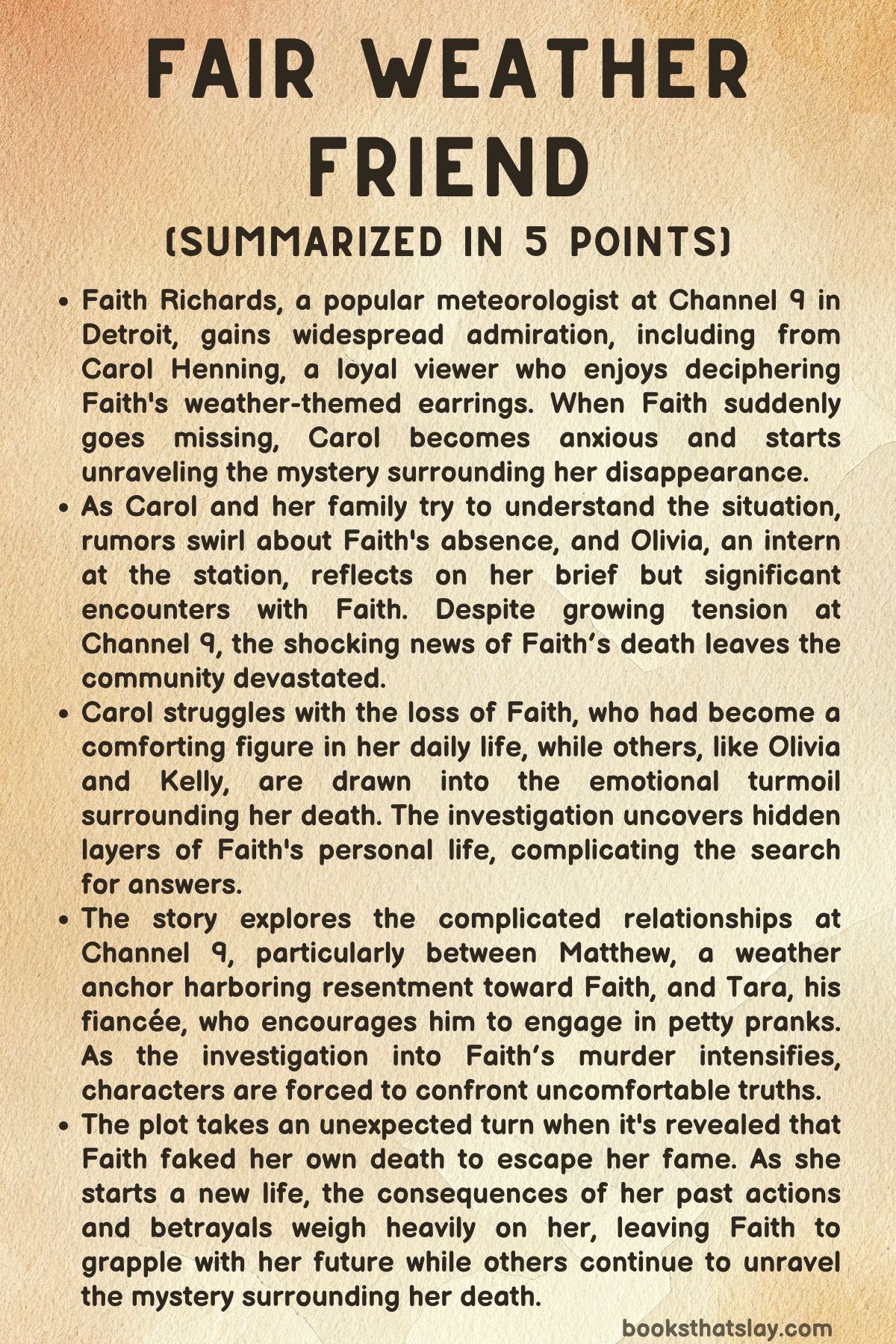
Faith Richards, a popular and charismatic meteorologist at Channel 9 in Detroit, captivates her viewers with her unique weather-themed earrings and engaging personality. One evening, Carol Henning, a loyal fan, watches her nightly weather forecast only to notice that Faith is missing from the broadcast.
Faith’s absence raises alarms, especially when Carol learns that Faith hasn’t returned from her dinner break and might have left behind a mysterious note for Tom, the main anchor. Carol’s worry grows as she texts her niece, Olivia, who is interning at Channel 9 and has a firsthand look at the chaotic situation unfolding in the newsroom.
As the mystery deepens, Olivia shares more unsettling details. Faith’s disappearance becomes a topic of intense speculation, with wild theories circulating, from illness to abduction.
Carol’s concern turns to panic when she learns the next day that Faith has been found dead. The news confirms the unthinkable: Faith has been murdered, and the investigation into her death begins.
The revelation shocks Carol, who, despite never having met Faith in person, feels a deep sense of loss. Olivia, still processing the tragedy, provides little new information to Carol, further intensifying the sense of confusion and grief.
As the community grapples with the loss of Faith, Channel 9 airs a special segment to honor her memory. Tributes pour in from viewers, and Carol reflects on how much Faith had meant to her, even though they had never met face-to-face.
The mystery of Faith’s murder lingers, leaving everyone wondering what really happened. Meanwhile, Olivia continues to feel the weight of the situation, especially after learning that a note Faith had handed her to deliver to Tom may hold crucial information about her death.
The story shifts to explore the complex relationships at Channel 9. Matthew, another weather anchor, is revealed to harbor resentment toward Faith.
His jealousy stems from his belief that Faith overshadowed him, despite his own ambitions to gain more recognition. Matthew’s bitterness leads him to partake in a series of harmless pranks on Faith, including hiding her lipstick.
Though Matthew feels conflicted about his actions, they provide a glimpse into the tension brewing behind the scenes at the station. His actions, however, only add to the mounting suspicion surrounding Faith’s death.
Amidst the brewing tension, Kelly, a colleague of Faith’s, struggles with her past conflicts with Faith. She had hoped to reconcile with Faith over a tense lunch meeting, but the encounter only leaves Kelly with more doubts.
Faith’s apology for past wrongdoings, including stealing from Kelly, is met with lingering resentment, and Kelly soon discovers that her family’s prized jewelry has gone missing. She begins to suspect that Faith might have been involved in the theft, further complicating her feelings about the woman who had just died.
When Kelly attends a vigil for Faith, she meets Heather, a woman who claims to have been a close friend of Faith. Heather’s peculiar behavior raises Kelly’s suspicions, adding another layer of uncertainty to the situation.
As the investigation into Faith’s murder unfolds, it becomes clear that there is much more to Faith’s life than meets the eye. The public image she had cultivated as a cheerful, quirky meteorologist masks a troubled and complicated personal life.
Faith had strained relationships with her family and colleagues, which leads to further questions about the circumstances of her death. While Carol and Olivia continue to reflect on their connections to Faith, others at Channel 9, including Matthew and Kelly, begin to uncover the darker side of her life.
Faith’s death is a catalyst for unraveling long-held secrets, including those about her difficult upbringing. Faith had suffered trauma from her father and the death of her younger sister, Charity.
As more details about her past surface, her actions, including her thefts and manipulative behaviors, begin to make sense, though they do not excuse them. Despite these revelations, the mystery of her death remains unsolved, and the people around her are left to grapple with the unanswered questions.
In the aftermath of Faith’s murder, the investigation takes a surprising turn. It is revealed that Faith had staged her own death with the help of her sister, Hope, to escape her fame and begin a new life.
The plan involved bribing a medical examiner to falsify her death, and Faith’s disappearance was meant to be a fresh start far away from the pressures and troubles that had defined her life. However, things begin to unravel when Tom, the main anchor at Channel 9, is found dead of poisoning.
This death, along with the subsequent investigation, casts doubt on everything that had been believed about Faith’s fate.
As the investigation intensifies, Matthew finds himself implicated in both Tom’s murder and Faith’s staged death. His involvement in the deaths becomes a subject of scrutiny, and he faces legal consequences for his role in the unfolding drama.
Meanwhile, Faith, who had planned to start over in a new life, finds herself betrayed by her sister Hope, who takes most of the money from their scheme and abandons Faith in the process. Alone and devastated, Faith must now figure out how to move forward in a world that has left her behind.
Olivia, who had learned of Faith’s survival but decided not to reveal the truth, is now caught in a moral dilemma. She is questioned by the police as part of their investigation, and her decision to keep Faith’s secret weighs heavily on her.
Though she empathizes with Faith’s difficult past, Olivia realizes that she is now entangled in a web of lies and deceit that stretches far beyond her initial internship at Channel 9.
As the investigation comes to a close, it becomes clear that the truth about Faith’s death and her staged disappearance will never fully be revealed. The lives of those connected to her are forever changed, as they come to terms with the tangled web of lies, betrayals, and secrets that surrounded her life and death.
Faith, now living under a new identity in Las Vegas, reflects on the choices that led her to this point. Though she is free from the past that haunted her, she is left to face the consequences of the life she left behind, while those who knew her are left to pick up the pieces of their own shattered lives.
In the end, The Fair Weather Friend leaves its readers questioning the nature of public personas, the weight of personal secrets, and the devastating effects of betrayal. As the characters confront their own guilt and responsibility, they are forced to reckon with the aftermath of their actions, knowing that the true story of Faith’s life and death may never be fully understood.
Characters
Faith Richards
Faith Richards, a prominent meteorologist at Channel 9 in Detroit, is a complex character whose life is marked by both public adoration and private struggles. On the surface, Faith is a beloved figure, known for her engaging presence and her trademark collection of weather-themed earrings.
She is admired by viewers like Carol Henning, who follows her career and even decodes the weather based on the earrings Faith wears. However, as The Fair Weather Friend unfolds, we learn that Faith is not as perfect as she appears.
She has a turbulent personal life, strained relationships with family members and colleagues, and a history of manipulation and betrayal. Faith’s tragic fate—being murdered after faking her death to escape her fame—adds a dark layer to her character.
Although she initially stages her death to escape her past, the pain of her history continues to haunt her, especially after being betrayed by her sister Hope. In the end, Faith’s journey is one of attempting to rebuild her life, but she is burdened by guilt and the consequences of her decisions, even as she seeks freedom in a new identity.
Carol Henning
Carol Henning, a devoted fan of Faith Richards, represents the emotional connection that viewers can develop with public figures. She admires Faith from afar, watching her every broadcast and eagerly anticipating behind-the-scenes details shared by her niece Olivia, who is interning at Channel 9.
Carol’s relationship with Faith is rooted in admiration and a sense of familiarity, though they have never met. When Faith mysteriously disappears, Carol becomes deeply concerned, and this concern escalates into heartbreak upon learning of Faith’s death.
Carol is devastated, feeling a sense of loss for someone who had become an almost intimate part of her life, even though they were strangers. Her emotional journey highlights the impact that public figures can have on their audience, and she grapples with the idea of closure, as she continues to mourn the loss of Faith.
Her personal connection to Faith, though distant, underscores the deep emotional investment viewers can have in celebrities, especially when they experience a shocking loss.
Olivia
Olivia, Carol’s niece, is an intern at Channel 9 and finds herself at the center of the mystery surrounding Faith’s disappearance and death. Though Olivia is new to the station, she feels a sense of camaraderie with Faith, who she briefly interacts with when Faith gives her a note for Tom, the main anchor.
Olivia becomes entangled in the intrigue surrounding Faith’s absence and the wild speculations that follow. Her role in the story is crucial, as she holds a key piece of information—Faith’s note—but struggles with whether to reveal it or not.
Olivia is torn between her loyalty to her job and her desire to help solve the mystery. Her internal conflict and the tension she faces from both her coworkers and her own conscience add depth to her character.
As the investigation progresses and suspicions grow, Olivia’s innocence and naivety make her a sympathetic character caught in a web of secrets and lies.
Matthew
Matthew, a fellow meteorologist at Channel 9, is a character marked by bitterness, jealousy, and professional frustration. His resentment toward Faith grows as he feels overshadowed by her popularity, despite his own position at the station.
Matthew’s jealousy becomes more evident as he vents to his fiancée, Tara, about his grievances with Faith. He plays a prank on Faith, hiding her lipstick, but later regrets his involvement in the childish trick, especially as it escalates into something more serious.
As The Fair Weather Friend develops, Matthew finds himself wrapped up in the investigation into Faith’s death, eventually becoming a suspect in the murder of Tom, another colleague. His guilt, regrets, and the complicated nature of his relationship with Tara reflect the emotional turmoil that comes with working in a competitive and high-pressure environment.
Matthew’s involvement in both Faith’s and Tom’s deaths is central to the unfolding mystery, and his character grapples with the consequences of his actions, ultimately revealing the dark undercurrents of his personality.
Kelly
Kelly is a character driven by a mix of past resentments and present frustrations, particularly regarding her relationship with Faith. Her interactions with Faith are rooted in their shared history, where Faith had manipulated Kelly in their college years.
When Faith attempts to apologize and make amends, Kelly is skeptical, finding Faith’s actions insincere. This dynamic shapes Kelly’s view of Faith, and when she later discovers that her prized family jewelry is missing, she becomes paranoid and begins to suspect that Faith might be involved in the theft.
Kelly’s character is marked by emotional turmoil, as she navigates her growing distrust of Faith and the unraveling of her personal life. Her suspicions about Faith’s involvement in the theft and her subsequent encounter with an obsessive fan at Faith’s vigil further complicate her emotions.
As Kelly’s investigation into the theft deepens, her detachment from her boyfriend Joel grows, adding to the tension in her personal relationships. Kelly’s journey is one of emotional conflict and the realization that the past has a lingering impact on the present, as she struggles to reconcile with the truth about Faith.
Tara
Tara, Matthew’s fiancée, plays a secondary yet significant role in the story. She is portrayed as a source of concern for Matthew, especially as she begins to exhibit increasingly strange behavior.
Tara’s actions, including her heavy drinking and her interactions with the eccentric fan club members, contribute to the tension in Matthew’s life. Her involvement in the pranks played on Faith, and her subsequent encouragement of Matthew to escalate these pranks, further complicates their relationship.
Tara’s struggles with her emotions, particularly in the aftermath of Faith’s death, add to the sense of unease that surrounds her character. As the story progresses, Tara’s emotional state deteriorates, and her behavior becomes more erratic.
Her actions and her relationship with Matthew reflect the psychological toll that the events surrounding Faith’s death have on those close to her, and she ultimately becomes a character marked by instability and unresolved conflict.
Steve
Steve, a fan of Faith Richards, is an enigmatic and unsettling character. He claims to have been Faith’s boyfriend, but his story is met with skepticism by those around him, especially Carol, who becomes increasingly suspicious of him as she investigates Faith’s life and death.
Steve’s behavior at Faith’s vigil, as well as his odd interactions with others, raises alarms and makes him a key figure in the investigation into Faith’s death. His connection to the fan club and his eccentricities create a sense of unease, and Carol begins to suspect that Steve may be hiding something.
As the story unfolds, Steve’s role in the mystery becomes more ambiguous, and he remains a figure of suspicion, whose true motivations and involvement in the events surrounding Faith’s death are unclear. Steve’s character embodies the obsessive nature of fandom and the lengths to which some individuals will go to attach themselves to a public figure, even to the point of manipulation and deceit.
Hope
Hope, Faith’s sister, plays a pivotal role in the story, especially in the final revelation about Faith’s faked death. Hope’s betrayal of Faith, taking the majority of the money from their scheme to escape their troubled past, is a significant turning point in the narrative.
Hope’s decision to abandon Faith highlights the toxic and manipulative dynamics within their family. Her actions complicate Faith’s quest for freedom, as she is left to confront her painful past alone.
Hope’s character is defined by her self-serving behavior, and her abandonment of Faith marks her as a deeply flawed individual, willing to sacrifice her sister’s well-being for personal gain. Her role in the faked death scheme ultimately becomes a crucial element in understanding the full scope of the tragedy that surrounds Faith’s life and death.
Themes
The Impact of Public Perception and Celebrity Culture
In The Fair Weather Friend, the theme of public perception and the influence of celebrity culture is central to the narrative. Faith Richards, the beloved meteorologist, becomes more than just a weather personality to her viewers; she embodies the ideal of trust, reliability, and familiarity.
Her persona, built on her expertise and weather-themed earrings, makes her a symbol of consistency for the public. Carol, one of her most devoted viewers, experiences an intense emotional connection to Faith despite never having met her.
The loss of Faith, especially in such a tragic and mysterious manner, shakes Carol to her core, highlighting the powerful emotional bonds that can form through media personalities. The story explores how people can feel connected to public figures in ways that are more profound than they realize, and how the absence or loss of these figures can leave a void in their lives.
Faith’s fame, however, is not without its darker side. Her personal life, full of complexity, struggles, and secrets, contrasts sharply with the flawless image projected to the public.
The tension between the public persona and the private reality forms a crucial part of the narrative, reflecting on how fame can distort reality and how it can create pressures that ultimately lead to a breakdown.
Betrayal and Deception
The theme of betrayal and deception runs deep throughout the plot, affecting multiple characters and shaping their actions. Faith’s faked death is perhaps the most significant act of deception, a desperate attempt to escape the weight of her fame and the personal trauma she carries.
Faith’s calculated decision to stage her own death with the help of her sister Hope introduces the idea that sometimes people resort to drastic measures to break free from their pasts, even if it means deceiving everyone they know. This act of betrayal, however, creates a web of complications that ensnares not only Faith but also the people around her, including her colleagues at Channel 9.
The lies begin to unravel as people dig deeper into Faith’s life, especially when Olivia unknowingly uncovers evidence that proves Faith is alive. This betrayal, when exposed, shakes the trust of those closest to her.
In a broader sense, the novel explores how betrayal can manifest in many forms, whether through deceitful actions, broken promises, or the exploitation of personal connections for selfish gain. The characters who navigate this treacherous terrain, including Matthew and Tara, are forced to confront their own role in perpetuating these lies, which adds layers of guilt and regret to their personalities.
The Search for Truth and Closure
The quest for truth and closure is another key theme, particularly through Carol’s perspective. Her search for answers regarding Faith’s disappearance and subsequent death is driven by her deep admiration for the meteorologist.
As Carol uncovers more information and becomes tangled in the mystery, the feeling of uncertainty heightens, and she is left grappling with her own feelings of helplessness. The inability to find definitive answers about Faith’s death underscores the emotional turmoil that Carol experiences, especially as she processes the loss of someone she thought she knew so well.
This theme extends beyond Carol, with characters like Olivia and Kelly also questioning their perceptions of the people around them. The mystery of Faith’s death is compounded by the lack of clarity surrounding the events leading up to it, and it becomes clear that closure may never fully come.
The characters are left in a state of suspended disbelief, where their need for closure is in constant conflict with the incomplete and fragmented truths they uncover. In this context, the narrative reflects on the broader human desire to seek meaning and resolution, even when faced with the complex and often unresolved nature of real-life tragedies.
The Consequences of Professional Jealousy
Professional jealousy emerges as a destructive force that shapes the relationships between characters. Matthew, one of the weather anchors, harbors resentment toward Faith for overshadowing his career and stealing the spotlight.
His bitterness grows as Faith continues to receive attention and accolades, despite his efforts to compete with her. This jealousy is compounded by his relationship with his fiancée, Tara, who encourages him to engage in petty pranks on Faith.
The rivalry between Faith and Matthew highlights the toxic impact of professional jealousy, where personal insecurities and frustrations begin to cloud judgment and lead to harmful actions. Matthew’s internal conflict, as he grapples with his resentment and the guilt of his involvement in various pranks and lies, shows how professional jealousy can morph into deeper emotional and psychological issues.
His role in the plot also underscores the negative effects of feeling overlooked and undermined in a competitive professional environment. The character of Matthew offers a nuanced exploration of how jealousy, when left unchecked, can poison relationships and distort one’s sense of right and wrong, leading to actions that have far-reaching consequences.
The Complexities of Personal Relationships
The novel also delves into the complexities of personal relationships, particularly through the interactions and evolving dynamics between characters. Faith’s relationship with her sister Hope is a focal point in this regard.
Their bond, while initially one of mutual support, ultimately fractures when Hope betrays Faith by abandoning her after their staged death plan falls apart. This betrayal emphasizes how fragile even the closest relationships can be when personal desires and survival instincts come into play.
Similarly, the relationships within the Channel 9 newsroom are far from straightforward. Colleagues like Kelly and Matthew, who initially appear to have amicable connections, are revealed to have underlying tension, often due to past conflicts, resentment, or unresolved issues.
The struggles each character faces in their personal lives, whether it’s Kelly’s distrust in her boyfriend, Joel, or Matthew’s strained relationship with Tara, highlight the tension between personal and professional lives. In these ways, the book portrays how personal relationships are often tested by external pressures, whether those pressures come from work, deceit, or personal betrayals.
These complex dynamics serve to humanize the characters, making their actions and decisions more relatable and reflective of real-life struggles that people face when navigating the difficult terrain of relationships.
Guilt and Redemption
Guilt and redemption are prominent themes in the lives of many characters, particularly Matthew and Kelly. Matthew’s involvement in Faith’s murder and his subsequent guilt illustrate the burden of unconfessed actions.
His growing remorse, especially for his petty pranks and deceitful behavior, underscores the psychological toll of harboring guilt. As the investigation into Faith’s death unfolds, Matthew’s struggle to atone for his actions becomes a central conflict in his character development.
Similarly, Kelly’s guilt manifests when she questions her role in Faith’s death, especially after reflecting on her past relationship with the meteorologist. Both characters, in different ways, grapple with their actions and seek redemption, though the path to forgiveness and self-acceptance is fraught with obstacles.
The novel explores the ways in which guilt can shape a person’s actions, decisions, and relationships, and how the desire for redemption often conflicts with the difficulty of facing one’s past mistakes. Ultimately, the story illustrates the heavy emotional weight of guilt, but also offers a glimpse of hope, showing that redemption is possible, even if it requires acknowledging past wrongdoings and confronting uncomfortable truths.