The Promise of Wonder Summary, Characters and Themes
The Promise of Wonder by Katherine Webb (Hallewell Trilogy, Book 1), is a historical novel about guilt, injustice, love, medical ambition, and the long consequences of decisions made in youth.
Beginning in rural England in 1889 and continuing into the early twentieth century, the story follows Theodora Hallewell and Toby Meriwether after a childhood adventure ends in death and a terrible miscarriage of justice. Their lives separate, but neither escapes what happened. As Theo gradually discovers disturbing truths about her husband and Missy Cartwright’s death, Toby turns his grief into a campaign against judicial cruelty. Their separate journeys slowly lead them back toward the same unresolved past.
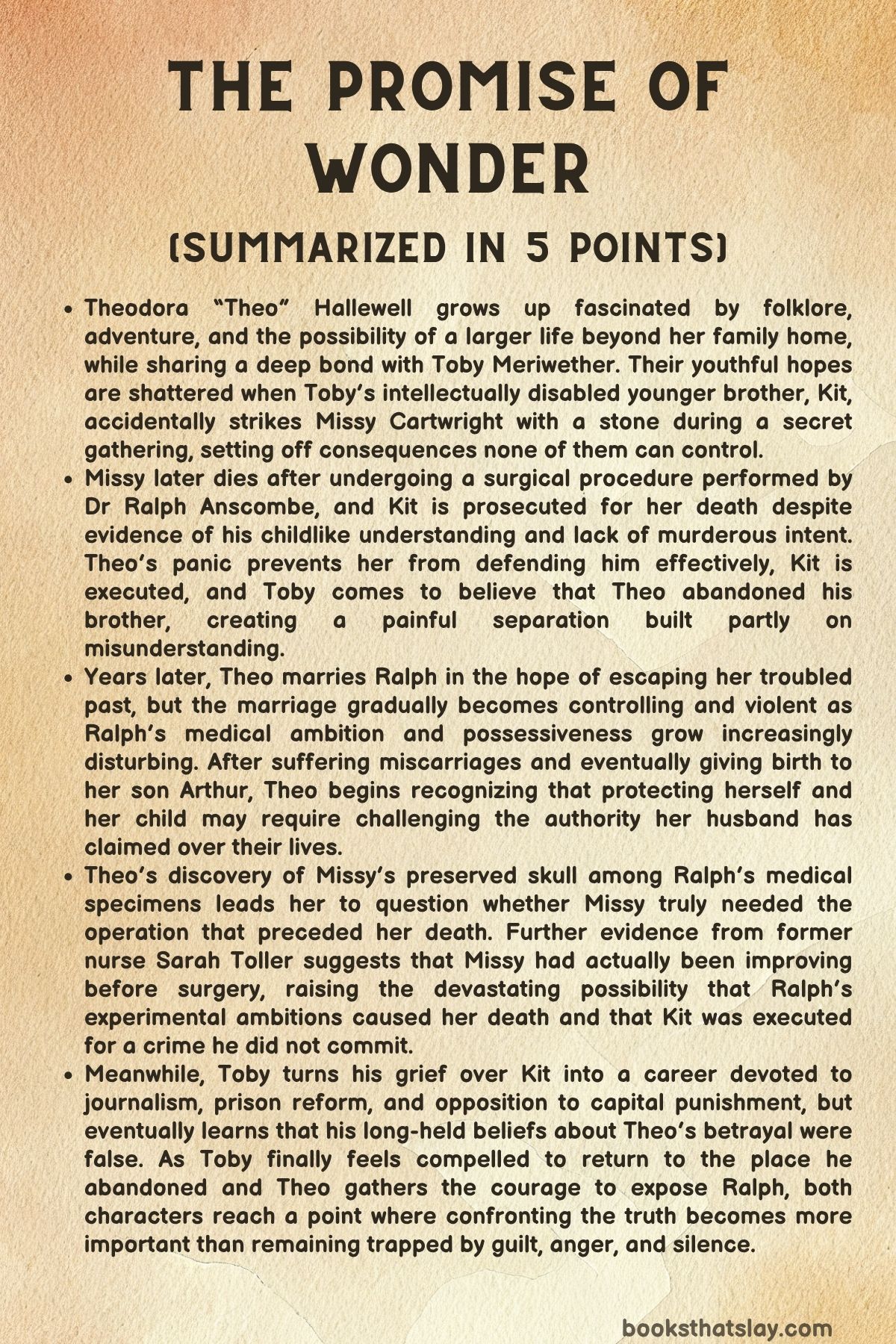
Summary
Nearly sixteen-year-old Theodora “Theo” Hallewell lives at Hallewell House beside the ruins of an ancient family castle and a sacred spring associated with the legendary Lord Abrecan. Fascinated by folklore, history, distant places, and the possibility that life might contain something extraordinary, Theo feels trapped by the narrow future expected of a young woman of her position.
Her closest emotional connection is Toby Meriwether, an intelligent eighteen-year-old preparing for an examination that may win him a scholarship to Durham. Toby dreams of education and independence, but he worries constantly about his younger brother Christopher, known as Kit, whose intellectual development remains childlike and whose impulsive behaviour requires careful supervision.
Theo hopes a secret Midsummer gathering at the castle will bring her and Toby closer before he leaves. Her fascination with the supernatural has been encouraged by Timothy Crudge, an antiquarian family friend who understands her hunger for a life beyond Hallewell.
At midnight, Theo gathers with Toby, Kit, Missy Cartwright and Joanna Bowen among the castle ruins. Using sacred spring water, candles, an old silver coin connected in her imagination with Lord Abrecan, and words inspired by poetry, Theo conducts a ritual intended to summon something extraordinary.
The ritual does not produce anything clearly supernatural, but Theo and Toby finally acknowledge the attraction that has been developing between them. They talk about distant roads and the lives they want to lead, and Toby nearly kisses her.
Their happiness is suddenly destroyed when Missy encourages Kit to climb on a dangerous section of ruined wall. Kit, eager for Missy’s attention, throws or dislodges a stone that strikes her on the head.
Missy initially regains consciousness, and the frightened young people agree to claim that she fell down some stairs. Theo believes the injury will pass, especially after the young doctor Ralph Anscombe examines Missy and initially diagnoses concussion.
Missy’s condition later worsens. Ralph decides that pressure inside her skull may require trephining, but she dies after undergoing the operation without recovering from the anaesthetic.
The consequences are immediate. Joanna reveals what truly happened at the castle, Kit is arrested, and Theo is overwhelmed by guilt because she arranged the gathering and distracted Toby at the moment Kit needed supervision.
Kit cannot properly understand the seriousness of his situation. Theo visits him in his cell and gives him the old silver coin as a protective charm, while Toby and his parents struggle desperately to prevent an intellectually disabled boy from being treated as an ordinary murderer.
Crudge arranges legal representation for Kit through his barrister brother’s connections. Theo promises to support the defence and writes a statement saying that she believes the stone was accidentally dislodged and that Kit would never intentionally harm Missy.
At the magistrates’ hearing, however, Theo becomes terrified when required to distinguish between what she actually saw and what she believes happened. Unable to maintain the certainty expressed in her written statement, she damages Kit’s defence.
Kit is sent to the assizes. Theo’s mental condition deteriorates so severely that she cannot attend the trial, while Toby, his parents and Crudge watch the legal system reduce Kit’s complicated condition to a crude question of guilt.
Although medical testimony establishes that Kit’s intellectual development resembles that of a young child and that he has no murderous tendencies, he is convicted. At only seventeen, Kit is sentenced to death.
From prison, Kit repeatedly asks for Theo. Diana intercepts communication intended for her, leaving Theo unaware of the full extent of Kit’s desire to see her before his execution.
Kit is hanged on 4 November. Toby, already shattered, comes to believe that Theo refused Kit even at the end and cared more about recovering the old Abrecan coin than about his brother.
Theo tries to reach Toby before he leaves for Durham, but he refuses to turn toward her at the railway station. Their relationship, which had seemed on the verge of becoming love, is replaced by silence, anger and misunderstanding.
Two years later, Theo remains burdened by Missy’s death, Kit’s execution and Toby’s rejection. She has written repeatedly to Toby asking for forgiveness, but he has answered none of her letters.
Theo takes fourteen-year-old orphan Audrey Wagstaff as her maid. Audrey gradually becomes a steady presence in her life, while Ralph Anscombe develops from physician into trusted companion.
Toby, meanwhile, has transformed his grief into relentless academic work at Durham. He succeeds brilliantly but develops a dangerous temper and continues to carry memories of Kit that emerge whenever he encounters situations involving reckless danger.
Ralph eventually proposes to Theo. He openly accepts that she does not love him and presents marriage as a relationship in which affection may eventually become something deeper.
After learning that Toby appears connected to another woman, Theo accepts the possibility that her childhood love is permanently gone. She marries Ralph, hoping marriage will provide an escape from Hallewell and from a past that seems to inhabit every room of her childhood home.
At first, life at Tout Hill House feels freer. Yet Theo soon discovers that companionship cannot create love simply because she wishes it could, and Ralph’s attitudes toward servants, women and medicine begin revealing aspects of his personality that make her uncomfortable.
Pregnancy gives Theo a new source of happiness, but she miscarries a daughter she names Amelia. Ralph responds clinically and suggests that Theo’s emotional condition may have contributed to the loss, leaving her with an additional burden of guilt.
A second pregnancy also ends in tragedy. Theo believes the baby boy, whom she names Timothy, showed signs of life, while Ralph insists otherwise and again implies that Theo’s resistance to his medical supervision may have played a role.
During the same years, Toby moves to London and enters journalism. Reporting on criminal courts exposes him to cases in which intention, circumstance and punishment bear little relation to one another.
Kit’s execution becomes the hidden foundation of Toby’s professional purpose. He begins writing publicly against unjust sentencing, harsh imprisonment and capital punishment, gradually turning private grief into political conviction.
Theo and Toby briefly see each other again after more than five years apart. The encounter unsettles them both, demonstrating that separation has not removed their emotional connection.
Soon afterward, Theo begins noticing disturbing inconsistencies in Ralph’s descriptions of Missy’s injury. While examining his private medical collection, she discovers Missy’s preserved skull in a locked cabinet.
The discovery horrifies Theo for several reasons. Ralph retained part of Missy’s remains without telling her, and the skull does not seem to display the terrible fracture Theo expects to find based on Ralph’s earlier explanations.
Theo secretly seeks medical information and learns that examining a dead patient’s remains may have been legally possible with permission from a guardian. More disturbing is the possibility that an unnecessary experimental operation would have represented a profound medical and moral violation.
Mrs Vine eventually admits that Ralph waived his medical fee in return for permission to examine Missy’s body after death. Theo begins confronting a possibility she can barely tolerate: Ralph may have performed the operation not because Missy urgently needed it, but because he wanted surgical experience.
If that is true, Kit may not have caused Missy’s death.
At home, Ralph becomes increasingly controlling. He searches Theo’s private correspondence, attempts to end her relationship with Crudge and declares that everything in his household, including Theo, belongs to him.
Theo gives birth to a healthy son, Arthur, whose arrival changes the balance of her life. She loves him without hesitation, and protecting him gradually becomes more important than preserving her marriage.
Ralph, meanwhile, becomes increasingly dependent on cocaine and heroin while maintaining affairs and growing resentful of Theo’s emotional distance. He eventually strikes her, apologises afterward and promises that it will never happen again.
The violence does not end. Over the following years Ralph repeatedly beats Theo while preserving his reputation as a respectable doctor.
At the same time, more questionable medical cases appear. When another patient dies following trephining and the necessity of the procedure is challenged, Theo becomes increasingly convinced that Missy’s death belongs to a larger pattern of Ralph using vulnerable patients to advance his medical ambitions.
Theo anonymously attempts to attract newspaper attention to such cases. Ralph suspects her and attacks her brutally.
When four-year-old Arthur tries to protect his mother by throwing a toy block at Ralph, Ralph beats the child. For Theo, violence against Arthur creates a boundary that even years of violence against herself had failed to establish.
She takes Arthur and Audrey and runs away. Yet Diana refuses to give her meaningful protection, while the law offers Theo few realistic options for leaving her husband without risking the loss of her son.
Theo therefore returns to Ralph under threat that he may have her committed to a sanatorium. Her situation seems nearly impossible until Sarah Toller, a former hospital nurse, contacts her.
Sarah remembers seeing Missy shortly before the operation. According to her recollection, Missy was cheerful, coherent and saying that her head no longer hurt.
This testimony directly contradicts Ralph’s claim that Missy had deteriorated so badly that dangerous surgery was essential. For the first time, Theo has evidence that can support what had previously been only suspicion.
Toby’s life also begins changing. After years in journalism and reform politics, he becomes a prominent critic of judicial cruelty, particularly the execution of young offenders.
A conversation with the independent suffragist Mary Gladwell reminds Toby of Theo’s childhood dream of travelling to Mesopotamia. He finally returns to the thirty-seven letters Theo sent him after Kit’s execution and opens one.
The truth destroys the story he has told himself for thirteen years. Theo had wanted to visit Kit, had never demanded the return of the coin and had tried repeatedly to explain herself.
Toby realises that Diana intercepted his communication and that his belief in Theo’s betrayal was founded largely on a misunderstanding. He must also admit that he deliberately avoided reading Theo’s letters because continuing to hate her was easier than discovering reasons to forgive her.
When Toby later hears Crudge speaking about Lord Abrecan and Hallewell, memories of Theo and their Midsummer night return with extraordinary clarity. He finally understands that leaving Hallewell never freed him from the people or events that shaped him.
At the same time, Theo sits beside Arthur after another attack from Ralph and considers Sarah Toller’s evidence. She thinks about Amy, Rosalind, Missy and Kit, and about the moral responsibility the living owe to people whose stories have been distorted after death.
Theo finally accepts the terrible possibility that she married the man whose actions may have caused Missy’s death and therefore contributed directly to Kit’s execution. Clearing Kit’s name, restoring dignity to Missy’s remains, exposing Ralph and escaping her marriage now become parts of the same struggle.
The story reaches its closing point with Toby finally wanting to return and Theo finally ready to act. Years of silence, guilt and misunderstanding have not erased the past; instead, the truth has created the possibility that the past can finally be confronted.
Characters
Theodora “Theo” Hallewell
Theo is the emotional and moral centre of The Promise of Wonder, developing from an imaginative adolescent who longs for magic into a woman forced to confront consequences that are frighteningly real. Her fascination with Lord Abrecan, folklore, travel and ritual initially represents resistance to the limited life prepared for her by class and gender.
The tragedy at the castle radically changes this imaginative temperament. Because Theo organised the gathering and was absorbed in Toby when Kit needed supervision, she assumes an enormous amount of responsibility for events that were never entirely within her control.
Her guilt also exposes one of her central weaknesses: fear can overwhelm her moral intentions. Theo genuinely wants to save Kit, but when legal proceedings demand courage and precision from her, panic prevents her from becoming the witness he needs.
This failure remains central to her identity for years. She does not simply mourn Kit; she interprets his execution as evidence that when courage mattered most, she failed somebody who trusted her.
Her marriage to Ralph initially reflects the same pattern of attempting to escape pain rather than fully confronting it. She knows she does not love him, yet chooses the security he represents because Toby appears lost and Hallewell has become unbearable.
Motherhood produces a major change in Theo. Her miscarriages deepen her vulnerability, but Arthur eventually gives her something she values more strongly than her own safety.
Her discovery of Missy’s skull begins another transformation. Instead of accepting Ralph’s authority automatically, Theo becomes observant, suspicious and increasingly willing to seek information independently.
By the later part of the story, she has developed a courage very different from her adolescent dreams of adventure. Her decision to investigate Ralph, protect Arthur and seek justice for Kit and Missy shows that wonder has given way to moral responsibility without entirely destroying her belief that life can still change.
Toby Meriwether
Toby is defined by intelligence, ambition, loyalty and a capacity for anger that becomes both productive and destructive. As a young man, he desperately wants education and independence, yet his responsibility for Kit prevents him from imagining freedom without guilt.
His relationship with Theo begins through shared childhood history and gradually develops into romantic attraction. Their connection is especially strong because both want to escape the boundaries of the lives into which they were born.
Kit’s arrest and execution transform Toby. He sees the law condemn a vulnerable boy who cannot understand the machinery working against him, and the experience permanently destroys his ability to regard justice as something automatically produced by courts.
His anger toward Theo becomes a psychological defence. Believing that she abandoned Kit allows Toby to direct unbearable grief toward a single person, and refusing to read her letters allows that interpretation to survive unchallenged.
Toby’s professional development grows directly from this unresolved suffering. Journalism, political activism and campaigns against capital punishment turn Kit’s death into a social argument about intention, responsibility and the cruelty of irreversible punishment.
His later discovery that Theo tried to reach Kit forces him to confront his own moral failure. He has spent years believing that she lacked courage, only to discover that he also chose avoidance when truth threatened the emotional structure on which he had built his life.
Toby therefore becomes one of the clearest examples in The Promise of Wonder of the difference between remembering suffering and understanding it. His eventual desire to return to Hallewell suggests that maturity requires more than escaping the past; it requires revisiting the judgments created by it.
Christopher “Kit” Meriwether
Kit is the character around whom the novel’s central questions of responsibility and justice are organised. Although physically approaching adulthood, his intellectual understanding remains that of a much younger child, making the legal system’s treatment of him especially disturbing.
His behaviour at the castle is dangerous, but his intention is fundamentally different from the intention associated with murder. He throws the stone while seeking Missy’s attention rather than because he understands or desires the deadly consequence.
Kit’s vulnerability is repeatedly misinterpreted. Behaviours resulting from intellectual disability, impulsiveness and poor social understanding are presented in court as evidence of danger rather than as reasons to question whether ordinary standards of criminal responsibility can fairly be applied to him.
His repeated requests for Theo reveal his emotional simplicity. While the adults around him struggle with law, reputation, guilt and strategy, Kit wants reassurance from people he trusts.
His execution is therefore more than an individual tragedy. It exposes a justice system capable of recognising a person’s limitations in evidence and then effectively disregarding those limitations when imposing punishment.
The later possibility that Missy may actually have died because of Ralph’s surgery makes Kit’s fate even more disturbing. His identity as a convicted murderer may have been constructed around both misunderstanding and medical deception.
Missy Cartwright
Missy is energetic, irreverent and rebellious, providing a sharp contrast to the restrictions surrounding Theo. Living at St Agnes’s gives her fewer social privileges than Theo, yet she possesses a boldness Theo envies.
Her teasing, romantic enthusiasm and reckless challenge to Kit initially appear like ordinary expressions of youthful confidence. The same qualities contribute indirectly to the accident when she encourages Kit into behaviour whose danger he cannot properly judge.
Missy’s death becomes the event through which nearly every major character is altered. Yet the later discovery of her skull changes her role from apparent victim of Kit’s violence into a possible victim of medical ambition.
Her treatment after death is important as well. Ralph’s retention of her remains turns her body into an object of study, extending the novel’s concern with how vulnerable people can lose control over their stories and even over their physical remains.
Sarah Toller’s recollection restores something of Missy’s voice. The image of Missy shortly before surgery as coherent, cheerful and apparently improving directly challenges the medical account used to explain both her operation and Kit’s prosecution.
Dr Ralph Anscombe
Ralph is initially presented as intelligent, attentive and dependable. He enters Theo’s life during Missy’s medical crisis and later becomes someone whose calm professional authority seems capable of protecting her from instability and fear.
His proposal is unusually clear about Theo’s emotional limitations. He knows she does not love him, and his willingness to accept friendship rather than romantic passion initially makes him appear patient and generous.
Over time, however, patience becomes possession. Ralph increasingly treats marriage as a structure that grants him authority over Theo’s correspondence, friendships, medical choices and eventually her body.
His medical ambition follows a similar progression. A desire to improve surgical practice might initially appear admirable, but Ralph becomes increasingly focused on breakthroughs, professional recognition and opportunities to test difficult procedures.
Missy’s skull becomes the most disturbing symbol of this ambition. The possibility that Ralph performed unnecessary trephining because Missy offered an opportunity to develop his skills transforms professional confidence into potential exploitation.
Ralph’s domestic violence and medical conduct arise from a related belief in entitlement. Whether controlling a wife, medicating a child or deciding what risks a vulnerable patient should endure, he repeatedly assumes that his judgment gives him the right to override another person’s autonomy.
His public respectability makes him particularly dangerous. Theo’s difficulty escaping him depends partly upon the contrast between the charming physician recognised by society and the violent, controlling husband known inside the home.
Timothy “Crudge”
Crudge is Theo’s intellectual mentor and one of the few adults who consistently treats her curiosity as valuable rather than inconvenient. Through history, folklore and accounts of travel, he gives Theo access to possibilities beyond the conventional future Diana imagines for her.
His support becomes especially significant during Kit’s prosecution. Rather than protecting Hallewell’s reputation, Crudge uses his connections to obtain legal assistance and encourages Theo to act according to conscience.
Crudge also understands endurance. His assurance that an “afterwards” exists becomes an important idea because Theo repeatedly finds herself trapped in situations that appear permanent.
His own experiences of social exclusion, particularly surrounding his relationship with Arnaud and Ralph’s hostility toward suspected homosexuality, place him outside the moral respectability claimed by characters such as Ralph. Ironically, the supposedly unconventional Crudge repeatedly behaves with greater compassion and integrity than those protected by respectable institutions.
By the later story, Crudge also serves as an indirect bridge between Theo and Toby. His continuing presence demonstrates that the past they abandoned has remained alive and that returning to it does not necessarily mean surrendering to it.
Diana Hallewell
Diana represents social convention at its most emotionally destructive. She is concerned with respectability, scandal and the maintenance of appearances, often responding to human suffering according to the effect it may have on the Hallewell family.
During the crisis surrounding Kit, Diana urges Theo toward silence rather than moral action. Her interference with communication between Toby and Theo contributes directly to the misunderstanding that separates them for more than a decade.
Her treatment of Theo is controlling even when presented as protection. Threats involving sanatorium confinement create a powerful fear that Theo’s emotional instability can be used to remove her independence.
Diana’s refusal to shelter Theo after she escapes Ralph is one of her most revealing moments. By telling an abused daughter that a wife should avoid provoking her husband, she protects the institution of marriage and social order at the expense of Theo’s physical safety.
She is therefore not simply an unsympathetic mother. Diana illustrates how harmful systems survive because ordinary people defend their rules even when confronted with obvious suffering.
David Meriwether
David is a schoolmaster and Crimean War veteran whose disability has shaped his view of heroism. His experience has taught him to distrust romantic accounts of warfare, giving Toby an early example of the difference between heroic stories and physical consequences.
As Kit’s father, David understands his son’s vulnerability but cannot protect him from institutions that interpret that vulnerability through suspicion. His presence reinforces the helplessness of a family forced to watch legal authority take control of their child.
David also refuses to allow Toby to abandon his educational future entirely for the family crisis. The decision reflects parental sacrifice: even while one son’s life is threatened, he does not want the catastrophe to destroy the other son’s possibilities as well.
Mona Meriwether
Mona embodies the contradictions of grief. She understands rationally that Theo did not intend the castle accident, yet she admits that emotionally she cannot entirely stop blaming her.
That admission makes Mona more complex than a simple grieving mother. She recognises the unfairness of her own response while also acknowledging that bereavement does not always obey reason.
Her conversation with Theo years later shows how Kit’s death remains present in ordinary relationships. Even where forgiveness is intellectually possible, emotional damage may continue resisting resolution.
Mona also influences Toby’s choices when she tells him about Theo’s apparent intention to marry Ralph. Toby’s impulsive response demonstrates how information moving between these families continues to shape lives long after direct communication has broken down.
Audrey Wagstaff
Audrey enters Theo’s life as a fourteen-year-old orphan chosen to become her personal maid. Quiet and observant, she gradually develops into one of Theo’s most reliable sources of stability.
Her occupation of Amy’s former bedroom carries symbolic significance. A room preserved around death becomes a living space again, suggesting that memory does not have to require permanent preservation of grief.
Theo’s decision to teach Audrey to read also shows the difference between Theo and Ralph. Where Ralph sees education as unnecessary for a servant, Theo sees Audrey as a person capable of growth beyond the role society has assigned her.
As Theo’s marriage becomes increasingly dangerous, Audrey becomes a confidante rather than merely an employee. She eventually learns Theo’s suspicions about Missy and escapes with Theo and Arthur when Ralph’s violence becomes intolerable.
Her loyalty is quiet rather than dramatic, but it repeatedly gives Theo the practical and emotional support needed to continue functioning.
Arthur Anscombe
Arthur is Theo and Ralph’s surviving son and becomes the strongest force behind Theo’s determination to resist her husband. His birth follows repeated pregnancy loss, making Theo’s attachment to him especially intense.
Arthur also exposes Ralph’s jealousy and emotional insecurity. Ralph recognises that Theo gives the child a spontaneous love she has never been able to give him.
The decisive moment comes when Arthur tries to defend Theo during one of Ralph’s attacks. Ralph’s decision to beat his four-year-old son destroys whatever remaining belief Theo has that endurance may protect the family.
Arthur therefore changes Theo’s understanding of courage. She has tolerated danger to herself for years, but once that danger reaches her child, remaining passive becomes morally impossible.
Joanna Bowen
Joanna plays a decisive role in the legal consequences of the castle accident. She refuses to support the group’s false account and tells authorities that she saw Kit deliberately throw the stone.
From one perspective, Joanna represents insistence upon factual truth. She will not alter her account simply because doing so might help Kit.
Yet her certainty also demonstrates the limits of eyewitness interpretation. Seeing Kit perform an action does not necessarily reveal whether he understood its likely consequences or possessed murderous intent.
Joanna therefore becomes important to the novel’s distinction between observation and meaning. Her testimony may accurately describe movement while still failing to explain the mind behind it.
Rosalind Mackie
Rosalind appears early in Theo’s story as a young woman dying from an inoperable lung tumour. Her desire to believe in the sacred spring’s healing power gives Theo an early experience of the complicated relationship between truth and hope.
Theo knows she cannot genuinely promise a cure, yet she invents a ritual because she believes hope may still offer something valuable. Rosalind’s later death does not render that gesture meaningless.
The butterfly pendant Rosalind leaves Theo confirms that the ritual gave comfort even without producing recovery. Her role therefore establishes an important distinction between false certainty and hope freely embraced in the face of uncertainty.
Dr Mackie
The physician connected with Rosalind later becomes an important source of independent medical information for Theo. Unlike Ralph, he responds to her questions without trying to control what she is permitted to know.
His explanations concerning preserved remains, consent and the meaning of Ralph’s specimen labels allow Theo to understand that some disturbing practices may be legally permitted while still raising serious ethical questions.
More importantly, his warning about unnecessary experimental surgery gives Theo a medical framework through which to reconsider Missy’s operation. He helps move her from private suspicion toward a more informed evaluation of Ralph’s conduct.
His observation that Theo’s correspondence does not sound like that of a happy woman also demonstrates an attentiveness to her emotional condition that contrasts sharply with Ralph’s tendency to interpret her feelings as problems requiring control.
Hermione Abbott
Hermione becomes important during Theo’s marriage because she offers the emotional validation Ralph repeatedly withholds. After Theo’s pregnancy losses, Hermione recognises the reality of her grief rather than reducing the children to clinical descriptions.
Her presence demonstrates how friendship can protect a person’s understanding of their own experience. Ralph repeatedly encourages Theo to doubt herself, whereas Hermione confirms that Theo’s sorrow, fear and attachment to her lost children are legitimate.
Although Hermione does not dominate the plot, she represents a form of female companionship that quietly counters the isolation on which Ralph’s control depends.
Mary Gladwell
Mary Gladwell is a wealthy widow, suffragist and experienced traveller whose independence makes her a striking figure in Toby’s later life. She challenges his assumptions about women simply by living with freedoms that would have seemed extraordinary within Theo’s youth at Hallewell.
Her descriptions of travel unintentionally reconnect Toby with Theo. When Mary discusses the Middle East, Toby remembers the girl who once dreamed of Mesopotamia.
Mary therefore functions as a catalyst rather than a replacement romantic interest. Her freedom reminds Toby of possibilities Theo once imagined for herself and forces him to reconsider what may have happened to the young woman he left behind.
Tom Womersley
Tom becomes Toby’s closest friend at Durham and offers companionship without demanding immediate access to Toby’s painful history. His easy nature initially contrasts with Toby’s anger and emotional guardedness.
When a dangerous prank triggers Toby’s memories of Kit, Tom becomes one of the first people to whom Toby fully explains the tragedy. Their friendship gives Toby a space in which his past can be spoken rather than merely suppressed.
Their relationship is temporarily damaged by Toby’s engagement to Lily, but Tom’s resentment disappears when Toby later returns ill and vulnerable. His willingness to help demonstrates a loyalty capable of surviving disappointment.
In the later legal context, Womersley’s connection with the law also helps reveal how difficult it is for Theo to separate from Ralph while retaining Arthur, showing that even sympathetic individuals operate within restrictive legal structures.
Lily Womersley
Lily becomes engaged to Toby largely because he reacts impulsively to news of Theo’s intended marriage. The engagement is therefore built upon emotional avoidance rather than genuine romantic commitment.
Lily eventually recognises what Toby refuses to face: affection and respect are insufficient foundations for marriage when love is absent. Her decision to end the engagement shows greater emotional clarity than Toby possesses at that stage.
She also serves as a parallel to Theo. Both become involved with men who cannot give them the form of love marriage supposedly promises, though Lily possesses the freedom to leave before marriage makes that absence permanent.
Sarah Toller
Sarah Toller becomes one of the most important late-arriving figures because she provides evidence capable of changing the meaning of events that occurred many years earlier. As a former nurse, she remembers Missy’s condition immediately before the operation.
Her recollection that Missy was cheerful, coherent and free from severe headache directly challenges Ralph’s claim that dangerous surgery had become urgently necessary.
Until Sarah writes, Theo possesses disturbing objects, inconsistencies and suspicions. Sarah supplies eyewitness testimony.
Her importance therefore lies in the movement from memory to evidence. Through her, a person who seemed lost to history gains the possibility of influencing justice years later.
Amy Hallewell
Amy, Theo’s dead sister, remains psychologically present despite dying before the central action. Her preserved bedroom and Theo’s memories of being made to pose for a post-mortem photograph show how deeply death has shaped Hallewell House.
Amy’s continued presence helps explain Theo’s early fascination with magic and transformation. She grows up in an environment where the dead are constantly remembered but cannot be restored.
When Audrey eventually occupies Amy’s room, the change suggests an alternative relationship with loss. Remembering the dead does not require preventing the living from occupying the spaces they left behind.
Cassandra Pridde
Cassandra is Toby’s married lover during his adult life in London. His relationship with her reflects his determination to keep intimacy separated from commitment.
Toby is willing to accept a relationship that cannot become an ordinary domestic future because such emotional limits protect him from the vulnerability he once associated with Theo.
Cassandra therefore reveals how Toby’s unresolved past shapes even relationships that seem unrelated to Hallewell. He can desire closeness, but he carefully chooses circumstances that make complete emotional surrender unnecessary.
Havelock Pridde
Havelock is Cassandra’s violent husband and becomes part of Toby’s tendency toward reckless self-destruction. When Toby, upset after learning about Theo’s life, deliberately provokes him, Havelock fires a gun and leaves shot lodged in Toby’s arm.
The incident demonstrates that Toby’s anger is not limited to political conviction. At moments of emotional distress, it can become a willingness to endanger himself.
Havelock is less psychologically developed than the central characters, but his violence gives physical form to Toby’s inability to handle feelings he has spent years denying.
Mrs Vine
Mrs Vine occupies a morally uncomfortable position in the history of Missy’s body. She eventually admits that Ralph waived his medical fee in exchange for permission to examine Missy after death.
Her decision illustrates how legal permission does not necessarily settle the ethical meaning of an act. Missy’s social vulnerability makes her particularly easy to convert from a dead young woman into a medical specimen.
Mrs Vine’s eventual honesty, however, becomes one of the pieces that allows Theo to reconstruct what happened. She participates in the troubling arrangement but later provides information necessary to challenge Ralph’s version of events.
Dr Heinemann
Dr Heinemann provides psychological evidence during Kit’s trial and explains that Kit possesses the intellectual development of roughly a seven-year-old child. He also finds no murderous tendencies in him.
His testimony should radically alter the way Kit’s responsibility is understood. Instead, the court absorbs the evidence without allowing it to prevent a death sentence.
His role therefore highlights a central institutional failure: expert knowledge can be presented clearly yet remain powerless when the legal framework insists upon categories too rigid to accommodate the person being judged.
Lord Paxton-Nevis
The judge at Kit’s trial represents the authority of a legal system more concerned with fixed categories than individual complexity. His framing effectively leaves Kit trapped between being considered fully responsible and being considered dangerously incapable.
Either interpretation works against the boy. Intellectual disability, which should complicate the question of culpability, becomes another route toward condemnation.
Lord Paxton-Nevis therefore matters less as a private personality than as the human face of institutional certainty. His authority converts an inadequate interpretation of Kit into an irreversible sentence.
Constable Pryce
Constable Pryce contributes to the prosecution’s negative portrait of Kit by recounting previous incidents involving trespassing, climbing and throwing objects. Behaviours already understood by his family as part of his impulsiveness become evidence suggesting dangerous character.
His testimony shows how context can change the moral meaning assigned to behaviour. Actions that once appeared troublesome but manageable become, after Missy’s death, components in a retrospective narrative of criminality.
Dr Fortescue
Dr Fortescue’s role is most visible when Theo becomes so overwhelmed by panic before Kit’s trial that she is sedated and remains at Hallewell. His intervention reflects the period’s tendency to treat intense female psychological distress primarily through medical management.
Although the sedation may be intended to protect Theo, its consequence is severe. She is absent at the moment when Kit’s defence most needs her participation, strengthening her lifelong sense that fear and passivity helped determine his fate.
Arnaud
Arnaud appears indirectly through Crudge’s painful past as a former assistant and intimate companion. His absence helps explain the sadness surrounding Crudge when Theo later seeks his advice about marriage.
Although little direct information is supplied about him, his relationship with Crudge broadens the story’s examination of forms of attachment that respectable society refuses to recognise openly.
Arnaud’s importance lies partly in what cannot be publicly acknowledged. The pain surrounding his separation from Crudge parallels other relationships in the novel damaged by social expectations, secrecy and fear.
Themes
Guilt, Responsibility and the Difference Between Intention and Consequence
A central moral problem in The Promise of Wonder arises from the distance between causing an event and intending its result. Kit throws the stone, but nothing about his intellectual capacity or behaviour suggests that he understands his action as an attempt to kill Missy.
The legal system nevertheless reduces a complicated event to a simple chain: Kit threw the stone, Missy died, therefore Kit is a murderer. The later possibility that Ralph’s operation rather than the original injury caused Missy’s death makes this reasoning even more unstable.
Theo experiences the same problem internally. She organised the gathering, distracted Toby and failed to defend Kit effectively, so she begins treating herself as though she were morally responsible for everything that followed.
Toby also creates a distorted structure of blame. Unable to direct his anger at death itself, he turns Theo into the person responsible for abandoning Kit, allowing a mistaken interpretation to shape thirteen years of his life.
The novel repeatedly asks whether responsibility should be judged according to action, intention, knowledge, power or foreseeable consequence. It refuses to suggest that these categories always produce the same answer.
By placing Kit, Theo, Toby and Ralph beside one another, the story shows several very different forms of responsibility. Kit causes harm without murderous intention, Theo fails through fear, Toby chooses prolonged emotional avoidance, while Ralph may knowingly endanger vulnerable people for professional advancement.
Justice, Punishment and Institutional Failure
Kit’s prosecution exposes the danger of a justice system that can acknowledge human complexity while still imposing an inflexible punishment. Expert evidence establishes his childlike intellectual development, yet the court ultimately treats him as sufficiently responsible to be executed.
Capital punishment makes the failure absolute. A mistaken sentence cannot be corrected after Kit has been hanged, so later questions about Missy’s true cause of death transform legal error into something permanently irreparable.
Toby’s adult career develops as a response to this problem. His journalism and political work focus increasingly on sentencing, prisons, young offenders and the gap between intention and punishment.
His activism demonstrates one possible response to private suffering: converting grief into an argument for structural change. Kit cannot be restored, but Toby can challenge the conditions that made his execution possible.
The theme also extends beyond criminal law. Theo discovers that marriage law makes escaping Ralph extremely difficult and may even threaten her custody of Arthur.
Institutions presented as sources of order repeatedly fail vulnerable people. Courts fail Kit, marriage law traps Theo, medical authority shields Ralph, and social respectability protects abusive behaviour.
The story therefore treats injustice not simply as the result of individually cruel people. It shows how destructive outcomes become possible when legal and social structures give authority greater protection than vulnerability.
Medical Ambition, Authority and the Ethics of Human Life
Ralph’s medical career raises difficult questions about the boundary between innovation and exploitation. Medicine requires experimentation and advancement, but the story repeatedly asks what happens when a doctor’s desire to achieve something important becomes stronger than his obligation to protect the person in front of him.
Missy’s operation becomes the central example. If she was recovering before surgery, trephining may not have been a desperate attempt to save her but an opportunity Ralph chose because the case could advance his experience.
The preservation of Missy’s skull makes the ethical violation more personal. Her identity is reduced to a labelled specimen stored among organs, bones and other remains, while Theo gradually recognises that professional curiosity may have overridden respect for Missy as a person.
Ralph’s behaviour at home strengthens this interpretation of his medical authority. He administers drugs, dismisses Theo’s understanding of her pregnancies and assumes that being a doctor gives him greater authority over Arthur than motherhood gives Theo.
His professional and domestic behaviour therefore reflect the same fundamental problem: he confuses expertise with ownership. Knowledge gives him genuine power, but he repeatedly treats that power as permission.
The story ultimately distinguishes medical achievement from medical morality. Scientific progress has value only when the lives used in pursuit of it retain their dignity, autonomy and right to protection.
Memory, Silence and the Possibility of Redress
The past remains active throughout the story because neither Theo nor Toby has truly resolved what happened in 1889. Their lives change dramatically, yet Missy and Kit continue influencing marriages, careers, relationships, political beliefs and private fears.
Silence allows distorted versions of that past to survive. Diana’s interception of communication convinces Toby that Theo rejected Kit, while Toby’s refusal to open Theo’s letters protects that misunderstanding for thirteen years.
Theo’s silence within her marriage works similarly. Fear of Ralph, fear of institutionalisation and fear of losing Arthur allow violence and suspicion to remain hidden behind the respectable surface of their household.
Objects repeatedly preserve memories when people cannot speak openly. The silver coin carries Kit’s trust and Toby’s resentment, Rosalind’s butterfly pendant represents hope, Missy’s skull carries evidence of possible wrongdoing, and Theo’s unopened letters contain a truth Toby refuses to encounter.
Eventually, recovery begins only when silence is interrupted. Toby opens a letter, Sarah Toller writes down what she remembers, Mrs Vine admits the arrangement surrounding Missy’s body, and Theo finally recognises that exposing Ralph may restore Kit’s reputation.
Nothing can undo the deaths that have occurred. Redress instead means correcting the stories attached to the dead, assigning responsibility more truthfully and refusing to let fear determine what remains unspoken.