The Witching Hours Summary, Characters and Themes
The Witching Hours by Heather Graham is a fast-moving FBI suspense novel set in and around Salem, Massachusetts, where old fears still cling to the streets. The story follows Skye McMahon, an agent whose rare gift lets her witness past events as intense, sensory visions.
When a murder and a missing child pull Skye into a case tied to eerie “witch” sightings, she’s paired with Zachary Erickson, another federal agent who reads traces left on objects. Together they race through historic landmarks, dark forests, and modern crimes dressed in ancient superstition, hunting abductors who hide behind a costume and a cause. The book kickstarts the Crows series by the author.
Summary
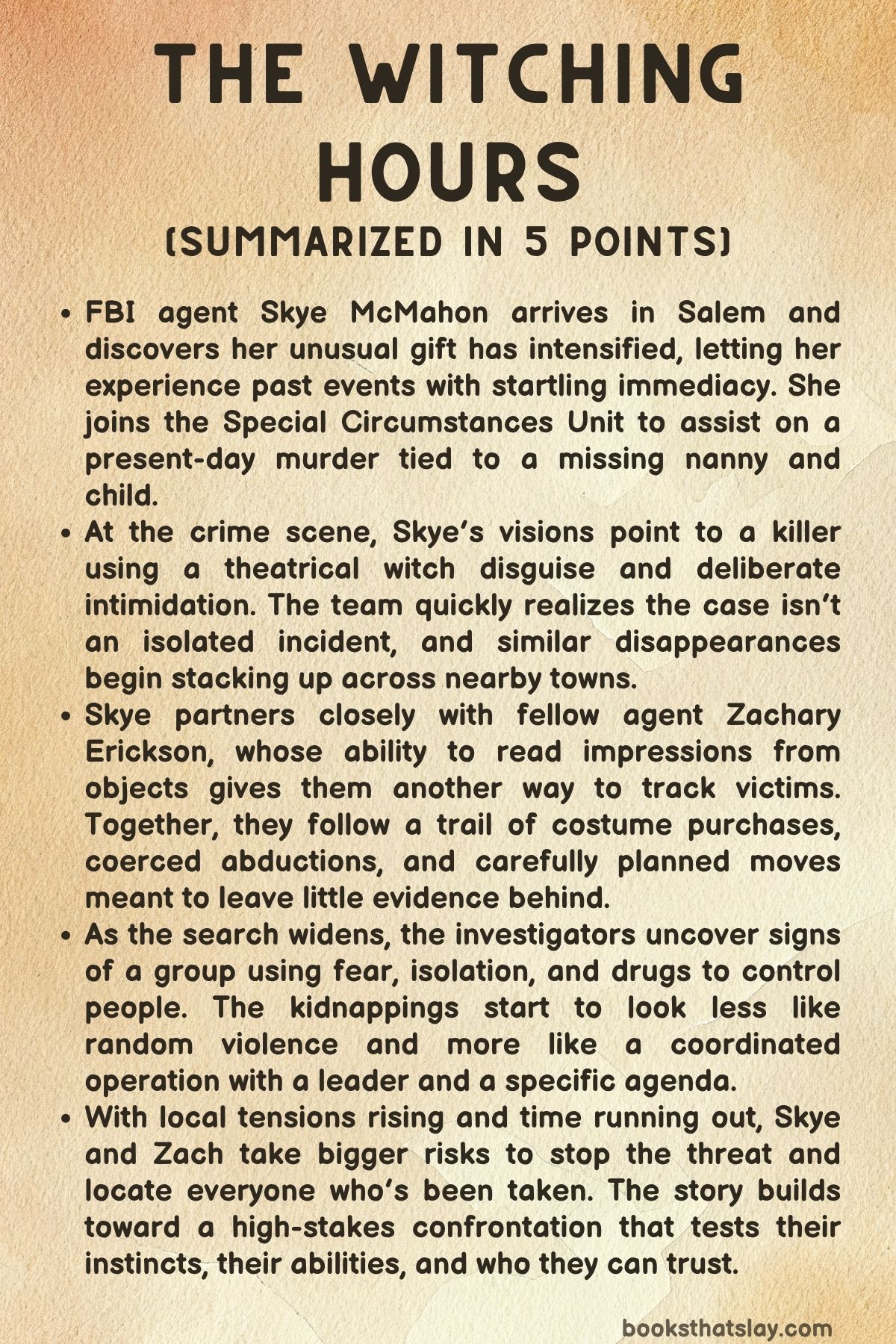
Skye McMahon arrives in Salem with Jackson Crow and Angela Hawkins, agents from the FBI’s Special Circumstances Unit. Skye’s ability is unusual even among their team: when she’s near certain places or scenes, she can see the past as if it’s happening around her.
Standing near Proctor’s Ledge, she experiences a vision of the 1692 executions so vivid it becomes physical—sound, emotion, and terror pressing in on her—before Jackson calls her back to the present.
They’re in town for a current crime, not history. An elderly man named Mike Bolton has been found dead in a carriage house behind the Bolton family’s historic home.
At the same time, the family nanny, Patricia Yale, and five-year-old Jeremy Bolton have vanished. The infant, Lily Marie, was left behind crying in her playpen.
The medical examiner has ruled Mike’s death a homicide: he suffered a heart attack triggered by cocaine ingestion, despite no known history of drug use. The case quickly draws federal attention because it looks staged, controlled, and connected to a kidnapping.
At the Bolton home, Skye meets Zachary Erickson, a Boston-based FBI agent who can sometimes pick up impressions by touching objects connected to a person or event. Zach has already begun working with Salem police, including Lieutenant Gavin Bruns and detectives Connie Berkley and Vince Cason.
Skye goes to the carriage house bedroom where Mike died and forces herself to focus. Her vision shows a killer entering while Mike sleeps—someone dressed in a classic storybook-style “wicked witch” outfit, face painted green, tall hat, dark cloak.
The attacker smothers Mike, forces something into his mouth, and leaves him to die.
Skye’s next vision shifts to the kidnapping itself. Patricia is inside the Bolton house with Jeremy and the baby when a doorbell rings.
She opens the door and reacts as if she recognizes the costume or finds it ridiculous—until the “witch” produces a gun. The kidnapper threatens the baby’s life to force compliance.
Patricia gathers Jeremy, tries to reassure the infant, and goes outside with the armed stranger. Skye reports that Patricia was coerced and is almost certainly another victim.
With few physical traces, Skye and Zach start thinking like people who know Salem well. They consider how easy it would be to blend into the town’s constant Halloween-and-history tourism scene.
They learn Patricia has a boyfriend, Phineas “Fin” Yarborough, a college student obsessed with Salem history. When questioned, Fin is shaken and protective of Patricia, but his story holds together.
He mentions he recently wrote an article comparing the witch trials to modern gullibility, and worries it angered someone. Skye and Zach leave unconvinced he’s involved, and they plan to verify his movements through his car’s GPS.
Before they can settle on a focused suspect list, the case expands. Another woman and child disappear from a costume shop in nearby Swampscott: the owner’s wife, Jane Howell, and their six-year-old daughter, Sophie.
The shop sells the same style of witch costume and green body makeup. Records show someone recently bought green makeup and a matching outfit using cash.
There are no security cameras, and the abduction appears calm and efficient. Skye’s vision confirms that a single armed person in green makeup forced Jane to comply, made her put on a cape, and took another cape from the racks—an extra layer of concealment meant to confuse witnesses and any nearby cameras.
A task force meeting forms around the growing pattern: an armed kidnapper using a green “witch” disguise, targeting women and children, and moving quickly. Zach quietly keeps a stuffed zebra toy from the costume shop so he can try to read Sophie’s situation later.
When he does, he senses darkness, night sounds, and the smell of trees and grass—suggesting the captives are being held or moved through wooded areas. Skye is wary of relying on impressions alone, but the lack of traffic-camera hits for a green-faced suspect makes the woods feel like the best path forward.
Skye and Zach return to the Bolton property and hike into the forest behind it. They spot subtle signs of recent movement: broken branches, disturbed leaves, a route that looks chosen by someone who knows how to avoid attention.
Zach’s impressions suggest the women are trying to keep the children calm, and he repeatedly hears the word “master” as if it’s being used as a title. He also senses preaching—warnings about darkness and evil—like someone is mimicking old Puritan language to frighten and control.
Skye tries her own ability along the trail and catches flickers of the abducted group moving through the trees. Near a stream, her vision jumps and then sharpens into something crucial: there are two “witches,” not one—two green-faced figures in similar costumes.
The discovery changes everything. It explains how the kidnappers can manage multiple abductions and control several victims at once.
Skye and Zach find a small toy in the brush that likely belongs to Jeremy, and later an abandoned cabin that appears recently used as a temporary stop with supplies. They take these findings back to Lieutenant Bruns, who agrees to widen the search with additional officers and rangers.
As pressure rises, another thread snaps into place. The police reconsider a “runaway” case from two weeks earlier: teens Allie Mason and Beau Carter vanished after a dance in Saugus.
Witnesses saw them get into a dark sedan, suggesting persuasion before force. When Zach holds Allie’s hairbrush, he sees her tied to a large oak in the woods, terrified.
In the same impression, he hears a child crying and senses Patricia nearby, proving the cases are connected and that multiple victims are being held together.
Using Beau’s shirt, Zach senses a different kind of manipulation. Beau and Allie thought they were being offered a way to stay together, perhaps tied to Beau’s athletic future.
Instead, they were pulled into captivity where men and women are separated, victims are drugged, and some people begin repeating the “master’s” beliefs. The team starts thinking less like this is a lone criminal kidnapping for ransom and more like a controlled operation building a compliant group through fear, substances, and isolation.
To spot recruitment in action, Bruns suggests an undercover move. Skye and Zach pose as tourists on a Salem ghost trolley tour.
During the tour, they watch the guide, Nick Sandoval, focus intensely on teenage girls and a woman traveling with a young boy. Their instincts flare when the driver suddenly acts as if he’s having a heart attack and crashes the trolley in a remote area with poor cell service.
In the panic, Nick grabs one teen, Cathy, and runs into the forest.
Skye pursues them through near-total darkness and confronts Nick as Cathy weakens, clearly drugged. Nick insists he’s “saving” her and talks about “the way” and “the master.” Skye draws her weapon and orders him to stop.
Zach arrives in time to help secure Nick and the fake driver. Cathy is rushed to the hospital, and the drugs involved appear consistent with a tactic meant to disorient and create dependency.
Skye later realizes, through a vision, that the real driver was attacked and replaced earlier—proof the kidnappers plan operations in advance and have the resources to stage them.
Nick is interrogated but spirals into fanatic talk, claiming Salem is full of evil and that he serves the “master.” He implies Mike Bolton was killed because he might have interfered. Meanwhile, Cathy’s story adds another missing person: Bella Dunn, an older sister who left rehab and never returned.
The investigators begin checking local treatment centers and learn that at least one patient escaped and others may have been lured away while vulnerable.
Then the case takes a sharp, dangerous turn: Detective Connie Berkley goes missing. Soon after, Skye spots Berkley running into the woods near a roadside café.
Skye follows and finds Berkley held at knifepoint by another green-faced “witch.” Skye keeps him talking long enough for Zach to strike from behind and help subdue him. Berkley is barely coherent and insists the café coffee mattered—hinting she may have been drugged as well.
Inside the café, they find the staff collapsed, one stabbed and another near death, confirming the operation’s reach and brutality. The captured “witch” refuses his real identity at first and calls himself “Beelzebub,” speaking like a devoted follower.
Eventually, he’s identified as David Harrison, someone connected to Bella’s rehab circle. David claims he delivered Bella to the “master,” says only the master carries the assault rifle, and repeats that meetings happen in the woods.
Berkley’s hospital account raises a chilling possibility: she ditched her phone because she feared someone in law enforcement was involved. With that warning in mind, Skye and Zach search for a distinctive clearing David mentioned.
While Zach follows a lead about a child who supposedly escaped, Skye stays behind and uses her gift. Her vision reveals the truth behind the costume: Detective Vince Cason is the one under the disguise.
Skye tries to warn Zach, but service drops. She soon finds Officer Ben Chambers and Jeremy Bolton tied to a tree.
She frees Jeremy, urging him to run, but Cason reappears in full disguise with an assault rifle. He forces Skye to disarm and ties her to Ben, bragging about using hostages and brainwashed followers for a larger goal: stealing advanced security access technology from a local firm developing military-grade systems, even discussing biometric hurdles in cold, practical terms.
Zach realizes the “escaped child” call was staged when he finds the homeowner bound and the scene planted. He tracks the trap back to Skye, confronts Cason, and a firefight erupts.
Skye and Ben manage to cut themselves partially free and drop low as shots tear through the clearing. Zach hits Cason in the shoulder, keeping him alive long enough to force answers.
Under pressure, Cason reveals where the captives are hidden: tunnels beneath an abandoned store near the café.
Law enforcement floods the area. The missing women, children, and other abducted victims—some frightened, some drugged, some repeating the master’s lines—are pulled from the underground space.
Medical teams triage injuries and withdrawal symptoms. Investigators begin sorting who was taken, who was coerced into assisting, and how the network recruited people from vulnerable places like rehab and exploited Salem’s tourist atmosphere as camouflage.
With the immediate danger ended, Skye and Zach spend a brief, quieter stretch in Salem, letting the tension release. Lieutenant Bruns, shaken by how close the town came to something worse, decides to pursue further training with their organization.
Skye and Zach leave together, their partnership no longer just professional, knowing the unit will call them again when the next impossible case arrives.
Characters
Skye McMahon
Skye McMahon is the emotional and investigative engine of The Witching Hours. As an FBI agent whose psychic gift replays the past with unnerving clarity, she carries a lifetime of tension between wanting to be purely rational and knowing that her “visions” routinely outperform conventional evidence.
What changes for her in Salem is intensity: the past isn’t only seen, it is physically felt, and that sensory overload makes the case personal in a way she can’t compartmentalize. Skye’s strength is disciplined empathy—she can sit in a murder scene and force herself into the terror of the victim without letting it paralyze her—yet that same openness makes her vulnerable to emotional spillover, childhood memories, and the surrounding hysteria Salem symbolizes.
Across the investigation she proves she isn’t merely “the psychic”; she’s a competent agent who synthesizes impressions into actionable leads, pushes back when people dismiss victims like Patricia, and repeatedly chooses courage when she’s isolated, outgunned, or unsure whether her perceptions will be believed. Her arc also includes intimacy and trust: she begins as an outsider recruited for her talent, but by the end she’s integrated into a partnership where she can rely on Zach in the field and allow herself to be vulnerable without losing professional control.
Zachary Erickson
Zachary Erickson functions as Skye’s mirror and stabilizer, bringing a different paranormal channel—psychometry—that is quieter, object-based, and often more strategically usable. Where Skye’s visions can be explosive and disorienting, Zach’s impressions are incremental, interpretive, and tied to tactile evidence, which helps bridge the gap between the supernatural and what law enforcement can justify operationally.
He is methodical without being cold; his gift tends to arrive through sensory fragments that resemble a victim’s lived reality, and he treats those fragments with respect, using them to keep urgency grounded rather than sensational. Zach’s personality reads as steady competence: he’s careful with people, practical about verification such as car GPS, receipts, and timelines, and willing to take interpersonal risks—such as manipulating suspects’ fear of “the master”—when it may save lives.
His relationship with Skye evolves naturally through shared exhaustion, trust under pressure, and a mutual recognition that each of them carries a burden others can’t fully understand. By the climax he embodies the ideal partner for this kind of case: willing to enter darkness both literal and psychological, while still thinking like an agent who needs proof, containment, and a path to rescue.
Jackson Crow
Jackson Crow is the institutional backbone of the Special Circumstances Unit, and his presence establishes the team’s competence and credibility even when he’s not on the page for long stretches. He is portrayed as calm, directive, and confident in unusual methods, which is crucial because the case requires federal authority and paranormal willingness to exist in the same sentence.
Jackson’s leadership style is pragmatic: he recruits Skye not to validate her gift as a novelty, but because he understands it as a tactical advantage that can shorten the timeline between disappearance and recovery. Even when he is called away to another assignment, his earlier framing shapes the investigation—Skye and Zach operate with the clarity that they have permission to treat the supernatural seriously, but never at the expense of procedure.
Jackson represents the unit’s quiet ethos: believe what works, protect the vulnerable, and keep moving before the trail goes cold.
Angela Crow
Angela Crow plays a reinforcing role that matters more than it looks at first glance: she helps normalize the abnormal. She is competent, composed, and aligned with Jackson’s approach, which signals to Skye that she isn’t being exploited or treated like an oddity; she is being treated like a professional whose abilities are part of a larger toolkit.
Angela also functions as connective tissue—someone Skye can contact for reinforcements and alignment when the case expands—and her presence anchors the idea that the unit is built on trust, partnership, and shared load, not lone-wolf mysticism. Even with limited scenes, Angela adds texture to the Krewe dynamic by embodying stable teamwork, particularly important when local detectives resent federal involvement and the case begins to resemble a roaming, cult-like predator network rather than a single kidnapping.
Lieutenant Gavin Bruns
Gavin Bruns begins as the local authority figure forced into uneasy collaboration, but becomes one of the story’s clearest examples of growth. Initially he operates within the normal instincts of a police lieutenant—contain panic, rely on standard evidence, manage pride and jurisdiction—but the escalating pattern of abductions and the eerie precision of the perpetrators push him toward adaptability.
Gavin’s value is that he listens when it counts: once Skye and Zach present tangible signs from the woods, he mobilizes resources and treats the case as the widening conspiracy it is. He is also emotionally invested in his people; Berkley’s disappearance hits him hard, and his urgency becomes protective rather than bureaucratic.
By the end, his decision to join the academy signals a personal reckoning—he has seen how unusual evil can be, and he chooses expansion over denial. Gavin’s arc therefore mirrors the book’s broader theme: fear and certainty can make institutions brittle, but humility and learning make them resilient.
Detective Constance “Connie” Berkley
Connie Berkley is framed as skeptical, combative, and increasingly resentful of federal presence, yet the story uses her to explore how fear can distort judgment even in professionals. Early on, her posture toward Patricia implies the familiar investigative bias of the “easy suspect,” and her defensiveness reads as territorial rather than purely logical.
When she becomes a target herself, her worldview fractures: she experiences disorientation, paranoia, and drugging, and her subsequent statements about not being able to tell one witch from another capture the perpetrators’ strategy—overwhelm perception until reality becomes unreliable. Berkley’s insistence that she suspected someone in the department might be involved is not only plot-relevant; it reveals an anxious intelligence beneath her abrasiveness, an instinct that something about the operation has insider skill.
She ends up embodying the cost of this case on law enforcement: even the armed, trained investigator can be reduced to a frightened witness when confronted with cult tactics, sensory manipulation, and the humiliation of being hunted.
Detective Vincent “Vince” Cason
Vince Cason is the story’s most chilling human face of calculated corruption in The Witching Hours because he weaponizes legitimacy. As a detective, he understands investigative rhythms, search patterns, jurisdictional blind spots, and how quickly confusion becomes a shield.
His use of the witch disguise is more than theatrics; it is operational camouflage in a town primed for costumes, making violence blend into local culture and turning folklore into cover. Cason’s psychology is opportunistic rather than mystical—he performs the rhetoric of “the master” because it controls followers, not because he believes it—and his willingness to use hostages, firearms, and threats against children reveals a predatory pragmatism.
He also represents the story’s critique of power: the scariest villain is not the supernatural, but the person who knows the system intimately and chooses to exploit it. His eventual exposure through Skye’s vision feels thematically inevitable, because a man hiding behind masks is undone by a woman who can see through time and performance.
Patricia Yale
Patricia Yale is one of the narrative’s moral anchors because she represents ordinary goodness under extraordinary coercion. She is introduced as a missing nanny, which could easily make her a suspect in a lesser story, but Skye’s vision immediately reframes her as protective and terrified rather than complicit.
Patricia’s defining trait is caretaking under threat: even when a gun is pointed at her and the baby is used as leverage, she stays focused on minimizing trauma, keeping Jeremy quiet, and obeying only as a strategy to keep him alive. Later impressions and visions show her crying privately while still maintaining calm outwardly, which captures the psychological burden of hostage survival—she must cooperate enough to prevent violence while resisting internal collapse.
Patricia also becomes a human counterpoint to the cult’s ideology: where the captors talk about masters and salvation, Patricia’s “faith,” if it can be called that, is faith in the child’s survival and in small, practical acts of comfort.
Jeremy Bolton
Jeremy Bolton is not only a victim; he is also a crucial sensory conduit for the investigation, because the agents’ abilities repeatedly connect to the child’s fear, confusion, and repeated references to authority figures. As a five-year-old, Jeremy processes captivity in fragments—darkness, commands, the word “master,” separation from safety—and those fragments become clues that the operation is structured like indoctrination rather than simple ransom.
His significance is heightened by the villains’ strategy: children are used as leverage to control adults, meaning Jeremy is both precious and instrumental to the captors, which increases risk and urgency. When Jeremy is finally found tied to a tree, his presence crystallizes the cruelty of the perpetrators and also becomes a pivot point for Skye’s courage; freeing him is both rescue and proof that the conspiracy has moved into overtly tactical hostage-taking.
Lily Marie Bolton
Lily Marie Bolton, though an infant with no agency, carries symbolic weight because her vulnerability sharpens the moral stakes and exposes the kidnappers’ manipulation. The baby is left behind crying, which functions as both evidence of the abductors’ priorities and a psychological weapon against Patricia, who is threatened with Lily’s death if she resists.
Lily’s survival underscores that the crime isn’t random slaughter; it is control. Her presence also keeps the Bolton family’s grief immediate and tangible, turning the investigation from an abstract pattern into a constant reminder that the victims include those who cannot understand what is happening to them.
Mike Bolton
Mike Bolton’s death is the case’s spark, and the manner of his murder reveals the perpetrators’ blend of theatricality and calculated cruelty. He is killed not with a straightforward weapon but through forced ingestion of cocaine to trigger a heart attack, which suggests someone who wants death to look medically ambiguous while still guaranteeing it.
Mike’s role in the living arrangement—elderly resident in the carriage house behind a prominent family home—also makes him a practical obstacle: he is close enough to notice unusual activity and could have interfered. In that sense, Mike is less a personal target than a tactical problem eliminated, and his murder sets the pattern of the villains’ approach: disguise, intimidation, and an obsession with controlling what others can see and prove.
Alicia Bolton
Alicia Bolton is portrayed as the shock-stricken witness and mother thrust into crisis, and her role emphasizes the story’s focus on aftermath as well as action. She discovers Mike’s body and then returns to a home where her child and nanny are gone, a sequence designed to maximize helplessness.
Alicia’s significance is that she represents the normal world being violated: wealth, stability, and domestic routine do not protect her, and her family’s status cannot buy immediate answers. Though she does not drive the investigation, her perspective supplies the emotional reality behind the procedural work, reminding the reader that every clue is attached to a household that has been shattered.
Keith Howell
Keith Howell is positioned as the anxious spouse and business owner whose credibility becomes a small battleground between dismissive assumptions and genuine threat. When he finds his costume shop open and his wife and daughter missing, the initial tendency of others is to minimize it as miscommunication, but his insistence—and Zach and Skye’s willingness to believe him—pushes the case toward recognizing a pattern.
Keith’s detail-oriented contribution is also practical: receipts, inventory, and knowledge of what costumes and makeup are available become investigative leverage. He embodies the everyday man confronting horror he cannot rationalize, and his cooperation shows how civilian information becomes critical when crimes are designed to hide inside “normal” local behavior like tourist shopping and costume culture.
Jane Howell
Jane Howell represents protective motherhood under coercion, paralleling Patricia but with a distinct emotional texture: she actively reframes terror as “adventure” for Sophie to keep her calm. That coping strategy is both heartbreaking and psychologically astute; Jane understands that panic will make her child harder to control and more likely to be harmed, so she performs calm as a survival tactic.
Jane’s forced participation in disguising herself with a cape also highlights the villains’ operational intelligence—they aren’t only abducting, they are managing optics, using clothing to defeat cameras and witnesses. Jane therefore becomes an example of how the captors’ planning turns victims into unwilling accessories, increasing shame and confusion while still relying on the victim’s love for their child to ensure compliance.
Sophie Howell
Sophie Howell functions as both victim and vital “signal,” because Zach’s impressions from her belongings provide some of the earliest sensory confirmation that the captives are alive, outdoors, and being moved through darkness. As a six-year-old, Sophie’s fear is vivid and simple—night sounds, insects, the smell of trees—details that become investigative coordinates.
She also reveals the kidnappers’ method of control: children are kept frightened but unharmed enough to remain leverage, which creates a cruel equilibrium that maximizes obedience. Sophie’s presence intensifies the urgency and also underscores the psychological violence of captivity; even without physical injury, the deliberate staging of terror is its own form of harm.
Phineas “Fin” Yarborough
Fin Yarborough is designed as a plausible early suspect, and the story uses him to explore how Salem’s cultural history can attract people who become collateral damage in hysteria—both literal and investigative. As Patricia’s boyfriend and a history-obsessed student who has written provocatively about gullibility and witch-trial thinking, he fits the profile that fearful communities often seize upon: the intense young man with ideas.
Yet his grief reads as authentic, and his most important narrative function is to show how easily intellectual fascination can be misread as motive. Fin also indirectly reinforces the theme of modern hysteria; just as Salem once accused people based on social discomfort, the present-day case risks accusing the “wrong kind” of person because the setting primes everyone to see villains in the familiar shapes of obsession and spectacle.
Professor Isaac Stanley
Professor Isaac Stanley embodies the fine line between performance and fanaticism. As a dramatic history professor with an interest in fear and social hysteria, he looks, on paper, like exactly the kind of charismatic figure who could seed a cult in a town like Salem.
His dinner conversation and self-presentation, however, frame him as someone who uses theatrics as pedagogy rather than manipulation, making him a deliberate red herring that tests the investigators’ discipline. Stanley’s role sharpens the book’s central anxiety: in a place saturated with stories about evil and belief, how do you distinguish the educator, the entertainer, the tourist, and the predator?
Even if he is not the mastermind, he contributes by pointing toward the ecosystem of students and locals who might be unusually fixated, reinforcing that obsession with Salem can be harmless scholarship—or a doorway for someone more dangerous.
Nick Sandoval
Nick Sandoval is the recruitment face of the cult operation, and he is frightening precisely because he appears normal, friendly, and helpful. As a ghost-tour guide, he occupies a trusted position in a tourism machine built on manufactured fear, making him an ideal predator in plain sight.
Nick’s method is seduction before force: attention to teenagers, whispered promises of belonging, pills offered as a social gateway, and the suggestion that he can deliver a better life through “the way.” When the trolley incident turns staged chaos into an abduction attempt, Nick’s impatience and entitlement emerge, revealing that his spiritual language is a sales pitch backed by violence. He represents how cults can function like criminal networks with a customer-acquisition strategy, and his capture provides the investigators with proof that the kidnappings are coordinated rather than coincidental.
Cathy
Cathy’s experience illustrates the predators’ grooming pipeline in miniature. She is targeted through a mix of attention, peer-pressure-adjacent temptation, and chemical impairment, which reduces resistance and scrambles memory.
Her collapse and hospitalization show the physical stakes of the operation—this is not just ideology, it is pharmacological control—while her testimony provides a grounded account that complements Skye and Zach’s paranormal information. Cathy also reveals a crucial truth about victimhood in this kind of crime: at the beginning, compliance can look like choice, especially to outsiders, but choice is rapidly replaced by coercion once the target is isolated, drugged, and frightened.
Sheryl Dunn
Sheryl Dunn appears as part of the widening ripple effect, representing the ordinary family suddenly realizing their loved one is part of a bigger pattern. Her importance lies less in direct action and more in what her connections uncover: the rehab thread and the fact that disappearances can be misfiled as personal failure or relapse rather than abduction.
Through Sheryl’s family reaching outward, the narrative shows how these crimes thrive on misclassification—authorities and communities assume “runaway,” “addict,” or “unstable” before they assume “taken.”
Bella Dunn
Bella Dunn embodies vulnerability exploited, a person whose history with addiction makes her disappearance easier for institutions to dismiss and easier for predators to absorb into a coercive structure. The fact that she walked away from rehab after claiming she felt great hints at manipulation—chemical, ideological, or both—suggesting she may have been “converted” rather than simply abducted at gunpoint.
Bella’s character function is to expose the cruelty of targeting people society already treats as disposable; her absence expands the case beyond children and respectable households, showing that the same network preys on those least likely to trigger immediate urgency.
Allie Mason
Allie Mason brings the theme of adolescent longing and vulnerability into the novel. Her disappearance initially carries the social stigma of “maybe she ran off,” especially given conflict with her parents, which mirrors how quickly communities default to moral narratives rather than investigating predation.
Zach’s vision of her tied to a tree strips away any ambiguity: whatever choice she might have made early on is irrelevant once she is restrained, terrified, and isolated. Allie’s wealth and family panic also contrast sharply with other victims’ situations, illustrating that the cult operation crosses class lines, selecting targets based on opportunity and psychological leverage rather than a single demographic.
Emilia Mason
Emilia Mason represents parental fear mixed with social control. Her attempt to forbid Allie’s relationship and the memory of Allie threatening to run away show a family dynamic where love is present but expressed through restriction, which can unintentionally increase a teen’s susceptibility to outsiders offering acceptance.
Emilia’s most important role is informational—she remembers the watcher at the football game—but emotionally she illustrates how parents reinterpret every conflict as a possible warning sign once a child is gone, turning ordinary family tension into lifelong guilt.
Theo Mason
Theo Mason functions as the other half of the Mason family’s anxious portrait, embodying a pragmatic desperation that wants answers fast and wants the system to work. He participates in the painful honesty about their household rules and Allie’s threats, which helps the investigators reconstruct the “went willingly at first” phase that predators often exploit.
Theo’s presence emphasizes how abductions destabilize family identity: parents who believed they were protecting their child must now confront the possibility that their protection strategies helped push her toward risk.
Beau Carter
Beau Carter is central to the story’s exploration of temptation and coercion because he is targeted through aspiration. As an athlete with attention from scouts, Beau is approached with promises that sound like a solution to his obstacles—housing, scholarship pathways, a future with Allie—making him susceptible to a pitch disguised as opportunity.
Zach’s impressions reveal the emotional cruelty of the cult structure: Beau is separated from Allie, placed among broken adults, and kept under a hierarchy that frames obedience as gratitude for “saving.” Beau’s character illustrates how predators exploit a young person’s hope, then weaponize shame and fear to keep him compliant.
Artie Carter
Artie Carter represents grounded protectiveness, a parent without the Masons’ wealth but with deep belief in his child’s character. His family’s modest home and the mention of scouts create a portrait of a household where Beau’s future is precious and hard-won, making the abduction not only terrifying but also existentially unfair.
Artie’s role shows how crime impacts families differently depending on resources, and how credibility in the eyes of institutions can be uneven—yet the pain is the same.
Sybil Carter
Sybil Carter’s contribution is both practical and emotional. By providing Beau’s unwashed T-shirt, she enables Zach’s most revealing impressions about recruitment, separation, and indoctrination, turning maternal care into investigative leverage.
Emotionally, she reflects a parent’s helplessness when the last physical traces of a child become evidence rather than comfort. Sybil embodies the quiet devastation of waiting, the kind that doesn’t dramatize itself but sits in every object left behind.
Captain Claybourne
Captain Claybourne represents institutional strain—a commander trying to keep control as the case expands from local tragedy to multi-jurisdictional conspiracy. His frustration is not simple arrogance; it is the pressure of public safety, missing officers, and the fear that his department may be compromised.
Claybourne’s willingness to grant access to the captured suspect after Skye and Zach save Berkley also indicates a shift from resistance to cooperation, suggesting a leader who can recalibrate when facts demand it. He symbolizes how institutions respond to escalating chaos: anger, defensiveness, then reluctant alignment once the threat becomes undeniable.
Reggie Woodson
Ranger Reggie Woodson functions as a connective clue rather than a fully realized personality, but the mention of his meetings with Berkley and Cason highlights how the wilderness setting is not just atmosphere—it is operational terrain. His involvement points to the forest as a shared jurisdictional space where law enforcement, rangers, and criminals intersect, and it raises the unsettling possibility that legitimate access to the woods can be leveraged by those with authority.
Reggie’s narrative role is to suggest that the investigation’s geography is itself a character: the woods invite secrecy, misdirection, and the kind of disappearances that can be rationalized until too many names accumulate.
Debbie
Debbie, the assistant manager at the costume shop, serves as a small but important realism detail: she anchors the timeline and routine that make Jane and Sophie’s disappearance unmistakably abnormal. By existing as the last known “normal” touchpoint, Debbie helps define the window during which the abduction occurred, reinforcing the perpetrators’ pattern of striking during predictable daily transitions.
She is not a developed character, but she supports the procedural scaffolding that keeps the paranormal investigation tied to time, place, and human habits.
Officer Ben Chambers
Ben Chambers becomes a visceral symbol of hostage strategy. His discovery tied to a tree alongside Jeremy demonstrates how the villains escalate from abduction to tactical entrapment, using law enforcement bodies as leverage and warning.
Ben’s role also magnifies Skye’s bravery: she is forced into a situation where procedure collapses into survival choices, and she must create a sliver of opportunity by slipping him a knife and trusting timing under gunfire. Ben represents the fact that once the conspiracy is exposed, it no longer hides behind folklore—it directly attacks the people trying to stop it.
Charles Durbin
Charles Durbin illustrates a key theme of predation: the use of society’s forgotten. As an escaped court-ordered rehab patient, he reflects a population that can disappear without immediate mobilization, making them attractive targets for recruitment, coercion, or exploitation.
His mention broadens the reader’s understanding of the network’s feeding ground, implying a pipeline from institutions meant to help people into a structure designed to control them.
David Harrison
David Harrison, the captured follower who calls himself “Beelzebub,” is the clearest portrait of indoctrination. Unlike Cason, who performs belief as a tool, David appears to inhabit the cult language as identity: martyrdom, saving, evil in the world, and devotion to an unseen authority.
His inability or unwillingness to identify the master, paired with his certainty that the master is righteous, shows how control systems erase personal judgment and replace it with borrowed certainty. David is terrifying not because he is brilliant, but because he is sincere—he demonstrates how a manipulated person can become a weapon, and how the villains’ real power lies in turning damaged lives into obedient extensions of a larger plan.
Themes
Power, Fear, and Manufactured Hysteria
Salem’s historic memory functions as a ready-made engine for control in The Witching Hours. Skye’s first intense experience at Proctor’s Ledge establishes that terror is not only remembered but transmissible: a crowd’s certainty can feel righteous in the moment, even when it is built on rumor, performance, and the human need to simplify blame.
That same mechanism is repeated in the present-day crimes, where the kidnappers weaponize a familiar symbol—the green-faced “witch”—to trigger instant obedience. The disguise is effective precisely because it bypasses reasoning.
People don’t react to a person; they react to a cultural cue loaded with childhood chants, folklore, and the idea of “evil” as something visible and external. The victims are forced into a role where compliance becomes the only way to protect children, and bystanders become unreliable because fear narrows what they can process.
The story keeps returning to the way institutions and communities can be steered by emotion: local skepticism toward the federal team, initial assumptions that disappearances are misunderstandings or runaways, and the repeated delays caused by ego and resentment. The kidnappers exploit those human and procedural weaknesses, not just the woods and the darkness.
Even the cult language—“master,” sermons about corruption, warnings about darkness—works as a script that converts anxiety into certainty. The theme lands in how easily panic becomes a social system: it gives people an explanation, a villain, and permission to act, while reducing empathy for anyone labeled suspicious.
The result is a modern echo of old Salem logic, where fear is useful to those who know how to stage it.
Identity as Costume and the Performance of Evil
The “witch” disguise is more than concealment; it is a strategy for controlling perception. A costume does two jobs at once: it hides the individual and creates a character that others instantly understand, even if that understanding is inaccurate.
The kidnappers rely on that shortcut. When Patricia opens the door and laughs at the absurdity, the moment flips the second a gun appears—because the costume shifts from silly to monstrous, and the victim’s mind accepts the “character” as capable of anything.
That snap from humor to terror shows how fragile normal perception is when someone forces a new narrative onto a scene. The use of capes adds another layer: the criminals think about cameras, angles, and plausible deniability, treating crime as choreography.
Their victims are also pushed into performance. Jane turns the abduction into an “adventure” for Sophie not because she believes it, but because performance is the only tool she has to regulate a child’s panic.
Skye and Zach perform too, adopting tourist identities to get close to the recruitment pipeline on the trolley. Even law enforcement becomes part of the theme when the reveal of an officer behind the mask reframes the entire investigation: the most frightening “monster” is not supernatural but ordinary, sanctioned, and positioned to shape the story from inside.
The theme presses on a specific discomfort: when evil looks theatrical, people search for theatrical motives. The case reveals something colder—crime that borrows theatrical imagery to distract from practical goals like leverage, trafficking, and theft.
The costume becomes a way to outsource responsibility; followers can claim they serve a role, a mission, a “master,” instead of admitting personal choice. By the end, the narrative suggests that identity is vulnerable in both directions: criminals can hide behind symbols, and victims can be reshaped by repeated scripts, drugs, and isolation until they no longer trust their own interpretation of reality.
Consent, Coercion, and the Fragility of Autonomy
Control is shown as a gradual erosion rather than a single act. Some victims are taken at gunpoint, but others are lured through a softer entry point—promises of belonging, opportunity, romance, or relief from pain.
The teens’ disappearance illustrates how easily “willing” can be misread: leaving with someone who seems helpful is not consent to captivity, yet the initial appearance of choice slows urgency and complicates how others respond. The kidnappers understand that ambiguity is protective.
Once victims are isolated, coercion becomes layered: threats against children, separation of couples, sleep deprivation, sermons, and drugging. The pills offered on the trolley demonstrate how recruitment can look like partying, tourism, or harmless rebellion, until the body is compromised and resistance becomes physically difficult.
The story also explores coercion through caretaking roles. Patricia and Jane are forced into a cruel equation: obey or watch a child suffer.
Their compliance is not weakness; it is a protective instinct being exploited. That dynamic expands into the cult structure, where “broken” adults are used as evidence that the “master” rescues people, turning gratitude and dependency into submission.
The phrase “Beware the devil in the darkness” signals a moral frame imposed on captives—if the outside world is painted as corrupt, escape begins to feel like danger, and captivity begins to feel like safety with rules. The theme becomes even sharper when law enforcement corruption enters: institutional power amplifies coercion because the victim expects protection from that uniform, not manipulation.
Autonomy fails not only under direct threat, but under confusion—poor cell service, unfamiliar terrain, conflicting authorities, and the inability to verify what is true. Against that, Skye and Zach’s paranormal methods highlight a human truth: when victims cannot speak freely, investigators need alternative ways to “hear” them.
The novel treats autonomy as something that must be defended through community vigilance and ethical clarity, because once coercion normalizes—once obedience becomes the condition for survival—it can reshape a person’s decisions until even rescue is met with fear.
Knowing the Past, Living with It, and the Ethics of Seeing
Skye’s ability to experience past events gives the narrative a sustained meditation on what it means to witness suffering—especially suffering that a community has turned into story, tourism, and identity. Her first vision is not a clean historical snapshot; it is sensory overwhelm, layered with crowd emotion and childhood mockery.
That combination matters: the past is not distant when it is embedded in songs, jokes, and public memory that still circulates. Skye’s new capacity to “feel it” suggests an ethical burden: knowledge is not neutral when it arrives with pain attached.
The theme also plays out in the investigative partnership between Skye and Zach. Their abilities can look like shortcuts, but the narrative repeatedly stresses limits and responsibility.
A vision does not replace evidence, and an impression does not justify an accusation. They have to translate what they sense into actions that can save people without turning intuition into authority.
That is especially important when local detectives resent federal involvement or when early suspicion falls on Patricia. The story demonstrates how easy it is to assign guilt to the most convenient figure, and how ethical seeing requires resisting that impulse.
Skye’s visions become acts of advocacy: she clarifies that Patricia is coerced, not complicit, and that there are two disguised offenders, not one. At the same time, the theme confronts the danger of being wrong.
If visions are misread, they can become another form of hysteria—another crowd certainty. The narrative therefore treats paranormal perception as a test of character: the real question is not whether Skye can see, but how she uses what she sees under pressure, fatigue, fear, and attraction to Zach.
Finally, the Salem setting sharpens the point: a place famous for judging “witches” becomes the stage where modern criminals hide behind that label, while the investigators must avoid repeating the town’s oldest mistake—confusing symbols with truth. The theme resolves in a sober idea: the past can inform the present, but only if witnessing leads to restraint, empathy, and careful action rather than spectacle or certainty.