The Rainy Day Bookshop Summary, Characters and Themes
The Rainy Day Bookshop by RaeAnne Thayne is a contemporary family drama and romance centered on second chances, unresolved grief, and the difficult work of rebuilding trust.
Set in the coastal town of Wood Briar, Oregon, the story follows several people whose lives have been shaped by loss, regret, family responsibility, and memories they have struggled to confront. At its center are a mother and daughter trying to repair years of estrangement, alongside two developing romances that challenge long-held fears about love. The bookstore becomes a symbol of renewal as damaged relationships, abandoned dreams, and uncertain futures gradually find new possibilities.
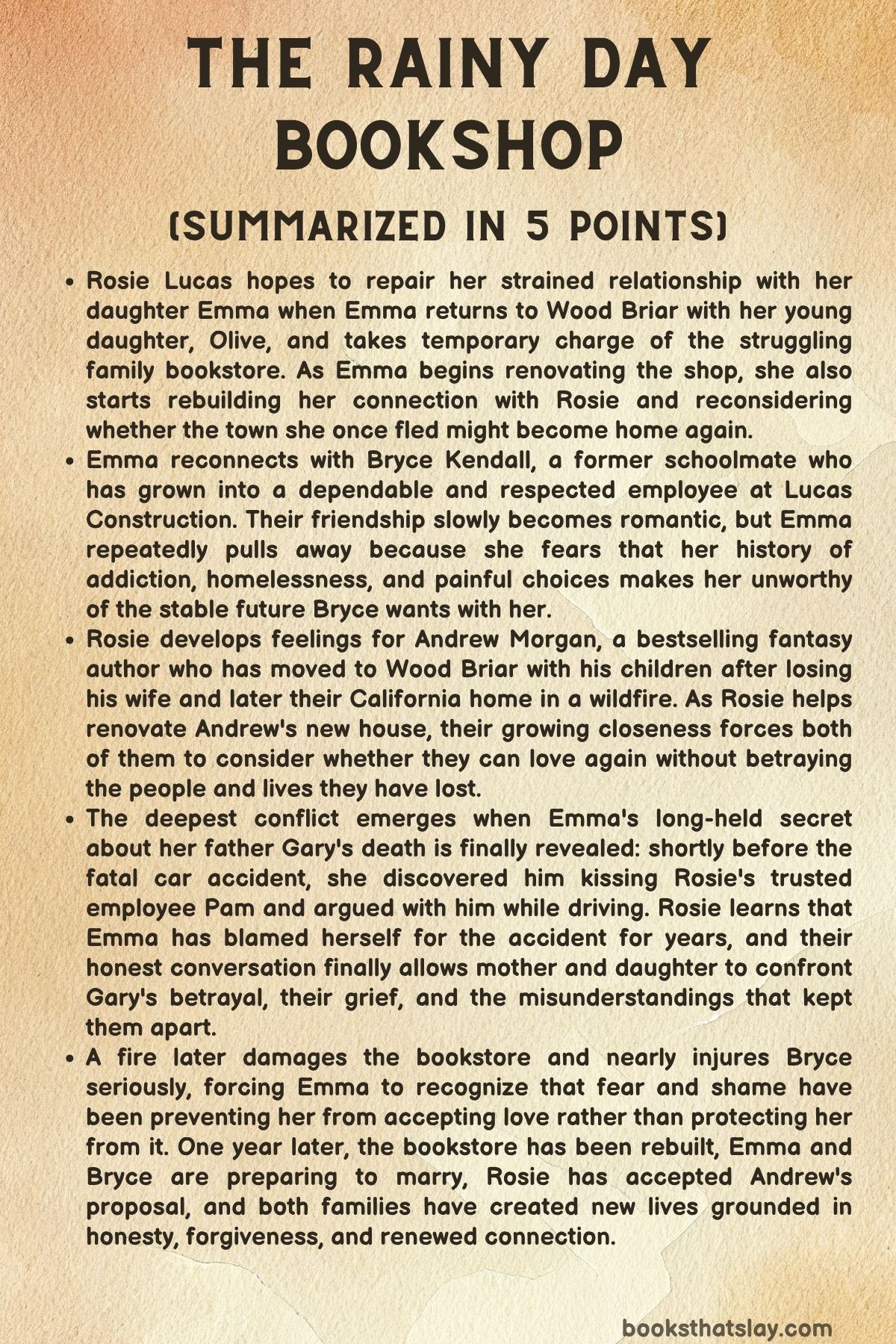
Summary
Rosie Lucas is thrilled when her estranged daughter Emma returns to Wood Briar with her three-year-old daughter, Olive. Their relationship has improved since Olive’s birth, but Rosie remains cautious because years of conflict and Emma’s troubled past have left both women afraid of saying or doing the wrong thing.
Emma has returned partly because Rosie’s mother, Sylvia, has injured her ankle and can no longer properly manage the family bookstore. Emma agrees to take temporary responsibility for the neglected shop, whose crowded shelves, dim interior, and weak finances immediately convince her that major changes are necessary.
The work gives Emma an opportunity to prove that she is no longer the rebellious young woman who left home after her father’s death. She has survived addiction, homelessness, an unhealthy relationship, and years of instability, but she is now sober, educated, fiercely devoted to Olive, and determined to create a dependable future for her daughter.
At the bookstore Emma encounters Bryce Kendall, whom she knew as a teenager. Bryce once appeared to be an unserious student and troublemaker, but adulthood has transformed him into one of the most trusted employees at Lucas Construction, Rosie’s successful family business.
Their reunion unsettles both of them because Bryce secretly carried strong feelings for Emma when they were younger. He remembers trying to stop her from leaving Wood Briar with Kevin, the older man whose influence contributed to the destructive years that followed, while Emma gradually discovers that the man standing before her is much more capable and emotionally mature than the boy she remembers.
Bryce begins helping Emma renovate the bookstore, offering inexpensive construction solutions and encouraging her ideas for a brighter, more community-oriented space. Working together changes their relationship as Emma begins to respect his intelligence, practical creativity, loyalty, and generosity, while Bryce becomes increasingly impressed by the strength required for Emma to rebuild her life.
Both are carrying difficult histories. Bryce grew up managing the consequences of his mother Terri’s alcoholism and instability, and he now continues caring for her as early-onset dementia gradually takes away her independence.
Emma eventually tells Bryce about her addiction and explains that becoming pregnant with Olive forced her to confront her life. She left Kevin, became sober, considered adoption before choosing to raise Olive herself, completed her education, and slowly created the stable existence she had once believed was impossible.
As their emotional trust grows, attraction follows. Several kisses make their feelings impossible to deny, but Emma repeatedly withdraws because she fears romance could destroy the friendship and security she has begun to value.
Running parallel to their relationship is Rosie’s growing connection with Andrew Morgan, a bestselling fantasy novelist who has moved to Wood Briar with his children, Zara and Finn. Andrew’s wife Tracy died from leukemia several years earlier, and the family later lost their California home and neighborhood in a devastating wildfire.
Andrew purchases Stormhaven, an old mansion being renovated by Lucas Construction, without initially realizing its importance to Rosie. Rosie and her late husband Gary once bought the same house as their dream home, but Gary died shortly afterward, forcing Rosie eventually to sell the property while struggling to rescue their construction company.
Rosie becomes Andrew’s project manager and gradually grows close to him and his children. Andrew admires her competence, humor, generosity, and ability to create community, while Rosie is surprised to discover that she can feel powerful romantic attraction after spending a decade emotionally tied to Gary’s memory.
Andrew also carries wounds that extend beyond his wife’s death. As a child, he lost his older brother Will in a drowning accident, after which books became an emotional refuge, and despite enormous commercial success as a novelist, he continues struggling with insecurity about whether his writing deserves respect.
Rosie and Andrew eventually kiss, but both initially agree that a relationship would create too many complications. Andrew has grieving children, an unfinished novel, and a house under renovation, while Rosie is responsible for her mother, daughter, granddaughter, construction company, bookstore, and the demanding process of rebuilding her family.
Meanwhile, Emma begins feeling increasingly at home in Wood Briar. Her relationships with Rosie and Sylvia improve, Olive develops strong bonds with the family, and the bookstore starts becoming not merely a temporary project but something Emma genuinely wants to transform into a thriving center for the community.
Yet one secret continues controlling Emma’s relationship with Rosie. Pam Clarke, Rosie’s trusted office manager at Lucas Construction, has a history with Emma that causes immediate hostility whenever they meet, and Sylvia knows exactly why.
The truth finally emerges during a book-club gathering. Emma reveals that shortly before Gary’s fatal accident, she unexpectedly arrived at Lucas Construction and discovered her father kissing Pam.
Furious that Gary had betrayed Rosie, teenage Emma confronted him, and their argument continued while Emma was driving during a lesson with her father. The car went off the road, Gary was killed, and Emma survived, leaving her convinced for years that her anger and final words to him had somehow caused his death.
Pam’s presence after the accident made the burden even worse. Emma believed revealing the affair would destroy Rosie’s idealized memories of her husband, so she remained silent while privately carrying guilt, grief, anger, and confusion until those emotions contributed to her rebellion and eventual self-destruction.
Rosie is devastated when she learns both that Gary had betrayed her and that Emma had endured the knowledge alone. However, once mother and daughter finally speak honestly, Rosie makes clear that Emma was a frightened teenager and that the crash was an accident rather than punishment for an argument.
Rosie also recognizes her own failure during the years after Gary’s death. Her grief consumed her so completely that she failed to understand how much Emma was suffering, while Emma interpreted her mother’s emotional distance as evidence that Rosie blamed her for the accident.
Their conversation finally breaks the misunderstanding that has separated them for a decade. They acknowledge their anger toward Gary, mourn the past more honestly, and choose to build their relationship around openness rather than silence and fear.
Rosie must then confront Pam, who resigns from Lucas Construction and claims that she and Gary loved one another. The revelation destroys Rosie’s romanticized image of her marriage, but Andrew helps her recognize that Gary’s betrayal does not erase every genuine part of the life they shared and that she cannot blame herself for choices he made without her knowledge.
This new understanding also changes Rosie’s relationship with Andrew. Gary is no longer an untouchable ideal against whom every future relationship must be measured, allowing Rosie to consider Andrew as a real partner rather than someone competing with a perfect memory.
Emma faces a similar emotional barrier with Bryce. Although she realizes she loves him, she convinces herself that her history of addiction, bad decisions, and single motherhood makes her unsuitable for a man she considers loyal, respected, and good.
She also abandons her old ambition of eventually claiming a major position at Lucas Construction because she believes Bryce has earned his place there through years of dedication. Instead of recognizing that a shared future might be possible, she attempts to protect him by insisting they should remain friends.
Everything changes when a fire breaks out at the bookstore. Bryce remains inside too long while trying to contain what appears to be an electrical fire, and Emma arrives terrified that the man she loves might have been killed.
Finding Bryce alive but injured forces Emma to confront the truth behind her resistance. Her problem was never a lack of love but a belief that her past made her undeserving of happiness, and Bryce refuses to accept that judgment of her.
After receiving treatment for smoke inhalation and a burned hand, Bryce tells Emma that he does not want an imaginary woman with an easier past. He loves the woman Emma fought to become, and she finally allows herself to believe that love does not require erasing the difficult parts of her history.
The fire also becomes an unexpected turning point for the family businesses. Although the bookstore’s inventory is destroyed, the building survives, and Emma proposes that Rosie finally rebuild the shop according to the dream she once abandoned.
Rosie realizes she genuinely wants to run the bookstore rather than continue carrying every responsibility at Lucas Construction. Emma and Bryce, whose abilities and interests naturally suit construction work, can take larger roles in managing the company together.
A year later, the results of these decisions are visible throughout the family. The bookstore has been rebuilt into a bright, welcoming community space, Rosie loves running it, and Emma and Bryce have established a successful professional partnership at Lucas Construction.
Emma and Bryce are preparing to marry beside the Pacific, with Olive delighted to welcome Bryce as her stepfather. Emma’s closeness with Rosie has been restored, and the family can remember Gary without either idealizing him or allowing the circumstances of his death to control their lives.
Andrew’s children have also become part of this extended family, while Stormhaven has finally become the warm home he hoped to create after years of loss and instability. Andrew’s writing career continues successfully, but his personal life now matters just as much as his professional achievements.
Before Emma and Bryce’s wedding ceremony, Rosie finally answers Andrew’s earlier proposal. She accepts, choosing a future with Andrew, Zara, and Finn and allowing herself to build a new family without treating new love as a betrayal of the life she once shared with Gary.
Characters
Rosie Lucas
Rosie is one of the emotional anchors of The Rainy Day Bookshop, a woman whose apparent strength has been built through years of responsibility, bereavement, and survival. After Gary’s death, she saves Lucas Construction because its survival affects not only her family but also the employees who depend on it, revealing a powerful sense of obligation that often causes her to place everyone else’s needs before her own.
Her greatest vulnerability concerns Emma. Rosie desperately wants her daughter back but understands that affection alone cannot repair years of estrangement, so much of her development involves learning to give Emma room rather than attempting to control the reconciliation out of fear.
Rosie’s grief has also preserved an idealized version of Gary. Discovering his involvement with Pam damages that memory, yet the truth eventually becomes liberating because Rosie no longer has to measure her future against an unrealistically perfect image of her late husband.
Her relationship with Andrew marks her gradual return to emotional risk. Rosie learns that loving someone new does not erase her history with Gary, and her decision to accept Andrew’s proposal represents a willingness to build a future based on present truth rather than loyalty to an unchangeable past.
Emma Lucas
Emma undergoes the most substantial personal transformation in The Rainy Day Bookshop, although much of that transformation began before she returned to Wood Briar. She arrives as a sober single mother who has already survived addiction, homelessness, a destructive relationship, and the immense difficulty of rebuilding her life while raising Olive.
Her independence is both a strength and a defense mechanism. Emma has spent so long depending primarily on herself that accepting help from Rosie, Bryce, or anyone else can feel dangerous because trust carries the possibility of disappointment, judgment, and abandonment.
The secret surrounding Gary’s death explains much of her emotional behavior. Emma has spent years believing that her anger contributed to the accident, while simultaneously resenting her father for betraying Rosie, leaving her unable to mourn him honestly or forgive herself.
Her relationship with Bryce directly challenges her shame. Emma initially assumes that her past makes her unworthy of someone she considers good, but Bryce sees recovery, courage, intelligence, devotion, and persistence where Emma sees permanent damage.
Motherhood provides Emma with both motivation and emotional clarity. Her desire to give Olive a secure childhood gradually helps her recognize that Wood Briar can offer stability without forcing Emma to become the teenager she once was, allowing her eventually to reclaim family, career, community, and romantic love on her own terms.
Bryce Kendall
Bryce initially appears through Emma’s memories as the struggling boy who never seemed particularly serious about school, but adulthood reveals how misleading that impression was. His intelligence is practical, inventive, and deeply connected to observation, craftsmanship, problem-solving, and the ability to understand how physical spaces can be improved.
His difficult childhood explains both his insecurities and his extraordinary dependability. Growing up with Terri’s alcoholism forced Bryce to assume adult responsibilities early, and her later dementia continues the pattern of caregiving that has shaped much of his personal life.
Rosie’s faith in Bryce becomes essential to his identity because she recognizes his potential when others might have dismissed him. His loyalty to Lucas Construction therefore comes from gratitude as much as ambition, making his eventual leadership role feel earned rather than inherited.
His love for Emma is patient but not passive. Bryce is willing to challenge her false belief that she is defined by addiction and past mistakes, yet he repeatedly restrains himself when he senses that emotional pressure would make her retreat.
His growing affection for Olive is equally significant. Bryce does not view Olive as an obstacle attached to Emma’s complicated life; instead, he naturally begins imagining Emma and her daughter as one family he wants to protect and join.
Andrew Morgan
Andrew is outwardly successful but privately insecure, creating an important contrast between public achievement and private self-doubt. He is a bestselling fantasy writer with a large readership and film adaptations, yet dismissive comments from literary authority figures have left him uncertain about whether his commercial success proves genuine artistic ability.
Loss has shaped his emotional world from childhood onward. The drowning death of his brother Will first made books a refuge, while Tracy’s death and the later wildfire reinforced Andrew’s fear that security can disappear without warning.
His strongest concern is therefore the stability of Zara and Finn. Andrew does not resist a relationship with Rosie because he lacks feeling but because his children have already endured several disruptive losses, making him reluctant to introduce another uncertain attachment into their lives.
Rosie appeals to him because she represents warmth without sentimentality and competence without emotional coldness. She understands responsibility, bereavement, family complication, and the restorative power of books, giving Andrew a form of companionship that feels both intellectually and emotionally natural.
Olive
Olive represents possibility because she belongs to a generation not personally burdened by the conflict surrounding Gary’s death. Her presence encourages Rosie and Emma to imagine their family as something that can continue rather than something permanently defined by tragedy.
She is also central to Emma’s recovery story. Pregnancy forces Emma to reconsider the direction of her life, and raising Olive gives her a concrete reason to seek sobriety, education, stability, and stronger family connections.
Olive’s easy affection for Bryce helps reveal qualities Emma is afraid to acknowledge. His natural patience with her demonstrates that a future relationship would not require Emma to divide her identity between motherhood and romantic love.
Sylvia
Sylvia combines stubbornness, loyalty, directness, and emotional insight. Her determination to continue working despite her injured ankle reflects the same attachment to independence that appears in Rosie and Emma, suggesting that self-reliance is a deeply rooted family characteristic.
She understands the damage caused by the secret surrounding Gary long before Rosie does. Sylvia respects Emma’s right to reveal it herself but also challenges Emma’s belief that continued silence is protective, recognizing that concealment has become a form of emotional imprisonment.
Her decision to step away from managing the bookstore is equally important. Rather than competing with Emma for control, Sylvia recognizes when a younger generation needs freedom to change something she loves.
Zara Morgan
Zara responds to loss with anger and resistance, particularly toward the family’s move to Oregon. Her unhappiness is understandable because relocation follows her mother’s death, the destruction of her home, and repeated changes in the adults and environments she had relied upon.
Her gradual attachment to Rosie, Olive, Wood Briar, and Stormhaven demonstrates that children often rebuild security through ordinary relationships rather than dramatic reassurances. Gardening, beach outings, camp performances, and family gatherings slowly give Zara evidence that the new place can become home.
Finn Morgan
Finn is more openly curious and adaptable than Zara, but his questions about Tracy reveal that grief remains present beneath his enthusiasm. His concern about whether his mother would have liked Oregon shows a child’s desire to connect new experiences with someone who can no longer participate in them.
His growing attachment to Rosie helps Andrew recognize how naturally she fits into the children’s lives. Finn’s gestures of affection, including making a gift for Rosie, show that belonging is developing before the adults have fully admitted what their relationship may become.
Gary Lucas
Gary is absent from the present action, yet his influence shapes almost every major conflict within the Lucas family. For years, Rosie remembers him as a beloved husband lost tragically, while Emma remembers both a father she loved and the man whose betrayal shattered her understanding of her parents’ marriage.
The revelation involving Pam complicates Gary without reducing him entirely to his worst decision. His betrayal was real and damaging, but the story also allows Rosie and Emma to retain authentic good memories without pretending that those memories make him morally flawless.
His greatest narrative significance lies in how the living characters stop allowing his unfinished choices to determine their futures. Healing becomes possible when Rosie and Emma replace idealization, secrecy, and guilt with a more complete acceptance of who Gary actually was.
Pam Clarke
Pam functions as both an individual character and the embodiment of a secret that has remained unresolved for a decade. Her continued presence at Lucas Construction means Emma repeatedly encounters someone connected to the most traumatic moment of her adolescence.
Pam’s relationship with Gary makes her betrayal of Rosie especially painful because she later becomes one of Rosie’s trusted professional allies. Rosie therefore discovers that the woman who helped her survive after Gary’s death was also connected to a truth that contributed to Emma’s emotional collapse.
Pam’s insistence that she loved Gary adds another layer of uncertainty because Rosie can never verify what Gary ultimately intended. Her departure forces Rosie to accept that some questions about the past will remain unanswered.
Terri Kendall
Terri’s presence explains much of Bryce’s development even though dementia limits her role in the present-day action. Her alcoholism and instability forced Bryce to become responsible at an age when he should have been concentrating primarily on his own development.
Her early-onset dementia creates a painful reversal because the son who once managed the consequences of his mother’s behavior must now care for a woman who is gradually losing her memory and independence. Bryce’s commitment to her demonstrates loyalty without pretending that their relationship has always been easy.
Nancy Morgan
Nancy is a steady source of emotional support within Andrew’s family. Unlike Andrew’s father, who dismissed his writing ambitions, Nancy encouraged him and therefore represents the kind of parental faith that helped him develop confidence despite childhood grief.
She also understands that Zara and Finn need community rather than isolation. Her encouragement pushes Andrew toward social situations he might otherwise avoid, indirectly helping him become more connected to Rosie and Wood Briar.
Tracy Morgan
Tracy is remembered rather than actively present, but her death remains central to Andrew, Zara, and Finn. Andrew’s caution about new relationships comes partly from knowing that his children have already experienced the permanent loss of their mother.
Importantly, Tracy is not treated as a romantic competitor to Rosie. Andrew’s developing relationship shows that continued love for a deceased spouse can coexist with the possibility of another meaningful partnership.
Kevin
Kevin represents the destructive direction Emma’s life took after Gary’s death. Older than Emma and associated with drugs and instability, he becomes part of the environment in which grief, rebellion, and addiction gradually replace the promising future Emma once appeared likely to have.
His eventual relinquishment of parental rights leaves Emma solely responsible for Olive. That absence makes Emma’s successful rebuilding of her life even more significant because she creates stability without relying on the man connected to some of her darkest years.
Will Morgan
Will exists primarily through Andrew’s childhood memories. Confident and outgoing, he represents qualities Andrew believed he himself lacked, making Will’s death especially influential in the formation of Andrew’s identity.
The drowning pushes Andrew more deeply toward books and solitude. His later career as a writer therefore develops partly from the coping mechanism he created after losing his brother.
Carly
Carly provides insight into Bryce’s earlier romantic experiences and insecurities. Her relationship with him eventually fails partly because the demands created by Terri’s dementia become difficult to accommodate.
Bryce’s impression that Carly wanted someone more conventionally intellectual also reinforces wounds created by his academic struggles. Emma’s fierce rejection of that judgment becomes meaningful because she recognizes forms of intelligence that Bryce himself has been trained to undervalue.
Willow Voss
Willow Voss represents the difference between public appearances and private emotional reality. Media coverage makes her connection with Andrew appear more serious than it actually was, contributing to Rosie’s assumption that someone with Andrew’s fame would naturally prefer glamorous women from his professional world.
Andrew’s explanation of the relationship removes that imagined obstacle. His attraction to Rosie is based not on celebrity excitement but on trust, shared values, companionship, and the sense of home he experiences around her.
Nina
Nina is one of Rosie’s friends who encourages her to reconsider the limitations she has placed on her romantic life. Her teasing about Andrew serves a serious purpose by exposing how quickly Rosie dismisses possibilities before they have the chance to develop.
Through Nina and the wider friendship circle, the story emphasizes that Rosie is not emotionally isolated even when she behaves as though every responsibility belongs to her alone.
Mei Lin
Mei Lin joins Nina in observing the attraction between Rosie and Andrew before Rosie is prepared to take it seriously. Her role reinforces the importance of friendship as an outside perspective capable of identifying desires a person may be deliberately ignoring.
She also contributes to the sense of Wood Briar as a community built through long-term relationships. Rosie does not simply live in the town; she belongs to a network of people who know her habits, losses, strengths, and defenses.
Josie
Josie is one of the old friends who welcomes Emma after her return. Her enthusiasm helps challenge Emma’s fear that everyone in Wood Briar is silently judging her because of addiction, tattoos, past choices, and the dramatic difference between the teenager who left and the woman who returned.
Josie’s acceptance demonstrates that Emma’s shame often predicts rejection more strongly than the behavior of the people around her does.
Brooke
Brooke plays a similar role in Emma’s return to community life. Her friendliness and interest in the bookstore indicate that Emma has not lost every relationship from her youth simply because her life followed an unexpected path.
Together with Josie, she helps establish that coming home does not necessarily mean facing endless condemnation. It can also mean rediscovering people capable of accepting change.
Jack
Jack appears briefly as a teenage worker but helps reveal Bryce’s character. Bryce’s instinctive willingness to help him find better-paying employment shows that Bryce has become the kind of established adult who notices younger people and gives them opportunities.
The interaction is especially meaningful because Bryce himself benefited from Rosie’s willingness to see potential in a struggling teenager. Helping Jack suggests that Bryce has learned to extend the same kind of support to others.
Themes
Healing Requires Truth
The story repeatedly shows that pain cannot be resolved when people protect themselves through incomplete versions of the past. Emma believes for years that silence about Gary and Pam protects Rosie, while Rosie preserves a nearly flawless image of Gary because death prevented their marriage from reaching any natural resolution.
Both forms of protection eventually become damaging. Emma’s secret feeds guilt, shame, addiction, estrangement, and the belief that she caused her father’s death, while Rosie’s idealization of Gary keeps part of her emotional life permanently attached to someone who can never be questioned or understood more completely.
The revelation of Gary’s betrayal initially creates more pain rather than less. Rosie loses the comforting certainty she associated with her marriage, and Emma must finally revisit the argument and accident she has spent years interpreting as proof of her own guilt.
Yet truth creates possibilities that silence never could. Rosie can tell Emma directly that the crash was an accident, Emma can admit that she was angry with her father as well as devastated by his death, and both women can finally recognize how grief distorted their understanding of each other.
Healing therefore does not require recovering a perfect past. It requires accepting a complicated one and deciding that honest relationships in the present matter more than protecting comforting illusions.
The Difference Between Guilt and Responsibility
Emma’s life demonstrates how easily guilt can become mistaken for responsibility. Because she argued with Gary immediately before the accident and survived when he did not, she builds a moral explanation around a tragic event, convincing herself that anger, harsh words, and teenage impulsiveness somehow make her responsible for his death.
That belief gradually becomes part of her identity. Addiction and self-destructive behavior are influenced not only by grief but also by an unconscious conviction that she deserves punishment for surviving.
Gary’s betrayal intensifies the problem because Emma experiences emotions she considers unacceptable toward a dead parent. She loves him, misses him, hates what he did to Rosie, resents the impossible position he placed her in, and feels ashamed that her final interaction with him was filled with anger.
Bryce and Rosie both help separate these feelings from actual responsibility. Emma was a teenager reacting to an adult betrayal, and neither her anger nor her final words transform an accident into a deliberate act.
The same distinction eventually helps Rosie with Gary’s affair. She can examine problems within her marriage without accepting responsibility for a decision Gary made independently, allowing both women to stop carrying blame for choices that were never theirs.
Rebuilding a Life Without Erasing the Past
Reinvention throughout The Rainy Day Bookshop is not presented as becoming an entirely different person. Emma remains someone who experienced addiction, homelessness, family estrangement, and an unhealthy relationship, but recovery allows those experiences to become part of her history rather than permanent definitions of her worth.
Bryce faces a related struggle with the labels attached to his adolescence. Academic difficulty and family instability once made him appear unreliable, yet adulthood reveals intelligence, professional skill, generosity, and leadership that traditional measures of success failed to recognize.
Rosie rebuilds herself in several stages. She first becomes the person capable of rescuing Lucas Construction after Gary’s death, then later learns that survival does not require remaining permanently attached to the role she adopted during crisis.
Andrew’s family undergoes its own reconstruction after bereavement and wildfire. Stormhaven, the bookstore, Wood Briar, and the growing extended family provide new forms of stability without demanding that Tracy, Will, or the family’s California life be forgotten.
The physical rebuilding in the story mirrors these personal changes. Damaged buildings can be restored without pretending damage never occurred, just as people can create meaningful futures without rewriting or denying the experiences that shaped them.
Love as an Act of Acceptance
Romantic and familial love repeatedly become meaningful when characters stop demanding perfection from themselves or others. Emma cannot fully accept Bryce’s love while she believes that addiction and past mistakes make her fundamentally less deserving than people whose histories appear cleaner.
Bryce does not deny what Emma has experienced. His love becomes powerful because he sees recovery, motherhood, intelligence, resilience, fear, regret, and vulnerability as parts of one complete person rather than dividing Emma into an acceptable present and an unacceptable past.
Rosie’s relationship with Andrew develops through the same principle. Andrew is not a replacement for Gary, and Rosie does not need to erase her first marriage before allowing herself to love someone else.
Andrew likewise carries grief for Tracy without treating that loyalty as a prohibition against future happiness. His children remain central to his decisions, so his relationship with Rosie becomes possible only because she can enter his existing family rather than demanding that he construct a completely separate life around her.
The restored relationship between Rosie and Emma gives the theme its strongest family expression. Their reconciliation succeeds when each woman stops expecting the other to undo the past and instead accepts the flawed, grieving, changed person standing in front of her.