The Reimagining of Thornwood House Summary, Characters and Themes
The Reimagining of Thornwood House by Jaleigh Johnson is a fantasy novel about belonging, responsibility, grief, and the freedom to choose one’s own future.
At its center is Evie Sharpe, a gifted land witch who takes a difficult caretaker position in the remote village of Iskendra because succeeding there could give her and her young ward, Ruby, the permanent home they both need. What begins as the restoration of a damaged sentient house soon becomes a mystery involving stolen magic, hidden trees, old betrayals, dangerous ambitions, and competing ideas about what it truly means to care for something that is alive.
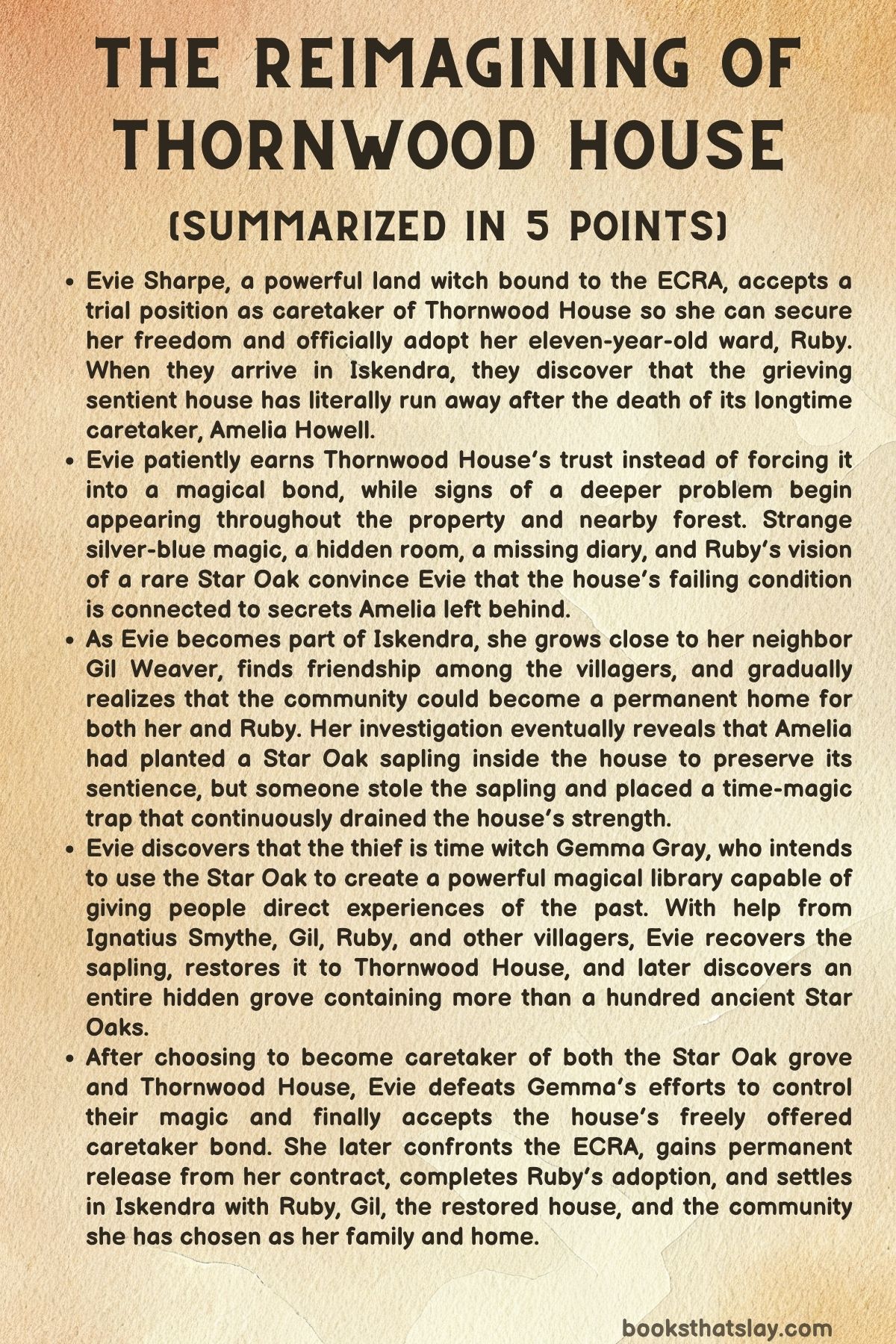
Summary
Evie Sharpe receives the opportunity to become caretaker of Thornwood House, a sentient magical home in Iskendra whose previous caretaker, Amelia Howell, died six months earlier. The house has rejected every replacement since Amelia’s death, and Evie understands from the beginning that she will have to earn its trust rather than simply take possession of it.
For seven years, Evie has worked as an earthwalker for the ECRA, using her exceptional land magic in dangerous situations. She is still bound to the organization by a long contract, but she discovers that becoming the protector of a rare magical resource could release her from that obligation.
Her strongest reason for taking the position is Ruby Keeler, her eleven-year-old apprentice and ward. Evie wants to adopt Ruby, but the ECRA questions whether her dangerous work makes her a suitable parent and also appears reluctant to give up its influence over Ruby, whose farsight is extremely valuable.
The ECRA gives Evie four months to succeed in Iskendra. If Thornwood House accepts her, Evie will be released from her contract and Ruby’s adoption can proceed; if she fails, they must return.
Evie and Ruby arrive expecting to find the house waiting beside the ancient Thornwood forest. Instead, they discover an empty foundation and enormous three-pronged tracks leading into the woods because Thornwood House has literally run away.
Evie follows the traces of its magic and finds the badly damaged house beside the river, balanced on wooden chicken-like legs. Rather than commanding it to return, she acknowledges its grief over Amelia, offers it some of her magic, and leaves it free to choose what to do.
That evening, while Evie reads Ruby a bedtime story in the temporary shelter she has created, the house quietly returns to its foundation. The moment becomes the first sign that it may be willing to trust them.
Evie promises that she will restore the house without forcing it to bond with her. Thornwood House soon begins showing affection toward Ruby, even rebuilding its porch and creating a swing because Ruby says she has always wanted one.
Inside, however, Evie discovers severe destruction and signs that the house’s suffering involves more than grief. Strange bluish-gray wood shavings containing silver magic appear, and Mayor Cinda eventually admits that the house has run away more than once since Amelia died.
Evie also learns about Ignatius Smythe, Amelia’s longtime student and the man everyone assumed would become caretaker. Shortly before her death, Amelia unexpectedly declared that neither Ignatius nor anyone else in Iskendra should inherit the position.
Ignatius openly resents Evie’s arrival and believes Thornwood House needs firmer control. Meanwhile, Evie treats a sick village boy named Jamie Green and notices a strange bluish-silver rash around an injury he received near the forest, connecting his condition to the magical material she found inside the house.
Another villager, Gemma Gray, becomes friendly with Evie. Gemma is a time witch who can alter an object’s relationship with time, and she offers to help research the unusual history of Thornwood House.
As Evie and Ruby continue cleaning, the house slowly begins cooperating with them. Yet it refuses to let Evie enter one concealed room, reacting with intense fear whenever she approaches it.
Ruby’s farsight eventually reveals a magnificent silver-barked tree with deep-blue leaves. Evie recognizes it as a Star Oak, an almost vanished magical species whose wood possesses extraordinary restorative and magical properties.
Evie realizes that Thornwood House may itself have been built from Star Oak wood. The mysterious shavings, Jamie’s strange injury, and the house’s repeated journeys into the forest now seem connected to a surviving Star Oak hidden somewhere within the Thornwood.
During a nighttime search for the tree, Evie rescues Gil Weaver’s missing dog, Snow, from an abandoned shed. Through Snow’s memories, she learns that Veld Tapper, Ignatius’s foreman, deliberately injured the animal while wandering in the woods.
Returning Snow changes Evie’s relationship with Gil. Previously distant and suspicious, he apologizes for his behavior, listens to Evie’s fears, and becomes one of the few people with whom she can openly discuss both the Star Oak mystery and the danger of being forced back to the ECRA.
Thornwood House gradually allows Evie to restore more of its damaged spaces, including a glasshouse filled with magical plants. A stained-glass image of a Star Oak inside gives further support to Evie’s theory about the house’s origin.
The locked room is revealed to be Amelia’s study, where her missing diary is believed to have been kept. Evie refuses to force her way inside because she believes doing so would violate the trust she is trying to build.
Meanwhile, Evie’s personal life begins changing. Gil becomes a regular presence during repairs, Ruby forms a genuine friendship with Trin Green, and Evie starts being accepted by more of Iskendra’s residents as their healer and local witch.
The house itself grows increasingly attached to Ruby. It creates a bedroom specifically suited to her tastes, while Ruby begins to think of Evie less as a teacher or guardian and more as her mother.
Evie also tells Gil about her childhood home of Elerva, a place once rich in magic until generations of overuse and ECRA intervention left the land magically depleted. Her anger toward the ECRA comes partly from learning that officials knew how dangerous the situation had become but failed to prevent the destruction.
Her bond with Gil grows stronger as they spend time together in the forest and orchard. Although attraction develops between them, both hesitate because Evie may still be forced to leave Iskendra.
A new problem emerges when Evie discovers that the magic she has been giving Thornwood House is disappearing. The structure looks better, but beneath its repairs it remains dangerously weak.
Historical accounts confirm that a sentient house deprived of enough magic can eventually lose its consciousness. Gemma encourages Evie to break into Amelia’s study if necessary, arguing that saving the house matters more than respecting its resistance.
Evie nearly follows this advice but stops when she realizes that forcing the house “for its own good” resembles the ECRA’s habit of taking away people’s choices while claiming to protect them. Instead, she returns to the Thornwood and asks the land itself to guide her.
The forest responds to Evie when she exposes the memories and emotions that define her. Just as she seems close to discovering something important, an unknown observer interrupts her connection and escapes.
Gil follows her into the forest because he is worried about her. During their conversation, he reveals that Amelia once predicted a land witch would capture his heart, making him afraid that his feelings for Evie might be dictated by prophecy rather than personal choice.
Evie understands because she also fears allowing predictions or outside forces to determine her life. They agree that whatever develops between them must come from their own decisions.
Evie’s suspicions increasingly turn toward Ignatius because of his knowledge of Amelia, his activity in the Thornwood, and his connection to magical objects that might preserve Star Oak branches. Their confrontation grows bitter, but some of his reactions suggest that he may not understand the mystery as fully as Evie assumed.
At the village library, Evie and Ruby discover a source of Amelia’s old land magic behind a locked Special Collections door. Evie breaks in and finds Amelia’s missing diary.
The final entries reveal that Thornwood House had already been weakening before Amelia died. Amelia therefore received a Star Oak sapling from the ancient tree and planted it inside her study so that its magic could merge with the house and sustain its sentience.
Amelia originally intended Ignatius to succeed her but changed her mind after seeing visions of Evie and Ruby. She came to understand that Ignatius was not truly meant to become the house’s caretaker, even if obligation had convinced him otherwise.
Soon afterward, Ruby is nearly struck by falling stone during a library accident. Evie’s terror helps her finally understand Thornwood House’s behavior: the house has not merely been angry about Amelia’s study; it has been frightened and trying to protect people from something dangerous inside.
With the house’s cooperation, Evie breaks through an unnatural barrier surrounding the study. She finds the room ransacked, the Star Oak sapling missing, and a hidden sphere of time magic that attacks her and attempts to freeze her within a single moment.
After destroying the trap, Evie realizes that Ignatius cannot be responsible because the attack was created with time magic. The evidence points instead to Gemma.
Gemma stole both Amelia’s diary and the sapling and placed the magical trap inside the house. The trap had been draining away all the magic Evie supplied, explaining why Thornwood House could not recover.
The house’s repeated journeys toward the forest also become understandable. It was moving in the direction of the library because it could sense the stolen sapling hidden there.
Evie brings Ignatius into the truth rather than continuing to treat him as an enemy. He admits that Amelia’s rejection wounded him deeply, but he also recognizes that he had spent much of his life following expectations instead of asking what he genuinely wanted.
Evie and Ignatius form an unlikely partnership to retrieve the sapling. With help from Cinda, Gil, the Greens, and others, they arrange a nighttime break-in at the library.
Inside the basement, Evie and Ignatius discover that their different forms of magic can work remarkably well together. They eventually locate the sapling hidden behind a magically protected section of the foundation.
Ignatius accidentally activates another time trap and becomes frozen. Rather than abandon him, Evie asks the sapling for help, frees it from the wall with its cooperation, and uses its power to rescue Ignatius before they escape.
When the sapling is returned to Thornwood House, the house and tree immediately recognize each other. Evie, Ruby, Gil, and Ignatius replant it in Amelia’s study, allowing their magic to reconnect.
Gemma later confronts Evie and admits what she has done. She intended to let Thornwood House weaken until it lost its sentience so that the sapling could be used to create an extraordinary magical library capable of giving people direct access to the past.
Evie rejects Gemma’s belief that the house must justify its existence through usefulness. To Evie, its life has value because it is alive, loved, and connected to generations of people.
Gemma retaliates by informing the ECRA about Evie’s difficulties. The organization cancels Evie’s trial and orders her and Ruby back to Dorna City.
Ruby, terrified of losing their new life, enters the Thornwood with Snow in search of the mature Star Oak. Evie and Gil follow, only to discover that Gemma has filled the forest with dangerous time magic.
Gemma’s traps separate them, freeze Gil, and drag Evie into the river. Evie survives and finally reaches through the magical interference to the ancient power hidden within the Thornwood.
She then discovers that the supposedly rare Star Oak is not represented by one surviving tree. More than a hundred ancient Star Oaks have been hiding themselves in a secret grove for generations.
The grove asks Evie where she stands. She realizes that the question concerns not her power but her willingness to choose a place, a community, and a responsibility after years of allowing outside institutions and uncertain futures to dictate the direction of her life.
Evie chooses Iskendra, Ruby, Gil, Thornwood House, and the Star Oak grove. The trees accept her as their caretaker and give her the strength to locate Gemma, Ruby, and Gil.
Gemma is holding Ruby while Gil remains trapped in time magic. Ruby uses her farsight and discovers that Gemma’s plan was always destined to fail because the stolen sapling had chosen Thornwood House and would eventually have died in the library.
During the confrontation, Thornwood House itself arrives in the forest on its wooden legs, newly restored. It finally offers Evie the caretaker bond she has refused to force from it, and Evie accepts.
The ancient Star Oaks offer Gemma another path. They will allow her access to their enormous store of memories if she gives up her time magic and remains with them, and Gemma chooses to accept the condition.
With Ruby and Gil safe, Evie decides that she will no longer hide from the ECRA. She returns to its headquarters and directly challenges the officials who controlled her career and attempted to pressure Ruby into future service.
The agency ultimately recognizes Evie as caretaker of both Thornwood House and the Star Oak grove. Her ECRA contract is dissolved, and Ruby’s adoption is formally completed, ending the organization’s power to separate them.
Months later, Evie and Ruby are fully settled in Iskendra. Thornwood House has recovered, the Star Oak sapling is securely bonded to it, the villagers have returned to treating the house as part of community life, and Gil has naturally become part of Evie and Ruby’s household.
Evie has finally stopped defining home as a place that could be taken from her. Surrounded by Ruby, Gil, the village, the restored house, and the ancient grove she has chosen to protect, she has built a life based not on duty or prediction but on mutual trust, care, and freely chosen belonging.
Characters
Evelyn “Evie” Sharpe
Evie is the emotional and moral center of The Reimagining of Thornwood House. At twenty-five, she is already an unusually powerful land witch, yet much of her life has been controlled by institutional demands rather than by choices she has made entirely for herself.
Her years as an ECRA earthwalker have taught her competence, courage, discipline, and the habit of responding immediately when others are in danger. They have also left her deeply suspicious of organizations that justify control by claiming that their actions serve a greater good.
Evie’s relationship with Ruby reveals her most important quality: she does not want love to become another form of possession. Even when Ruby’s extraordinary farsight could help solve problems, Evie repeatedly refuses to pressure the child into using it because she understands how destructive it is to treat someone primarily as a source of useful power.
The same principle shapes her relationship with Thornwood House. She desperately needs the house to accept her because Ruby’s adoption and their freedom from the ECRA depend on it, yet she promises not to force a caretaker bond even when doing so might serve her own interests.
Her greatest internal conflict comes from the fear of allowing herself to want permanent happiness. Evie gradually falls in love with Iskendra, grows attached to Gil, becomes part of the village, and increasingly thinks of Ruby as her daughter, but uncertainty makes her cautious about claiming any of these relationships as truly hers.
The hidden Star Oak grove finally forces her to answer the question she has avoided for years. Evie becomes a caretaker not simply because a magical house or tree chooses her, but because she consciously chooses a place and accepts the responsibilities that come with belonging to it.
Ruby Keeler
Ruby is Evie’s eleven-year-old apprentice, ward, and eventual adopted daughter. Her farsight makes her extremely valuable to the ECRA, but the book consistently presents her first as a child who deserves affection, friendship, security, and freedom rather than as a magical resource.
Ruby carries more anxiety than someone her age should have to bear. The ECRA’s attempt to pressure her into signing a future contract has taught her that powerful adults may try to turn her gift into an obligation, and her repeated checking of the mailbox shows how deeply she fears being separated from Evie.
At the same time, Ruby retains curiosity, humor, loyalty, and an eagerness to experience an ordinary childhood. Her friendship with Trin, her excitement about her bedroom and porch swing, her desire for pets, and her enjoyment of village life show how quickly she responds to an environment in which she is treated as a person rather than a tool.
Her relationship with Thornwood House is especially significant because the house trusts her before it fully trusts Evie. Both Ruby and the house have experienced adults trying to determine their futures, which may help explain the instinctive tenderness that develops between them.
Ruby’s eventual decision to call Evie “Mom” completes one of the story’s most important relationships. Their family does not become real because a committee finally approves paperwork; the legal adoption recognizes a bond that has already been created through years of care, protection, trust, and freely given love.
Thornwood House
Thornwood House functions as a full character rather than a passive setting in The Reimagining of Thornwood House. It possesses memory, emotion, preferences, fear, affection, grief, and the ability to choose the witch with whom it will form a caretaker bond.
Its early behavior appears irrational because it runs away, rejects potential caretakers, damages itself, and reacts violently to certain areas and people. Once the truth is known, these actions become understandable responses from a living being that has lost Amelia, had part of itself stolen, and been trapped by hostile time magic.
The house’s relationship with Ruby reveals its affectionate nature. Rebuilding the porch swing and designing Ruby’s bedroom show that it does not merely accept her presence but actively wants to make her feel safe and wanted.
With Evie, trust develops more cautiously. The house pays close attention to the fact that Evie repeatedly asks permission, respects locked spaces, offers magic without demanding repayment, and ultimately chooses the house’s well-being even when her own future is uncertain.
Its final offer of a caretaker bond matters because the choice remains Thornwood’s own. Evie succeeds precisely because she never treats its sentience as something she is entitled to control.
Amelia Howell
Although Amelia dies before the main events begin, her decisions shape almost everything that follows. As Thornwood House’s caretaker for nearly seventy years, she develops an extraordinary connection with the house, the village, the Thornwood, and the magical traditions surrounding them.
Her decision not to appoint Ignatius appears cruel and mysterious until her diary explains her reasoning. Amelia sees that Ignatius has spent his life pursuing a role because he believes he should want it, while Evie and Ruby represent a different future for the house.
Amelia is also willing to make difficult choices to preserve Thornwood House’s sentience. By requesting and planting the Star Oak sapling, she attempts to ensure that the house can continue living after her death.
Her farsight occasionally complicates the lives of those around her, particularly Gil, who spends years wondering whether his future feelings have already been decided. Even so, Amelia’s deeper legacy is not one of controlling the future but of recognizing when people need permission to imagine lives different from those expected of them.
Gil Weaver
Gil initially appears suspicious and unwelcoming, but his hostility is largely the behavior of a private man dealing with fear and worry over his missing dog. Once Evie returns Snow safely, Gil’s kindness, patience, and loyalty become much clearer.
His orchard reveals something essential about him. Although he does not formally identify himself as a witch, generations of care have created a deep magical bond between the Weaver family and their land, suggesting that genuine stewardship can develop through sustained love and responsibility rather than titles.
Gil’s relationship with Evie grows slowly because both are afraid of committing to an uncertain future. His additional concern comes from Amelia’s old prediction that a land witch would one day capture his heart, since he wants his feelings for Evie to be chosen rather than imposed by prophecy.
Over time, Gil becomes one of Evie’s strongest sources of practical and emotional support. He offers his magic freely when she needs strength, accompanies her into danger, accepts Ruby without hesitation, and repeatedly reminds Evie that building a life with other people requires allowing them to share its risks.
Ignatius Smythe
Ignatius first appears arrogant, territorial, and resentful. Because everyone expected him to succeed Amelia, Evie’s arrival feels to him like a public reminder that the mentor he served for years ultimately decided that he was not the right person for the life he assumed would be his.
His hostility therefore grows from more than jealousy. Ignatius has organized much of his identity around duty, family expectation, and the belief that commitment requires carrying forward an inherited role.
The discovery of Amelia’s reasoning forces him to confront a difficult truth: he may never have genuinely wanted to become caretaker. Amelia’s rejection hurt precisely because she made a decision he had not yet found the courage to make himself.
His gradual cooperation with Evie shows substantial growth. Their magical partnership during the library break-in requires him to trust the person he initially considered an outsider, while Evie’s refusal to abandon him during the time trap proves that their alliance is becoming genuine.
By the end, Ignatius is able to accept a new relationship with Thornwood House and the Star Oak grove without needing to possess either one. He remains part of Amelia’s legacy, but on terms that allow him to build an identity beyond the role once chosen for him.
Gemma Gray
Gemma is one of the story’s most deceptive characters because she initially represents intellectual curiosity, friendship, and useful knowledge. As a time witch and librarian, she seems perfectly positioned to help Evie understand Iskendra’s history.
Her eventual betrayal grows from an ideology rather than simple greed. Gemma genuinely believes that transforming the library into a magical institution capable of giving people direct access to history could improve society.
The danger lies in her belief that a valuable goal permits her to decide what other beings should sacrifice. She is willing to let Thornwood House lose its sentience because she considers her proposed library more useful, making her reasoning disturbingly similar to the institutional logic Evie has learned to distrust.
Gemma’s actions also show how intellectual certainty can become a form of cruelty. She steals the Star Oak sapling, plants dangerous time traps, manipulates Evie’s trust, endangers Ruby and Gil, and interferes with the Thornwood because she has convinced herself that the outcome will justify the harm.
Her final choice is nevertheless complicated rather than purely punitive. When the Star Oaks offer her access to their memories in exchange for surrendering her time magic, she accepts, showing that her hunger for knowledge was genuine even though the methods she chose were destructive.
Mayor Cinda Cartwright
Cinda serves as Iskendra’s mayor and one of Evie’s earliest institutional allies. She is the person who invites Evie to become caretaker and recognizes that the damaged house may require someone from outside the village’s existing expectations.
Her mistake is withholding information about the house’s previous escapes. This choice shows that even well-meaning authority figures can become too focused on achieving an outcome and fail to give others all the information they deserve.
Unlike the ECRA officials, however, Cinda is capable of becoming a genuine partner rather than insisting on control. She supports Evie’s growing place in the village and later participates directly in the plan to recover the stolen sapling.
Veld Tapper
Veld is Ignatius Smythe’s foreman and initially becomes one of Evie’s main suspects because of his unexplained activity in the Thornwood. His cruelty toward Snow establishes him as someone willing to harm a vulnerable animal when there appears to be no immediate consequence.
His role also complicates Evie’s judgment of Ignatius. Although Veld’s behavior makes Ignatius look suspicious by association, Ignatius later fires him after learning what happened, separating Veld’s personal cruelty from Ignatius’s more complicated motives.
Caleb Bearn
Caleb is a glassblower whose workshop is damaged during one of Thornwood House’s earlier escapes. His initial hostility toward Evie is therefore understandable because she represents a magical problem that has already caused him financial and emotional frustration.
Evie earns some of his respect by giving him an enchanted stone that protects glass and pottery from breaking. His decision to offer her a magical vase in return establishes a more balanced relationship and also introduces an object that later becomes important to Evie’s suspicions about the Star Oak.
Caleb illustrates how community acceptance is not automatic. Evie has to demonstrate through her actions that being Iskendra’s witch means accepting responsibility for problems she did not personally cause.
Abby Gray
Abby is Gemma’s younger sister and is noticeably colder toward Evie than Gemma initially appears to be. Her closeness to Ignatius makes the villagers assume that some of her distrust has come from his early suspicions.
She also controls access to library materials that Evie urgently needs, placing her in opposition to Evie’s investigation. Yet the eventual revelation about Gemma changes the context around Abby, leaving her as someone who must continue her life independently after her sister chooses to remain with the Star Oaks.
Trin Green
Trin becomes Ruby’s first real childhood friend in Iskendra. Her role may be quieter than those of the central magical characters, but she represents something extremely important that Ruby has been denied by the ECRA: ordinary companionship.
Through Trin, Ruby begins participating in village life as a child rather than primarily as a farseer. Baking, spending time together, and sharing everyday experiences help establish the sense of normality and belonging that Evie wants for her.
Jamie Green
Jamie becomes connected to the central mystery after suffering an infected injury acquired near the Thornwood. The strange bluish-silver markings around his wound provide Evie with one of her first clues that the house’s condition is connected to a form of Star Oak magic.
His recovery also helps establish Evie in her public role as Iskendra’s healer. Through treating Jamie, she begins moving from being a suspicious outsider toward becoming someone the village can rely upon.
Shara Green
Shara is part of the welcoming Green family and contributes to the growing network of support around Evie and Ruby. Her household gives Ruby a place where friendship and ordinary family activities can develop naturally.
Shara also repeats Amelia’s important observation that something changed by grief cannot simply be restored to what it once was. Her words help Evie understand that recovery requires imagining a new form of life rather than attempting to recreate the past exactly.
Ben Green
Ben participates in the community that gradually accepts Evie and later assists with the plan to recover the stolen sapling. His presence reinforces the idea that Evie’s work is no longer something she must perform entirely alone.
Along with Shara and the other villagers who support her, Ben helps transform Iskendra from a place Evie has temporarily entered into a community willing to defend what she is building.
Snow
Snow is Gil Weaver’s white dog and an important emotional link between Gil and Evie. Evie’s decision to abandon her search for the Star Oak in order to rescue and heal him demonstrates that her instinct as a caretaker extends beyond whatever objective she is currently pursuing.
Snow later accompanies searches and becomes part of the household network surrounding Evie, Ruby, and Gil. His presence also exposes Veld’s cruelty and indirectly helps redirect Evie’s investigation.
Arthur Smythe
Arthur is Ignatius’s older brother and an ECRA official. His earlier departure from Iskendra contributed to Ignatius’s sense of abandonment and responsibility, especially because Ignatius remained behind carrying expectations tied to family and community.
Near the end, Arthur supports Evie during her confrontation with the ECRA at Ignatius’s request. His appearance also creates the possibility that the brothers may repair a relationship damaged by distance and different life choices.
Mrs. Shields
Mrs. Shields is one of the ECRA officials involved in the final decision about Evie’s future. Unlike those who continue questioning Evie in a controlling manner, she eventually acknowledges that the organization exceeded its authority in its treatment of Ruby.
Her decision to recognize Evie as a capable caretaker and dissolve her contract shows that institutions are not completely incapable of correction. The possibility of future cooperation with Mrs. Shields also suggests that Evie’s rejection of institutional abuse does not require rejecting every individual within the institution.
Cinton
Cinton represents the more controlling side of the ECRA during Evie’s final confrontation with the organization. Even after investigators verify the existence of the Star Oak grove, Cinton continues questioning Evie’s account and conduct.
His attitude reflects the institutional mindset Evie has spent much of the story resisting. Authority is treated as something the organization naturally possesses, while Evie’s growth allows her to see that such officials are simply people whose judgments do not automatically define her worth or future.
Tansling
Tansling participates in the ECRA committee that evaluates Evie and continues challenging her actions near the end. Like Cinton, Tansling helps embody the pressure of an organization accustomed to deciding what powerful witches should do with their abilities.
The character is less individually developed than Evie, Ruby, or Ignatius, but serves an important structural purpose by demonstrating that Evie’s struggle is not only against one hostile official. She is confronting a broader culture of authority that repeatedly values magical usefulness over personal autonomy.
Agnes Fuller
Agnes Fuller, the village butcher, is one of the residents Evie meets as she becomes more involved in Iskendra’s community. Although she does not play a major role in the central magical conflict, her presence helps make the village feel like a functioning social world rather than merely a setting for Evie’s personal struggle.
Characters such as Agnes are important because Evie’s final sense of home depends on many ordinary relationships. Belonging is created through everyday familiarity with neighbors as much as through dramatic magical bonds.
Malcolm Jent
Malcolm Jent, Iskendra’s postmaster, similarly represents the wider village community into which Evie gradually settles. His role is small, but he contributes to the network of residents whose presence makes Iskendra socially real.
This matters especially for Evie because she has spent years moving through dangerous assignments rather than living within a stable community. Even minor village figures therefore help mark the difference between temporary service and genuine residence.
Themes
Choice, Autonomy, and the Right to Shape the Future
Questions of choice determine nearly every major relationship in The Reimagining of Thornwood House. Evie’s conflict with the ECRA begins because the organization repeatedly treats magical ability as something that creates an obligation to serve, while Ruby is pressured toward a future contract before she is old enough to make such a decision freely.
Evie becomes determined not to reproduce this behavior in her own relationships. She refuses to pressure Ruby into using farsight, refuses to force Thornwood House into a caretaker bond, and even hesitates about her feelings for Gil when prophecy seems capable of influencing their relationship.
The story repeatedly distinguishes between knowing what might happen and choosing what should happen. Amelia can glimpse possibilities, Ruby can see elements of the future, and Gemma can reach into the past, yet none of these powers should replace the freedom of people to make decisions in the present.
Evie’s final transformation occurs when she stops waiting for institutions, predictions, or magical beings to decide whether she belongs. The Star Oak grove asks where she stands, and her answer comes through a conscious decision to choose Ruby, Gil, the house, Iskendra, and the responsibilities attached to them.
Even Thornwood House must be allowed this freedom. Its eventual bond with Evie is meaningful because she has spent the entire story giving it the right to refuse her, proving that genuine commitment gains its value from consent rather than necessity.
Home, Belonging, and Chosen Family
Home is presented as something created through relationships rather than simply inherited or occupied. Evie begins the story wanting a permanent location primarily because remaining in Iskendra could allow her to adopt Ruby and escape the ECRA, but the meaning of home gradually becomes far more personal.
Her first nights at Thornwood House are marked by uncertainty. She does not know whether the house will accept her, whether the villagers will trust her, whether Ruby can remain with her, or whether allowing herself to care for Gil will only make a future departure more painful.
Small experiences gradually change this uncertainty. Ruby makes a friend, Thornwood House creates spaces for them, Gil leaves his tools in the glasshouse, villagers seek Evie’s help as their healer, and ordinary routines begin to acquire emotional weight.
Chosen family follows the same pattern. Evie becomes Ruby’s mother through years of protection and care before the adoption committee formally recognizes that relationship, while Gil becomes part of their household through repeated acts of presence rather than through any official declaration.
By the ending, Evie understands that permanence is not guaranteed by avoiding attachment. Home exists because she is willing to commit herself to people and places despite the possibility of loss, accepting that belonging carries responsibilities as well as comfort.
Grief, Recovery, and Reimagining Life After Loss
Thornwood House’s grief after Amelia’s death provides the clearest expression of how loss changes both individuals and communities. The house cannot simply be repaired physically and returned to exactly what it was because Amelia’s absence has permanently altered its identity.
Shara’s explanation that a grieving sentient house must be allowed to reimagine what it will become gives the story one of its central ideas. Recovery does not mean restoring an earlier version of life as though the loss never occurred; it means building something new while allowing the past to remain meaningful.
This idea applies equally to Evie. Her childhood home of Elerva has been stripped of the magic that once made it feel alive, and she cannot recover the life she knew there simply by longing for it.
Ignatius experiences a different form of loss. Amelia’s decision not to make him caretaker destroys the future he expected, but eventually he understands that losing that expected role also gives him the chance to discover what he actually wants.
Thornwood House ultimately survives because it accepts new relationships without erasing Amelia. The Star Oak sapling is replanted, villagers return, children add new memories beside those of earlier generations, and Evie becomes caretaker without replacing Amelia as though the former witch never existed.
Caretaking, Power, and the Ethics of Usefulness
The story repeatedly asks what it actually means to care for something powerful. The ECRA, Gemma, Evie, Ignatius, and Amelia all interact with valuable forms of magic, but their methods reveal very different ideas about responsibility.
The ECRA often evaluates witches through usefulness. Evie’s land magic makes her valuable as an earthwalker, while Ruby’s farsight makes the organization reluctant to allow her future to escape its influence.
Gemma takes this logic even further. She believes the Star Oak sapling could serve a greater social purpose inside a magically enhanced library and therefore concludes that sacrificing Thornwood House is acceptable if the result benefits enough people.
Evie rejects the assumption that usefulness determines whether something deserves protection. Thornwood House does not need to prove that it can serve a grand purpose; the fact that it is conscious, loved, and capable of experiencing fear and affection is enough to make its existence worthy of respect.
Her approach to caretaking is therefore based on cooperation rather than ownership. She asks plants for assistance, requests permission before giving magic to the house, treats the Star Oak as a living being rather than valuable material, and accepts help from Gil and Ignatius rather than trying to control every responsibility herself.
By the end, power is presented as something that creates obligations of restraint as much as opportunities for action. Evie becomes worthy of protecting the house and the grove because she consistently proves that having the ability to control something does not give her the moral right to do so.