The River She Became Summary, Characters and Themes
The River She Became by Emily Varga is a fantasy novel about occupation, stolen magic, rebellion, family, and the difficult choices people make while trying to free their communities.
The story follows Yaseema Nazir, a human scholar who discovers that the famine destroying her homeland is connected to the Empire’s removal of ancient magical relics, and Kiyan, a hidden prince serving the enemy regime that conquered his own people. Their separate searches for Queen Azari’s lost crown bring them together across a magical barrier. What begins as distrust gradually becomes an alliance shaped by shared resistance, personal sacrifice, and the realization that neither nation can secure freedom by sacrificing the other.
Summary
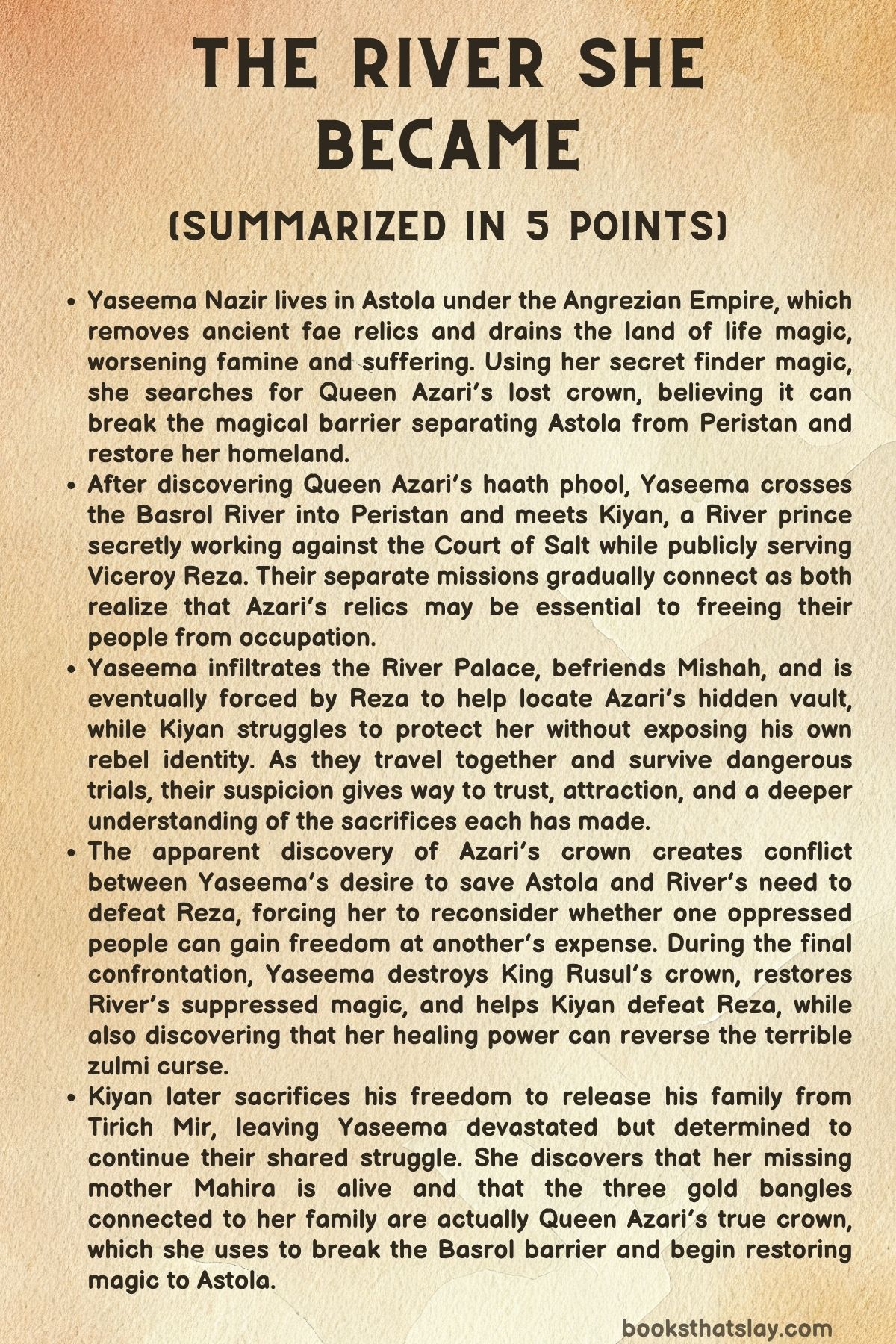
Yaseema Nazir lives in Astola, a country controlled by the Angrezian Empire through the powerful Citadel. The occupiers regulate food, employment, customs, scholarship, and even burial rites while excavating ancient fae relics from Astolan soil and sending them to the Empress.
Yaseema works as a scholar in the Citadel archives, giving her access to the very institution she secretly opposes. She has discovered that the removal of magical relics is draining life magic from Astola, worsening the famine that has already devastated ordinary families.
Her resistance initially takes a hidden form. Yaseema possesses unusual golden magic that allows her to locate lost things, reveal concealed objects, and sometimes open locks, and she secretly uses this gift to steal relics before the Citadel can remove them.
Her interest in rebellion is deeply personal because her father was executed for resisting imperial rule and her mother, Mahira, disappeared years earlier. Mahira left behind research suggesting that Queen Azari’s lost crown may possess enough power to destroy the magical wall dividing Astola from the fae world of Peristan.
Yaseema becomes more directly involved with local resistance after helping Bair bury Ghassan Javed, a former Citadel excavator who had fallen into poverty after challenging imperial authority. On Ghassan’s body, Yaseema discovers a mysterious golden key marked with Queen Azari’s jasmine symbol.
The key leads her into an ancient Golden Vault before the Citadel can fully excavate it. After surviving deadly traps, Yaseema discovers Queen Azari’s haath phool, magical hand jewelry capable of allowing a person to cross the barrier between the human and peri worlds.
Citadel forces soon break into the vault, accompanied by Yaseema’s former friend Sophie Hightower. Sophie had used Mahira’s private research to help locate the site and believes the Empire is preserving Astola’s cultural treasures, while Yaseema understands that removing those objects is slowly killing the land.
When the vault begins collapsing because of the excavators’ actions, Yaseema escapes with the haath phool. She realizes that she can no longer maintain the appearance of a loyal Citadel scholar and decides to complete the mission her mother apparently began.
At the Basrol River, Citadel forces attempt to stop her by taking her grandmother Nani hostage. Safiyya and other rebels attack, allowing Nani to push Yaseema into the River so she can continue her mission.
The haath phool carries Yaseema through the magical wall. On the other side, she enters Peristan and immediately sees the contrast between fertile River lands and famine-stricken Astola, confirming that the disappearance of life magic from her homeland is not natural.
Meanwhile, Kiyan has spent years living an equally divided existence. Publicly, he is the feared captain serving Viceroy Reza, the ruler installed by the conquering Court of Salt, but secretly Kiyan is a surviving prince of River and an ally of the Red Jasmine rebellion.
Reza conquered River using the power of King Rusul’s crown, which suppresses River magic. Kiyan’s mother, brother, and sister remain trapped inside the magically sealed palace of Tirich Mir, while Kiyan has stayed close to Reza hoping to undermine him and eventually rescue his family.
Kiyan discovers that although his ordinary life magic is restricted, he can still command decay because death belongs to the same natural cycle as life. His experiments allow him to create creatures from decomposing matter, giving him a form of power that Reza cannot completely suppress.
Kiyan is also searching for Queen Azari’s crown after receiving a mysterious ring from a rebel prisoner. When the ring transforms into a golden key and directs him toward the mountains, he realizes that Azari’s relics may offer the power required to free River.
Yaseema and Kiyan first meet after she crosses the wall and encounters a monstrous halmasti. Their relationship begins with suspicion, sarcasm, and mutual irritation, but they are forced to cooperate in order to survive.
Yaseema later infiltrates the occupied River Palace by pretending to be a kitchen worker. There she becomes close to Ramishah, known as Mishah, and secretly searches palace libraries for information about Queen Azari.
Kiyan eventually discovers Yaseema’s golden finder magic and realizes that she may be capable of locating Azari’s hidden vault. At the same time, General Faisal becomes suspicious of rebel activity inside the palace and attacks Mishah.
Yaseema intervenes to save her friend and kills Faisal during the struggle. The apparent scholar quietly witnessing the confrontation turns out to be Viceroy Reza himself, who arrests Yaseema and decides to use her abilities to locate Queen Azari’s crown.
Kiyan helps prevent Reza from immediately controlling or destroying her. Yaseema agrees to participate in the expedition only because Reza can threaten Mishah and other people she cares about.
During her time near Reza, Yaseema increasingly recognizes the similarities between Salt’s occupation of River and the Angrezian Empire’s control of Astola. Both conquerors weaken populations by taking control of their magic, culture, resources, and political choices.
Kiyan and Yaseema also grow closer as they recognize similar contradictions in one another. Each has entered an enemy-controlled institution while secretly working against it, and each carries guilt about what survival under occupation has required.
Their expedition takes them toward the mountains indicated on the ancient map. Along the way, Yaseema learns that Mahira’s gold bangles were made in the magical town of Tashuna and that the two bracelets she possesses are actually part of a three-piece set.
Kiyan’s Red Jasmine allies become suspicious of Yaseema because they fear she will deliver Azari’s crown to Reza. Talal and other rebels even abduct her, but Kiyan intervenes and makes clear that he will not allow the resistance to treat her as a disposable instrument.
Yaseema eventually uses her finder magic to reveal the entrance to Azari’s hidden vault. Inside, she and Kiyan survive ancient magical tests by relying on her knowledge and problem-solving abilities as well as his physical strength and magical experience.
During the journey, Kiyan finally reveals that he belongs to River’s royal family. Yaseema keeps his secret, while Kiyan learns that she is human and crossed the Basrol wall using Azari’s haath phool.
At the end of the vault, they find what appears to be Queen Azari’s crown along with a small golden dagger. Yaseema secretly hides both objects because she intends to use the crown to free Astola rather than surrender it to Reza.
Their return becomes chaotic when Red Jasmine rebels attack the expedition. Reza responds with Salt magic, transforming one rebel into a zulmi, one of the cursed people stripped of youth, language, identity, and bodily freedom.
Everyone believes the rebels escaped with Azari’s crown, but Yaseema still has it hidden inside her clothing. Kiyan eventually discovers this secret and feels betrayed because Reza punished him severely for supposedly losing the relic, yet he chooses not to expose Yaseema.
Their emotional connection deepens when Reza’s punishment leaves Kiyan dangerously wounded. Yaseema discovers that Mahira’s bangles possess healing power and combines that ability with her finder magic to identify and remove the curse from his body.
The experience finally breaks down much of the distance between them, and they acknowledge their attraction through a kiss. Even so, both continue withholding important information because their obligations to Astola and River remain unresolved.
Yaseema eventually tries to escape with the crown, believing she must return home immediately. Mishah reveals that she belongs to the Red Jasmine rebellion and had originally been assigned to watch Yaseema on Kiyan’s orders.
Their confrontation forces Yaseema to recognize an uncomfortable truth. Taking River’s greatest hope in order to save Astola would reproduce the same logic used by the Empire when it steals Astolan relics for its own benefit.
Yaseema turns back, but Reza captures her, confiscates the apparent crown and Mahira’s bangles, and breaks both of her legs. When Kiyan discovers that Reza is torturing her, he finally abandons the secret position he has protected for years and openly attacks the regime.
Kiyan rescues Yaseema and joins the Red Jasmine resistance openly. At their camp, both finally reveal the full truth about their histories, missions, losses, and loyalties.
Yaseema also reconciles with Mishah after confronting her about the betrayal that led to her capture. She decides that River must first reclaim its freedom before she can solve Astola’s crisis, while Kiyan promises that Astola will not be abandoned afterward.
The rebels attempt to ambush Reza before he can reach Tirich Mir, but Reza anticipates the attack. During the battle, Kiyan uses the bodies of fallen soldiers to create an enormous figure powered by death magic, temporarily bypassing the restrictions imposed on River.
Yaseema reaches Reza with Mishah and discovers that the supposed Azari crown has been fused into his head while King Rusul’s crown remains embedded in his chest. When Reza transforms Mishah into a zulmi, Yaseema asks her finder magic how he can be killed.
The answer leads her to Azari’s golden dagger and Rusul’s crown. She drives the dagger into the crown in Reza’s chest, destroying the source of his control over River.
With his full magic restored, Kiyan reveals himself as a River prince and drains Reza’s life completely. Yaseema recovers Mahira’s bangles and discovers that their healing power can restore Mishah from the supposedly irreversible zulmi curse.
Kiyan and Yaseema then travel to Tirich Mir to free his imprisoned family. Yaseema locates the hidden entrance, but they discover that the curse permits freedom only through an exchange of royal blood.
Kiyan chooses to take his family’s place inside the prison. Despite Yaseema’s attempts to stop him, he enters Tirich Mir so that his mother, brother, and sister can finally leave.
Yaseema is devastated but continues the mission they shared. She takes the golden object believed to be Azari’s crown to the Basrol River, only to discover that it is not the true crown and cannot destroy the wall.
Then she recognizes the cursed woman who helped her when she first entered Peristan. The woman possesses the missing third bangle and is revealed to be Mahira, who had been transformed into a zulmi years earlier.
Yaseema joins the three bangles and uses their power to restore her mother. Mahira explains that Yaseema’s father once stole Queen Azari’s actual crown from the Empire and that Mahira melted it down into three bangles to hide its identity.
When all three pieces are reunited, their jasmine design reveals the truth. The bangles themselves are Queen Azari’s crown.
Yaseema reforms the three pieces into a single magical cuff and directs its power against the Basrol barrier. The wall begins collapsing, restoring the connection between Astola and Peristan and allowing life magic to flow back toward the human land.
The victory remains incomplete because Kiyan is still imprisoned inside Tirich Mir. Yaseema ends her journey with three goals before her: return to Astola, fight the Empire that devastated her homeland, and find a way to free the man who sacrificed his freedom so that others could have theirs.
Kiyan, meanwhile, remains alone inside the cursed palace. His final thoughts are directed toward Yaseema, whom he loves enough to hope that she will choose life and freedom even if rescuing him proves impossible.
Characters
Yaseema Nazir
At the center of The River She Became, Yaseema Nazir develops from a cautious intellectual rebel into someone willing to place her body, future, and emotional security at risk for liberation. Her greatest strength is not physical power but the combination of curiosity, moral stubbornness, scholarship, and an unusual ability to recognize connections that other people overlook.
Her finder magic reflects her personality unusually well because Yaseema is constantly searching for what has been hidden, whether that means lost relics, concealed doors, forgotten history, political truth, or the motives of the people around her. As her powers develop, finding becomes restoration and even combat, suggesting that knowledge itself can become a means of resistance.
Her greatest internal conflict concerns the difference between saving her people and behaving justly toward others. She initially believes taking Azari’s crown from River is acceptable because Astola faces starvation, but she eventually recognizes that stealing another oppressed population’s source of freedom would repeat the same moral logic used by the Citadel.
This realization marks one of her most important developments. Yaseema stops treating liberation as a competition between suffering communities and begins understanding that a victory built on someone else’s exploitation remains corrupted.
Her relationships also reveal different parts of her personality. Safiyya challenges her caution, Nani connects her with familial courage, Mahira represents both loss and inherited purpose, Mishah tests her ideas about trust, and Kiyan forces her to confront the emotional cost of keeping every part of herself protected.
By the end, Yaseema has not become fearless or uncomplicated. She has instead learned to act while afraid, admit when her own plan is morally compromised, forgive without pretending betrayal did not matter, and accept responsibility for a struggle larger than the one she originally intended to fight.
Kiyan
Kiyan is built around contradiction. He is a River prince working as the feared captain of the regime that conquered River, a rebel who publicly hunts rebels, a wielder of life magic who discovers his greatest weapon through death, and a deeply protective man who has committed acts that leave him carrying enormous guilt.
His years beside Reza have trained him to survive through secrecy, performance, calculation, and emotional restraint. He understands that maintaining his position occasionally requires terrible choices, including killing imprisoned rebels quickly rather than allowing them to suffer prolonged torture and hurting allies sufficiently to preserve his cover.
These actions make his moral position difficult rather than clean. Kiyan does not consider himself innocent, and his scars are both physical evidence of Reza’s abuse and reminders of the compromises that have defined his resistance.
His death magic is especially important to his characterization. Reza has restricted the life magic associated with River, but Kiyan realizes that decay cannot be separated entirely from life, allowing him to reclaim power through a part of nature that his enemy failed to understand.
Yaseema changes the way he thinks about people and strategy. Because he has spent years being used as a tool, he becomes increasingly unwilling to let the rebellion treat her finder magic as another weapon to be controlled.
His decision to abandon his position when Reza tortures Yaseema is the moment when private loyalty becomes public rebellion. Later, his sacrifice at Tirich Mir completes the pattern of his character: Kiyan has spent years trying to free his family, and when freedom finally demands a personal cost, he chooses imprisonment for himself rather than leaving them trapped.
Mahira Nazir
Mahira exists for much of the story as an absence, but that absence shapes Yaseema’s life almost as powerfully as a present parent would. Her journal, research, goldwork, warnings, and vanished mission give Yaseema the intellectual foundation for understanding the relationship between Astola’s famine and the disappearance of magical relics.
Her eventual story reveals a woman whose rebellion required extraordinary foresight. Rather than allowing Queen Azari’s crown to remain recognizable, Mahira melts it down and disguises it as three bangles, turning a politically dangerous artifact into objects that could pass unnoticed as family jewelry.
That transformation also reflects Mahira’s talent as a goldsmith and her understanding that preservation does not always mean keeping an object unchanged. She protects the crown by altering its form while preserving its purpose.
Her fate as a zulmi gives the novel one of its most severe examples of Reza’s cruelty. Mahira spends years physically present near the River yet unable to communicate her identity, leaving mother and daughter separated not by distance alone but by the deliberate destruction of language, appearance, and bodily control.
Her restoration therefore carries significance beyond reunion. Through Mahira, Yaseema proves that Reza’s supposedly permanent curses can be reversed and discovers that the object she has carried from the beginning was much closer to her goal than she ever understood.
Viceroy Reza
Within The River She Became, Reza represents domination that depends not simply on military strength but on controlling what other people are permitted to become. He conquers River through King Rusul’s crown, restricts the population’s magic, turns opponents into zulmi, tortures Kiyan into obedience, and treats useful people such as Yaseema as resources rather than individuals.
His attitude toward power is fundamentally possessive. He assumes that magical abilities, relics, bodies, and knowledge become legitimate tools once he has enough force to claim them.
This explains why Yaseema is so valuable to him. He has little interest in understanding her as a person because her finder magic matters more to him than her autonomy, just as Kiyan’s usefulness matters more than the prince’s suffering.
Reza is also dangerous because he understands fear as a governing system. His punishments are designed not only to injure individuals but also to convince everyone nearby that resistance will bring consequences.
Yet his worldview contains the weakness that eventually destroys him. Because he thinks almost entirely in terms of control, he underestimates powers that exist outside his system, including Kiyan’s death magic, Yaseema’s evolving finder ability, voluntary loyalty among the rebels, and the possibility that people he has broken may be restored.
His death is therefore more than the defeat of a villain. Destroying Rusul’s crown ends the magical structure through which he has restricted River, demonstrating that oppressive power can appear personal while actually depending on systems, artifacts, institutions, and enforced fear.
Ramishah “Mishah”
Mishah begins as the friendly kitchen worker who gives Yaseema an accidental route into the River Palace, but her role becomes much more complicated once her connection to the Red Jasmine rebellion is revealed. Her early warmth is genuine even though her relationship with Yaseema begins under conditions of surveillance.
This contradiction creates the central problem in Mishah’s character. She loves River and is willing to make severe choices for its freedom, but her fear of losing Azari’s crown causes her to betray Yaseema to Reza, producing consequences far worse than she intended.
Her mistake demonstrates how resistance can reproduce forms of dehumanization when people begin treating one another entirely according to strategic value. Mishah does not betray Yaseema because she has stopped caring about her; she betrays her because political desperation temporarily becomes stronger than personal trust.
Yaseema’s decision to reconcile with her does not erase the harm. Their repaired friendship instead acknowledges that loyalty during rebellion requires accountability, honesty, and recognition that relationships are themselves part of what people are fighting to protect.
Mishah’s transformation into a zulmi and later restoration also makes her living evidence that Reza’s power is not absolute. Her recovery turns Yaseema’s healing ability from a private discovery into a possible source of hope for many other victims.
Safiyya
Safiyya represents a more visible and direct form of Astolan resistance than Yaseema initially embraces. While Yaseema hides behind scholarship and secret theft, Safiyya is already associated with activities that openly challenge imperial restrictions.
Her frustration when she learns how much Yaseema has concealed is therefore understandable. She recognizes the irony of being criticized for rebellious behavior by someone who has secretly been conducting an even more dangerous campaign.
Despite that conflict, Safiyya remains fiercely loyal to Yaseema and their family. Her participation in the attack at the Basrol River helps give Yaseema the opportunity to cross into Peristan and continue the mission.
Safiyya also acts as a measure of Yaseema’s transformation. When she finally describes Yaseema as behaving like a true Nazir, she connects her cousin’s actions with the rebellious tradition represented by Yaseema’s father.
Nani
Nani represents familial courage without needing magical power or political authority. Her importance becomes especially clear at the Basrol River, where she refuses to let herself become the reason Yaseema abandons the mission.
By pushing Yaseema into the River despite the danger surrounding them, Nani chooses the future of Astola over her own immediate safety. That choice demonstrates why Yaseema’s resistance cannot be reduced to individual heroism, because her journey repeatedly depends on sacrifices made by family and community members.
Nani also helps connect rebellion with inheritance. The courage Yaseema eventually claims has existed within her family long before she understands her own role in it.
Sophie Hightower
Sophie is especially effective because her conflict with Yaseema is ideological as well as personal. As a former friend who steals Mahira’s research and helps the Citadel locate the Golden Vault, she turns intellectual trust into a tool of imperial acquisition.
She genuinely appears to believe that the Empire protects artifacts through preservation, scholarship, and collection. Yaseema’s response exposes the violence hidden inside that argument: removing the relics from Astola does not merely relocate historical objects but drains the land of the magic required to sustain life.
Sophie therefore represents the respectable language through which exploitation can be defended. She does not need to see herself as cruel because ideas such as preservation and civilization allow her to reinterpret possession as service.
Her betrayal also leaves Yaseema more suspicious of friendship, institutions, and scholarly authority. Through Sophie, the story questions whether knowledge remains neutral when the people producing it benefit from conquest.
General Faisal
General Faisal embodies the everyday brutality supporting Reza’s larger political order. He is suspicious, aggressive, and willing to terrorize vulnerable people in order to expose rebellion within the palace.
His attack on Mishah forces Yaseema into her first direct killing. Until then, much of her resistance has involved investigation, theft, concealment, and escape, but Faisal’s violence creates a situation in which intellectual resistance is no longer enough.
His death therefore becomes an important threshold for Yaseema. Killing him saves Mishah, yet it also confronts Yaseema with the psychological consequences of using lethal force even when she believes the action was necessary.
Faisal further demonstrates how authoritarian systems depend on subordinates who turn suspicion into routine violence. Reza establishes the structure, but men such as Faisal make its fear present in ordinary spaces.
Talal
Talal is one of Kiyan’s oldest and most important connections to the life he had before becoming Reza’s captain. Their shared history as street orphans and fighting-pit companions gives Talal access to a version of Kiyan that few others can reach.
As a Red Jasmine rebel, Talal wants Kiyan to abandon secrecy and publicly claim his identity as River’s prince. His impatience comes from believing that Kiyan could become a rallying figure for the population, while Kiyan fears that years spent hunting rebels have permanently damaged his legitimacy.
Talal can also be ruthless. He is willing to consider killing Yaseema if her abilities could deliver the crown to Reza, which places him in direct conflict with Kiyan’s growing belief that resistance should not reproduce the coercion practiced by its enemies.
Their relationship becomes especially painful when Kiyan must genuinely injure Talal in order to maintain his cover. Talal therefore represents both the loyalty sustaining Kiyan’s resistance and the personal damage created by long-term undercover rebellion.
Queen Azari
Queen Azari is not physically active in the present action, yet her influence reaches almost every major conflict. Her relics, crown, vaults, symbols, bargains, puzzles, and magical legacy determine the journeys of both Yaseema and Kiyan.
The protections surrounding her artifacts suggest that Azari did not believe power should simply belong to whoever possessed sufficient strength or royal blood. Intelligence, judgment, courage, and the ability to survive difficult tests matter alongside inheritance.
The true form of her crown is especially meaningful. What nearly everyone imagines as a conventional royal object has been transformed into three pieces of jewelry and carried quietly through family history, making political power far less obvious than the characters expect.
Azari’s legacy ultimately becomes a bridge between Astola and River. Her magic provides the means to challenge the barrier separating the two lands and reveals that their histories have always been more connected than occupation allowed them to understand.
Robert Winthrop
Robert Winthrop represents the aggressive institutional greed of the Citadel’s archaeological project. His willingness to arrest Yaseema despite benefiting from her research demonstrates how imperial scholarship values local knowledge without granting equal authority to the people who produce it.
His behavior inside the Golden Vault is especially revealing. Rather than respect the mechanisms protecting the site, he removes the phoenix relic without understanding its puzzle and triggers the collapse of the structure.
Winthrop therefore embodies extraction without responsibility. His goal is possession, and the consequences suffered by the land or the people around him matter less than securing valuable artifacts for the Empire.
Bair
Bair helps move Yaseema from private resistance toward direct participation in her community’s rebellion. His request that someone help bury Ghassan forces her to confront a law that has turned even ordinary funeral practices into acts of political disobedience.
Although his role is smaller than those of the principal characters, Bair represents the practical networks through which resistance survives. His actions show that rebellion is not limited to battles or magical confrontations but also includes preserving customs that occupiers attempt to control.
Ghassan Javed
Ghassan appears primarily through his death, yet the circumstances surrounding it reveal the human cost of imperial punishment. Once connected to Citadel excavation work, he is dismissed and blacklisted after challenging authority, leaving him without the means to support himself.
The golden key hidden on his body also connects his individual tragedy with the larger search for Queen Azari’s relics. His burial becomes the event that leads Yaseema toward the Golden Vault and changes the direction of her life.
Ghassan therefore functions as both a victim of colonial control and an unexpected link in the resistance. Even after death, what he carries helps another person challenge the system that destroyed him.
Baghisha
Baghisha is the churail who sets part of Kiyan’s search into motion by sending the mysterious ring that later becomes a key. She knows more about his royal identity and Queen Azari’s legacy than she initially reveals.
Her role reflects the old magical networks surviving outside formal political structures. While kings, viceroys, soldiers, and rebels struggle over visible control, figures such as Baghisha preserve fragments of knowledge that can redirect history.
She also reminds Kiyan that his princely identity cannot remain entirely buried. By addressing him according to who he truly is rather than the role he performs for Reza, she quietly challenges the false identity that has dominated his adult life.
Zaye
Zaye provides the healing that allows Yaseema to recover after Reza breaks her legs. Working with weakened River magic, splints, herbs, and medical knowledge, Zaye demonstrates how people adapt when occupation deliberately restricts their natural abilities.
Her presence also broadens the depiction of resistance. The rebellion needs fighters such as Talal and strategic leaders such as Kiyan, but it also depends on people capable of preserving life after violence occurs.
Zaye’s explanations help Yaseema understand healing as both magical practice and resistance to destruction. Her work prepares the emotional and practical environment in which Yaseema begins considering restoration as another direction for her own power.
Gul
Gul is the older palace attendant who cares for Yaseema after Reza decides she is useful enough to receive comfortable treatment. Her quiet gratitude for Yaseema’s attempt to save Mishah reveals the hidden loyalties existing beneath the controlled surface of palace life.
She also gives Yaseema important information about Kiyan’s public reputation. Through Gul, Yaseema learns how completely Kiyan appears to belong to the oppressive regime, strengthening the uncertainty surrounding whether he can be trusted.
Her role demonstrates that even spaces controlled by Reza contain ordinary people who recognize injustice. Resistance does not always announce itself openly.
Zafreen
Zafreen, the head cook, gives Yaseema an accidental opening into palace life by accepting her as a kitchen worker. Her practical need for labor allows Yaseema to enter a place that would otherwise have been nearly impossible to infiltrate.
Although she remains a minor figure, Zafreen contributes to the ordinary social world of the palace. Her presence reminds the reader that political occupation continues alongside cooking, cleaning, employment, shortages, rumors, and daily survival.
Badar and Bisma
Badar and Bisma represent Red Jasmine members whose individual roles are smaller but whose experiences reveal the dangers surrounding the rebellion. Badar participates in the attempt to prevent Yaseema from helping Reza obtain the crown, showing how urgently the resistance views the relic.
Bisma’s fate is more severe because Reza transforms her into a zulmi. Her punishment demonstrates the terrifying consequences facing ordinary rebels and prepares the reader to understand what happened to Mahira years earlier.
Together, they give the resistance a broader human presence beyond Kiyan, Talal, and Mishah. River’s rebellion is shown as a collective movement composed of people risking identity, bodies, and lives rather than merely supporting a hidden prince.
The Queen of River
Kiyan’s mother represents the royal family whose imprisonment has motivated nearly every major decision he makes. For years she remains trapped inside Tirich Mir while Kiyan structures his entire life around the possibility of freeing her and his siblings.
Her release should represent the completion of his mission, yet it becomes inseparable from his own sacrifice because the curse requires another royal family member to take their place. Her freedom therefore carries both relief and grief.
She immediately becomes important to Yaseema after leaving the prison. She helps Yaseema return to the Basrol River and recognizes the significance of the completed jasmine pattern formed by Mahira’s three bangles.
Her response also suggests that River’s restored monarchy will be connected to the wider struggle rather than isolated from it. Kiyan’s sacrifice creates an obligation that now joins his family’s future with Yaseema’s fight for Astola.
Taym
Taym is Kiyan’s brother and one of the relatives imprisoned within Tirich Mir. Although he receives little independent development in the available story, his existence is central to understanding the emotional burden Kiyan has carried for years.
Kiyan’s desire to free Taym is part of what keeps him working under Reza despite humiliation, torture, and moral compromise. Taym therefore represents the family future Kiyan refuses to abandon.
His eventual release demonstrates that Kiyan’s years of suffering did achieve something tangible. The cost, however, is devastating because the brother he regains his freedom through loses his own.
Amani
Amani, Kiyan’s sister, occupies an especially emotional place in his private life. Kiyan carries her ring while searching for a way to rescue his family, making it a physical reminder of the people he refuses to forget.
When Kiyan sacrifices himself, he gives the ring to Yaseema. The object therefore passes from a symbol of the family he hoped to recover into a connection between Yaseema and the future he may never personally experience.
Amani’s release gives Kiyan the outcome he has fought toward for years, but her inability to immediately free him emphasizes the cruel structure of Tirich Mir’s curse. Love within the royal family cannot simply cancel the magical price demanded by the prison.
Kiyan’s Father
Kiyan’s father is present chiefly through memory, particularly the trauma of Reza’s conquest. His murder and magical draining become one of the defining events of Kiyan’s life and provide a personal image of what Salt’s occupation took from River.
The loss also shapes Kiyan’s complicated relationship with royal identity. Being a prince is not merely a claim to authority for him; it is connected to a murdered parent, a shattered family, a conquered population, and responsibilities he does not know whether he deserves to inherit.
King Rusul
King Rusul is most significant through the crown associated with him. Once fused into Reza’s chest, that crown becomes the mechanism through which River’s magic is restricted and its population is kept politically vulnerable.
His legacy therefore survives as an instrument rather than through an active personal presence. The destruction of his crown by Yaseema ends the structure supporting Reza’s magical dominance and allows Kiyan to reclaim his full connection to River.
Themes
Colonial Extraction and the Theft of Life
In The River She Became, conquest is presented not simply as control over territory but as a system that removes the very conditions people need in order to live independently. The Angrezian Empire extracts magical relics from Astola while claiming to preserve them, yet every object taken away carries life magic with it and leaves the land increasingly barren.
The famine therefore becomes political rather than accidental. Astolans are not suffering because their homeland lacks resources naturally; they are suffering because an outside power has separated those resources from the community that depends on them.
The same pattern appears in River under the Court of Salt. Reza uses King Rusul’s crown to suppress River magic, weakening the population and making resistance much more difficult.
These parallel occupations allow Yaseema to recognize that imperial control often depends on making exploitation appear legitimate. The Citadel calls its activities scholarship and preservation, while Salt frames domination through magical superiority and political conquest.
Sophie’s belief that the Empire is saving Astolan artifacts reveals how cultural extraction can be defended using respectable language. Yaseema counters that an object cannot truly be preserved when its removal destroys the living community that gave it meaning.
The destruction of the Basrol wall finally challenges the separation that made such exploitation possible. Restoring the movement of life magic turns liberation into the recovery of a relationship between land, people, history, and power rather than the simple possession of a magical object.
Resistance, Compromise, and Moral Responsibility
Resistance in the story rarely offers completely clean choices. Yaseema works inside the Citadel, Kiyan serves as Reza’s captain, Mishah spies on a friend, Talal considers killing someone who may threaten River, and rebels repeatedly face situations in which protecting one person may endanger many others.
Kiyan carries this problem most visibly because his undercover position forces him to appear responsible for the very violence he is attempting to undermine. He kills prisoners quickly to spare them prolonged torture, protects rebels when possible, and sometimes harms allies in order to preserve access to Reza.
The story does not treat those choices as emotionally costless. Kiyan’s guilt matters precisely because resistance has not allowed him to remain morally untouched.
Yaseema encounters a similar crisis when she attempts to take Azari’s crown back to Astola. Her reason is understandable because her country is starving, but she eventually realizes that River would lose its own hope of liberation if she succeeded.
Turning back becomes a crucial ethical decision because she refuses to reproduce oppression while claiming to fight it. Her development suggests that suffering does not automatically make every action taken in response morally defensible.
Mishah’s betrayal reinforces this idea. She believes she is protecting River, yet her willingness to sacrifice Yaseema to that goal leads directly to Reza’s brutality.
Resistance therefore requires more than opposing the correct enemy. It also requires examining the methods used, accepting responsibility for harm, preserving individual choice whenever possible, and refusing to let liberation become another excuse for treating people as instruments.
Identity, Secrecy, and the Cost of Survival
Nearly every important relationship in the story is shaped by concealed identity. Yaseema appears to be a loyal Citadel scholar while stealing relics, Kiyan appears to be Reza’s devoted captain while serving the Red Jasmine rebellion, Mishah appears to be only a kitchen worker while secretly acting as a rebel, and Mahira exists for years inside a body that prevents anyone from recognizing who she really is.
These hidden lives allow characters to survive oppressive systems, but survival through secrecy carries a price. Yaseema cannot initially trust Safiyya with her resistance, Kiyan cannot openly claim his family or political loyalty, and Mishah’s surveillance poisons a friendship that later becomes genuine.
Kiyan demonstrates the emotional cost most clearly. He has performed his false identity for so long that he doubts whether River would accept the prince beneath the reputation of Reza’s rebel hunter.
Yaseema faces a related problem when her Citadel connection makes villagers suspicious despite the resistance she has conducted in secret. Public identity and private loyalty repeatedly fail to match.
The zulmi curse presents the most extreme destruction of identity. Reza removes victims’ appearance, language, youth, and bodily control, turning identity itself into something he believes he can confiscate.
Yaseema’s healing of Mishah and Mahira directly rejects that idea. Restoration proves that the self Reza attempted to erase still exists beneath the imposed transformation.
The story consequently treats identity as something vulnerable but persistent. Names, memories, relationships, choices, and inherited connections can be suppressed, disguised, or misunderstood, yet they remain capable of resurfacing when control is broken.
Love, Loyalty, and Freedom Without Possession
Love becomes meaningful in the story because it is repeatedly contrasted with possession. Reza treats people according to their usefulness, the Citadel treats Astolan relics as objects available for acquisition, and even members of the resistance sometimes risk reducing individuals to whatever strategic value they possess.
Yaseema and Kiyan gradually build a different kind of relationship. Their bond develops only as they begin giving one another choices rather than demanding obedience.
Kiyan becomes especially sensitive to this distinction because Reza has spent years controlling him through threats, torture, and political pressure. When the rebels discuss using Yaseema’s finder magic, Kiyan objects to the language of use because he knows personally what it means to have one’s value reduced to usefulness.
Yaseema reaches a similar understanding when she abandons her attempt to steal River’s crown. Loving Astola cannot justify possessing something River requires for its own freedom.
Friendship follows the same principle. Mishah’s betrayal nearly destroys her relationship with Yaseema because she chooses River’s strategic needs over Yaseema’s autonomy, while their reconciliation becomes possible only through confession and accountability.
Kiyan’s final sacrifice gives the theme its most painful expression. He frees his family by surrendering his own freedom, but even from Tirich Mir his concern is that Yaseema should not destroy herself trying to rescue him.
His love is therefore expressed not through a demand that she belong with him, but through a desire that she remain alive and free. The story ultimately presents genuine loyalty as something voluntarily given, sustained by respect, and fundamentally different from ownership.