The Secret Attic Summary, Characters and Themes
The Secret Attic by Chelsea Conradt is a supernatural domestic suspense novel about grief, marriage, secrecy, and the dangerous consequences of possessive love.
After Addison Lowe accompanies her husband, Luke, to Oregon to clear his late mother Barb’s enormous house, an ordinary estate cleanout begins exposing disturbing objects connected to women who suffered strange accidents and deaths. A concealed attic, handmade dolls, black crow feathers, missing possessions, and the decades-old disappearance of Cassidy Warren gradually challenge everything Addison believes about Barb and Luke. At its center, the book asks a disturbing question: how well can someone truly know the family they married into?
Summary
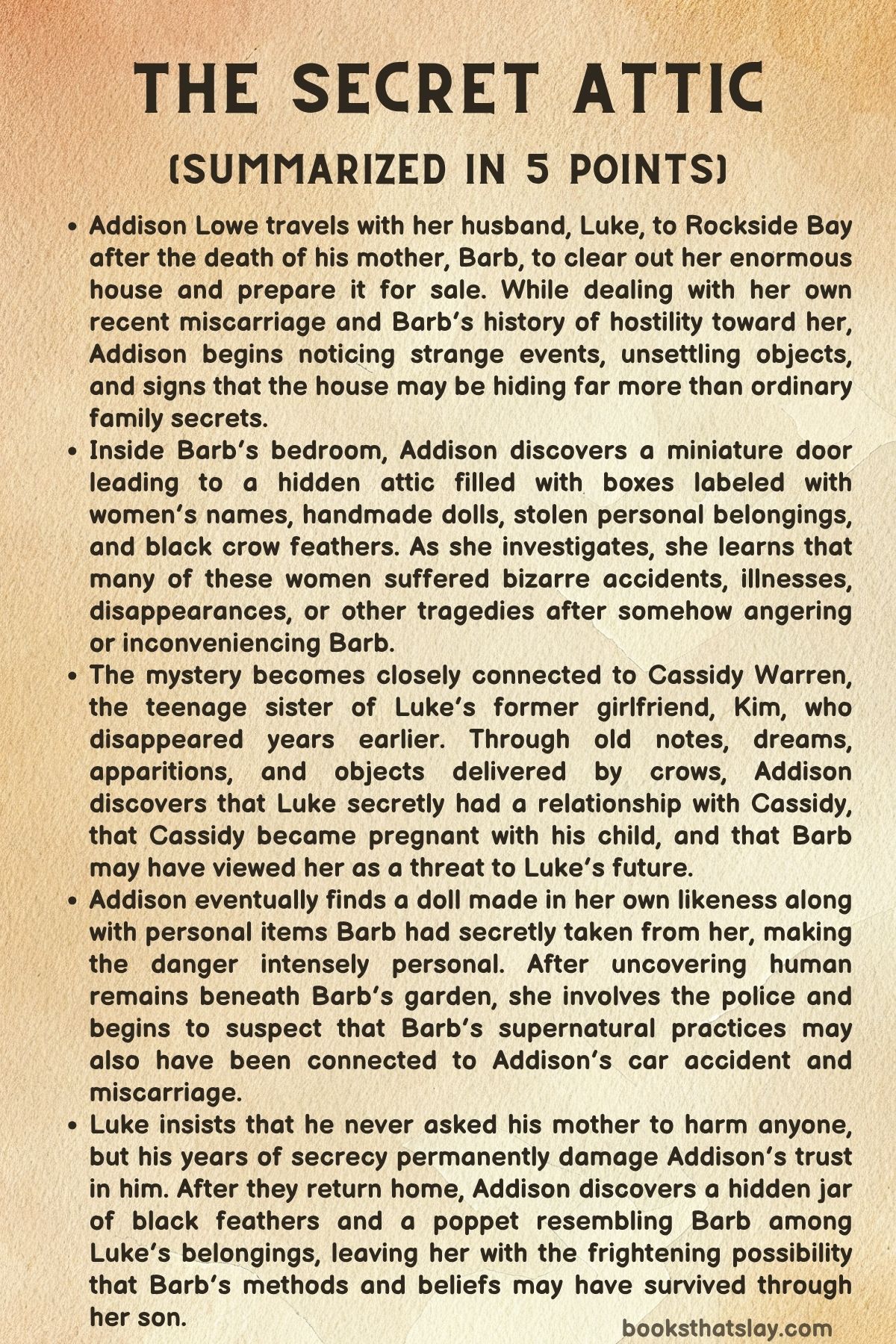
Six months after suffering a miscarriage following a frightening car accident, Addison Lowe travels with her husband, Luke, from Austin to Rockside Bay, Oregon. Luke’s mother, Barb, has died, leaving behind an enormous three-story house filled with possessions that must be sorted before the estate can be sold.
Addison has complicated feelings about the task because Barb never welcomed her into the family. She criticized Addison regularly, openly preferred other women for Luke, and filled the house with reminders of her son’s achievements, yet Addison suppresses her resentment because Luke supported her through the trauma of their miscarriage and now needs her help with his own grief.
From the moment Addison enters the house, however, she feels uncomfortable. Barb’s presence seems to remain in the rooms, Luke becomes increasingly overwhelmed by his mother’s possessions, and unexplained incidents make Addison feel watched.
A local woman named Meg Haltom soon arrives looking for a cherry-painted baking dish she once brought to Barb’s house and never received back. During the conversation, Meg claims she thought she saw Addison’s teenage daughter standing in an upstairs window, even though Addison and Luke have no daughter.
The comment strikes Addison particularly hard because of her recent pregnancy loss. Soon afterward, she begins feeding the crows that gather around Barb’s property, developing affection for birds she names Nixie, Eddie, and others, while Luke reacts with surprising hostility and warns her that crows remember those who hurt them.
As Addison begins clearing Barb’s bedroom, she discovers the full extent of her mother-in-law’s hoarding. Expensive clothes, jewelry, cosmetics, shoes, unopened packages, and hundreds of bottles of nail polish crowd the room, while Barb’s perfume and remembered criticisms make Addison feel as if the dead woman is still judging her.
Behind piles of boxes inside Barb’s walk-in closet, Addison finds a miniature decorated door. Crawling through it leads not to a small storage space but to an enormous hidden attic containing row after row of carefully labeled boxes.
Each box bears a woman’s name. When Addison opens one marked Cassidy Warren, she finds personal belongings, handwritten papers, a handmade doll resembling Cassidy, and a black crow feather.
Luke reacts intensely when Addison brings him the box and hurriedly throws it away. He explains that Cassidy was the younger sister of his high-school girlfriend, Kim Warren, but Addison later remembers that Cassidy disappeared and died when she was only fourteen.
The discovery changes Addison’s attitude toward the house. She begins wondering why Barb kept a secret collection involving a dead teenage girl and why Luke seems unwilling to discuss it.
Stranger evidence soon appears. Addison finds black feathers inside dishes, a doll arm in the garden, strange physical marks on her body, tapping noises, shifting spaces inside the attic, and objects that should not be where she finds them.
She dreams about Cassidy and later encounters what appears to be the dead girl’s presence. Meanwhile, the crows repeatedly bring Addison meaningful objects, including a bead from Cassidy’s bracelet, an old note, and eventually Cassidy’s promise ring.
Luke insists that these events either have ordinary explanations or should simply be forgotten. His defensiveness begins creating a divide between husband and wife, especially because Addison realizes that she has started hiding information from him just as he appears to be hiding information from her.
While sorting Barb’s possessions, Addison discovers decades of newspaper clippings about accidents, disappearances, illnesses, deaths, and unexplained tragedies in Rockside Bay. Several surnames correspond with names she has seen on boxes inside the hidden attic.
Her suspicions deepen when she meets local women and asks about several of the names. She learns that people associated with Barb often experienced astonishing misfortune after offending, competing with, or angering her.
Kathryn Wall, for example, suffered repeated personal disasters after her husband disappeared at sea. Debbie Thorne once angered Barb by pushing her daughter Becky toward Luke, and Becky later survived a devastating wakeboarding accident.
The pattern suggests that Barb’s dolls were never harmless gifts. Addison begins to suspect that the objects in the hidden attic somehow correspond to the suffering experienced by Barb’s enemies.
Her concern becomes personal when she finds a porcelain doll head resembling herself. Shortly afterward, she enters the attic again and discovers Meg Haltom’s missing baking dish inside Meg’s box, proving that Barb deliberately collected personal objects belonging to the women represented there.
Addison also finds black feathers, twine, paintbrushes, red velvet, and other objects that resemble ritual materials. Through her phone camera, she sees the figure of a young woman hidden among vines, silently warning her.
Luke nevertheless tries to explain the dolls as products of Barb’s artistic hobby. Addison can no longer accept that interpretation because the stolen objects, feathers, injuries, historical tragedies, and secret boxes form too clear a pattern.
Their marriage is strained further when Addison discovers that Luke has secretly allowed Kim Warren to help with Barb’s finances. The betrayal is particularly painful because Addison is a CPA and specifically came to Oregon to support him.
Luke finally admits that Barb made him promise not to share her finances with Addison. He says he was trying to protect his wife from learning that Barb continued to reject her even while dying, but Addison recognizes that his secrecy has repeatedly prevented them from confronting important truths together.
Cassidy’s presence becomes more direct. In a disturbing dream, she tells Addison that Barb never gave anything without a reason, warns that Barb would not tolerate anyone interfering with Luke’s future, and repeatedly begs Addison to find her.
When Addison wakes with actual dirt on her clothing, she stops treating the experiences as ordinary nightmares. She becomes convinced that Cassidy is attempting to guide her toward something hidden on the property.
The crows soon deliver Cassidy’s promise ring, which Luke immediately recognizes. He claims not to know who gave it to her, but his reaction convinces Addison that there is still more to his relationship with Cassidy than he has admitted.
Determined to discover the truth, Addison returns to the attic while Luke is away. The room seems to shift around her until she reaches another concealed chamber containing hundreds of completed dolls arranged like an audience.
At the center is a newer box containing a doll made to look exactly like Addison. The box also contains possessions Barb secretly collected from her, including an orange sweater, an earring, a receipt, a vitamin container, and strands of her hair.
Many of the older dolls have injuries painted onto them, and black crow feathers have been attached to their backs. Addison notices that her unfinished doll does not yet have a feather, suggesting that whatever Barb intended for her may not have been completed before Barb died.
Cassidy’s apparition warns Addison that she is running out of time and that someone knows what she has discovered. Filled with anger toward Barb, Addison goes outside and begins destroying the garden her mother-in-law loved.
While digging, she strikes something hard beneath the soil. The object is a human femur.
Luke returns and tries desperately to stop Addison from digging, but she refuses. The police are called, and Addison finally tells them about both the human remains and the hidden attic.
Officers enter the secret rooms and see the dolls for themselves, proving that Addison has not imagined Barb’s collection. The investigation also forces Luke into a confrontation with secrets he has avoided for decades.
At a motel afterward, Addison reads another letter from Cassidy to Luke. The note reveals that Cassidy and Luke shared a secret romantic and sexual relationship while Luke was dating Cassidy’s older sister, Kim.
Luke eventually confesses that he was eighteen and Cassidy was a high-school freshman when they slept together. More seriously, Cassidy told him shortly before her disappearance that she was pregnant with his child.
Luke says he panicked and told no one. He then admits that he knew what Barb’s dolls actually represented: they were poppets through which Barb believed she could direct intentions toward people, with crow feathers apparently serving as part of the binding process.
Luke concludes that Barb must somehow have discovered Cassidy’s pregnancy and regarded the girl as a threat to the future she planned for her son. Addison now has a possible explanation for Cassidy’s disappearance and death.
The discovery also forces Addison to reconsider her own tragedy. Luke admits that Barb knew Addison was pregnant and knew about a disagreement between Luke and Addison over his desire to buy an expensive Porsche.
Addison suddenly sees her unexplained car accident and miscarriage differently. Although she cannot prove Barb caused them, the existence of Addison’s unfinished poppet makes the possibility terrifyingly credible.
Luke insists that he never asked his mother to harm Cassidy, Addison, or anyone else. Addison partly believes him, but she realizes that he understood more about Barb’s abilities and behavior than he had ever admitted.
The problem is therefore no longer only Barb’s actions. Addison must confront the fact that Luke’s lifelong habit of silence allowed his mother’s secrets to remain protected even when other people suffered.
After returning to Austin, Luke seems able to resume normal life much faster than Addison. Disturbingly, he uses part of his inheritance to buy the Porsche he had always wanted, making the vehicle inseparable in Addison’s mind from the argument that may have motivated Barb to target her.
Officer Brady later tells Addison that investigators have cleared Luke in Cassidy’s death while uncovering disturbing connections between Barb, the attic, and other events in Rockside Bay. Brady also reveals that Cassidy was his cousin and gives Addison an unusual warning to take care of herself.
Still suspicious, Addison searches Luke’s home office and closet. Hidden on a high shelf, she finds a jar filled with black crow feathers.
Beside it is a small woolen poppet made to resemble Barb, with a feather tied around its neck. The discovery transforms Addison’s understanding of Luke once again.
Throughout their marriage, Luke has repeatedly promised that he would do anything for Addison and the family they hope to build. Seeing the poppet and feathers, Addison finally understands that his promise may be much more literal than she ever imagined.
Barb may be dead, but the methods she used to protect Luke may not have died with her. Addison ends the story facing the possibility that Luke, whether through inheritance, knowledge, or choice, has become capable of continuing the very practices that terrified her in his mother’s house.
Characters
Addison Lowe
Addison is the central consciousness of The Secret Attic, and much of her characterization grows from the tension between her instinct to care for other people and her increasing realization that constant self-sacrifice can make her vulnerable. She arrives in Rockside Bay determined to support Luke despite her own grief, instinctively placing his bereavement ahead of her miscarriage, her discomfort around Barb’s possessions, and her painful memories of how Barb treated her.
Her identity as a practical fixer initially gives her emotional stability. She organizes clutter, reassures Luke, makes decisions, plans donations, and searches for rational explanations because solving problems has been one of her lifelong survival strategies.
The house gradually defeats that strategy because the problems cannot be reduced to ordinary tasks. Moving objects, physical injuries, impossible spaces, dreams, dolls, feathers, and apparitions force Addison to consider possibilities that contradict the practical worldview through which she normally controls fear.
Her relationship with Luke reveals another important side of her character. Addison loves him deeply and repeatedly gives him the benefit of the doubt, even when his reactions would justify suspicion.
That loyalty is admirable but also dangerous because she sometimes turns trust into self-silencing. She conceals her doubts, postpones confrontations, accepts incomplete explanations, and tells herself that protecting Luke’s emotional state is more important than demanding answers.
Her development therefore depends less on becoming fearless than on learning to take her own perception seriously. Once she accepts that her discomfort matters, she begins documenting the attic, investigating the women, challenging Luke, calling the police, and refusing to remain in Barb’s house.
The miscarriage also shapes nearly every part of Addison’s emotional journey. Cassidy’s pregnancy, Barb’s obsession with Luke’s future, the baby clothes, Addison’s dreams of motherhood, and the possibility that Barb caused her accident all turn the central mystery into something intensely personal.
By the end, Addison has gained information but not security. Her discovery of Luke’s hidden feathers and Barb poppet suggests that her greatest danger may no longer be the dead woman whose house she escaped, but the husband whose capacity for secrecy she has repeatedly underestimated.
Luke Lowe
Luke is one of the book’s most morally complicated figures because he exists simultaneously as a grieving son, loving husband, frightened keeper of family secrets, former teenage offender, and possible inheritor of Barb’s methods. His affection for Addison appears genuine, yet genuine love does not prevent him from repeatedly withholding information that directly affects her safety.
His attachment to Barb dominates his behavior in Rockside Bay. He struggles to throw away her belongings, cannot initially enter her bedroom, protects her financial privacy after death, and instinctively searches for harmless explanations whenever Addison uncovers evidence that threatens his image of his mother.
These reactions can partly be understood as grief, but they also reflect conditioning. Luke grew up under a mother whose love was intensely protective and controlling, so silence around difficult subjects has become normal to him.
His relationship with Cassidy exposes the darkest part of his past. At eighteen, he secretly slept with the significantly younger Cassidy while dating her sister Kim, and he kept silent when Cassidy revealed that she was pregnant.
The book does not present him as directly responsible for Cassidy’s death, and police eventually clear him, but his choices created circumstances in which secrecy became dangerous. His later insistence on withholding information from investigators continues the same behavioral pattern.
Luke often claims that he hides things to protect Addison. He uses similar reasoning when explaining why he allowed Kim to handle Barb’s finances and why he avoided discussing painful parts of his history, but these attempts at protection repeatedly deny Addison the information she needs to make decisions for herself.
This makes his final portrayal particularly unsettling. The jar of crow feathers and poppet of Barb suggest that Luke may have learned far more from his mother than he admitted, leaving open whether he has adopted her supernatural practices, experimented with them, or intends to use them for the people he loves.
His final significance lies in the disturbing similarity between Barb’s declarations of protective love and Luke’s repeated promise that he would do anything for Addison and their future family. What once sounded reassuring becomes threatening because the story has already shown what “anything” can mean in the Lowe family.
Barb
Although Barb is dead before the main events begin, she remains the dominant force in The Secret Attic. Her belongings, opinions, secrets, rituals, social relationships, and expectations continue controlling the living long after her physical absence.
Publicly, Barb appears to have been energetic, socially influential, charitable, and deeply involved in Rockside Bay. Her food-bank work and community connections created a respectable public identity that existed beside a much harsher private personality.
Her relationship with Addison reveals her controlling nature. Barb criticizes her daughter-in-law, questions her suitability for Luke, excludes her financially, and appears to have secretly collected Addison’s possessions while constructing a poppet in her likeness.
Her love for Luke is the key to understanding her character. Barb preserves almost everything connected with his childhood, celebrates his accomplishments, interferes in his relationships, and seems determined to remove anything she interprets as a threat to the life she imagines for him.
That devotion is not selfless because it refuses to recognize Luke as an independent adult. Barb’s idea of protecting her son requires controlling other people’s choices and, potentially, their bodies and lives.
The attic exposes the scale of her behavior. Women who angered or inconvenienced her appear to have been represented through poppets made using stolen possessions and crow feathers, while many of those women subsequently experienced terrible misfortune.
Cassidy becomes the clearest example of Barb’s possible capacity for violence. If Barb discovered that Cassidy was pregnant with Luke’s child, the teenager would have represented everything Barb feared: scandal, loss of control, and a future for Luke that Barb had not chosen.
Addison’s unfinished doll shows that Barb’s obsession continued until the end of her life. Even her son’s wife and unborn child could apparently become obstacles if Barb believed they stood between Luke and the future she preferred.
Her character ultimately turns maternal devotion into a question about possession. Barb does not merely want Luke to be happy; she wants the authority to define happiness for him and to eliminate whatever threatens her definition.
Cassidy “Cassie” Warren
Cassidy is initially introduced as a missing and murdered teenager from Luke’s past, but she gradually becomes the emotional and moral center of the mystery. Her voice has been suppressed for years, and much of the story concerns Addison learning to hear what Cassidy was never allowed to reveal while alive.
The early clues present Cassidy through fragments: a sweatshirt, bracelet, doll, notes, promise ring, newspaper articles, dreams, and apparitions. This fragmented presentation reflects the way her identity was reduced after her disappearance to a tragedy people preferred not to discuss.
As more information emerges, Cassidy becomes much more than a victim. She loved Luke, believed he had made promises to her, secretly continued a relationship with him, became pregnant, and expected some form of future that Luke was unwilling or unable to face.
Her age makes the relationship especially troubling. Cassidy was a high-school freshman while Luke was eighteen, creating an imbalance that complicates every later description of their connection.
In death, Cassidy becomes Addison’s guide rather than her tormentor. Her appearances are frightening in form, but her actions are consistently directed toward warning Addison, exposing Barb, revealing hidden evidence, and preventing another woman from suffering the same fate.
Cassidy’s connection with the crows and vines also gives her a form of agency she lacked during life. Objects connected to her repeatedly return, as though the truth itself refuses to remain discarded.
Her pregnancy creates a painful parallel with Addison’s miscarriage. Both women become vulnerable because their pregnancies may interfere with Barb’s plans for Luke, linking two women from different generations through the same controlling family dynamic.
Cassidy ultimately represents the cost of secrecy. Her tragedy becomes possible not simply because one person may have wanted her gone, but because fear, shame, silence, and loyalty allowed the truth surrounding her life to remain buried for decades.
Kim Warren
Kim is Luke’s former girlfriend and Cassidy’s older sister, placing her at the intersection of Luke’s adolescent past and Addison’s present insecurity. At first, Addison understandably sees her as a possible romantic threat because Kim remains connected with Luke and shares a history that he seems unwilling to discuss openly.
Kim’s behavior does little to reduce that tension. Her long lunch with Luke, involvement in Barb’s financial affairs, familiarity with his grief, and dismissive treatment of Addison at the pub create a sense that she still possesses access to parts of Luke’s life from which his wife has been excluded.
Yet Kim is also another person damaged by secrecy. She lost her younger sister without knowing that Cassidy had secretly been involved with her own boyfriend or that Cassidy was pregnant.
Luke’s decision never to tell her means Kim has spent decades understanding Cassidy’s disappearance through incomplete information. Her later closeness with Luke therefore acquires tragic irony because she turns to someone who knows far more about her sister’s final days than she realizes.
Kim also demonstrates Barb’s influence beyond her immediate family. Barb apparently preferred Kim to Addison, and Kim’s involvement with Barb’s charitable legacy and finances allows the dead woman’s preferences to continue shaping Luke’s relationships.
She is not established as a villain. Instead, her presence exposes the consequences of information being distributed unequally, with Addison, Kim, and Cassidy each knowing different pieces of a story that Luke and Barb helped keep divided.
Katy Colter
Katy Colter provides Addison with one of her first important sources of outside validation. As someone who knew Luke and Barb within Rockside Bay, she can speak about the family without sharing Luke’s instinctive need to defend his mother.
Her acknowledgement that Barb performed substantial charitable work without necessarily being kind helps Addison separate reputation from character. This distinction becomes crucial because Barb’s public usefulness has protected her from closer moral scrutiny.
Katy’s own serious bicycle accident also places her near the pattern Addison is discovering. Because Addison remembers seeing Katy’s name among Barb’s boxes, even seemingly ordinary conversation with Katy becomes evidence that the attic may correspond with real suffering.
As a local attorney and former school competitor of Luke, Katy also represents a life outside Barb’s control. Her relatively independent perspective gives Addison information she cannot obtain inside the Lowe family.
Kathryn Wall
Kathryn Wall functions primarily as evidence of the historical reach of Barb’s possible actions. Addison recognizes her name both from the hidden collection and from local accounts of extraordinary misfortune.
After Kathryn’s husband disappeared at sea, her life reportedly became marked by repeated difficulties involving her health, work, appearance, relationships, and general fortune. The sheer accumulation of disasters makes her story important to Addison’s developing theory about the dolls.
Luke’s refusal to discuss Kathryn inside Barb’s house adds another level of significance. His reaction suggests that Kathryn represents more than distant community gossip and that certain names carried unspoken rules within the Lowe household.
Kathryn therefore helps move Addison beyond the possibility that Cassidy was an isolated tragedy. Her multiple damaged dolls indicate that Barb’s practices may have been repeated, sustained, and refined across time.
Meg Haltom
Meg initially appears to be a minor local acquaintance searching for a missing baking dish, but her role becomes unexpectedly important. Her casual claim that she saw a teenage girl in the upstairs window gives Addison one of her earliest indications that another presence may exist inside the house.
The later discovery of Meg’s cherry-painted dish inside her hidden box proves something equally important: Barb deliberately took personal objects belonging to the women represented by the dolls. That finding makes it much harder to explain the collection as an innocent artistic hobby.
Meg therefore contributes both supernatural and physical evidence. Without intending to investigate anything, she provides Addison with clues that later help connect the secret attic to real people outside the Lowe family.
Officer Brady
Officer Brady occupies a small but strategically important role near the end of the story. As one of the authorities involved after human remains are uncovered, he helps move Cassidy’s case from private suspicion into an official investigation.
His personal connection to Cassidy changes the emotional meaning of his involvement. Cassidy was his cousin, making the investigation part of his own family history rather than merely another old case.
Brady eventually tells Addison that Luke has been cleared in Cassidy’s death while also acknowledging disturbing connections involving Barb and the attic. His warning that Addison should take care of herself suggests that even official conclusions have not eliminated every source of danger.
Because Addison soon discovers Luke’s hidden feathers and poppet, Brady’s warning takes on additional significance. Whether he knows more than he says remains uncertain, but his caution prepares both Addison and the reader to question the apparent resolution.
Debbie Thorne
Debbie Thorne matters because her conflict with Barb provides another example of the pattern Addison identifies throughout Rockside Bay. Debbie repeatedly attempted to encourage a relationship between Luke and her daughter Becky, despite Luke’s lack of interest.
Barb reportedly resented this pressure intensely. Once Addison understands the relationship between Barb’s anger and other people’s accidents, Debbie’s behavior becomes part of a much larger system of cause and possible retaliation.
Debbie herself is not developed extensively in the supplied material. Her importance lies mainly in demonstrating how aggressively Barb guarded Luke’s romantic future and how even ordinary social interference could apparently earn her resentment.
Becky Thorne
Becky is another possible victim of the consequences surrounding Barb. After Debbie’s attempts to push her toward Luke anger Barb, Becky suffers a horrific wakeboarding accident that breaks nearly every bone on one side of her body.
The accident is significant because it resembles the extreme and improbable misfortunes connected to other women in Barb’s orbit. Addison therefore interprets Becky’s suffering not as an isolated event but as another possible result of Barb attempting to remove an unwanted influence.
Becky also shows the indiscriminate nature of Barb’s supposed protection. Even if Debbie created the conflict, it is Becky who suffers physically, suggesting that Barb’s desire for control matters more to her than fairness or proportion.
Uncle Stan
Uncle Stan appears mainly through Luke’s account of a disturbing childhood story involving the crows. According to Luke, a crow destroyed Stan’s eye following a bitter property dispute, helping establish the family belief that the birds remember hostility and retaliate against enemies.
His experience gives context to Luke’s fear of the flock. What Addison initially sees as irrational hostility toward harmless birds may instead come from a lifetime of stories in which crows were associated with punishment, memory, and family conflict.
Stan therefore helps explain why Addison and Luke interpret the birds so differently. For Addison they become protectors and messengers, while for Luke they represent dangerous forces that should never be trusted.
Addison’s Mother
Addison’s mother appears largely through memory, yet she contributes to Addison’s sense of identity. She taught her daughter to value financial independence, practicality, and the ability to survive without relying entirely on another person.
Those lessons help explain why Addison becomes so frustrated when Luke excludes her from Barb’s finances despite her professional expertise. The issue is not merely jealousy over Kim; it strikes directly at values Addison has been taught to regard as central to adulthood and self-respect.
Her mother also provides an important contrast with Barb. Both women influence their children deeply, but Addison’s mother encourages competence and independence, whereas Barb’s love for Luke repeatedly moves toward control and possession.
Eddie, Nixie, and the Crows
The crows function almost like a collective character because their actions consistently influence Addison’s investigation. Eddie and Nixie become especially familiar to her, turning what Luke considers threatening animals into sources of comfort during her growing isolation.
They repeatedly deliver evidence connected with Cassidy, including a bracelet bead, notes, and the promise ring. Their behavior suggests that they are assisting the dead girl or responding to forces associated with Barb’s rituals.
The black feathers also have a darker meaning because Barb uses them in connection with the poppets. The same species can therefore symbolize both harm and resistance, depending on who controls or interprets the feathers.
For Addison, the living crows ultimately become allies rather than threats. Their willingness to tear at the invasive vines and bring hidden objects into view associates them with exposure, memory, and the refusal to let buried wrongdoing remain forgotten.
Wendy Owen and the Other Women in Barb’s Collection
Wendy Owen, Beverly Polson, Evelyn Caputo, Ellie Watts, and several other women appear mainly through names attached to boxes in the attic. The supplied material does not provide enough individual history to support detailed personal biographies for each of them.
Their collective importance, however, is substantial. Their number demonstrates that Barb’s collection extends far beyond Cassidy, Kathryn, Meg, or anyone connected directly with Luke’s adolescence.
The women transform the attic from evidence of one obsession into evidence of a long-term system. Each box suggests that Barb observed people, collected objects associated with them, represented them through dolls, and possibly directed harmful intentions toward them.
Their limited characterization is therefore part of their narrative function. Addison cannot fully recover every person’s story, which reinforces the unsettling possibility that many lives were affected without anyone recognizing the pattern while Barb was alive.
Themes
Love, Protection, and Control
Love repeatedly becomes dangerous when one person decides that caring for someone gives them the right to control that person’s future. Barb’s devotion to Luke is genuine in the sense that she treasures his childhood, celebrates his achievements, protects his interests, and organizes much of her emotional world around him.
Yet her love refuses to accept boundaries. Rather than allowing Luke to make mistakes, choose relationships, manage disappointment, or face consequences independently, she appears to remove the people and situations she considers threatening.
This distinction between support and possession shapes The Secret Attic. Barb does not merely want Luke to succeed; she wants his life to follow a course she has chosen, even if protecting that course requires violating other people.
Cassidy becomes an apparent threat because her pregnancy could permanently change Luke’s future. Addison may later become another because her disagreement with Luke and her pregnancy give her influence over a life Barb still treats as belonging partly to herself.
The final revelation makes the theme more disturbing because Luke repeatedly uses the language of protection as well. He hides information from Addison because he claims he wants to spare her pain, yet his protection also takes away her ability to make informed choices.
By the closing pages, the jar of feathers and Barb poppet raise the possibility that Luke has inherited more than his mother’s possessions. The story leaves readers questioning when devotion stops being an expression of love and becomes a justification for controlling another person’s reality.
Secrecy and the Destruction of Trust
The central relationships are damaged less by single revelations than by layers of concealed information. Addison initially trusts Luke deeply, but that trust begins weakening each time she discovers that his explanation is incomplete.
Luke hides the nature of his relationship with Cassidy, Cassidy’s pregnancy, his knowledge of Barb’s poppets, Barb’s financial instructions, and Kim’s involvement with the estate. Even when his motives are understandable, the cumulative effect is destructive because Addison can no longer determine which version of events will remain true after the next discovery.
Secrecy also destroys relationships beyond the marriage. Kim does not know that Luke slept with Cassidy, Cassidy had to hide her relationship with Luke from her sister, and Cassidy’s pregnancy disappears into decades of silence after her death.
Barb depends on secrecy even more completely. Her public identity as a respected charitable woman remains possible because the attic, stolen possessions, dolls, feathers, and resentments are concealed behind walls and social respectability.
The physical architecture of the house reflects this emotional structure. Rooms exist behind rooms, boxes conceal objects, doors open only at certain times, possessions disguise entrances, and evidence remains buried beneath a carefully maintained garden.
Addison’s investigation therefore becomes a movement from concealment toward knowledge. Her marriage does not become safer simply because she learns more, but knowledge allows her to stop relying entirely on another person’s version of reality.
The final scene shows why trust cannot survive indefinitely without transparency. Finding Luke’s secret collection means that even after every confession, Addison still does not know the full truth about the person beside her.
Grief, Motherhood, and Reproductive Loss
Addison’s miscarriage gives emotional weight to almost every discovery she makes. She arrives at Barb’s house already grieving a child she expected to have, while also trying to support a husband whose loss seems more immediate because his mother has recently died.
Her instinct is to minimize her own pain. Yet the house repeatedly forces the subject of motherhood back into her consciousness through baby clothes, Barb’s expectations, Cassidy’s pregnancy, Luke’s hopes for future children, and the doll created in Addison’s likeness.
Cassidy’s story transforms Addison’s grief because the two women may have been targeted for related reasons. Cassidy was pregnant with Luke’s child when she disappeared, while Barb also knew of Addison’s pregnancy before the car accident that caused her miscarriage.
This parallel turns reproductive loss into more than private sorrow. Pregnancy becomes connected with power because Barb appears unwilling to let women shape Luke’s future through motherhood unless their presence fits her own expectations.
Addison consequently has to reclaim the idea of becoming a mother from Barb’s judgment. She resists the suggestion that Barb should remain the model against which her own maternal worth is measured and begins imagining motherhood according to her own values.
Luke’s desire for children initially offers hope, but the ending complicates even that dream. If he has inherited Barb’s belief that protecting family justifies extreme actions, Addison must question what kind of protection he might consider acceptable for their future household.
The theme therefore connects grief with autonomy. Addison is not only mourning the child she lost; she is struggling to regain authority over what motherhood, marriage, and family should mean in her own life.
The Persistence of the Past
Rockside Bay is filled with events that have technically ended but have never truly disappeared. Cassidy has been dead for years, Barb is gone, Luke’s adolescence is long over, and many of the town’s accidents belong to previous decades, yet every hidden object shows that unresolved history continues shaping the present.
Barb’s house becomes the clearest representation of this persistence. It contains Luke’s childhood possessions, ancient newspapers, telephone records, stolen belongings, secret dolls, forgotten notes, and physical remains buried beneath the garden.
Nothing has really been discarded. Even objects Luke throws away return through the crows, suggesting that suppression cannot permanently erase what happened.
The same principle applies psychologically. Luke believes he can avoid Cassidy by refusing to discuss her, but his refusal only allows the secret to control his behavior more strongly when Addison starts asking questions.
Addison initially tries a similar strategy with her miscarriage. She channels her energy into helping Luke and completing practical tasks, yet grief repeatedly returns through objects and experiences that demand recognition.
Cassidy embodies the past’s refusal to remain silent most clearly. Her apparition does not seek revenge against Addison; she seeks discovery, recognition, and the recovery of a truth that was denied while she was alive.
The final discovery in Austin extends the theme beyond Barb’s house. Addison may leave Rockside Bay physically, but she cannot leave behind what the attic revealed because the feathers and poppet in Luke’s closet show that family histories survive through habits, beliefs, secrecy, and imitation.
The ending therefore denies the comfort of treating the past as something safely completed. Until concealed actions are understood and destructive patterns are consciously broken, what happened before continues shaping what people become next.