The Secret World of Briar Rose Summary, Characters and Themes
The Secret World of Briar Rose by Cindy Pham is a dark reimagining of the Sleeping Beauty story that examines what happens when people stop believing that love, courage, or goodness can guarantee a happy ending.
Set across two connected timelines, the novel follows Corin, a hardened survivor searching for her missing sister, and Amelia, the legendary sleeping princess whose disappearance helped shape a century of suffering. Their stories gradually reveal that fairy tales have hidden the truth about Gyldan, its rulers, its supposed heroes, and its monsters. At its core, the book is about grief, choice, survival, identity, responsibility, and the difficult decision to continue living without knowing what comes next.
Summary
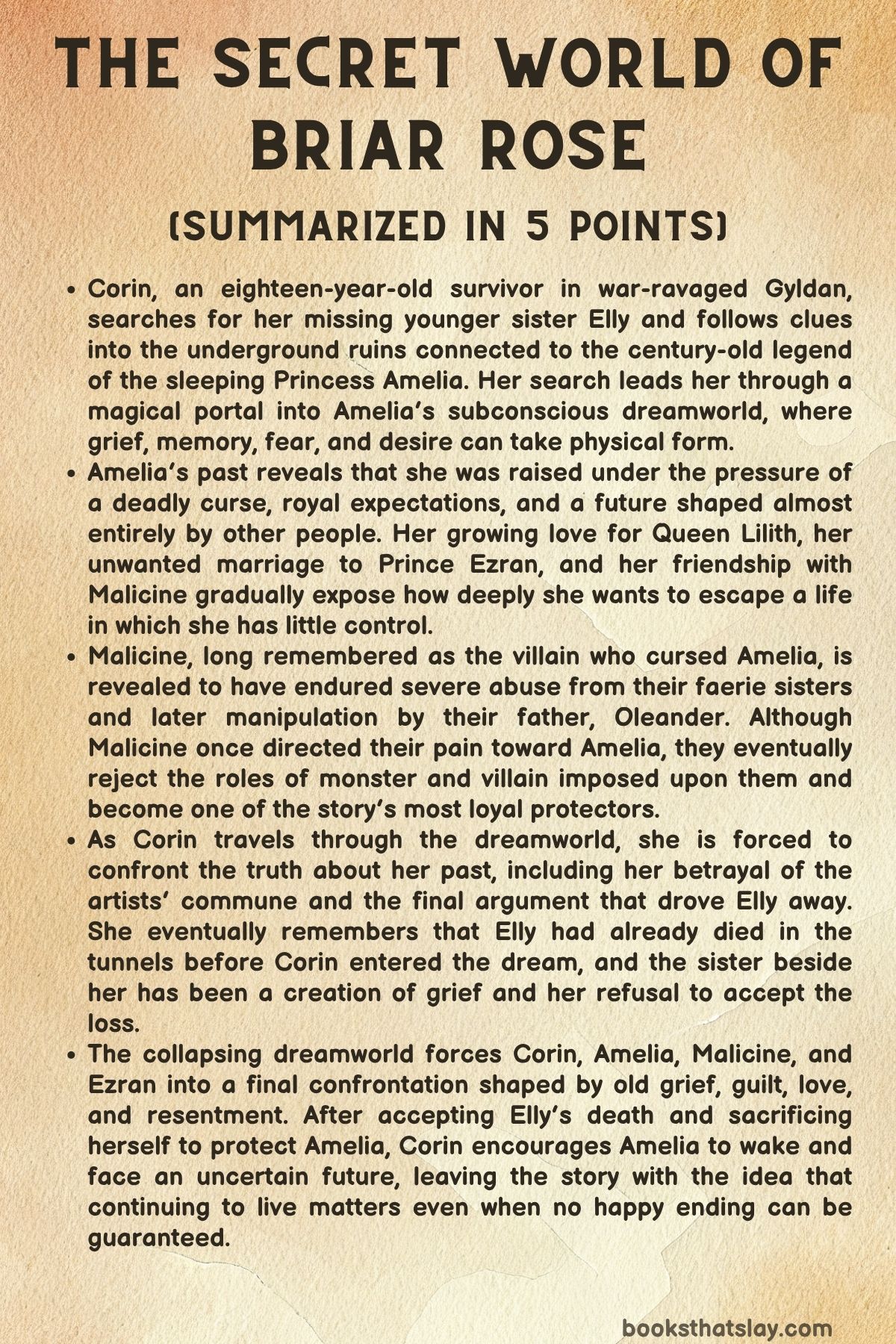
Eighteen-year-old Corin lives in the ruined country of Gyldan, a place devastated by generations of territorial warfare. Her twelve-year-old sister, Elly, has disappeared after a terrible argument in which Elly told Corin that she hated her, leaving Corin to search desperately through streets where poverty and violence have made compassion difficult to maintain.
Corin has spent years learning that survival often demands ugly choices. Once a child who loved painting, she lost her mother at ten, then watched her grieving father attempt to drown himself and his daughters; Corin managed to save baby Elly but could not save him.
The sisters later found a new family among an artists’ commune led in part by Harlow. That refuge was also destroyed by political violence, reinforcing Corin’s belief that love creates vulnerabilities that the world eventually punishes.
After soldiers destroy Corin’s latest shelter, she discovers signs that Elly has entered the underground tunnels connected to Gyldan’s Sleeping Beauty legend. According to the story, Princess Amelia fell into an enchanted sleep one hundred years earlier, and the castle was eventually buried with her after true love failed to awaken her.
Corin follows Elly underground despite considering the legend foolish. Starving and exhausted, she encounters the remains of previous treasure seekers before discovering a hidden entrance into the buried castle, where Amelia is still asleep beneath roses and moonflowers.
There Corin sees three faerie godmothers, Dahlia, Iris, and Clover, along with an apparently immortal warrior named Ezran. When a magical portal opens above Amelia’s bed and Corin hears Elly calling from within it, she enters without hesitation.
The story simultaneously reveals Amelia’s life more than a century earlier. Raised as King Victor’s only daughter, Amelia has known since childhood that a curse supposedly condemns her to eternal sleep on her eighteenth birthday unless true love’s kiss saves her.
Her godmothers have blessed her with beauty and song, but their gifts offer little comfort. Amelia feels increasingly detached from a life in which everyone values what she represents while rarely asking what she actually wants.
Her most meaningful relationship develops with her young stepmother, Queen Lilith. Lilith supports refugees, challenges Gyldan’s isolationism, and believes that societies improve when people choose to help one another rather than protect privilege.
Amelia gradually falls in love with her. Yet she knows that acknowledging those feelings would threaten her position, her father’s expectations, and the future others have designed for her.
Meanwhile, another hidden history emerges through Malicine. Born to the same faerie family as Dahlia, Iris, and Clover, Malicine enters the world with green skin, horns, and claws, and their mother dies giving birth to them.
Instead of receiving comfort, Malicine is blamed for the death. Their sisters imprison and abuse them for years, treating physical difference as evidence of evil until Malicine finally escapes after transforming into a dragon and rescuing an injured raven they name Talon.
At eighteen, Malicine takes revenge by appearing at Amelia’s birth celebration. They curse the infant princess to fall into eternal sleep, not because Amelia has done anything wrong, but because harming the godmothers’ royal charge will humiliate the sisters who abused Malicine.
Years later, Amelia grows increasingly trapped between royal duty and private despair. Victor demands that she become strong according to his definition of strength, marry, continue the bloodline, and prepare the kingdom for her expected death or disappearance.
Prince Ezran appears at exactly the moment everyone expects Amelia’s destined rescuer to arrive. When Amelia confesses that she does not desire men and loves Lilith, Ezran uses that knowledge to gain power over her rather than offering understanding.
Amelia marries him because refusal seems almost impossible. Yet her dissatisfaction deepens, and her curiosity turns toward an old account concerning King Samael and the mysterious faerie Oleander, whose relationship helped create the legends surrounding Gyldan.
With Malicine’s help, Amelia discovers that magical blood can open portals between worlds. Amelia and Malicine enter another realm together, each hoping that somewhere beyond Gyldan they might discover a form of existence not dictated by other people’s expectations.
The Otherworld gives physical form to internal identity. Amelia becomes transparent glass, while Malicine meets the Demon King, who reveals himself as their father and as Oleander, the supposedly benevolent figure from Gyldan’s founding legend.
Oleander explains that King Samael persecuted beings he considered monstrous and later attacked Oleander after being denied immortality. Their mixed blood opened the first portal, and Oleander eventually killed Samael after discovering that the king had murdered his parents.
Yet Oleander has not overcome the cruelty he condemns. He intends to use Malicine’s blood to expand his own power, proving that a person who has suffered oppression can still choose to become an oppressor.
When Oleander attempts to sacrifice Malicine, Amelia returns to save them even though her glass body is already breaking. Oleander shatters Amelia, but her decision to come back shows Malicine that someone has chosen them without obligation.
Malicine defeats Oleander by rejecting every narrow identity others have imposed upon them. They then restore Amelia’s body, revoke the sleeping curse, and send her back to Gyldan.
Months have passed in the mortal world. Amelia returns to discover that Lilith has been imprisoned after her relationship with Ezran was exposed, while Victor has become even more determined to preserve royal control.
Victor eventually brings Amelia to a clearing where Lilith and Ezran are bound. Lilith is already dead from abuse and blood loss, and Victor intends to kill Ezran as well.
Amelia finally resists her father openly. During the confrontation, Victor dies while pushing Amelia out of the path of Ezran’s sword, leaving Amelia to confront the complicated reality that an oppressive father can still perform one final act of protection.
Ezran responds to Lilith’s death with rage and blames Amelia. Amelia escapes until Malicine finds her and shelters her in the cottage once intended as the setting for her curse.
At midnight on Amelia’s eighteenth birthday, the moonflowers bloom. Although Malicine has already removed the curse, Amelia deliberately wounds herself on the spindle because she no longer wants to face grief, guilt, political responsibility, or an uncertain future.
Malicine refuses to let her die. Using their combined blood, they restore the sleeping curse and create a portal into Amelia’s subconscious, allowing her to survive within a dream rather than die in reality.
That dream eventually becomes a world divided into seasonal regions. Amelia remakes herself as Briar Rose, the anonymous girl she once imagined becoming, while Malicine joins her in avoiding the lives from which both of them wanted to escape.
A century later, Corin enters this dream while searching for Elly. She finds her sister alive there and initially believes she has succeeded in rescuing her.
Corin, Elly, Malicine, and Briar travel through the dream while searching for a treasure Corin hopes will buy safety in the real world. Yet each seasonal region forces Corin to confront memories she has spent years suppressing.
She remembers her parents, her artistic childhood, the commune, Harlow, and the choices that helped destroy the only community she and Elly had known. Before the commune was attacked, Corin secretly gave information about its resistance activities to the landlord Woodbine in exchange for the possibility of stable housing.
Harlow and the others were later killed. When Corin confessed the truth to Elly, she defended herself by describing everything she had sacrificed for her sister and finally said that she had never wanted Elly.
The revelation explains their final argument, but an even harsher truth waits beneath it. Corin eventually discovers that Elly did not survive the underground tunnels.
Corin had found her sister already dead from starvation before entering Amelia’s dream. The Elly beside her has been created from memory, guilt, love, and Corin’s inability to accept what happened.
This realization nearly destroys Corin. She believes Elly died thinking she was unwanted and interprets every tragedy in her life as proof that she deserves punishment.
Malicine challenges this belief without promising that suffering will disappear. They tell Corin that she cannot make permanent judgments about her life while trapped in the darkest part of her own mind.
Corin also begins to recognize herself in Amelia. She had condemned the princess for sleeping while Gyldan suffered, but both women have been using different forms of escape to avoid unbearable uncertainty.
Corin avoids hope because hope can lead to loss. Amelia avoids waking because life offers no guarantee that pain, failure, or loneliness will ever end.
Their growing emotional connection becomes romantic. For a moment, Corin even suggests that she and Amelia remain asleep together forever, preserving a perfect world where Elly can live and the two women never have to face another goodbye.
The fantasy cannot survive. Ezran enters Amelia’s subconscious, driven by a century of resentment and grief over Lilith.
Malicine attempts to stop him and is fatally wounded while protecting Corin. Before dying, they place a fragment of their magical amulet inside Corin’s family pendant, giving her the power needed to help Amelia escape.
As the dream begins to collapse, Corin’s imagined Elly also starts disappearing. Corin finally understands that keeping Elly alive inside the dream cannot undo her death.
She says goodbye and allows her sister to go. The act does not eliminate grief, but it changes grief from a weapon Corin uses against herself into something she can carry while continuing to live.
Amelia ultimately confronts Ezran and reveals what Lilith meant when she called something her treasure. The treasure was not hidden gold or a magical object but Gyldan itself: an imperfect country whose people and future Lilith believed were worth helping.
Ezran cannot accept that Lilith’s dreams extended beyond him. He attacks again, and Corin takes the wound intended for Amelia before pushing him into the collapsing void.
Dying inside the dream, Corin gives Amelia the amulet and pendant. Rather than asking Amelia to preserve their shared fantasy, she tells her to wake.
The dream briefly offers Corin and Amelia an imagined lifetime together, filled with ordinary seasons, aging, love, disagreement, family, and small pleasures. Its beauty comes precisely from the fact that such a life includes change rather than remaining permanently perfect.
Corin eventually realizes that even this imagined lifetime must end. Amelia fears that waking will only expose her to more pain, and Corin cannot truthfully promise otherwise.
Instead, Corin offers a different reason to continue. No one can guarantee that Amelia’s life will improve, but remaining alive allows possibilities that permanent escape would erase.
The story therefore ends by rejecting the traditional promise that true love rescues people from suffering. What matters is the willingness to remain curious about a future that has not yet been written and to continue despite uncertainty.
Characters
Corin
Corin is the emotional center of The Secret World of Briar Rose, and much of her personality has been formed by repeated loss. She begins as someone who believes survival requires distrust, emotional distance, practical thinking, and the willingness to make morally questionable decisions before someone else takes advantage of her.
Her hardness is not presented as her natural personality. Memories of painting with her mother, playing with Elly, and living among the artists reveal that Corin once possessed imagination, affection, and a strong desire to belong somewhere permanently.
The destruction of each home teaches her to associate attachment with danger. Because people she loves repeatedly disappear, she attempts to protect herself by expecting disappointment before happiness has the chance to reach her.
This worldview explains both her strengths and her failures. Corin is extraordinarily protective of Elly and repeatedly risks her life for her, but she also allows years of responsibility to become resentment that she feels ashamed to admit.
Her betrayal of Harlow’s commune is particularly important because it destroys the simple idea that she is merely a victim of circumstance. She makes a damaging choice in pursuit of security and must later live with consequences that cannot be undone.
Corin’s development therefore depends upon rejecting two extremes. She cannot pretend that her choices caused no harm, but she also cannot reduce her entire identity to the worst decisions she has made.
Her relationship with the dream version of Elly eventually teaches her that regret does not require self-destruction. She learns to acknowledge that she loved her sister while sometimes resenting her, failed her while also protecting her, and caused pain without becoming nothing more than that pain.
Her connection with Amelia extends this lesson. Corin initially judges the princess for choosing escape, only to recognize that her own refusal to hope is another form of running away.
By the end, Corin’s greatest act of courage is not fighting Ezran or enduring physical danger. It is accepting that she cannot control what happens next and still choosing possibility over permanent retreat.
Amelia / Briar Rose
Amelia is one of the most psychologically complex figures in The Secret World of Briar Rose because she spends much of her life being treated as an object within other people’s stories. She is a princess, an heir, a cursed child, a future wife, and a symbol of national stability long before she is allowed to discover who she might become for herself.
Her beauty and musical ability intensify this problem rather than solving it. The gifts supposedly designed to improve her life make other people admire qualities that require nothing from them emotionally, while Amelia remains isolated beneath the image of the perfect princess.
Her dream of becoming Briar Rose reflects the depth of this dissatisfaction. The cottage, sunflowers, animals, and anonymous identity represent a life stripped of expectation, but they eventually become another prison because Briar exists by avoiding everything Amelia cannot bear to confront.
Amelia’s love for Lilith offers her first genuine experience of wanting something outside the role assigned to her. Yet her fear of social judgment, her father’s authority, and Ezran’s manipulation make her feel that desire itself is dangerous.
Her depression cannot be reduced to Malicine’s curse. Learning that the curse had been revoked forces Amelia to recognize that her wish to disappear belongs to her rather than to a supernatural force controlling her.
That realization is painful because it removes a convenient explanation, but it also creates the possibility of agency. If the wish to disappear is hers, then the decision to remain can eventually become hers as well.
Amelia’s relationship with Corin changes her because Corin does not worship the princess or accept Briar’s fantasy at face value. She becomes angry with Amelia, challenges her, sees her failures, and ultimately loves her without requiring perfection.
The ending leaves Amelia with no guarantee of happiness. Her development instead points toward a more difficult form of courage: accepting responsibility for the life she abandoned while allowing herself to believe that an uncertain future may still contain something worth discovering.
Elly
Elly initially appears to represent innocence in contrast with Corin’s harsh realism, but her role is more complicated than simply being the hopeful younger sister. She has grown up amid the same poverty, death, war, and instability as Corin, yet she responds by preserving belief where Corin has learned to destroy it.
Her interest in the Sleeping Beauty legend reveals both imagination and desperation. The fairy tale gives her a reason to believe that the ruined world might contain something beyond hunger and fear, which is why Corin’s constant rejection of hope becomes emotionally exhausting for her.
Elly’s relationship with Corin also exposes the costs of being protected. Corin sees every sacrifice as proof of love, while Elly sometimes experiences that protection as a life in which decisions have already been made for her.
Their final argument contains anger on both sides because neither sister can express the full complexity of their dependence on one another. Corin’s statement that she never wanted Elly attacks the deepest insecurity created by years of hardship, while Elly’s declaration of hatred becomes the final sentence Corin remembers after her death.
The dream version of Elly functions as more than a comforting hallucination. She becomes the form through which Corin gradually reconstructs a fuller memory of their relationship.
Corin initially uses her to deny death, but eventually understands that remembering Elly does not require pretending she is still alive. Elly’s final departure becomes an act of love because Corin stops demanding that memory perform the impossible task of reversing loss.
Malicine
Malicine is introduced through the cultural role of villain, yet their history exposes how completely that label depends upon perspective. They are treated as monstrous from birth because their body violates the standards of beauty accepted by their faerie family.
The death of their mother becomes an excuse for cruelty rather than a tragedy shared by the surviving children. Dahlia, Iris, and Clover imprison Malicine, starve them, humiliate them, and teach them to believe that difference itself is evidence of moral corruption.
Their curse upon Amelia is therefore understandable without being morally justified. Malicine redirects pain toward an innocent child because harming Amelia allows them to punish the sisters who built their reputations as benevolent protectors.
The book never requires the reader to pretend this choice is harmless. Instead, Malicine’s later growth depends upon recognizing that suffering may explain cruelty without making cruelty inevitable.
Their relationship with Oleander develops this idea further. Malicine initially hopes that finding a father who resembles them will provide belonging and an explanation for their abandonment.
Instead, Oleander demonstrates what Malicine might become if pain is converted entirely into the desire for domination. He does not want freedom from oppressive hierarchies; he wants control over the hierarchy himself.
Malicine ultimately rejects both the beautiful faerie identity imposed by their sisters and the destructive demon identity offered by their father. Their declaration that they cannot be contained within simple categories applies to gender, morality, species, family, and social role.
Their relationship with Corin is equally important. Malicine never responds to Corin’s despair with empty promises, which makes their compassion unusually convincing.
By the time they sacrifice themselves against Ezran, Malicine has moved far beyond the person who once believed love was impossible. They die defending people not because destiny demands it but because they have consciously decided that some connections are worth protecting.
Queen Lilith
Lilith represents a form of love grounded in action rather than fantasy. She believes that wealth, political authority, and social position matter only when they are used to improve the lives of people who possess less power.
Her commitment to refugees comes from personal history. The suffering experienced by her mother shapes Lilith’s conviction that borders, prejudice, and respectability should not determine whose life deserves security.
This outlook immediately separates her from Victor and the godmothers. Where they think primarily about royal continuity and preserving Gyldan’s existing order, Lilith imagines a society capable of changing its priorities.
Her relationship with Amelia is tender but complicated by their positions. Amelia sees in Lilith an adult who takes ideas seriously, accepts imperfection, and understands that beauty is not the only measure of value.
Lilith’s history with Ezran adds another dimension to her character. She does love him, but she refuses his belief that romantic love should become the organizing purpose of an entire life.
Her decision not to flee with Ezran is central to understanding her. Lilith wants love, but she also wants her existence to benefit other people, and she refuses to reduce either herself or Gyldan to a prize that a lover can possess.
Her description of Gyldan as her treasure expresses this philosophy most clearly. She recognizes the country’s corruption and failures yet believes its people and future are still worth working for.
Prince Ezran
Ezran is constructed to resemble the traditional prince who should complete the Sleeping Beauty story. He is attractive, royal, courageous in appearance, and introduced at a moment when everyone expects Amelia’s destined rescuer to arrive.
The character gradually exposes the danger of confusing romantic persistence with love. Ezran believes his devotion to Lilith gives him moral authority, yet he repeatedly disregards what Lilith actually wants when her desires conflict with his own.
His treatment of Amelia reveals this selfishness early. When she confesses her attraction to women, he uses her vulnerability to strengthen his position rather than protecting the trust she placed in him.
His marriage to Amelia also serves his continued attachment to Lilith. Amelia becomes useful to him because proximity to the princess gives him proximity to the woman he truly wants.
Lilith’s death transforms his existing possessiveness into obsession. He survives for a century carrying the belief that Amelia destroyed the future he deserved, even though this interpretation strips Lilith of agency and reduces her ambitions to her relationship with him.
Ezran’s misunderstanding of the treasure becomes the clearest expression of his limitation. He assumes Lilith must have meant an object because he cannot imagine that the kingdom and its ordinary people could matter to her as much as personal love.
His final role overturns the traditional fairy-tale structure. The handsome prince becomes the destructive force, while the supposed villain Malicine repeatedly acts with greater loyalty and sacrifice.
King Victor
Victor is both a political authoritarian and a father whose relationship with Amelia is distorted by fear. He wants his daughter to survive, but he cannot separate survival from his own ideas about power, courage, royal responsibility, and legacy.
His treatment of Amelia constantly communicates that her natural personality disappoints him. Her gentleness, imagination, emotional sensitivity, and reluctance toward violence appear to him as weaknesses that must be corrected.
The hunting scene captures this conflict particularly well. Victor believes killing the deer will teach Amelia strength, while Amelia’s refusal to kill demonstrates an entirely different form of conviction.
His violence toward Lilith further reveals the limits of his worldview. He considers her infertility a betrayal because he evaluates marriage largely through dynasty and reproduction.
Yet Victor is not written as a completely emotionless figure. His final act of pushing Amelia out of Ezran’s path demonstrates that his love for his daughter exists even alongside the enormous harm he has caused her.
That contradiction prevents his death from becoming simple moral punishment. Amelia loses both an oppressive ruler and a father, forcing her to hold anger, grief, and love together without pretending they cancel one another out.
Dahlia, Iris, and Clover
Dahlia, Iris, and Clover are associated publicly with kindness, beauty, magical blessings, and the traditional role of benevolent faerie godmothers. Their treatment of Malicine exposes the hypocrisy beneath that image.
Rather than responding to their sibling’s unusual appearance with grief, curiosity, or protection, they immediately decide that Malicine must be dangerous. Their abuse demonstrates how easily societies can redefine cruelty as protection when the victim has already been labeled monstrous.
Dahlia appears especially forceful in establishing Malicine’s imprisonment, while Iris and Clover participate in or accept the same system. Their later status at the royal court allows them to transform themselves from abusers into celebrated symbols of goodness without confronting what they did.
Their relationship with Amelia repeats the pattern in subtler form. They sincerely want to protect her from the curse, but protection becomes control when they destroy anything associated with danger and insist that their preferred version of Amelia’s future must be the correct one.
Even Clover’s modification of Malicine’s curse reflects the limits of their thinking. True love’s kiss sounds merciful, but it still makes Amelia’s salvation dependent upon someone else arriving to rescue her.
Oleander
Oleander represents the transformation of justified anger into authoritarian ambition. His history initially makes him sympathetic because Samael’s treatment of him and his family reveals that Gyldan’s celebrated foundation rests partly on violence and prejudice.
Discovering that Samael killed his parents destroys Oleander’s belief in the man who raised him. His eventual killing of Samael emerges from betrayal, grief, and the realization that human admiration for faeries has always depended upon which beings appear acceptable.
His criticism of those hierarchies contains truth. The distinction between beautiful Fae and monstrous demons is shown to have been constructed partly through appearance, adaptation, and cultural prejudice.
The danger appears when Oleander decides that exposing an unjust hierarchy gives him the right to create a new one with himself at the top. His rule of the Otherworld reproduces the same logic of exploitation that harmed him.
His treatment of Malicine completes this moral failure. After criticizing humans for treating others as resources, he intends to kill his own child because Malicine’s blood can increase his power.
Oleander therefore becomes a warning against confusing revenge with justice. Reversing who possesses power does not create liberation if the basic structure of domination remains unchanged.
Talon
Talon begins as an injured raven whose suffering mirrors Malicine’s own condition. Both characters are wounded beings treated as disposable, and their bond forms before either can offer the other status, beauty, or social advantage.
His attempt to defend Malicine from their sisters marks one of the earliest moments in Malicine’s life when another creature willingly risks harm for them. That experience helps explain the extraordinary loyalty that develops between them.
Talon remains a companion across worlds and decades rather than functioning merely as a magical animal. He acts as witness to Malicine’s transformations, their anger, their search for belonging, and their eventual ability to care for others.
His appearance while mortally injured becomes especially important near the end. By returning with evidence that Malicine is in danger, Talon forces Corin and Amelia to leave the apparent safety of their dream and confront what is happening elsewhere.
Harlow
Harlow represents the communal life Corin might have embraced if fear had not gradually convinced her that dependence was dangerous. After the deaths of Corin’s parents, Harlow and the artists provide the sisters with belonging, practical support, and a form of family that does not depend upon blood.
Harlow also sees through Corin’s developing survival philosophy. They understand that Corin’s thefts and secrecy are not simply practical choices but signs that she has begun treating emotional independence as the only reliable protection against loss.
The warning that Corin will eventually leave herself completely alone becomes tragically accurate. Corin betrays the commune partly because she believes stable shelter for herself and Elly must come before loyalty to the larger group.
Harlow’s death therefore becomes both a genuine bereavement and the center of Corin’s guilt. Remembering Harlow means remembering not only someone she loved but also the consequences of choosing security through betrayal.
King Samael
Samael survives primarily through history and legend, but the gradual correction of that legend makes him important to the novel’s larger argument about power. Gyldan remembers him as a great founder connected to supernatural prosperity, encouraging later generations to treat national history as a heroic inheritance.
The hidden record reveals a much darker figure. His fear of mortality leads him to demand immortality from Oleander, and his prejudice toward supernatural beings allows him to justify violence against people he considers monsters.
His relationship with Oleander is especially disturbing because apparent parental care exists alongside concealed brutality. Samael raises Oleander after having killed his parents, turning generosity into a form of control built upon a lie.
The discovery changes how both the kingdom and the fairy tale must be understood. A society can preserve a flattering national memory for generations when the people harmed by its founders do not control the official story.
Woodbine
Woodbine has comparatively little direct presence, but his actions have enormous consequences for Corin. He understands her desperation for stable shelter and uses that need to obtain information about Harlow and the commune’s resistance activities.
His role shows how exploitation often operates through unequal choices rather than obvious physical force. Corin technically agrees to give him information, but she does so within a world where security, food, and shelter are scarce enough to distort the meaning of consent.
Woodbine also complicates Corin’s responsibility. His manipulation does not erase her betrayal, yet recognizing his role prevents the situation from being reduced to a simple story about individual moral failure.
Penny and Dime
Penny and Dime are talking animals created within Briar Rose’s idealized life. Their cheerful presence helps make the cottage feel like the harmless fairy-tale existence Amelia once wanted.
Because they are products of the dream, they initially seem less emotionally significant than the human characters. Their final appearance during the destruction of the dreamworld changes that impression.
They remain together as the world around them disappears, accepting the end of their existence without attempting to preserve themselves indefinitely. Their quiet response contrasts with the desperate efforts of Corin and Amelia to avoid loss.
Through these small figures, the story reinforces the idea that something does not become meaningless merely because it ends. Their existence matters to the people who knew them even though it cannot continue forever.
Corin’s Mother
Corin’s mother represents the artistic identity Corin abandons after trauma. She teaches Corin to paint and belongs to memories associated with warmth, creativity, color, and family rather than hunger and calculation.
Her early death becomes one of the first events teaching Corin that beautiful things disappear. Art consequently becomes dangerous to Corin because creating something requires caring about something that might later be destroyed.
The childhood painting discovered as Corin’s supposed treasure therefore carries her mother’s influence. Corin destroys it because she initially sees it as useless beside the material security she expected, but the act reveals how fiercely she has rejected the person she once was.
Corin’s Father
Corin’s father illustrates the destructive consequences of grief when despair overwhelms responsibility. After his wife’s death, he attempts to drown himself and both daughters, leaving young Corin to save Elly while being unable to save him.
His actions shape Corin’s relationship with responsibility for the rest of her life. She becomes a parent-like protector while still a child herself, which helps explain why love for Elly becomes inseparable from exhaustion and resentment.
The drowning also leaves both sisters with lasting fear connected to water. When dream experiences later return them to oceans, rivers, and drowning imagery, those environments carry emotional meanings rooted in this childhood event.
Corin’s Grandmother
Corin’s grandmother is largely present through inherited memory and the copper pendant Corin refuses to surrender. The pendant survives when houses, belongings, communities, and people do not, making it a physical representation of family continuity.
Learning that her grandmother once traveled through the same underground tunnels also turns the object into evidence of survival across generations. Corin’s fierce attachment to it therefore exceeds its monetary value.
Its eventual fusion with Malicine’s amulet gives the pendant a second meaning. An object representing inherited survival becomes connected to newly chosen relationships, suggesting that identity can carry both what has been received from the past and what has been built in the present.
Themes
Grief, Memory, and the Need to Let Go
Grief in The Secret World of Briar Rose is not presented as a problem that can be solved by recovering what has been lost. Corin’s journey becomes meaningful precisely because she eventually understands that neither magic nor love can return Elly to the physical world.
The dream initially allows her to avoid this reality. Elly can laugh, argue, play, grow, and speak with her again, giving Corin the second chance she desperately wants after their final cruel conversation.
Yet preserving Elly indefinitely would require Corin to remain inside a false world. The comfort offered by the dream gradually becomes another form of refusal because Corin is using memory to prevent the dead from becoming part of the past.
The story does not suggest that healing means forgetting Elly. Corin instead learns to remember her sister more completely, including affection, anger, resentment, sacrifice, playfulness, arguments, and love.
This distinction matters because guilt has reduced Elly to the final sentence spoken between them. Once Corin allows earlier memories to carry equal weight, she can recognize that one terrible argument did not erase an entire relationship.
Amelia’s grief functions similarly. Her refusal to wake preserves a world where she does not have to face Lilith’s death, Victor’s death, political responsibility, or her own choices.
Both women eventually discover that letting go is not the same as declaring the lost person unimportant. It means allowing love to remain meaningful without demanding that the past become physically recoverable.
Hope, Uncertainty, and the Choice to Continue
Corin and Amelia respond differently to the same fundamental fear: neither can tolerate uncertainty. Corin protects herself by expecting the worst, while Amelia creates a dream in which nothing has to develop beyond what she can control.
Corin describes herself as realistic, but her realism gradually emerges as fear disguised as certainty. If she assumes that every beautiful thing will eventually be destroyed, she never has to risk trusting happiness while it is present.
Amelia makes the opposite-looking choice but reaches a similar destination. Her dream allows her to create perfect seasons, companions, landscapes, and a cottage where she can remain forever untouched by unpredictable events.
The problem is not that either woman fears pain irrationally. Their histories provide substantial evidence that the future can be cruel, which is why the story refuses to solve their dilemma by promising that life will improve.
The ending instead changes the question. Continuing to live becomes worthwhile not because happiness is guaranteed but because the future remains unwritten.
This makes curiosity a surprisingly powerful form of hope. Corin does not tell Amelia that everything will be fine; she asks her to remain long enough to discover what might happen.
Hope therefore becomes different from optimism. Optimism expects favorable outcomes, while the kind of hope developed in the story accepts that pain may continue and chooses possibility anyway.
Identity, Otherness, and the Construction of Monsters
Malicine’s history challenges the assumption that physical appearance reveals moral character. Their family identifies them as monstrous almost immediately because green skin, horns, and claws contradict the appearance expected from a faerie.
The cruelty that follows creates part of the anger later used to justify calling Malicine dangerous. Their sisters abuse them because they consider them a monster, and the damage caused by that abuse later becomes evidence used to confirm the original label.
The revelation about faeries and demons expands the argument beyond one family. Beings celebrated as beautiful Fae have altered themselves over generations to match human standards, revealing that cultural categories of beauty and monstrosity are historically constructed rather than morally objective.
Oleander initially appears capable of exposing this injustice. His history demonstrates that those classified as monsters have legitimate reasons to resent the societies that persecuted them.
Yet the novel carefully separates marginalization from moral innocence. Oleander’s suffering does not excuse his decision to exploit others, just as Malicine’s abuse does not make the curse placed upon an innocent baby morally right.
Malicine’s growth comes through rejecting the demand to fit any single category. They refuse to define themselves exclusively as human, Fae, demon, villain, hero, man, woman, good, or evil.
Identity becomes strongest when it is not dependent upon receiving approval from the systems that originally created the categories. Malicine ultimately claims the right to exist as a complete person whose contradictions do not require simplification.
Love, Responsibility, and the Failure of Fairy-Tale Rescue
Love repeatedly fails when characters mistake possession, protection, or sacrifice for understanding another person’s actual needs. Ezran loves Lilith intensely, but his obsession becomes destructive because he assumes that devotion gives him the right to define what should matter most to her.
Lilith rejects that assumption by refusing to abandon her political work simply because Ezran offers romantic escape. She loves him while also believing that responsibility toward vulnerable people forms an essential part of the life she wants to live.
Victor’s relationship with Amelia creates a different version of the same problem. He believes he is preparing his daughter for survival, yet his efforts to make her strong repeatedly communicate that the person she naturally is does not deserve acceptance.
The godmothers also confuse protection with control. Their efforts to eliminate every possible danger surrounding Amelia prevent her from learning how to make meaningful choices about her own life.
Corin’s relationship with Elly shows how genuine love can also contain unhealthy forms of responsibility. Corin gives everything to keep her sister alive until sacrifice becomes resentment, then feels monstrous for experiencing the resentment her circumstances have produced.
The story ultimately replaces rescue with recognition. Corin cannot bring Elly back, Amelia cannot repair the past, Malicine cannot make their childhood unhappen, and romantic love cannot guarantee safety.
What love can do is allow one person to see another clearly without requiring perfection. Corin’s final gift to Amelia is therefore not rescue from uncertainty but the courage to face uncertainty without facing it entirely alone.