The Someday Garden Summary, Characters and Themes
The Someday Garden by Ashley Poston is a romantic fantasy about grief, friendship, second chances, and the courage to build a future after losing someone who once seemed inseparable from it.
At its center is Sophie Drear, a gifted horticulturist whose temporary job at an old Maine estate brings her face-to-face with a mysterious garden, an impossible version of time, and a man trapped several weeks ahead of her. Beneath the magical mystery lies a story about unfinished lives: promises postponed, relationships damaged by guilt, dreams abandoned for practical reasons, and the difficult realization that continuing to live does not require leaving the dead behind.
Summary
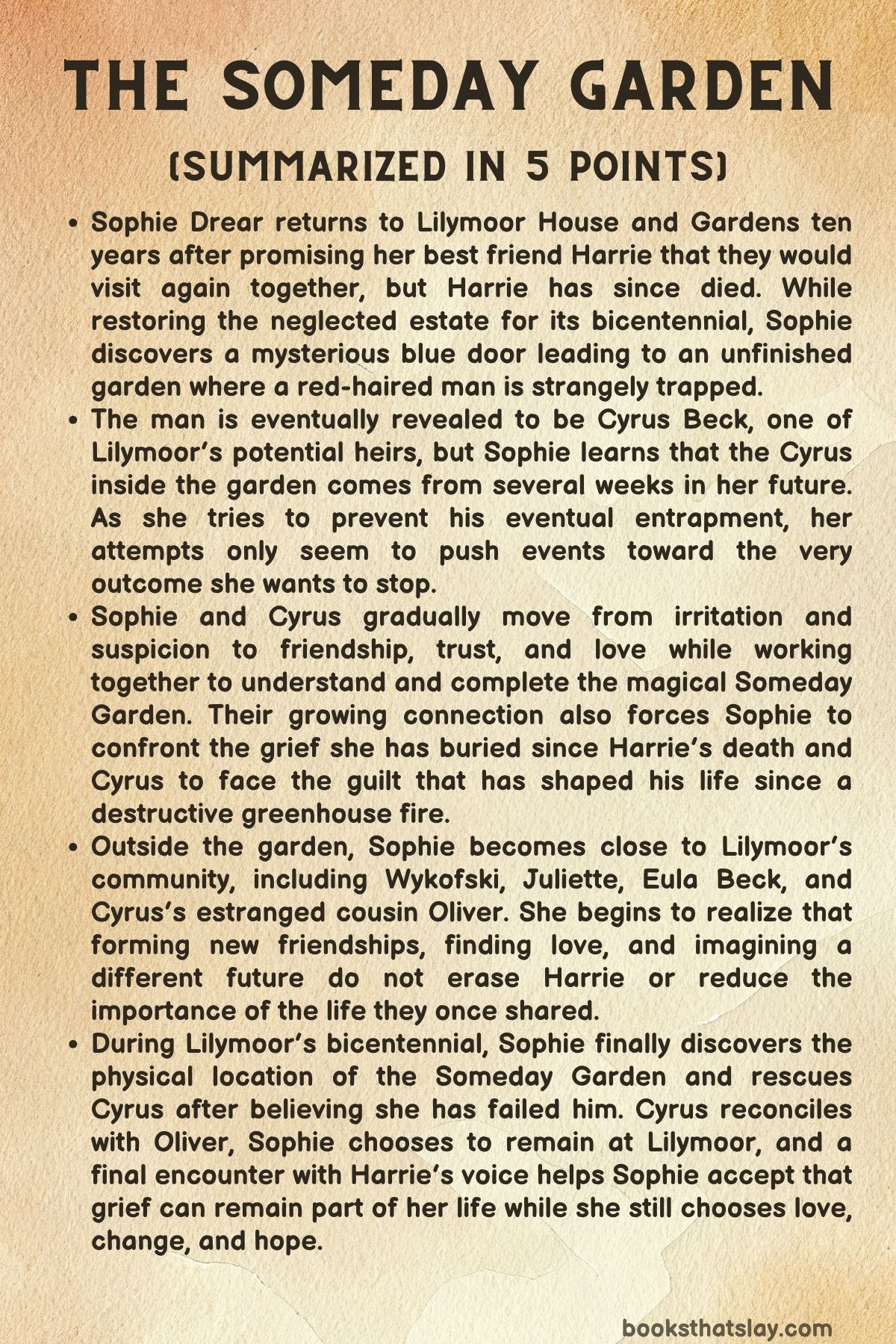
Ten years before the main events of The Someday Garden, college friends Sophie Drear and Harriett “Harrie” Fisher visit Lilymoor House and Gardens in Maine, a place they have long dreamed of seeing after becoming fascinated by a documentary about the estate. Harrie, an aspiring writer with a habit of collecting unusual words from different languages, embraces Lilymoor’s legends immediately, especially the story that the wind in its hedge maze can carry the voice of a person’s truest love.
Sophie is more practical and skeptical, trained in biology and preparing for a career in horticulture, yet Lilymoor affects her more deeply than she admits. Before the friends leave, Harrie makes Sophie promise that they will return exactly ten years later for Lilymoor’s bicentennial, and Sophie gives her word with complete confidence that she will keep it.
A decade later, Sophie does return, but Harrie is dead. Less than a year after losing her best friend to illness, Sophie has temporarily left her position at the New York Botanical Garden to become Lilymoor’s head gardener, responsible for repairing its neglected grounds before the estate’s two-hundredth anniversary.
Work provides Sophie with a way to avoid thinking too closely about her grief. She approaches damaged gardens scientifically because plants, unlike people, usually respond predictably to care, and this certainty comforts someone who has learned that devotion cannot always save the people she loves.
Lilymoor is owned by Eula Beck, an elderly and unconventional gardener recovering from a fractured hip. The estate is also maintained by Wykofski, an inventive handyman and landscaper who calls Sophie “Sunny,” and Juliette, an overworked events coordinator preparing an increasingly complicated bicentennial celebration.
Sophie initially refuses to become emotionally attached to any of them because she expects to return to New York when her temporary assignment ends. That plan begins changing when she discovers a faded blue door in a section of the grounds where no door should exist.
Beyond it is an unfinished garden caught in permanent golden light. Inside Sophie discovers a well-dressed red-haired man asleep beneath a willow tree, and their first encounter is marked by confusion, irritation, and mutual suspicion because he behaves as though very little time has passed while Sophie knows the garden should not exist at all.
The door soon disappears, only to emerge elsewhere on the estate. Each time Sophie enters, she finds the same man still trapped inside, unable to open the door himself, unable to use his phone, and apparently experiencing time differently from her.
Sophie eventually identifies him after seeing an old photograph in Eula’s room. He is Cyrus Beck, Eula’s great-nephew and one of two possible heirs to Lilymoor, although everyone outside the garden insists that Cyrus is currently living elsewhere and working as a successful lawyer.
The contradiction becomes clearer when Sophie discovers that the trapped Cyrus comes from several weeks in her future. For Sophie, it is still July, but Cyrus remembers arriving at Lilymoor on August 16, the night of the bicentennial, meaning she is meeting a future version of a man who has not yet become trapped.
Sophie decides she can prevent the entire problem by stopping present-day Cyrus from attending the celebration. She sends him a vague warning, but the mysterious letter has the opposite effect: Cyrus becomes curious and irritated enough to decide that he will attend after all.
Meanwhile, another Beck returns to Lilymoor. Oliver, Cyrus’s cousin and former childhood companion, is charming, warm, and openly interested in Sophie, and their easy attraction initially offers Sophie the possibility of romance without the impossible complications surrounding Cyrus.
Oliver also reveals that he and Cyrus were once nearly inseparable. Their friendship collapsed after a greenhouse fire during their teenage years, an event Cyrus accepted complete responsibility for even though Oliver was involved, and both men have spent their adult lives carrying different forms of guilt over what happened.
As Sophie continues entering the hidden garden, her relationship with Cyrus changes. Their early arguments become teasing, then trust, and eventually emotional intimacy as they work together to understand why the garden exists and how he can escape it.
They learn that the garden was designed by Eula’s late husband, Henry Beck, as an unfinished project intended for Eula. Henry believed that Lilymoor possessed a strange magic connected to possibilities and unfinished things, and the mysterious space appears to have preserved the Someday Garden he imagined but never completed.
Sophie and Cyrus begin restoring the magical version together. Their work becomes personal because both are struggling with lives shaped by loss: Sophie cannot forgive herself for surviving Harrie and building experiences her friend will never share, while Cyrus cannot forgive himself for the reckless teenager he once was.
For the first time since Harrie’s death, Sophie begins talking openly about her friend instead of referring only to the circumstances of her illness. She tells Cyrus about Harrie’s humor, ambitions, strange vocabulary, love of books, terrible ideas, and the future they once imagined sharing.
Cyrus does not try to reduce her grief to a lesson or demand that she move past it. His willingness to listen allows Sophie to understand that remembering Harrie through happiness and stories can keep her present in a different way, rather than preserving her only through pain.
Sophie also begins forming relationships outside the magical garden. She becomes close to Juliette, accepts Wykofski’s friendship, participates in staff gatherings she previously avoided, and slowly realizes that loving new people does not diminish what Harrie meant to her.
Her connection with Oliver also changes. What initially seems romantic gradually becomes affectionate friendship, while Oliver begins developing a more natural connection with Juliette, and Sophie recognizes that Cyrus is the person who reaches the emotional parts of her she has spent months protecting.
Sophie and Cyrus eventually kiss, but Sophie retreats because the intensity of wanting someone frightens her. To love again means accepting the possibility of another loss, and she has built much of her life around avoiding precisely that vulnerability.
When she finally returns, Sophie tells Cyrus the full truth about Harrie’s death and admits that she has treated happiness almost as a betrayal. Cyrus, in turn, admits that his prestigious career and controlled personality are partly an attempt to destroy every trace of the reckless young man he once was.
Their similarities become impossible to ignore. Sophie is trying to remain loyal to the past by refusing to change, while Cyrus is trying to escape the past by changing himself completely, and both have allowed grief and guilt to dictate who they are permitted to become.
As they complete the magical garden, their romance deepens into love. Sophie gradually accepts that something does not become worthless merely because it may end, while Cyrus begins considering the possibility that Lilymoor might represent home rather than punishment.
Outside the garden, Sophie discovers that Eula never truly intended to choose between Oliver and Cyrus as competing heirs. Eula and Henry had always imagined the cousins inheriting Lilymoor together, and her elaborate succession announcement was partly an attempt to bring the estranged men back to the estate and force them to confront what they had avoided.
Sophie is also forced to decide what she wants for herself. New York represents the respectable future she once assumed she should pursue, but Lilymoor increasingly offers what her old life lacks: community, friendship, meaningful work, emotional connection, and the possibility of building something instead of merely maintaining what already exists.
The bicentennial finally arrives, bringing present-day Cyrus to Lilymoor. Sophie recognizes that events are beginning to occur exactly as future Cyrus remembered them, and she desperately tries to prevent him from reaching the gardens before the critical moment can occur.
Her plan fails when Oliver takes Cyrus into the grounds hoping to resolve their conflict. Their reunion becomes another argument, Cyrus disappears into the maze, golden hour arrives, and the mysterious door vanishes before Sophie can stop him from entering.
Believing she has failed, Sophie finally breaks down. Her grief over Cyrus becomes inseparable from the grief she has been suppressing for Harrie, and Wykofski remains with her while she cries without trying to repair something that cannot simply be repaired.
At the bicentennial celebration, Eula speaks about gardens as places that must continually grow and change. She explains that Lilymoor itself had remained emotionally frozen after Henry’s death until Sophie restored it, and she describes the people gathered there as Henry’s greatest creation.
Eula’s words give Sophie the final clue. Every major path in Lilymoor eventually leads toward the Central Garden, so Sophie realizes the Someday Garden must physically exist somewhere behind its walls.
Armed with a sledgehammer, she breaks through an overgrown section concealed by honeysuckle and discovers the real blue door. Using Henry’s skeleton key, she enters the physical Someday Garden, which remains abandoned rather than magically completed, and finds Cyrus asleep exactly where the future garden had placed him.
When Sophie wakes him, Cyrus remembers her. The magical future they shared has not disappeared, and the rescue succeeds not by preventing the events from occurring but by allowing Sophie to find him after they do.
Cyrus returns to the celebration and begins making different choices. He ignores a work call, admits that Lilymoor matters to him, and later reconciles with Oliver, who refuses to accept Cyrus’s attempt to surrender his half of the inheritance as another act of self-punishment.
The cousins finally agree to inherit Lilymoor together, recovering part of the future they imagined as boys. Sophie accepts Eula’s offer to remain head gardener, choosing Lilymoor not because she is afraid of returning to New York but because she has finally identified the life she genuinely wants.
Sophie and Cyrus openly acknowledge their love and begin imagining a future that neither of them can guarantee. Cyrus considers changing careers, Sophie prepares to continue restoring the estate, and they plan to turn Henry’s unfinished garden into something real rather than leaving it preserved as an unrealized dream.
One final experience completes Sophie’s emotional journey. While separated from Cyrus in Lilymoor’s hedge maze, she hears Harrie’s voice carried through the garden and finally receives the conversation she never had before her friend died.
Sophie tells Harrie that she loves her, and Harrie answers before fading away. Sophie understands that moving forward does not mean becoming the person she was before Harrie’s death, nor does it require erasing grief; it means allowing love, friendship, work, memory, and new possibilities to grow around the absence that will always remain.
She returns to Cyrus with plans to rise early and listen to the birds, echoing one of Harrie’s treasured words. Instead of organizing her life around someday, Sophie begins choosing what can be loved, built, repaired, and experienced now.
Characters
Sophie Drear
Sophie Drear is the emotional center of The Someday Garden, and nearly every major relationship in the book reveals a different aspect of her struggle with grief. She begins as a highly capable horticulturist who trusts systems, biology, and practical action because they provide a sense of order that human mortality has taken away from her.
Her career is both a genuine passion and a defense mechanism. Plants give Sophie problems she can diagnose and often solve, while Harrie’s death taught her that no amount of care, knowledge, preparation, or devotion guarantees that a person can be saved.
Sophie therefore turns productivity into emotional avoidance. Her determination to rehabilitate Lilymoor is admirable, but the intensity with which she works also allows her to postpone confronting the parts of Harrie’s death she cannot fix.
Her attachment to promises is especially revealing. Keeping her word gives Sophie a moral certainty that feels dependable, yet it also becomes a burden when she promises to save Cyrus because she interprets failure as something almost unforgivable.
Sophie initially treats new relationships as temporary because attachment seems dangerous. She keeps Wykofski and Juliette at a professional distance, hesitates with Oliver, and panics when her feelings for Cyrus prove powerful enough to make her imagine a future again.
Her development is not about ceasing to grieve. Instead, she learns that Harrie can remain central to her identity without controlling every choice she makes, and that new friendships or romantic love do not compete with the dead.
Her eventual decision to remain at Lilymoor is therefore more significant than a career change. Sophie stops organizing her life according to what appears sensible from the outside and begins choosing the life in which she feels connected, useful, challenged, loved, and fully present.
Cyrus Beck
Cyrus Beck initially appears arrogant, impatient, and difficult, but those qualities gradually reveal a man who has built an entire adult identity around self-discipline and punishment. His polished career as a lawyer is impressive, yet it also functions as evidence in the private case he has constructed against his younger self.
The greenhouse fire defines Cyrus long after the physical damage has disappeared. He accepted all responsibility partly to protect Oliver, but he also absorbed the family role of troublemaker so completely that guilt became a permanent judgment on his character.
His response was not simply to mature. Cyrus attempted to eliminate the impulsive boy he had been by becoming controlled, successful, relentlessly hardworking, and emotionally guarded.
Being trapped in the Someday Garden removes many of the structures that maintain this identity. Without work, professional status, schedules, or ordinary escape routes, Cyrus is forced to garden again, remember Henry, confront Lilymoor, and spend time with someone who refuses to accept his worst interpretation of himself.
His relationship with Sophie works because she recognizes his self-punishment while practicing another version of it herself. Cyrus wants to destroy his former identity, while Sophie fears creating a new identity after Harrie, allowing each to see the damage in the other’s approach before fully recognizing it in themselves.
Cyrus also demonstrates considerable tenderness beneath his argumentative exterior. He protects Sophie during dangerous experiments, listens when she speaks about Harrie, refuses to trivialize her grief, and later allows himself to admit jealousy, attraction, fear, affection, and love.
By the end of the novel, his choice to inherit Lilymoor with Oliver marks a rejection of punishment disguised as sacrifice. He no longer believes that caring about the estate makes him undeserving, and he begins accepting that accountability for a mistake does not require spending an entire life in emotional exile.
Harriett “Harrie” Fisher
Harrie is physically absent from most of the book, yet she remains one of its most influential characters. Her presence survives through Sophie’s memories, her collection of unusual words, the Magic 8 Ball containing part of her ashes, her unfinished writing, and the habits of thought Sophie acquired during their friendship.
Harrie represents curiosity and emotional openness in contrast with Sophie’s preference for rational certainty. Where Sophie wants explanations, Harrie enjoys mysteries; where Sophie worries about becoming lost, Harrie sees getting lost as part of discovery.
Her collection of words from different languages also gives her an important symbolic role. Harrie searches for language capable of naming experiences that ordinary vocabulary does not fully capture, and those words continue helping Sophie identify grief, longing, nostalgia, compromise, love, regret, and hope after Harrie herself is gone.
Sophie initially remembers her primarily through illness and death. As Sophie gradually tells Cyrus and others about Harrie’s jokes, ambitions, interests, and personality, Harrie becomes a full person in the narrative again rather than only the source of Sophie’s pain.
The final conversation in the Hedges provides emotional resolution without undoing the reality of her death. Harrie cannot return to the life Sophie once imagined for them, but Sophie finally says the words left unsaid and understands that memory does not require permanent emotional isolation.
Harrie’s influence ultimately points Sophie toward life. Her final message, her ashes, her language, and even Sophie’s habit of consulting the Magic 8 Ball become ways for love to continue changing form rather than remaining fixed at the moment of loss.
Oliver Beck
Oliver initially appears to be the obvious romantic possibility for Sophie. He is handsome, funny, socially confident, considerate when he wants to be, and associated with Lilymoor without carrying the immediate mystery and hostility that characterize Sophie’s first encounters with Cyrus.
His importance soon extends beyond romance. Oliver represents another response to family grief and guilt, because he has lived for years with the knowledge that Cyrus protected him after the greenhouse fire and then pushed him away.
Oliver loves Lilymoor deeply even while insisting that he does not want to inherit it alone. That contradiction reveals that his real resistance is not directed toward the estate but toward the idea of possessing a shared childhood home without the person with whom he once expected to protect it.
His early flirtation with Sophie also helps measure her emotional development. She enjoys his attention and briefly considers what being with him might mean, but their relationship gradually settles into affection without the vulnerability she experiences with Cyrus.
Oliver is imperfect in ways the story allows to remain visible. He can be judgmental, defensive, immature, and spectacularly embarrassing when drunk, yet he is also capable of recognizing when he has behaved badly and offering sincere apologies.
His growing connection with Juliette suggests that his own romantic assumptions change as well. Instead of pursuing Sophie simply because attraction is easy, Oliver begins noticing someone with whom he already shares friction, familiarity, humor, and emotional investment.
His reconciliation with Cyrus completes one of the book’s major family arcs. By refusing to inherit Lilymoor alone, Oliver rejects Cyrus’s habit of making unilateral sacrifices and insists that genuine repair requires both men to choose their shared future.
Eula Beck
Eula Beck is the eccentric, perceptive, and emotionally complicated steward of Lilymoor. Her flamboyant behavior, sharp humor, impatience with physical limitations, and tendency to manipulate events make her entertaining, but beneath that energy is an elderly woman confronting grief, aging, loneliness, and the loss of an identity she has maintained for decades.
In The Someday Garden, Eula represents both the beauty and danger of preserving the past. She loves Lilymoor fiercely, yet after Henry’s death her grief leads her to close areas of the estate, remove painful places from maps, leave projects unfinished, and allow parts of the gardens to deteriorate.
Her treatment of Oliver and Cyrus reflects a similar pattern. Eula loves both men but has allowed years of silence and guilt to remain largely unchallenged until her retirement plan becomes a deliberate attempt to force them home.
The succession contest therefore reveals her manipulative side but also her faith in reconciliation. She already knows what she wants: Oliver and Cyrus sharing Lilymoor as Henry intended, with neither man using inheritance or rejection as another weapon against himself.
Eula also serves as an important older counterpart to Sophie. Both women have lost a person central to the life they imagined, and both respond by becoming emotionally attached to forms of preservation that eventually prevent growth.
Her retirement requires courage because Lilymoor has become inseparable from her sense of self. By accepting that the estate must change after her stewardship ends, Eula demonstrates the same principle Sophie ultimately learns: protecting something one loves sometimes means allowing it to become different.
Wykofski
Wykofski initially appears as comic relief through his endless practical abilities, game-night invitations, eccentric interests, and affectionate nickname for Sophie. His deeper function is that of a quiet emotional guide who repeatedly offers Sophie a healthier way of thinking without demanding that she accept it.
His personality is defined by adaptability. He repairs, builds, gardens, performs music, creates topiary, cooks, and solves problems with whatever resources are available, making his practical flexibility an extension of his philosophical flexibility.
Unlike Sophie, Wykofski does not automatically interpret change as loss. When Lilymoor’s future becomes uncertain, he suggests the possibility of an outcome in which nobody has to lose everything, challenging Sophie’s grief-conditioned assumption that every transition demands sacrifice.
His personal history reinforces this outlook. He attended Yale but left because the expected version of success did not make him happy, later coming to Maine after his mother’s death and eventually choosing Lilymoor as home.
This makes Wykofski an important influence on Sophie’s career decision. He embodies the possibility that a person can leave a prestigious path without failing, provided the alternative reflects a more meaningful understanding of what constitutes a worthwhile life.
His finest moment occurs when Sophie finally collapses after believing Cyrus is lost. Wykofski does not lecture her, minimize the situation, or insist on optimism; he simply remains present while she grieves, demonstrating the kind of friendship Sophie has been afraid she could never have again.
Juliette
Juliette begins as Lilymoor’s highly competent but increasingly overwhelmed events coordinator. The enormous bicentennial celebration places relentless demands on her, and her professionalism initially hides how much personal uncertainty and romantic disappointment she is carrying.
Her friendship with Sophie becomes important because it develops gradually through ordinary acts rather than one dramatic declaration. Lunches, work problems, nights out, private conversations, shared embarrassment, and eventually simple companionship transform two coworkers into genuine friends.
Juliette’s romantic history also mirrors some of Sophie’s fears in a less tragic form. After unhealthy or disappointing relationships, she begins wondering whether repeated failure indicates something fundamentally wrong with her.
Sophie’s response to Juliette shows how much Sophie herself has changed. Instead of avoiding another person’s emotional needs because she fears attachment, she offers comfort and companionship without attempting to provide a perfect solution.
Juliette’s acceptance of the truth about Harrie’s ashes is particularly meaningful. When Sophie reveals that the unusually heavy Magic 8 Ball contains part of Harrie, Juliette does not react with discomfort or pity, allowing Sophie to discover that other people can know about Harrie without threatening the privacy or importance of their bond.
Her eventual attraction to Oliver provides a lighter secondary romance. Their connection grows through irritation, embarrassment, reluctant concern, and increasing awareness, giving both characters the possibility of something less immediate but potentially more grounded than Oliver’s early flirtation with Sophie.
Henry Beck
Henry Beck is dead before the main events, yet his influence remains embedded throughout Lilymoor. His unfinished projects, gardening philosophy, relationship with Eula, mentorship of Cyrus, and plans for the estate continue determining the choices of people who have spent years trying to understand or preserve what he left behind.
For Cyrus, Henry was particularly important because he gave the restless young boy responsibility and treated him as capable. Lilymoor under Henry therefore represents a version of Cyrus’s past in which energy and impulsiveness were not automatically evidence of bad character.
The Someday Garden expresses Henry’s central philosophy. He believed in unfinished things, possibility, experimentation, and gardens that remained capable of becoming something different rather than existing as perfectly completed monuments.
His death creates emotional winter throughout the estate. Eula stops maintaining parts of Lilymoor, Cyrus distances himself from the place, Oliver loses the shared home he remembers, and unfinished projects become physical evidence of futures that never occurred.
Yet Henry’s legacy is ultimately not represented by buildings or plant collections alone. Eula’s recognition that the people gathered around Lilymoor constitute his greatest garden gives his character lasting meaning because what he created survives through relationships, skills, memories, and choices rather than through perfect preservation.
Sanchez
Sanchez, Harrie’s former fiancé, appears mainly through Sophie’s memories and later messages, but his choices become an important test of Sophie’s understanding of grief. When he announces his engagement less than a year after Harrie’s death, Sophie initially experiences the news as almost a betrayal.
Her reaction is not truly about Sanchez having done something wrong. Instead, his willingness to imagine another future forces Sophie to confront her own belief that continuing to live enthusiastically might demonstrate insufficient loyalty to Harrie.
Sanchez ultimately becomes evidence that mourning does not follow one morally correct timetable. His engagement does not prove that he loved Harrie less, just as Sophie’s love for Cyrus does not erase her friendship with Harrie.
His message telling Sophie that she deserves a good life becomes especially important because it removes one imagined source of judgment. A person who loved Harrie deeply is not asking Sophie to remain emotionally frozen; he is encouraging her to accept that survival can eventually include joy.
Sophie’s Mother
Sophie’s mother is a practical but affectionate influence whose travel-nursing career shaped Sophie’s childhood. Frequent moves meant Sophie rarely had a stable physical home, helping explain why plants became dependable companions and why gardening offered continuity when locations changed.
Her conversations with Sophie repeatedly challenge the belief that love is worthwhile only when permanence is guaranteed. She argues that caring for a person, place, or project is not wasted simply because the outcome cannot be controlled.
That idea directly counters Sophie’s response to Harrie’s death. Sophie has become reluctant to invest emotionally in anything she might someday lose, while her mother encourages an understanding of value based on how fully something is loved while it exists.
Her eventual arrival at Lilymoor with Eddie also carries symbolic importance. Sophie has spent much of the summer assuming her family remains separate from the new life forming around her, but their visit demonstrates that the different parts of her life do not need to remain isolated.
Eddie
Eddie, Sophie’s stepfather, has a relatively small role but contributes to the sense that Sophie belongs to a family willing to enter the new life she is creating. His arrival with Sophie’s mother during the bicentennial turns Lilymoor from a temporary workplace into a place where different parts of Sophie’s emotional world can meet.
He does not drive the central conflicts, yet his presence matters because Sophie’s eventual decision is not framed as abandoning her family for Lilymoor. Instead, the visit suggests that choosing a new home can expand a person’s life without requiring the destruction of earlier relationships.
Damnit
Damnit, the aggressive Canada goose, is primarily a comic character, but the bird also contributes unexpectedly to the story’s emotional and temporal structure. Her repeated attacks create chaos, expose vulnerabilities, force characters into contact, and occasionally move the plot forward.
Her history with Cyrus is especially revealing because he rescued her as an abandoned gosling. The adult goose’s determination to attack him despite this kindness becomes a running joke, but it also gives Sophie evidence linking the trapped man to the Cyrus everyone else remembers.
Damnit belongs to Lilymoor’s refusal to behave according to anyone’s carefully organized plans. She makes sophisticated adults run, ruins dignified moments, and repeatedly reminds both characters and readers that life at the estate cannot be completely controlled.
Reggie
Reggie, the dog supposedly responsible for helping control Damnit, functions mostly as comic contrast because he is remarkably ineffective at the task assigned to him. His failures contribute to Lilymoor’s slightly eccentric social world, where people and animals rarely behave according to formal job descriptions.
Although he has little influence over the central emotional conflict, Reggie reinforces the estate’s warmth. Lilymoor gradually feels like a home partly because it contains these recurring absurdities alongside its grief, history, work, and magic.
Themes
Grief as Change Rather Than Erasure
Grief throughout The Someday Garden is presented as something that changes shape rather than something a person eventually defeats. Sophie initially behaves as though healing would require choosing between loyalty to Harrie and participation in a future that Harrie can no longer share.
This belief causes her to protect grief almost as carefully as she protects memory. Happiness becomes suspicious because every good experience creates another moment Harrie will never witness, making Sophie feel as though her own continued growth increases the distance between them.
Eula demonstrates a related response after Henry’s death. She closes sections of Lilymoor, removes painful places from maps, and allows unfinished projects to remain untouched, effectively turning preservation into stagnation.
The estate therefore becomes a physical representation of grief that has stopped moving. Areas once associated with love become neglected because caring for them would require acknowledging that they must exist differently without the person who helped create them.
Sophie eventually discovers that remembrance does not depend on remaining unchanged. Speaking about Harrie allows others to know her humor, imagination, vocabulary, and ambitions, meaning Harrie becomes more present in Sophie’s community when Sophie stops guarding her memory so privately.
The final encounter in the Hedges confirms that Sophie does not need to choose between grief and joy. Harrie remains irreplaceable, but the absence she leaves can coexist with Cyrus, Juliette, Wykofski, Lilymoor, meaningful work, laughter, desire, and future plans.
Healing is therefore presented not as forgetting but as allowing life to grow around loss. The person who died remains part of the emotional landscape even as that landscape develops new paths.
The Danger of Living for Someday
The idea of “someday” operates as both hope and warning. Harrie plans to become the writer she wants to be someday, Sophie imagines telling Eula about her dream of working at Lilymoor someday, and Henry intends to finish his special garden someday.
Death exposes the danger hidden inside indefinite postponement. Harrie never receives all the years Sophie assumes they will share, Henry never completes the garden intended for Eula, and Sophie is left remembering conversations in which everyone acted as though another opportunity would naturally arrive.
The magical garden gives physical form to these postponed possibilities. It is beautiful partly because it represents what could exist, but Cyrus becomes literally trapped inside it, showing that possibility becomes destructive when a person remains suspended between intention and action.
Sophie develops the same habit emotionally after Harrie dies. She does not fully choose New York, Lilymoor, friendship, romance, or even grief itself because postponing decisions protects her from confronting what each choice might cost.
Cyrus also lives through postponement despite his relentless productivity. He delays reconciling with Oliver, acknowledging his love for Lilymoor, reconsidering his career, and forgiving himself because work gives him an endless reason not to address the emotional decisions waiting underneath it.
The eventual creation of the physical Someday Garden changes the meaning of the phrase. A dream does not become valuable because it remains safely imagined; it gains meaning when someone accepts uncertainty and begins turning possibility into lived experience.
Sophie and Cyrus consequently end by making plans without demanding guarantees. They choose mornings, gardening, love, career changes, community, and shared work now, accepting that an uncertain present can be more meaningful than a perfect future indefinitely postponed.
Guilt, Forgiveness, and Self-Punishment
Guilt affects Sophie, Cyrus, Oliver, and Eula in different ways, but the story repeatedly distinguishes responsibility from permanent punishment. Each character has experienced something irreversible and then developed habits intended to prevent themselves from feeling the full uncertainty of forgiveness.
Cyrus provides the clearest example. After the greenhouse fire, he accepts all the blame and eventually constructs a disciplined adult identity designed to prove that he is no longer the reckless teenager who caused it.
The problem is that improvement becomes punishment. Rather than learning from the fire and allowing himself to mature naturally, Cyrus decides that the younger version of himself deserves rejection, so achievement becomes a method of maintaining distance from everything that once made him feel alive.
Sophie recognizes this pattern because she is punishing herself differently. She could not save Harrie, and although she rationally knows this was beyond her control, she behaves as though refusing happiness might compensate for the fact that she survived.
Oliver carries guilt because Cyrus protected him and their friendship collapsed afterward. Eula carries guilt because grief prevented her from recognizing how badly both the estate and the boys needed attention after Henry’s death.
None of these characters can reverse what happened. Their progress begins only when they stop asking how to undo the past and instead ask what responsibility looks like in the present.
Forgiveness is therefore active rather than sentimental. Cyrus must return, Oliver must tell the truth, Eula must relinquish control, and Sophie must stop treating sorrow as an obligation she owes Harrie.
The story ultimately argues that regret can guide better choices without becoming a permanent identity. Accepting responsibility may require honesty, apology, repair, or change, but none of those actions demand that a person remain forever defined by their worst moment.
Home, Belonging, and the Courage to Choose a Life
Lilymoor gradually changes from a temporary assignment into the clearest expression of what Sophie wants from a home. Her childhood was shaped by frequent moves, and her adult life in New York is professionally respectable, yet neither has given her the deeper sense of belonging she develops during one summer in Maine.
That belonging does not come from scenery alone. It develops through repeated ordinary experiences: working beside Wykofski, helping Juliette, eating with the staff, arguing over games, caring for Eula, dealing with ridiculous animals, sharing private grief, and anticipating the people she will see each day.
Cyrus faces the opposite problem because Lilymoor already is home, yet he refuses to admit it. Returning means confronting Henry’s absence, the greenhouse fire, Oliver, his younger self, and the possibility that the place he loves most is also where he feels least deserving of love.
Oliver’s longing has similar roots. He does not truly want Lilymoor without Cyrus because the estate’s meaning comes from shared history rather than ownership, making inheritance alone an inadequate substitute for restored belonging.
The theme also challenges conventional definitions of success. Sophie’s prestigious New York position and Cyrus’s legal career are both valid achievements, but the story refuses to treat professional status as proof that either person has chosen the correct life.
Wykofski reinforces this idea through his own decision to leave an elite academic path and build a life that better suits him. What appears unconventional from the outside may be more successful if it creates purpose, relationships, and daily satisfaction.
By choosing Lilymoor, Sophie is therefore not escaping adulthood or ambition. She is becoming more deliberate about what she wants adulthood and ambition to serve.
Home finally emerges as something partly inherited and partly chosen. It is the place where people allow themselves to be known, where memory can exist beside change, and where staying becomes an active commitment rather than a refusal to move forward.