Tillinghast Summary, Characters and Themes
Tillinghast by Clare Cavenagh is a dark supernatural novel about violence, immortality, guilt, and the disturbing possibility that monstrous instincts can exist alongside love and moral choice.
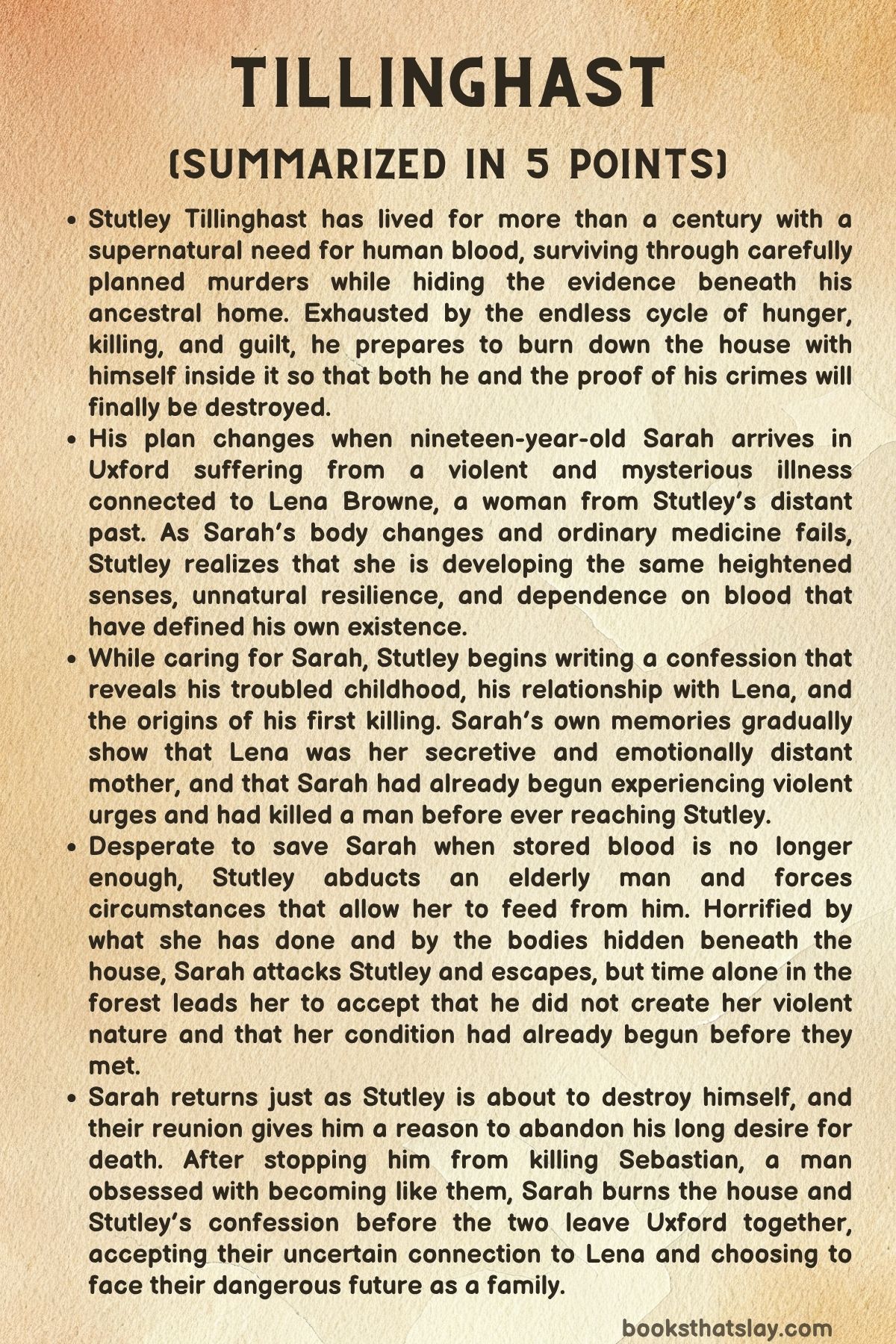
At its centre is Stutley, an isolated man who has survived for more than a century while living with a recurring need for human blood. His carefully controlled existence changes when nineteen-year-old Sarah arrives carrying an unexplained connection to Lena Browne, a woman from his distant past. What begins as a story about a killer preparing for death gradually becomes an examination of inheritance, responsibility, loneliness, family, and whether a person defined by terrible actions can still choose differently.
Summary
Stutley lives alone in his ancestral home near Uxford, maintaining an existence that depends upon secrecy, routine, and murder. Roughly every seventy days, an unbearable physical hunger takes control of him, forcing him to seek a victim whose blood can satisfy a need that ordinary food cannot touch.
His latest victim is Daniel Marin, a young construction worker whom Stutley lures away from a worksite, knocks unconscious, transports home, kills, and buries beneath the cellar floor. The killing produces a temporary state of extraordinary physical pleasure and sensory clarity, but that exhilaration quickly fades into disgust, exhaustion, and the familiar burden of knowing that the cycle will eventually begin again.
Stutley has survived far beyond a normal human lifespan and has discovered that conventional suicide is almost impossible because his body heals from injuries that should kill him. Tired of murder and unable to imagine continuing indefinitely, he decides to destroy himself by burning down the old wooden house, allowing the fire to reveal the human remains hidden beneath it as a final confession of what he has done.
His preparations are disturbed by an encounter at the abandoned family church, where a young mother asks him to baptise her baby, Liam. The warmth and scent of the child awaken predatory impulses in Stutley even though he has fed recently, forcing him to confront how little control he truly possesses over the instincts that govern him.
The encounter also revives his memory of Lena Browne, a mysterious young woman he met more than a century earlier. Soon afterward, a young English woman telephones asking for Lena, and Stutley later discovers that Lena’s grave has become part of a local vampire legend connected to an old nineteenth-century exhumation.
A second call brings a stranger named Sarah into his life. Mrs Willcox, the local innkeeper, tells him that a young woman claiming to be his relative has become seriously ill, and although Stutley initially intends to avoid her, he eventually collects Sarah and carries her home.
Sarah suffers from violent convulsions, strange bodily pain, black vomiting, and periods of near unconsciousness. Her documents make the situation even more unsettling because they identify her mother as Lena Browne, while Sarah’s unusually dark eyes resemble Stutley’s own.
Suspecting that Sarah may be undergoing the same transformation he once endured, Stutley begins watching and treating her instead of taking her to a hospital. His decision is medically reckless, but his curiosity slowly becomes genuine concern as Sarah’s continued survival begins to matter to him in a way no other life has mattered for decades.
While caring for her, he starts writing a confession intended to accompany his planned death. He records his murders and describes his childhood under a severe religious father, his mother’s strange visionary experiences, the collapse of the family church, his parents’ deaths, and his eventual inheritance of the role of pastor.
His account also returns to Lena. As a young man, Stutley met her in an orchard, where she offered him an apple with an unnaturally red centre and immediately fascinated him through her cold skin, dark eyes, unusual smell, and unsettling familiarity.
Meanwhile, Sarah’s condition becomes increasingly unnatural. She experiences the sensation of her bones shifting inside her body, and when she briefly regains consciousness, her senses have become sharp enough that she can locate Stutley by smell before she even sees him.
A man named Sebastian Kilner begins appearing around the house, asking about Sarah and showing an unhealthy interest in Stutley’s family history. He has discovered historical evidence connecting a Reverend Stutley to Lena’s nineteenth-century story, raising the possibility that someone may finally notice that the man living in the house and the historical clergyman are the same person.
Sarah temporarily awakens and becomes understandably suspicious of the stranger who has kept her unconscious in an isolated house while giving her injections. Stutley insists that she is free to leave, yet her body continues to deteriorate until he recognises that medicine alone cannot help her.
He blackmails a hospital employee named Jason into supplying stolen blood and attempts an improvised transfusion. The blood initially stabilises Sarah, confirming Stutley’s growing suspicion that her illness is actually the beginning of the same supernatural condition that controls his life.
Sarah’s memories gradually explain how she arrived in Uxford. She was raised in London by Lena, an emotionally distant mother who suffered mysterious recurring illnesses, taught Sarah to conceal personal information, reacted violently to anything connected with vampires, and eventually disappeared without a convincing explanation.
After Lena vanished, Sarah discovered a hidden collection of personal objects belonging to men who were later found to be dead. Among these objects was Stutley’s antique pocket watch, leading Sarah to investigate Lena’s connection with Uxford and travel to America in search of answers.
When Sarah becomes strong enough to speak openly with Stutley, the two cautiously compare what they know. She describes Lena’s recurring illnesses, the collection of men’s possessions, and her own suspicions, while Stutley finally admits that Lena possessed the same unnatural condition that he does.
Their growing trust is interrupted when Sarah’s condition worsens again. Intravenous blood stops being sufficient, and Stutley discovers that drinking blood directly provides a much stronger effect, leaving him with the terrible conclusion that keeping Sarah alive may eventually require a living human victim.
Around the same time, Sebastian sends evidence concerning the death of Elliot Chambers, a young man killed in Providence shortly before Sarah arrived in Uxford. Stutley remembers evidence he discovered among Sarah’s belongings and sickness and realises that she almost certainly killed Elliot before reaching him.
This discovery changes Stutley’s understanding of his responsibility. Sarah’s predatory nature did not begin because he gave her blood; the hunger had already awakened, meaning that whatever she is becoming existed independently of his intervention.
When Sarah begins dying again, Stutley abducts an elderly man named Ephraim Mason and brings him into the cellar. Sarah initially shows no response, so Stutley cuts the man’s neck and physically exposes her to his blood until instinct takes control and she begins feeding.
Sarah recovers physically but is horrified when she regains awareness and sees the dead man, the blood, and the graves beneath the house. Learning that Stutley abducted someone specifically for her destroys the fragile trust between them, and she attacks him before escaping into the forest.
Stutley searches desperately for Sarah but cannot find her. When he returns home, he discovers that someone has broken into the house and stolen the documents proving his impossible lifespan, convincing him that Sebastian or another investigator has discovered enough of the truth to threaten them both.
Believing Sarah may be gone permanently, Stutley returns to his original suicide plan. He finishes his confession, records his victims, accepts responsibility for Ephraim’s death, and finally describes how his first killing occurred after his own transformation, when an uncontrollable hunger drove him to attack Lena’s father, George Browne.
Sarah, however, has spent several days alone in the forest reconsidering what happened. She remembers that before becoming ill she had already experienced violent hunger, attacked the intrusive journalist Ryan Young, travelled impulsively to America, and later killed Elliot after he behaved threateningly toward her.
Recognising that Stutley did not create the darkness within her, Sarah returns just as he is preparing to ignite the gasoline throughout the house. Her arrival immediately destroys his desire to die, and the two reconcile after admitting that they are both dangerous, frightened, and connected by something neither fully understands.
Their reunion is interrupted when Sebastian appears and admits that he stole Stutley’s documents. Rather than intending to expose them, Sebastian has become obsessed with proving their supernatural nature and wants Stutley or Sarah to transform him into what they are.
Stutley’s immediate reaction is to kill Sebastian, but Sarah stops him and insists that murder is unnecessary. Her intervention matters because it demonstrates that she may become more than another version of Stutley: despite having killed, she can still question violence and restrain him when his old habits take control.
They deliver Sebastian to a hospital and return to the house, where Sarah is allowed to decide what should happen next. She sets the gasoline alight but also burns Stutley’s confession, victim list, and inheritance documents, rejecting his attempt to define their future entirely through guilt and punishment.
Before leaving Uxford, Stutley takes Sarah to the cemetery connected with Lena’s story and explains that Lena was never truly buried beneath her marked grave. He believes she may have entered a deathlike state, awakened after being placed in a crypt, escaped, and continued living under new identities.
Stutley also admits that he may have misunderstood Lena for most of his life. He once preferred to believe she transformed him because that explanation gave a cause to his suffering, but his symptoms had probably begun before their intimacy, suggesting that Lena merely recognised a condition that was already developing.
Sarah concludes that Lena may have given her the shared surname because Stutley was one person from her distant past whom she believed might still be alive. Whether Stutley is Sarah’s biological father remains uncertain, but their relationship has become more important than biological proof.
The burning house behind them will expose the bodies Stutley buried, and modern surveillance makes their future secrecy increasingly difficult. Yet the man who once wanted nothing except annihilation now chooses to leave with Sarah, accepting an uncertain future because he has finally found another person to whom he feels responsible and connected.
Characters
Stutley
Stutley is the central moral contradiction of the book: a serial killer capable of calculated abduction and ritualised murder who is also exhausted by his own violence, disgusted by what he has become, and desperate to end a life that appears physically impossible to destroy. His killings are neither presented as accidental nor excused by supernatural hunger, since he repeatedly plans them, conceals evidence, reuses graves, and develops systems that allow him to continue surviving.
At the same time, Tillinghast gives considerable attention to the difference between compulsion and responsibility in Stutley’s personality. He may require blood to remain alive, but the book constantly asks what choices remain available once that need exists, especially when Stutley himself recognises the humanity of his victims and understands the enormity of what he has done.
His religious upbringing intensifies this conflict. Raised beneath a severe father whose faith is associated with punishment, shame, and emotional cruelty, Stutley carries spiritual language into his later murders, praying over bodies and treating memory almost as a form of penance even when those gestures have lost their power.
Sarah transforms him because she gives his immortality a purpose outside himself. Before her arrival, continued existence means only another cycle of hunger and death; afterward, he lies, steals, blackmails, nurses, protects, worries, and ultimately abandons suicide because another person’s survival has become more important than his desire for extinction.
His most important development occurs when Sarah begins challenging his assumption that violence is inevitable. When she prevents him from killing Sebastian, Stutley obeys, demonstrating that attachment can interrupt patterns he had treated as permanent and suggesting that his moral future depends not on becoming innocent, which is impossible, but on becoming capable of choosing restraint.
Sarah
Sarah begins as a mystery because both she and Stutley lack the information needed to understand what is happening to her. Her sickness, heightened senses, altered physical needs, and connection to Lena initially make her appear to be following Stutley’s path almost exactly, but her personality gradually establishes important differences between them.
Her childhood explains much of her emotional caution. Lena provides materially for her while remaining secretive and distant, teaching Sarah to conceal information and eventually abandoning her, so Sarah enters adulthood expecting intimacy to be unstable and answers uncertainty with suspicion, self-protection, and occasional aggression.
Her transformation forces her into a frightening confrontation with her own capacity for violence. She initially believes the man in Stutley’s cellar represents a moral boundary he has forced her to cross, but her memories later reveal that she had already killed Elliot before arriving in Uxford, meaning she must accept that the hunger belongs to her rather than treating Stutley as its sole cause.
That recognition does not make Sarah passive or resigned. In Tillinghast, she becomes the character most capable of imagining a life in which supernatural hunger does not automatically justify every murder, as shown when she refuses to let Stutley kill Sebastian simply because doing so would be convenient.
Sarah also gives the story its strongest expression of chosen family. Whether Stutley is biologically her father remains unresolved, yet she eventually decides that the emotional bond between them can exist without certainty, allowing both characters to move toward a relationship founded on responsibility rather than proof of ancestry.
Lena Browne
Lena stands behind almost every major mystery even though much of her presence reaches the reader through memory, records, objects, and other people’s interpretations. She connects Stutley’s transformation, Sarah’s birth, the Uxford vampire legend, the hidden collection of dead men’s possessions, and the possibility that their supernatural condition has existed across generations.
Her character remains deliberately difficult to classify because Stutley and Sarah remember different versions of her. To Stutley, she is the cold, strange young woman who recognised something unusual in him before he understood it himself; to Sarah, she is a secretive mother who provided housing, money, and practical security but withheld emotional closeness and finally disappeared.
The evidence surrounding her suspected victims complicates any attempt to treat Lena simply as an absent parent. The possessions connected to dead men strongly suggest that she experienced the same recurring hunger and used methods of survival resembling Stutley’s, although the available information never reveals exactly how she understood or justified her actions.
Her abandonment of Sarah is one of her most damaging choices. Lena apparently knew enough about the condition to recognise its dangers, yet she leaves her daughter without an explanation just as Sarah approaches the age when similar symptoms emerge.
At the same time, the surname she gives Sarah may represent an indirect attempt at protection. If she believed Stutley was still alive, naming her daughter after him could have been a way of leaving a path toward the one person capable of recognising what Sarah would eventually become.
Sebastian Kilner
Sebastian initially appears threatening because his repeated visits, historical research, and interest in Sarah bring him dangerously close to discovering Stutley’s secret. His theft of the forged identities confirms that he is willing to invade another person’s home and manipulate evidence in pursuit of an obsession.
The later revelation that he does not primarily want exposure changes the nature of his threat. Sebastian is fascinated by supernatural existence and wants access to it for himself, treating Stutley and Sarah’s condition as a desirable escape from ordinary mortality rather than recognising the hunger, killing, isolation, and fear that have defined their lives.
His obsession therefore functions as a form of romanticisation. Everything Stutley considers a curse appears to Sebastian as proof of possibility, and his desire to be transformed shows how easily extraordinary longevity can seem attractive to someone who has not experienced its moral cost.
Sebastian also becomes an important test for Sarah and Stutley. Stutley sees murder as the simplest solution, while Sarah refuses that logic, making Sebastian the person through whom the difference between their moral instincts becomes clearest.
John Conway
John Conway represents science, compassion, friendship, and a version of morality not built primarily upon punishment. Stutley remembers him as one of the few people he genuinely loved, which makes John particularly significant in understanding the emotional life Stutley possessed before decades of killing and isolation narrowed his relationships.
As a doctor, John resists the vampire panic surrounding tuberculosis and attempts to explain decomposition through medical reality rather than superstition. His participation in the exhumations becomes traumatic because rational knowledge proves unable to control a frightened community determined to impose supernatural meaning upon disease and death.
John’s friendship also reveals that Stutley once had someone who trusted him without knowing the full truth about him. His later death from consumption, followed by Stutley’s decision to burn the house in order to honour John’s wish that his body never be exhumed, demonstrates an early example of Stutley using destruction in an act motivated by loyalty rather than predation.
The memory of John therefore complicates the idea that Stutley’s humanity begins only when Sarah arrives. Long before her, he had demonstrated the capacity to love another person, keep a promise, and grieve, even though those capacities later existed beside increasingly terrible acts.
Ryan Young
Ryan represents a modern form of intrusion that contrasts with Sebastian’s historical obsession. As a tabloid journalist pursuing Lena’s disappearance, he repeatedly pressures Sarah for information and turns her private confusion into material that might be exploited for a story.
His behaviour becomes especially important because it coincides with Sarah’s first strong experiences of violent impulse. When his persistence becomes threatening enough that Sarah attacks him with a bottle, the incident shows that her emerging aggression predates her full physical collapse in America.
Ryan also contributes indirectly to Sebastian’s investigation. Their collaboration connects Sarah’s private family mystery to a broader external threat, making clear that secrecy is becoming increasingly difficult in a world of journalism, digital records, surveillance, and searchable histories.
Although Ryan does not possess the complexity of the central characters, his role is structurally important. He turns curiosity into pressure and demonstrates how ordinary human investigation can become almost as dangerous to Stutley and Sarah as their supernatural hunger is to others.
Jason
Jason is a compromised character whose relationship with Stutley is founded on coercion rather than trust. Because Stutley knows about Jason’s involvement in an earlier fatal accident, he can force him to provide medical supplies and later stolen blood.
His presence exposes another aspect of Stutley’s morality. Even when Stutley is desperately trying to save Sarah, he relies upon intimidation and another person’s fear, showing that care for one individual does not automatically erase his willingness to manipulate others.
Jason nevertheless establishes boundaries. When Stutley demands blood, Jason eventually provides it for money but declares their arrangement finished, suggesting that even a person carrying serious guilt recognises that Stutley’s demands are becoming increasingly dangerous.
Through Jason, the story also emphasises how improvised Sarah’s treatment is. Stutley has no proper medical training and uses supplies he barely understands, so Sarah’s survival results less from medical competence than from Stutley’s desperate experimentation and the supernatural nature of her body.
Anton Mooney
Anton Mooney belongs primarily to Stutley’s earlier life and helps establish the social world that existed before Stutley’s isolation became complete. Wealthy, grieving, and interested in contacting his dead son, Anton invites Stutley and John to observe a séance conducted by visiting mediums.
His grief makes him vulnerable to spiritual promises. Rather than being portrayed simply as foolish, Anton represents the human desire for certainty after death, a desire that mirrors Stutley’s later struggle to interpret his own unnatural survival through religious and supernatural explanations.
Anton also has a major indirect effect on Stutley’s future. His later bequest grows into the financial resources that allow Stutley to move through generations, adopt new identities, and survive without ordinary employment.
The money therefore carries an irony Anton could never have anticipated. An act presumably intended as generosity ultimately helps sustain a life of concealment and repeated murder across decades.
Miss Latimer and Miss Agnello
Miss Latimer and Miss Agnello appear as spirit mediums during the gathering organised by Anton. Their importance lies less in their individual biographies than in what they unexpectedly expose about Stutley’s private fears.
During the séance, their description of a dark-eyed, cold-handed woman in an orchard and a clergyman associated with an apple closely resembles Stutley’s secret encounter with Lena. Whether this moment involves genuine supernatural perception or coincidence remains less important than Stutley’s reaction, because he experiences it as an intolerable invasion of his hidden life.
His panic drives him into a snowstorm, where his physical condition worsens and events eventually bring him back into Lena’s presence. The mediums therefore become catalysts whose words push Stutley toward a decisive stage of his transformation.
They also strengthen the story’s uncertainty about supernatural knowledge. Their vision sounds remarkably accurate, yet the wider novel repeatedly shows how superstition can misread reality, leaving readers to decide how much weight their apparent insight deserves.
Mrs Kaplan
Mrs Kaplan occupies a small but emotionally meaningful place in Sarah’s childhood memories. Her apartment offers ordinary domestic warmth through food, furniture, television, photographs, music, and patient companionship, providing a sharp contrast with Lena’s emotional distance.
Her response when young Sarah breaks a porcelain kitten is particularly revealing. Instead of punishing or shaming the child, Mrs Kaplan quietly cleans the pieces and reassures her, giving Sarah an experience of forgiveness that differs from the secrecy and tension surrounding her home life.
Mrs Kaplan therefore represents the kind of ordinary human attachment Sarah might have developed under different circumstances. Her gradual disappearance from Sarah’s life also contributes to the pattern of abandonment that shapes Sarah’s difficulty trusting others.
The memory matters during Sarah’s transformation because it demonstrates that her identity is not composed only of violence and supernatural inheritance. She also carries memories of gentleness, patience, and care, qualities that later influence the moral limits she tries to establish with Stutley.
Mrs Willcox
Mrs Willcox functions as the practical link that brings Sarah physically into Stutley’s care. As the owner of the local inn, she contacts him because Sarah has presented herself as his relative and has become dangerously ill.
Her decision forces Stutley to confront a responsibility he could easily have rejected. He is preparing to die and initially wants nothing that could interfere with that plan, yet Mrs Willcox’s call creates a situation in which walking away would mean knowingly abandoning Sarah.
Although she knows nothing about the larger supernatural conflict, her role shows how ordinary social assumptions can create major consequences. Because she believes Stutley is the appropriate person to help a supposed relative, she unintentionally redirects the entire course of his life.
Daniel Marin
Daniel Marin is the first victim shown directly and therefore establishes the reality behind Stutley’s guilt. He is not presented merely as an anonymous body; his name, occupation, vulnerability, and brief interaction with Stutley force the reader to recognise that every feeding cycle requires the destruction of a real person.
Stutley’s internal claim that he would have allowed Daniel to leave if he had refused to follow him reveals the moral evasions surrounding his murders. He constructs arbitrary conditions that allow him to imagine the killing as partly determined by circumstance, even though he is the person who creates the trap and chooses to strike.
Daniel’s death also establishes the terrifying normality of Stutley’s routine. Cleaning, burial, disposal of possessions, and concealment have become habits, showing that the true horror lies not only in supernatural hunger but in how thoroughly murder has been incorporated into everyday life.
Ephraim Mason
Ephraim Mason becomes the victim through whom Stutley’s love for Sarah reaches its darkest expression. Stutley abducts him not because his own hunger demands blood but because he believes Sarah will die without a living source.
That distinction does not make the act morally better, but it changes Stutley’s psychological relationship to murder. He feels none of the anticipation associated with his own feeding and instead treats Ephraim’s body as a resource needed to save someone he loves.
Stutley’s decision to record Ephraim’s death as his own responsibility is therefore significant. He recognises that Sarah’s feeding occurred only because he selected, kidnapped, wounded, and delivered the victim, and he refuses to place the moral burden entirely upon her.
Ephraim’s death becomes the moment when protection and violence become inseparable. Stutley’s strongest act of care for Sarah is also an act of extreme cruelty toward an innocent stranger, demonstrating how dangerous love becomes when one person’s survival is valued above another person’s life.
Elliot Chambers
Elliot is crucial because his death proves that Sarah’s violence existed before Stutley knowingly assisted her. His encounter with Sarah begins socially, but her later memory indicates that his behaviour became sexually threatening, triggering the violent hunger that had already been developing inside her.
Sarah’s attack is therefore complicated by both self-defence and predation. Elliot’s threatening conduct creates the immediate confrontation, yet Sarah’s response goes far beyond escaping danger because she feeds on him and experiences intense physical satisfaction.
His death removes one of Sarah’s easier explanations for what she has become. She cannot claim that Stutley turned her into a killer by exposing her to Ephraim, because Elliot was already dead before she entered Stutley’s house.
This knowledge becomes essential to Sarah’s return. Once she accepts that the capacity for killing belongs to her, she can confront Stutley without treating him as the sole source of her condition and begin deciding what moral limits she wants to impose upon herself.
George Browne
George Browne, Lena’s father, occupies a decisive position in Stutley’s history because he becomes his first human victim. His visit occurs when Stutley’s transformation has reached a crisis, and the ordinary physical signs of another living person become impossible for Stutley to resist.
George’s death establishes the beginning of the cycle that later defines more than a century of Stutley’s existence. The first feeding is not part of an organised hunting ritual but an eruption of hunger that teaches Stutley what his altered body requires.
His connection to Lena adds another layer of guilt. Stutley’s first murder destroys the father of the woman around whom he has built so much of his understanding of his transformation, permanently binding Lena’s family history to his own violence.
The fact that George is eventually recorded in the final confession shows how important this death remains. Long after many later victims begin disappearing from Stutley’s memory, George remains tied to the moment when fear of what Stutley might become turned into certainty about what he was capable of doing.
The Young Mother and Liam
The unnamed young mother and her baby, Liam, create one of the clearest tests of Stutley’s ability to resist immediate predatory desire. Their vulnerability is especially dangerous because he encounters them outside the routines he normally uses to manage his hunger.
When the mother places Liam in his arms, Stutley experiences the terrifying possibility that he could simply take the child. He does not do so, and his decision to return Liam safely demonstrates that the supernatural impulse can be resisted even when it is powerful.
This encounter therefore challenges any claim that Stutley has absolutely no choice when hunger appears. His control may be difficult and temporary, but Liam survives because Stutley chooses not to act.
The mother’s ordinary trust also exposes the distance between Stutley’s outward identity and inner reality. To her, he appears to be an eccentric former clergyman who might baptise a child; she has no idea that placing her baby in his arms has created a life-or-death struggle.
Stutley’s Father
Stutley’s father represents an oppressive model of authority built around religious severity, punishment, and shame. His treatment of his son teaches Stutley to associate morality less with compassionate guidance than with judgment and humiliation.
His harsh response to a parishioner’s suicide contributes to the collapse of the family congregation, showing that his rigid beliefs harm not only his son but the community he is supposed to serve. The gap between spiritual leadership and emotional cruelty becomes one of the formative contradictions of Stutley’s childhood.
The beating and sexual shame inflicted upon Stutley leave particularly deep marks. Even as an adult, Stutley’s memories of desire are burdened by guilt, suggesting that his father’s influence continues long after the man’s death.
His character also helps explain why Stutley later turns confession into self-punishment. The need to catalogue crimes, condemn himself, and imagine destruction as the only appropriate ending reflects a moral imagination shaped in a household where wrongdoing and suffering were closely connected.
Stutley’s Mother
Stutley’s mother is a more mysterious figure whose visionary episodes introduce uncertainty into his family history. Her behaviour suggests that unusual perception or instability may have existed around Stutley long before Lena entered his life.
Her fatal illness and self-inflicted wound leave Stutley with another experience of death that cannot be neatly understood. The almost immediate death of his father afterward further isolates him and pushes him toward inheriting the church at a relatively young age.
Unlike his father’s direct cruelty, his mother’s influence is largely defined by absence, illness, and ambiguity. She contributes to the atmosphere in which Stutley grows up surrounded by religious interpretation yet receives few reliable explanations for the disturbing events occurring inside his family.
Her presence also leaves open questions about inheritance. Because Stutley’s unusual birth predates his encounter with Lena, the details surrounding his mother encourage the possibility that his supernatural condition may come from forces or biological traits rooted much earlier in his family line.
Themes
Guilt, Responsibility, and the Limits of Excuse
Stutley’s supernatural hunger creates a difficult moral problem because his survival appears to require blood, yet the story repeatedly refuses to treat necessity as complete absolution. He plans abductions, chooses victims, hides bodies, destroys evidence, and develops rituals that make continued killing possible, meaning that an involuntary appetite exists beside deliberate decisions about how to satisfy it.
His confession shows that guilt has accumulated until it becomes almost indistinguishable from identity. He no longer imagines himself simply as a person who has committed terrible acts; he sees his entire continued existence as something that deserves destruction, which is why burning the house becomes both suicide and public exposure of his crimes.
Sarah complicates this understanding of responsibility. She also develops violent hunger and has already killed Elliot before fully understanding what she is becoming, yet she later prevents Stutley from killing Sebastian, demonstrating that possessing a predatory nature does not eliminate every meaningful choice.
Ephraim’s death makes the issue even harder because Stutley abducts him out of love rather than personal hunger. His motive has changed, but the victim is just as dead, forcing the story to ask whether loving intentions can reduce responsibility when the chosen method sacrifices an innocent person.
Family, Abandonment, and Chosen Belonging
Sarah’s life has been shaped by an unstable relationship with Lena, who provides material security while withholding much of the emotional openness and explanation a child normally expects from a parent. Lena’s eventual disappearance leaves Sarah financially prepared but psychologically abandoned, forcing her to face adulthood and her emerging condition without guidance from the only person who might have understood it.
Stutley begins from the opposite direction: he has lived for generations without close family and has deliberately reduced human relationships because attachment threatens secrecy. Sarah’s arrival gives him someone whose survival matters more than his routines, possessions, confession, or even the death he has spent years planning.
The uncertainty over biological parenthood strengthens rather than weakens this theme. Sarah repeatedly wonders whether Stutley might be her father, but the book refuses to make genetic certainty the foundation of their relationship; by the end, they choose responsibility for one another without first receiving a definitive answer.
In Tillinghast, family therefore becomes something created through continued presence rather than guaranteed by blood. Lena may be Sarah’s biological mother yet still abandon her, while Stutley may or may not be her biological father but chooses to remain when she fears he will disappear as Lena did.
Monstrosity and Moral Choice
The supernatural condition changes the body dramatically, producing heightened senses, unusual healing, physical transformation, and a recurring dependence on blood. Yet the story consistently treats the physical condition and moral character as related but separate questions, asking not merely what Stutley and Sarah are but what they decide to do with what they have become.
Stutley has spent decades assuming that violence is inevitable. His routines reveal how this assumption becomes self-reinforcing: because he believes another killing will eventually be necessary, he maps potential hunting areas, manages graves, changes identities, destroys evidence, and prepares for the next cycle before it even begins.
Sarah presents the possibility of a different response. She cannot deny her attack on Elliot or her feeding on Ephraim, but she still refuses to accept unnecessary murder when Sebastian becomes vulnerable, establishing a distinction between possessing violent instincts and surrendering every decision to them.
The story consequently locates monstrosity less in appearance or supernatural biology than in repeated choices about other people’s humanity. Sarah and Stutley may never become harmless, but their future depends on whether they can recognise that danger within themselves and create limits before instinct becomes justification.
Death, Immortality, and the Search for Meaning
Stutley’s extraordinarily long life has not produced freedom or wisdom in any simple sense. Immortality has instead become repetitive: hunger arrives, someone dies, temporary relief follows, guilt returns, and the cycle begins again until the passing decades lose much of their individuality.
His desire for suicide grows from this repetition. Death represents not merely escape from pain but an end to the moral damage created by his continued survival, and burning the house seems attractive because it can destroy him while simultaneously exposing the graves he has spent years hiding.
Sebastian views the same condition from the outside and reaches the opposite conclusion. He sees extended life and supernatural power as desirable because he has never experienced the century of murder, isolation, concealment, and emotional exhaustion that accompany them, revealing how fantasies of immortality depend upon ignoring their human cost.
Sarah changes the meaning of continued life for Stutley because she introduces responsibility where previously there was only endurance. He does not suddenly decide that immortality is good; rather, he discovers that an uncertain future with another person can possess enough meaning to outweigh his immediate wish for extinction, turning survival from an endless sentence into a difficult choice he is willing, for now, to make.