You Girls Play Nice Summary, Characters and Themes
You Girls Play Nice by KD Aldyn is a dark crime novel about friendship, grief, revenge, and the dangerous distance between imagining violence and carrying it out. It follows four women whose closest friend, Helen Wyatt, was raped and murdered, only for the man they believe responsible to walk free.
Years later, a private revenge game gives the women an outlet for their unresolved anger, but their imaginary murders begin appearing in real life. What follows is both a murder investigation and a moral reckoning in which buried secrets, old crimes, hidden perpetrators, and competing ideas of justice gradually come to the surface.
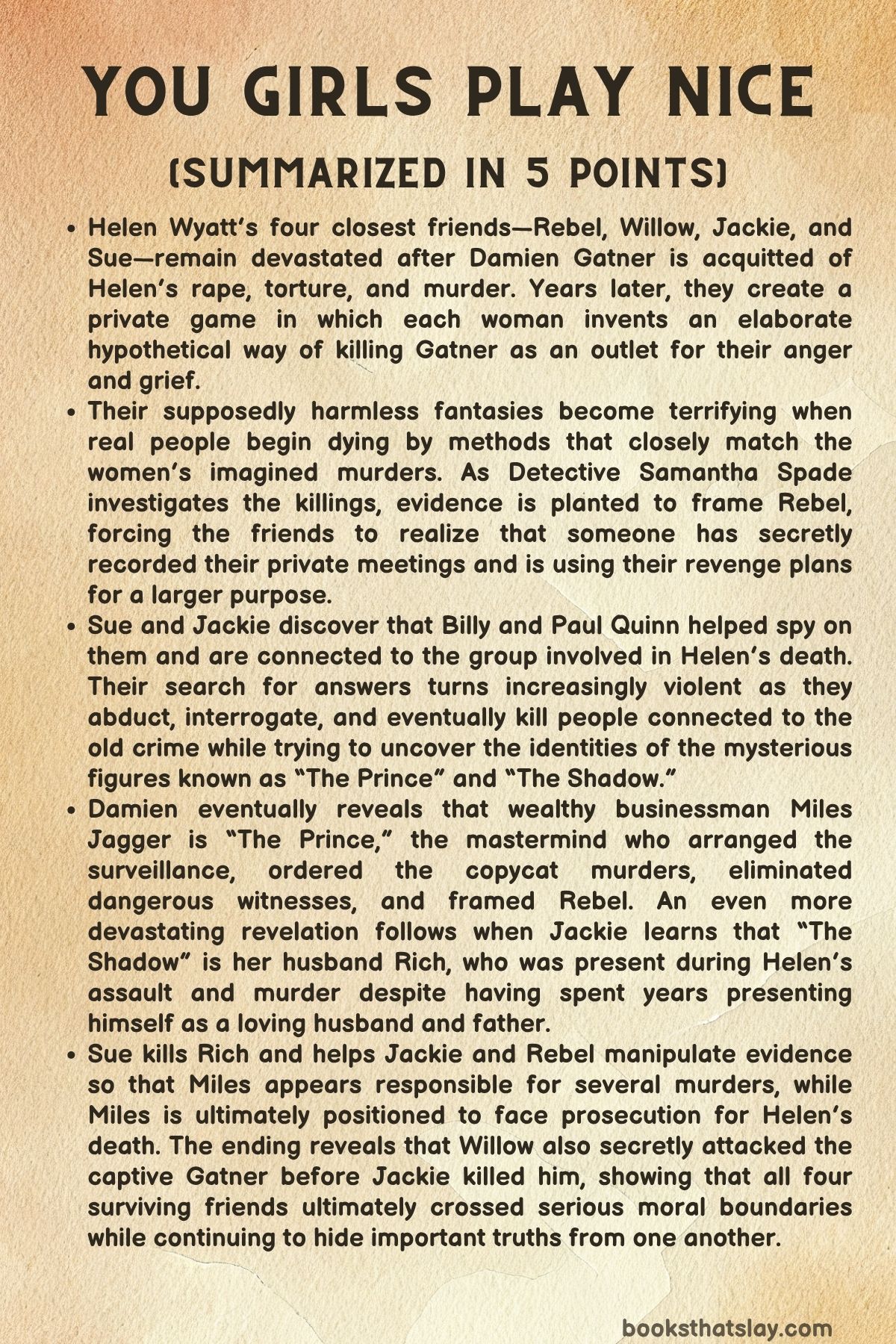
Summary
Helen Wyatt’s four closest surviving friends, Rebel Campbell, Willow Barnes, Jackie Kidman, and Sue Green, sit together in court awaiting the verdict in Damien Gatner’s murder trial. They are certain that Gatner raped, tortured, and killed Helen, but the jury finds him not guilty, leaving Helen’s family and friends devastated while Gatner appears almost triumphant.
Five years after Helen’s death, the four women gather at Sue’s home on what would have been Helen’s thirtieth birthday. Willow reveals that she once tried to find Gatner because she wanted to confront him and possibly kill him, and she has recently learned that he is living in Barcelona.
The confession releases years of suppressed anger among the friends. They begin joking about ways Gatner could be murdered and eventually agree to turn the idea into a private ritual in which each woman designs a hypothetical plan for killing him.
Willow goes first. Although she is gentle, conflict-averse, and works with children, her fantasy is surprisingly brutal: she imagines drugging Gatner, cutting his Achilles tendons, immobilizing him, and repeatedly stabbing him with a metal skewer.
Rebel follows with a much more theatrical plan. She imagines restraining Gatner and slowly lowering him into a highly corrosive chemical mixture capable of destroying his body, allowing the murder method to dispose of the evidence as well.
Jackie devises a mechanical execution. She would lure Gatner by pretending to have car trouble, knock him unconscious, restrain him beneath a giant concrete slab, and slowly lower the slab until he is crushed.
Sue, a florist with extensive knowledge of plants, constructs an elaborate scenario involving poisonous substances, sunlight-sensitive plants, burning, stinging vegetation, and concentrated sunlight. Her fantasy is especially unsettling because it comes from a woman who normally appears nurturing, practical, and restrained.
At first, the women regard these presentations as private acts of catharsis. Their certainty begins collapsing when an unidentified homeless man named Cyris Kimran is murdered after being drugged, stabbed, and having his Achilles tendons cut, almost exactly reproducing Willow’s imagined method.
Soon afterward, Perry Smailes is abducted and killed with the same corrosive chemical process Rebel designed. Perry is not a random victim: years earlier he worked at Damien Gatner’s apartment building, knew Gatner had lied about his movements on the night Helen died, and had attempted to blackmail him.
Another man, Austin Tanner, is then found crushed beneath an elaborate concrete mechanism that strongly resembles Jackie’s presentation. Detective Senior Sergeant Samantha Spade, already investigating Cyris’s death, recognizes similarities between the killings and begins considering whether she is dealing with a connected series.
The situation becomes even more alarming when another victim is discovered burned in an outdoor clearing surrounded by equipment corresponding to Sue’s plant-and-sunlight fantasy. The Four can no longer dismiss the murders as coincidence.
Suspicion begins infecting their friendship. Each woman knows the others are capable of imagining extreme violence, and Rebel’s forceful personality makes her particularly easy to suspect when tensions rise.
Police eventually arrest Rebel after finding highly incriminating evidence. Helen’s missing purse, stained with what appears to be her blood, is discovered in Rebel’s apartment, while Rebel’s Barbie doll appears at another murder scene and a photograph bearing her address directs investigators toward her.
The evidence is almost too obvious. Samantha begins questioning why a calculating killer would deliberately leave such direct clues, especially when Rebel has reasonable alibis and had no involvement in Helen’s original murder.
The Four gradually realize that someone may have learned about their private presentations. Their meetings all occurred in Sue’s living room, making electronic surveillance a possible explanation.
Sue discovers that the house had indeed been bugged. Instead of turning the device over immediately, she removes it and begins investigating for herself, eventually identifying William “Billy” Quinn as one of the men who entered her home while posing as a smoke-alarm technician.
Sue takes Jackie into her confidence, and the pair locate Billy, abduct him, restrain him, and violently interrogate him. Billy admits that he and his older brother Paul, known as Egg, installed the surveillance equipment and received recordings of the Four’s murder presentations.
Billy explains that the copied murders were organized through instructions that appeared to come from Damien Gatner. He also mentions mysterious figures called “The Prince” and “The Shadow,” names connected to a secret group involved in torture and sexual violence.
Helen, who periodically narrates the story from beyond death, begins recovering memories that had been buried beneath trauma. Hearing Billy’s distinctive speech allows her to recognize Billy and Egg as two of the men who participated in her assault and torture.
After the interrogation, Billy is murdered and deliberately marked with injuries associated with Helen’s death, including the distinctive zigzag pattern made by pinking shears. Police therefore begin connecting the recent murders not merely to the Four’s fantasies but directly to Helen’s unsolved case.
Sue and Jackie continue their private investigation by watching Egg. Their surveillance pays off when Damien Gatner unexpectedly returns to Australia and visits him.
They follow the men to an abandoned warehouse and manage to capture both. Sue and Jackie have now crossed far beyond hypothetical revenge, becoming kidnappers who are willing to use threats, drugs, and physical violence to obtain answers.
Egg reveals that the instructions directing the copycat killings were not truly coming from Damien. Someone else had manipulated both the Quinn brothers and Gatner while using the initials associated with Damien to hide the real source.
Sue eventually kills Egg and helps stage the scene so that physical evidence points toward Gatner. She still intends to turn Gatner over to police once they have enough information, believing he can finally be prosecuted through the evidence surrounding the newer murders.
Jackie is less interested in trusting the legal system. Having already watched Gatner escape conviction once, she becomes increasingly convinced that leaving him alive creates too great a risk.
While captive, Gatner finally identifies “The Prince.” The man behind the surveillance and the later murder conspiracy is wealthy businessman Miles Jagger, the host of the party Helen attended on the night she was killed.
Miles had secretly recorded the Four’s revenge meetings and then used Egg and Billy to recreate the women’s imaginary murders. Cyris was chosen largely to establish the pattern, Perry was killed because he could expose Gatner’s false alibi, and Austin was eliminated because Perry had shared dangerous information with him.
Miles also engineered Rebel’s arrest. He possessed Helen’s missing purse, arranged for evidence to be planted in Rebel’s apartment, and used Rebel’s stolen possessions and murder research to create an apparently convincing case against her.
Helen’s recovering memories confirm something even worse. Miles was not merely protecting those responsible for her death; he was physically present in the garage, filming and directing what happened while Damien, Egg, Billy, and others participated.
Another person was also present, someone known as The Shadow. Gatner eventually reveals that identity to Jackie, and the discovery destroys the foundation of her personal life.
The Shadow is Jackie’s husband, Rich Kidman.
Jackie had believed Rich to be a loving husband, devoted father, and literature academic with whom she had built a stable family. A surviving recording from the garage proves that he was present during Helen’s torture and murder.
Before Sue fully understands what Jackie has learned, Gatner is found dead in the basement where the women had been holding him. Jackie has shot him, although the later revelation shows that she was not the only friend who personally confronted him.
Willow had secretly discovered the location after deliberately providing Jackie with information about an unfinished construction project connected to Jacob’s work. She followed Sue to the building, found Gatner restrained, and attacked him with Helen’s red stiletto shoe, driving the heel into his ear before leaving him behind.
Jackie’s gunshots ultimately caused Gatner’s death, but Willow’s actions reveal that the apparently gentlest member of the group had also chosen personal revenge.
With Gatner dead, Sue and Jackie turn their attention toward Miles and Rich. Jackie arranges a confrontation in a hotel room, where Miles arrives expecting to meet Rich.
Jackie reveals the evidence proving Rich’s identity as The Shadow. Rich attempts to minimize his responsibility by claiming that he did not know Helen would be the victim and that he could not prevent what happened once it began, but Jackie cannot reconcile these excuses with the man she believed she knew.
Jackie prepares to kill her husband. Sue intervenes, not because she intends to spare him, but because she refuses to make Jackie personally carry the memory of shooting the father of her children.
Sue uses Miles’s gun to kill Rich. She and Jackie then carefully manipulate the physical evidence so that Miles appears responsible for Rich’s death.
Rebel is brought into the conspiracy and agrees to help. She plants additional evidence at Miles’s property, including a weapon linked to the other killings, and anonymously directs police toward him.
The police case subsequently forms around a mixture of genuine evidence and manufactured clues. Recordings prove that Damien, Billy, Egg, and Miles were associated with the torture group, while the pinking shears connected to Helen are recovered from Miles’s property.
Samantha explains to the Four that investigators believe Miles killed Rich and Damien and that he will now face prosecution for Helen’s murder. The women know the official version is incomplete, but it is close enough to the truth to place one of Helen’s principal attackers before the courts.
The surviving friends appear ready to close this part of their lives. Signs surrounding Willow, Jackie’s daughter Bennet, and Samantha suggest that Helen’s restless presence has finally found some form of peace.
Yet the final revelation prevents any clean moral resolution. Willow secretly participated in Gatner’s torture, Sue and Jackie committed multiple killings, and Rebel knowingly helped manufacture evidence.
The four women raise a toast to having no more secrets, even as Rebel and Willow continue hiding the truth about Willow’s role in Gatner’s death. Their friendship survives and some of Helen’s killers face consequences, but justice has been achieved through lies, murder, manipulation, and loyalty that repeatedly overrides the law.
Characters
Helen Wyatt
Helen is both the absent center of the story and one of its most active moral voices. Although she is dead before the principal events begin, You Girls Play Nice allows her to observe her friends, remember their secrets, reconsider her relationships, and gradually recover the truth about the night she was killed.
Her narration prevents her from becoming merely the victim around whom other characters act. Helen repeatedly insists on remembering herself as an artist, a friend, an independent woman, and a person who enjoyed pleasure, travel, sexuality, humor, and creative freedom rather than reducing her identity to the violence inflicted upon her.
Her synesthesia and artistic imagination are especially important because they show how she experiences the world through color, sound, texture, and visual association. Even during her final suffering, she mentally returns to art, music, Tuscany, and sensory memories as a means of preserving some control over herself.
Helen also functions as the keeper of secrets among the women. She knows what Rebel regrets, what Willow endured in childhood, what Jackie feels guilty about, and what Sue has concealed, yet she discovers that even her knowledge has limits.
Her attitude toward revenge is complex. She understands the anger of the women who loved her but repeatedly wishes they would stop allowing Gatner and her death to dominate their lives, making her perspective significantly different from their belief that retaliation may offer closure.
Her final movement toward peace gives You Girls Play Nice an emotional counterweight to the escalating violence. Helen ultimately recognizes that she cannot determine what the living choose to do, and her release comes from refusing to remain psychologically attached to those who destroyed her.
Rebel Campbell
Rebel is outspoken, combative, theatrical, fiercely loyal, and often the member of the Four most comfortable expressing anger. Her personality makes her appear capable of violence long before there is any evidence that she has actually committed it, which is precisely why framing her becomes so effective.
Much of Rebel’s aggression is defensive rather than careless. Childhood bullying, the early death of her biological mother, and the helplessness she experienced after Helen’s murder have taught her that strength can feel like protection against situations in which she once had none.
Her revenge presentation reflects her personality perfectly. She treats the occasion almost as a performance, using spectacle, research, humor, props, and dramatic timing to transform private rage into something she can control.
Yet Rebel is far more vulnerable than her confidence suggests. Her imprisonment breaks through the identity she has carefully constructed, leaving her frightened, claustrophobic, uncertain, and desperate for the emotional security offered by her father and stepmother Muriel.
The deepest source of her guilt is her final argument with Helen. Rebel had told Helen she would never share the same bond that Rebel had with Willow, and the fact that these became her last words to Helen causes years of self-punishment.
Her development comes through learning that a cruel moment does not erase an entire friendship. By the end, she has also accepted moral compromise, helping Sue and Jackie manipulate evidence against Miles while remaining capable of understanding exactly how dangerous that choice is.
Willow Barnes
Willow initially appears to be the moral opposite of Rebel. She is gentle, conflict-averse, spiritually inclined, nurturing toward children, and uncomfortable with confrontation, creating the impression that she would be the least likely member of the group to commit an act of violence.
That identity gradually proves incomplete. Willow carries enormous suppressed anger, and her childhood history explains why she has spent so much of her life trying to remain agreeable, peaceful, and emotionally manageable.
Her father repeatedly damaged her self-confidence through criticism of her appearance, intelligence, and future. Helen became one of the few people who understood how deeply those comments affected her, strengthening the emotional dependence Willow later develops around Helen’s memory.
Willow’s relationship with Jacob provides a healthier form of intimacy. He supports her grief, rejects the victim-blaming used against Helen, and offers her stability, yet Willow’s decision to hide the revenge meetings from him shows that part of her already knows the game is awakening something she cannot easily explain.
Her murder fantasy is the first warning that kindness and violence are not mutually exclusive. The precision with which she imagines drugging, disabling, and stabbing Gatner shocks even her friends because it exposes the rage beneath her peaceful exterior.
Her eventual attack on the captive Gatner completes that development. Willow deliberately gives Jackie information about the construction site, follows Sue, discovers Gatner, and attacks him with Helen’s shoe, proving that she is capable not merely of imagining revenge but of enjoying a moment of physical retaliation.
Willow therefore becomes one of the novel’s strongest challenges to simple judgments about personality. Gentleness is genuinely part of who she is, but it does not erase resentment, moral anger, or the capacity to choose violence when she believes ordinary justice has failed.
Sue Green
Sue initially serves as the emotional and practical center of the Four. Her home becomes their meeting place, her florist business and gardening reflect her nurturing qualities, and her yearly ritual of sending roses to Helen’s family and friends shows how deliberately she maintains bonds with the people she loves.
Beneath that calm exterior lies a far more decisive personality. Sue is capable of long-term planning, deception, physical courage, and a willingness to protect friends through methods that progressively move beyond legal and moral limits.
Her past with Robbie is crucial to understanding her. As a teenager, she deliberately pushed him from a cliff after he confronted her and Jackie about their earlier manipulation, then persuaded Jackie to conceal what had happened.
This means that Sue has already crossed the line into killing long before Helen’s death. The later events do not create that capacity so much as give her new reasons to use it.
Her confrontation with Gatner sets much of the later plot in motion. By bluffing that she knew who his accomplices were and possessed proof, she unintentionally frightens the hidden group responsible for Helen’s death and convinces them that the Four have become a serious threat.
Sue’s strengths become increasingly dangerous once she begins investigating the surveillance device. She hides evidence from police, locates Billy, abducts and tortures him, captures Gatner and Egg, kills Egg, assists in staging murder scenes, kills Rich, and helps construct the final frame against Miles.
At the same time, she does not perceive herself as indiscriminately violent. She repeatedly distinguishes between people she believes are guilty and innocent, and she initially wants Gatner turned over to police rather than executed.
Her interest in motherhood creates an important contradiction. Sue is considering bringing a child into her life at the same moment she is becoming capable of calculated murder, forcing the reader to confront how care, loyalty, violence, and self-justification can exist within a single person.
Jackie Kidman
Jackie begins as a woman divided between domestic identity and frustrated ambition. She loves Rich and their daughters, Bennet and March, but she also worries that marriage and motherhood have caused her friends to see her only as a wife and mother rather than the daring, intellectually ambitious woman she once wanted to become.
Her fantasy murder therefore becomes an act of self-reassertion. The elaborate crushing mechanism demonstrates intelligence, patience, imagination, and a desire to reclaim the part of herself that enjoys darker creative thought.
Jackie also carries powerful guilt about Helen. She believes her flirtation with Helen’s former boyfriend contributed to the breakup that eventually led Helen toward Damien, although Helen’s narration makes clear that Jackie has exaggerated her own responsibility.
Her relationship with Sue is loving but morally complicated. They have protected one another since adolescence, conspired in retaliation against bullies, concealed Robbie’s death, and committed private betrayals against each other while somehow preserving an unusually strong bond.
As the investigation progresses, Jackie becomes more extreme than Sue expects. Torturing Billy does not frighten her away from violence; instead it seems to harden her conviction that the men responsible for Helen should suffer.
Discovering that Rich is The Shadow destroys the central structure of Jackie’s adult identity. The man she trusted as a husband, intellectual companion, and father to her children was present during the rape, torture, and murder of her closest friend.
Her killing of Gatner is therefore motivated by revenge, fear, and desperation. When she later prepares to kill Rich, her crisis is even more complicated because punishing him means destroying the image of the father her daughters love.
Jackie’s character ultimately shows how an apparently stable person can become highly skilled at compartmentalization. She lies convincingly to homicide detectives while caring for her baby, creates false timelines, participates in murder, and returns to domestic life while carrying knowledge that can never be safely shared.
Damien Gatner
Damien is initially presented through the devastating gap between legal innocence and moral guilt. His acquittal does not establish that Helen’s friends were wrong; instead, later revelations confirm that he participated directly in her rape, torture, and death.
He is manipulative, self-protective, sexually predatory, and accustomed to treating other people as tools for pleasure or protection. His early relationship with Helen contains excitement and genuine attraction, but his growing verbal cruelty reveals his need to control and diminish her.
After Helen’s death, Damien survives primarily by relying on more powerful men. He lies about his movements, benefits from false testimony, pays Perry to silence him, flees overseas when ordered, and trusts Miles to manage threats on his behalf.
His cowardice becomes especially visible once he loses control. Captivity reduces the swaggering man who escaped conviction to someone who bargains, lies, redirects blame, and reveals secrets in the hope of surviving.
Damien is not the ultimate strategist behind the conspiracy, but that does not lessen his responsibility. He repeatedly tries to portray himself as manipulated by others even though he knowingly participated in extreme sexual violence and helped conceal what happened afterward.
His death denies the story a conventional courtroom reckoning. Instead of being publicly forced to answer for Helen, he becomes another victim of the private justice created by her friends.
Detective Senior Sergeant Samantha Spade
Samantha represents the legal system functioning at its most conscientious. She is intelligent, observant, skeptical of easy answers, and determined not to allow victims such as Cyris Kimran to be forgotten merely because they lack powerful families or social status.
Her professional life also places her in conflict with sexism. She has learned to judge colleagues quickly and refuses to tolerate Max Stripping’s dismissive behavior, while her partnership with Grant works because she respects his competence and seriousness.
Samantha’s greatest strength is her resistance to convenient explanations. Rebel’s arrest could easily have closed the investigation, yet Samantha notices that the evidence appears excessively obvious and continues testing alternative theories.
She gradually recognizes that the copied murders, Helen’s case, the Quinn brothers, Damien, and Miles all belong to the same larger structure. Her investigation repeatedly moves closer to the truth even while Sue, Jackie, and Rebel manipulate evidence around her.
Samantha also provides a moral contrast with the Four in You Girls Play Nice. She experiences anger, exhaustion, frustration, and personal attachment to cases, but she continually attempts to operate through evidence, procedure, and accountability rather than private punishment.
Her marriage to Ravi humanizes the cost of that commitment. She struggles to leave homicide work at the station, and her repeated interruptions of domestic life show that pursuing justice professionally can consume a person even without the additional burden of personal revenge.
By the end, Samantha solves only the version of events that the women allow police to see. She reaches many correct conclusions, but the manufactured evidence demonstrates that even an excellent investigator can be guided toward a partly false narrative when genuine guilt and fabricated proof point in the same direction.
Miles Jagger
Miles is the central strategist behind the criminal network. His wealth, social respectability, charm, and apparent cooperation with the original investigation allow him to remain almost invisible while less sophisticated men attract suspicion.
His most disturbing quality is his ability to separate appearance from intention. He treats Helen with warmth, shows interest in her artwork, attracts her romantically, and gives her reasons to imagine a future connection while secretly belonging to the group that will later torture and kill her.
Miles operates through surveillance, money, proxies, and blackmail. Rather than expose himself unnecessarily, he directs Damien, Billy, and Egg, finances lifestyles, controls evidence, and constructs schemes in which other people perform the physical violence.
The copycat murders display his strategic thinking. He recognizes that the Four’s private revenge fantasies can be transformed into an instrument against them, allowing him to remove inconvenient witnesses while simultaneously creating a case against Rebel.
His weakness is arrogance. Miles becomes so accustomed to remaining several moves ahead of everyone else that he underestimates the capacity of Helen’s friends to investigate him, commit crimes themselves, and manipulate evidence with the same cold planning he once used.
His eventual framing carries deliberate irony. The man who built false narratives around others becomes trapped inside a narrative created for him, although unlike Rebel, he is genuinely responsible for many of the crimes that make the accusations believable.
Rich Kidman
Rich is one of the story’s most disturbing characters because his secret identity contradicts almost everything Jackie and the reader have been encouraged to believe about him. He appears educated, loving, supportive, literary, and devoted to his daughters.
His identity as The Shadow destroys that image. Evidence places him at the garage during Helen’s rape, torture, and murder, connecting Jackie’s apparently safe domestic world directly to the violence that has haunted her for years.
Rich attempts to defend himself through technical distinctions. He claims he did not know Helen would be the victim and suggests that once events began he had little ability to intervene, but these explanations reveal moral cowardice rather than innocence.
His character raises questions about how well people know those closest to them. Jackie has spent years sharing a home, marriage, intellectual interests, and children with a man whose past contains something she would have considered unforgivable.
His death at Sue’s hands also complicates Jackie’s position permanently. Rich is both a perpetrator who participated in Helen’s destruction and the father her children knew and loved, meaning Jackie can never simplify him into a single identity without denying part of her own life.
Jacob
Jacob provides Willow with the healthiest intimate relationship among the central women. He is patient, supportive, and especially clear in his rejection of the arguments used during Gatner’s trial to blame Helen for what happened to her.
His presence also highlights Willow’s transformation. She normally shares almost everything with him, so her decision to conceal the revenge meetings indicates how deeply she senses that the game is changing her.
Jacob does not rescue Willow from her anger, nor can he fully understand the private bond connecting Helen’s surviving friends. Instead, he represents an ordinary, emotionally supportive life that Willow repeatedly risks losing as her obsession with Helen’s death returns.
Sasha
Sasha is important primarily through her relationship with Rebel. She wants greater domestic stability and hopes for children, while Rebel values independence and has never wanted motherhood, creating a basic incompatibility beneath their strong physical connection.
She also feels excluded from Rebel’s friendship with the other women. The revenge meetings intensify that exclusion because Rebel regards anything connected to Helen as belonging to a private emotional territory Sasha cannot enter.
Their relationship demonstrates how unresolved grief affects people who were not part of the original trauma. Sasha is not competing with Helen as an individual, but she cannot fully share a relationship in which the dead friend and the surviving group continue to occupy such enormous psychological space.
Billy “The Kid” Quinn
Billy is both perpetrator and victim, although the second identity never erases the first. He participated in Helen’s assault and later helped install surveillance equipment in Sue’s house, allowing Miles to obtain the murder presentations that would become templates for real killings.
His dependence on his older brother Egg is central to his personality. Billy frequently follows instructions instead of exercising independent moral judgment, but the story refuses to treat obedience as an excuse for participation in torture and murder.
His interrogation by Sue and Jackie marks an important turning point because the Four are no longer merely pursuing information. They use physical suffering as a tool, adopting methods disturbingly similar to those used by the men they hate.
Billy’s death then helps expose the connection to Helen. The deliberate use of injuries associated with her murder transforms his body into evidence pointing investigators toward crimes that had remained hidden for years.
Paul “Egg” Quinn
Egg is Billy’s protector, partner, and older brother. Their shared childhood under abusive parents creates genuine loyalty between them, even though that loyalty eventually develops inside a life defined by escalating violence.
Egg’s history shows that his capacity for killing existed long before Helen. He kills his abusive stepfather and mother and later becomes part of a secret culture in which torture and sexual violence are normalized.
Unlike Billy, Egg appears more capable of understanding the larger danger surrounding them. Once Billy dies, he quickly recognizes that somebody is targeting people connected to their past and that their former protection has collapsed.
His grief for Billy is sincere, creating an uncomfortable emotional complexity. A person capable of terrible cruelty can still deeply love another person, and the book refuses to pretend that affection automatically produces morality.
Egg ultimately becomes another target of Sue and Jackie. His death demonstrates how completely the women have abandoned the expectation that the legal system must decide punishment.
Grant Levington
Grant functions as Samantha’s most effective professional partner. Unlike Max, he respects her authority, contributes useful observations, and approaches the murders with the same seriousness she demands from herself.
His interviews with Rebel and Jackie show that he is attentive without becoming unnecessarily aggressive. He recognizes inconsistencies and emotional signals but does not confuse intuition with proof.
Grant also helps the investigation advance through forensic and factual connections, particularly when evidence begins linking Gatner directly to the Quinn murders. He represents competent police work that steadily narrows the gap between the official investigation and the hidden truth.
Themes
Revenge and the Collapse of Moral Boundaries
Revenge begins as imagination rather than action. In You Girls Play Nice, the Four create their murder presentations because the legal system has failed to give them the outcome they believe Helen deserved, allowing fantasy to become a private space where they can temporarily control the man who once seemed untouchable.
That distinction initially matters to them because they repeatedly insist that everything is hypothetical. Their elaborate scenarios seem to offer emotional release without harming anyone, which allows them to experience violent thoughts while still viewing themselves as fundamentally separate from actual killers.
The copied murders destroy that comfortable separation. Once their ideas are used against real victims, the women must confront the fact that violence can move from imagination into reality far more easily than they expected.
Sue and Jackie then cross the boundary deliberately by kidnapping Billy, torturing him, capturing Egg and Gatner, and eventually killing. Willow later attacks Gatner herself, while Rebel participates in planting evidence, meaning every surviving friend eventually becomes involved in conduct she would once have considered unacceptable.
The novel does not present this progression as a simple transformation from goodness into evil. Each woman believes there are reasons for what she does, and their targets are often genuinely guilty of horrific crimes, which makes the moral problem more difficult rather than easier.
Their revenge brings consequences that formal justice failed to provide, but it also requires secrecy, false evidence, murder, and the corruption of relationships. The result is justice of a kind, but one that cannot be separated from the very violence the women initially believed existed only in imagination.
Friendship, Loyalty, and the Burden of Secrets
The friendship among Helen, Rebel, Willow, Jackie, and Sue is built on genuine love, but it has never been completely transparent. Long before Helen’s death, the women were already protecting one another, withholding painful information, carrying private guilt, and deciding which truths their friends could handle.
Those secrets often originate in loyalty. Rebel hides what she knows about Sue and Jackie because she wants to protect the group, Willow conceals witnessing Robbie’s death, and Helen guards private confessions because she respects the trust placed in her.
Yet protection repeatedly becomes manipulation. Deciding that another person should not know something can easily become a way of controlling that person’s understanding of her own life, as Willow recognizes when she learns that others have treated her as too fragile for difficult truths.
Sue and Jackie represent the most extreme version of this loyalty. Their friendship survives jealousy, betrayal, concealment, adolescent wrongdoing, murder, and the later vigilante campaign because each repeatedly chooses the other over external moral rules.
Rebel eventually joins their conspiracy, while Willow creates a secret of her own by participating in Gatner’s attack. By the ending, friendship has become both a source of survival and a structure capable of hiding serious crimes.
The toast to having no more secrets therefore becomes deliberately ironic. The women sincerely want closeness and honesty, yet their relationships have reached a point where certain truths may threaten the very bonds they are trying to preserve.
Justice, Law, and the Failure of Institutions
Damien Gatner’s acquittal creates the central crisis of faith that shapes the story. Helen’s friends believe they know what happened to her, but the courtroom requires evidence strong enough to satisfy legal standards, creating a painful separation between personal certainty and judicial proof.
The trial also demonstrates how victims can be judged alongside defendants. Helen’s intoxication, sexuality, photographs, clothing, and drug exposure are used to make Gatner’s version of events appear more plausible, leaving her friends with the sense that the legal process has examined Helen’s choices more harshly than the behavior of the men who harmed her.
Samantha offers an important counterargument to complete rejection of the justice system. She is careful, persistent, compassionate toward overlooked victims, and willing to challenge convenient theories, showing that institutions are not automatically indifferent simply because they can fail.
The problem is that lawful investigation operates within limits. Samantha needs evidence, warrants, corroboration, and defensible conclusions, while Sue and Jackie can abduct suspects, use torture, plant evidence, and act on information that would never survive normal legal procedures.
This gives the vigilantes an obvious advantage in speed, but it also creates terrible risks. They decide guilt for themselves, select punishments themselves, destroy evidence, conceal perpetrators, and manipulate innocent investigators.
The ending therefore refuses to provide a clean victory for either legal justice or private retaliation. Miles may finally face prosecution, but the official case contains manufactured evidence, while several actual killings committed by Helen’s friends remain hidden from the law.
Grief, Guilt, and the Difficulty of Letting Go
Helen’s death freezes the surviving women around a moment none of them can change. Their lives continue through work, relationships, marriage, children, acting, teaching, and personal ambitions, yet part of each woman remains emotionally attached to the night Helen died and the courtroom where Gatner walked free.
Guilt makes that attachment even stronger. Rebel punishes herself for cruel final words, Jackie imagines that her behavior indirectly pushed Helen toward Damien, Willow repeatedly returns to court transcripts, and Sue carries responsibility for confronting Gatner in a way that later triggers dangerous consequences.
Much of this guilt depends on the illusion that the past could have been controlled. Each woman imagines some earlier choice that might have saved Helen, even though Helen herself rejects many of those interpretations and repeatedly wishes her friends would stop constructing their lives around her death.
Helen experiences a parallel struggle. Her continued presence keeps her connected to unfinished memories, hidden perpetrators, and the worsening behavior of the women she loves, but recovering every secret requires her to revisit the violence she most wants to escape.
Her eventual decision to stop searching for every final answer becomes one of the story’s clearest statements about release. Peace does not arrive because all wrongdoing has been repaired or every truth has been spoken; it arrives when Helen refuses to allow suffering to remain the only force defining her existence.
The surviving women reach a less complete form of closure. They obtain revenge and expose several perpetrators, but the secrets they preserve show that grief has changed them permanently, leaving them alive and united without ever restoring the people they were before Helen died.