Extracurricular by Rachel Lynn Solomon Summary, Characters and Themes
Extracurricular by Rachel Lynn Solomon is a contemporary romance about celebrity, reinvention, education, power, and the difficult work of deciding who you are after spending years becoming what other people wanted.
At its center is Ramona Wilder, a former pop superstar who abruptly leaves the music industry and enrolls at UCLA in search of an ordinary life she has never experienced. There she meets psychology professor Nick Navarro, whose own life has been unsettled by divorce. Their initially hostile relationship grows increasingly personal, forcing both of them to confront questions about independence, trust, professional boundaries, trauma, intimacy, and what it means to build a future by choice rather than expectation.
Summary
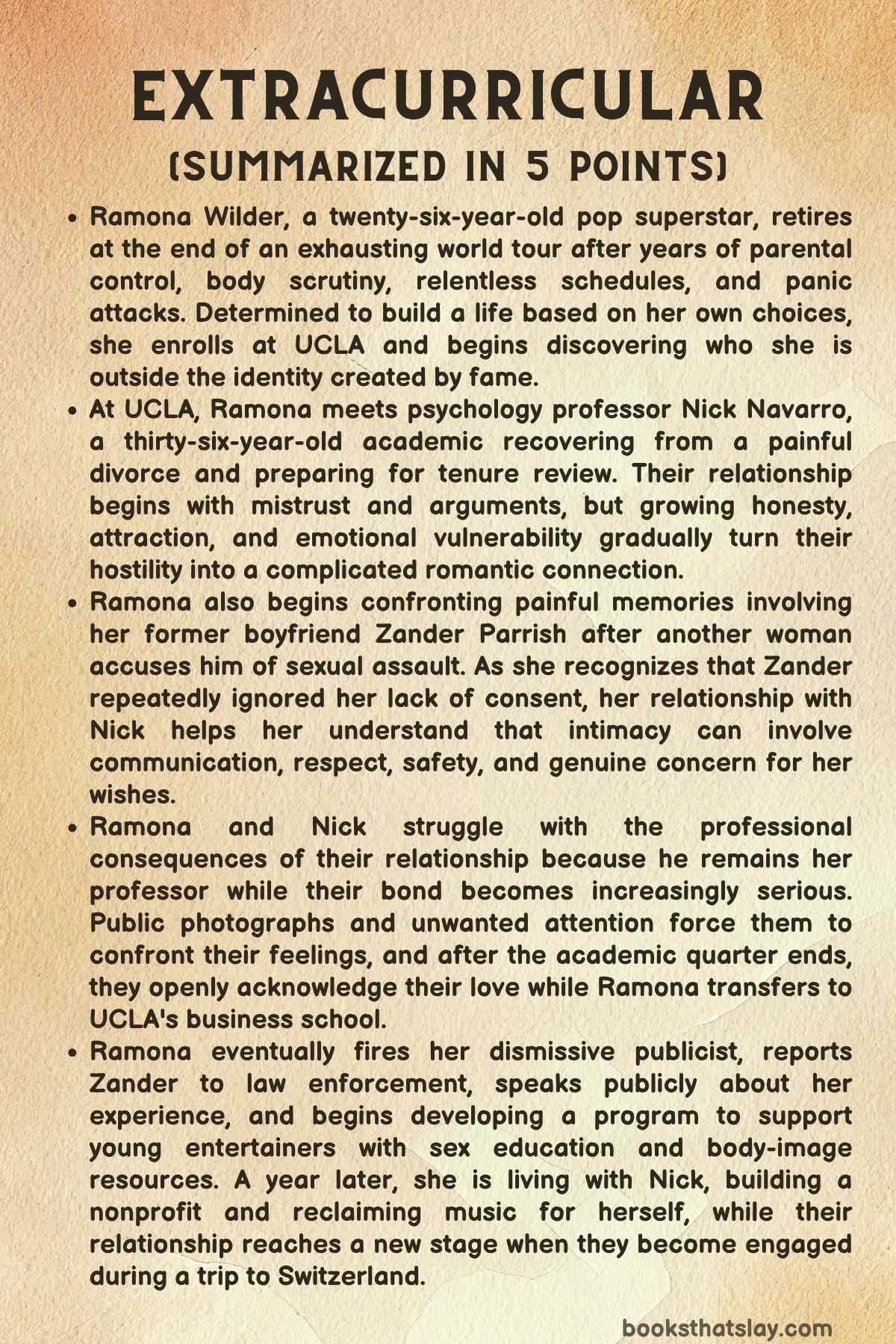
At twenty-six, Ramona Wilder reaches the end of an enormously successful world tour feeling physically ill, emotionally exhausted, and increasingly unable to tolerate the life built around her fame. She has been working since childhood, first in commercials and television and later as a pop singer whose parents, DeeAnn and Beck, effectively turned her career into the family business.
Years of rigid schedules, body scrutiny, sexualization, pressure to remain commercially useful, and recurring panic attacks have destroyed much of the pleasure Ramona once found in music. When she tells her parents that she wants to retire, they treat her exhaustion as a temporary problem rather than recognizing her desire to leave.
Ramona finally takes control by announcing publicly that her last concert truly is her last. The decision shocks her family, her management team, and millions of fans, but she refuses to reverse it, eventually hiring her own lawyers and representatives and buying herself out of professional obligations.
Six months later, Ramona is living alone in Calabasas and trying to understand who she is without a stage, a tour schedule, or an industry constantly evaluating her. Her best friend, Betty Zhu, becomes one of the few people who treats her as a person rather than a celebrity product, while Ramona begins repairing her relationship with food, exercise, and her changing body.
Her most important new decision is enrolling at UCLA. Because work prevented her from having an ordinary education, attending college represents far more than earning a degree: it is one of the first major choices she has ever made entirely for herself.
At UCLA, Ramona enters the psychology class taught by thirty-six-year-old Nick Navarro. Nick is recovering from a painful divorce after his former wife, Kathryn, fell in love with someone else, and he is temporarily living in the guesthouse belonging to his sister Lexi and niece Audrey while preparing for an important tenure review.
Nick initially assumes Ramona may be treating college as another publicity exercise. Their first encounters reinforce the tension when Ramona accidentally damages his Prius before class and later discovers that Nick has turned the incident into a discussion about morality.
When Nick questions why someone as wealthy and famous as Ramona needs university at all, she angrily explains how little control she had over her own education and career. Nick begins recognizing that his assumptions about her are unfair, although their relationship remains argumentative and charged by an attraction neither wants to acknowledge.
College is initially difficult for Ramona. She falls behind on assignments, struggles with ordinary academic systems, performs badly on a quiz, and reacts defensively when Nick suggests reducing her course load.
At the same time, news about Ramona’s former boyfriend Zander Parrish begins reopening memories she has avoided for years. A woman has accused Zander of sexual assault, and Ramona’s publicist Petra pressures her to defend him publicly even though Ramona remembers disturbing experiences from their own relationship.
The memories contribute to severe anxiety, and after being surrounded by fans at a mall, Ramona experiences a panic attack. Unable to reach Betty and unwilling to call her estranged mother, she turns unexpectedly to Nick.
Nick comes immediately, helps her leave the mall in a ridiculous disguise, and takes her for tacos. Away from the classroom, they speak honestly for the first time about fame, loneliness, education, divorce, family, and the identities other people have assigned to them.
Their relationship soon moves beyond ordinary professor-student interaction. Text messages become playful and increasingly flirtatious, while both recognize that Nick’s authority over Ramona’s grade makes their attraction professionally dangerous.
They eventually kiss and become physically involved. For Ramona, intimacy with Nick is significant because he consistently asks what she wants and refuses to treat sex as something she owes him, exposing how deeply her earlier relationships taught her to ignore her own comfort and desires.
The two attempt to restore boundaries by redefining themselves as friends. Instead, ordinary activities such as attending a Clippers game, drinking coffee, browsing thrift stores, going to Betty’s Halloween party, and looking at apartments bring them closer.
Ramona discovers that being with Nick allows her to experience something she has rarely had: normality. Nick, meanwhile, discovers that Ramona sees through the relentless optimism he uses to hide his loneliness and fear that Kathryn left because he was somehow inadequate.
Their growing attachment attracts public attention when photographs identify Nick as Ramona’s professor. Dean Traci Eckhart warns Nick about professional boundaries, forcing him and Ramona to distance themselves while the quarter continues.
Their separation becomes difficult when Ramona becomes seriously ill. Nick learns that she is alone without medicine and goes to her house, where he cooks, cleans, cares for her, and protects her when DeeAnn unexpectedly appears and attempts to force herself back into Ramona’s life.
The visit changes the emotional character of their relationship. Ramona shows Nick the room containing guitars, awards, records, photographs, and other objects from her former career, while explaining the degree to which her parents controlled her appearance, schedule, sexuality, finances, and sense of responsibility.
Nick in turn admits that his cheerful personality partly hides unresolved insecurity from his divorce. Their willingness to reveal the parts of themselves they normally conceal turns attraction into genuine emotional dependence.
They begin a secret romantic relationship while maintaining academic fairness in the classroom. Ramona continues studying seriously and becomes increasingly confident in psychology, while Nick becomes invested in the ordinary domestic moments they share away from campus.
Ramona also reconnects with former industry friend Arlie J and is forced to confront Zander’s past behavior more directly. She remembers telling him that she was not ready for sex, asking him to stop, and having him continue anyway.
Accepting that a boyfriend could sexually assault her is difficult because Ramona spent years interpreting what happened through Zander’s explanations rather than her own experience. She gradually begins recognizing that her uncertainty and silence do not make his actions acceptable.
As Christmas approaches, Nick and Ramona travel to Mammoth Lakes to stay with his family. Ramona is welcomed by Nick’s parents, Lexi, Audrey, and the rest of the family, giving her access to the affectionate family environment she has long wanted.
There, Ramona finally tells Nick what Zander did. Nick believes her immediately, refuses to pressure her into publicly discussing the assault, and promises to support whatever decision she makes, giving Ramona the freedom to determine her next step herself.
A secretly recorded video of Ramona and Nick soon appears online, making their relationship impossible to hide. Ramona assumes that the complications created by her fame will eventually drive Nick away and offers him an opportunity to leave.
Instead, Nick tells her that difficulty and conflict are not reasons to abandon a relationship. He admits that he wants a real future with her, and Ramona recognizes that her insistence on keeping their relationship casual has been an attempt to protect herself from rejection.
They finally admit that they love each other. Once the academic quarter ends, Ramona transfers to UCLA’s business school, removing herself from Nick’s department, while Nick considers resigning because he fears that their relationship could damage her education or his integrity.
Dean Eckhart refuses to accept the resignation because Ramona is no longer Nick’s student and evidence of their relationship became public only after grades were submitted. Ramona then discovers that she earned an A-minus in psychology, a result that matters deeply because she achieved it through her own effort rather than fame or influence.
Ramona’s next stage of independence involves deciding what to do with the public power she once wanted only to escape. She fires Petra after Petra minimizes Zander’s accuser, tells Arlie the truth, and contacts law enforcement with help from someone Nick knows in criminal justice.
Ramona eventually makes her experience public. Zander’s television project is canceled, other women later come forward, and Ramona begins separating herself more decisively from the people who protected the system around him.
Her family situation also changes. Beck admits that DeeAnn secretly provided the favorable quote about Zander that appeared in the press and reveals that their marriage is experiencing serious problems, while Ramona blocks DeeAnn and leaves open only a cautious possibility of reconnecting with her father someday.
Rather than returning to professional music, Ramona studies business and develops a plan to support young entertainers who lack access to proper sex education and healthy guidance about body image. She also begins forming real friendships and finally takes out one of her guitars, not for an audience or a recording contract but simply because she wants to play.
A year later, Ramona and Nick are living together in Encino. Nick has received tenure, Ramona is developing a nonprofit for young performers, and much of her old memorabilia has been sold or donated to benefit sexual-assault survivors.
Three additional women have come forward against Zander, criminal charges have followed, and his career has collapsed after a plea agreement. Ramona no longer treats her past as something she must either romanticize or completely reject; she is learning that painful experiences and meaningful accomplishments can exist in the same history.
While hiking with Nick in Switzerland, Ramona unexpectedly tells him that she wants to marry him. Nick reveals that he had already planned to propose and has a ring waiting at their hotel.
Their engagement completes Ramona’s movement toward a kind of life she once believed was unavailable to her. What she ultimately finds is not the anonymity she originally imagined she needed, but the ability to make choices, accept love, use her influence deliberately, and build an ordinary future without surrendering control over herself.
Characters
Ramona Wilder
In Extracurricular, Ramona Wilder is built around the conflict between public success and private autonomy. She appears to possess almost every conventional privilege associated with celebrity, including wealth, recognition, beauty, professional achievement, and millions of admirers, yet the book gradually reveals how little control she possessed over the structure of the life that produced those privileges.
Her retirement therefore represents more than professional exhaustion. It is Ramona’s first serious attempt to separate desire from obligation and determine what she likes when managers, parents, fans, photographers, and commercial expectations are no longer making choices for her.
Her decision to attend UCLA becomes essential to that process because education offers something fame never gave her: the satisfaction of being evaluated for work she personally performs. Her early academic failures are painful precisely because celebrity cannot solve them, but this is also why her eventual progress matters so deeply.
Ramona’s changing relationship with her body follows the same pattern. For years, food and exercise were organized around marketability, costumes, photographs, and other people’s judgments, while retirement allows weight gain and physical strength to become signs that she is listening to herself rather than maintaining an externally approved image.
Her trauma involving Zander adds another dimension to her struggle for self-definition. Ramona has spent years accepting interpretations of sexual intimacy that reduced her wishes to inconveniences, making her gradual recognition of assault difficult because acknowledging what happened requires her to trust her own memory and boundaries over the explanations she was given.
Her relationship with Nick matters because he consistently returns choice to her. His support is most valuable when he believes her, respects her decisions, and refuses to determine whether she should speak publicly about Zander, allowing care to strengthen rather than replace her independence.
Ramona’s flaws remain important throughout the story. She can be defensive, impulsive, suspicious of permanence, and quick to interpret conflict as evidence that someone is preparing to leave, all of which emerge from years in relationships where affection was often conditional on usefulness.
By the end, Ramona does not simply exchange celebrity for romance. She learns to claim education, friendship, music, sexuality, public influence, and love on terms she can actively choose, which makes her development fundamentally about ownership of the self.
Nick Navarro
Nick Navarro functions in Extracurricular as both Ramona’s romantic counterpart and a character undergoing his own reconstruction. His optimism, patience, enthusiasm for teaching, loyalty to family, and affection for ordinary routines initially make him appear exceptionally stable, but that stability partly depends on avoiding emotions he does not know how to process.
Kathryn’s departure has left Nick questioning whether some hidden deficiency in him caused the collapse of his marriage. He no longer necessarily wants Kathryn back, yet he remains attached to the idea that if he had been better, more attentive, or more desirable, the marriage might have survived.
This insecurity explains why Ramona’s attraction affects him so powerfully. Being desired restores confidence he lost after divorce, but his connection with her eventually becomes more meaningful because she recognizes that constant cheerfulness can itself function as a performance.
Nick’s most serious weakness is his handling of professional boundaries. Although Ramona is an adult and their emotional connection is mutual, he is still responsible for grading her, and his willingness to continue a secret relationship exposes both of them to legitimate professional consequences.
Importantly, the story does not portray him as unaware of the ethical problem. His anxiety about tenure, his meeting with Dean Eckhart, and his eventual willingness to resign demonstrate that he understands his choices have consequences even when he believes the relationship itself is sincere.
As Ramona’s partner, Nick is defined by attentiveness rather than rescue. He helps during panic, illness, family confrontation, and trauma disclosure, but his strongest moments come when he avoids turning assistance into control.
His eventual relationship with Ramona also changes his understanding of love after divorce. Instead of interpreting Kathryn’s departure as proof that permanence can never be trusted, he learns that vulnerability includes accepting uncertainty without treating uncertainty as evidence of inevitable abandonment.
DeeAnn Wilder
DeeAnn is one of the story’s most complicated sources of harm because her control is closely connected to the career that made Ramona successful. She does not need to see herself as cruel in order to behave destructively; she repeatedly frames management, discipline, publicity, and interference as practical necessities.
Her greatest failure is her inability to recognize Ramona as an adult whose desires exist independently of the family enterprise. When Ramona announces retirement, DeeAnn interprets the decision in terms of damage to the business rather than asking what years of performing have done to her daughter.
DeeAnn’s control extends into areas that should have remained private, including Ramona’s body, relationships, schedule, public image, and personal history. Her decision to provide a favorable comment about Zander despite Ramona’s refusal to speak demonstrates that she still believes she has the right to convert her daughter’s experiences into publicity material.
The confrontation at Ramona’s house further exposes DeeAnn’s difficulty accepting boundaries. Even after months of estrangement, she arrives expecting access, criticizes Ramona’s silence, and attempts to regain authority rather than earning trust.
DeeAnn therefore represents a form of parental exploitation made more disturbing by the possibility that genuine attachment and economic fear once existed beneath it. The book does not excuse her through those possibilities, because love that consistently refuses another person’s autonomy still produces lasting damage.
Beck Wilder
Beck is less openly controlling than DeeAnn, but his quieter presence makes his failures significant in a different way. He participates in the family system that depends on Ramona’s career and does not protect her from the pressures imposed by her mother or the industry.
His relative passivity creates the impression of someone who may have allowed DeeAnn to take the dominant role while still benefiting from the results. That makes him an example of how harm can be sustained not only by the person exercising control but also by people who repeatedly choose not to challenge it.
Later, Beck confirms that DeeAnn was responsible for the misleading quotation about Zander and reveals that their marriage is faltering. His honesty creates a limited possibility that his relationship with Ramona could someday be repaired.
Ramona’s decision not to restore immediate closeness is important. Beck’s late willingness to acknowledge problems does not erase the years during which he failed to intervene, and the uncertain future of their relationship respects the fact that reconciliation must be earned rather than demanded.
Betty Zhu
Betty Zhu is Ramona’s strongest model of non-transactional friendship. Their relationship began through fitness, an area that had previously been associated with punishment and appearance for Ramona, but Betty’s refusal to treat her body as a commercial problem allowed trust to develop.
Betty understands the difference between supporting Ramona and managing her. She offers honesty, companionship, and practical help without expecting access to celebrity or trying to determine the direction of Ramona’s life.
Her importance also becomes visible whenever she is unavailable. Ramona’s panic at the mall is intensified by realizing how few people she can call, demonstrating that one genuine friendship cannot by itself replace the broader social world Ramona was prevented from building.
Betty’s plan to transform a camper van into a mobile gym parallels Ramona’s reinvention in a smaller but meaningful way. Both women are learning that changing direction does not invalidate what came before and that adulthood can include redesigning work around personal values.
Zander Parrish
Zander Parrish embodies the danger of confusing affection, familiarity, and public charm with safety. Because he was Ramona’s boyfriend and someone associated with her early career, she struggles for years to understand behavior that violated her consent.
His actions are especially damaging because they trained Ramona to doubt whether discomfort, refusal, or pain were sufficient reasons for a partner to stop. That distorted understanding continues into later relationships, where she learns to approach sex as something performed for someone else’s satisfaction.
The accusation made by another woman becomes the event that destabilizes Ramona’s old explanations. Hearing people defend Zander and discredit his accuser forces her to compare the public story about him with experiences she has spent years minimizing.
Zander also represents the institutional protection available to famous men when reputation, money, professional relationships, and loyal representatives work together. The story emphasizes that Ramona’s eventual decision to speak does not create his wrongdoing; it challenges the protections that allowed wrongdoing to remain hidden.
Lexi Navarro
Lexi is Nick’s younger sister and one of the people most responsible for giving him stability after divorce. By allowing him to live in her guesthouse and including him in daily family life, she provides support without encouraging him to remain emotionally dependent.
Her perspective on Ramona is generally practical. She recognizes that the age difference between two adults is less troubling than Nick’s professional position as Ramona’s professor, allowing her to distinguish social appearance from the actual ethical concern.
Lexi becomes more protective when Ramona grows close to Audrey. Her Christmas conversation with Ramona may activate Ramona’s deepest fears, but her concern is understandable because she wants to know whether someone entering her daughter’s emotional world intends to remain there.
That makes Lexi an effective counterbalance to unconditional approval. She can welcome Ramona while still asking difficult questions, suggesting that healthy family relationships can contain boundaries and accountability without becoming controlling.
Audrey
Audrey, Nick’s thirteen-year-old niece, brings warmth and emotional clarity to the book. She is intelligent, enthusiastic, slightly socially uncomfortable, and deeply attached to adults who take her thoughts seriously.
Nick’s relationship with Audrey reveals his instinctive patience. When she is teased for being different from other children her age, he does not dismiss her embarrassment but helps her see that difference does not make her defective.
Audrey’s admiration for Ramona initially comes from fandom, but their relationship gradually becomes personal. Ramona treats her with unusual sensitivity because Audrey represents the childhood Ramona never experienced: ordinary insecurity, family traditions, school friendships, and the freedom to grow without being commercially useful.
Through Audrey, Ramona also begins imagining herself inside a family rather than merely beside one. Her growing attachment to the girl raises the emotional stakes of her relationship with Nick because leaving him would no longer mean losing only a romantic partner.
Arlie J
Arlie J represents Ramona’s complicated relationship with the career she abandoned. She is genuinely affectionate and supportive, yet her continued professional success reminds Ramona that the entertainment industry did not collapse when she left it.
That realization produces mixed emotions. Ramona can be relieved to escape fame while still feeling displaced when attention moves elsewhere, and Arlie’s presence allows the story to acknowledge that leaving an unhealthy environment does not eliminate grief for what was valuable inside it.
Arlie also helps Ramona rediscover friendship with someone from her former world. Their renewed connection demonstrates that not every relationship formed through the music industry must be discarded simply because the system itself caused harm.
When Ramona eventually tells Arlie the truth about Zander and challenges Petra’s behavior, their friendship becomes part of Ramona’s wider rejection of silence. Arlie therefore links Ramona’s past career to the healthier social life she is building.
Petra
Petra represents professional loyalty stripped of moral responsibility. As Ramona’s publicist, her instinct is repeatedly to protect reputation, reduce controversy, and manage public narratives rather than ask what is true or what Ramona actually needs.
Her response to the accusation against Zander exposes the limits of that worldview. Asking Ramona to describe him as harmless prioritizes industry relationships over both Ramona’s uncertainty and the seriousness of the accusation.
Petra’s later dismissal of the accuser as merely a costume-department employee reveals an especially damaging hierarchy. It suggests that fame and professional status influence whose experiences she considers worthy of protection.
Firing Petra is consequently one of Ramona’s clearest acts of ethical independence. She is no longer merely refusing to be managed; she is deciding that the people around her must meet standards that are not based solely on commercial usefulness.
Dean Traci Eckhart
Dean Traci Eckhart represents institutional accountability without being reduced to an antagonist. She is concerned about Ramona’s presence on campus from the beginning because celebrity can create complications for faculty and students, but she does not attempt to exclude Ramona.
Her handling of Nick is similarly measured. Once his relationship with Ramona becomes publicly suspicious, she warns him because a professor becoming personally involved with a current student creates legitimate concerns regardless of their intentions.
Later, she refuses Nick’s attempt to sacrifice his career unnecessarily. Because grades have already been submitted and Ramona has transferred outside his academic area, Eckhart recognizes that resignation would not meaningfully correct the earlier boundary problem.
Her role is therefore to insist that feelings do not remove professional responsibility while also refusing punishment for its own sake. That balance makes her one of the more grounded authority figures in the story.
Kathryn
Kathryn appears primarily through Nick’s memories, but her influence on his emotional life is substantial. Her decision to leave their marriage after falling in love with a colleague leaves Nick with a persistent need to identify what he did wrong.
The important distinction is that Kathryn’s departure does not automatically make her a villain. Nick’s pain is genuine, yet the story gradually moves him away from the belief that the end of a relationship must prove one partner was fundamentally inadequate.
Kathryn therefore functions as the source of a question Nick must eventually abandon. Instead of asking how he could have made himself impossible to leave, he must learn that love cannot guarantee permanence and that another person’s changing feelings do not determine his worth.
Fumiko Hayashi
Fumiko Hayashi, one of Nick’s academic friends and another of Ramona’s professors, offers a useful contrast to Nick’s initial skepticism. She describes Ramona warmly and appears more willing to judge her according to direct classroom experience rather than celebrity assumptions.
Her presence also situates Nick inside a professional community beyond his relationship with Ramona. Conversations with colleagues remind readers that his decisions exist within an academic environment where reputation, fairness, and responsibility matter.
Although Fumiko occupies a relatively small role, she helps prevent the university from becoming merely a backdrop for romance. She represents the ordinary faculty relationships Nick risks damaging when his private and professional lives become difficult to separate.
Jozef
Jozef is important primarily because he challenges Nick’s post-divorce isolation. Nick has gradually allowed his social world to shrink, partly because friendships once connected to his marriage no longer fit comfortably into his new life.
Through conversation with Jozef, he begins realizing that adult friendship does not need to remain limited to colleagues performing specific roles. This complements Ramona’s parallel discovery that social relationships can exist without publicity, obligation, or transaction.
Jozef’s function is subtle but valuable. He reminds Nick that emotional recovery requires rebuilding community rather than expecting one romantic relationship to answer every form of loneliness.
Hunter
Hunter, a teaching assistant, gives voice to suspicion surrounding Ramona’s celebrity. His warning that famous people may know how to manipulate others reflects a common tendency to treat public figures as strategic performers even in private relationships.
The warning matters because Nick has already made similar assumptions himself. Hunter therefore reinforces the social environment that encourages Nick to question whether Ramona’s behavior can ever be taken at face value.
At the same time, the story does not make Hunter’s caution completely irrational because Nick genuinely is entering a professionally dangerous situation. His limited role helps preserve the distinction between unfair stereotypes about Ramona and legitimate concerns about Nick’s judgment.
Valerie
Valerie appears briefly at Betty’s Halloween gathering as another recently divorced person Nick might theoretically date. Her presence is significant less because of her individual development than because of what Ramona’s reaction reveals.
Ramona encourages Nick toward another woman while simultaneously feeling relieved when Valerie admits she is not ready for romance. That contradiction exposes how far Ramona’s feelings have moved beyond the friendship arrangement she continues to describe as harmless.
Valerie therefore functions as a mirror for Ramona’s jealousy. She helps Ramona recognize a desire she is not yet prepared to name directly.
Callie
Callie provides one of Ramona’s earliest experiences of being treated casually by another student. Her simple appreciation of Ramona’s music offers the possibility that classmates might acknowledge her past without turning every interaction into spectacle.
That small moment matters because Ramona enters UCLA expecting either worship or hostility. Callie suggests that ordinary social contact may be possible even when people know exactly who she is.
Trevor
Trevor represents the harsher response Ramona receives at college. He publicly questions her age, retirement, mental health, and right to occupy university resources, reducing her attempt at education to assumptions about privilege and celebrity.
His comments affect Ramona because they express fears she already carries about whether she belongs. Rather than being an important long-term character, Trevor functions as an early embodiment of the judgment Ramona must learn not to treat as the final authority on her choices.
Thaniel
Thaniel, Ramona’s casual romantic partner during her final tour, appears briefly but helps establish the emptiness surrounding her celebrity life. Their relationship offers physical companionship without the emotional security Ramona increasingly realizes she lacks.
His limited importance is itself meaningful. At the height of her fame, Ramona can be surrounded by performers, employees, fans, and romantic attention while still having very few relationships that feel dependable.
Jenni Grant
Reporter Jenni Grant represents the invasive commercial interest surrounding Ramona even after retirement. Her attempt to pressure Nick into discussing Ramona’s private academic life shows how celebrity surveillance can extend to anyone who becomes associated with a famous person.
The encounter changes Nick’s perspective because he experiences a small portion of what Ramona has endured for years. Privacy stops being an abstract complaint and becomes something he understands as persistently threatened.
Jenni’s role therefore supports one of the story’s important distinctions: public curiosity may be expected, but expectation does not automatically make intrusion harmless.
Miguel and Dawn Navarro
Miguel and Dawn, Nick’s parents, help create the family environment Ramona finds so unfamiliar and attractive. Rather than defining her primarily through fame, they are interested in whether she and Nick make each other happy.
Their acceptance is especially meaningful because Ramona associates family with management, expectation, and economic dependence. Nick’s parents show her a form of family closeness in which participation can be welcoming rather than compulsory.
Their warmth during the Christmas gathering also helps Nick understand his own feelings more clearly. Watching Ramona become part of his family’s routines makes the future he wants with her feel concrete rather than hypothetical.
Janet
Janet, Ramona’s animal companion, occupies a small but symbolically useful place in her private world. As Ramona retreats from celebrity, the home she shares with Janet becomes one of the few spaces initially protected from fans, journalists, and professional demands.
Nick’s decision to bring something for Janet when caring for Ramona illustrates how naturally he begins noticing the details of her everyday life. Janet therefore contributes to the domestic atmosphere that gradually replaces the isolation of Ramona’s enormous Calabasas house with a stronger sense of home.
Themes
Autonomy and the Right to Define Yourself
Control over one’s own life sits at the center of Extracurricular, beginning with Ramona’s decision to retire from a career that appears enviable from the outside. Her wealth and fame complicate the idea of victimhood because she possesses enormous material privilege, yet the story repeatedly distinguishes access to resources from genuine freedom of choice.
Ramona’s childhood labor, education, body, schedule, public image, and romantic narrative were all shaped by adults and commercial expectations before she had the maturity or authority to decide what she wanted. Retirement therefore becomes less an escape from work than a declaration that success has no value if she is never allowed to define it for herself.
College reinforces this theme because academic work gives Ramona an arena in which effort belongs directly to her. Failing a quiz, struggling with assignments, and eventually earning strong grades provide forms of ownership that platinum records and awards never could, precisely because no manager can manufacture the achievement on her behalf.
Her final decisions extend autonomy beyond personal comfort. She chooses whether to report Zander, whom to remove from her professional circle, what to study, how to use her money, and whether to return to music privately.
The conclusion suggests that independence does not require isolation. Ramona becomes most autonomous not when she refuses all help, but when support from Nick, Betty, Arlie, and others allows her to make decisions without surrendering responsibility for them.
Celebrity, Privacy, and the Cost of Being Publicly Known
Fame gives Ramona extraordinary visibility while depriving her of the experience of being known in an ordinary human sense. Millions of people recognize her face, songs, relationships, body, and professional history, yet she reaches a panic-stricken moment in a public bathroom and realizes she has almost nobody she can safely call.
That contradiction exposes the difference between attention and intimacy. Fans may genuinely care about what Ramona’s music means to them, but their affection cannot provide the reciprocal knowledge, privacy, disagreement, and vulnerability that personal friendship requires.
The story also rejects the fantasy that retirement can simply switch fame off. Ramona can stop touring, stop recording, change her body, attend college, and avoid interviews, yet strangers continue photographing her, reporters investigate Nick, businesses request access to her celebrity, and old stories continue circulating without her permission.
Nick initially misunderstands this because he sees celebrity largely as privilege. His perspective changes after witnessing Ramona’s panic, encountering a reporter himself, and discovering how quickly ordinary outings can become publicly documented.
Ramona’s development eventually involves accepting that she cannot completely erase her public identity. Instead of continuing to define freedom as invisibility, she learns to decide when her influence can serve purposes she values, allowing her to use public recognition without once again allowing public recognition to own her.
Trauma, Consent, and Reclaiming Trust in One’s Own Experience
Ramona’s memories of Zander demonstrate how difficult it can be to recognize violation when the person responsible is a romantic partner. She remembers saying she was not ready, experiencing pain, asking him to stop, and having him continue, yet for years she struggles to use the language of assault because their relationship was publicly described as loving.
The theme is therefore concerned not only with what happened but with the interpretations imposed afterward. Zander’s behavior, later sexual relationships, industry culture, and Ramona’s own uncertainty teach her to treat discomfort as something she should tolerate rather than information she has the right to trust.
Her experiences with Nick do not erase this history. Their significance comes from showing Ramona that intimacy can operate through communication, attention, patience, humor, and active choice, allowing her to recognize how abnormal earlier treatment had been.
The allegation against Zander by another woman becomes particularly important because it disrupts Ramona’s private rationalizations. Listening to people dismiss the accuser forces her to confront the same mechanisms of disbelief she has been applying internally to herself.
When Ramona eventually tells Nick, his response matters because he does not seize control of what should happen next. Believing her without deciding for her allows recovery to remain connected to agency, reinforcing the idea that healing depends partly on restoring the authority over one’s own experience that violation attempted to remove.
Love, Permanence, and the Fear of Being Left
Both Ramona and Nick enter their relationship carrying different versions of the same fear: that another person’s departure will prove something fundamentally wrong with them. Nick interprets Kathryn’s decision to leave their marriage as possible evidence that he failed to be enough, while Ramona assumes relationships are temporary because so many people in her life have valued what she could provide rather than who she was.
Their defensive strategies move in opposite directions. Nick clings to optimism and wants to believe commitment can succeed if he works hard enough, whereas Ramona protects herself by minimizing attachment, calling their relationship casual, and offering Nick opportunities to leave before he can choose abandonment himself.
The relationship develops when both stop treating permanence as something that can be guaranteed in advance. Nick must admit that cheerfulness cannot protect him from loss, and Ramona must accept that refusing commitment does not prevent pain; it only prevents her from fully participating in the relationship she already values.
Their conflicts are especially important because the story treats disagreement differently from rejection. When fame creates problems, Nick does not automatically leave, and when professional consequences arise, Ramona does not demand that he sacrifice his career as proof of devotion.
By the engagement, permanence no longer means certainty that nothing can change. It means repeatedly choosing a shared life while accepting vulnerability, allowing Ramona and Nick to understand commitment as an active decision rather than a promise that fear, conflict, or uncertainty will never return.