A Forsaken Prophecy Summary, Characters and Themes
A Forsaken Prophecy (Book 2 of The Artisan Trilogy) by Stacy McEwan is a dark fantasy novel centered on magic, class inequality, political control, inherited trauma, and the dangerous question of who has the right to possess power. In Belavere, magical ability is controlled by an elite ruling order while impoverished Crafters live with scarcity, dangerous labor, and limited access to the substance that makes magic possible.
At the center of the story are Nina Harrow and Patrick Colson, two people drawn together despite deception, rebellion, family loyalties, and competing ideas about freedom. Their search for the truth behind an ancient legend gradually exposes the violent foundations of the society in which they live.
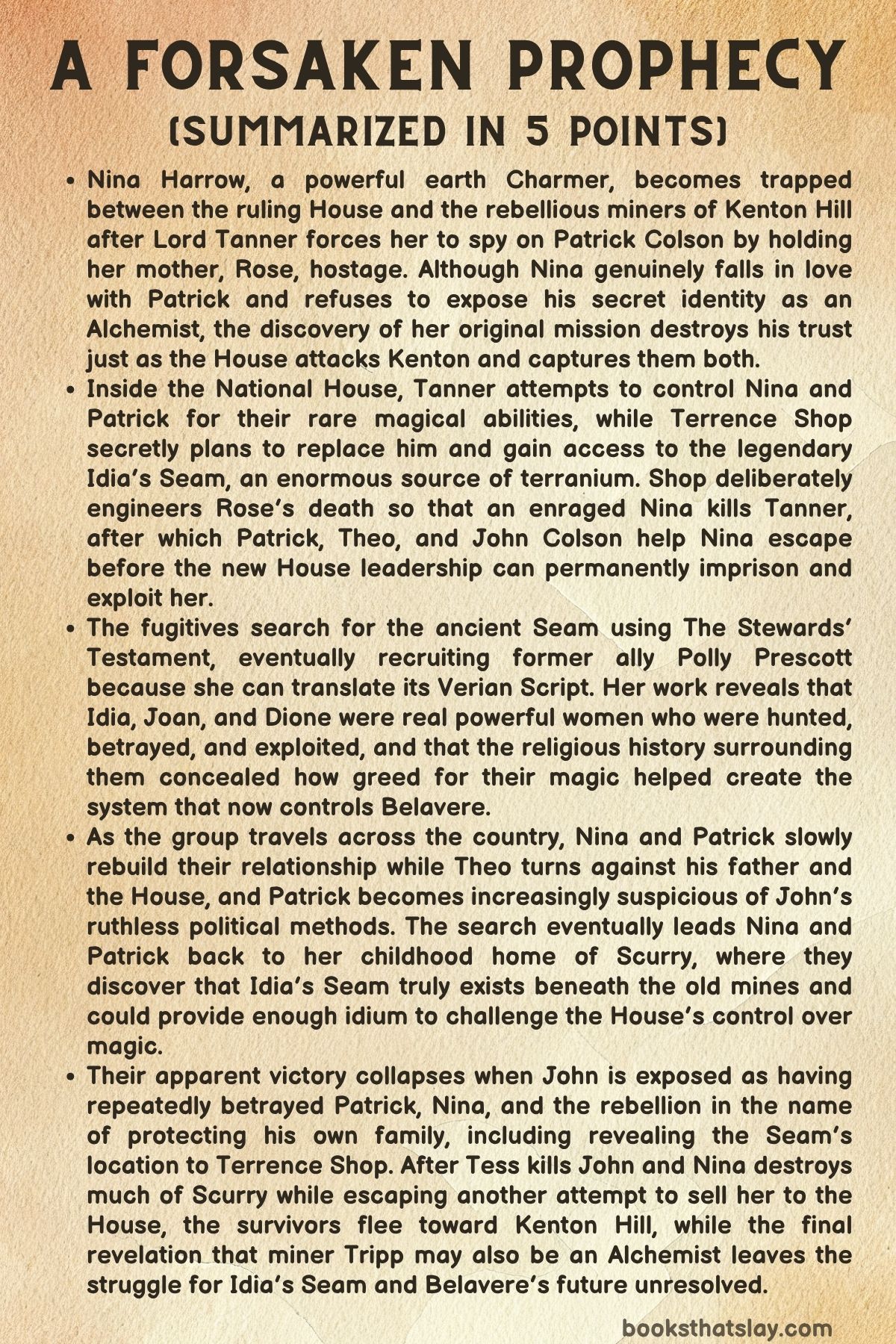
Summary
Seventeen years before the main events, eight-year-old Nina attends church in the impoverished town of Scurry with her mother, Rose. Nina already doubts the religion surrounding the revered figures Idia, Joan, and Dione, while Rose tells her an old story claiming that the three women possessed extraordinary magic, were hunted for it, and left behind graves where wishes might still be granted.
Rose promises that one day she and Nina will search for those graves together. Yet the promise exists beside the reality of Rose’s abusive marriage to Fletcher Harrow, teaching Nina early that stories of hope often survive in places where ordinary life offers very little of it.
Years later, Nina has become an exceptionally powerful earth Charmer. She is captured alongside Patrick Colson and Theo after the House attacks Kenton Hill, a rebellious mining community where Patrick has secretly served as the last known Alchemist and helped lead the Miners Union.
Patrick believes Nina betrayed him because she originally entered Kenton under orders from Lord Geoffrey Tanner. Tanner had imprisoned Rose and forced Nina to locate the hidden Alchemist, gain Patrick’s trust, and discover information about the rebellion.
Nina insists that although she accepted the mission under coercion, she eventually refused to reveal Patrick’s identity or deliberately lead the House into Kenton. Patrick cannot easily believe her because she knows his secrets, entered his life under false pretenses, and allowed him to love someone he did not fully understand.
At the National House, Tanner drains Nina and Theo of idium to prevent them from using magic. Patrick is separately forced to produce idium after Tanner reveals that Patrick’s father, John Colson, presumed dead for two years, is actually alive.
Patrick’s reunion with John is initially overwhelming, but it soon becomes unsettling. John has survived captivity by negotiating, trading information, and accepting compromises that Patrick increasingly regards as betrayals of the people the Miners Union claimed to protect.
A second political force soon emerges through Terrence Shop, Theo’s father and Tanner’s likely successor. Shop claims he wants reform, including fairer distribution of bluff and more opportunities for children from the brink, but his ambitions depend upon finding a legendary deposit of terranium called Idia’s Seam.
An ancient text called The Stewards’ Testament may contain the location of the Seam. Shop requires Nina’s earth medium to find it and Patrick’s Alchemist abilities to turn terranium into usable idium, placing both of them at the center of a larger struggle over the future of Belavere.
Shop secretly recruits Patrick and Theo into a plan to remove Tanner. Patrick provides idium to Theo, who is supposed to use his water medium to kill Tanner, while Nina receives a hidden dose of idium that restores her ability to defend herself.
The plan changes when Tanner brings Rose to a public gallows and threatens to execute her unless Nina submits. Nina finally agrees to cooperate, but the execution mechanism is activated anyway and Rose is killed.
Nina’s grief becomes uncontrollable fury. She uses her earth medium to suffocate Tanner with soil and drag him beneath the ground, killing the man who spent years treating her mother and daughter as objects that could be threatened, traded, and controlled.
The apparent accident is soon exposed as deliberate political murder. Shop arranged Rose’s death because he knew it would provoke Nina into killing Tanner, clearing his own path to leadership while keeping his hands publicly clean.
Even worse, John accepted the logic of the plan. Patrick is horrified that both men could treat Rose’s life as an acceptable price for political advantage, and the distance between father and son begins widening rapidly.
Shop intends to punish Nina publicly before forcing her to work for the House. Patrick, Theo, and John instead help her escape, although John briefly uses Nina as a hostage during the escape, reinforcing her growing belief that men on every side of the political conflict are willing to convert women into bargaining tools.
The fugitives flee to Morland, where they learn that Theo stole The Stewards’ Testament during the escape. If they can translate it and locate Idia’s Seam before Shop does, the Miners Union could gain access to enough terranium to challenge the House’s control over magic.
Their search for someone who can read the ancient Verian Script leads them to Polly Prescott, a former ally whom Patrick and Nina believe helped betray Kenton Hill. Polly admits providing information to Tanner but explains that the House discarded her afterward despite promising protection.
Polly’s grandfather was connected to the Stewards and taught her Verian Script. She agrees to translate the Testament in exchange for passage away from Belavere, turning a hated former ally into someone the group cannot afford to lose.
Meanwhile, Nina and Patrick slowly confront what remains between them. Patrick begins understanding the scale of the coercion Nina faced, while Nina continues insisting that her feelings for him became genuine even though their relationship began inside Tanner’s scheme.
Their journey also exposes the cost of rebellion. In Trent they find a community devastated by House retaliation after labor unrest, forcing Patrick to confront the fact that encouraging resistance is easier than protecting everyone who suffers afterward.
Theo also undergoes a profound change. Raised inside Artisan privilege, he increasingly recognizes the cruelty of the system that benefited him, especially its treatment of Crafters and women.
When House soldiers attack, Theo uses his water medium against them and is badly wounded. His choice makes clear that he is no longer merely a conflicted House servant but someone willing to suffer for his rejection of its authority.
Polly’s translation gradually reveals that Idia, Joan, and Dione were not distant religious symbols but powerful women whose suffering was distorted into official mythology. Joan and Dione were hunted, exploited, betrayed, and killed, while later generations turned their stories into foundations for political and religious authority.
The fugitives eventually reach Lavnonshire, where Polly locates her grandfather’s missing cipher inside a restricted library. With it, she finally understands the Testament and discovers that Idia’s own countrymen hunted her because they wanted her power.
Rather than allow herself and the Stewards to be captured, Idia opened a vast wound in the earth and disappeared beneath it. The search for the magical substance associated with her eventually became the basis of terranium mining and the House’s monopoly over idium.
Terrence Shop arrives before the group can escape with the completed translation. Theo and Polly are captured, Polly’s hands are brutally damaged to prevent her from secretly communicating, and Shop takes possession of the Testament and its cipher.
Nina, Patrick, and John escape, but Polly manages to send part of the translation to Patrick through her Scribbler magic. The message contains the clue they need: Idia’s resting place is associated with hills covered in widow’s lace.
Nina immediately recognizes the location as Scurry.
Returning to her childhood town forces Nina to confront Fletcher, now physically ruined by addiction and barely capable of understanding who she is. The meeting offers no satisfying confrontation because the man who terrorized Nina and Rose has become a wreck, leaving Nina with memories that power alone cannot repair.
Patrick senses an enormous terranium deposit beneath the abandoned mines of Scurry. To reach it, the group reluctantly works with Nina’s uncle Harland Seymour and his miners, men Nina distrusts because they reflect the cruelty, selfishness, and indifference that shaped her childhood community.
During this period, Nina and Patrick finally acknowledge that their love has survived everything that damaged it. Their reconciliation does not erase deception, mistrust, violence, or grief; instead, both accept that their relationship can only continue if it becomes a deliberate choice rather than another form of possession.
With Nina opening the earth and Patrick guiding her through his ability to sense terranium, the miners finally break through to a vast blue-black deposit. Idia’s Seam is real.
For a brief moment, Patrick imagines the Union gaining enough idium to resist the House and transform life throughout the brink. That hope disappears almost immediately when Theo, Donny, Gunner, Tess, and others arrive with devastating information.
The Miners Union has largely collapsed under shortages, propaganda, distrust, and internal violence. Worse, Theo reveals that Shop intentionally allowed Nina and Patrick to continue their search because he needed Nina to uncover the Seam for him.
The group then learns the full extent of John Colson’s betrayals. Tess reveals that John stole The Stewards’ Testament from Polly’s grandfather Sullivan, killed him, later attempted to negotiate with the House, and revealed Patrick’s identity as the surviving Alchemist.
John admits that his rebellion was never founded upon universal liberation. His deepest concern was securing the future of his own family, even when doing so required sacrificing others.
Patrick disowns him, but John makes one final betrayal by informing the House about the newly discovered Seam and arranging for Nina to be delivered as part of another bargain. Tess overhears the confrontation and kills John before the House raid begins.
Separated from Patrick, Nina is captured by Harland and his men. Harland believes lies claiming that Nina betrayed the miners and decides to sell her to the approaching House forces.
Bound near the church where she once prayed beside Rose, Nina recognizes that her own life has begun repeating Idia’s history. Once again, a powerful woman is surrounded by men who do not see a person but a source of wealth and power.
Nina finally refuses the pattern completely. She unleashes her earth medium with unprecedented force, breaking roads, buildings, the church, and much of Scurry itself.
Patrick reaches her as underground gas begins exploding through the collapsing town. Nina uses the last of her strength to protect them from the destruction she has caused, and Patrick carries her to the river, where their surviving companions wait.
The group escapes toward Kenton Hill while Scurry lies in ruins behind them. Terrence Shop arrives too late to capture Nina or take peaceful control of the town, but Idia’s Seam remains beneath the devastation.
The ending introduces another dangerous possibility through Tripp, one of Harland’s miners. After being captured by Shop, Tripp reveals that he can manipulate terranium himself and may possess the same Alchemist ability thought to belong only to Patrick.
Shop immediately understands the importance of the discovery. Patrick is no longer the only person capable of unlocking the power buried beneath Scurry, leaving the struggle over the Seam, idium, and Belavere’s future unresolved.
Characters
Nina Harrow
Nina is the emotional and moral center of A Forsaken Prophecy, and much of her development concerns the struggle to distinguish personal choice from the demands other people place upon her. Her extraordinary earth medium makes her politically invaluable, but it also ensures that powerful men repeatedly look at her as a resource before they look at her as a person.
Her childhood with Rose and Fletcher teaches her that love can exist beside fear, while Tanner’s imprisonment of Rose turns that old vulnerability into a weapon. Nina’s original deception of Patrick therefore comes from coercion rather than simple ambition, although the book does not erase the damage caused by her choices.
Rose’s death becomes the central break in Nina’s emotional life. Before it, Nina still imagines that obedience, compromise, or strategic restraint might preserve the people she loves; afterward, she increasingly responds to control with anger and destruction.
Her magic changes with her emotional state. Earth once represents possibility and freedom, but after Rose dies it becomes closely associated with grief, retaliation, and the terrifying ease with which Nina can destroy people who threaten her.
Her most important development concerns autonomy. Tanner, Shop, John, Harland, Theo, and even Patrick at certain moments believe they know what should happen to her, yet Nina increasingly refuses to let protection become another form of imprisonment.
Her relationship with Patrick ultimately works because he begins learning that loving her cannot mean choosing for her. Nina’s final destruction of Scurry is therefore both catastrophic and symbolic: she tears apart the physical place where generations of fear and exploitation shaped her, even though doing so cannot erase what happened there.
Patrick Colson
Patrick is one of the central figures in A Forsaken Prophecy, carrying the responsibilities of lover, son, brother, revolutionary leader, miner, and Alchemist at the same time. His emotional difficulty comes from the fact that each role demands a different kind of loyalty.
His initial fury toward Nina is understandable because their relationship was partly built upon concealed motives. Yet Patrick gradually recognizes that his own submission to Tanner when John is threatened resembles Nina’s earlier submission when Rose was held hostage.
That realization allows him to understand coercion more compassionately. He does not simply forget Nina’s deception, but he becomes capable of separating what she was forced to do from the feelings and choices she later made freely.
Patrick’s most important conflict is with John. As a child, he imagined his father as nearly infallible, and John’s apparent return from death initially seems like the restoration of certainty.
Instead, Patrick discovers that John’s methods violate many of the principles Patrick believed the rebellion represented. His eventual rejection of his father marks his transition from inherited leadership to an independent moral identity.
Patrick also develops a more mature understanding of love. He repeatedly wants to protect Nina, but experience teaches him that protection becomes dangerous when it ignores the protected person’s agency.
By the later stages of the story, Patrick’s devotion is defined less by possession and more by his willingness to stand beside Nina even when he disagrees with her choices. That distinction separates him from Tanner, Shop, John, Harland, and eventually Theo.
Theo Shop
Theo begins as a man divided between two worlds. He has been raised inside Artisan privilege and conditioned to believe that family duty, social rank, and service to the House should determine his future, yet his experiences with Nina and Kenton expose the human cost of that system.
His betrayal of Nina grows partly from jealousy and wounded pride. By exposing her attempt to discover Patrick’s identity, he makes a selfish emotional decision whose consequences become much larger than he intended.
Theo’s guilt thereafter becomes a major force in his development. He saves Crafters, helps Nina escape, opposes his father, fights House soldiers, and repeatedly risks himself, but none of these actions automatically cancels his earlier failures.
His relationship with Terrence Shop reveals how deeply Theo has been shaped by paternal expectations. Terrence measures worth through usefulness and status, while Theo gradually learns to define himself through choices his father despises.
Theo’s lingering love for Nina also tests whether his moral growth is genuine. At first, he sometimes behaves as though becoming better should restore their former relationship.
Nina’s rejection forces him to understand that redemption cannot be a transaction. His protection of Polly becomes particularly important because it shows him acting morally without expecting Nina’s affection as payment.
John Colson
John is one of the book’s most morally unsettling characters because his betrayals emerge from a philosophy he sincerely regards as practical love. He believes a man’s first obligation is to protect his own family, and that belief permits almost any compromise when Tess or his sons might benefit.
Patrick remembers John as an admired revolutionary leader, which makes the reality more painful. John survives House captivity by trading information and later continues negotiating even when other people’s lives become part of the price.
His willingness to accept Rose’s death, use Nina as a hostage, expose Patrick’s Alchemist identity, and reveal the Seam shows how thoroughly he reduces morality to outcomes. To John, a betrayal can become acceptable if it increases the chances that his family survives.
The tragedy is that this philosophy ultimately destroys the family unity he claims to protect. Patrick disowns him, Tess kills him, and his sons are left to deal with the consequences of choices supposedly made for their benefit.
John therefore represents the danger of allowing loyalty to become morally absolute. His devotion is genuine, but because it excludes the equal humanity of outsiders, it becomes capable of cruelty.
Donny Colson
Donny’s storyline examines leadership without preparation or certainty. With Patrick absent and John presumed dead, he inherits responsibility for Kenton Hill at precisely the moment when its resources, alliances, and confidence are collapsing.
His blindness does not prevent him from exercising authority, but Donny himself worries that he lacks Patrick’s strategic instincts. This insecurity makes his gradual hardening particularly significant.
At first, Donny tries to preserve solidarity through trade, redistribution, careful appearances, and acts of good faith. He understands that punishing ordinary communities because their leaders distrust Kenton would only deepen the crisis.
His decision to kill visiting Union delegates marks a devastating change. He begins using the same logic that corrupts many other political figures in the story: the belief that individual lives may be sacrificed to preserve a larger structure.
Donny is therefore neither presented as weak nor simply transformed into a villain. He shows how prolonged pressure can push an ordinary person toward decisions he once would have regarded as unthinkable.
Gunner Colson
Gunner is defined by intensity, loyalty, and emotional volatility. His physical injuries after the attack on Kenton leave him in pain and dependent on substances, making an already forceful personality even less stable.
He responds to threats against the Colson family with immediate anger. Where Donny tries to calculate consequences and Patrick increasingly questions inherited methods, Gunner often wants direct retaliation.
This makes him a useful contrast within the family. His reactions reveal how rebellion can become personal very quickly when political violence has wounded one’s home, body, and relatives.
His devotion to Patrick is especially strong. The reunion in Scurry demonstrates how deeply the brothers’ identities depend upon one another, even after separation and political disaster have changed them.
Tess Colson
Tess combines toughness, practical intelligence, maternal devotion, and a capacity for decisive violence. She has survived poverty, illness, family separation, rebellion, and years of believing John dead while continuing to hold the Colsons together.
Her physical condition also reveals the cruelty of Belavere’s unequal access to medicine. She depends on extraordinary amounts of bluff, making the search for terranium a personal matter for Patrick as well as a political one.
Unlike Patrick and Donny, Tess understands much of John’s history before the final revelations. Her cold reaction when he returns signals that resurrection does not automatically restore trust.
Her decision to shoot John is one of the story’s harshest expressions of judgment. She kills the husband she once loved because his repeated betrayals have placed their children and Nina in immediate danger.
Tess therefore represents a form of loyalty that eventually recognizes limits. Family matters deeply to her, but unlike John, she does not treat family loyalty as permission to sacrifice everyone beyond it.
Rose Harrow
Rose shapes Nina’s life even when she is absent from the immediate action. She is both a loving mother and a woman whose understanding of suffering has been influenced by religion, poverty, abuse, and repeated disappointment.
The childhood story she tells Nina about Idia, Joan, and Dione becomes one of the foundations of the entire plot. What appears to be a comforting legend eventually contains fragments of suppressed history.
Rose’s relationship with Tanner reveals another dimension of her vulnerability. As a Crafter servant, she was exploited by a powerful man who could offer resources and protection she did not possess independently.
Her death is politically engineered by men who consider it useful. This makes her fate an especially clear example of the story’s criticism of systems that turn vulnerable people into instruments.
For Nina, Rose becomes both memory and warning. The search for Idia’s Seam is partly a revolutionary mission, but it is also Nina’s attempt to discover whether the stories her mother carried through suffering contained a truth larger than either of them understood.
Lord Geoffrey Tanner
Tanner represents the most openly brutal form of House power. He believes social order depends upon controlling idium, and he approaches human beings according to how efficiently they can be manipulated.
His personal history suggests that he once possessed emotional vulnerability, but disappointment does not make him compassionate. Instead, he uses his own suffering to justify becoming harder and more exploitative toward others.
His treatment of Crafter women is particularly revealing. He uses economic inequality, promises, sexual access, intimidation, and institutional authority in ways that demonstrate how private abuse and political hierarchy reinforce one another.
Tanner’s treatment of Nina follows the same pattern on a larger scale. He identifies Rose as Nina’s emotional weakness and repeatedly turns a mother’s life into leverage.
His death is therefore symbolically appropriate. The man obsessed with controlling Nina through threats is finally destroyed by the power he believed he could permanently command.
Terrence Shop
Terrence Shop initially appears more reasonable than Tanner because he speaks the language of moderation, reform, negotiation, and gradual change. That difference is important, but it does not make him committed to equality.
His plans for reform are designed largely to preserve social stability and strengthen his own position. He may offer more resources to Crafters, but he does not abandon the assumption that the House should remain in control.
Rose’s execution exposes his methods. Instead of openly murdering Tanner, he arranges circumstances in which Nina will do it for him, allowing him to gain power while appearing innocent.
His treatment of Theo reveals similar values. He expects his son to serve family ambition and regards disobedience as failure rather than evidence that Theo has developed an independent moral judgment.
Shop is dangerous precisely because he understands how to make domination sound reasonable. His political language is softer than Tanner’s, but his willingness to sacrifice individuals shows that the underlying structure remains largely unchanged.
Polly Prescott
Polly is a character built around betrayal, shame, survival, and the possibility of change. Her decision to give Tanner information about Kenton makes her responsible for real harm, yet the story also shows how fear and insecurity shaped that decision.
The House promises her safety and then abandons her once she is no longer useful. Her experience becomes another example of the false security offered by obedience to powerful institutions.
Her Scribbler ability is central to the search for Idia’s Seam because her knowledge of Verian Script allows the fugitives to recover a history the House has buried. Translation gradually gives her a purpose greater than escaping punishment.
The destruction of her hands is especially cruel because her body and her magical identity are attacked together. Shop understands that controlling knowledge requires controlling the person capable of transmitting it.
Polly’s alliance with Theo becomes important because both characters know what it means to betray others and then discover that institutional loyalty offers no lasting belonging. Their relationship creates space for moral rebuilding without pretending the past can be erased.
Harland “Kicker” Seymour
Harland represents the ugliest elements of the culture Nina associates with Scurry. He is crude, domineering, opportunistic, and willing to treat both women and political relationships according to immediate advantage.
As Rose’s brother, his refusal to take responsibility for what happened to her reveals a family culture in which abuse could be ignored once a woman was considered another man’s concern.
Harland initially cooperates with Patrick because access to terranium and idium benefits him. His loyalty is therefore economic rather than ideological.
When he believes John has offered him a more profitable explanation of events, he quickly turns against Nina. His decision to sell her to the House shows how closely personal greed can resemble institutional oppression.
His behavior also strengthens the connection between Nina and Idia. Both women become valuable in the eyes of surrounding men because of what can be extracted from them.
Tripp
Tripp appears late but becomes crucial to the future of the conflict. Unlike Harland, he survives by observing carefully, remaining quiet, and avoiding some of the destructive habits common among the miners around him.
His childhood memories of Rose and Nina give him an unusual connection to the story’s beginning. He has witnessed fragments of the Harrow family’s suffering long before understanding their political importance.
After Scurry is destroyed, Tripp immediately recognizes the opportunity created by Shop’s need for an Alchemist. His ability to move terranium suggests that Patrick may not be unique after all.
This revelation changes the balance of power. Tripp may become a rival, ally, tool of the House, or independent actor, but the ending deliberately leaves his future open.
Fletcher Harrow
Fletcher is the source of much of Nina’s childhood fear and Rose’s suffering. His abuse creates the domestic environment from which Nina spends years trying to escape.
When Nina finally returns to Scurry, however, Fletcher no longer resembles the powerful figure of her memories. Addiction has reduced him physically and mentally until he can barely understand the daughter standing before him.
The encounter refuses Nina the clean satisfaction of confronting an unchanged villain. Fletcher remains responsible for the harm he caused, but he has also become a ruined human being.
His condition demonstrates one of the story’s harsher ideas: revenge cannot always restore balance because the person one wants to confront may already have been destroyed by other forces.
Tamir
Tamir serves as a practical ally during the fugitives’ stay in Morland. By operating The Mistress and maintaining connections with the Miners Union, Tamir provides shelter inside a city structured around Artisan wealth and Crafter service.
Tamir’s value lies partly in understanding social performance. Transforming Nina’s appearance so she can enter Rickers demonstrates how class identity in Belavere is read through clothing, behavior, access, and confidence as much as through formal magical distinctions.
The character also represents the hidden networks that make resistance possible. Revolutions depend not only on visible leaders but on people who provide rooms, disguises, contacts, information, and temporary safety.
Mrs. Trunk
Mrs. Trunk offers one of the rare spaces of uncomplicated hospitality in the story. A mute wood Mason who communicates partly through music, she takes the fugitives into her Lavnonshire home despite the danger attached to them.
Her house becomes a temporary refuge from political violence. It allows Theo to recover and gives the others enough stability to continue the search.
Mrs. Trunk also connects Nina to an earlier period of her life, showing that not every relationship associated with the Artisan world was defined by exploitation. Her kindness provides a quiet contrast to the calculated behavior of Tanner and Shop.
Otto
Otto is important primarily through Polly’s emotional history. He represents a relationship that existed beyond the respectable ambitions imposed upon her by family and House expectations.
The letters he sends become evidence that Polly was loved as a person rather than valued only for her Scribbler medium or social usefulness. That distinction matters greatly after the House discards her.
His insistence that Polly receive treatment after she reaches Kenton also shows that anger over betrayal can coexist with the desire to understand. Through Otto, the story offers Polly a connection to a life she once abandoned but may not have lost completely.
Reginald Prescott
Reginald is shaped by a lifetime of trying to secure respectability within a society obsessed with hierarchy. As a Black Crafter who married into an Artisan family, he builds his identity around proving that the Prescotts deserve acceptance.
That ambition makes Polly’s choices particularly threatening to him. Her association with the Union and her rejection of House service challenge the survival strategy around which he organized his family.
His conflict with Polly demonstrates how oppressed people can sometimes internalize the standards of the institutions that marginalize them. Reginald believes obedience offers safety even after Polly’s experience proves otherwise.
His eventual admission that Sullivan’s belongings were donated to the library becomes essential to recovering the Verian cipher. He therefore contributes to the collapse of the respectable narrative he spent years defending.
Sullivan Prescott
Sullivan is never developed through extensive present-day action, but his influence reaches deeply into the central mystery. As Polly’s grandfather and a descendant of the Stewards, he preserved knowledge of Verian Script and the traditions surrounding Idia, Joan, and Dione.
His cipher makes full translation of the Testament possible. Without his work, the truth behind the religious mythology would likely remain inaccessible.
The later revelation that John killed Sullivan while stealing the Testament adds another layer to John’s moral collapse. Sullivan’s death demonstrates that even those claiming to fight oppressive institutions can reproduce violence when secret knowledge becomes politically valuable.
Idia
Idia begins as a religious figure but gradually becomes a historical woman whose story has been transformed by the society that benefited from her suffering. Her extraordinary connection to the earth makes her both revered in memory and hunted in life.
When her own countrymen seek to possess her power, she refuses capture by opening the earth and disappearing beneath it. That act becomes the foundation of the legendary Seam.
The later mining of terranium transforms Idia’s suffering into an economic and political system. The people who inherit power from her exploitation eventually present that inheritance as sacred legitimacy.
Her connection with Nina is therefore central. Both women possess rare power, both are pursued because of what others can obtain through them, and both ultimately answer attempted possession by turning the earth itself into resistance.
Joan
Joan’s history gives physical reality to a legend initially treated as folklore. Her capture, torture, and death show that the three daughters were subjected to human violence rather than merely participating in a distant religious myth.
Her story is especially important when the fugitives reach Trent. The possibility that her suffering occurred in the same landscape where House violence continues centuries later suggests that political brutality changes its language more easily than its underlying logic.
Joan therefore functions as evidence that the present conflict has deep historical roots. Her fate strengthens Nina’s conviction that recovering the truth matters alongside controlling the Seam.
Dione
Dione’s story centers on usefulness followed by betrayal. She protects a southern community from destructive seas, helps stabilize its environment, builds a life there, marries, and becomes part of the settlement.
When protecting her becomes dangerous, however, the same community sacrifices her. The people benefit from her power and then surrender her when their own survival appears threatened.
Nina immediately recognizes the pattern because it resembles her own treatment. Dione’s value exists only while others can use her safely.
Her story therefore sharpens one of the book’s recurring questions: whether gratitude has any meaning in societies where power encourages people to measure one another according to usefulness.
Edith
Edith represents civilians trapped between oppression and rebellion. She survives the devastation of Trent and initially reacts to the fugitives with suspicion because her community has already paid an enormous price for resistance.
Her demand that Patrick and the others avoid bringing another battle into Trent is morally significant. She demonstrates that supporting justice does not automatically require ordinary people to sacrifice themselves for every revolutionary strategy.
Through Edith, the book refuses to romanticize rebellion as universally welcomed. People who have lost homes, relatives, medicine, and security may reasonably fear both the House and the consequences of sheltering those who oppose it.
Frederick Dunce
Frederick functions as the link that leads Nina and Theo to Polly. As an archivist and Scribbler operating within the privileged environment of Rickers, he initially appears to be the translator the fugitives need.
Although he cannot read Verian Script himself, his knowledge allows the mission to advance. His presence also demonstrates that specialized magical knowledge is unevenly distributed even among trained Artisans.
When Nina’s disguise begins failing, Frederick becomes one of the people capable of recognizing the danger surrounding her identity. He therefore helps transform what was intended as a controlled infiltration into a rapidly escalating confrontation.
Luderman
Luderman appears briefly but establishes the brutality surrounding Nina’s captivity. His sexual assault during the train journey shows how quickly institutional power can become personal violence when soldiers believe prisoners cannot resist them.
Nina’s response demonstrates her refusal to submit quietly, while Patrick’s intervention reveals that his anger toward her does not eliminate his instinct to protect her from abuse.
The scene also reinforces a larger pattern in the story: women in politically vulnerable positions face dangers that cannot be separated from the broader structures controlling class and magic.
Scottie
Scottie belongs to the network surrounding the Colsons and becomes useful when the group attempts to identify the location connected with widow’s lace. His knowledge of Scurry helps confirm the clue Polly provides.
Although he receives less psychological development than the central characters, his presence reflects the collective nature of the struggle. Information, travel, survival, and resistance repeatedly depend upon people beyond the most visible leaders.
Sam
Sam is another member of the group involved in the desperate journey toward Scurry. Like Scottie, his characterization is limited in the supplied material, so his importance lies more in participation than in an extensive individual arc.
His presence reinforces the fact that the conflict is larger than Nina, Patrick, and the Colson family. The movement of people toward Scurry becomes a collective attempt to prevent Shop from turning the discovery of the Seam into permanent House control.
Domelius Becker
Domelius Becker matters largely because of the secrecy surrounding Alchemists and the House’s search for the ability to extract idium. His death makes Patrick particularly valuable because Patrick is believed to be the surviving person capable of performing that work.
The belief that Patrick is the final Alchemist shapes Tanner’s treatment of him and later becomes one of the reasons every faction attempts to preserve, control, or bargain with him.
Tripp’s final revelation undermines the assumption created by Becker’s death. The supposed rarity of Alchemy may depend partly upon incomplete knowledge rather than absolute biological scarcity.
Olivette Tanner
Olivette appears mainly through Tanner’s personal history. She becomes his wife after he is prevented from marrying the poorer Crafter woman he once loved.
Their marriage represents the social expectations that Tanner claims helped harden him. Yet Olivette should not be treated as responsible for what Tanner later becomes.
Her limited presence instead reveals something about Tanner himself: he turns his dissatisfaction with class rules into an excuse for infidelity and exploitation rather than questioning the hierarchy that gave him power.
Themes
Power, Exploitation, and the Ownership of Magic
Magic is never merely a supernatural ability in A Forsaken Prophecy; it functions as a political resource that determines who receives medicine, education, status, protection, and authority. Idium is scarce, terranium is controlled, and the House maintains its dominance largely because it controls access to the substance that allows magical abilities to function.
The struggle over Nina demonstrates the human consequences of this system. Because her earth medium could expose enormous quantities of terranium, politicians, rebels, relatives, and opportunists repeatedly discuss what should be done with her body and abilities.
The historical stories of Idia, Joan, and Dione reveal that this exploitation began long before Nina’s lifetime. Their powers made them useful, but usefulness did not lead to safety; it made other people feel entitled to possess them.
Idia’s Seam becomes the clearest symbol of that history. The society that celebrates Idia has built part of its power by extracting resources associated with her persecution while erasing the violence that produced them.
The book therefore asks whether power can ever create freedom when people continue thinking of one another as resources. Changing who controls idium may alter the political balance, but genuine liberation requires rejecting the assumption that magical ability gives anyone ownership over the person who possesses it.
Autonomy, Love, and Control
Many relationships in the story are tested by the difference between caring for someone and controlling them. Nina’s life is filled with people who claim that coercion is justified because they know what must be done for her safety, their family, or the country.
Tanner is the clearest example because he openly uses Rose to force Nina’s obedience. Shop is more sophisticated, but he follows the same logic when he decides that Nina’s suffering can be managed as part of a larger political strategy.
John also reduces people to pieces within protective calculations. His love for his family is real, yet he repeatedly decides that other individuals may be sacrificed if doing so improves the Colsons’ chances of survival.
Theo faces the problem more personally. He genuinely cares for Nina, but his desire to protect her sometimes becomes an assumption that he should decide what risks she is allowed to take.
Patrick gradually learns a different form of love. He remains protective, sometimes excessively so, but his growth depends upon recognizing that Nina must retain the right to make choices he fears or dislikes.
Nina’s insistence upon choosing her own alliances, risks, revenge, and romantic attachments therefore becomes central to her identity. Freedom is not presented as freedom from relationships; it is the ability to participate in those relationships without surrendering ownership of oneself.
Revolution, Compromise, and Moral Corruption
The rebellion begins with understandable grievances: poverty, dangerous labor, medical scarcity, political exclusion, and the House’s monopoly over magical resources. Yet the story repeatedly shows that possessing a just cause does not make every action taken in its name just.
Patrick experiences this conflict most strongly when he sees Trent. The House is responsible for destroying the town, but Patrick cannot ignore that the Union encouraged resistance without possessing the power to protect everyone who followed.
Donny’s leadership takes the problem further. Desperate to prevent the Union from collapsing, he eventually murders delegates who want to withdraw, preserving the appearance of unity by destroying the freedom the movement supposedly represents.
John becomes the strongest warning against unrestricted political pragmatism. Every betrayal can be explained as a strategic necessity, and every sacrificed person can be described as the price of protecting something larger.
The result is a rebellion that sometimes begins resembling the institution it opposes. Both sides learn to speak about human lives as costs, leverage, percentages, risks, or useful pieces.
The novel does not argue that resistance is pointless. Instead, it suggests that methods matter because a movement that abandons its moral purpose while pursuing victory may reproduce the same hierarchy it hoped to defeat.
History, Memory, and Repeated Suffering
The stories of Idia, Joan, and Dione initially appear to belong to religion and childhood folklore, yet the discovery of the Testament reveals that legends can preserve fragments of truths deliberately removed from official history. What society remembers as sacred mythology may therefore conceal acts of persecution that later institutions have an interest in forgetting.
Nina’s personal history follows the same pattern. Rose’s suffering, Fletcher’s abuse, Tanner’s exploitation, and Scurry’s silence are not isolated memories; they shape every decision Nina later makes about trust and power.
When Nina returns to Scurry, the connection between personal memory and historical memory becomes impossible to ignore. She stands near the same religious symbols that shaped her childhood while recognizing that Idia may have suffered from the same basic desire to control powerful women.
The destruction of Scurry becomes disturbing precisely because the cycle repeats instead of ending cleanly. Nina has learned the historical truth, but knowledge does not automatically free her from reacting through the pain that history produced.
Memory therefore carries both danger and possibility. It can preserve trauma until revenge feels inevitable, but it can also restore stolen identities and expose political myths.
Recovering the truth about the three daughters cannot undo their suffering, just as Nina cannot undo Rose’s death. What it can do is prevent the people who benefited from that suffering from remaining the unquestioned authors of history.