Forsaking Midnight Summary, Characters and Themes
Forsaking Midnight (Defying the Stars #2) by Emily McIntire is a dark romantic suspense novel centered on Lance Calloway and Genevieve DeGrance, two people whose hostile relationship gradually exposes years of coercion, betrayal, family damage, and hidden criminal activity. Beneath the wealthy surface of Rosebrook Falls lies an underground fighting operation that has shaped Lance’s adult life and quietly influenced Genevieve’s future.
At its core, the book examines what happens when loyalty becomes imprisonment, protection becomes control, and love requires people to choose one another rather than simply fulfill old obligations. The romance develops alongside a larger struggle for personal freedom, truth, and the right to build a life outside other people’s expectations.
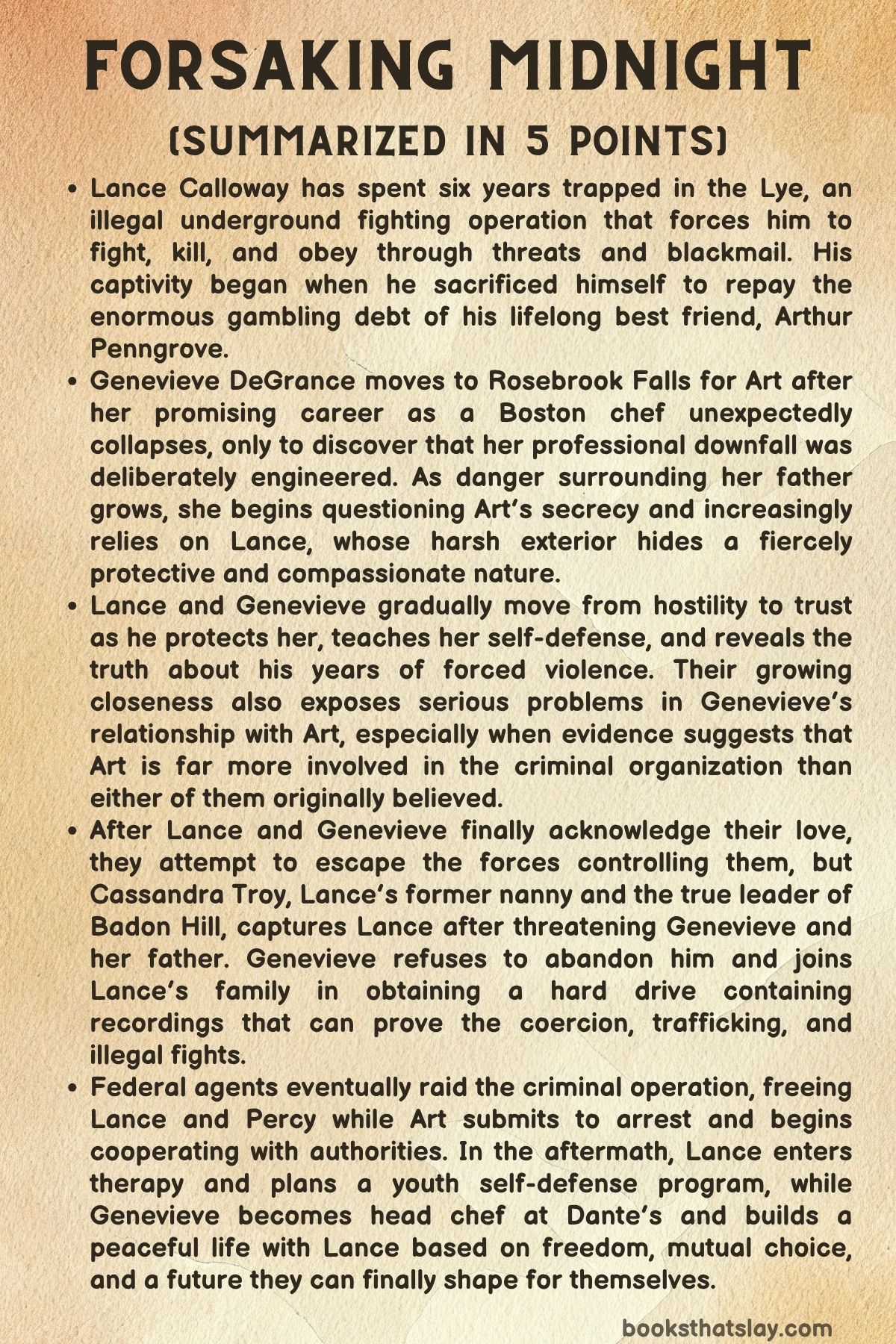
Summary
Lance Calloway has spent years fighting in the Lye, an illegal arena hidden beneath the Round Table Tavern. During one manipulated match, he notices a red-haired woman named Genevieve DeGrance watching from beside Arthur Penngrove, Lance’s lifelong best friend, and their brief eye contact creates an immediate connection neither understands.
Fourteen months later, Genevieve has moved to Rosebrook Falls for Art, but the future she expected with him has never quite materialized. Art keeps much of their relationship separate from his powerful father, Franklin Penngrove, while Genevieve works at the Round Table and struggles with the loss of her former career as a talented Boston chef.
Her hostility with Lance is immediate and mutual. Genevieve sees him as arrogant, violent, and unnecessarily cruel, while Lance regards her as an outsider who has disturbed the friendship that has defined his entire life, yet their arguments repeatedly contain an attraction both try to disguise.
The criminal danger surrounding them becomes harder to ignore when Genevieve overhears that the underground fights have started again and that her father, Leo DeGrance, may somehow be connected to Brutus Myrddin, the man behind the Lye. Leo behaves strangely when Genevieve contacts him, and his warnings suggest that something dangerous is happening in Boston.
Lance understands the Lye better than anyone because it has controlled him since he was eighteen. Years earlier, Art accumulated nearly two million dollars in gambling debt, and rather than allow the scandal to destroy Franklin Penngrove’s political ambitions, Lance’s father, Craig Calloway, agreed to let Brutus use Lance as a fighter until the debt was repaid.
Lance accepted because Art was more than his friend. The two had survived emotionally abusive fathers together, formed their childhood “Silver Spoon Survivors’ Club,” and sworn lifelong loyalty, so Lance believed entering the fighting operation was simply what a brother should do.
The promised year or two becomes six years. The organization forces Lance not only to fight but sometimes to kill, records his actions, and later uses the footage as blackmail to ensure that he cannot leave.
In the present, another young man, Percy Galois, is drawn into the same system through gambling debt. Lance is ordered to train him, but instead of shaping Percy into an aggressive fighter, he focuses on teaching him how to defend himself and survive, revealing the compassion Lance tries hard to hide.
Genevieve begins seeing that same side of Lance when a blond stranger starts following her. Lance repeatedly protects her, escorts her home, guards her apartment, and eventually brings her to his isolated cabin after the threat becomes impossible to dismiss.
Their relationship gradually changes through ordinary moments rather than dramatic declarations. Genevieve cooks for Lance, rediscovers some of the confidence she lost with her career, and explains her private habit of holding meaningful experiences for seven seconds because she likes imagining that treasured memories might return at the end of life.
Lance becomes fascinated by the ritual. Genevieve, meanwhile, begins understanding that his violence does not tell the entire story of who he is, especially when she learns that much of what happens in the Lye occurs under threats and coercion.
At the same time, her relationship with Art deteriorates. He repeatedly hides information, prioritizes political appearances, leaves Genevieve alone during moments when she needs him, and insists that his secrecy is meant to protect her.
Genevieve eventually discovers evidence that changes her understanding of her entire move to Rosebrook. Her firing from the prestigious Boston restaurant Cameliard and her inability to find another job afterward were deliberately engineered by people connected to Badon Hill, making relocation with Art seem like her only reasonable option.
Soon afterward, Percy inadvertently reveals that Art is much more involved with the Lye than Genevieve realized. Genevieve later overhears Art describing Percy as bait and hears information suggesting that Art coordinates parts of the criminal operation rather than merely tolerating them.
Lance has even more difficulty accepting these signs because doing so would force him to reconsider the meaning of six years of suffering. He has survived by believing Art is fundamentally good and worth saving, so accepting that his childhood brother may now participate in the machinery controlling him threatens the story Lance has told himself about his sacrifice.
As Genevieve and Lance investigate together, their emotional dependence grows. He teaches her self-defense, she encourages him to imagine freedom, and each provides the other with something missing from their existing relationships: Lance gives Genevieve honesty and safety, while Genevieve gives Lance acceptance without pretending that his past does not exist.
Genevieve eventually learns that her father is genuinely endangered when Leo uses a coded phrase they created years earlier. Lance finally tells her everything he knows about Brutus, federal interest in Badon Hill, and the possibility that Genevieve herself was moved to Rosebrook so she could be used as leverage against Leo.
Life at Lance’s cabin creates a closeness that neither can deny. Morning runs, cooking, self-defense lessons, conversations beside the waterfall at Lovers’ Alcove, and quiet evenings with Lance’s dog Cavall allow them to imagine a life based on ordinary choice instead of secrecy and obligation.
Their suspicions about Art become stronger when Rosalie Voltaire tells Lance that Benny, who manages much of the Lye’s activity, actually works for Art. Lance is forced to recognize that Art may have become one of the people controlling the very system from which Lance once saved him.
Eventually Lance tells Genevieve the worst parts of his history, including his father’s decision to offer him to Brutus and the killings he has committed under coercion. Rather than reject him, Genevieve tells him that she sees the difference between what he has been forced to do and who he is.
Lance finally admits that Genevieve has become his “seven seconds,” the person he would want to remember at the end of his life. Genevieve refuses to let his loyalty to Art make her decision for her, and the two finally acknowledge their love and begin a physical relationship.
Their happiness immediately collides with their circumstances. At a public anniversary gala, Art proposes to Genevieve in front of both families and influential guests, creating a situation in which rejecting him could expose her suspicions before she knows whether her father is safe.
Lance, devastated but aware of the danger, silently encourages her to accept. Genevieve agrees to the engagement while knowing that the man she actually loves is watching from across the room.
The engagement finally pushes Lance to confide in his older brother Paxton. He reveals the Lye, his years of forced fighting, Craig’s betrayal, Art’s role in the original debt, Genevieve’s danger, and the blackmail footage that prevents him from escaping.
Paxton responds by protecting Lance instead of judging him. He arranges money, transportation, security, and a plan to help Lance take Genevieve to Boston, giving Lance his first real experience of allowing a family member to share the burden he has carried alone.
Before the escape can happen, Genevieve discovers underground blueprints and secretly enters the Lye during another fight. There she sees Art sitting with Brutus and Bors, the man who has been stalking her, finally confirming that Art is far closer to the criminal operation than either she or Lance wanted to believe.
When Bors moves toward Genevieve with a weapon, Lance abandons instructions to lose his match. He escapes the cage, kills Bors to protect her, and flees through an underground tunnel with Genevieve, forcing them to leave Rosebrook immediately.
After a brief stop in Massachusetts where they experience an anonymous day of ordinary freedom, they reach Leo in Boston. Leo explains that federal investigators are building a RICO case against Badon Hill and that Genevieve’s manipulated career was what finally convinced him to cooperate.
The investigators still need direct physical evidence of the fighting operation. Genevieve remembers seeing a backup hard drive in Art’s office, and she and Lance realize that the recordings once used to enslave Lance may also become the evidence capable of freeing him.
Their plan is interrupted when Beverly, the beloved nanny from Lance’s childhood, suddenly appears. Lance already knows Beverly’s real identity is Cassandra Troy, but he now discovers something worse: Cassandra herself controls Badon Hill, Brutus is her brother, and many of the skills she taught Lance as a child were part of a long-term effort to shape him into a useful weapon.
Cassandra threatens Leo and Genevieve and offers Lance a choice. If he willingly goes with her, they live; Lance repeats the pattern that has defined his life and sacrifices himself again.
Genevieve refuses to accept that sacrifice as permanent. With Leo’s help, she returns to Rosebrook and tells Juliette, Roman, and Paxton everything, discovering that Paxton has independently gathered financial evidence connecting Badon Hill to years of corruption and manipulation.
Genevieve enters the Round Table alone and retrieves the backup drive from Art’s office. Art catches her, and the two finally abandon their deceptions as Genevieve admits her love for Lance and accuses Art of helping preserve the system that destroyed his best friend.
Art confirms that the hard drive contains recordings of the fights and killings. Faced with the consequences of what he has become, he chooses not to stop Genevieve and allows her to leave with the evidence.
Five days after surrendering to Cassandra, Lance finds himself trapped in another cage, this time opposite Percy. Percy has been told that killing Lance will erase his family’s debts, but Lance refuses to fight the frightened young man seriously because he will not make Percy carry the same burden of violence.
Before either man is forced into an irreversible choice, federal agents raid the warehouse. The hard drive, Leo’s cooperation, and the other accumulated evidence finally give authorities what they need, while Art submits to arrest rather than attempting to escape.
Lance is classified as a victim of trafficking, coercion, and forced criminal activity rather than treated simply as a murderer. Leo offers to represent him, and Genevieve finally takes Lance home without another cage waiting for him.
Freedom does not instantly erase Lance’s trauma. He remains hypervigilant, attends therapy, experiences nightmares, and must gradually learn that nobody is about to summon him for another fight.
Genevieve stays beside him while reclaiming her own future. She becomes head chef at Dante’s, restoring the professional identity that Badon Hill deliberately stole, while Lance begins planning a youth self-defense and confidence program that will transform the skills once used to exploit him into tools for helping others.
Percy also begins rebuilding his life through university classes and therapy, becoming a regular part of Lance and Genevieve’s home. Ordinary routines such as cooking, studying, walking Cavall, drinking coffee, and sharing quiet mornings become symbols of how far all of them have moved from a life governed by fear.
The larger danger has not completely disappeared because Cassandra and Brutus remain free, but Lance and Genevieve no longer allow that uncertainty to determine every part of their lives. Their seven-second ritual now represents memories they treasure not because they expect happiness to end, but because they finally believe they will have enough time to create many more.
Characters
Lance Calloway
Lance Calloway is the emotional center of Forsaking Midnight, and much of his complexity comes from the contradiction between how dangerous he appears and how little control he has possessed over his own life. He is physically capable, sarcastic, intimidating, and highly skilled in violence, yet those qualities were repeatedly exploited by people who recognized that his strongest weakness was his willingness to suffer for those he loved.
His defining characteristic is loyalty, but the book gradually asks whether loyalty remains virtuous when it requires the destruction of the self. Lance agrees to fight because Art is his blood brother, hides the truth to protect Juliette and the rest of his family, continues obeying criminal orders because others are threatened, and later surrenders himself to Cassandra when Genevieve and Leo are placed in danger.
That tendency makes Lance both admirable and self-destructive. He has spent so many years judging his worth by what he can endure for others that he initially cannot imagine that protecting himself might also matter.
His relationship with violence is equally important. Lance has killed people, but he does not approach those deaths with pride, excitement, or a desire for domination; instead, he has developed emotional numbness because separating himself from his actions has been necessary for survival.
Percy exposes Lance’s true moral instincts particularly clearly. Given the opportunity to reproduce the brutal training methods used against him, Lance does the opposite and teaches Percy to defend himself, survive, and preserve as much of himself as possible.
Genevieve eventually becomes the person who challenges Lance’s belief that forced actions define his identity. Her refusal to treat him as either an innocent saint or an irredeemable monster allows him to acknowledge the damage he has caused while also accepting that coercion matters.
His final development is therefore not simply escaping the Lye. Lance begins therapy, allows his siblings to help him, plans to teach young people, and learns that his skills can create confidence instead of fear, meaning his future is finally based on choice rather than usefulness to someone else.
Genevieve DeGrance
Genevieve DeGrance functions as both Lance’s romantic counterpart and a character pursuing her own recovery of agency in Forsaking Midnight. Her life has been manipulated differently from Lance’s, but she too discovers that decisions she believed were freely made were quietly engineered by powerful people.
Her career as a chef is fundamental to her identity. Cooking connects her to Leo, to childhood, to competence, and to the satisfaction of creating something through her own talent, which makes the deliberate destruction of her Boston career far more devastating than a simple employment setback.
Genevieve initially moves to Rosebrook because she believes she is choosing a future with Art. Discovering that Badon Hill manipulated her dismissal and blacklisting forces her to question not only Art but the authenticity of the circumstances that brought her there.
She is also stubborn, inquisitive, and increasingly unwilling to accept protection that depends on keeping her ignorant. Art repeatedly argues that secrecy is necessary for her safety, while Genevieve gradually realizes that being denied information makes her easier to control.
Her relationship with Lance grows because he eventually learns to respect that distinction. Although he initially repeats Art’s mistake by deciding what Genevieve can handle, he apologizes, teaches her self-defense, shares information, and begins treating her as a partner in the danger rather than someone who should remain passive.
Genevieve’s seven-second practice reveals her emotional philosophy. She fears loss because so many important things have disappeared from her life, so intentionally preserving good moments becomes her small act of resistance against impermanence.
By the conclusion, Genevieve has changed without losing the qualities that originally defined her. She remains nurturing, romantic, and connected to food, but she also becomes more decisive, strategically patient, and willing to place herself at risk when action is necessary.
Becoming head chef at Dante’s completes that development because her career is not merely restored to its earlier condition. Genevieve now succeeds after learning that her talent belongs to her regardless of who attempts to control where or how she uses it.
Arthur “Art” Penngrove
Arthur Penngrove is one of the book’s most complicated characters because he occupies several roles that gradually become incompatible: Lance’s childhood brother, Genevieve’s boyfriend, Franklin’s politically valuable son, and an increasingly active participant in the criminal structure beneath Rosebrook Falls. The charming “people’s prince” admired by the town exists beside a man capable of secrecy, manipulation, and using people as pieces in larger plans.
Art’s relationship with Lance begins in genuine affection. Their childhood oath grows from shared experiences with controlling fathers, and there is substantial evidence that Art once loved Lance deeply and understood him as family.
The tragedy lies in how that relationship changes. Lance sacrifices six years to resolve Art’s gambling debt, but Art eventually becomes connected to the very operation holding Lance captive, creating a severe moral imbalance between the two men.
Art also develops a possessive understanding of loyalty. His suggestion that Genevieve belongs to him and that Lance is bound to him by their childhood promise demonstrates how an oath once created for mutual survival has become a tool of control.
His relationship with Genevieve follows a similar pattern. Art may care for her, but he repeatedly withholds information, allows Franklin’s expectations to determine their public relationship, and focuses on protecting the appearance of their romance instead of understanding what Genevieve actually needs.
The public proposal demonstrates that problem in its clearest form. Art sees the proposal as a declaration of commitment, yet Genevieve experiences it as another situation in which social pressure limits her ability to make a free decision.
Still, Art is not portrayed as completely without conscience. His decision to allow Genevieve to take the hard drive, his eventual surrender, and his final silent exchange with Lance suggest that some part of the person Lance once loved remains capable of recognizing what he has become.
Art therefore works as a warning about inherited patterns. He spends much of his life resenting Franklin’s control, yet gradually begins repeating the same tendency to manage other people through pressure, secrecy, image, and obligation.
Leo DeGrance
Leo DeGrance is a loving father placed in an ethically and legally complicated position by his work. As an attorney connected to dangerous clients, he has spent years close enough to criminal activity to understand its consequences while remaining constrained by professional obligations and personal risk.
His relationship with Genevieve gives him his strongest emotional dimension. Food is their shared language, and meals such as coq au vin are associated with comfort, family, memory, and reassurance.
Leo’s emergency code with Genevieve proves especially important because it shows both his awareness of danger and his determination to protect his daughter without exposing her unnecessarily. When he finally uses the phrase, Genevieve understands that his earlier reassurances cannot be taken literally.
The revelation that Genevieve’s career was deliberately destroyed becomes Leo’s moral turning point. Once he realizes his daughter has effectively been transformed into leverage against him, he begins cooperating with federal authorities using information he can lawfully provide.
Leo also becomes essential to Lance’s recovery because he immediately sees the legal distinction between voluntary criminal behavior and acts committed through trafficking, threats, blackmail, and coercion. Instead of reducing Lance to the people he has killed, he understands how the criminal organization systematically removed meaningful choice.
His acceptance of Lance also provides a contrast with Craig Calloway. Where Craig treats his son as an expendable resource, Leo reacts to danger by trying to preserve both Genevieve’s safety and Lance’s chance at a future.
Cassandra Troy / Beverly
Cassandra Troy is frightening partly because her role as Beverly was once associated with some of Lance’s safest childhood memories. For years, Lance remembers his nanny as one of the few adults who gave him affection, attention, and skills that made him feel capable.
The revelation that Cassandra leads Badon Hill forces Lance to reconsider nearly every memory connected to her. She claims that her lessons in martial arts, chess, patience, and strategy were intended to shape him into a useful future weapon.
Her manipulation is especially damaging because it does not depend solely on violence. Cassandra understands emotional attachment, observes vulnerabilities over long periods, and allows people to believe they are making independent decisions before revealing how carefully she has positioned them.
She also represents a darker form of parental influence. Unlike Craig, whose cruelty toward Lance is obvious, Cassandra combines affection with exploitation, making it much harder for Lance to separate authentic childhood comfort from later betrayal.
Genevieve helps him recognize that the happiness he felt as a child was still real to him even if Cassandra had hidden motives. That distinction becomes important because healing requires Lance to reclaim his own memories rather than allowing Cassandra’s later revelations to contaminate every part of his past.
Brutus Myrddin / Brutus Troy
Brutus serves as one of the principal architects of the system that keeps Lance imprisoned. He understands debt, fear, violence, reputation, and blackmail as interchangeable forms of control, which allows him to turn desperate people into profitable resources.
His original arrangement with Craig and Art reveals how casually he treats human autonomy. Art’s financial debt becomes Lance’s physical sentence, demonstrating Brutus’s willingness to transfer punishment onto whoever offers the greatest utility.
The Lye reflects his broader philosophy. Fighters are not treated as athletes or even conventional criminals; they are assets whose bodies, fear, and recorded actions can be converted into money and future obedience.
His relationship with Cassandra ultimately reveals that he is not the highest authority, but that does not reduce his responsibility. Brutus has knowingly maintained the trafficking network, supervised its violence, and participated in the manipulation of Genevieve and Leo.
Paxton Calloway
Paxton initially exists in Lance’s mind as the successful older brother who satisfied the standards Lance never could. Because Craig repeatedly compared his sons, Lance internalized Paxton’s competence as evidence of his own failure.
That impression changes once Lance finally tells Paxton the truth. Paxton’s response is not disgust or blame but anger at what was done to Lance, followed almost immediately by practical efforts to help him.
His question about whether Lance is okay carries unusual weight because Lance has spent years being valued for endurance rather than emotional well-being. Paxton becomes one of the first family members to communicate that Lance matters apart from what he can survive or provide.
Paxton’s independent investigation of Badon Hill also shows that his polished corporate identity does not equal moral passivity. He uses the resources available to him to confront corruption and later supports Lance’s proposed youth program, turning family wealth into something constructive.
Juliette Calloway
Juliette is one of the clearest sources of unconditional family affection in Lance’s life. He loves her enough to hide years of abuse and coercion because he believes knowing what Craig did would hurt her.
The irony is that his secrecy creates another kind of pain. Juliette notices Lance’s injuries, disappearances, emotional distance, and evasiveness, and she repeatedly tries to understand why her brother keeps shutting her out.
When Genevieve finally tells her the full truth, Juliette’s reaction proves that Lance underestimated her ability to face it. Her anger is directed at the people who harmed him and at the years he suffered alone, not at Lance for becoming difficult or damaged.
Juliette therefore contributes to the book’s rejection of sacrificial secrecy. Lance believes silence protects the people he loves, but Juliette demonstrates that genuine family can survive painful truth and may be stronger when given the opportunity to help.
Percy Galois
Percy represents the younger version of Lance that Lance is desperate to save. He enters the underground fighting system through debt, fear, and limited choices, making his situation painfully familiar to the man assigned to train him.
Lance’s behavior toward Percy reveals his moral character more clearly than almost anything he says about himself. He teaches survival rather than dominance because he wants Percy to leave the system with as much humanity intact as possible.
Percy also demonstrates how criminal organizations create cycles. Victims are pressured into committing increasingly serious acts, those acts are recorded or used against them, and the resulting guilt becomes another method of control.
The final confrontation between Percy and Lance brings this cycle to its most severe point. Percy is told that killing Lance can erase his family’s debt, while Lance refuses to seriously attack him because he would rather die than force Percy to become what the organization tried to make of him.
Percy’s later therapy, education, and time in Lance and Genevieve’s home give the character a hopeful continuation. His recovery shows that escaping physical captivity is only the beginning, but it also suggests that trauma does not have to determine the rest of a person’s life.
Benny Voltaire
Benny Voltaire initially appears as one of the aggressive operational figures surrounding the Lye. He enforces rules, handles fighters, carries information, and participates in the intimidation that keeps the organization functioning.
His significance increases when Rosalie reveals that Benny works for Art. That information transforms Genevieve and Lance’s understanding of Art because it suggests that Art holds meaningful authority rather than simply existing near the criminal operation.
Benny also represents the type of person who allows systems of exploitation to continue through routine obedience. He may not be the central mastermind, but his willingness to execute orders makes the larger structure possible.
Rosalie Voltaire
Rosalie operates quietly but becomes important because she notices what others ignore and eventually gives Lance crucial information. Her difficult relationship with Benny also suggests that criminal control does not stop at the doors of the Lye but affects the private lives of people connected to it.
Her revelation that Benny answers to Art changes the direction of Lance’s thinking. Until that moment, Lance can still imagine Art as someone trapped near the organization rather than someone exercising authority within it.
Rosalie’s willingness to speak therefore carries moral importance. In a community structured around secrets and family loyalties, she chooses to give Lance information that may help him understand the truth even though doing so could create consequences for her.
Craig Calloway
Craig Calloway is central to Lance’s emotional damage because he teaches his son that love and usefulness are conditional. Rather than recognizing Lance’s differences as ordinary parts of his personality, Craig treats him as the disappointing child beside the more successful Paxton.
His worst act is agreeing to use Lance as payment for Art’s debt. Craig has the financial means to intervene differently but instead decides that his son’s fighting ability makes him a convenient resource.
That decision explains much of Lance’s later psychology. When a parent effectively tells a child that suffering is the most valuable thing he can contribute, Lance grows into an adult who repeatedly measures love through self-sacrifice.
Craig’s influence therefore continues even when he is not physically present. Lance must eventually escape not only the Lye but the belief his father installed in him that being useful to others matters more than protecting himself.
Franklin Penngrove
Franklin Penngrove represents control through status, politics, and public image. His relationship with Art teaches his son to evaluate personal decisions according to how they will affect reputation, influence, and electoral success.
Genevieve is particularly threatening to Franklin because he views her less as a person than as a variable in Art’s political image. His demand that she appear publicly after rumors about Lance demonstrates how quickly personal relationships become public-relations problems in his worldview.
His influence also helps explain Art without excusing him. Art grows up resenting paternal control yet internalizes many of Franklin’s habits, especially secrecy, image management, and the assumption that other people can be directed for their own good.
Roman Montgomery
Roman becomes important during the effort to recover Lance because he responds to Genevieve’s revelations with immediate commitment. Rather than treating Lance’s problems as a Calloway matter, he recognizes that the criminal network has damaged several interconnected families.
His declaration that Lance is family, and that Genevieve therefore belongs within that circle as well, gives Genevieve a form of acceptance she never receives from the Penngroves. Roman’s support expands the idea of family beyond bloodlines and inherited names.
He also contributes practical knowledge through the financial and corporate investigation surrounding Badon Hill. His role helps connect Lance’s personal imprisonment with the wider corruption influencing Rosebrook’s businesses and property relationships.
Alex Calloway
Alex contributes humor and social ease, but his observations are often more perceptive than his theatrical behavior initially suggests. During the market encounter with Lance and Genevieve, he immediately notices the domestic familiarity developing between them.
His observation about proximity creating comfort helps Genevieve confront feelings she has been trying not to name. Alex also suggests that Art does not always appreciate the people beside him, quietly challenging the idealized image of Art without forcing Genevieve toward a conclusion.
His function is therefore small but meaningful. Alex often identifies truths through humor before the more emotionally involved characters are ready to acknowledge them directly.
Felicity
Felicity gives Genevieve something she desperately needs: friendship that exists independently of Art. Her warmth and willingness to include Genevieve in social activities help Genevieve begin building a life in Rosebrook that is not defined by being Arthur Penngrove’s girlfriend.
Her presence also supports Genevieve during a period when distrust dominates nearly every close relationship. Through Felicity and Juliette, Genevieve gains female companionship that is neither transactional nor connected to political appearances.
Felicity consequently contributes to Genevieve’s growing independence. Rosebrook eventually becomes home because Genevieve creates her own relationships there, and Felicity is part of that transition.
Frederick Lawrence
Frederick is one of the figures associated with Lance’s years of coercion inside the Lye. His involvement in the organization links him directly to the logistics and brutality that turned Lance’s supposed temporary arrangement into long-term captivity.
Lance eventually kills Frederick and feels little conventional remorse because Frederick represents years of abuse, threats, and forced violence. The death nevertheless contributes to the evidence later used against Lance, showing how the organization forces victims into criminal actions and then uses those actions to maintain control.
Frederick therefore remains important even after his death. Documents and communications connected to him help Genevieve uncover the manipulation behind her lost career and the wider conspiracy surrounding Badon Hill.
Bors
Bors is the visible face of the threat against Genevieve. His repeated appearances outside the tavern, in the park, and near Lance’s cabin convert vague warnings about Leo and Badon Hill into a constant physical danger.
His stalking also exposes Art’s dishonesty. When Art claims that the danger has ended and Bors appears again, Genevieve and Lance gain concrete reason to stop trusting Art’s explanations.
Bors’s death marks a major turning point for Lance because protecting Genevieve finally becomes more important than obeying the Lye’s rules. Lance abandons the arranged outcome of his fight, escapes the cage, kills Bors when he threatens her, and openly chooses Genevieve over the system controlling him.
Chef Michel
Chef Michel initially appears to be the person responsible for destroying Genevieve’s career, but later information reveals that he too acted under pressure. Badon Hill threatened his family and forced him to dismiss Genevieve despite her professional ability.
His role broadens the book’s examination of coercion. Not everyone who participates in harmful actions possesses equal freedom, and understanding the pressures behind an action can change how responsibility is judged without pretending that the consequences disappear.
For Genevieve, learning the truth also restores faith in her own talent. She was never fired because she had failed as a chef; her professional exclusion was deliberately created by people who needed to control where she lived.
Cavall
Cavall, Lance’s German shepherd, contributes significantly to the reader’s understanding of Lance despite being a nonhuman character. The affection Lance gives Cavall, including his tolerance of the dog’s beloved pink stuffed duck, reveals tenderness that clashes sharply with the violent identity associated with Excalibur.
Cavall also becomes part of Genevieve’s growing sense of safety at the cabin. Lance instructing the dog to guard her reflects his protective instincts, while Genevieve’s easy relationship with Cavall helps transform the cabin from Lance’s isolated refuge into a shared home.
By the extended ending, Cavall belongs naturally within the domestic life Lance once considered impossible. His presence reinforces the ordinary happiness Lance gains after years in which nearly every important relationship could be weaponized against him.
Themes
Loyalty, Obligation, and the Right to Walk Away
Loyalty begins as one of the most admirable qualities in Forsaking Midnight, yet the story repeatedly demonstrates how easily loyalty can become destructive when people treat it as permanent ownership. Lance’s childhood oath with Art originally gives two frightened boys emotional security against controlling fathers, but the same promise later becomes the justification Lance uses for sacrificing six years of his life.
Art eventually exploits that history by reminding Lance of their bond whenever Lance begins questioning him. What began as mutual devotion becomes unequal because Lance continues believing that brotherhood requires endless sacrifice while Art increasingly accepts the benefits of that sacrifice.
Lance’s development therefore depends on redefining loyalty. Supporting someone does not require surrendering judgment, accepting betrayal, or allowing old promises to erase present harm.
Genevieve faces a parallel problem in her romantic relationship. Moving to Rosebrook, defending Art, attending public events, accepting his explanations, and even agreeing to his proposal are all connected to obligations she once accepted willingly but can no longer experience as free choices.
The story ultimately distinguishes commitment from captivity. Healthy loyalty allows people to remain because they choose to remain, whereas unhealthy loyalty treats previous promises as permanent claims over another person’s future.
Choice, Control, and Personal Agency
Nearly every major conflict involves one person trying to determine what another person is allowed to know, do, or become. Lance is physically forced into fights, Genevieve’s career is secretly destroyed to influence where she lives, Percy’s debt is used to control his body, and Leo’s love for his daughter becomes leverage against his legal decisions.
Protection can also become a form of control. Art repeatedly claims that withholding information from Genevieve keeps her safe, and even Lance initially makes similar decisions when he refuses to teach her self-defense or tell her everything he knows.
The difference emerges when Lance recognizes his mistake and begins respecting Genevieve’s right to participate in decisions affecting her own safety. Giving her information and training does not eliminate danger, but it returns some control over how she responds to that danger.
Genevieve’s growth is consequently tied to becoming an active participant in her own life. She investigates, trains, questions Art, enters the Lye, retrieves the hard drive, recruits Lance’s family, and ultimately helps dismantle the system that tried to treat her as leverage.
Freedom in the story therefore means more than escaping a locked room or criminal organization. It means possessing enough truth and independence to make meaningful decisions about one’s own life.
Trauma, Identity, and the Difference Between Actions and Character
Lance spends much of the story convinced that the violence he has committed has made him monstrous. Because the Lye repeatedly forces him to fight and sometimes kill, he begins treating those actions as evidence that the person he once was no longer exists.
Genevieve challenges that conclusion without pretending the violence is insignificant. She recognizes his guilt and damage while also observing his behavior toward Percy, Cavall, Juliette, herself, and other people who need protection.
That distinction becomes central to Lance’s recovery. A person can be responsible for confronting the consequences of harmful actions while also recognizing that coercion, threats, trafficking, and survival conditions affect the moral meaning of those actions.
The legal resolution reinforces this idea when Lance is treated as a trafficking victim rather than simply as a willing participant in organized violence. Yet legal freedom does not instantly repair his psychological injuries.
Therapy, nightmares, hypervigilance, and his expectation that another order will arrive show that trauma continues after physical captivity ends. Lance’s progress comes through learning that healing is not the restoration of some untouched former self but the creation of an identity that includes his past without being controlled by it.
Love as Recognition Rather Than Possession
The contrast between Art and Lance is most visible in the way each man relates to Genevieve. Art increasingly speaks and behaves as though his established relationship gives him a claim over her, while Lance initially refuses to act on his feelings because he believes Genevieve’s relationship with Art places her beyond his reach.
Both attitudes, however, risk ignoring Genevieve’s own choice. Her most important romantic declaration occurs when she refuses to allow Lance to decide that she cannot choose him simply because he believes loyalty requires him to stay away.
Love becomes healthier when it is based on recognition rather than ownership. Genevieve sees Lance’s fear, violence, humor, tenderness, guilt, protectiveness, and damage without reducing him to any one part, while Lance pays close attention to the details Art increasingly overlooks: her cooking, anxieties, ambitions, habits, memories, and desire for professional independence.
Their seven-second ritual captures this form of intimacy. The moments they preserve are valuable because neither person is forcing the other to perform a role.
By the end, their domestic life matters precisely because it is ordinary and freely chosen. Coffee, cooking lessons, Cavall, therapy, work, Percy studying at the table, and quiet mornings become evidence that lasting love is not possession but the repeated decision to know another person and remain beside them.