Love Wells Kept Summary, Characters and Themes
Love Wells Kept by Bailey Hannah is a contemporary romance centered on marriage, memory, family, and the difficult work of rebuilding a life after sudden trauma. Jackson and Kate Wells have spent sixteen years creating a loving marriage and raising their children at Wells Ranch when a devastating accident leaves Jackson with a serious brain injury and no memory of much of his adult life.
The novel asks what remains when shared history disappears and whether love can survive without the memories that first created it. Through Jackson and Kate’s changing relationship, the story presents marriage not simply as remembrance, but as an ongoing decision to know, trust, and choose another person. It’s the 5th book of the Wells Ranch series.
Summary
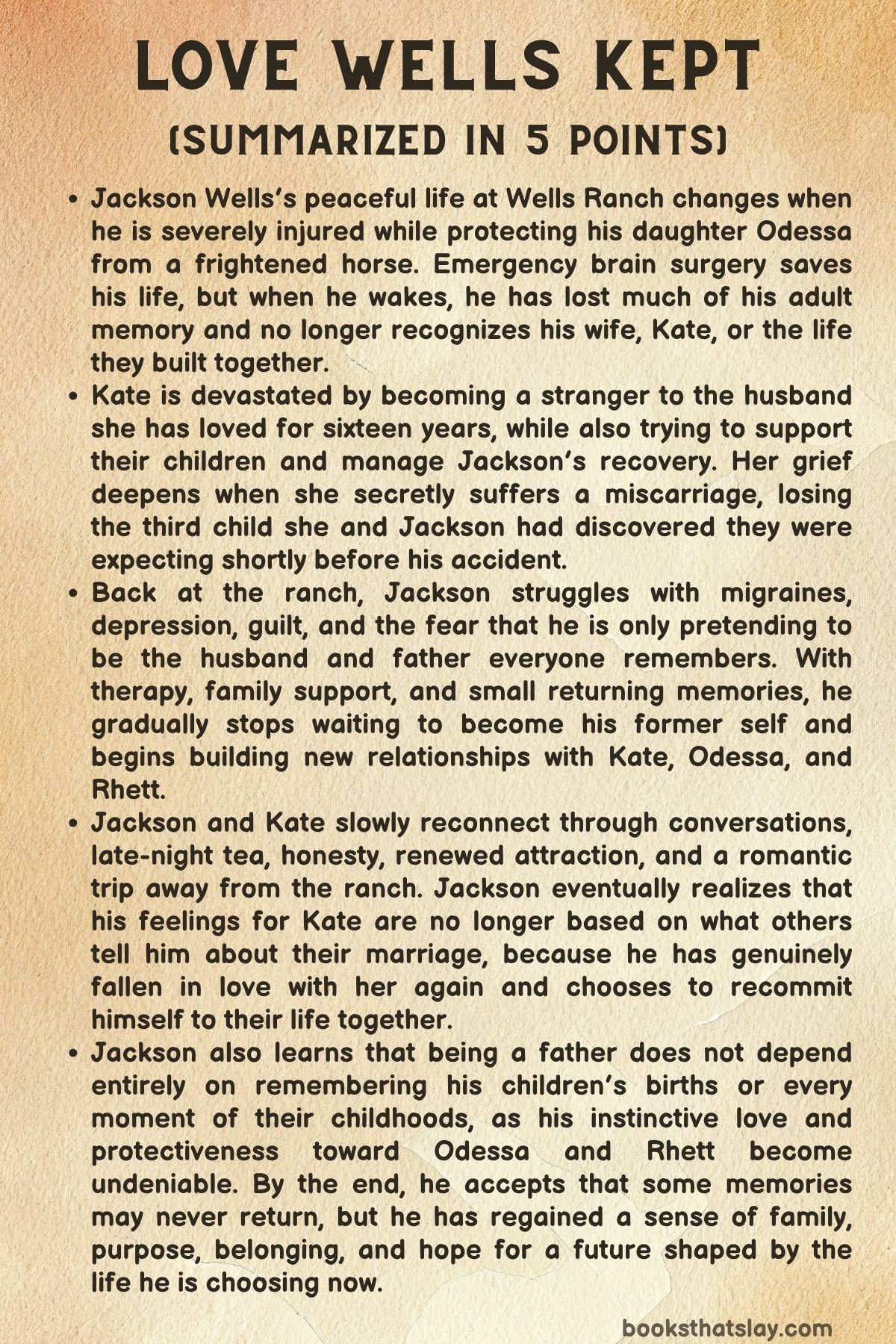
Jackson Wells begins the story secure in the life he has built at Wells Ranch with his wife, Kate, their seven-year-old daughter Odessa, and three-year-old son Rhett. He and Kate have recently discovered that they are expecting a third child, and the pregnancy feels like another joyful addition to a marriage that remains affectionate and deeply connected after sixteen years.
Jackson is especially excited about taking horse-loving Odessa to choose her first horse as an early birthday present. Before leaving, however, Odessa enters the stall of a frightened gelding, and when danger erupts Jackson instinctively places himself between his daughter and the horse.
The horse strikes Jackson, leaving him unconscious with a catastrophic head injury. Kate reaches the barn to find him bleeding on the concrete, and the terror of the moment becomes even sharper because only that morning Jackson promised that he would never leave without saying goodbye.
Jackson is airlifted to a hospital, where doctors perform emergency surgery for a subdural hematoma and temporarily remove part of his skull to relieve pressure on his brain. Kate refuses to abandon his bedside, joined by Jackson’s brothers Austin and Denny and later by their estranged father, Bennett.
The crisis begins quietly repairing old fractures within the Wells family. Bennett had left the ranch after the death of his wife, Lucy, because the grief of remaining there became unbearable, and Kate gradually begins understanding that his departure grew from devastation rather than an absence of love for his sons.
After several days in a medically induced coma, Jackson begins waking. The first signs of movement fill Kate with hope, but that relief is destroyed when he looks directly at the woman who has been his wife for sixteen years and asks who she is.
Jackson remembers parts of his childhood and recognizes Bennett, but large portions of his adult life are missing. He does not recognize Kate, Austin, Denny, or the life he supposedly built with his children, leaving Kate in the unbearable position of loving a husband who now experiences her largely as a stranger.
While trying to manage Jackson’s condition, Kate suffers another private tragedy when she miscarries their unborn child. Jackson no longer remembers that pregnancy, so Kate is left carrying the memory of their excitement and the reality of the loss almost entirely alone.
When Jackson eventually returns to Wells Ranch, the place that should feel like home instead resembles somebody else’s life. He sleeps in the bedroom he once shared with Kate, meets people who speak to him with years of familiarity, and struggles to understand how he can be a husband, father, brother, and rancher when he remembers almost none of the experiences that created those identities.
His physical recovery is accompanied by migraines, exhaustion, depression, and a growing sense of inadequacy. Stories about Odessa’s birth or family history often make him feel worse because they remind him that everyone around him knows a version of Jackson Wells that he cannot remember being.
Denny becomes one of the people who challenges Jackson’s belief that forgotten memories make present relationships meaningless. Instead of promising that everything will return, he reminds his brother that the people from those stories are still standing beside him and loving him now.
A small breakthrough arrives at Odessa’s birthday celebration when Jackson unexpectedly remembers an old incident involving Denny in a ridiculous costume. The memory matters, but an even greater change occurs when Jackson recognizes that he cannot spend his life waiting for his past to return before participating in his family’s present.
Jackson begins asking Kate about their marriage instead of avoiding the subject. When she describes how they became friends, fell in love, raised their children, and remained best friends throughout their marriage, he proposes rebuilding their relationship from the friendship upward.
Their growing closeness develops during late-night conversations over chamomile tea, echoing the talks through which they originally became close. Jackson admits that his depression has sometimes led him to think his family might be better without him, but Kate makes clear that his death would be far more devastating than any changes caused by his injury.
Therapy helps Jackson challenge the idea that feeling like a failure automatically means he is one. He begins returning to bedtime routines, family activities, ranch conversations, and small moments with Odessa and Rhett, slowly learning that fatherhood can exist through what he does now rather than through perfect access to what happened before.
His relationship with Kate also becomes increasingly romantic. Their attraction never completely disappeared, but Jackson fears using physical intimacy to imitate a marriage that he cannot emotionally remember, and his hesitation repeatedly hurts Kate because she does not want him to perform love out of obligation.
Eventually Kate confronts him about the limits of what she can endure. She refuses to beg him to love her or accept a false version of their former relationship, while Jackson admits that his real fear is not a lack of desire but the possibility that he can never equal the husband everyone remembers.
A fishing trip with Austin, Denny, and Bennett gives Jackson room to reconsider that fear. Bennett openly apologizes for abandoning his sons after Lucy’s death and reminds Jackson that marriage is not about never making mistakes, but about continuing to return, apologize, and show up.
Jackson decides to take Kate away for a weekend at a hot-springs cabin, but before the trip another emotional barrier finally breaks. Kate tells him that she had been pregnant when he was injured and that she miscarried while he was hospitalized.
Jackson cannot remember learning about the pregnancy, yet he refuses to let that make the loss solely Kate’s. He comforts her as the father of the child they lost, showing that emotional responsibility does not require him to pretend that he remembers something he does not.
Their renewed intimacy becomes another stage in their relationship. Rather than trying to reproduce exactly what they once had, they begin learning each other again, and Jackson discovers that his desire for Kate belongs to the man he is now rather than only to the husband he used to be.
During their weekend away, Jackson increasingly recognizes that he has fallen in love with Kate independently of the marriage he was told existed. He chooses a new wedding band for himself and tells her that even if he is not precisely the same man who wore the first one, he belongs to her and the family they are rebuilding.
His greatest remaining insecurity concerns Odessa and Rhett. Jackson worries that he is only acting like their father because he cannot remember the powerful emotions associated with their births and childhoods.
That fear changes when Odessa disappears after overhearing him discuss those doubts. A returning memory leads Jackson to the barn rafters where she is hiding, and Odessa confesses that she blames herself for his accident because he was injured while protecting her.
Jackson immediately rejects her guilt and comforts her. As he holds his frightened daughter, fatherhood stops feeling like a role he has been assigned; he recognizes her simply as his child and understands that love can survive even where memory has failed.
A similar realization comes with Rhett when the little boy is stung by a bee. Jackson may not remember basic details about Rhett’s medical history, but his instinctive fear, care, humor, and protectiveness reveal that the bond between them is becoming fully his again.
Kate eventually sees Jackson interacting naturally with both children rather than constantly measuring himself against his former identity. He even fulfills the promise interrupted by the accident by telling Odessa that it is finally time to choose her horse.
The family gradually settles into a new normal in which trauma has not been erased but no longer controls every moment. Kate can leave the ranch without constantly worrying that Jackson cannot handle the children, and Jackson finds ways to participate in ranch life even as he accepts that returning to horse training may not be possible.
When Austin and Cecily welcome a baby daughter named Lucy, the newborn reminds Kate of the child she lost while also opening a conversation about the future. Jackson and Kate realize that they may eventually want another child, not because they are trying to recreate what disappeared, but because their lives are continuing to expand.
Months later, Jackson remains changed and still lacks many memories, although some return unexpectedly. While dancing with Kate, he remembers a moment from their elopement, but the significance of the recovery is different now because he no longer believes complete memory is necessary for happiness.
By the end of the story, Jackson understands that identity is not limited to everything he can remember. He has rebuilt his marriage, rediscovered his love for his children, repaired important family bonds, found a new sense of purpose at the ranch, and chosen a future that belongs to the person he has become rather than merely to the person he once was.
Characters
Jackson Wells
Jackson is the central figure through whom Love Wells Kept examines the difference between remembering a life and actually living one. Before his accident, he is presented as a devoted husband, affectionate father, experienced rancher, and quiet man whose deepest confidence comes from the family he has built.
His injury removes much of the history supporting those identities, leaving him physically alive but psychologically separated from almost everything that once defined adulthood for him. His greatest conflict is therefore not simply amnesia; it is the fear that without memory he has no legitimate claim to being Kate’s husband, Odessa and Rhett’s father, or the man everyone at Wells Ranch expects him to be.
Jackson initially responds to this uncertainty through withdrawal. The migraines and exhaustion caused by his injury are real physical barriers, but isolation also protects him from continually confronting stories about experiences he cannot remember.
His depression grows from the belief that his existence has become burdensome to the people around him. Even love becomes painful because every expression of affection reminds him that others know him more completely than he knows himself.
Jackson’s development begins when he accepts that waiting passively for memory is another form of surrender. Therapy, conversations with Denny, Kate’s refusal to accept emotional distance indefinitely, and his experiences with the children gradually teach him that relationships can be created through present choices.
His eventual bond with Kate becomes especially meaningful because he refuses to falsely claim emotions he does not yet possess. When he finally says that he loves her, the declaration matters because the feeling has been formed through his new experiences rather than repeated from somebody else’s description of their past.
His growth as a father follows a similar pattern. Odessa’s disappearance and Rhett’s bee sting reveal protective instincts that no medical test or recovered memory could prove, allowing him to understand that fatherhood exists in his immediate emotional response to his children.
By the end, Jackson stops treating his former self as a standard he must perfectly reproduce. His recovery becomes an acceptance that change does not make him fraudulent and that a meaningful identity can contain both what survived and what had to be rebuilt.
Kate Wells
Kate is the emotional center of Love Wells Kept, carrying the consequences of Jackson’s injury from the perspective of the person who remembers everything he has forgotten. Her difficulty is fundamentally different from Jackson’s because she possesses the entire shared history of their marriage while being unable to make him emotionally experience any of it.
Her loyalty is immediate and almost absolute. She remains beside Jackson during surgery and his coma, brings photographs and family stories when he awakens, manages the children during his recovery, adjusts living arrangements to reduce his discomfort, and continually protects him from pressures he is not ready to face.
That devotion, however, does not make Kate endlessly passive or self-sacrificing. One of her strongest qualities is her eventual willingness to admit that love cannot survive indefinitely if only one partner is consciously participating in the marriage.
She refuses to pressure Jackson into physical intimacy or demand declarations he cannot honestly make. Her insistence that he choose her freely preserves the dignity of their relationship even when doing so places her own hopes at risk.
The miscarriage adds another dimension to Kate’s grief because it creates a tragedy that Jackson cannot remember sharing with her. Her decision to conceal the loss initially reflects how completely she has prioritized everyone else’s crisis above her own suffering.
When she finally tells Jackson, the confession allows Kate to stop treating grief as something she must manage privately. His willingness to mourn with her even without the missing memory becomes one of the clearest signs that their new relationship can carry real emotional responsibility.
Kate also learns that rebuilding does not mean restoring every old detail. She gradually stops treating complete memory recovery as the only acceptable ending and begins valuing the man Jackson is becoming alongside the husband she remembers.
Her arc therefore moves from desperate preservation toward acceptance without resignation. She does not abandon her past with Jackson, but she becomes capable of loving continuity and change at the same time.
Odessa Wells
Odessa is much more than the child whose danger causes Jackson’s accident. Her experience shows how traumatic events can affect children deeply even when adults attempt to shield them from the worst details.
Before the accident, Odessa’s relationship with Jackson is defined by trust, admiration, horses, and the uncomplicated certainty that she is her father’s beloved daughter. His amnesia destroys that certainty because she must confront the confusing idea that her father knows she exists without remembering the experiences that made them close.
Her avoidance of the barn reveals the lasting fear associated with witnessing the circumstances of Jackson’s injury. More seriously, she privately carries guilt because her disobedience placed her in danger, leading her to believe that Jackson’s damaged brain is somehow her responsibility.
The disappearance episode gives Odessa’s emotional struggle its clearest expression. Hearing Jackson admit that fatherhood sometimes feels unnatural convinces her that she might have lost the bond she depended upon, and she reacts by hiding in the place associated with both her guilt and their former relationship.
Jackson’s discovery of her becomes healing for both of them. Odessa receives the reassurance that she is not responsible for the accident, while Jackson realizes that his concern for her requires no conscious memory of her birth or childhood.
Her desire for a horse also becomes symbolic of interrupted normality. When Jackson finally renews his promise to get her one, the moment confirms that their relationship can again include excitement, plans, humor, and ordinary family happiness rather than being defined solely by injury.
Rhett Wells
Rhett is too young to understand the full medical and emotional complexity of Jackson’s condition, which gives his interactions with his father a distinctive simplicity. He approaches Jackson with affection more naturally than Odessa because he does not carry the same level of conscious expectation about what Jackson should remember.
His presence repeatedly pushes the adults toward ordinary family life. His superhero drawings, childish behavior, mud games, swearing, and dependence on his parents create moments in which Jackson has to respond rather than analyze.
The bee sting becomes particularly important because Jackson initially panics over not knowing whether Rhett has an allergy. That uncertainty reminds him how much basic parental knowledge he has lost, but his instinctive reaction afterward demonstrates that emotional fatherhood can exist even when factual memory does not.
Jackson cleans him, treats him, comforts him, and turns fear into a superhero joke. Rhett’s trusting hug confirms that the child is not evaluating whether Jackson has reconstructed the past correctly; he simply recognizes the care his father is giving him now.
Austin Wells
Austin represents the lasting consequences of abandonment within the Wells family. Of the brothers, he remains the most wounded by Bennett’s decision to leave after Lucy’s death, suggesting that loyalty and responsibility are central to how Austin judges family relationships.
During Jackson’s medical crisis, however, Austin consistently shows those same qualities in constructive ways. He remains beside Kate, helps manage the uncertainty surrounding Jackson’s condition, and later supports his brother without constantly drawing attention to what he has forgotten.
His behavior during the fishing trip is especially revealing. When Jackson cannot remember how to tie a fishing knot, Austin simply demonstrates rather than humiliating him or turning the moment into another reminder of his lost abilities.
Austin’s relationship with Bennett also demonstrates the slow nature of forgiveness. He does not suddenly erase years of anger, but his willingness to remain present during Bennett’s apology suggests that old family injuries can soften without pretending that they never happened.
Denny Wells
Denny often uses humor as his primary way of supporting the people around him, but beneath his comic presence is a remarkably realistic understanding of Jackson’s condition. He refuses to offer false reassurance when Jackson admits how hopeless he feels.
Instead of insisting that every memory will certainly return, Denny focuses Jackson on what remains available in the present. His argument that the people from Jackson’s missing memories are still physically there becomes one of the book’s clearest challenges to Jackson’s belief that forgetting automatically destroys relationships.
Denny also contributes to the family’s ability to survive crisis without allowing grief to dominate every interaction. His jokes, embarrassing stories, costumes, accidents, and willingness to make himself ridiculous bring laughter into situations where everyone is carrying emotional strain.
The spontaneous memory Jackson recovers about Denny is significant because it emerges through humor rather than through forced recollection. Their brotherly relationship therefore becomes one of the first areas where Jackson sees evidence that memory may return naturally while life continues.
Bennett Wells
Bennett begins as a complicated father whose abandonment of Wells Ranch created lasting resentment among his sons. His departure after Lucy’s death initially appears selfish because Austin, Jackson, and Denny were left to sustain an enormous family responsibility while still young.
Kate’s experience after Jackson’s accident creates a different perspective on Bennett. As she imagines what it would mean to live surrounded by reminders of a dead spouse, she begins understanding how grief could drive a person away from places once associated with happiness.
Bennett never uses grief to deny the harm he caused. His later apology acknowledges that his suffering does not erase his responsibility toward his sons, which gives his return greater emotional credibility.
He becomes particularly important to Jackson because he offers advice based on imperfection rather than idealized romance. His description of marriage as repeatedly making mistakes, apologizing, and returning the next day helps Jackson stop believing that being Kate’s husband requires perfect imitation of his former self.
Red
Red is introduced during the original accident as the ranch hand who brings the terrible news to Kate and Austin. His visible panic immediately communicates the seriousness of Jackson’s condition because a normally composed cowboy has been shaken by what he witnessed.
As Jackson recovers, Red becomes part of the ordinary social environment that helps reconnect him to ranch life. He allows Jackson to participate without forcing him to demonstrate remembered expertise, helping transform the ranch from a place of lost identity into a community where new belonging is possible.
Red’s eventual offer of ownership is particularly significant. The Wells brothers are not merely rewarding an employee; they are formally acknowledging that years of loyalty, work, and shared life have already made him part of the family.
His character therefore broadens the definition of kinship in the story. Family is shown not only as biological connection but also as belonging earned through constancy and mutual commitment.
Beryl
Beryl provides stability within the ranch household during the period when almost every immediate member of the Wells family is emotionally overwhelmed. She notices Kate’s physical condition early, encourages her to rest, and later continues offering practical and emotional support without demanding explanations.
Her first interaction with Jackson after his return demonstrates unusual sensitivity. Rather than forcing him into the embarrassment of admitting that he does not remember her, she introduces herself naturally and allows him to accept the relationship without shame.
That small act captures Beryl’s larger function. She helps people without turning their vulnerability into an event, which makes her presence especially valuable in a household where Jackson constantly feels observed and tested by his own missing memories.
Beryl also becomes part of the women’s supportive social circle around Kate. Her presence helps ensure that Kate’s identity does not shrink completely into being Jackson’s caregiver.
Blair
Blair plays an important role in recognizing that Kate’s suffering deserves attention even while Jackson’s brain injury remains the most visible crisis. Because she knows about the miscarriage, she understands that Kate is carrying a separate grief that the rest of the family may not fully see.
Her support challenges Kate’s tendency to place her own emotional and physical needs last. By reminding Kate to care for herself, Blair acts as a counterweight to the expectation that a devoted spouse must endure everything silently.
Blair also contributes to the return of ordinary friendship through humor and female companionship. The later gathering with the women allows Kate to discuss her marriage as a romantic relationship again rather than solely as a medical emergency.
Cecily
Cecily is part of the extended Wells family network that surrounds Kate and Jackson throughout the recovery. Her presence in domestic scenes helps establish Wells Ranch as a communal environment in which family responsibilities are widely shared.
Her pregnancy and eventual delivery of a daughter named Lucy carry particular emotional importance. The baby connects the current generation to Jackson’s late mother while also confronting Kate with the child she miscarried.
Cecily does not function merely as a reminder of Kate’s loss. Her new motherhood also demonstrates that grief and new happiness can exist in the same family at the same time.
Through baby Lucy, Cecily indirectly helps Kate and Jackson begin discussing whether they might want another child. That conversation becomes evidence that their attention has shifted from surviving the past toward imagining a future together.
Cassidy
Cassidy appears as part of the close community of women surrounding Kate. Although the supplied material gives her less individual development than several other characters, her repeated presence reinforces the strength of Kate’s social support system.
Her importance lies largely in normalcy and companionship. She helps create spaces in which Kate can laugh, gossip, discuss relationships, and experience herself as something more than the wife of an injured man.
Through characters such as Cassidy, the story avoids presenting recovery as the work of one couple in isolation. Jackson and Kate are able to rebuild partly because a wider group continues carrying portions of everyday life around them.
Lucy Wells
Although Lucy dies long before the central events, her influence extends throughout the novel. Kate originally arrives at Wells Ranch as Lucy’s care aide, meaning Lucy’s illness indirectly creates the circumstances in which Kate becomes part of the Wells family and grows close to Jackson.
Lucy’s death also shapes nearly every Wells man differently. Jackson and his brothers remain to preserve the ranch, while Bennett leaves because living among reminders of his wife becomes emotionally unbearable.
Her memory therefore sits at the center of an earlier family trauma that parallels Jackson’s later accident. Both events force the family to confront what happens when a person who structures everyone else’s emotional world is suddenly lost or profoundly changed.
The naming of Austin and Cecily’s daughter after Lucy shows that remembrance does not need to imprison people in grief. Lucy continues to matter, but the family increasingly carries her memory forward through affection rather than allowing loss to dictate their lives.
Colt
Colt belongs primarily to Jackson’s ranch environment and helps make his gradual social reintegration possible. His banter and repeated talk about Whit allow Jackson to sit among the ranch crew without every conversation turning into a test of forgotten skills.
That ordinary interaction is valuable because Jackson has begun questioning whether Wells Ranch still has a place for him. Colt helps create a space where participation matters more than mastery.
His role also illustrates how community recovery often happens through uneventful social contact. Jokes among ranch hands may appear minor, but for Jackson they provide evidence that he can still belong before knowing what his future work will look like.
Whit
Whit is connected to the ranch community through Colt and later appears among the women gathered with Kate. The available material gives her limited independent development, yet her inclusion reinforces how broadly the social life around Wells Ranch extends beyond the central family.
Her presence during Kate’s time away from the ranch contributes to an important stage in Kate’s recovery. Kate can finally enjoy friendship without constantly checking whether Jackson and the children are safe.
Whit therefore participates in the novel’s movement from crisis toward everyday community. Normal conversations and shared gatherings become signs that life is no longer organized entirely around Jackson’s injury.
Hazel
Hazel appears among the children during the mud-restaurant game supervised by Jackson and the other men. Her role is small, but the scene she participates in is important because Jackson is no longer standing outside childhood play wondering how a father should behave.
Together with Rhett and Odessa, Hazel helps create an ordinary environment in which Jackson responds spontaneously. The ridiculous mud feast gives him an opportunity to experience family life without history being explained to him.
Her presence also reinforces the communal nature of the ranch. Children move within an extended family setting rather than isolated individual households, contributing to the sense that Wells Ranch functions as a shared home.
Dr. Perron
Dr. Perron represents the medical reality surrounding Jackson’s injury. The doctor explains the subdural hematoma, brain swelling, surgery, and uncertainty surrounding neurological damage without offering guarantees that medicine cannot provide.
That uncertainty is essential to the emotional conflict. Neither Jackson nor Kate is given a simple timetable promising when memory will return, forcing them to make decisions without knowing whether recovery will ever resemble their previous life.
Dr. Perron therefore helps establish an important limit within the story: physical survival and emotional restoration are not the same process. Medicine can stabilize Jackson’s brain and monitor his recovery, but it cannot reconstruct sixteen years of marriage for him.
Themes
Memory and Identity
Jackson’s amnesia creates a powerful distinction between autobiographical memory and personal identity. He initially assumes that because he cannot remember being Kate’s husband, raising Odessa and Rhett, working with horses, or building a life at Wells Ranch, the identity attached to those experiences no longer truly belongs to him.
That assumption produces much of his suffering because he constantly compares himself with a version of Jackson described by other people. Every forgotten birthday, family story, ranch skill, private joke, and intimate habit becomes evidence in his mind that the person everyone loves may effectively be gone.
Love Wells Kept gradually challenges that definition of identity. Jackson’s humor, attraction to Kate, protectiveness toward the children, affection for his brothers, instinctive responses, and sense of belonging repeatedly appear before the corresponding memories return.
The story therefore presents memory as important without making it the sole foundation of the self. Jackson remains changed by his injury, and some parts of his former life may never return, but change does not make his current personality less genuine.
His final acceptance depends on stopping the attempt to prove that he is exactly the man he was before. Once identity becomes something that can be continually formed through relationships, values, actions, and new experiences, Jackson is able to live without treating every missing memory as evidence that he has failed.
Love as Choice and Renewal
Kate and Jackson’s marriage tests whether love can continue when only one partner remembers how that love was created. Kate initially possesses sixteen years of certainty while Jackson has only other people’s descriptions of a relationship he cannot emotionally access.
The easiest direction for the story would be to treat recovered memories as the only solution. Instead, Jackson and Kate gradually discover that their marriage can gain meaning through new conversations, new attraction, new trust, and new emotional experiences.
Kate’s refusal to demand that Jackson love her is essential to this process. She desperately wants her husband back, but she understands that words or intimacy offered solely from obligation would reduce their marriage to performance.
Jackson responds by learning Kate again rather than simply memorizing information about her. Late-night tea, questions about her past, flirtation, therapy exercises, physical closeness, and the trip away together allow affection to develop from direct experience.
When Jackson finally tells Kate that he loves her, the declaration is powerful precisely because he has not been repeating something he was told to feel. Their relationship suggests that long-term love is not preserved only through shared history; it survives because people repeatedly continue choosing one another.
The rebuilt marriage is therefore not presented as a weaker substitute for what existed before. It becomes proof that commitment can contain continuity, rediscovery, change, desire, uncertainty, and deliberate renewal at the same time.
Trauma, Grief, and Healing
Trauma affects nearly every member of the family differently, preventing recovery from being reduced to Jackson’s physical injuries. His accident causes fear, depression, memory loss, altered identity, and suicidal thoughts, but Kate and the children also carry consequences that cannot be seen through medical tests.
Kate experiences the visual horror of finding Jackson injured, months of emotional uncertainty, the loss of her unborn child, and the strange grief of having a living husband who no longer remembers their marriage. Odessa associates the barn with terror and secretly blames herself for the accident, while Jackson interprets his dependence on others as proof that he has become a burden.
Earlier family history shows the destructive consequences of grief that is never adequately processed. Bennett’s response to Lucy’s death is escape, and although his pain is understandable, leaving his sons creates another injury that survives long after the original loss.
Healing begins when characters stop hiding what their suffering has produced. Jackson admits the darkness of his depression, Kate reveals the miscarriage, Odessa confesses her guilt, and Bennett apologizes for abandoning his children.
None of these disclosures instantly eliminates pain. Their importance comes from ending the isolation surrounding it.
The story ultimately treats healing as the ability to live honestly alongside what happened rather than erasing it. Therapy, communication, humor, ordinary routines, family support, new memories, and forgiveness gradually reduce trauma’s control without pretending that the past has vanished.
Family, Belonging, and Everyday Commitment
Wells Ranch functions as more than the setting of the story because it represents a form of belonging that Jackson must rediscover. Before the accident, his place there is unquestioned; afterward, every familiar room, person, and responsibility reminds him of a life he cannot remember creating.
His return to belonging happens through repeated ordinary participation rather than one dramatic revelation. Sitting with the ranch crew, attending Odessa’s birthday, listening to bedtime stories, helping Rhett after a bee sting, playing in the mud, joining his brothers on a fishing trip, and learning different ranch work all slowly reconnect him with the community.
The wider family also demonstrates that belonging is not limited to blood. Beryl’s quiet care, Red’s years of loyalty, the friendships among the women, and the ranch hands’ easy acceptance create a network that supports Jackson and Kate while they recover.
Red’s eventual inclusion as an owner makes this idea explicit. The brothers formally acknowledge a relationship that years of shared responsibility have already established.
Even Bennett’s return shows that belonging can sometimes survive absence when accountability and renewed effort are present. He cannot undo leaving his sons, but he can choose to become part of their lives again.
Through these relationships, family becomes less about possessing an uninterrupted history and more about continuing to show up. Home is ultimately created by people who care for one another in crisis, make room for change, forgive without denying harm, and remain present through the ordinary days that follow.