Sibylline Summary, Characters and Themes
Sibylline by Melissa de la Cruz is a dark-academia fantasy about ambition, exclusion, friendship, and the dangerous secrets protected by elite institutions. Set around a powerful magical college in North America, the story follows Raven Chen, Atticus Garcia, and Dorian Winthrop after their dreams of admission are crushed.
Instead of giving up, they take jobs on campus and begin teaching themselves magic from the inside. What starts as a clever workaround soon becomes a dangerous investigation into hidden archives, collapsing towers, forbidden rituals, and a shadow creature tied to Sibylline’s buried past.
Summary
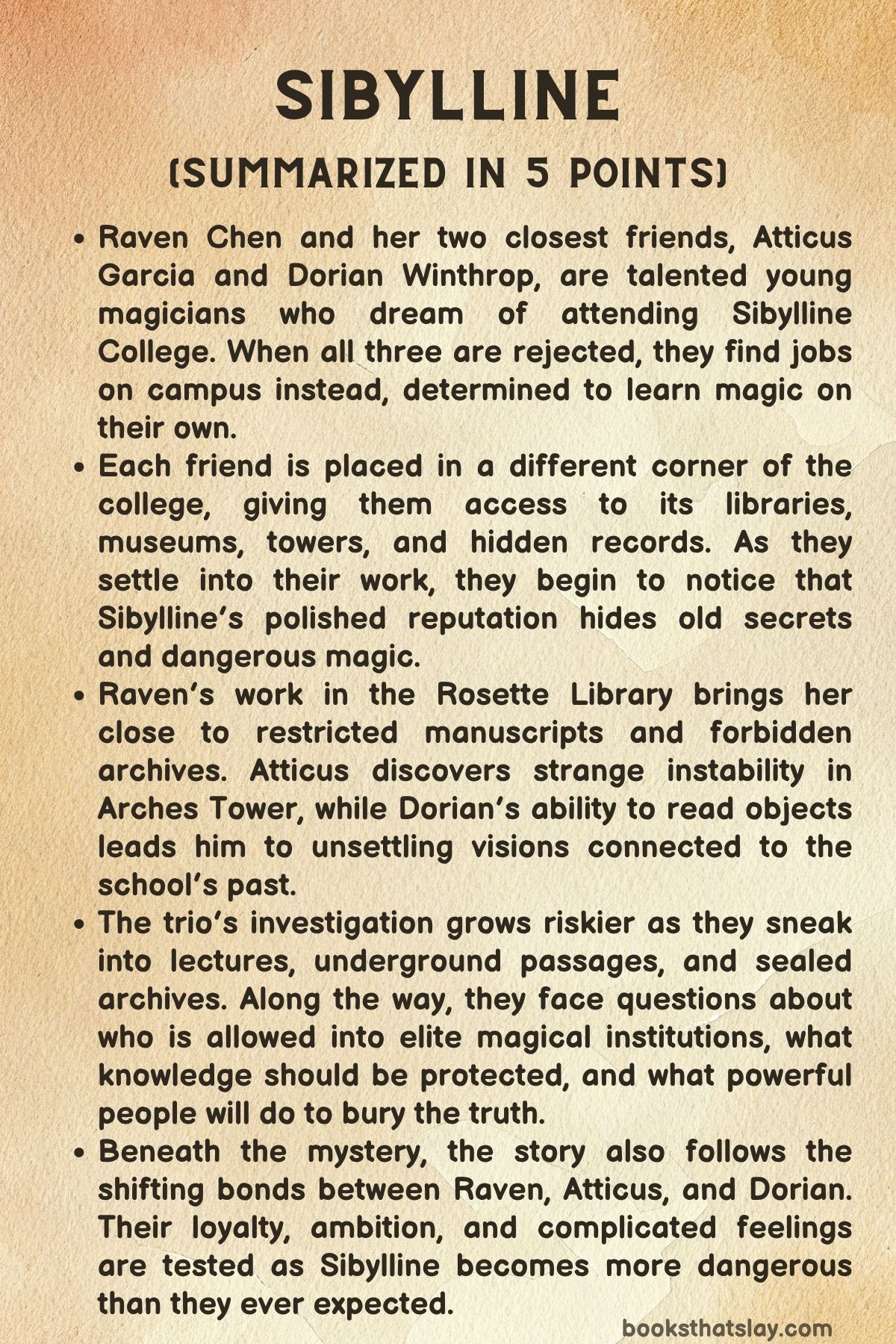
Sibylline opens with a midnight initiation at Sibylline College, where a young woman attempts to prove herself worthy of St. Adolphus Hall, a secret society tied to power and prestige. She climbs Arches Tower, speaks a forbidden magical word, and launches herself toward a higher platform, hoping to reach the angel statue that will grant her status and strength.
Before she can complete the ritual, a shadow rises, wraps around her, and pulls her into darkness. Her disappearance sets a sinister tone for the mysteries hidden beneath the college’s polished surface.
Months later, Raven Chen waits with her two closest friends, Atticus Garcia and Dorian Winthrop, to open their admissions letters from Sibylline. All three are talented young magicians with unusual gifts.
Raven can understand languages when the situation demands it. Atticus can sense emotions and thoughts.
Dorian can read the history of objects through touch. They have imagined attending Sibylline together, training their powers, and finally entering the world they believe they deserve.
Instead, all three are rejected.
The rejection devastates them, but Raven refuses to accept it as the end. She suggests that if Sibylline will not admit them as students, they should enter as workers.
Once employed there, they can listen to lectures, use the library, study hidden materials, and teach themselves what the college has denied them. The plan is risky, but it works.
Atticus becomes an administrative assistant in Mansart Hall, working in the architecture department under Professor Anna White. His early tasks seem ordinary, but he quickly learns that Arches Tower is in serious danger.
The building is not only old; it was created through ancient architectural magic that modern wizards barely understand. Professor White reveals that Sibylline’s structures were built with forces and techniques that current scholars can only maintain, not fully recreate.
When stone crashes inside the tower, she realizes something is badly wrong.
Dorian begins work at the Benoist Museum, known as Old Bones, under Professor Nathan Evander. Evander takes an immediate interest in Dorian’s psychometry.
When Dorian is asked to examine a supposedly lost magical painting, he touches it and sees that it is a modern forgery. His skill impresses Evander.
Later, Dorian handles a wand said to have belonged to Hecate and receives a terrifying vision of thunder, blood, ritual magic, a dead body in Sibylline robes, the name Adelina, and a shadow. He collapses, but when Evander questions him, Dorian hides the most important details.
Raven becomes an archivist in the Rosette Library. She has lied to her parents, telling them she is spending a gap year in Paris because they would not support her plan to work at Sibylline.
While shelving books, she discovers old magical manuscripts in Welsh and realizes they contain powerful incantations. A senior archivist named Aspen Franklin shows her the Eastern Archive, an underground restricted area filled with dangerous magical books locked behind cages.
Raven immediately sees that these books may be the key to the education she and her friends were refused.
As the three settle into campus life, Sibylline begins affecting them. Their gifts grow sharper, and the college feels less like a workplace than a forbidden classroom.
Atticus discovers he can sense the magical structure of Arches Tower, almost as if he can read the building itself. Using this ability, he finds a hidden sigil carved high in the tower.
It is a mark of undoing connected to Beelzebub. Professor White concludes that the tower is not simply decaying; someone is sabotaging it.
She promotes Atticus from routine assistant work to a direct role in the restoration investigation.
Raven, Atticus, and Dorian compare notes at the Acroteria café. They realize that each of them has found signs that Sibylline is hiding more than academic secrets.
Raven pushes them to sneak into a magical theory lecture. Wearing student robes, they sit in on Warden Jeremiah Stone’s class about goetia and watch him summon a grimoire.
Professor White catches them afterward but does not punish them. Instead, she warns them and hints that the real knowledge they seek may be in the library.
That hint leads Raven to plan a theft from the Eastern Archive. She steals Aspen’s key by staging an ink spill and accepting his invitation for coffee.
During their walk, they encounter protesters accusing Sibylline of having “blood on your hands.” Warden Stone silences one protester with magic, an act that disturbs Raven. Aspen explains that some people believe Sibylline stole magical texts from cultures around the world and hoarded them for itself.
At midnight, Atticus and Dorian use Raven’s stolen key and copied tunnel blueprints to enter the underground passages beneath campus. Dorian uses his gift to uncover the hidden password to a sealed tunnel.
When they reach the Eastern Archive, they find the door already unlocked. Warden Stone appears, searching the restricted archive late at night.
The boys hide behind a fireplace until he leaves with a book. During the tense wait, their unspoken feelings surface.
Later, Dorian allows himself to touch Atticus without a glove, and their minds connect. He kisses Atticus, and Atticus is overwhelmed because he has wanted Dorian for years.
But Dorian’s feelings for Raven remain tangled in the moment, and he pulls away, leaving Atticus hurt and confused.
Dorian struggles after the kiss. At Old Bones, Evander sends him to retrieve old admissions essays from the Rosette.
In the records room, Dorian touches an old book and sees a memory from Sibylline’s past: officials rejecting strong magical applicants while admitting weak but wealthy ones. A previous warden refers to the need to avoid “another incident,” suggesting a buried scandal shaped the school’s admissions system.
The danger at Arches Tower soon becomes impossible to ignore. Professor White believes renovation mistakes have disturbed the magic and spirits bound into the building.
The tower shakes and begins collapsing while Atticus is inside. Raven sees it fall and panics, certain he has died.
A body is recovered, but it belongs to Pippa, a library worker Raven knew. Atticus survives and emerges with a book Professor White gave him.
Raven notices claw marks on Pippa’s body, suggesting she was murdered before the collapse.
The friends gather again and connect their discoveries. Dorian explains the admissions cover-up.
Atticus shows them the Akkadian book from Professor White, which Raven translates as a text about binding magical creatures. Professor White then brings Atticus back to the ruins and reveals that hidden underground archives were exposed by the collapse.
They will soon be demolished. Without openly saying so, she urges him to save the books before Warden Stone destroys the site.
That night, Raven, Atticus, and Dorian sneak beneath Arches. They find tunnels, iron bars, cuneiform markings, and signs that the space was once a prison rather than a workshop.
In a hidden laboratory, they discover Adelina Ward’s journal. A secret passage leads them to a circular chamber covered in binding sigils.
At its center stands an iron cage containing a skeleton.
By touching Adelina’s journal together, they enter memories from 1917. Adelina was a brilliant but obsessive student who believed chaos could be used to create life.
She persuaded Mary to steal Hecate’s wand from Old Bones, then lured Henri to her workshop, wounded him, and used his blood and the wand in a ritual. The result was a shadow creature called a malum.
The creature fed on Mary’s magic and killed her. Sibylline authorities imprisoned Adelina beneath Arches with the malum bound into the walls, then erased the truth.
The friends understand that the collapse has freed the malum. As they try to escape, it attacks.
Atticus is badly clawed while protecting Raven and Dorian. Dorian uses his power to take Atticus’s wounds into his own body, saving him.
Raven casts a fire spell using Atticus’s blood and forces the creature back. Demolition begins above them, but workers see the group in time and stop.
After their rescue, they tell Warden Stone what they found, but he already knows about the malum and dismisses them. Rather than thank them, he fires all three and bans them from campus.
At the Acroteria, they argue over Adelina’s journal, Stone’s secrets, and a new student death connected to St. Adolphus Hall. Atticus suspects Aspen may know more than he has admitted.
The emotional strain breaks open when Atticus accidentally reveals he kissed Dorian, hurting both Raven and Dorian. Feeling humiliated and rejected, Atticus leaves alone in the rain.
Later, Raven returns to apologize, only to find him gone—and Aspen waiting instead.
Characters
Raven Chen
Raven Chen is one of the central characters in Sibylline, and her role in the book is shaped by ambition, intelligence, pride, loyalty, and a growing awareness of institutional corruption. At the beginning, Raven is devastated by her rejection from Sibylline College, but she refuses to let that rejection define her future.
Instead of surrendering to disappointment, she immediately begins looking for another way in, which shows both her determination and her unwillingness to accept closed doors. Her idea that she, Atticus, and Dorian should work at the college in order to gain access to its knowledge reveals her resourcefulness, but it also shows that Raven can be reckless when she believes the goal is important enough.
Raven’s magical ability to understand languages situationally makes her especially important to the mystery at the heart of the story. She is not simply someone who reads old texts; she becomes the one who can unlock buried histories, forbidden spells, and hidden meanings that others might miss.
Her work in the Rosette Library places her close to Sibylline’s most dangerous knowledge, and her discovery of powerful manuscripts in Welsh shows how naturally she is drawn toward secrets. Raven’s curiosity is one of her strengths, but it also creates moral tension because she is willing to steal Aspen’s key and break into restricted spaces when she believes the institution is hiding something.
Emotionally, Raven is loyal but also somewhat self-focused. She cares deeply about Atticus and Dorian, yet she does not always understand the feelings moving between them.
Her bond with Dorian is complicated by his long-standing love for her, while her bond with Atticus is damaged when she learns about his kiss with Dorian. Raven’s hurt suggests that she feels betrayed not only romantically or personally, but also because the friendship among the three of them has always depended on honesty and trust.
Her reaction makes her human: she is brave and clever, but she is also capable of jealousy, confusion, and wounded pride.
Raven’s lie to her parents about spending a gap year in Paris adds another layer to her character. She wants independence and recognition, but she is still caught between family expectations and her own desire for magical greatness.
Throughout the book, Raven grows from a rejected applicant trying to prove herself into someone who begins to see the darker cost of power, privilege, and secrecy. Her confrontation with Sibylline’s hidden past forces her to question whether the knowledge she wants is worth the danger attached to it.
Atticus Garcia
Atticus Garcia is one of the most emotionally perceptive characters in the book, and his magical ability mirrors his personality. Because he can sense emotions and thoughts, he is often more aware of what others feel than they are willing to say aloud.
This makes him compassionate and sensitive, but it also leaves him vulnerable. Atticus carries his feelings deeply, especially his love for Dorian, which has remained unspoken for years.
His emotional openness contrasts with Dorian’s hesitation and Raven’s forward momentum, making Atticus the quiet heart of the trio.
At Sibylline, Atticus’s placement in Mansart Hall connects him to the physical and magical structure of the college. His ability to read Arches Tower and sense the hidden sigil shows that his power is not limited to people; he can connect with the emotional and magical residue of buildings as well.
This makes him essential to uncovering the sabotage of the tower. Atticus is observant, patient, and careful, and Professor White quickly recognizes that he is more than an assistant.
His promotion into the restoration investigation confirms that he has genuine talent even though the school rejected him.
Atticus’s relationship with Dorian is one of the most tender and painful parts of the story. When he encourages Dorian to practice controlling his visions by touching him, Atticus is offering trust in its purest form.
He knows the risk, but he wants to help Dorian feel less afraid of his own power. Their kiss gives Atticus a moment of hope, but that hope is quickly wounded when Dorian pulls away because of his feelings for Raven.
Atticus tries to hide his devastation, which shows how used he is to protecting others from the full force of his emotions.
His bravery becomes especially clear beneath Arches, when the malum attacks and he is badly wounded while helping Raven and Dorian escape. Atticus is not reckless in the same way Raven can be, but he is self-sacrificing.
He repeatedly puts himself in danger for the people he loves. After the confrontation with Stone and the argument about the kiss, Atticus leaves alone in the rain, which suggests that his emotional strength has limits.
He has spent much of the story supporting others, and by the end of the provided events, he is the one who feels abandoned, exposed, and hurt.
Dorian Winthrop
Dorian Winthrop is a complex character whose power, fear, desire, and guilt are closely linked. His psychometric ability allows him to read the history of objects through touch, which gives him access to truth in a uniquely intimate way.
However, that gift also makes him vulnerable to overwhelming visions. When he touches Hecate’s wand and sees blood, ritual violence, a dead body, Adelina, and the shadow, his collapse shows that his magic is not just useful but dangerous.
Dorian’s habit of wearing gloves reflects both practical caution and emotional guardedness; he protects himself from the world because the world leaves too much behind.
Dorian’s work at Old Bones places him among artifacts, histories, and magical relics, which suits his gift perfectly. Professor Evander quickly notices his talent, and Dorian proves himself by identifying a forged magical painting.
Yet Dorian often hides what he truly sees, especially after the vision involving the wand. This secrecy is not malicious; it comes from fear and uncertainty.
He does not yet trust himself enough to reveal the full truth, and that hesitation becomes part of the danger surrounding him and his friends.
His emotional life is deeply conflicted. Dorian has loved Raven for a long time, but his kiss with Atticus reveals feelings he has not fully admitted to himself.
The moment when he touches Atticus and their minds connect is important because Dorian cannot hide behind his usual restraint. His desire becomes visible, and for a short time he acts on it.
Yet his thoughts return to Raven, and he retreats. This makes Dorian sympathetic but also hurtful.
He does not intend to wound Atticus, but his confusion causes real pain.
Dorian’s greatest moment of courage comes when he absorbs Atticus’s wounds into his own body. This act transforms his touch from something frightening into something healing and sacrificial.
Earlier, his power exposed violence and death; here, it saves someone he loves. That moment suggests that Dorian’s arc is about learning that his gift does not have to isolate him.
It can connect him to others, but only if he is willing to face the emotional truth that comes with it.
Professor Anna White
Professor Anna White is an important adult figure because she recognizes Atticus’s talent and appears to understand more about Sibylline’s crumbling magical foundations than most people are willing to admit. As a professor in the architecture department, she is connected to the ancient magic that shaped the college’s buildings.
Her concern over Arches Tower is not merely academic; she understands that the building is alive with old enchantments, spirits, and structural magic that modern wizards barely know how to preserve.
Professor White’s treatment of Atticus shows that she values ability over official status. Although he begins as an administrative assistant, she quickly sees that he can sense things others cannot.
Her decision to involve him more directly in the investigation suggests that she is practical, open-minded, and perhaps desperate enough to trust someone outside the student body. She is one of the few authority figures who does not simply dismiss the rejected applicants.
At the same time, Professor White is not completely straightforward. She gives Atticus the Akkadian book and later subtly urges him to save the exposed underground texts before Warden Stone destroys the site.
This makes her seem like someone working around the system rather than openly against it. She may be trying to protect knowledge, expose the truth, or prevent Stone from burying evidence.
Her ambiguity makes her interesting because she is helpful, but not entirely transparent.
Professor Nathan Evander
Professor Nathan Evander is the curator of the Benoist Museum, and his role in the book is tied to artifacts, hidden histories, and Dorian’s developing power. He immediately notices Dorian’s psychometric ability and tests it by asking him to authenticate a supposedly lost magical painting.
His interest in Dorian is partly professional, because Dorian’s gift is extremely useful in museum work, but it may also suggest that Evander understands the value of people whose talents fall outside ordinary academic categories.
Evander’s personality comes across as demanding and sharp. He scolds Dorian for being late, which shows that he expects discipline and professionalism.
Yet he also gives Dorian meaningful work rather than treating him as insignificant. His museum, known as Old Bones, becomes one of the gateways into Sibylline’s buried past because it contains Hecate’s wand, the object that triggers Dorian’s violent vision.
Whether Evander fully understands the danger of the artifacts under his care is unclear, but his environment is deeply connected to the old secrets surrounding Adelina and the malum.
Evander functions as a mentor figure, but not a warm one. He pushes Dorian into contact with objects that reveal the truth, though Dorian does not always share what he sees.
This creates distance between them. Evander may respect Dorian’s power, but he does not yet seem to understand the emotional and physical cost of using it.
Aspen Franklin
Aspen Franklin is a senior archivist in the Rosette Library and one of the more suspicious characters in the book. At first, he appears helpful because he introduces Raven to the Eastern Archive, a restricted underground space filled with dangerous magical books.
This makes him a guide into Sibylline’s hidden world, but it also raises questions about how much he knows and why he allows Raven to see so much.
Raven is able to steal Aspen’s key by staging an ink spill and accepting his invitation for coffee, which suggests that Aspen may be trusting, distracted, or interested in Raven. His conversation with her during the encounter with protesters reveals that he knows about accusations against Sibylline.
He explains that some people believe the college stole magical texts from around the world and hoarded them. This makes him a source of information, but also places him near the moral conflict surrounding the institution’s power.
By the end of the provided events, Aspen becomes more suspicious because Atticus connects the deaths to St. Adolphus Hall and wonders whether Aspen knows more than he admits. Aspen’s arrival at the apartment after Atticus disappears adds tension.
He may be an ally, a manipulator, or someone caught between loyalty to the school and sympathy for Raven. His role remains uncertain, which makes him one of the characters whose politeness may conceal deeper involvement.
Warden Jeremiah Stone
Warden Jeremiah Stone represents Sibylline’s institutional authority, secrecy, and control. He is introduced as a powerful figure who teaches magical theory and demonstrates advanced command over goetia.
His ability to summon a grimoire in front of students shows that he is not merely an administrator but a formidable magician. He embodies the official power of the college, and that power is often intimidating.
Stone’s behavior toward the protesters reveals his authoritarian side. When he magically silences a protester accusing the college of having “blood on your hands,” he does not answer the accusation; he suppresses it.
This moment is important because it shows how Sibylline protects its image. Stone’s response suggests that the institution is more interested in control than transparency.
His late-night search of the Eastern Archive also implies that he is personally involved in hiding or retrieving dangerous knowledge.
When Raven, Atticus, and Dorian tell him about the malum, Stone already knows what it is, but he refuses to take them seriously and instead fires and bans them. This makes him deeply suspect.
He is not ignorant; he is withholding. His reaction suggests that he may be trying to contain the scandal, protect the school’s reputation, or prevent the trio from exposing a truth that has been buried for generations.
In Sibylline, Stone is not simply a strict authority figure; he is a symbol of how powerful institutions preserve themselves by dismissing inconvenient truth.
Adelina Ward
Adelina Ward is one of the most tragic and dangerous figures in the book. She appears through memories connected to her journal, and those memories reveal a brilliant student whose ambition becomes monstrous.
Adelina is fascinated by chaos and believes it can be used to create life. Her intelligence is undeniable, but it is joined to obsession, arrogance, and a willingness to cross moral boundaries.
Her desire to create the malum shows how far she is willing to go in pursuit of magical discovery. She begs Mary to retrieve Hecate’s wand from Old Bones, then later lures Henri to her workshop and uses his blood in a ritual.
Adelina does not merely make a mistake; she knowingly uses other people as materials in her experiment. This makes her horrifying, but not flatly evil.
She represents the danger of genius without restraint, especially in an academic world that values power and achievement.
After the malum kills Mary, Adelina’s punishment is also disturbing. Rather than publicly confronting what happened, school authorities imprison her beneath Arches with the creature bound into the walls and hide the truth.
Adelina is both perpetrator and evidence. Her fate shows how Sibylline handles catastrophe: it buries the person, the creature, and the scandal together.
Through Adelina, the story explores the cost of forbidden knowledge and the danger of institutions that hide their own failures.
Mary
Mary is a victim of Adelina’s ambition, but she is also important because her actions help set the tragedy in motion. She retrieves Hecate’s wand for Adelina, which suggests trust, loyalty, or perhaps pressure.
Mary may not fully understand what Adelina intends to do, but her involvement places her close to the dangerous experiment that creates the malum.
Her death is especially significant because the creature feeds on her magic. This turns Mary into the first major human cost of Adelina’s creation.
She represents innocence, trust, and the vulnerability of those drawn into another person’s obsession. Her fate also deepens the horror of Adelina’s experiment because it shows that the malum is not just a magical achievement gone wrong; it is a predator born from violence and sustained by stolen power.
Mary’s role may be brief, but it carries emotional weight. She becomes part of the buried truth that Sibylline chose to conceal.
Her death is not simply a past tragedy; it is one of the original wounds that continues to affect the present.
Henri
Henri is another victim of Adelina’s experiment, and his role shows the cruelty behind her pursuit of magical creation. Adelina lures him to her workshop and wounds him so that his blood can be used in the ritual.
This makes Henri less a participant than a sacrifice. His trust is exploited, and his body becomes part of Adelina’s attempt to create life from chaos.
Although the provided events do not reveal as much about Henri’s personality as they do about the central trio, his importance lies in what his treatment reveals about Adelina. She is willing to harm someone directly in order to achieve her goal.
Henri’s suffering also makes the hidden laboratory beneath Arches feel more sinister. The place is not only a site of study; it is a crime scene.
Henri’s role reinforces one of the book’s central moral questions: what happens when magical ambition is valued above human life? Through him, the story shows that the old scandal was not abstract.
It involved real people whose pain was buried beneath the college.
Pippa
Pippa is a library worker known to Raven, and her death changes the story’s stakes. At first, the collapse of Arches Tower seems like a structural disaster connected to unstable magic and sabotage.
However, when Pippa’s body is found with claw marks, it becomes clear that something more violent is happening. Her death helps reveal that the danger is not only architectural but monstrous.
Pippa’s connection to the library also matters because the library is one of the main spaces where hidden knowledge is stored, restricted, and controlled. Her death near the unfolding mystery suggests that people connected to Sibylline’s secrets are in danger.
She is also linked to St. Adolphus Hall, which connects her to the earlier disappearance of the initiate and to the later death mentioned in the school paper.
Pippa’s role is tragic because she becomes evidence before she becomes fully understood. Her body tells Raven and the others that the malum is active, even before they fully know what it is.
In that sense, Pippa is part of the transition from mystery to horror.
Warden Kerrigan
Warden Kerrigan appears through Dorian’s vision of the old admissions records, and his role reveals the institutional corruption of the past. In the memory, Sibylline officials deny magically powerful applicants while approving weak but wealthy students.
Kerrigan’s statement that they cannot risk “another incident” suggests that the school’s admissions decisions were shaped by fear, reputation, and class privilege rather than merit.
Kerrigan represents an earlier version of the same secrecy embodied by Warden Stone in the present. He is part of a system that responds to scandal not by becoming more honest, but by becoming more selective and defensive.
The fact that powerful applicants were rejected while wealthy ones were accepted also echoes Raven, Atticus, and Dorian’s rejection. Their failure to gain admission may not reflect their talent at all; it may reflect Sibylline’s long-standing habit of protecting itself.
His role is brief but important because he helps connect the present mystery to an older pattern. The college’s corruption is not new.
It has been shaped by generations of administrators willing to hide truth, manipulate access, and preserve prestige.
Themes
Ambition and the Cost of Access
Sibylline presents ambition as both a source of courage and a force that can push people toward danger. Raven, Atticus, and Dorian are rejected by the college, yet they refuse to accept that rejection as the end of their magical futures.
Their decision to work on campus shows determination, resourcefulness, and hunger for knowledge, but it also places them in spaces they do not fully understand. Their ambition leads them to secret archives, forbidden books, hidden tunnels, and truths that powerful people have buried for generations.
The story suggests that access to education is not always fairly granted; talent alone does not guarantee entry, while wealth and status can shape who is welcomed. At the same time, the friends’ search for knowledge becomes morally complicated because they steal keys, sneak into restricted areas, and risk their lives.
Their ambition is admirable because it challenges exclusion, but it is also dangerous because it brings them closer to forces that have already destroyed others.
Institutional Corruption and Hidden Histories
The college appears prestigious, disciplined, and ancient, but beneath that reputation lies a history of cover-ups, unfair admissions, stolen knowledge, and concealed violence. The discoveries made by Raven, Atticus, and Dorian reveal that the institution has protected itself rather than its students.
The old admissions memory shows that powerful applicants could be rejected while wealthy but weaker students were accepted, suggesting that the school’s public image of excellence is built on hypocrisy. The imprisonment of Adelina and the malum beneath Arches shows another layer of corruption: instead of confronting what happened honestly, the authorities buried the truth inside the architecture itself.
Warden Stone’s behavior in the present repeats this pattern. He silences protest, removes dangerous books in secret, dismisses the students’ warnings, and bans them rather than investigating openly.
The theme shows how institutions maintain power by controlling information, rewriting history, and punishing those who expose uncomfortable truths.
Friendship, Desire, and Emotional Fracture
The bond between Raven, Atticus, and Dorian is one of the emotional centers of the story, but it is not simple or stable. Their friendship begins with shared rejection and a collective plan to reclaim the future they believe they deserve.
They trust one another enough to break rules, enter dangerous places, and face the malum together. Yet their closeness also exposes hidden feelings, jealousy, shame, and insecurity.
Atticus’s long-standing desire for Dorian becomes painful after their kiss, especially because Dorian’s feelings remain divided by his love for Raven. Dorian’s confusion, Atticus’s heartbreak, and Raven’s hurt create a fracture that no magical danger can easily solve.
The emotional conflict matters because it shows that friendship can survive shared danger while still being damaged by silence and unspoken longing. The story treats love not as a simple reward, but as something that can unsettle loyalty, identity, and trust.
Knowledge, Power, and Responsibility
In Sibylline, knowledge is never neutral. Books, artifacts, memories, languages, buildings, and visions all carry power, but that power can save lives or destroy them depending on how it is used.
Raven’s gift allows her to understand old magical texts, opening doors that others cannot enter. Dorian’s psychometry reveals hidden truths, but it also harms him physically and emotionally.
Atticus’s ability to sense the magical structure of Arches helps expose sabotage and danger, yet it places him directly in the path of collapse and attack. Adelina’s story offers the darkest version of this theme.
Her brilliance and curiosity lead her to create life through blood, chaos, and stolen power, but she refuses to respect the consequences of what she is doing. The three friends contrast with her because they make mistakes, yet they also try to protect one another and uncover the truth.
The story suggests that power becomes dangerous when separated from responsibility, humility, and care for others.