The Mortal Trials Summary, Characters and Themes
The Mortal Trials by Megan Shunmugam is a fantasy novel built around a brutal contest between mortals and powerful elven rulers, but its central story gradually expands into something far larger than survival.
Lirahna Aldhur begins as an abandoned servant whose life is stolen by another person’s lie, only to discover that her history, abilities, and identity are connected to conflicts among gods, fae, and immortals. The novel combines dangerous trials, hidden histories, friendship, romance, questions of free will, and an evolving mystery surrounding Lirah’s unusual powers. Her fight to return home eventually becomes a struggle over who has the right to decide her future.
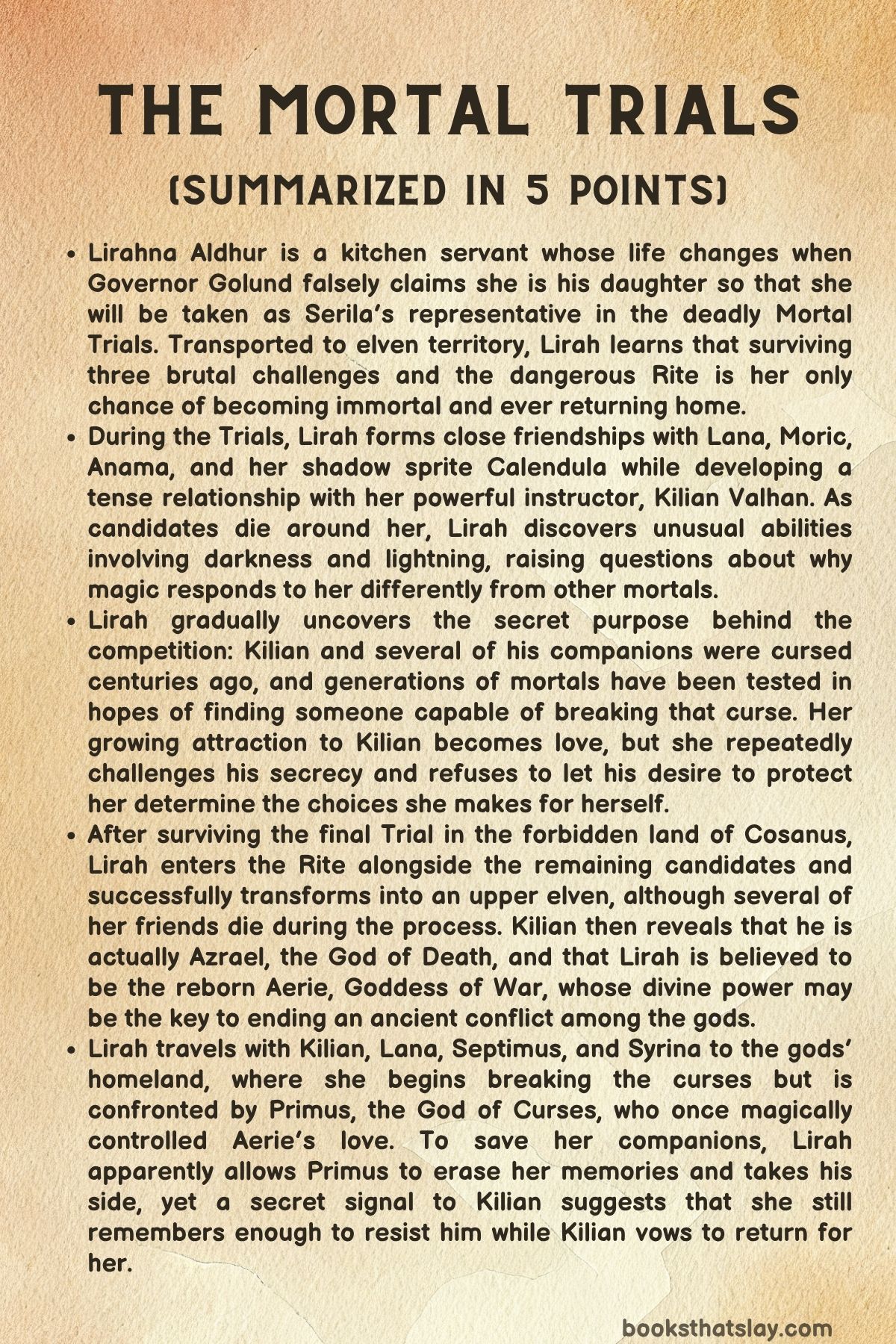
Summary
Lirahna Aldhur, usually called Lirah, works in the kitchens of Governor Unferth Golund’s fortified home on the island of Serila. Abandoned as a baby and raised by the servant Umma, Lirah has little status but considers Umma her true family and expects her life to remain within the governor’s household.
Everything changes when elven warriors arrive during Augustine to claim Governor Golund’s hidden daughter as Serila’s candidate for the Mortal Trials. The governor protects his real child by identifying Lirah as his daughter instead, and when Umma attempts to expose the deception, Echon magically takes away her voice; unable to risk Umma’s life, Lirah accepts the false identity and is taken by Kilian Valhan and his companions.
After being drugged throughout the journey, Lirah wakes beside another candidate, Solana “Lana” of Dorisport. Lana explains that every ten years one mortal is taken from each of Tarlor’s thirteen islands, and anyone who survives three Trials may attempt the Rite, a dangerous transformation that can turn a mortal into an immortal upper elven.
The system continues partly because the elven use magic to sustain the mortal islands’ crops, making rebellion potentially disastrous. Lirah refuses to accept that death is inevitable because she promised Umma she would return, and that determination strengthens when she and Lana survive a preliminary challenge involving a disappearing floor and concealed keys.
At the elven stronghold, Lirah meets other candidates, including Moric, Rayna, and the scholar Anama. Kilian reveals that once mortals set foot on elven territory they cannot leave while remaining mortal, meaning survival of both the Trials and the Rite is their only path home.
Each candidate receives an instructor and a sprite, with Lirah paired with Kilian and the shadow sprite Calendula Mirau IV. A sacred oath creates a magical bond between Lirah and Kilian, allowing him to sense her emotions and danger while giving her access to a small fragment of his power; Lirah immediately resents the invasion and even attempts to escape, only to discover that the environment, magical restrictions, and oath make running nearly impossible.
During combat training, Lirah finally tells Kilian that she is not Governor Golund’s daughter but a servant sacrificed in the governor’s place. Kilian reacts with extraordinary fury, revealing how unstable and destructive his power can become, while Lirah begins noticing that some elven, including Syrina and healer Midius, are disturbed by the deaths caused by the Trials rather than indifferent to them.
Lirah grows closer to Calendula, Lana, Moric, and Anama while researching how to survive the coming challenges. In Lomask, a mysterious elderly woman gives Lirah a silver-and-onyx bracelet containing protective magic, and later Lirah learns that Kilian recognizes it because it once belonged to Elena, an earlier mortal candidate he cared about deeply.
The first official Trial sends Lirah, Lana, Moric, and Anama into the deadly Forests of Dalhur. A navigation error leads them to a river inhabited by an arrow-tailed lancer, and Anama is dragged into the water and killed, forcing Lirah to overcome her grief long enough to lead the others away.
Their danger continues when Moric is poisoned and the survivors must enter separate caves to retrieve keys from a monster. Lirah unexpectedly discovers that she can see through shadow and summon blue lightning, while Lana later uses Septimus’s golden magic to help kill the creature; all three escape, but Lirah becomes increasingly suspicious of how naturally Kilian’s power responds to her.
Returning from the forest does not bring peace. Kilian had felt Lirah’s injuries through their bond and believed she had died when the connection vanished, leading to a furious confrontation in which Lirah accuses the elven of treating mortal deaths as acceptable losses while Kilian begins showing that his emotional detachment is less complete than she assumed.
Training reveals an even greater secret. Septimus teaches Lirah to channel Kilian’s power and explains that Kilian, Septimus, and Syrina were cursed centuries earlier and stripped of most of their abilities; the Mortal Trials have secretly been used to search for a mortal capable of becoming elven and breaking that curse.
Lirah is furious that generations of people may have died for this hidden purpose, and learning about Elena makes her question whether Kilian’s growing attachment to her is genuine. Yet their emotional bond becomes harder to deny, especially after Kilian admits that Lirah makes him feel alive in a way he has not experienced for decades and later explains that Elena’s death caused him to distance himself from subsequent candidates.
The second Trial begins unexpectedly after the remaining candidates have been deliberately exhausted and deprived of food. They fail a deceptively simple riddle, releasing a ghoul that cannot be harmed by ordinary weapons; the creature behaves strangely after tasting Lirah’s blood, saying she seems familiar, before Lirah and Lana combine darkness, lightning, and golden light to drive it away.
Lirah and Kilian eventually stop pretending that their attraction is only hostility, and their relationship becomes openly romantic. At the same time, Augustine Devior, the only known mortal to have survived the Rite, reveals that Cosanus is the ancient name of Lortan from the era when the fae controlled the land and suggests that some fae may have survived their supposed extermination.
Kilian explains that candidates might survive the Rite by channeling excess magical energy through the power borrowed from their instructors. Lirah demands that all surviving candidates receive this training, while she continues hearing a mysterious voice inside her darkness that cannot be explained by her connection to Kilian.
The final Trial sends the candidates in pairs into Cosanus, a magic-starved forbidden territory where surviving fae are believed to remain dormant. Their mission is to recover an ancient weapon, and Lirah enters with Caleb while Calendula accompanies them, despite Kilian’s desperate fear that Lirah will not return.
Inside Cosanus, Lirah hears voices connected to the enormous amount of death in the land and follows them to a cave containing thirteen dormant fae. She discovers a ruby-hilted dagger identical to the weapon Umma gave her, but touching it awakens one of the fae, who recognizes something about Lirah that she herself does not understand.
Lirah escapes with the dagger but suffers terrible burns and passes through a portal that sends her to Greyhaven instead of Lomask. Several days later Kilian finally finds her, and she learns that Lana and Moric survived while several other candidates died; the matching daggers, meanwhile, appear to belong to a set of thirteen ancient weapons.
Before the Rite, Kilian begs Lirah not to risk herself, finally confessing that he loves her and revealing that he restored Umma’s voice and relocated her to safety. Lirah admits that she loves Kilian too but refuses to surrender the decision, arguing that after being chosen, abducted, and controlled by others, undergoing the Rite must be her own choice.
Five candidates attempt the transformation: Lirah, Lana, Moric, Rayna, and Caleb. Caleb dies almost immediately, while Lirah survives by allowing the mysterious darkness inside her to absorb excess magical current; Lana survives as well, but Moric and Rayna die, turning what should have been liberation into another painful loss.
After emerging as an immortal, Lirah finally learns the truth Kilian has been hiding. The ruby daggers contain fragments of divine power, Kilian is actually Azrael, God of Death, and his punishment began after he killed Kadax, God of Cruelty and Malice, while trying to prevent a divine plan to destroy humanity.
The Trials had a second secret purpose: finding Aerie, Goddess of War, whose soul disappeared centuries earlier after she rejected Primus, God of Curses. Kilian believes Lirah is Aerie reborn, a conclusion supported by her ability to understand an ancient fae language, survive the Rite, command darkness independently of Kilian, and carry divine power within herself.
When the darkness calls her Aerie, Lirah accepts that the ancient goddess is part of her existence, although she does not surrender her present identity. She travels with Kilian, Lana, Septimus, and Syrina to Tuscan, the homeland of the gods, where she successfully breaks Septimus’s curse and restores him as Adonitis, God of Luck and Fortune.
Primus then appears and captures them. He claims Lirah as Aerie and intends to restore their former relationship, but Syrina reveals that Primus once forced Aerie to love him through a curse, explaining why Aerie chose death rather than remain under his control.
Unable to defeat Primus while he tortures the others, Lirah offers herself in exchange for their freedom and allows him to begin altering her memories. Kilian reluctantly obeys her secret request to trust her and leave, even as Primus appears to erase everything she remembers about her friends and the man she loves.
From Kilian’s perspective, Lirah seems completely transformed when she accepts Primus’s hand without recognition. Yet she quietly hides her protective charm and gives Kilian the smallest signal not to act, suggesting that her surrender is not complete and that she may still be carrying out a plan of her own.
Kilian leaves Tuscan with Septimus, Syrina, and the unconscious Lana because attacking Primus would only get them killed. As Primus takes Lirah away and declares that they will begin with war, Kilian vows to return for her, ending the story with Lirah apparently trapped beside her former abuser but possibly still fighting from within his control.
Characters
Lirahna Aldhur
Lirah is the emotional and moral center of The Mortal Trials, beginning as a kitchen servant with almost no control over the circumstances of her life. Her defining quality is not physical strength or magical talent at first, but a refusal to accept that other people have the right to determine whether she lives, dies, belongs somewhere, or becomes useful to them.
Her promise to return to Umma gives her an immediate reason to survive, yet her motivations gradually expand beyond personal escape. She begins protecting Lana, Moric, Anama, and other candidates, often placing herself in danger because she cannot accept the elven belief that some deaths must simply be tolerated.
Lirah’s anger is one of her greatest strengths because it repeatedly pushes her to question systems that everyone else has learned to accept. She challenges Kilian, demands Rite training for all survivors, investigates forbidden history, and refuses even Kilian’s loving request that she avoid the transformation because she understands that accepting his decision would reproduce the same loss of autonomy that has shaped her entire life.
Her eventual identity as Aerie complicates rather than replaces her identity as Lirah. She accepts that Aerie’s power and history exist within her, but when Primus tries to define her entirely through the woman he once controlled, she insists that she is Lirahna now, making her final conflict as much about ownership of identity as divine power.
Kilian Valhan / Azrael
Within The Mortal Trials, Kilian initially appears to represent everything Lirah hates about the elven system. He is powerful, commanding, invasive through the sacred oath, and directly involved in a competition that repeatedly kills mortals, making Lirah’s hostility toward him understandable rather than merely romantic tension.
His character becomes more complicated once his fear, guilt, and history emerge. Anama’s death and Lirah’s injuries reveal that he is not emotionally indifferent to the candidates, while Elena’s earlier death explains why he trained himself to maintain distance from mortals he expected to lose.
Kilian’s love for Lirah exposes both his best and worst tendencies. His desire to protect her is genuine, yet that protectiveness sometimes becomes another attempt to make decisions for her, particularly when he asks her not to attempt the Rite; his eventual acceptance of her choice marks an important shift from possession toward respect.
The revelation that he is Azrael, God of Death, recasts much of his behavior without excusing the suffering caused by the Trials. He sacrificed his divine position after trying to stop Kadax and Primus from destroying humanity, but he also allowed generations of mortals to face lethal tests in hopes of locating Aerie, leaving him as a character whose noble goal is permanently complicated by morally damaging methods.
Solana “Lana”
Lana becomes Lirah’s first true ally among the candidates and eventually her closest friend. Unlike Lirah, she initially enters the Trials with relatively little expectation of survival, and her acceptance of death comes partly from relief that her younger sisters were spared.
Her relationship with Lirah gives both women emotional stability in an environment designed to isolate and frighten them. Lana remains beside Lirah when other candidates question her usefulness, shares information rather than guarding it, and repeatedly chooses cooperation over competition.
Lana also provides a different response to mortality. She believes the possibility of dying makes immediate experience more valuable, which influences her relationship with Septimus and contrasts with Lirah’s initial tendency to treat emotional attachment as another source of possible loss.
Her survival of the Rite confirms her resilience, but it does not separate her from Lirah. Even after becoming elven, she insists on accompanying Lirah to Tuscan, proving that the friendship created under threat has developed into chosen family.
Septimus / Adonitis
Septimus begins as a seemingly lighthearted contrast to Kilian’s severity, but his history places him at the center of the larger divine conflict. As Lana’s instructor, he becomes emotionally involved with her despite knowing how frequently mortal candidates die, showing the same vulnerability that Kilian has spent decades trying to suppress.
He is also one of the first characters to give Lirah meaningful information about Kilian’s true power and curse. By revealing that Kilian’s magic is fundamentally connected to wrath and destruction, and that the Trials are searching for someone capable of breaking an ancient curse, Septimus helps Lirah understand that the competition has motives far beyond those officially stated.
The later revelation that he is Adonitis, God of Luck and Fortune, changes his apparent role from supportive elven companion to cursed deity. His connection to Primus makes the final confrontation more personal, especially when Primus tortures Lana to control him.
Moric
Moric becomes one of Lirah’s most dependable companions because he approaches the Trials with loyalty rather than self-interest. His inclusion in Lirah and Lana’s group gives the story a friendship that never depends on romance, and his presence helps transform the candidates from isolated competitors into a small community.
His poisoned injury during the first Trial demonstrates his vulnerability, but he continues moving despite pain and fear. He also contributes practically by locating the impid root that saves both himself and Lirah after the cave attack.
Moric’s final moments before Cosanus show how deeply the candidates have come to trust one another. Asking Lirah to look after his younger brother if he dies reveals that his greatest fear is not death itself but leaving behind someone who depends on him.
His death during the Rite is especially painful because he survives all three Trials only to die at the threshold of freedom. Lirah’s desperate effort to revive him shows that surviving the system does not prevent it from taking away the people who made survival meaningful.
Calendula Mirau IV
Calendula initially appears cynical and emotionally distant because she has already watched generations of candidates die. Her reluctance to care for Lirah is therefore a defense mechanism created by repeated grief rather than simple hostility.
Lirah gradually earns her loyalty through persistence, humor, and genuine affection. Calendula begins secretly helping her, worries about her during the Trials, and ultimately performs the extraordinary feat of crossing the Green Sea to find Kilian after Lirah disappears in Greyhaven.
Her attachment demonstrates that sprites are not merely magical accessories assigned to competitors. Calendula becomes another example of how repeated exposure to mortal death damages even immortal beings, while her bond with Lirah proves that fear of future grief cannot completely prevent affection.
Umma
Umma is Lirah’s mother in every meaningful sense despite having no biological connection to her. She raises an abandoned infant, protects her through childhood, and immediately risks herself when Governor Golund falsely identifies Lirah as his daughter.
Although she disappears physically from much of the story, Umma remains central to Lirah’s choices. Memories of baking with her provide the peace Lirah needs to summon magic safely, and the promise to return home gives Lirah a reason to resist hopelessness long before she has friends or romantic attachments among the elven.
The ruby dagger Umma gives Lirah also suggests that her role in Lirah’s past may contain mysteries that have not yet been fully explained. Its connection to the divine weapons raises questions about how an ordinary servant came to possess an object connected to gods and fae.
Anama
Anama serves as the intellectual center of Lirah’s first group. Older and more knowledgeable than the other candidates, she helps them research survival, history, magic, dangerous creatures, and the Forests of Dalhur, providing information that later saves lives.
Her resemblance to Umma in Lirah’s mind strengthens the emotional bond between them. This makes Anama’s death at the river particularly damaging because Lirah loses not only a teammate but also someone who represented wisdom, comfort, and a connection to the mother she is trying to return to.
Anama’s death is also important because it destroys any remaining illusion that intelligence or preparation guarantees survival. A small navigational mistake places the entire group in danger, emphasizing how unforgiving the Trials are.
Rayna
Rayna initially doubts Lirah because she appears physically unprepared, which creates distance between them. Over time, however, she begins respecting Lirah after hearing how she survived the forest monster and later cooperates with her in researching Cosanus.
Her development reflects the gradual destruction of competition among the survivors. Once enough people have died, the remaining candidates understand that cooperation offers more hope than rivalry.
Rayna survives every official Trial only to die during the Rite. Like Moric, her fate demonstrates the cruelty of a system in which completing the challenges does not actually guarantee the promised transformation or freedom.
Echon
Echon represents the cruelest side of elven authority. He steals Umma’s voice when she tries to reveal Governor Golund’s deception and later mocks Anama’s death, showing little respect for mortal suffering.
His hostility toward Lirah often backfires because she refuses to respond with submission. When he attempts to frighten her by mentioning Cosanus, he instead gives her valuable information about the final Trial.
Unlike Kilian, Septimus, and Syrina, Echon receives little moral softening. His behavior gives Lirah legitimate reason to distrust elven power even after she forms relationships with individual elven.
Syrina
Syrina is one of the clearest examples that participation in the Trials does not necessarily mean emotional acceptance of them. She openly admits that she hates watching instructors become attached to mortals who repeatedly die, giving Lirah an early glimpse of disagreement within elven society.
Later revelations establish that Syrina is herself a cursed goddess who helped Kilian oppose the threat against humanity. Her compassion therefore reflects a broader history of resistance rather than a temporary sympathy for individual candidates.
During the confrontation with Primus, she exposes his past abuse of Aerie by revealing that he once used a curse to force Aerie to love him. That truth becomes essential to Lirah’s rejection of Primus’s claim over her identity.
Primus
Primus represents domination expressed through both magical power and emotional control. His abilities allow him to curse people, restrain gods, alter memory, inflict suffering, and manipulate love itself.
His former relationship with Aerie is revealed to have been based on magical coercion rather than genuine consent. When Lirah returns to Tuscan, he treats her rebirth as restoration of something that belongs to him rather than recognizing that centuries of experience have produced a person with her own identity and choices.
His cruelty is also strategic. He hurts Lana, Kilian, Septimus, and Syrina because he understands that Lirah’s attachments are the easiest way to control her, turning love itself into leverage.
The ending nevertheless suggests that he underestimates Lirah. Her hidden signal to Kilian implies that allowing Primus to believe he has regained control may be the first step in resisting him from within.
Augustine Devior
Augustine is important because his survival has sustained generations of hope surrounding the Rite. Before Lirah meets him, his existence proves that transformation is technically possible, even though the odds remain terrible.
In person, however, Augustine is far less reassuring. He explains that the Rite is a violent biological transformation involving more magical energy than most mortal bodies can tolerate and admits that meaningful preparation normally requires years rather than days.
His doubts about official history are equally important. By identifying Cosanus as the old name of Lortan and questioning whether the fae were truly exterminated, he helps Lirah recognize that accepted historical accounts may have been constructed to conceal uncomfortable truths.
Elena
Elena never appears directly, yet her memory significantly affects Kilian and Lirah. As an earlier mortal candidate whom Kilian genuinely cared about, her death explains much of the emotional distance he maintained for decades afterward.
For Lirah, Elena initially represents the fear that she is merely repeating an old pattern. The protective bracelet creates an uncomfortable link between the two women, making Lirah wonder whether Kilian’s affection is unique or simply another cycle of attachment to doomed candidates.
Kilian’s explanation eventually turns Elena into evidence of his unresolved grief rather than manipulation. Her absence therefore continues shaping the emotional lives of people who survived her.
Caleb
Caleb is paired with Lirah during the expedition into Cosanus. His instinct is to remain near the portal rather than risk entering the dead territory, which makes him more cautious than Lirah and emphasizes how unusual her willingness to pursue answers has become.
He survives the awakening of the fae and provides one of the most important clues about Lirah afterward by revealing that she spoke to the creature in an unknown ancient language. His observation becomes evidence supporting Kilian’s later conclusion that Lirah is connected to the divine past.
Caleb then dies almost immediately during the Rite, demonstrating again that survival of the Trials provides no protection against the transformation itself.
Governor Unferth Golund
Governor Golund begins the entire chain of events through an act of cowardice. Rather than allow his hidden daughter to become the island’s candidate, he sacrifices a servant with little social power, relying on Lirah’s vulnerability to protect his own family.
His decision establishes the social inequality that exists among mortals even before the elven Trials are considered. Lirah is not chosen because of destiny, merit, or even legal obligation; she is chosen because someone more powerful believes her life is easier to spend.
Midius
Midius plays a smaller but meaningful role as the healer who treats Lirah after Kilian’s training leaves her seriously injured. His willingness to repair her broken body contributes to Lirah’s gradual realization that the elven cannot be treated as a single morally identical group.
He represents an everyday form of compassion within a society built around disturbing institutions. Although he does not challenge the Trials directly, his care shows that personal kindness can exist inside a deeply unjust system without automatically correcting that system.
Ayden
Ayden appears primarily during Lirah’s attempt to escape her confused feelings for Kilian. His flirtation gives her an opportunity to act on anger and jealousy, leading her to kiss him even though she immediately recognizes that the attraction is not genuine.
His role is brief, but the encounter forces both Lirah and Kilian to confront emotions they have been attempting to disguise. Kilian’s aggressive jealousy also demonstrates that his attachment to Lirah has already become far deeper than professional concern.
Aaron
Aaron rescues Lirah after the malfunctioning portal sends her from Cosanus to Greyhaven. As a lower elven researcher interested in entering Cosanus, he introduces another perspective on the forbidden territory and immediately recognizes that Lirah’s matching daggers contain an unfamiliar form of magic.
His curiosity makes him potentially important beyond his immediate rescue role. He represents the continuing mystery surrounding Cosanus, the fae, and the divine weapons, suggesting that knowledge about the ancient conflict exists beyond the upper elven authorities.
Themes
Choice, Consent, and Control
Questions of who has the right to make decisions for another person shape nearly every major conflict in The Mortal Trials. Lirah first loses control over her future when Governor Golund falsely identifies her as his daughter, after which the elven abduct her, bind her through a magical oath, restrict her ability to leave, and place her inside lethal tests she never agreed to enter.
That pattern makes Lirah especially sensitive to situations where protection becomes another form of control. Kilian often wants to keep her safe, but she repeatedly challenges him when his concern turns into deciding what she should do, culminating in her refusal to abandon the Rite simply because he fears losing her.
The conflict becomes even more severe through Primus. His past relationship with Aerie was created through a curse that forced emotional attachment, meaning he transformed love itself into an instrument of possession.
Lirah’s declaration that she is Lirahna rather than the woman Primus claims therefore becomes a defense of personal identity as well as consent. Even when she offers herself to save her friends, the secret signal she gives Kilian suggests that she is attempting to preserve some element of choice inside a situation designed to erase it.
Mortality and the Value of Life
Mortals and immortals repeatedly disagree about what gives life meaning. The elven have centuries or longer to exist, while the mortal candidates enter every relationship knowing that injury, disease, the Trials, or the Rite may end their lives almost immediately.
Lana responds by choosing experience rather than restraint. Her belief that uncertain survival makes affection and pleasure more valuable contrasts with Lirah’s early instinct to avoid emotional vulnerability because attachment creates another person she might lose.
Kilian eventually expresses a similar idea despite being immortal. He tells Lirah that mortality might make individual moments matter more because limited time creates urgency, while endless existence can dull the feeling that any particular day is precious.
The deaths of Anama, Moric, Rayna, Caleb, and the other candidates give this idea painful consequences. Their lives are not presented as meaningless because they end; instead, their relationships, choices, courage, and influence on the survivors become more significant precisely because those lives cannot continue indefinitely.
Lirah’s argument that mortals love despite knowing everyone will eventually die becomes one of the clearest expressions of this theme. Mortality creates fear, but it also gives commitment its urgency.
Identity, Memory, and Rebirth
Lirah spends much of the story resisting identities that other people impose upon her. Governor Golund calls her his daughter when it is convenient to sacrifice her, Kilian initially knows her through that false identity, the sacred oath links her to another person’s power, and eventually the gods identify her as the reincarnation of Aerie.
Her response to discovering that she was once a goddess is particularly important because she does not simply abandon Lirahna Aldhur and become Aerie again. The statues and returning memories prove that another life exists behind her present one, but centuries of separation have created a new consciousness with different relationships, values, loyalties, and experiences.
Primus refuses to respect that distinction. To him, Aerie’s return means restoration of a woman he believes should resume an ancient role beside him.
The final attempt to erase Lirah’s memories therefore threatens more than her ability to recognize Kilian and her friends. Memory contains the experiences through which she became Lirah, so destroying those memories is an attempt to remove the identity she chose for herself.
Her hidden gesture in the final scene suggests that identity may survive even magical interference. Something within Lirah still appears capable of remembering purpose, resisting control, and distinguishing herself from Primus’s version of Aerie.
Friendship, Love, and Sacrifice
Survival begins as Lirah’s promise to Umma, but her reasons for living gradually multiply as she forms relationships with Lana, Moric, Calendula, Kilian, and others. These attachments make her more vulnerable to grief, yet they also give her the emotional strength to continue through experiences that would otherwise reduce survival to mere endurance.
Lana and Moric become family through shared danger rather than blood. They exchange knowledge, protect one another during the Trials, grieve Anama together, and eventually reach a point where Moric trusts Lirah with responsibility for his younger brother while Lana openly tells her that she loves her.
Calendula follows a similar pattern. She initially avoids attachment because she has lost too many mortals, but eventually risks herself by crossing the Green Sea to bring help after Lirah disappears.
Kilian and Lirah’s relationship is more complicated because love develops alongside unequal power, anger, secrecy, and moral disagreement. Their bond becomes healthier only as Kilian learns that loving Lirah cannot mean controlling her choices.
The final confrontation turns attachment into both weakness and strength. Primus exploits Lirah’s love by torturing the people around her, yet those same relationships motivate her sacrifice and provide the trust behind her secret plan, making connection the very thing that may eventually allow resistance to continue.