The Next Lie Summary, Characters and Themes
The Next Lie by Camden Baird is a domestic mystery built around the damage caused by concealed histories, misplaced loyalty, jealousy, and assumptions that harden into apparent facts.
Baird begins with a dead woman, a missing husband, and a wife who cannot decide whether she should protect the man she loves or fear him. What initially looks like a straightforward murder investigation steadily exposes affairs, secret children, false identities, family abuse, revenge schemes, and competing attempts to protect loved ones. At its center is Sadie Wilson, whose desperate search for certainty becomes increasingly difficult as almost everyone around her is hiding something. It is the 2nd book of The Secrets of Chapel Roads, and is the sequel to The Last Morning.
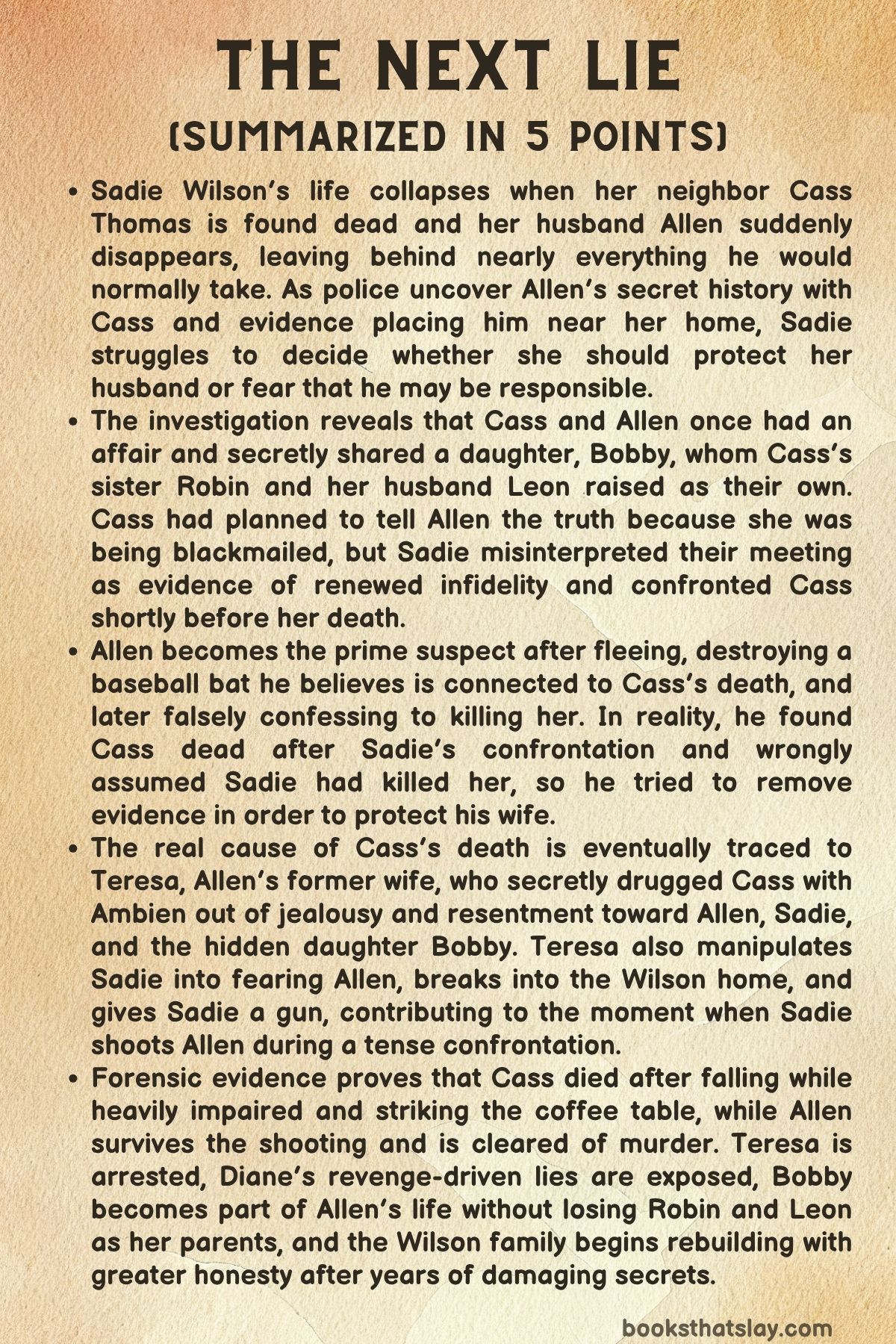
Summary
Sadie Wilson wakes to discover that her neighbor Cass Thomas is dead and her husband Allen is missing. Allen has left behind his SUV, wallet, keys, phone, and passport, making his disappearance immediately suspicious, particularly because Cass and Allen share a history that Allen has repeatedly minimized.
The timing could hardly be worse. Eighteen months earlier, Sadie and Allen’s daughter Emma had been kidnapped, and the family had only recently regained some stability after counseling and months of fear. Allen had lied about aspects of his connection to Cass during that earlier crisis, but Sadie had chosen not to examine those lies too closely because she wanted her marriage to survive.
Police quickly determine that Cass’s death may involve violence. Her home contains evidence of an argument, a broken window, bruising, two recently used wineglasses, and no indication that an intruder forced entry, suggesting that Cass willingly admitted whoever visited her.
Allen soon becomes a natural suspect. His fingerprints are found on Cass’s wine bottle, investigators learn that he and Cass communicated through an encrypted application, and witnesses place him near her home. His disappearance immediately afterward makes everything look worse.
Sadie initially lies to detectives Shane O’Reilly and Val Rodriguez, claiming Allen went to work and insisting that nothing unusual happened during the night. In reality, she knows Allen disappeared after behaving strangely, and she remembers waking around two in the morning when he was absent from bed.
When Allen returned that night, he told Sadie that he had merely gone for a walk. His remarks about accidents happening and his ability to “clean up messes” now sound frightening in light of Cass’s death, even though Sadie had originally allowed herself to accept his reassurances.
Sadie’s doubts intensify when an unfamiliar woman arrives and identifies herself as Diane Martin, Allen’s teenage girlfriend. According to Allen, Diane drowned decades earlier, yet she is alive and claims Allen actually tried to kill her during a late-night swim.
Diane says she has returned because Allen must finally face consequences. She also claims she saw him leaving Cass’s house and later fleeing while carrying suspicious evidence, causing Sadie to wonder whether Allen’s entire past has been constructed from lies.
Diane herself has an agenda. She has spent years living under another identity and has returned to Chapel Roads to destroy Allen’s comfortable life. She secretly discovered that Cass had concealed an extraordinary secret from him and began blackmailing Cass in order to force that secret into the open.
Cass and Allen had once had an affair while Allen and his first wife Teresa were separated. Allen later returned to Teresa briefly before their reconciliation failed, and Cass eventually disappeared from his romantic life. Years later, Allen and Sadie unknowingly moved into the house directly behind Cass, forcing Allen to confront a relationship he had never admitted to his new wife.
Shortly before her death, Cass asked Allen to visit her because the blackmail had made continued secrecy impossible. She finally revealed that their old affair had produced a daughter.
Cass had become pregnant after Allen left her. Unable to imagine raising the child alone, she entered an arrangement with her sister Robin and Robin’s husband Leon, who desperately wanted a baby. Cass gave birth while using Robin’s identity, and Robin and Leon raised the girl, Barbara, nicknamed Bobby, as their own daughter.
Allen never knew Bobby existed. Learning that he had unknowingly lost seven years with his daughter devastates and enrages him, but he does not attack Cass. He leaves intending to return to the discussion later.
Sadie, however, has secretly followed him. Teresa had informed Sadie that Allen planned to meet Cass, deliberately feeding Sadie’s suspicion that the old affair had resumed. After Allen leaves, Sadie confronts Cass.
Their argument becomes physical. Cass is already weak, dizzy, and unsteady, although neither woman understands why. During the struggle, they crash into a window and both sustain injuries before Sadie leaves Cass alive.
Sadie hides this confrontation from police until fibers from her brown cardigan are discovered on Cass’s broken window. Forced to admit she was present, she explains the fight while insisting she did not kill Cass.
Meanwhile, toxicology changes the investigation. Cass had a dangerous amount of zolpidem, or Ambien, in her system along with alcohol, yet there is no prescription bottle in her house and the remaining wine was not drugged. Investigators realize Cass may have been deliberately drugged before Allen arrived.
Allen’s conduct nevertheless continues to make him look guilty. He secretly takes a bicycle from Teresa’s property, travels to an isolated family cabin at Lake Gaston, and disposes of a baseball bat taken from Cass’s house by dropping it into deep water.
Police interpret this as evidence destruction by a murderer. In reality, Allen returned to Cass’s house around two in the morning and found her already dead. Knowing Sadie had fought Cass earlier and seeing the damaged room and nearby bat, he concluded that his wife had killed Cass.
Allen therefore takes the bat and disappears because he wants to remove what he thinks is the strongest evidence against Sadie. His strange behavior, flight, lies, and willingness to sacrifice himself are all driven by the mistaken belief that he is protecting his wife.
Sadie does not know this and becomes steadily more afraid of him. Diane’s allegations, Allen’s concealed affair, his secret communications with Cass, and his continued flight make murder seem increasingly possible.
Her fear is reinforced by Teresa, Allen’s former wife. Teresa repeatedly presents herself as Sadie’s ally, encouraging her to interpret Allen’s behavior in the darkest possible way. When someone later breaks into Sadie’s home and steals a spare key, Teresa encourages the belief that Allen is responsible.
The situation becomes even more disturbing when Diane is found dead near the Haw River. Because Diane recently returned claiming Allen once tried to kill her, her death appears to establish a pattern surrounding him.
That interpretation eventually collapses. Kate, Diane’s younger sister, tells O’Reilly that Diane’s version of her teenage relationship with Allen was misleading. Diane’s own past reveals that Allen did not try to drown her; dangerous water conditions separated them, after which Diane used the opportunity to disappear from her abusive home.
Diane later returned obsessed with revenge and manipulated Cass into revealing Bobby’s existence. Eventually overwhelmed by her history and by the violence surrounding her family, Diane deliberately takes her own life after ensuring that her daughter Nellie will be cared for by relatives.
Attention gradually shifts toward Teresa. Kate remembers seeing Teresa meet Cass at Café Latte shortly before Cass died. Teresa purchased Cass’s drink, and Kate recalls seeing her briefly remove the lid and stir something into it.
Investigators discover Teresa had an Ambien prescription. They also realize Teresa repeatedly tried to direct suspicion toward Allen’s wine meeting with Cass even though the toxicology evidence indicated Cass was drugged earlier.
Police eventually persuade Kate to wear a wire and confront Teresa. Kate bluffs that she directly witnessed the drugging. Teresa’s reactions help investigators expose her, and officers emerge to arrest her.
Teresa’s motive is rooted in her long obsession with Allen. She never accepted the end of their marriage and remained bitter that Sadie built the family life Teresa believed should have belonged to her.
Discovering Bobby made that resentment worse. Teresa had once hoped to have a daughter with Allen, and now she learned that Cass had secretly given him one. She also feared that Bobby would take Allen’s attention away from their son Forrest.
Teresa therefore crushed Ambien and secretly added it to Cass’s coffee. Her original plan was to incapacitate Cass and create circumstances that would destroy Allen’s marriage and possibly send him to prison, but the combination of the medication, alcohol, physical struggle, and Cass’s later fall became fatal.
Forensic evidence finally establishes how Cass actually died. The baseball bat does not match her fatal injury. Heavily impaired, Cass fell backward and struck the curved edge of her coffee table, suffering catastrophic injuries; the drug level alone might also have killed her.
Teresa is also revealed as the person who prowled around Sadie’s property and broke into the house. She wanted Sadie frightened enough to believe Allen might murder her.
Before Teresa’s guilt is fully established, police use Sadie’s house in an attempt to draw Allen back. Teresa stays with Sadie, while Sadie keeps the handgun Teresa has given her for protection.
Allen enters through the garage, hoping to explain himself. Terrified and convinced he may be dangerous, Sadie points the gun at him. When he moves toward her after she mentions Bobby, Sadie fires and shoots him in the abdomen.
Allen survives. Once Teresa’s scheme is exposed, Sadie finally learns why Allen disappeared and why he took the bat. He believed Sadie had killed Cass and was attempting to protect her, just as Sadie had repeatedly lied to protect him.
Allen then gives Sadie the rest of the truth about his past, including his affair with Cass and two occasions when he slept with Teresa during his marriage to Sadie. The admissions badly damage their relationship, but for the first time their future is based on full knowledge rather than selective truth.
Allen also begins forming a relationship with Bobby while respecting Robin and Leon as the parents who raised her. Emma and Bobby grow close, and Forrest increasingly becomes part of Sadie and Allen’s household.
One year later, Teresa is receiving psychiatric treatment. Forrest has struggled with what his mother did, but counseling, family stability, school, and sports have helped him recover.
For Teresa’s birthday, Forrest finally agrees to visit her. He approaches carrying flowers and quietly wishes her a happy birthday, leaving the fractured family not restored to what it once was, but finally moving forward without the lies that created the tragedy.
Characters
Sadie Wilson
Sadie is the emotional center of The Next Lie, and much of her characterization comes from the conflict between love and suspicion. She begins as a woman who has already endured the kidnapping of her daughter and consciously chosen to rebuild her marriage despite knowing that Allen has not always been truthful.
Her greatest strength and greatest weakness are closely connected: she is fiercely protective of her family. That instinct causes her to hide Allen’s disappearance, lie repeatedly to investigators, conceal her own confrontation with Cass, and resist evidence that threatens the image of the husband she wants to believe in.
Sadie’s fear eventually reverses direction. Once Diane’s accusations, the encrypted messages, Allen’s flight, and Teresa’s manipulation accumulate, the same protective instinct that once made Sadie defend Allen convinces her that she may need to defend herself from him.
Her decision to shoot Allen is the most extreme consequence of that transformation. She does not act because she has stopped loving him; she acts because fear has overwhelmed her ability to distinguish what she knows from what she has been encouraged to believe.
By the end, Sadie becomes more willing to accept painful truth rather than comforting explanations. Reconciliation remains possible only because she and Allen finally abandon the pattern of mutual concealment that repeatedly placed them in danger.
Allen Wilson
Allen’s role in The Next Lie is constructed around the gap between suspicious behavior and actual intention. Nearly everything he does after Cass’s death resembles the behavior of a murderer: he disappears, destroys evidence, avoids police, lies about Cass, uses secret communications, and eventually confesses to a killing he did not commit.
Beneath those choices is a powerful but unhealthy belief that love requires protection regardless of the consequences. When Allen finds Cass dead after Sadie’s confrontation, he immediately concludes that Sadie killed her and decides that preserving his wife matters more than honesty, the law, or his own freedom.
Allen is not innocent in a broader moral sense. His affair with Cass, his secrecy about it, his later infidelity with Teresa, and his habit of withholding difficult truths help create the conditions in which Sadie can no longer trust him.
His discovery of Bobby also exposes one of his deepest vulnerabilities. He is devastated not simply because Cass hid something from him, but because fatherhood is central to his identity and he learns that seven years of a daughter’s life have been taken from him.
Allen ultimately represents the danger of confusing devotion with concealment. His desire to save Sadie is genuine, but his methods repeatedly worsen the crisis.
Cass Thomas
Cass is the victim whose hidden history drives almost every major revelation in the story. Her death initially reduces her to a crime scene in the eyes of many characters, yet the later reconstruction shows a woman carrying grief, regret, desire, and an enormous secret.
Her affair with Allen becomes one of the defining decisions of her adult life. Although Allen eventually leaves her, Cass later discovers that she is pregnant and makes the difficult choice to allow Robin and Leon to raise Bobby.
Cass’s secrecy is not motivated by one simple emotion. She wants Bobby to have stable parents, understands Robin and Leon’s longing for a child, and recognizes that contacting Allen after he has started another family could cause enormous disruption.
Her final attempt to tell Allen the truth reflects an acceptance that the arrangement can no longer remain hidden. Diane’s blackmail removes Cass’s ability to control when and how the secret becomes public.
Cass is also tragically misread during her final hours. Her weakness during the fight with Sadie appears like drunkenness or aggression, when she is actually suffering from the medication Teresa has secretly put into her drink.
Teresa
Teresa is the principal human cause of the tragedy and one of the book’s most psychologically revealing characters. Her actions grow from years of unresolved attachment to Allen and a conviction that the life he built with Sadie should have belonged to her.
She repeatedly disguises manipulation as concern. She tells Sadie about Allen’s meeting with Cass, encourages suspicion about his behavior, presents herself as a loyal confidante, supplies Sadie with a gun, and later stays beside her while waiting for Allen to return.
What makes Teresa especially dangerous is that she understands the emotional weaknesses of the people around her. She knows Sadie’s marriage has already been damaged by secrecy and therefore rarely needs to invent evidence; she simply interprets real facts in ways that make Allen appear threatening.
Her discovery of Bobby intensifies her resentment because Bobby represents the daughter Teresa wanted with Allen. Instead of accepting that Allen’s life has moved beyond her, Teresa treats the existence of other relationships as something personally stolen from her.
Even her poisoning plan begins as an attempt at control rather than a straightforward intention to kill. That distinction does not lessen her responsibility, because she knowingly drugs Cass in order to manufacture a disaster and then continues manipulating people after Cass dies.
Diane Martin
Diane is defined by the complicated boundary between victimhood and destructive retaliation. She grows up in an abusive household and survives experiences that give her legitimate reasons to fear the people closest to her.
Her disappearance after the swimming incident allows her to escape that life and create another identity. However, decades later, she transforms her history with Allen into a false account in which he deliberately tried to kill her.
Diane’s revenge campaign depends on manipulation. She investigates Allen, uncovers Bobby’s parentage, blackmails Cass, watches the neighborhood, and deliberately pushes hidden information toward exposure because she wants Allen’s marriage and reputation destroyed.
Her actions are morally complicated because the past she is reacting to contains genuine trauma, but Allen is not responsible for much of the suffering she assigns to him. Her need to create a single villain eventually distorts her understanding of her own life.
Her death is particularly tragic because it follows a life shaped by escape. After arranging protection for Nellie, she chooses suicide rather than another cycle of prosecution, concealment, or flight.
Kate Davis
Kate represents the possibility of changing without pretending the past never happened. She enters the story after serving prison time for her role in events surrounding Emma’s kidnapping and is determined not to repeat the choices that led her there.
Her struggle with the internal voice she calls Katherine gives her recovery a personal dimension beyond legal rehabilitation. Medication, therapy, structured work, and healthier relationships gradually allow her to respond to stress without surrendering control.
Kate also serves as an important contrast to Diane. Both sisters come from the same abusive family, yet Kate increasingly recognizes that trauma does not justify manipulating everyone around her.
Her decision to tell O’Reilly about Diane’s blackmail and later help expose Teresa shows considerable growth. Instead of hiding information because she fears police involvement, she accepts responsibility for what she knows and assists the investigation.
Her developing relationship with Nick and her visit to Mark, Elena, and Nellie suggest that her future is no longer entirely defined by prison or family violence.
Shane O’Reilly
O’Reilly is the investigator most consistently responsible for testing appearances against evidence. He is suspicious of Allen because the available facts justify suspicion, but he remains willing to alter his theory when new information contradicts it.
His familiarity with the earlier kidnapping investigation gives him insight into several characters’ histories, particularly Kate, Sadie, Allen, and Cass. That background helps him recognize how earlier secrets are influencing current behavior.
O’Reilly’s strongest characteristic is his resistance to convenient conclusions. Allen appears guilty, then Sadie appears guilty, and later Diane’s death seems to reinforce the case against Allen, yet O’Reilly continues examining inconsistencies.
His eventual recognition that Allen’s confession does not match the forensic evidence is especially important. Rather than accepting a confession simply because it closes the case, he understands that Allen is trying to protect someone.
Emma Wilson
Emma is not directly responsible for the mystery, but she is one of the central reasons Sadie and Allen make the choices they do. Her earlier kidnapping has left the family emotionally damaged and has taught both parents to treat family preservation as an urgent responsibility.
Sadie continually shields Emma from the crisis surrounding Cass’s death. Sending her on the cruise allows Emma to experience ordinary childhood happiness while the adults face the consequences of their secrets.
Emma also represents the future the family is trying to protect. Her developing friendship with Bobby suggests that the discovery of Allen’s hidden daughter does not have to produce another generation of resentment.
Forrest Wilson
Forrest experiences the consequences of adult failures without having any control over them. As Allen and Teresa’s son, he has already endured his parents’ broken marriage and the tensions surrounding Emma’s kidnapping before Cass’s death creates another crisis.
His relationship with Teresa is especially difficult. He senses her dishonesty and resents the ways earlier events have affected him, but she remains his mother, preventing his feelings from becoming simple rejection.
After Teresa’s guilt is exposed, Forrest has to reconcile the mother he knows with the woman capable of poisoning Cass and manipulating Sadie. Counseling and life with Allen and Sadie give him greater stability.
His final decision to visit Teresa carries considerable significance. Bringing flowers does not erase what she has done; it shows that he is willing to acknowledge the relationship without denying the harm.
Bobby
Barbara “Bobby” is the secret around which many of the characters’ choices ultimately revolve. She is Cass and Allen’s biological daughter but has been raised by Robin and Leon, who are her parents in every practical and emotional sense.
Her existence changes the meaning of Cass and Allen’s final meeting. What appears to Sadie like evidence of an affair is actually Cass’s attempt to tell Allen that he has a daughter.
Bobby also becomes a powerful symbol of how adult secrecy affects innocent children. Cass, Robin, and Leon originally keep the truth hidden because they believe secrecy will protect everyone, but the concealment eventually becomes vulnerable to blackmail.
The ending avoids treating biology as something that automatically cancels the family Bobby already has. Allen gains a place in her life while respecting Robin and Leon’s parental role.
Robin Marconi
Robin is Cass’s sister and Bobby’s adoptive mother. Her decision to raise Cass’s baby emerges from both her own desire for motherhood and Cass’s uncertainty about parenting alone.
Robin’s participation in concealing Bobby’s true parentage is ethically complicated. She provides Bobby with a stable family, but maintaining that stability requires keeping Allen ignorant of his biological daughter.
Her guarded behavior during the investigation initially appears suspicious because she understands that revealing the truth could disrupt Bobby’s life. Once Cass is dead, however, protecting the secret becomes less important than discovering what happened to her sister.
Leon Marconi
Leon shares Robin’s role as Bobby’s parent and participates in the decision to conceal the circumstances of her birth. Although he receives less attention than Robin, his presence reinforces the idea that Bobby’s family cannot be reduced to biological relationships.
He is also part of the decision to prevent Allen from learning the truth when Allen appears at the hospital years earlier. From Leon’s perspective, the priority is preserving the family he and Robin are beginning to build.
The eventual arrangement allows Leon to remain Bobby’s father while accepting that Allen deserves a relationship with her. His role therefore helps the story distinguish parenthood from possession.
Sister Mary Catherine
Sister Mary Catherine functions as a guardian of Cass’s confidence and eventually as the person who helps Sadie understand the real purpose of Cass’s meeting with Allen. Her knowledge of Bobby allows her to correct one of the investigation’s most important misunderstandings.
Her initial hesitation reflects the conflict between protecting private family information and acknowledging that secrecy may obstruct the search for Cass’s killer. When she finally approaches Sadie with Bobby’s photograph, the investigation changes substantially.
She represents a quieter form of loyalty than that practiced by Sadie or Allen. Instead of destroying evidence or lying indefinitely, she eventually recognizes that protecting people may require telling a painful truth.
Nick
Nick provides Kate with a relationship based on honesty rather than chaos. As another former prisoner, he understands the difficulty of rebuilding a life after incarceration without treating Kate as permanently defined by what she did.
His straightforward attitude appeals to Kate because he does not hide his past or encourage her to hide hers. Their growing relationship gives Kate an alternative to the secrecy and emotional manipulation that dominate her family history.
Accompanying Kate to visit Mark, Elena, and Nellie suggests that he is becoming part of her future rather than merely serving as temporary emotional support.
Mark
Mark is one of the surviving members of Diane and Kate’s abusive family and represents the possibility of creating a safer family structure after escaping their childhood home. He becomes especially important when Diane arranges for Nellie to be placed with him and Elena.
His willingness to take responsibility for Nellie ensures that Diane’s daughter will not repeat the instability her mother experienced. Mark’s role is relatively quiet, but it gives the family’s later story a foundation of safety.
Nellie
Nellie is Diane’s daughter and the person Diane most genuinely tries to protect. Before confronting the past, Diane sends her away to Mark and Elena so that she will remain safe if the revenge campaign ends badly.
Nellie’s presence reveals a contradiction in Diane. Diane is capable of careful maternal concern even while making choices that threaten her own survival and destabilize several other families.
After Diane’s death, Nellie becomes part of the surviving family’s attempt to build something healthier from a deeply abusive history.
Pat
Pat is one of Sadie’s most reliable sources of emotional support. Unlike Teresa, whose sympathy conceals manipulation, Pat’s loyalty is directed toward Sadie’s wellbeing rather than toward controlling the outcome of her marriage.
When Sadie begins sharing the truth about Allen, Cass, and Diane, Pat gives her room to confront possibilities she would rather avoid. Pat’s presence also helps protect Emma by giving Sadie trusted adults with whom she can safely send her daughter.
Gayle
Gayle shares Pat’s supportive role and helps care for Emma during the cruise. Although less directly involved in the investigation, Gayle contributes to the stable social network surrounding Sadie and Emma.
That stability matters because so many other relationships in the story are based on incomplete truth. Pat and Gayle offer practical help without demanding emotional influence in return.
Henry
Henry exposes the extent of Teresa’s fixation on Allen. Although he is intelligent, professionally useful, and romantically involved with Teresa, she continually treats him as a substitute rather than a genuine partner.
His concern for Teresa before the final confrontation receives little emotional response from her. Her private decision to end contact after he leaves confirms that she has never allowed their relationship to become more important than her obsession with Allen.
Chief Claremont
Chief Claremont provides institutional direction to the investigation and repeatedly helps organize the growing body of evidence. His role becomes especially important when the case expands beyond Cass’s death into Allen’s disappearance, Diane’s identity, and Teresa’s actions.
Like O’Reilly, he does not treat the first plausible theory as permanent. His willingness to question Allen’s confession helps prevent the investigation from ending with a false solution.
Val Rodriguez
Rodriguez works closely with O’Reilly throughout the investigation and serves as a steady investigative presence. She participates in the questioning of Sadie, Teresa, Robin, Allen, and others as the case repeatedly changes direction.
Her character is less personally connected to the suspects than O’Reilly, which gives her a more detached position. She helps keep the investigation grounded in evidence rather than family loyalties.
Libby McMann
Forensic pathologist Libby McMann provides some of the most decisive evidence in the case. Her toxicology findings establish that Cass had a dangerous amount of Ambien in her body and that the medication was not simply present in the shared wine.
Her later reconstruction also destroys Allen’s false confession by showing that the baseball bat does not match Cass’s fatal injuries. Through forensic evidence, she transforms the investigation from one centered on apparent violence into one centered on deliberate poisoning.
Themes
Truth, Secrecy, and the Cost of Protection
Secrets repeatedly begin as attempts to protect someone and end by increasing the danger around them. In The Next Lie, Allen hides his affair with Cass because he wants to preserve his marriage, Cass conceals Bobby’s existence because she wants the child to have a stable family, and Sadie lies to police because she fears that telling the truth will destroy Allen.
Each act appears understandable when viewed from the perspective of the person making it. The problem is that secrecy prevents other people from judging events with complete information.
Sadie assumes Allen’s meeting with Cass concerns an affair because she does not know about Bobby. Allen assumes Sadie killed Cass because he knows about their fight but not Teresa’s poisoning.
Investigators repeatedly build reasonable theories from incomplete evidence, demonstrating that false conclusions do not always require fabricated facts. Sometimes the truth becomes distorted simply because important facts have been deliberately withheld.
The eventual resolution depends on reversing this pattern. Kate tells police what she knows about Diane, Sadie gives a fuller account of her confrontation with Cass, forensic evidence exposes Allen’s false confession, and Teresa’s hidden actions are finally brought into the open.
Truth does not repair every relationship immediately, but it creates the first possibility of genuine recovery.
Jealousy, Possession, and Emotional Entitlement
Teresa’s jealousy is dangerous because she gradually converts longing into a sense of entitlement. She does not merely miss Allen; she believes that his marriage to Sadie represents a life that should have remained hers.
Bobby’s existence intensifies this resentment. Teresa once wanted another child with Allen, particularly a daughter, and discovering that Cass secretly had Allen’s daughter makes Bobby feel to Teresa like another version of the future she believes other women have taken from her.
Her jealousy therefore becomes more than romantic rivalry. It extends to motherhood, family structure, Allen’s attention, Forrest’s place in his father’s life, and Sadie’s happiness.
This emotional entitlement allows Teresa to justify increasingly harmful actions. She drugs Cass, manipulates Sadie, breaks into the Wilson home, supplies Sadie with a weapon, and repeatedly encourages her to fear Allen.
Cass and Sadie are treated not as independent people but as obstacles in a story Teresa has constructed around herself and Allen. Even Forrest becomes part of that reasoning when Teresa convinces herself that Bobby’s presence might reduce the attention he receives.
The story presents jealousy as most destructive when desire turns into the belief that another person’s freedom is an injustice.
Family, Parenthood, and Chosen Bonds
Parenthood appears in several different forms, preventing biology from becoming the sole definition of family. Allen is Emma and Forrest’s father while unknowingly also being Bobby’s biological father, and Bobby is raised by Robin and Leon despite being born to Cass.
The discovery of Bobby could easily have turned parenthood into a competition. Instead, the eventual arrangement recognizes multiple legitimate relationships.
Allen mourns the seven years he lost, but he does not attempt to erase Robin and Leon’s role. They remain Bobby’s parents while allowing him to become part of her life.
Sadie’s relationship with Forrest develops in a similar way. Teresa’s crimes do not cause Sadie to treat Forrest as less worthy of love, yet Sadie also refuses to pretend Teresa has ceased to be his mother.
Emma further demonstrates the possibility of family expansion rather than replacement through her growing bond with Bobby. Their relationship offers a contrast to the resentment that shapes the adults.
The story therefore treats family as something built through responsibility, care, honesty, and continuing presence. Biological connection matters, but it does not automatically invalidate the bonds created through years of parenting.
Trauma, Revenge, and the Possibility of Recovery
Diane and Kate provide two sharply different responses to a shared history of childhood abuse. Both carry lasting psychological damage, but the paths they choose after that trauma move in opposite directions.
Diane allows revenge to dominate her understanding of justice. Her suffering is real, yet she eventually reshapes unrelated events around the idea that Allen is responsible for the life she lost.
That fixation leads her to lie about the swimming incident, investigate Allen’s family, blackmail Cass, and set in motion disclosures intended to destroy other people’s relationships. Trauma explains the emotional origin of her behavior without making those choices harmless.
Kate gradually chooses another path. She accepts treatment, takes medication, works, attends therapy, develops healthier friendships, and becomes willing to cooperate with police even when doing so exposes painful family history.
Forrest also begins recovering through counseling after learning what Teresa has done, while Sadie and Allen attempt to rebuild their marriage only after abandoning concealment.
Recovery is therefore presented not as forgetting the past but as refusing to let past injury dictate every future decision. The characters who move forward are those who eventually accept responsibility, tolerate painful truth, and allow relationships to change rather than forcing life back into an imagined earlier form.