The Associate Summary, Characters and Themes
The Associate by John Grisham is a legal thriller about ambition, coercion, and the cost of one mistake from the past. The novel follows Kyle McAvoy, a gifted Yale law student whose future seems clear until strangers use an old college scandal to force him into corporate law and legal espionage.
Grisham sets up a tense conflict between personal ethics and professional survival, showing how power can hide behind polished offices, secret files, and legal intimidation. At its core, the book asks what a young lawyer will sacrifice to protect his name, his family, and his future.
Summary
Kyle McAvoy is twenty-five years old, a Yale law student, and a person with a future that seems carefully planned. He is bright, disciplined, and respected by his classmates and professors.
Unlike many students at elite law schools, Kyle is not dreaming of becoming rich at a giant Wall Street firm. His goal is to take a public-interest job with Piedmont Legal Aid and use his legal training to help people who cannot afford powerful lawyers.
He also coaches a youth basketball team in New Haven, a small part of his life that shows his patience, competitiveness, and desire to serve others.
That ordinary life changes during one of his basketball games. Kyle notices a suspicious man in a suit watching him from the gym.
After the game, he tries to leave quietly through a back exit because some parents are angry about the result. Instead, the man is waiting near Kyle’s Jeep with another man.
They identify themselves as FBI agents Bob Plant and Nelson Ginyard. Their tone is controlled but threatening.
They bring up an incident from five years earlier, when Kyle was a student at Duquesne University and belonged to a fraternity.
The old incident involved a drunken fraternity party and a young woman named Elaine Keenan. Kyle had tried to bury the memory of that night.
The party had been chaotic, full of alcohol, bad judgment, and behavior no one wanted to defend. The men now claim that there is a sealed rape indictment in Pittsburgh connected to Elaine.
They suggest that Kyle’s career, reputation, and future could be destroyed if he does not cooperate. Kyle is alarmed but tries to remain cautious.
He agrees to meet them at Buster’s Deli, where he hopes to get more information and protect himself.
At the deli, Kyle demands to see badges and identification. He also wants a tape recorder so there will be a record of the conversation.
The men continue to act like federal agents and say a Pittsburgh sex-crimes detective named Bennie Wright wants to meet him. They claim cooperation might keep the indictment from becoming public.
Kyle insists that there was no rape and tries to leave, but the men stop him by revealing something far more dangerous: Wright has a video from the night of the party.
The existence of the video terrifies Kyle. Even if he did not commit a crime, a recording from such a night could be used to ruin him.
He agrees to go to a Holiday Inn, where the supposed meeting with Wright is arranged. When he arrives, the scene looks official.
There are men with guns, files, computers, and photographs. The setup includes photos of Kyle’s former fraternity brothers and a photo of Elaine.
Everything is designed to make Kyle believe he is trapped inside a serious law-enforcement operation.
Bennie Wright presents himself as a Pittsburgh detective and questions Kyle about nearly every part of his life. He asks about Kyle’s family, education, history with alcohol, law school, job offers, and memories of the party.
Wright then shows Kyle the video. It captures the disorder of the fraternity gathering, the presence of police, and later Elaine on a sofa with Baxter Tate and Joey Bernardo.
Kyle is not shown assaulting Elaine, but the audio includes Joey asking whether Elaine is awake. Wright makes it clear that the tape could be used to support rape allegations, even if Kyle’s role is indirect or uncertain.
Kyle argues back. He says Elaine had a reputation for promiscuity, that the police had dropped the matter years earlier, and that the sudden revival of the case sounds like an attempt to get money from Baxter Tate’s wealthy family.
Wright then hands Kyle what appears to be an indictment. Kyle opens it and finds blank pages.
At that point, the whole performance falls apart. Wright destroys the badges and identification and admits the FBI setup was fake.
There is no indictment. He is not a detective.
The men have staged the entire operation to frighten Kyle into obedience.
The real purpose is not prosecution. It is blackmail.
Wright works for a private contractor, and he wants Kyle to abandon his public-interest plans and accept a job at Scully & Pershing, a huge Wall Street law firm. Once Kyle is inside the firm, he must gather confidential information about a massive lawsuit involving two rival corporations.
The case concerns the B-10 HyperSonic Bomber project, defense contractors, secret technology, and billions of dollars. Kyle realizes he is being forced into legal espionage.
Kyle protests that the demand is illegal and that Wright is trying to turn him into a criminal. Wright responds with the video.
He can give it to Elaine’s lawyer, leak it online, or use it to destroy Kyle’s name before his career even begins. Kyle understands the danger.
He may not have raped Elaine, but the video could still make him look connected to a terrible crime. A public accusation could ruin his relationship, his family, his law license, and everything he has built.
Cornered and frightened, he agrees to follow Wright’s instructions.
The next day, Kyle begins lying to the people closest to him. He tells his girlfriend Olivia that he spent the night driving and thinking about his career.
Then he says he has decided to take the job at Scully & Pershing after all. Olivia is stunned.
She had believed Kyle shared her values and her commitment to public service. To her, the decision looks like surrender to money and prestige.
His friends and professors at Yale react in similar ways. They cannot understand why Kyle would abandon the path he had spoken about with such conviction.
Kyle also struggles with his father, John McAvoy, a small-town lawyer who represents ordinary people. John dislikes corporate law and sees firms like Scully & Pershing as places where talented lawyers trade their principles for wealth.
Kyle’s sudden change disappoints him deeply. Kyle wants to tell his father the truth but cannot.
The blackmailers have placed him in a position where honesty could make everything worse. His silence creates distance between him and the people who know him best.
Over the following months, Kyle meets repeatedly with Wright. The meetings remind him that he is under control and that his handlers expect obedience.
Wright gives him information about the Trylon-Bartin lawsuit and the B-10 HyperSonic Bomber project. Kyle researches the case and begins to understand its scale.
It is not a routine corporate dispute. It involves secret military technology, powerful companies, aggressive law firms, and enormous financial stakes.
The information Wright wants could affect fortunes, reputations, and national-security interests.
Kyle also contacts Joey Bernardo, one of the fraternity brothers from the night of the party. He tells Joey about the video and tries to piece together what actually happened with Elaine.
The past remains unclear, clouded by alcohol, shame, and conflicting memories. Kyle knows that even uncertainty can be dangerous.
The threat does not depend on a clean legal truth. It depends on fear, public perception, and the damage a scandal can cause.
After graduation, Kyle moves toward his new life in New York. Wright tries to control even practical details, including where Kyle lives and how he can be watched.
Kyle resists when he can, but he has limited power. He joins Scully & Pershing’s litigation group and begins the punishing life of a first-year associate.
The work is exhausting, repetitive, and impersonal. He spends long hours reviewing documents, trapped in the machinery of a firm he never wanted to join.
Inside Scully & Pershing, Kyle waits for the moment when his handlers will demand the secrets they sent him to steal. He is surrounded by brilliant lawyers, sealed files, and confidential material, yet he must constantly hide his true situation.
Every day deepens his danger. If he obeys Wright, he risks committing crimes and betraying his profession.
If he refuses, the video may be released and his life may collapse. The beginning of The Associate sets Kyle inside that trap: a young lawyer with strong ideals forced into a world where law, money, fear, and power are being used against him.
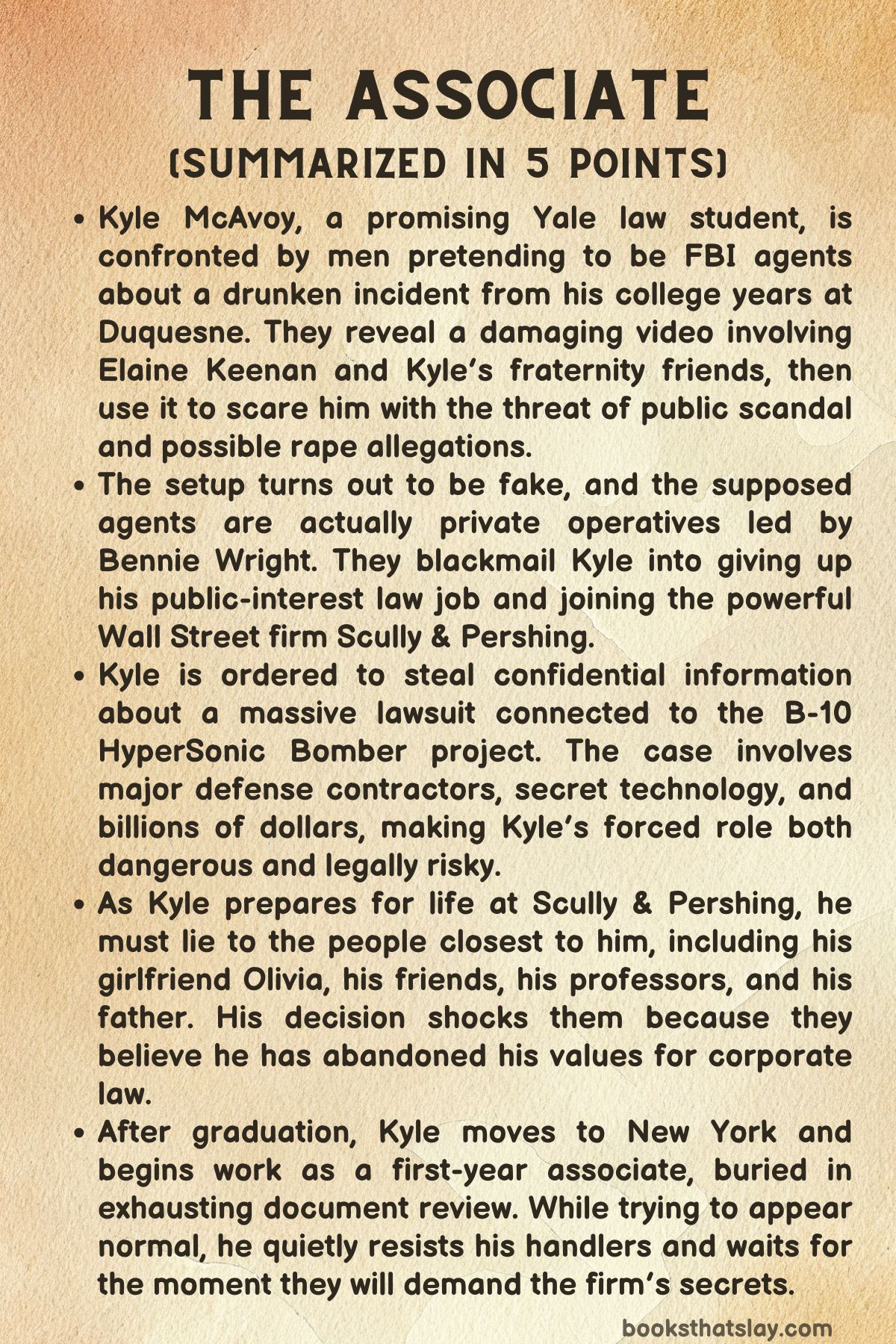
Characters
Kyle McAvoy
Kyle McAvoy is the central figure in The Associate, and his character is shaped by the conflict between who he wants to be and what he is forced to become. At the beginning of the story, he appears disciplined, intelligent, and socially responsible: he is a Yale law student, a youth basketball coach, and someone planning to work in public-interest law rather than chase money at a corporate firm.
This makes his forced shift toward Scully & Pershing especially painful, because it is not simply a career change; it is a betrayal of his own values. Kyle’s greatest struggle is internal.
He knows that stealing confidential legal information is wrong, but he is trapped by fear, shame, and the threat that an old incident could destroy his future. His intelligence helps him understand the situation quickly, but it does not free him from it.
He becomes a character under pressure, constantly calculating risks, hiding the truth from people he loves, and trying to survive without fully surrendering his conscience.
Kyle is also morally complicated because he is not portrayed as completely innocent in every sense, even though he insists he did not commit rape. The old fraternity incident hangs over him because he was part of a reckless and drunken environment where serious harm may have occurred.
His fear is not only about legal consequences; it is also about reputation, guilt by association, and the possibility that his past behavior has made him vulnerable to manipulation. This gives his character depth because he is both victim and compromised participant.
He is victimized by blackmailers who exploit him, but his past choices helped create the weakness they use against him. His journey in the book is therefore not just about espionage or legal danger, but about responsibility, fear, ambition, and the loss of moral freedom.
Bennie Wright
Bennie Wright is one of the most threatening and manipulative figures in the story. He first presents himself as a Pittsburgh sex-crimes detective, which allows him to control Kyle through fear and false authority.
His power comes from performance: he creates an atmosphere that looks official, complete with agents, files, laptops, guns, badges, and legal documents. This staged law-enforcement setting reveals that Wright understands psychology as well as intimidation.
He knows that Kyle is educated and cautious, so he does not rely only on threats; he builds a believable world around the lie until Kyle feels surrounded by official power.
Once Wright reveals that the entire setup is fake, his character becomes even more sinister. He is not acting under the law but outside it, using the appearance of law to force Kyle into corporate espionage.
He is cold, strategic, and patient. He knows exactly which emotional pressure points to use: Kyle’s fear of public disgrace, his legal career, his father’s respect, his girlfriend’s trust, and the possibility of the video reaching Elaine’s lawyer or the internet.
Wright represents a corrupt form of power, one that does not need truth or justice as long as it has leverage. His role in the book is to turn Kyle’s future into a trap and to show how easily professional ambition can be weaponized when someone’s past is used against him.
Elaine Keenan
Elaine Keenan is one of the most important figures in the story even though she appears mainly through memory, accusation, and the disturbing video. Her character carries the moral weight of the Duquesne incident.
The uncertainty surrounding what happened to her creates the central pressure that allows Kyle to be blackmailed. She is not simply a plot device; she represents the unresolved harm that can remain hidden beneath privilege, alcohol, fraternity culture, and legal silence.
The fact that others discuss her behavior, her reputation, and her possible motives shows how easily a woman at the center of a sexual assault allegation can be judged by people trying to protect themselves.
Elaine’s role is complicated because the truth about the incident is unclear from the information Kyle receives. Kyle insists there was no rape and suggests that the case may be about money, but those claims also reveal his own defensive position.
The video, especially Joey’s question about whether Elaine is awake, creates a deeply troubling possibility that cannot be dismissed. Elaine therefore functions as a reminder that the past cannot be neatly buried simply because powerful or ambitious people move on.
Her presence in the story gives the blackmail plot its moral seriousness, because Kyle’s fear is tied not only to scandal but also to the possibility that something genuinely terrible happened.
Joey Bernardo
Joey Bernardo is connected to Kyle through the old fraternity incident, and his presence helps reveal the lingering consequences of that night. In the video, Joey’s question about whether Elaine is awake is one of the most alarming details because it suggests awareness that something was wrong.
Even though Kyle is not shown assaulting Elaine, Joey’s words deepen the moral uncertainty surrounding everyone present. His character represents the kind of friend whose past actions can become dangerous to others years later, especially when those actions were recorded.
Joey is also important because Kyle later turns to him for information about the video and the incident. This shows that Joey is not just a figure from the past but a link to the truth Kyle desperately needs.
His role in the story is tied to memory, guilt, and the difficulty of reconstructing what happened during a drunken and chaotic night. Joey’s character helps show how one reckless social circle can continue to bind people together through fear long after they have moved into adult professional lives.
Baxter Tate
Baxter Tate is another former fraternity brother tied to the Duquesne incident, and his importance comes partly from his wealth and family background. Kyle suspects that the renewed threat may be a money grab aimed at Baxter’s wealthy family, which makes Baxter a symbol of privilege and legal vulnerability.
His presence in the video with Elaine places him close to the most serious part of the accusation, even if the full truth remains uncertain. Unlike Kyle, who is forced directly into the blackmail scheme, Baxter appears as someone whose past conduct helps create the danger surrounding the group.
Baxter’s character also reflects the protection that wealth may offer and the resentment it can create. Kyle’s belief that Elaine’s side might be targeting Baxter because of money shows how class shapes the way characters interpret justice, accusation, and motive.
Whether Baxter is guilty, careless, or simply implicated by association, he represents the privileged fraternity world that Kyle once belonged to and now cannot escape. His role in the book is important because he helps connect personal misconduct, family wealth, and legal threat into one source of pressure.
Bob Plant
Bob Plant is one of the men who first approaches Kyle under the false identity of an FBI agent. His character is significant because he helps establish the deception that traps Kyle.
By appearing at the gym and later near Kyle’s Jeep, Plant contributes to the feeling that Kyle is being watched and controlled. He does not need to be the main speaker to be effective; his presence gives the fake operation credibility and makes Kyle feel that powerful institutions are already moving against him.
Plant represents the machinery of intimidation. He is part of a carefully staged performance designed to make Kyle panic before he has time to think clearly.
His false badge and official manner show how symbols of authority can be used to manipulate someone who understands the legal system but still fears its power. In the story, Plant’s role is less emotional than functional, but that function matters: he helps create the illusion that Kyle’s life has already been seized by law enforcement.
Nelson Ginyard
Nelson Ginyard, like Bob Plant, is part of the false FBI setup used to pressure Kyle. His role reinforces the seriousness of the staged encounter.
By appearing alongside Plant, Ginyard helps make the threat feel organized and official rather than personal or random. The presence of multiple fake agents makes Kyle’s situation seem larger than one suspicious man following him; it makes him believe that a full investigation may already be underway.
Ginyard’s character shows how intimidation often depends on numbers, setting, and coordination. He is part of the team that corners Kyle psychologically before Bennie Wright fully reveals the real purpose of the scheme.
Although Ginyard is not developed as deeply as Kyle or Wright, his role in the book is still important because he helps turn a private secret into what appears to be a federal crisis. He is one of the figures who makes Kyle feel powerless before the truth is even explained.
Olivia
Olivia is Kyle’s girlfriend, and her character represents the personal life he begins to lose once the blackmail scheme takes control of him. Her reaction to Kyle’s sudden decision to join Scully & Pershing is one of shock and disappointment because she understands what that choice means in relation to his values.
To Olivia, Kyle’s decision looks like ambition, compromise, and moral surrender. Since Kyle cannot tell her the truth, their relationship becomes damaged by secrecy rather than honest disagreement.
Olivia is important because she reflects the version of Kyle that existed before fear took over. Her disappointment shows that Kyle’s public-interest ideals were not empty; the people close to him believed in them.
When she accuses him of selling out, she is responding to the visible facts, not the hidden coercion. This makes her role emotionally painful.
She is not wrong to feel betrayed, but Kyle is also unable to defend himself without exposing the blackmail. Through Olivia, the story shows that deception does not only protect secrets; it also destroys trust.
John McAvoy
John McAvoy, Kyle’s father, is a moral contrast to the corporate world Kyle is forced to enter. As a small-town lawyer who represents ordinary people, John embodies legal work as service rather than profit.
His values stand against the culture of elite firms, massive lawsuits, defense contractors, and billion-dollar disputes. Because Kyle originally planned to work in public-interest law, John’s influence is clearly important in shaping Kyle’s conscience and professional identity.
John’s disappointment matters because Kyle respects him deeply but cannot reveal the truth. Their conflict is therefore especially painful.
John believes Kyle has chosen corporate ambition over principle, while Kyle knows he has been forced into that path by blackmail. This creates one of the strongest emotional tensions in The Associate.
John represents integrity, simplicity, and moral clarity, while Kyle’s new life becomes defined by secrecy, compromise, and danger. His character helps measure how far Kyle is being pushed away from the person he wanted to become.
Themes
Coercion and Loss of Free Will
Kyle’s life changes because choice is taken away from him and replaced with fear. He is not persuaded through logic, opportunity, or ambition; he is trapped through blackmail.
The men who target him understand that his future depends on reputation, trust, and moral credibility, so they use an old incident to control every part of his present life. This theme shows how power can operate without open violence.
Kyle is not physically imprisoned, yet he is forced to abandon his public-interest plans, lie to people he loves, and enter a career path he had rejected. His freedom becomes an illusion because every decision he makes is shaped by the threat of exposure.
The blackmailers also turn uncertainty into a weapon. Kyle does not know exactly how damaging the video could be, but the possibility of scandal is enough to make him obey.
In The Associate, coercion is shown as psychological control, where fear makes a person act against his own values.
Moral Compromise and Guilt
Kyle’s struggle is not only about escaping blackmail; it is also about living with the moral damage caused by each lie he tells. He knows that joining Scully & Pershing is not an honest career decision, yet he must present it as one.
This creates a deep conflict between the person he wants to be and the person he is forced to become. His guilt grows because the deception spreads into every relationship around him.
Olivia sees his choice as betrayal, his professors see it as abandonment of principle, and his father sees it as surrender to corporate greed. Kyle cannot defend himself because telling the truth would put him in greater danger.
The theme becomes more painful because Kyle is not simply innocent or guilty; he exists in a morally confused space. He did not create the blackmail scheme, but he still becomes part of it.
His silence protects him, yet it also makes him dishonest.
Ambition, Career Pressure, and the Legal World
The legal profession is presented as a world where talent can quickly become a tool for powerful institutions. Kyle begins as a gifted law student with a clear desire to serve ordinary people through public-interest work.
That path reflects purpose, independence, and social responsibility. Scully & Pershing represents the opposite side of the profession: prestige, wealth, exhaustion, secrecy, and corporate power.
The pressure surrounding Kyle’s career choice shows how easily professional success can be separated from personal values. To outsiders, his decision to join the firm looks like ambition, but the reader understands that it is survival.
This contrast exposes the public image of elite legal careers. A position at a major firm may appear glamorous, but Kyle’s work is draining, impersonal, and controlled by forces above him.
The theme also questions whether success is meaningful when it requires a person to sacrifice integrity. Kyle’s career becomes less about achievement and more about being used.
Reputation, Shame, and the Power of the Past
The old incident involving Elaine continues to control Kyle because reputation is fragile, especially for someone entering a respected profession. The blackmailers do not need a proven crime; they only need an accusation, a video, and the fear of public judgment.
Kyle’s shame is tied to uncertainty, memory, and the reckless behavior of his younger self. Even though he insists he did not commit rape, he knows the night was ugly enough to damage him if exposed.
This theme shows how the past can become a weapon when it is recorded, hidden, and later released at the right moment. The threat of the video is powerful because it could destroy trust before any court or investigation decides the truth.
Kyle’s future depends on how others might interpret a few moments from years ago. The novel uses this fear to show that reputation is not built only on facts; it is also shaped by appearances, suspicion, and public reaction.