The Ask and the Answer Summary, Characters and Themes
The Ask and the Answer by Patrick Ness is the second book in the Chaos Walking series, a dark young adult science-fiction story about power, fear, loyalty, and moral compromise. It follows Todd Hewitt and Viola Eade after the fall of Haven, as the city is taken over by Mayor Prentiss and turned into New Prentisstown.
Separated, manipulated, and forced onto opposite sides of a growing conflict, Todd and Viola struggle to hold on to their love and their sense of right and wrong. The book asks how far people can be pushed before they become what they hate.
Summary
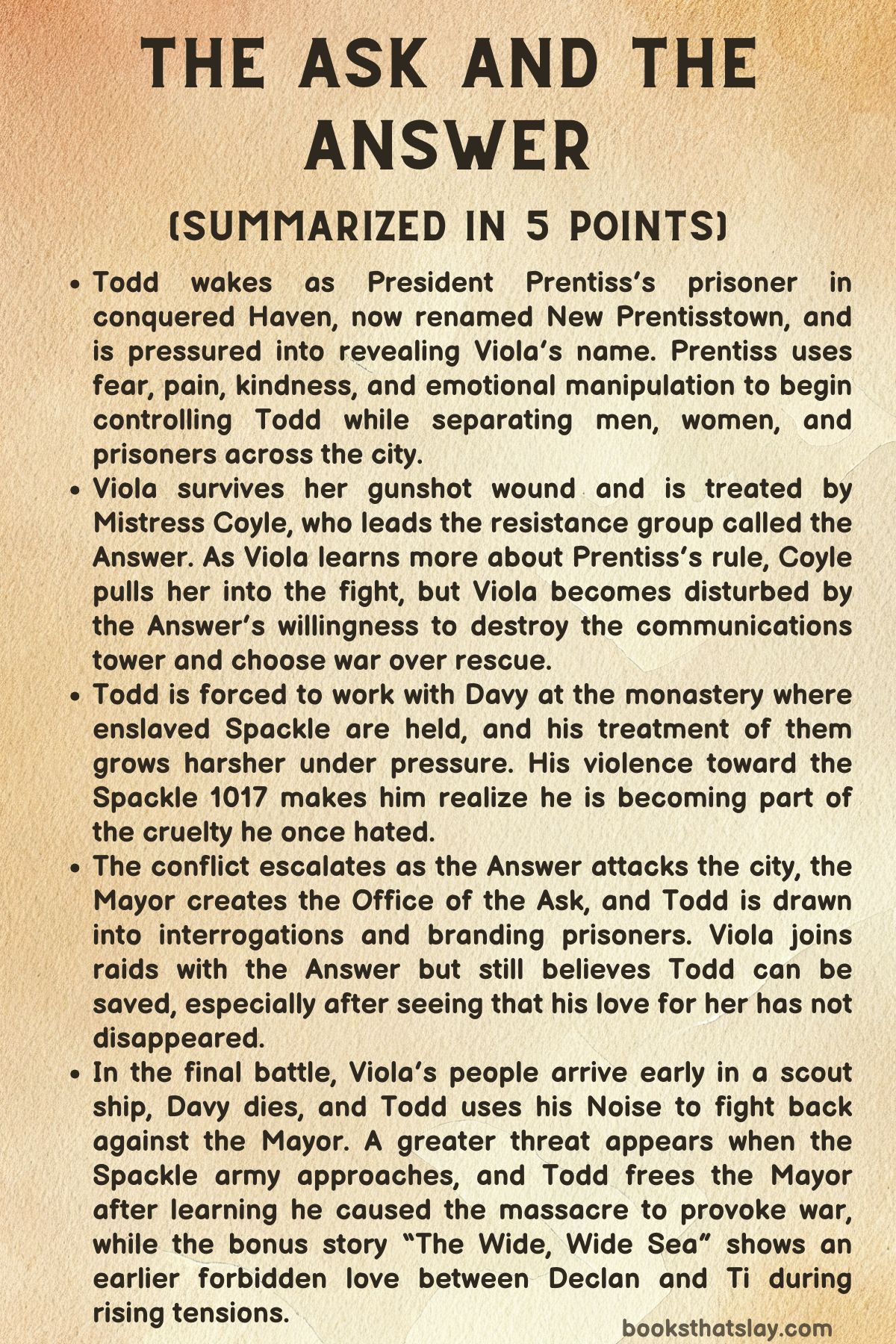
The Ask and the Answer begins with Todd Hewitt waking in terror, tied to a chair inside the former cathedral of Haven. The city that once promised safety has already fallen under Mayor Prentiss, who now calls himself President.
Todd’s first thought is Viola, who was badly wounded when they reached Haven, but Prentiss refuses to answer his questions. Instead, he questions Todd, pressing him again and again for Viola’s name.
Todd resists as long as he can, even when Mr Collins beats him, but Prentiss changes his method. After filling Todd with fear, he suddenly becomes gentle, treats Todd’s wounds, and speaks as though he is a protector rather than a captor.
Exhausted, drugged, and desperate for Viola to live, Todd finally gives him her name.
Todd is then imprisoned in the cathedral bell tower with Con Ledger, the former mayor of Haven. Ledger tells him that Haven surrendered before Prentiss’s army even arrived.
The city had created a cure that silences men’s Noise, but Prentiss has taken control of it and uses it as another tool of power. When the army enters Haven, Prentiss renames it New Prentisstown and stages a public display.
He appears ready to execute Ledger, then spares him, showing the people that mercy belongs to him alone. He announces that a new order has begun and that everyone must prove their worth.
Todd is placed under the supervision of Davy Prentiss, the Mayor’s son, and sent to work at a walled monastery where captured Spackle are being held. The Spackle have been given the cure, leaving them silent, obedient, and easier to control.
Todd is horrified by the cruelty of their imprisonment, but he has little power to resist. He feeds them, gives them water, and later helps number them like property.
One Spackle, known as 1017, watches Todd in a way that unsettles him because it reminds him of the Spackle Todd once killed.
Viola, meanwhile, wakes in a house of healing. She is alive, but weak from the gunshot wound.
Mistress Coyle and her apprentice Maddy care for her. Viola learns that Haven has surrendered, women have been separated from men, and Prentiss now rules the city.
Coyle quickly understands that Viola matters because she can communicate with the settler ships coming from space. Prentiss visits Viola and tells her Todd is alive, but he also tries to get information from her about the ships.
Coyle has drugged Viola to keep her from saying too much, and Viola slowly begins to see that Coyle has her own plans.
As Viola recovers, Coyle draws her closer to the resistance. Viola learns of the Answer, a group marked by a blue A that opposes Prentiss through bombings and raids.
Coyle eventually leaves the house of healing with many women to begin organized resistance, leaving Viola behind. A note later reaches Viola, asking whether the Answer can count on her.
Viola is uncertain, but the pressure of events soon leaves her with fewer choices.
Todd and Viola briefly reunite when Todd finds his tower door unlocked and escapes to the house of healing. Their meeting is full of relief, fear, and confusion.
They share what they know, including the location of the communications tower that may allow Viola to contact the incoming ships. Before they can act, Prentiss finds them.
He strikes Todd down with a blast of controlled Noise, showing a power Todd barely understands, and takes him away again.
Viola joins Mistress Coyle and the Answer in an attempt to reach the communications tower, hoping to warn the settlers. But Coyle destroys the tower before Viola can use it.
She claims she is stopping Prentiss from controlling the ships, but Viola sees that Coyle has chosen war over rescue. Viola is furious, realizing the Answer is willing to sacrifice truth and safety for strategy.
Still, Coyle tells her she has chosen a side and reveals the hidden army waiting outside the city.
Todd remains trapped under Prentiss’s influence. Prentiss suggests that Viola has abandoned him and joined the bombers, feeding Todd’s hurt and anger.
At the monastery, Davy continues to provoke him, and Todd becomes harsher toward the Spackle. When 1017 attacks Davy, Todd beats him brutally.
As 1017 lies wounded, Todd understands that he has repeated the kind of violence he hates. The silence of the Spackle makes the moment even worse, and 1017’s stare seems almost victorious, as if Todd has proven something terrible about himself.
Viola lives in the Answer’s camp but is frustrated because Coyle keeps her away from important missions and refuses to tell her clearly whether Todd is alive. Viola works in the kitchens with Lee, a young man who becomes close to her.
Lee joined the Answer after the Mayor’s army took the women of his family. During a major operation, Coyle keeps Viola behind by assigning her to sort medical supplies.
The Answer raids the Mayor’s prisons and frees many captives, but the cost is high. Corinne is returned tortured, infected, and dying.
Her death devastates Viola and pushes her fully into the Answer’s cause.
In the city, Todd and Davy find the Spackle at the monastery slaughtered, with the Answer’s blue A painted on the wall. Todd believes Viola may have had some part in it and breaks under the thought.
Prentiss uses the massacre to turn New Prentisstown against the Answer. He creates the Office of the Ask, a system of imprisonment, questioning, and punishment.
Todd and Davy become officers under Captain Hammar. Todd watches interrogations, helps brand prisoners, and later helps place numbered bands on women.
To endure what he is doing, he uses Prentiss’s mental “Circle” technique to numb his feelings.
Viola trains as a soldier and begins planting bombs for the Answer, but she refuses to believe Todd is truly lost. When she hears that Todd helped brand a woman, she goes into the city with Lee and Wilf and sees Todd in uniform beside Davy.
Later she enters the cathedral to confront him. Todd proves he still loves her, but Prentiss captures them both.
He forces Todd to watch Viola being Asked and reveals that Todd’s Noise has the potential to become a weapon. Ivan, a soldier troubled by the Mayor’s rule, helps them escape with Lee, and they try to confront Prentiss.
The conflict reaches a breaking point as the Answer launches a final attack. At the same time, a scout ship from Viola’s people lands earlier than expected.
Mistress Coyle races to reach it first because she wants to control what the settlers learn and possibly gain access to their weapons. Todd, Viola, Davy, and Prentiss collide in the chaos.
Prentiss shoots Davy, choosing Todd over his own son. As Davy dies, his Noise reveals that he once shot Ben and hid the truth.
Prentiss then attacks Todd with Noise and uses Viola’s danger to control him. Viola’s voice helps Todd fight back.
She strikes Prentiss with a stone, and Todd uses his Noise to overpower him.
Viola rides Davy’s horse toward the scout ship while Todd stays behind with the unconscious Mayor, believing he must face the army. Then Todd sees a huge Spackle army approaching.
Prentiss admits he ordered the murder of the enslaved Spackle and allowed 1017 to survive so he could carry news of the massacre to his people and provoke a war. With the Answer, Prentiss’s army, the scout ship, and the Spackle all arriving at once, Todd makes a bitter choice.
He frees Prentiss because he believes the Mayor may be the only person capable of organizing a defense and saving Viola.
The attached story, “The Wide, Wide Sea,” looks back to an earlier time and tells of Declan, a boy from Horizon, and Ti, a Spackle girl he loves. Their relationship is rejected by both humans and Spackle as tensions rise.
Mistress Coyle secretly helps fake Ti’s death to protect her from a mob. Declan loses his mother, escapes with Ti by boat, and the two head across the dangerous ocean together.
Their story adds a painful history to the larger conflict, showing that the war between humans and Spackle has always been shaped by fear, prejudice, love, and loss.
Characters
The characters in The Ask and the Answer are shaped by fear, power, loyalty, trauma, and the constant pressure of choosing sides. Patrick Ness presents them not as simple heroes or villains, but as people whose choices are tested by war, manipulation, grief, and survival.
Todd Hewitt
Todd is the emotional centre of the book, and his character is defined by conflict between the goodness he wants to protect and the violence he is gradually forced to confront inside himself. At the beginning, he is frightened, injured, and desperate to know whether Viola is alive, which shows how deeply his love for her guides him.
Yet his refusal to give Viola’s name also reveals his courage and loyalty. President Prentiss understands Todd’s emotional weakness and manipulates him through pain, kindness, fear, and false trust.
Todd’s journey becomes darker when he is placed in charge of the captured Spackle under Davy’s supervision. His horror at their suffering slowly turns into numbness, then cruelty, especially when he beats 1017.
This moment is crucial because Todd realizes that he is becoming capable of the same brutality he hates. His character is tragic because he does not turn cruel all at once; instead, he is worn down by pressure, confusion, guilt, and the Mayor’s psychological control.
Even when he joins the Office of the Ask and participates in branding prisoners, the book shows that his humanity has not completely disappeared. His love for Viola, his guilt over the Spackle, and his eventual resistance to the Mayor’s Noise prove that Todd is still fighting for his moral self.
By the end, Todd is no longer innocent, but he is not defeated either. He has learned that survival in a violent world can damage a person, and his greatest struggle is to remain human after being used as a weapon.
Viola Eade
Viola is one of the strongest and most morally alert characters in the story. After surviving her gunshot wound, she wakes into a world controlled by President Prentiss, separated from Todd and surrounded by uncertainty.
Her physical recovery happens alongside her political awakening. Mistress Coyle tries to shape Viola into a symbol for the Answer because of her connection to the incoming settler ships, but Viola is never simply passive.
She questions Coyle’s motives, especially when the communications tower is destroyed before she can contact her people. Viola’s anger at this moment shows her independence and her refusal to accept violence just because it is done by the side opposing the Mayor.
As she spends more time with the Answer, however, grief and injustice push her further into resistance. Corinne’s death especially hardens her and makes her feel that fighting back is necessary.
Viola’s love for Todd remains one of her defining qualities, but she is not blindly loyal. When she sees Todd in uniform, she is shaken, yet she refuses to believe he is completely lost.
Her courage lies in her ability to enter dangerous spaces, confront Todd, challenge Mistress Coyle, and finally help Todd resist the Mayor. Viola represents conscience, emotional strength, and the difficult search for the right path when every side is morally compromised.
President Prentiss
President Prentiss, formerly the Mayor, is the most manipulative and intellectually dangerous figure in the book. He does not rely only on violence; he uses mercy, language, public performance, and emotional control as weapons.
His treatment of Todd shows this clearly. He first terrifies and hurts Todd, then heals him gently, making cruelty and kindness part of the same strategy.
This makes him frightening because he understands that people can be controlled not just through fear, but through gratitude, confusion, and the desire to believe someone powerful may protect them. His renaming of Haven as New Prentisstown shows his need to reshape reality around himself.
He turns mercy into spectacle when he appears to execute Con Ledger but spares him instead, using the moment to display power rather than compassion. His creation of the Office of the Ask reveals his ability to make oppression seem organized, official, and necessary.
His relationship with Todd is deeply disturbing because he sees Todd’s potential and tries to replace Davy as the son or successor he truly values. The clearest proof of his coldness comes when he shoots Davy and chooses Todd over his own child.
His final revelation that he ordered the Spackle massacre exposes the depth of his strategic cruelty. He is not chaotic; he is calculating, and he is willing to provoke an entire war if it strengthens his position.
Davy Prentiss
Davy begins as a cruel, arrogant, and insecure young man who enjoys power because it gives him a way to hide his weakness. He taunts Todd with his mother’s book and supervises him at the monastery, often behaving as if brutality proves his strength.
However, Davy is also a victim of his father’s emotional neglect. His cruelty is partly learned from President Prentiss, and much of his behaviour comes from wanting approval he rarely receives.
His relationship with Todd gradually becomes more complicated. Although he remains aggressive and often hateful, there are moments when his loneliness and desire to be valued become visible.
His death is one of the most tragic moments in The Ask and the Answer because it reveals how little he truly mattered to the father he tried so hard to please. When his Noise exposes that he shot Ben and carried the secret, Davy becomes more than a simple bully.
He is shown as guilty, damaged, and desperate for recognition. His final moments make him pitiable because the power he admired destroys him.
Mistress Coyle
Mistress Coyle is one of the most morally complex figures in the book. She is brave, intelligent, organized, and genuinely opposed to President Prentiss’s tyranny, but she is also ruthless and manipulative.
As a healer, she saves Viola’s life, which makes her seem protective and trustworthy at first. Yet she quickly recognizes Viola’s political importance and begins drawing her into the Answer.
Coyle’s leadership is built on sacrifice, secrecy, and strategic violence. Her decision to destroy the communications tower shows that she is willing to prevent rescue if rescue might benefit her enemy.
This makes Viola realize that Coyle does not simply want freedom; she also wants control over the direction of the war. Coyle’s resistance is understandable because Prentiss’s rule is oppressive, but her methods often mirror the ruthlessness she claims to fight against.
She represents the danger of believing that a good cause justifies any action. Her character forces the reader to question whether rebellion remains moral when it begins using fear, deception, and civilian suffering as tools.
1017
1017 is one of the most haunting characters in the story, even though he is silent for much of it. As a captured Spackle, he represents the suffering of an entire oppressed people, but he also has a personal symbolic connection to Todd.
His constant gaze reminds Todd of the Spackle he once killed, making him a living reminder of Todd’s guilt. Because the Spackle have been given the cure and made silent, 1017’s power comes through his presence, his stare, and his refusal to disappear emotionally even when he is physically imprisoned.
When Todd beats him after he attacks Davy, 1017’s apparent look of triumph is deeply unsettling. It suggests that he has forced Todd to see the truth about himself: Todd is capable of becoming an abuser.
Later, the Mayor’s decision to spare 1017 so he can carry news of the massacre to the Spackle army turns him into an unwilling messenger of war. He is both victim and witness, and his character exposes the terrible consequences of dehumanizing another species.
The Spackle
The Spackle are not treated as fully understood individuals by most human characters, and that is part of the tragedy. In the monastery, they are imprisoned, silenced, numbered, and forced into conditions that deny their dignity.
Their silence is especially important because it makes their suffering easier for humans to ignore. Todd initially feels horror at their treatment, but the system around him slowly trains him to see them as objects of labour and control.
The massacre of the enslaved Spackle becomes one of the most important turning points in the story because it is used politically by both fear and blame. The later arrival of the vast Spackle army shows that the oppressed have not vanished and that violence against them has consequences.
As a group, the Spackle represent colonized, abused, and dehumanized people who are pushed into war by human cruelty.
Con Ledger
Con Ledger, the former mayor of Haven, represents failed civic leadership and the humiliation of surrender. He explains to Todd that Haven gave up before Prentiss’s army even arrived, which shows that fear had already defeated the town before direct violence began.
Ledger is not portrayed as heroic, but he is important because he reveals how easily institutions collapse when confronted by a stronger will. Prentiss’s staged execution of Ledger is a public lesson in power.
By sparing him, Prentiss does not show true mercy; he turns Ledger into a symbol of submission. Ledger’s character shows how weak leadership, fear, and compromise can allow tyranny to take control without a full battle.
Maddy
Maddy is a compassionate and courageous young healer who represents ordinary goodness in a world dominated by political extremes. As Mistress Coyle’s apprentice, she helps treat Viola and becomes part of the healing space that initially shelters her.
Maddy’s importance lies in her gentleness and moral clarity. Unlike Coyle, she is not primarily a strategist or revolutionary figure; she is someone whose care for others feels immediate and sincere.
Her presence helps show that resistance to cruelty does not always have to begin with bombs or armies. Sometimes it begins with tending wounds, protecting the vulnerable, and refusing to abandon people who are hurt.
Corinne
Corinne is a tragic character whose suffering pushes Viola more deeply into the Answer’s cause. After Mistress Coyle leaves the house of healing, Corinne remains with Viola, creating a sense of fragile safety and loyalty.
Her later return after being tortured and infected is devastating because it shows the real human cost of the Mayor’s regime. Corinne’s death becomes personal evidence for Viola that neutrality may no longer be possible.
She is not just a victim used to create emotion; she represents the many ordinary women caught between punishment, resistance, and war. Through Corinne, the story shows how cruelty turns private grief into political commitment.
Lee
Lee is warm, loyal, and wounded by loss. He becomes close to Viola in the Answer’s camp, and his personal history explains why he joined the resistance.
The disappearance of his mother and sister gives him a deeply personal reason to oppose the Mayor’s army. His connection with Viola also complicates her emotional world because he offers companionship and care while she is separated from Todd.
Lee is not presented as a replacement for Todd, but he is important because he shows that Viola’s life does not stop while Todd is absent. He helps her survive the loneliness of the camp and gives a human face to the Answer’s members.
His courage in helping Viola enter the city and confront danger proves that his loyalty is active rather than merely emotional.
Wilf
Wilf is a quiet but significant figure because he represents decency, simplicity, and moral steadiness. He helps Viola and Lee move through danger, and his presence suggests that not everyone in the conflict is driven by ideology or ambition.
Wilf’s goodness is practical rather than dramatic. He does what needs to be done, helps those who need help, and remains reliable in a world where many leaders manipulate others.
His character offers a contrast to both President Prentiss and Mistress Coyle because he does not seek power. He represents the kind of ordinary kindness that survives beneath the larger machinery of war.
Ivan
Ivan is an uneasy soldier whose decision to help Todd, Viola, and Lee escape shows that conscience can survive even inside an oppressive system. He is not a grand hero, but his hesitation and eventual action matter because they prove that the Mayor’s control is not absolute.
Ivan’s character shows the moral pressure faced by people who serve cruel institutions. He may be afraid, compromised, or uncertain, but he still recognizes that something wrong is happening.
By helping the captives escape, he chooses risk over obedience. His role is important because it suggests that resistance can come from within the enemy’s structure, not only from organized rebel groups.
Captain Hammar
Captain Hammar represents the brutal machinery of the Office of the Ask. Unlike President Prentiss, whose danger lies in psychological manipulation and political performance, Hammar embodies direct institutional cruelty.
Under his authority, interrogation, branding, and punishment become routine. His presence helps show how tyranny depends not only on one powerful leader but also on officers willing to carry out orders.
Hammar is frightening because he makes violence feel administrative. Through him, the book shows how cruelty becomes normalized when it is given uniforms, titles, and procedures.
Mr Collins
Mr Collins appears early as an instrument of President Prentiss’s violence. His beating of Todd helps establish the methods of the new regime: pain is used to break resistance, but it is paired with calculated kindness from Prentiss so that the victim becomes confused about who holds power and who offers relief.
Collins is not as psychologically complex as Prentiss, but his role is important because he shows how leaders like Prentiss depend on people willing to perform physical brutality for them. He represents the obedient violence that supports political control.
Ben
Ben is not physically central in the events described, but his presence remains emotionally important through Todd’s memory and Davy’s confession. The revelation that Davy once shot Ben and hid the truth adds weight to Davy’s guilt and Todd’s pain.
Ben represents Todd’s lost family, moral guidance, and earlier sense of safety. Even when absent, he remains part of Todd’s emotional world.
His importance lies in what he means to Todd: love, protection, and the life Todd was torn away from.
Declan
Declan, from “The Wide, Wide Sea,” is a young character whose love for Ti places him between two hostile communities. His story expands the world of the novel by showing that the conflict between humans and Spackle has a longer and more intimate history than the main war.
Declan’s courage is personal rather than political. He does not begin as a leader or soldier; he is simply someone who loves a Spackle girl in a world that condemns that love.
His loss of his mother and his escape with Ti show both grief and hope. Declan’s character suggests that peace is possible at the level of individual love, even when communities are trapped in hatred.
Ti
Ti is a Spackle girl whose relationship with Declan challenges the hatred between humans and Spackle. She is vulnerable because both communities reject the bond she shares with him, but she is also brave because she chooses survival and love despite danger.
The need to fake her death shows how extreme the hostility around her has become. Ti’s character gives the Spackle a more personal and intimate presence beyond their role as prisoners or soldiers.
Through her, the story shows that the divide between species is not natural or unbreakable; it is enforced by fear, prejudice, and violence.
Themes
Power as Control Through Fear and Mercy
The Ask and the Answer presents power not only as open violence but also as the ability to decide when to hurt, when to heal, and when to forgive. President Prentiss understands that fear alone can create resistance, so he uses mercy as a weapon.
When Todd is beaten and then gently treated, the kindness does not undo the cruelty; it makes the cruelty more confusing and harder to resist. Prentiss wants people to feel that their survival depends on him.
His public treatment of Con Ledger shows the same method: by pretending to execute him and then sparing him, Prentiss makes mercy look like generosity when it is really a performance of control. This kind of power traps people emotionally.
Todd begins to doubt what is true because Prentiss offers explanations, affection, discipline, and purpose all at once. The theme becomes darker because power is shown as psychological, not just political.
The strongest ruler is not simply the one with weapons, but the one who can make victims feel grateful, guilty, afraid, and dependent at the same time.
The Corruption of Good Intentions
Mistress Coyle’s resistance begins as an answer to tyranny, but her methods show how easily justice can become another form of harm. She opposes Prentiss because his rule depends on imprisonment, separation, torture, and public fear.
Yet she also hides information, uses Viola, chooses destruction over rescue, and accepts civilian suffering as the price of victory. Her decision to destroy the communications tower is especially important because it shows that she is not only fighting to save people; she is also fighting to control the future.
Viola’s anger comes from realizing that Coyle’s cause may be right, but her choices can still be morally wrong. This theme refuses to divide the conflict into simple good and evil.
The resistance offers hope, shelter, and purpose, but it also demands obedience and sacrifice. By placing Viola between Prentiss and Coyle, the story shows that noble language can hide ambition, and that fighting oppression does not automatically make every action pure.
A just cause can still damage the people it claims to protect.
Guilt, Violence, and the Loss of Innocence
Todd’s journey is shaped by the horror of becoming the kind of person he fears. His work at the monastery begins with disgust and pity, but under pressure, humiliation, and manipulation, he slowly becomes part of the system hurting the Spackle.
His treatment of 1017 is central to this theme because it forces him to face the violence inside himself. Todd wants to believe he is different from Prentiss, Davy, and the other men who abuse power, but his actions show that cruelty can grow from fear, anger, shame, and the need to survive.
The numbering, branding, and forced labor make violence seem ordinary, which is why Todd’s moral collapse feels so disturbing. He does not suddenly become evil; he is worn down until he accepts things he once would have rejected.
His guilt matters because it proves his conscience is still alive, but guilt alone cannot undo harm. The theme shows that innocence is not lost only through suffering, but also through participation in suffering inflicted on others.
Love as Resistance and Moral Memory
Todd and Viola’s bond becomes a force that keeps both of them connected to who they were before the war tried to change them. Their separation allows other people to fill their minds with suspicion: Prentiss tells Todd that Viola has abandoned him, while the Answer’s actions make Viola question what Todd may have become.
Yet their love continues to act as a form of moral memory. When Todd sees Viola again, his feelings cut through the Mayor’s influence and remind him that obedience is not the same as loyalty.
Viola also refuses to accept the easiest version of Todd as lost or corrupted forever. This does not excuse his actions, but it keeps open the possibility of return and responsibility.
Their relationship matters because it resists the isolation that both Prentiss and Coyle depend on. Each leader wants followers who choose sides before they choose people.
Todd and Viola’s love challenges that demand by insisting that truth, care, and personal loyalty still matter even in war.