The 8th Confession Summary, Characters and Themes
The 8th Confession is a crime thriller by James Patterson and Maxine Paetro, and the eighth novel in the Women’s Murder Club series.
Set in San Francisco, the book follows Lindsay Boxer, Cindy Thomas, Claire Washburn, and Yuki Castellano as they face separate cases that test their instincts and loyalties. A bus explosion, a murdered homeless man, unexplained deaths among the wealthy, and a troubled courtroom battle all create pressure from different sides. The novel moves through police investigation, forensic discovery, legal uncertainty, and moral conflict, showing that justice is often harder to define than it first appears.
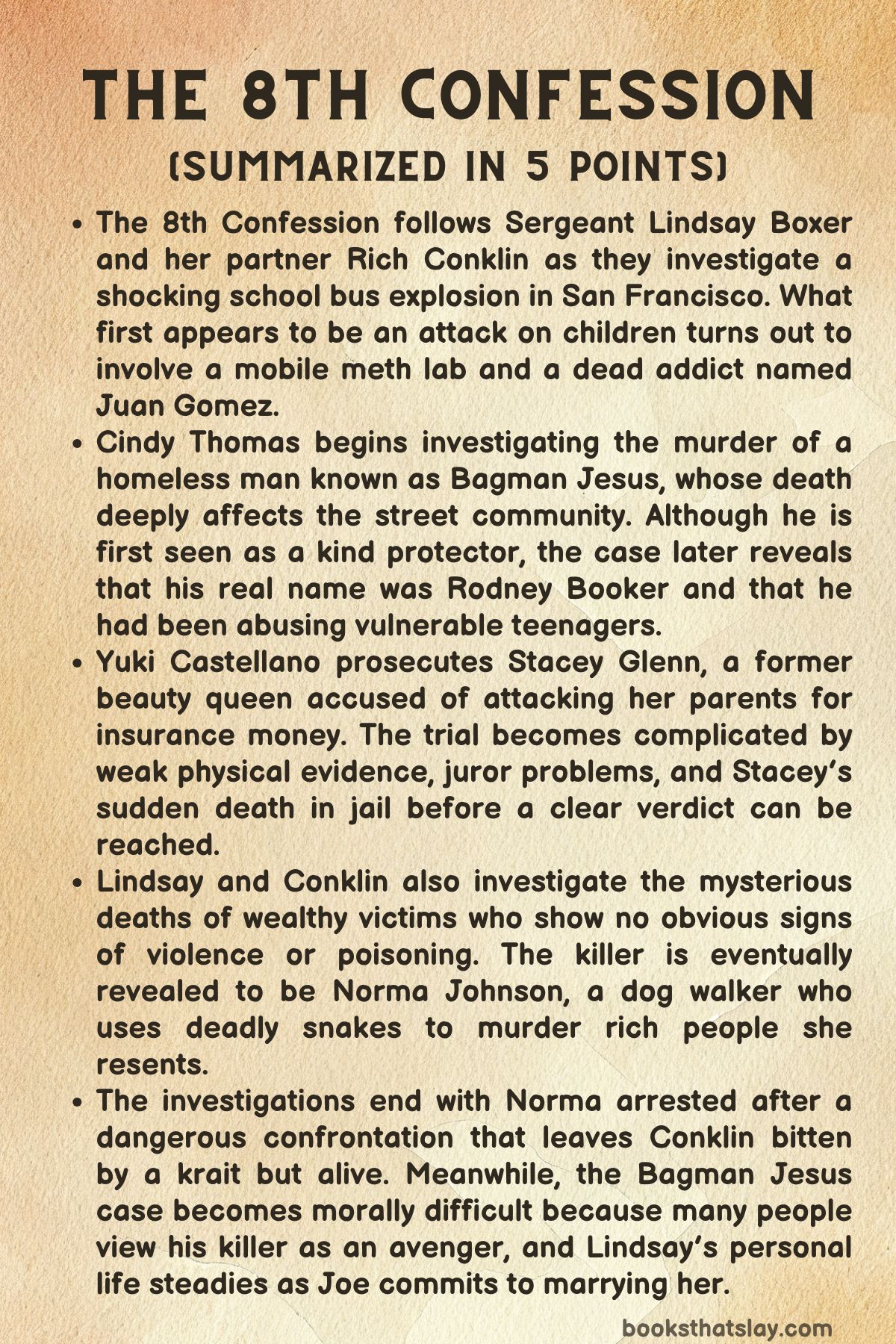
Summary
The 8th Confession begins with a violent explosion on Market Street in San Francisco. A school bus erupts in flames, scattering wreckage and panic across the street. Sergeant Lindsay Boxer and her partner, Rich Conklin, arrive quickly and face what first appears to be a horrific attack involving children. The truth is different, but still deeply disturbing. The bus had not been carrying students.
It had been converted into a mobile meth lab, and the dead man thrown through the windshield is Juan Gomez, a young addict whose body shows the damage of long-term drug use. The explosion reveals how drug crime spreads danger beyond the people directly involved.
As Lindsay and Conklin handle the bus case, reporter Cindy Thomas discovers another death near the Caltrain yard. A homeless man known as Bagman Jesus has been murdered. To many people living on the streets, he was not just another man without shelter.
They describe him as a protector, a giver, and a strange guardian figure who helped weaker people survive. He wore a homemade crucifix made from bolts and wire, with a small toy baby fixed to it. His death shocks the street community, and Cindy immediately senses that his story matters.
Lindsay, Conklin, and medical examiner Claire Washburn study the body and the crime scene. Claire finds that Bagman Jesus had been shot several times in the head and neck with .22-caliber bullets. He had then been beaten after death, and his crucifix had been forced down his throat.
The killing feels both personal and symbolic. Lindsay’s superior, Jacobi, does not want her to spend much time on the murder. From his view, the killing of a homeless man with no clear suspect will not attract official attention and will be hard to solve. Cindy refuses to accept that. Through her reporting, she keeps the case visible and pushes the police to continue looking for answers.
At the same time, Yuki Castellano is under pressure in court. She is prosecuting Stacey Glenn, a former beauty queen accused of killing her father and trying to kill her mother, Rose Glenn, for insurance money. Yuki’s strongest evidence is a video in which Rose, badly injured but still alive, identifies Stacey as the attacker.
The video is emotionally powerful, but the defense challenges it aggressively. Stacey’s lawyer, Philip Hoffman, argues that Rose was in shock and could not be trusted. He also points out the weakness of the physical evidence directly connecting Stacey to the crime. The trial becomes a serious test of Yuki’s ability to stand firm under pressure.
The case grows more difficult when the jury cannot agree. The court pushes them to keep working toward a verdict, but outside complications damage the process.
A juror’s jailed daughter becomes connected to information about Stacey, raising concerns about influence and fairness. Before the case can reach a proper legal conclusion, Stacey dies in jail after a fight. Her injury is an internal decapitation, rare and fatal.
Her death leaves Yuki without the verdict she had fought for and turns the case into another unresolved burden. Instead of legal closure, Yuki is left with doubt, frustration, and the emotional cost of a trial that ended in chaos.
Another mystery begins when Isa and Ethan Bailey, a wealthy and well-known couple, are found dead in bed. There are no signs of violence, no wounds that explain their deaths, no clear poison, and no evidence of a struggle.
Lindsay and Conklin search the house, question staff, speak with friends, and examine the couple’s family and social connections. Because the Baileys are rich and prominent, the case receives public attention. Yet the cause of death remains almost impossible to identify. The killer seems to have left no useful trace.
The person behind the deaths is Norma Johnson, though the police do not know this at first. Norma works as a dog walker and errand runner for wealthy clients. Her job gives her access to homes, keys, private routines, and personal schedules.
People know her as Pet Girl, a harmless helper who moves through expensive homes without attracting suspicion. Beneath that ordinary surface, however, she carries intense hatred for rich people and the social world that once rejected her. Her method is unusual and deadly: she kills with poisonous snakes.
Norma had already murdered rock star McKenzie Oliver, and she later kills the Baileys as part of her revenge against the privileged.
The pattern becomes clearer after fashion designer Sara Needleman dies in a similar way. Lindsay, Conklin, Claire, and the rest of the team begin connecting the recent deaths to old unsolved high-society murders from 1982. Those earlier victims were also killed by snakes.
The similarities suggest that the new deaths are not random accidents. They are part of a planned series of murders tied to old rage and long memory.
Norma keeps killing because her position allows her to pass unnoticed. She can enter homes, attend to pets, handle keys, and move near wealthy victims without seeming dangerous. At one party, a snake is released and creates another fatal situation.
Fear grows as the police begin to understand that the killer is using ordinary access as a weapon. The same quality that makes Norma invisible to her clients makes her extremely dangerous.
Eventually, Lindsay and Conklin focus on Norma. Her movements, keys, and links to the victims begin to point in one direction. When they confront her, the case turns immediately dangerous.
Norma releases snakes inside her apartment and throws a krait at Conklin. He is bitten and his life is suddenly at risk. Lindsay arrests Norma and rushes to get emergency help for her partner. Conklin survives, but the attack shows how close the investigation came to another death.
Evidence found in Norma’s storage unit connects her to poisonous reptiles and ties her to the unexplained deaths. It also helps explain the old murders from 1982. The police finally have proof of how the wealthy victims died without visible injuries. Norma is sent to prison, but she shows no real remorse. Instead, she enjoys the fame her crimes bring her. Her hatred of the wealthy has become a hunger for recognition, and prison gives her a new audience.
Meanwhile, Cindy’s investigation into Bagman Jesus changes the meaning of his death. She discovers that his real name was Rodney Booker. At first, he had seemed like a saintly protector of homeless people, a man who helped the weak and gave dignity to those who had nothing.
The truth is much darker. Rodney had been exploiting vulnerable teenagers, including Flora Gold and Sammy Pincus, using drugs and sex to control them. The man praised as a guardian had also harmed people who were already powerless.
His murder is eventually revealed as an act of revenge, but the legal situation becomes difficult. Several street people and the Pincus brothers create confusion by confessing or accepting blame in ways that make prosecution nearly impossible. Their statements blur responsibility and weaken the chance of a clean conviction.
Many people who know what Rodney did see the killer not simply as a criminal, but as someone who punished a predator when the law had failed to protect the victims.
By the end of The 8th Confession, the main cases reach conclusions, though not all of them are satisfying. Norma’s crimes are exposed, and the strange deaths of rich victims are finally explained. Conklin survives the snakebite. The truth about Bagman Jesus destroys the easy image of him as a holy man of the streets.
Yuki’s trial ends without the verdict she needed, leaving her with pain rather than justice. Lindsay also finds some peace in her personal life as she and Joe reconnect, and Joe makes it clear that he sees marriage in their future. The novel ends with justice achieved in some places, missed in others, and complicated in almost every case.
Characters
Lindsay Boxer
Lindsay Boxer stands at the center of The 8th Confession as a determined, emotionally steady, and morally alert police sergeant. In the book, she is shown as someone who responds quickly to crisis, especially when she and Rich Conklin arrive at the bus explosion and immediately begin securing the scene.
Her strength lies not only in her professional skill but also in her refusal to treat victims as case numbers. This becomes especially clear in the Bagman Jesus investigation, where official pressure pushes her to abandon the case because the victim is homeless and the crime seems difficult to solve.
Lindsay’s sense of justice makes her uncomfortable with that kind of dismissal. She understands that the value of a victim’s life should not depend on wealth, social status, or public sympathy.
At the same time, Lindsay is not portrayed as emotionally untouchable. Her relationship with Joe shows her personal vulnerability and her need for emotional certainty outside the violence of her work.
By the end, her reconciliation with Joe gives her character a sense of personal grounding after the chaos of the investigations.
Rich Conklin
Rich Conklin is Lindsay’s partner and one of the most dependable figures in the story. He is practical, courageous, and deeply committed to the work of investigation.
His role is important because he balances Lindsay’s intensity with steadiness and shared professionalism. Conklin does not simply function as a supporting officer; he actively participates in the major cases, from the bus explosion to the mysterious deaths among wealthy victims.
His courage becomes especially clear during the confrontation with Norma Johnson, when he is bitten by a deadly snake while helping Lindsay bring the killer down. This moment highlights his willingness to face danger directly, not as reckless heroism but as part of his loyalty to his partner and his duty.
His survival also gives emotional weight to the ending, because the danger he faces reminds the reader that the police work in the book has real physical consequences.
Cindy Thomas
Cindy Thomas is a persistent and morally driven reporter whose role shows the importance of public attention in uncovering ignored crimes. In the story, she discovers the body of Bagman Jesus and refuses to let his death disappear into the background simply because he was homeless.
Cindy’s strongest quality is her refusal to accept official indifference. She keeps pressing the story, not only because it is dramatic but because she recognizes that the street community has lost someone they considered meaningful.
Her reporting pushes the police to look deeper and eventually helps expose the truth about Rodney Booker’s life. Cindy’s character is also complex because her pursuit of justice reveals uncomfortable facts.
At first, Bagman Jesus seems saintly, but Cindy’s investigation helps uncover his exploitation of vulnerable young people. This makes her role more than that of a sympathetic journalist; she becomes someone who helps reveal the complicated difference between public image and hidden reality.
Claire Washburn
Claire Washburn is the medical examiner whose intelligence, calmness, and precision help give shape to the investigations. She brings scientific clarity to emotionally disturbing crimes.
In the case of Bagman Jesus, Claire’s examination reveals that he was shot multiple times and beaten after death, and that his crucifix was forced down his throat. Her findings show that the murder was not random violence but an act filled with rage and symbolism.
Claire’s role is important because she helps the investigators move from shock to understanding. She is compassionate, but she does not allow emotion to distort the evidence.
Her character represents the discipline needed to confront brutality without becoming overwhelmed by it. In the larger structure of the book, Claire acts as a stabilizing presence who helps connect physical evidence to human motive.
Yuki Castellano
Yuki Castellano is an ambitious and hardworking assistant district attorney whose storyline explores the uncertainty of courtroom justice. Her prosecution of Stacey Glenn places her under intense pressure because the case depends heavily on emotionally powerful but legally vulnerable evidence.
Yuki believes she is fighting for Rose Glenn and for the truth, yet the trial shows how difficult it can be to prove guilt beyond doubt when physical evidence is weak. Her character is defined by effort, conviction, and anxiety.
She is not careless, but she is trapped in a case where moral certainty and legal certainty do not fully align. The deadlocked jury and later complications reveal how fragile the justice system can be.
Yuki’s arc shows the burden carried by prosecutors who must transform suffering into evidence and evidence into a verdict.
Stacey Glenn
Stacey Glenn is one of the most troubling and ambiguous characters in the book. She is a former beauty queen accused of murdering her father and trying to murder her mother for insurance money.
Her public image creates a sharp contrast with the brutality of the crime she is accused of committing. Stacey’s character is shaped by suspicion, beauty, privilege, and possible greed, but the lack of physical evidence keeps her from becoming a simple villain in the courtroom storyline.
She represents the difficulty of judging someone when appearance, motive, accusation, and proof do not perfectly match. Her death in jail prevents the legal process from reaching a clean conclusion, which makes her character even more unsettling.
Instead of receiving a clear verdict, she exits the story through violence, leaving behind uncertainty and frustration.
Rose Glenn
Rose Glenn is a victim whose suffering becomes central to Yuki’s prosecution. Horribly injured but alive, she identifies her daughter Stacey as the attacker, making her statement the emotional heart of the case.
Rose’s character is important because she represents both the power and weakness of eyewitness testimony under extreme trauma. Her accusation feels deeply compelling because it comes from a mother who has survived a horrific attack, yet the defense argues that her condition makes her unreliable.
This places Rose in a painful position: she is both a wounded person seeking justice and a contested source of evidence. Her role shows how victims can become scrutinized in court, their pain transformed into something lawyers must challenge, defend, and interpret.
Philip Hoffman
Philip Hoffman is Stacey Glenn’s defense attorney, and his character represents the sharp, strategic side of the legal system. He challenges the prosecution by arguing that Rose Glenn’s identification is unreliable and that there is no physical evidence tying Stacey to the crime.
Hoffman is not presented simply as obstructive; he performs the essential role of forcing the state to prove its case. His character reminds the reader that emotional certainty is not the same as legal proof.
He is skilled because he understands where the prosecution is vulnerable, and he uses those weaknesses effectively. Through Hoffman, the book explores how defense attorneys can appear cold when they are actually protecting the principle that accusation alone cannot decide guilt.
Jacobi
Jacobi is Lindsay’s lieutenant and a practical authority figure who often sees cases through the lens of resources, priorities, and solvability. His instruction to Lindsay to drop the Bagman Jesus case reveals the institutional attitude toward crimes involving marginalized victims.
Jacobi is not necessarily cruel, but he is shaped by the pressures of police work and by a system that often ranks cases according to public attention and likelihood of success. His character creates conflict because Lindsay’s moral instincts push against his practical judgment.
In this way, Jacobi represents the bureaucratic side of law enforcement, where difficult cases can be dismissed not because they lack human importance, but because they appear unlikely to produce results.
Chuck Hanni
Chuck Hanni is the investigator who helps reveal the truth behind the bus explosion. His determination that the school bus was being used as a mobile meth lab changes the meaning of the scene completely.
At first, the explosion appears to suggest an attack involving children, but Chuck’s work uncovers a different and darker reality connected to drugs and criminal recklessness. His role is smaller than that of the main investigators, but it is important because he turns confusion into explanation.
Chuck represents the technical and investigative expertise needed to understand disaster scenes where first impressions can be misleading.
Juan Gomez
Juan Gomez is a tragic figure whose death exposes the destructive world behind the bus explosion. He is identified as a young meth addict whose drug abuse has made him look much older than he is.
His character is significant because he embodies the physical and human cost of addiction. Although he is dead when identified, his condition tells a story of decay, exploitation, and wasted youth.
Juan is not developed through dialogue or personal history, but his presence matters because he shifts the bus explosion from a spectacle of violence into a sign of social damage. He becomes a symbol of how addiction can erase youth, dignity, and future possibility.
Rodney Booker / Bagman Jesus
Rodney Booker, known to street people as Bagman Jesus, is one of the most morally complicated figures in the book. At first, he appears almost saintly.
The homeless community mourns him deeply, remembering him as someone who gave money, offered protection, and helped people survive. His homemade crucifix adds to the image of a strange urban holy man, someone who seemed to carry spiritual meaning for people living on the margins.
However, the investigation reveals that this image was incomplete and possibly deceptive. Rodney had exploited vulnerable teenagers through drugs and sex, including Flora Gold and Sammy Pincus.
This revelation transforms him from a beloved protector into a predator hiding behind generosity. His murder, especially the forcing of his crucifix down his throat, reflects the rage of people who saw his religious image as hypocrisy.
Rodney’s character shows how a person can be remembered as a savior by some and as a destroyer by others.
Norma Johnson / Pet Girl
Norma Johnson, secretly known as Pet Girl, is the main hidden killer behind the wealthy victims’ deaths. She is especially dangerous because she appears ordinary and useful, working as a dog walker and errand runner while quietly gaining access to rich people’s homes.
Her crimes are calculated, intimate, and unusual because she uses deadly snakes rather than obvious weapons. Norma’s hatred of the upper-class world is central to her character.
She kills not only out of cruelty but out of resentment toward a society that rejected and humiliated her. Her victims belong to a world of wealth, fashion, celebrity, and privilege, and her murders become a twisted revenge against that world.
Norma is frightening because she turns service work and trust into instruments of death. Her pleasure in notoriety after imprisonment shows that she wants recognition as much as revenge.
She is not merely a killer hiding in plain sight; she is someone who turns invisibility into power.
Isa Bailey
Isa Bailey is one of Norma Johnson’s wealthy victims, found dead in bed beside Ethan Bailey with no clear signs of trauma, poisoning, or struggle. Her character represents the protected world of privilege that Norma despises.
Isa’s death is disturbing because the absence of visible violence makes the crime feel almost impossible at first. She becomes part of the mystery that forces Lindsay and Conklin to look beyond ordinary explanations.
Though Isa is not deeply explored as an individual, her role is important because her death helps expose the pattern of high-society murders. She stands as one of the figures through whom the book examines wealth, vulnerability, and the false security of private spaces.
Ethan Bailey
Ethan Bailey, like Isa, is a wealthy victim whose death challenges the investigators because it leaves no obvious evidence of attack. His character functions as part of the upper-class world targeted by Norma Johnson.
Ethan’s death inside his own mansion shows that wealth cannot protect someone when danger comes through trusted access. He is important less for his personal actions than for what his murder reveals about the killer’s method.
Along with Isa, he helps establish the eerie nature of the snake killings and the way Norma uses secrecy, planning, and social invisibility to reach people who assume themselves safe.
McKenzie Oliver
McKenzie Oliver is a rock star and one of Norma Johnson’s earlier victims. His death helps establish that Norma’s crimes are not limited to one couple or one household but are part of a broader pattern.
As a celebrity victim, McKenzie represents fame and success, two things that connect him to the glamorous world Norma resents. His role also widens the social range of the murders, showing that Norma targets people who belong to elite circles of money, attention, and status.
Although he is not shown in depth, his murder matters because it helps connect the present crimes to a larger history of unexplained deaths.
Sara Needleman
Sara Needleman is a fashion designer who dies in the same mysterious pattern as the other wealthy victims. Her character represents another part of the privileged cultural world that Norma Johnson hates.
The fashion industry connection gives her death symbolic weight because fashion is associated with image, beauty, exclusivity, and social rank. Sara’s death strengthens the investigators’ recognition that the killings are connected.
Like the Baileys and McKenzie Oliver, she becomes evidence of Norma’s larger obsession with punishing people who belong to a world she believes rejected her.
Flora Gold
Flora Gold is one of the vulnerable teenagers exploited by Rodney Booker. Her character is important because she helps overturn the false saintly image of Bagman Jesus.
Through Flora, the story reveals that Rodney’s generosity toward street people had a darker side. She represents the young people who are easily harmed by adults who offer help, protection, drugs, or belonging while secretly taking advantage of them.
Flora’s role adds moral complexity to the murder investigation because it explains why some people might see Rodney’s death not as a tragedy but as revenge. She helps show that the street community is not simple or sentimental; it contains loyalty, fear, exploitation, anger, and survival.
Sammy Pincus
Sammy Pincus is another vulnerable teenager connected to Rodney Booker’s exploitation. His character deepens the darker truth behind Bagman Jesus’s public reputation.
Sammy’s involvement shows that Rodney’s abuse was not isolated and that his influence over young people caused serious harm. Sammy also connects the murder to the Pincus brothers and to the confusion surrounding responsibility for Rodney’s death.
His character helps explain why the case becomes morally and legally difficult. The law must treat murder as murder, but Sammy’s victimization makes the emotional response to Rodney’s death far more complicated.
Joe
Joe is important in Lindsay’s personal life because he represents love, commitment, and emotional stability beyond the violence of her work. His reconciliation with Lindsay near the end gives the story a private emotional resolution alongside the public resolution of the investigations.
Joe’s insistence that they are going to marry shows confidence and devotion, but it also reveals how much Lindsay’s life needs a space separate from crime scenes, trials, and danger. In a book filled with death, betrayal, and moral uncertainty, Joe’s role provides warmth and continuity.
He helps show Lindsay not only as a detective but as a person trying to build a future.
Themes
Appearance, Status, and Hidden Corruption
The 8th Confession repeatedly shows how public image can hide moral decay, danger, and criminal intent. Wealthy homes, famous names, beauty, and social respectability create a surface that looks polished and safe, but behind that surface are greed, cruelty, resentment, and murder.
The deaths of rich victims show that privilege does not protect people from violence; in fact, their status makes them targets. Norma’s crimes are driven by her hatred of a world that once rejected her, and her access to that world allows her to destroy it from inside.
Stacey Glenn’s trial also questions appearance, because her beauty and social identity become part of how people judge her guilt or innocence. The story suggests that society often trusts appearances too quickly, whether it is wealth, fame, beauty, or respectability.
What looks refined may be rotten, and what looks obvious may be misleading. The theme gives the crime narrative a sharp social edge by showing that evil is not limited to dark streets or desperate people; it can live comfortably inside mansions, courtrooms, and carefully managed reputations.
Justice and Moral Uncertainty
Justice in the story is not simple, because several cases blur the line between punishment, revenge, and truth. The murder of Bagman Jesus becomes especially complicated once his real identity and actions are revealed.
At first, his death seems like the killing of a beloved protector, but the later discovery that he exploited vulnerable teenagers changes the emotional meaning of the crime. The people involved in his death are not portrayed as ordinary murderers in the eyes of the street community; many see them as avengers who removed a predator.
This creates a painful conflict between legal justice and moral justice. The law demands evidence, prosecution, and accountability, but the community’s sense of justice is shaped by betrayal, trauma, and anger.
Stacey Glenn’s case also raises doubts about whether truth can be clearly proven in court when evidence is incomplete and testimony is challenged. The theme shows that justice depends not only on facts but also on perspective.
The story does not present every victim as innocent or every criminal as easy to condemn, making the pursuit of justice emotionally difficult.
Power, Vulnerability, and Exploitation
The novel places vulnerable people at the center of several crimes, showing how power is often abused by those who can hide behind authority, money, age, or trust. Rodney Booker’s public image as Bagman Jesus makes his exploitation more disturbing because he uses kindness and protection as tools of control.
The teenagers he harms are already exposed to poverty, drugs, and life on the margins, which makes them easier to manipulate and harder for society to notice. Their suffering is ignored until violence forces attention onto the truth.
The mobile meth lab also reflects a world where addiction damages bodies, identities, and lives, turning people like Juan Gomez into disposable figures within a larger criminal system. Even Norma’s story contains a different kind of vulnerability: rejection and humiliation harden into hatred, and she transforms her position as a trusted worker into a weapon.
The theme suggests that violence often grows where people are unseen, dismissed, or used. It also criticizes a society that notices suffering only after it becomes dramatic enough to disturb public order.
Loyalty, Persistence, and Human Connection
Amid the violence and confusion, loyalty becomes one of the strongest forces holding the characters together. Lindsay, Conklin, Cindy, Claire, and Yuki face different pressures, but each continues searching for truth even when the work becomes frustrating or dangerous.
Lindsay’s refusal to fully abandon difficult cases shows her commitment to victims who might otherwise be forgotten. Cindy’s persistence keeps attention on Bagman Jesus when official priorities push the case aside, proving that journalism can become a form of advocacy for people without power.
Conklin’s partnership with Lindsay is also central because trust between investigators becomes essential in situations where evidence is unclear and danger is immediate. His snakebite turns professional loyalty into personal fear, reminding the characters that their work carries real emotional costs.
Yuki’s courtroom struggles show another side of persistence, where justice depends on endurance under pressure and uncertainty. Personal relationships matter as much as professional duty, especially Lindsay’s reconciliation with Joe.
The theme shows that connection does not remove danger, but it gives characters the strength to keep acting with courage and purpose.