The Romance Revival Summary, Characters and Themes
The Romance Revival by Christina Lauren is a romantic science-fiction story about a marriage literally given a second life.
Emery Finch is a brilliant scientist whose devotion to classified medical research has gradually pushed her husband, Luca Martín, to the margins of their relationship. When Luca dies after a hit-and-run, Emery uses an unauthorized experimental procedure to revive him, only to discover that he has lost every personal memory of their life together. What follows is both a scientific crisis and a relationship reset, forcing two people who once loved each other imperfectly to decide whether they would freely choose one another again.
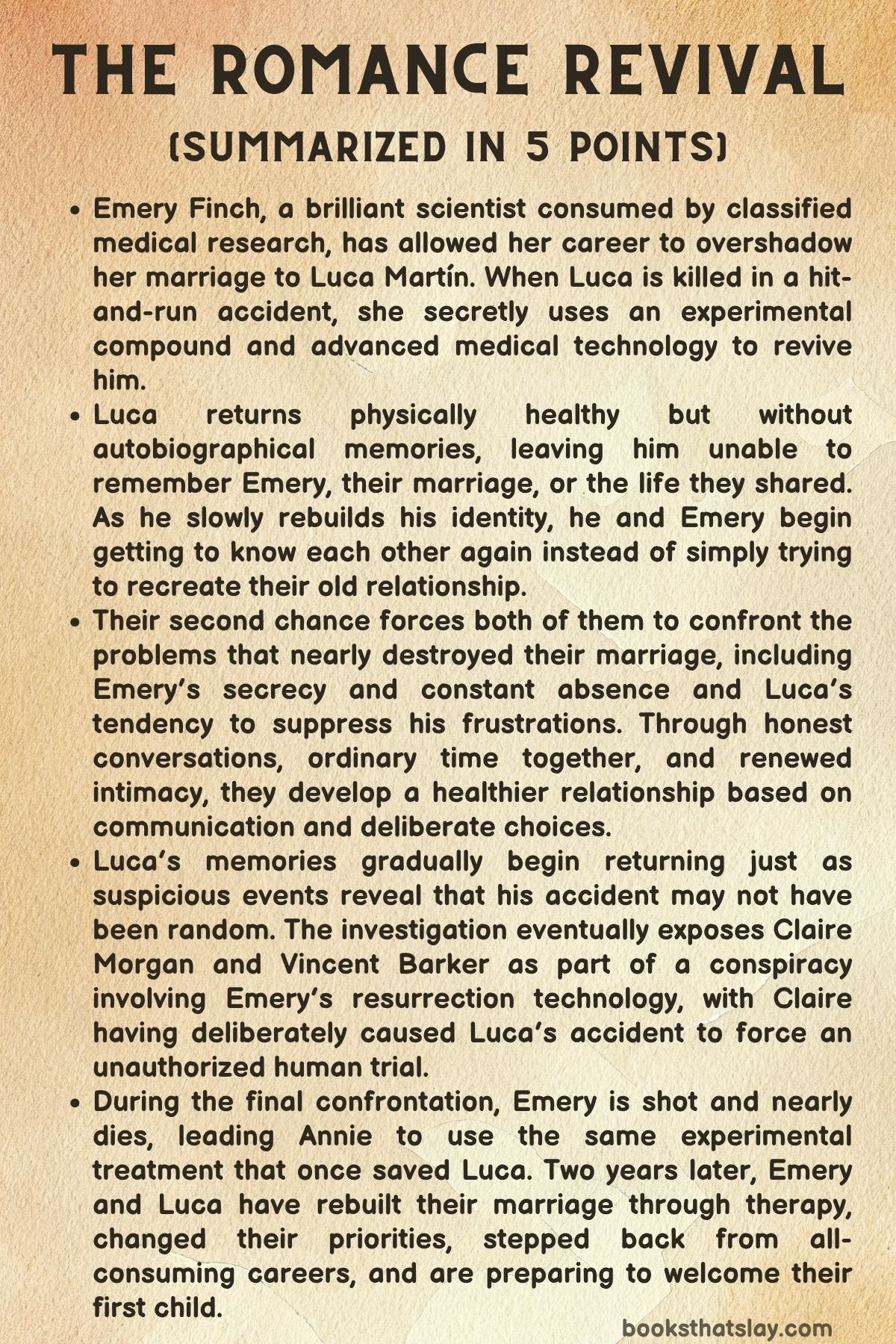
Summary
Emery Finch and Luca Martín appear mismatched from the beginning. Emery is intensely ambitious, introverted, skeptical of marriage, and consumed by scientific work, while Luca is warm, social, outdoorsy, affectionate, and certain that he wants marriage and children someday.
Their differences do nothing to weaken their immediate attraction when they meet at a Las Vegas wedding. Emery even tells Luca about the loss that has shaped her life: both of her parents died after a car accident when she was fourteen, leaving her obsessed with developing medical technology capable of giving critically injured people more time to survive.
Within months, Emery and Luca marry. Their relationship is passionate and loving, but Emery enters the marriage carrying a major secret because Luca believes she develops medical lasers for SurgOptix when she actually works for BioNEX, a highly classified research organization hidden beneath the company.
Three years later, the imbalance between marriage and work has become impossible to ignore. Luca handles much of the cooking, household organization, gardening, and emotional maintenance of their relationship while Emery spends most of her life working, and on the morning of their anniversary she forgets the occasion entirely before rushing to an important presentation.
Emery’s professional achievement is extraordinary. Her BioVIVE technology can identify serious medical problems and immediately treat them through methods including targeted chemotherapy, gene editing, laser procedures, and other interventions, and successful animal trials demonstrate how revolutionary the system could become.
The presentation goes wrong when Vincent Barker, a jealous colleague, exposes Emery’s far more controversial project. Compound Y can lower body temperature while maintaining enough cardiovascular and neurological activity to keep a recently deceased organism viable until BioVIVE can attempt repair and revival.
Because Compound Y has been tested without proper authorization, BioNEX suspends the research. Fearing that Vince may seize or destroy it, Emery secretly takes the remaining compound home, even though doing so violates security rules.
Meanwhile, Luca waits for an anniversary dinner Emery has promised to attend. Her continued absence forces him to confront how lonely his marriage has become, and although he still loves Emery, he is exhausted by always being the person who waits, adjusts, forgives, and keeps their shared life functioning.
Emery finally races home determined to explain more about her real work. Before they can have the conversation, Luca crosses the street toward her and is struck by a speeding vehicle, suffering catastrophic blood loss.
Emery attempts CPR but realizes that conventional emergency treatment will arrive too late. With Compound Y sitting in her car, she makes an irreversible decision: she injects Luca immediately after his heart stops and takes him to BioNEX instead of calling an ambulance.
With the reluctant assistance of her friend and colleague Annie Rodriguez, Emery secretly places Luca inside BioVIVE. Against every legal, scientific, and ethical restriction surrounding the project, the machine repairs his injuries and successfully revives him.
Luca wakes physically restored but mentally altered. He understands language and ordinary knowledge, yet possesses no autobiographical memories; he does not recognize Emery, does not know his own history, and is stunned when she reveals that she is his wife.
Taking Luca home creates a strange new reality. Emery must monitor his recovery while concealing the resurrection from BioNEX, and Luca must live inside a house filled with evidence of a life he cannot remember.
Emery introduces him to Honey, a dog previously revived through the same procedure. Honey initially experienced confusion and lost behaviors before recovering much of her former self, giving Emery hope that Luca’s memories could eventually return.
The crisis forces Emery to become more honest than she ever was during their marriage. She explains BioNEX, Compound Y, the death of her parents, her mother’s final voicemail, and the professional obsession that developed from Emery’s conviction that more time could have saved them.
Luca gradually understands that Emery’s secrecy was partly required by her work but that her emotional absence was still a choice. He also discovers a hidden safe inside their home, reinforcing how completely she separated him from major parts of her life.
Rather than insist that Luca become the person he used to be, Emery tells him that he is free to decide what he wants now, including whether he still wants their marriage. That freedom changes their relationship because Luca no longer feels obligated to reproduce emotions and commitments he cannot remember.
The two begin dating each other again. Luca learns about their courtship, visits familiar places, studies photographs, rediscovers his cooking and landscaping abilities, and starts recognizing that procedural memories remain even when his personal history is inaccessible.
Their new relationship is built on conversations they avoided before. Emery admits that work repeatedly came before Luca, while Luca begins recognizing his own tendency to avoid confrontation and suppress dissatisfaction instead of stating what he needs.
Physical attraction remains powerful between them, but it is no longer enough by itself. They deliberately establish new expectations: Emery must stop using secrecy and assumptions as excuses for withholding information, while Luca must speak honestly when something hurts him rather than silently accommodating it.
Outside their relationship, danger continues growing. Their suspicious neighbor Betty Caldwell believes she witnessed Emery killing Luca because she saw him bleeding in the street, saw Emery inject him, and then watched her drive away with what appeared to be his body.
Police eventually visit after Betty reports a possible homicide, but Luca manages to convince them that he suffered an accident and has been recuperating at home. The encounter unexpectedly strengthens his connection with Emery because they face the danger together as partners.
Soon another threat emerges. Honey disappears from the backyard and later returns with a shaved patch and puncture wound, indicating that someone deliberately took a blood sample from the revived dog.
At roughly the same time, Luca’s memories begin returning in fragments. He remembers childhood moments involving Crash, unconsciously whistles the couple’s wedding song, and recognizes pieces of his previous life that nobody has recently explained to him.
Emery and Luca travel to Yosemite, where they allow themselves several uninterrupted days together. Emery refuses a BioNEX request that would once have cancelled their plans, demonstrating that she is finally learning to establish boundaries between professional purpose and personal happiness.
During the trip, Luca’s memories become stronger, but he also realizes that he is frightened of remembering the resentment he once felt toward Emery. He has fallen in love with the woman she is becoming and worries that recovering his old pain could threaten their newly created relationship.
Their renewed commitment deepens, and Luca tells Emery that he loves her. By the time they return home, they are no longer simply recreating their marriage; they are forming a different partnership based on attention, communication, choice, and shared responsibility.
That progress is threatened when Luca discovers paperwork showing that, one week before the accident, he had retained a family-law attorney because he was considering divorcing Emery. Crash confirms that Luca had become deeply unhappy before his death.
Before Luca can fully process the discovery, an unknown caller threatens to expose Emery’s illegal experiment and orders him to come to an address alone. Wanting to protect her, Luca obeys and disappears.
At BioNEX, Emery and Annie face a separate crisis when investigators recover Luca’s damaged phone and deleted security footage showing that they smuggled a body into the facility and later left with an additional living person. Emery confesses to reviving Luca, and the board demands that he be brought in for examination.
When Emery returns home and discovers Luca missing, she initially fears that the divorce paperwork caused him to leave. She soon realizes that the man Luca has become would confront her rather than disappear without explanation, leading her to suspect that he is in danger.
Betty’s obsessive neighborhood surveillance becomes unexpectedly useful. Camera footage shows Vincent Barker returning Honey after her disappearance, linking him to the suspicious vehicle repeatedly observed around the neighborhood.
When Emery contacts Vince, he confirms that Luca is being held and demands Compound Y, Emery’s research, and Honey in exchange for him. Emery prepares to go to the meeting while Annie, Crash, and Betty insist on accompanying her.
At the warehouse, Emery finds Luca tied to a chair and appears to confirm that Vince is responsible. The greater betrayal comes when Claire Morgan, Emery’s trusted assistant, steps from the darkness holding a gun.
Claire reveals that she deliberately hit Luca on the anniversary night. Knowing Emery’s history and personality, she predicted that Emery would use Compound Y rather than surrender Luca to conventional emergency treatment, thereby creating the first unauthorized human trial of the resurrection technology.
Claire planned to profit regardless of the outcome. Luca’s permanent death could create a scandal exposing classified research, while his successful revival would prove the technology’s enormous value; Vince joined because resentment and greed made him willing to betray BioNEX as well.
Seeing Claire brings Luca’s remaining memories back. He remembers the accident and his former marriage, including months of loneliness, Emery’s deceptions, his own avoidance of confrontation, and the decision to consult a divorce lawyer.
Yet remembering why he once wanted to leave does not erase the love he has developed after his revival. Luca realizes that his first marriage had become unsustainable, but the relationship he and Emery rebuilt afterward is fundamentally different.
Claire orders Vince to kill Emery and Luca, but Vince finally turns against her. Annie, Crash, Betty, and police officers intervene, and during the confrontation Betty shoots Claire while Emery is also struck by a bullet.
Emery is now the one dying from catastrophic blood loss. Annie injects her with Compound Y, reversing the situation that began the story and giving Emery the same possibility of survival she once gave Luca.
Emery awakens inside BioVIVE with her memories intact and finds Luca waiting for her. Having both survived death, they are finally free to build a marriage based not on habit or obligation but on decisions they have consciously made after discovering how easily their old life could have ended.
Two years later, their life has changed dramatically. Claire and Vince have been imprisoned, BioVIVE has been transferred to an internationally supervised scientific consortium, and Emery has stepped away from the career that once consumed her identity.
Emery and Luca have also spent two years in couples therapy, improving their relationships with family and transforming Betty from suspicious neighbor into a close companion. Most importantly, Emery is pregnant with their daughter, and the couple now treats everyday life together as something to protect rather than something that can always be postponed until later.
Characters
Emery Finch Martín
Emery is the central force behind The Romance Revival, and much of her development concerns the difference between loving someone and actually building a life in which that person feels loved. She never doubts her feelings for Luca, yet before his accident she repeatedly behaves as though the relationship can survive indefinitely on affection while her career receives most of her time, attention, and emotional energy.
Her professional obsession originates in childhood trauma rather than simple ambition. Losing both parents in a car accident, especially knowing her mother survived long enough to leave a final message, gives Emery a lifelong need to defeat the narrow boundary between survivable injury and irreversible death.
This history makes her work understandable without excusing the damage it causes. Emery turns grief into scientific purpose so completely that she begins treating every sacrifice as justified by the importance of her research, including sacrifices Luca never consciously agrees to make.
Her greatest moral transgression is also her greatest act of love. When Luca dies, she uses an unapproved compound on him without consent and secretly transports him to BioNEX, violating professional rules because accepting his death is emotionally impossible for her.
The consequences force Emery into sustained self-examination. She recognizes that secrecy agreements may explain why she could not reveal everything about BioNEX, but they do not explain missed dinners, forgotten promises, emotional avoidance, or the assumption that Luca would always accommodate her.
Her growth becomes visible through ordinary decisions rather than dramatic declarations. She cooks badly for Luca, spends time gardening, goes on dates, refuses to interrupt Yosemite for work, and gradually learns that presence is something actively practiced rather than something guaranteed by marriage.
By the conclusion, Emery no longer defines herself entirely through scientific achievement. Her willingness to take time away from work, attend couples therapy, reconsider motherhood, and imagine a future without BioNEX shows that she has expanded her identity rather than merely abandoned ambition.
Luca Tomás Martín
Luca is the emotional counterweight of The Romance Revival, but his easygoing personality initially hides serious weaknesses of its own. He is caring, patient, domestic, affectionate, and naturally inclined to support others, yet those strengths gradually become mechanisms through which he avoids difficult confrontation.
His childhood helps explain this tendency. Because his parents were often absent and he became responsible for his younger sisters, Luca learned early to care for other people while expecting relatively little attention for himself.
That pattern carries directly into his marriage. Luca cooks, organizes the household, maintains the property, adapts to Emery’s schedule, and accepts disappointments until resentment becomes so great that he secretly consults a divorce lawyer rather than forcing a decisive confrontation.
His resurrection removes autobiographical memory while leaving language, knowledge, skills, preferences, attraction, and aspects of temperament intact. This makes him both the same person and someone newly liberated from the emotional habits that governed his former life.
The new Luca questions Emery directly. He asks whether they were happy, demands explanations about her work, reacts to evidence of secrecy, and eventually insists that their relationship must include open disagreement rather than polite avoidance.
His amnesia also turns love into an act of renewed choice. Luca cannot remain married merely because he remembers making vows; he has no emotional memory of those vows, so every movement toward Emery occurs because the person he is now genuinely likes, desires, trusts, and eventually loves her.
Recovering his old memories creates the story’s most important test of this new identity. Luca remembers the neglect, resentment, deception, and divorce consultation, yet he does not interpret those memories as commands that determine his future.
Instead, he accepts both versions of himself. The former Luca was justified in being unhappy, while the present Luca is equally justified in recognizing that Emery has changed and that their rebuilt relationship deserves to continue.
Dr. Annabella “Annie” Rodriguez
Annie is Emery’s closest friend, professional collaborator, moral challenger, and eventual protector. Her importance comes partly from the fact that she supports Emery without automatically approving every decision she makes.
When Emery brings Luca’s body to BioNEX, Annie immediately understands the magnitude of what has happened. She objects to the unauthorized human experiment and repeatedly raises the safer option of contacting emergency services, yet when Emery refuses, Annie helps because abandoning Luca would guarantee his death.
Annie consequently becomes responsible for protecting both Luca and Emery from the scientific, medical, and institutional consequences of the experiment. She evaluates Luca’s recovery, helps explain his memory condition, monitors Honey, manages practical problems, and shares responsibility when BioNEX eventually discovers the truth.
Her friendship is valuable because it contains honesty. Annie is willing to tell Emery when her choices are reckless, but she also refuses to allow Emery to take sole responsibility during the board investigation.
Her decisive role appears when Emery is shot. Rather than freezing, Annie uses Compound Y on Emery, applying the same scientific principle that Emery once used on Luca and completing the proof that the technology can preserve human life after catastrophic injury.
Claire Morgan
Claire is effective as an antagonist because she spends most of the story disguised as a dependable subordinate. She works closely with Emery, appears supportive, and even seems helpful when suspicions initially focus on Vince.
That apparent loyalty allows Claire to manipulate events without becoming the obvious suspect. Her betrayal becomes much more personal than Vince’s because Emery has trusted her inside the very research program Claire intends to exploit.
Claire’s plan demonstrates both intelligence and extreme moral detachment. She deliberately strikes Luca with a vehicle because she understands Emery well enough to predict that, under the right circumstances, Emery will use Compound Y on him rather than accept his death.
She therefore turns Emery’s love and unresolved grief into components of an involuntary experiment. Luca is not merely attacked for revenge or convenience; his body becomes a test Claire engineers so that she can obtain proof of concept without assuming the scientific and legal risk herself.
Her motivation ultimately reduces a lifesaving technology to financial value. Where Emery’s obsession grows from grief and the desire to save people, Claire views resurrection primarily as something that can be stolen, demonstrated, and sold.
Vincent “Vince” Barker
Vince functions as an obvious antagonist long before the deeper conspiracy becomes visible. Competitive, resentful, and professionally insecure, he dislikes the possibility that Emery’s BioVIVE will eclipse his own BioSCAN and publicly exposes Compound Y partly to undermine her position.
His behavior makes him easy to suspect, which helps conceal Claire. Vince’s sabotage, hostility, and willingness to participate in the kidnapping demonstrate genuine corruption even though he is not the principal architect of the attack on Luca.
His motives are dominated by envy and entitlement. Vince believes other people will profit disproportionately from technology connected to his own work, so he rationalizes betrayal as a means of claiming what he thinks he deserves.
Even so, he retains a limited moral boundary that Claire lacks. He secretly returns Honey after becoming uncomfortable with parts of the scheme and eventually refuses Claire’s order to murder Emery and Luca, turning against her during the final confrontation.
That decision does not erase his crimes. It instead distinguishes weakness and greed from Claire’s willingness to engineer death as a business strategy.
Crispin “Crash” Barnett
Crash represents continuity in Luca’s life. Their friendship reaches back to childhood and survives the extraordinary problem of one friend remembering decades of shared experiences while the other remembers none of them.
His first reaction to the resurrection secret is humor, but the jokes quickly give way to genuine sadness when he realizes Luca cannot remember their history. Rather than demanding that Luca recover the old friendship, Crash decides they can simply build it again.
That response mirrors the larger philosophy of Luca’s second life. Crash recognizes that memory matters, but relationship is also created through present behavior.
He is additionally one of the few people willing to discuss Luca’s old marriage without turning either spouse into a villain. Crash confirms that Emery’s absence hurt Luca while still insisting that the present Luca must make his own decisions about the future.
His loyalty becomes active during Luca’s kidnapping. He joins Emery, Annie, and Betty in searching for him and refuses to allow Emery to face the danger entirely alone.
Betty Caldwell
Betty begins as a comic and potentially dangerous neighborhood observer. Her habit of watching vehicles, recording activity, and noticing unusual behavior makes Emery view her as an intrusive nuisance, especially after Betty witnesses enough of Luca’s accident to conclude that Emery may have killed him.
Her suspicion is entirely reasonable from the evidence available to her. She sees Luca bleeding, watches Emery inject him, observes her moving his apparently lifeless body, and later notices that the blood at the scene has disappeared.
Betty therefore acts as an unexpected form of accountability. The secrecy that protects BioNEX cannot control an ordinary neighbor who is paying attention, making her a threat precisely because she exists outside Emery’s professional world.
Her apparent eccentricity becomes an advantage once Luca is kidnapped. Betty’s detailed records and surveillance footage provide crucial evidence linking suspicious neighborhood activity to Vince.
After learning the truth, Betty adapts quickly because her late husband’s classified intelligence work gives her some understanding of lives divided between public appearances and secret responsibilities. Her eventual participation in Luca’s rescue turns the suspicious neighbor into an unlikely ally, and the epilogue confirms that she becomes genuinely close to the couple.
Honey
Honey occupies an unusual position because she is both a beloved dog and living scientific evidence. Before Luca, she was successfully revived through Compound Y and BioVIVE, making her recovery the closest precedent Emery has when trying to understand Luca’s condition.
Her initial confusion and eventual behavioral recovery give Emery hope that autobiographical memory may not be permanently lost. For Luca, meeting Honey also makes his extraordinary experience slightly less isolating because another living creature has survived the same experimental process.
Honey later becomes valuable evidence to the conspirators. Her disappearance, shaved fur, and puncture wound show that someone is investigating the biological effects of the revival procedure.
Her role therefore moves between companion, precedent, evidence, and target while reinforcing the ethical problem of treating living beings primarily as scientific data.
Tom Halliday
Tom Halliday is one of Emery’s assistants at BioNEX and belongs to the professional world surrounding BioVIVE. Although he receives less direct development than several other supporting figures, his presence establishes that Emery’s accomplishments result from work taking place within a larger research structure rather than in isolation.
Later, Tom and Claire are among the people associated with monitoring Vince when sabotage is suspected. His comparatively limited role also makes him a contrast to Claire: both operate near Emery professionally, but only Claire uses that proximity as part of a larger betrayal.
Leonard
Leonard represents the institutional demands of BioNEX. His request that Emery return for a meeting about BioVIVE becomes important because Emery’s response reveals how much she has changed.
Earlier in her life, such a request would have immediately displaced personal plans. Before Yosemite, however, Emery tells Claire that Leonard will have to wait until she returns, discovering that professional boundaries do not automatically produce disaster.
Leonard therefore functions less as an individually developed personality and more as a symbol of the professional authority Emery once allowed to determine the structure of her entire life.
Jeffrey Lopez
Jeffrey Lopez is BioNEX’s security chief and becomes important when the institution finally discovers evidence of Luca’s unauthorized revival. He presents the damaged phone, recovered surveillance footage, and biometric irregularities that make continued denial impossible.
His role emphasizes that Emery and Annie’s concealment cannot last indefinitely inside an organization built around intensive monitoring and classified information. The recovered evidence forces Emery to stop managing the consequences privately and confront the institutional reality of what she has done.
Shandra
Shandra, Leonard’s assistant, has a brief but important function near the end of Emery and Luca’s Yosemite trip. Her urgent call tells Emery that BioNEX once again requires immediate attention.
The moment tests whether Emery’s newfound boundaries can survive professional pressure. Luca does not demand that she stay home; he asks only that she communicate, showing how different their rebuilt relationship has become from the silent resentment and assumptions that characterized their earlier marriage.
Ana Maria and Sofia
Ana Maria and Sofia are Luca’s younger sisters. Although their individual personalities receive limited attention in the supplied material, they are important to understanding why Luca became such an accommodating caretaker.
Because their parents were frequently absent, Luca assumed significant responsibility for his sisters while growing up. That experience helped make caregiving natural to him but also taught him to suppress his own needs.
The epilogue notes that Luca and Emery’s family relationships improve, particularly with his sisters. Their presence therefore connects his childhood responsibilities with the healthier extended-family life he and Emery eventually create.
Luca’s Parents
Luca’s parents influence him primarily through absence. Their repeated prioritization of other interests leaves Luca learning that love can coexist with neglect and that maintaining relationships may require accepting less attention than he actually needs.
This history helps explain why he tolerates Emery’s unavailability for so long. He does not initially interpret being placed second as an unacceptable condition because emotional accommodation has been part of his life since childhood.
The novel does not excuse Luca’s avoidance through this background. Instead, his second life allows him to recognize that caring for other people does not require abandoning his own needs.
Emery’s Parents
Emery’s parents remain central despite being dead before the main events begin. Their accident becomes the emotional origin of BioVIVE and Compound Y because Emery spends adulthood imagining how different medical technology might have prevented their deaths.
Her mother’s final voicemail is especially significant. Knowing that her mother remained alive for a period after the accident turns Emery’s grief into a technical problem she believes science might someday solve.
That motivation explains why Luca’s accident destroys Emery’s ability to behave like a detached scientist. Faced with another person she loves bleeding to death in front of her, she refuses to accept the same outcome she experienced as a teenager.
Frank
Frank is the name used by the suspicious man Luca encounters while walking Honey near the site of his accident. He claims he is considering buying a house in the neighborhood, yet his questions about Luca, Emery, and Honey immediately feel intrusive.
Betty later confirms that no nearby houses are actually for sale, strengthening the suspicion that his stated reason for being there is false. The supplied material does not definitively identify Frank, so his importance lies primarily in confirming that Luca and Emery are being watched.
Themes
Second Chances and the Meaning of Renewal
The Romance Revival treats a second chance as something far more demanding than simply reversing a mistake. Luca’s literal return from death gives the marriage another opportunity, but the book consistently shows that survival alone cannot repair the problems that existed beforehand.
Luca comes back without autobiographical memory, which prevents the couple from pretending that everything can simply continue where it stopped. Emery cannot rely on the fact that he once loved her, and Luca cannot rely on old habits or marital obligation when deciding whether to stay.
Their relationship therefore has to be created through present choices. They go on dates, discuss conflict, renegotiate expectations, share household experiences, reconsider their future, and slowly form an emotional connection independent of Luca’s missing history.
The return of his memories eventually strengthens this idea rather than undermining it. Luca remembers that he had been preparing for divorce, so the new relationship cannot be dismissed as a continuation of an uncomplicated past.
He understands that his former decision made sense while still choosing Emery again because the conditions of their relationship have changed. Renewal consequently requires more than restoring what existed; it requires recognizing what failed, preserving what mattered, and deliberately creating something healthier.
Love, Presence, and Emotional Neglect
Emery loves Luca throughout the story, but her behavior demonstrates that love does not automatically make a partner feel valued. Before the accident, she repeatedly assumes that Luca’s patience will compensate for her absence, allowing work to consume anniversaries, evenings, household responsibilities, and opportunities for ordinary companionship.
Luca’s response complicates the issue because he participates in maintaining the unhealthy arrangement. Instead of clearly confronting Emery, he adapts, waits, cooks alone, manages the house, and suppresses disappointment until he eventually seeks legal advice about divorce.
Their rebuilt marriage requires both characters to change their understanding of love. Emery learns that devotion has to appear in schedules, attention, communication, shared labor, and willingness to say no to work.
Luca learns that kindness without boundaries can become self-erasure. His new willingness to ask difficult questions and remain present during uncomfortable discussions allows disagreements to become constructive rather than threatening.
Small domestic scenes carry unusual importance because they represent precisely what the couple previously lacked. Cooking together, gardening, watching movies, travelling, sharing mornings, and protecting time from work become evidence that emotional security is created through repeated acts of presence.
The story ultimately separates loving someone from merely assuming that love will survive neglect.
Memory, Identity, and Personal Choice
Luca’s amnesia raises a fundamental question about whether identity depends on remembered experience. After revival, he retains language, physical abilities, preferences, attraction, procedural knowledge, and personality traits while losing the personal history that once gave those qualities context.
This creates a version of Luca who is recognizably himself yet no longer governed by every emotional pattern of his previous life. He can cook without remembering learning recipes, feel comfortable with Crash without remembering their adventures, and respond physically to Emery without remembering their marriage.
The separation between memory and instinct allows the story to examine how much of a person is inherited from experience and how much can be consciously reshaped. Emery eventually tells Luca that he does not have to become the person everyone keeps describing, giving him permission to treat his lost past as information rather than obligation.
When his memories return, the new identity is not erased. Luca integrates his old resentment with his newer experiences and chooses which lessons deserve to influence his future.
Emery undergoes a parallel transformation without amnesia. She remembers everything yet also chooses not to remain defined by the woman she once was, demonstrating that reinvention does not require forgetting the past; it requires refusing to let the past become the only possible version of oneself.
Science, Ethics, and the Desire to Defeat Death
Compound Y and BioVIVE begin as responses to an intensely human problem: critically injured people sometimes die not because their injuries are absolutely untreatable, but because medicine cannot repair them quickly enough. Emery’s research attempts to extend that narrow period by temporarily preserving the body until treatment becomes possible.
The potential benefit is enormous, but the story repeatedly exposes the ethical danger created when scientific possibility moves faster than accountability. Emery illegally takes Compound Y home and uses it on Luca without consent, Annie assists with an unauthorized human procedure, and BioNEX itself operates within a secret environment where extraordinary technologies are developed outside ordinary public scrutiny.
Claire represents the darkest version of this problem. She intentionally creates a fatal injury so that Emery will unknowingly perform the human trial Claire wants, converting Luca’s life into experimental evidence.
Institutional interest creates additional concerns once the military becomes interested in the technology. Emery’s reaction shows that successfully inventing something does not necessarily give its creator control over how governments, corporations, or other powerful institutions will use it.
The eventual transfer of BioVIVE to an internationally supervised consortium suggests that technologies capable of radically altering life and death require oversight beyond the ambition, grief, profit motive, or judgment of any single individual.