Demons and Diplomacy Summary, Characters and Themes
Demons and Diplomacy by Megan Frampton is a supernatural historical romance set in a transformed Victorian Britain where humans openly coexist with demons, vampires, fairies, ogres, and other beings after an event known as the Great Revelation.
At its center is Cora Hastings, a human government species ombudsman assigned to manage Satan’s month-long visit to London and prevent an international catastrophe. Her work brings her into constant contact with Satan’s formidable heir, Marcellus, and their uneasy professional partnership gradually becomes personal. Alongside the romance, the book explores diplomacy, prejudice, political extremism, social change, consent, independence, and the difficulty of building trust between people raised according to very different moral systems. It’s the 1st book of the Ministry of Supernatural Affairs series.
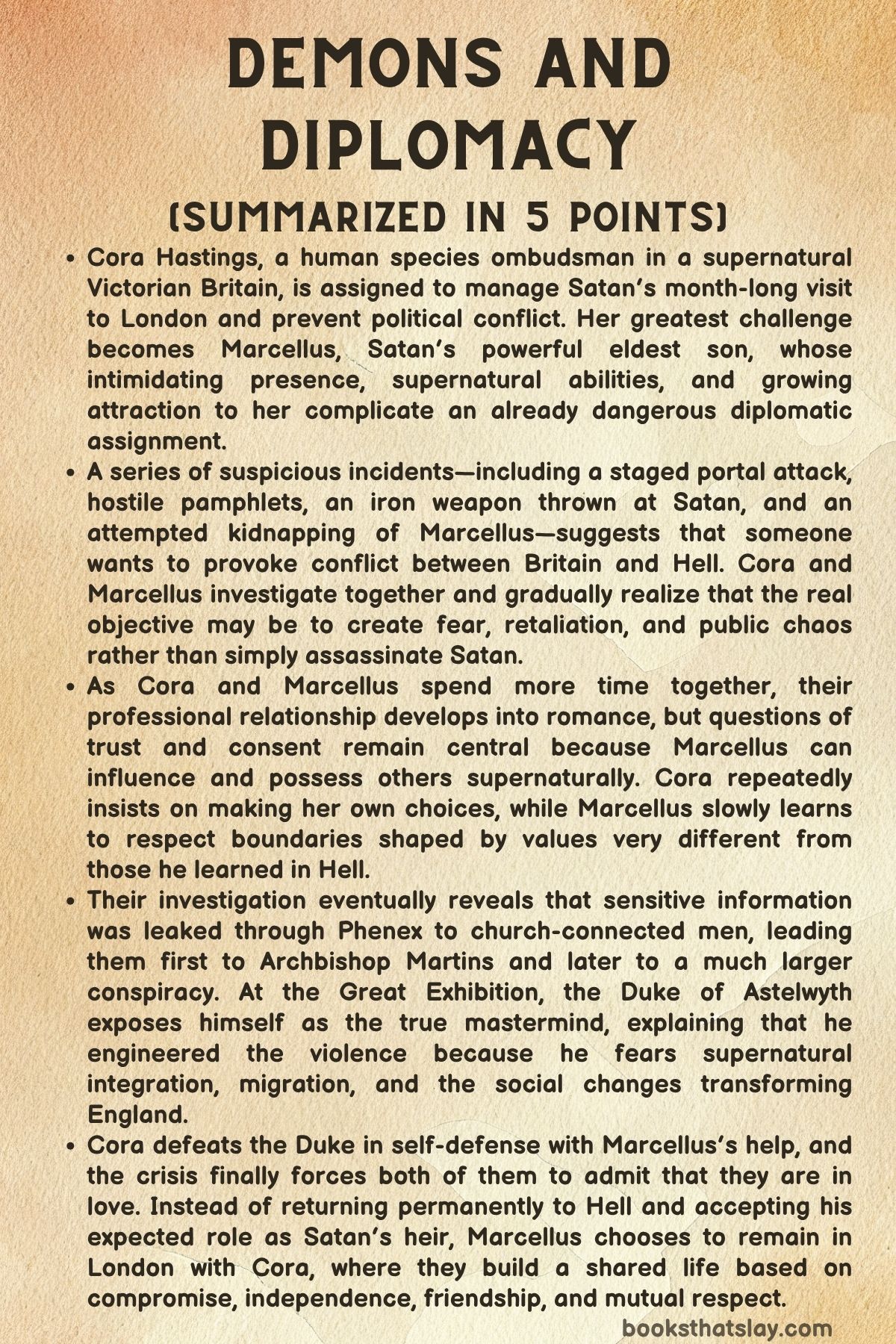
Summary
Cora Hastings is the only human species ombudsman working for the British government following the Great Revelation, which has forced humans and supernatural species to learn how to coexist. Her unusual career has given her independence in a society where women still face severe social restrictions, so when Lord Hennawi and Mr. Connors assign her to serve as the official liaison for Satan during his month-long visit to London, she sees the dangerous assignment as an opportunity to prove that her profession has value.
Satan arrives at Clarence House accompanied by an enormous infernal delegation, and Cora quickly learns that managing the Devil will require patience rather than traditional ideas of heroism. Satan is arrogant, demanding, curious, easily bored, and accustomed to getting whatever he wants, while his eldest son and probable heir, Marcellus, manages the practical details surrounding him.
Cora immediately finds Marcellus intimidating and physically attractive, though neither quality convinces her to surrender her authority. Marcellus likewise notices that she refuses to be frightened by his position, creating a tense relationship based on argument, professional necessity, and increasing fascination.
The first major problem begins when Satan sees an advertisement for a church bazaar and decides he wants to attend. Cora has little time to make the church safe for a demonic visitor, but she succeeds in arranging entry after overcoming supernatural restrictions that prevent Satan from entering without an invitation.
The outing suddenly becomes violent when a portal to Hell opens near the altar and humbeetles and lesser demons enter the church. Cora fights beside Marcellus instead of remaining safely behind, even rescuing him when one of the creatures attaches itself to him, and together they secure the portal.
Cora initially suspects that the breach may indicate a serious threat, only to discover later that Marcellus deliberately arranged the entire incident as a security test. She is furious that innocent people were placed in danger simply so he could judge her capabilities, and their disagreement establishes one of the central conflicts between them: Cora places enormous value on preventing harm to ordinary people, while Marcellus has been raised in a culture where danger and violence are accepted far more casually.
Their assignment becomes politically serious during a Buckingham Palace dinner hosted by Queen Victoria. Victoria, herself a vampire in this altered Britain, reveals that she has received a warning claiming Satan intends to unleash Hell upon England, while reports of strange demonic activity elsewhere in the country increase concerns.
Satan denies responsibility, and Cora proposes that someone may deliberately be encouraging distrust between Britain and Hell. Her reasoning earns Marcellus’s attention because conflict between the two powers could benefit someone who fears cooperation between supernatural and human societies.
Outside the palace, the professional tension between Cora and Marcellus turns personal when he reveals that he can supernaturally influence others. He kisses her after suggesting she will enjoy it, leaving Cora furious because she cannot initially know whether her response belongs entirely to her.
She slaps him and then deliberately kisses him herself, proving that attraction exists independently of any power he might possess. The incident creates a continuing concern about consent, because Cora refuses to allow supernatural influence to make decisions for her.
The danger surrounding Satan soon becomes undeniable. Hostile pamphlets appear across London, and during a visit to the Tower of London someone throws an iron weapon at Satan, exploiting a specific demonic weakness and proving that the attacker possesses specialized knowledge.
Cora and Marcellus suspect that information about Satan’s movements is being leaked from inside the delegation. Rather than immediately involve the wider government, they begin investigating privately, worried that official intervention might worsen already unstable relations.
Their search brings them into greater contact with Satan’s staff and gives Cora opportunities to see Marcellus outside formal diplomatic situations. During an evening at the Badger and Whistle, Marcellus relaxes enough to joke about his father, while Cora learns more about figures such as Phenex and begins viewing Hell’s representatives as individuals rather than a single threatening group.
Marcellus also learns why Cora chose her unusual profession. She explains that marriage has never appealed to her because Victorian law and convention would place too much of her life under a husband’s control, whereas becoming an ombudsman allowed her to support herself and help humans and supernatural species coexist.
Their careers prove unexpectedly similar. Marcellus spends much of his existence mediating Satan’s disputes and preventing his father’s impulsive decisions from becoming catastrophes, meaning both he and Cora have built lives around controlling powerful personalities and negotiating between conflicting interests.
Cora’s investigation takes her to an anti-Devil gathering held in a church. There she encounters Az’gen, a nervous worker from Hell secretly attending the meeting, while speakers encourage fear of Satan and depict his visit as an approaching invasion.
Marcellus arrives and uses supernatural compulsion to make Cora leave the potentially hostile gathering. This time she can clearly recognize the external force pushing against her will, which gives her reason to believe her earlier attraction to him was genuine even though she remains angry about his willingness to override her choices.
Their relationship becomes increasingly intimate through shared meals, private conversations, teasing, jealousy, and physical attraction. During a carriage ride, they finally allow that attraction to become sexual, but Cora deliberately gives permission before the encounter advances, ensuring that Marcellus understands that her participation must always be chosen.
Meanwhile, they conclude that killing Satan may not be the conspiracy’s actual objective. A failed attack could be more useful than a successful assassination if it provoked Satan into retaliating against Britain and convinced humans that demons represented an uncontrollable danger.
Marcellus hosts an elaborate party at Clarence House partly as a diplomatic event and partly to observe possible suspects. Humans and supernatural guests mix successfully, while Cora’s friends Hannah and Lily help watch the attendees for unusual behavior.
Suspicion begins falling on individuals connected to the Duke of Astelwyth, a powerful government figure who has repeatedly expressed anxiety about Satan and supernatural influence. Cora also encounters Mr. Hall, one of the Duke’s associates, whose remarks reveal strong concerns about immigration, social transformation, and deciding which supernatural species should be permitted to remain in England.
The investigation develops alongside Cora and Marcellus’s emotional attachment. When Marcellus joins Cora, Hannah, Lily, Mrs. Collins, and the other boardinghouse residents for an ordinary dinner, Cora sees that the intimidating Marquis of Hell can comfortably exist within the domestic community she values.
Marcellus, in turn, discovers a form of companionship largely absent from his life in Hell, where status and power dominate relationships. When their attraction again nearly leads them to bed, Cora stops because she wants time to understand what the decision means emotionally, and Marcellus ultimately respects her boundary.
Their investigation becomes more dangerous when Marcellus suddenly collapses during a carriage journey after apparently being exposed to holy water. Masked men attempt to capture him, leaving him too physically weak to defend himself.
Marcellus proposes possessing Cora’s body so he can fight through her, and Cora reluctantly agrees because the situation gives them few alternatives. Their shared consciousness allows him to defeat the attackers using her body, although the experience reinforces both the extraordinary trust developing between them and Cora’s discomfort with his capacity for violence.
A breakthrough follows when Phenex admits that two men connected with church finances befriended and flattered him into revealing information about Satan’s movements. Phenex did not deliberately betray anyone, but his desire to impress his new acquaintances provided the conspirators with the intelligence required for the Tower attack and the attempt to seize Marcellus.
The two men are confronted and, under Marcellus’s supernatural influence, identify Archbishop Martins as the person receiving their information. Satan learns what has happened and demands immediate revenge, but Cora convinces him that personally killing an English religious leader would create exactly the diplomatic disaster their enemy appears to want.
Queen Victoria therefore summons Archbishop Martins and questions him in the presence of Satan, Marcellus, Cora, Prince Albert, and the Duke of Astelwyth. Martins claims he acted to protect his religious community, but Victoria responds according to her own ruthless standards by killing him herself, horrifying Cora while depriving Satan of the retaliation he wanted.
Believing the conspiracy has finally ended, Cora turns her attention toward Marcellus and the limited time remaining before his return to Hell. She has realized that she loves him but assumes their relationship has no practical future, so she chooses to spend one complete night with him before the delegation leaves.
They go to a private club where they can be together discreetly, and their physical relationship finally becomes complete. Their intimacy is accompanied by personal conversation about Marcellus’s family, his life in Hell, and subjects they have previously avoided, yet neither is willing to confess love because both still assume separation is inevitable.
The following day brings the opening of the Great Exhibition at the Crystal Palace, which is supposed to be Cora’s last major responsibility as Satan’s liaison. During the event, Satan suddenly begins behaving strangely, declaring that supernatural beings should be destroyed while humans should survive.
Cora immediately understands that Satan has been possessed. She and Marcellus locate the unconscious body of the demon responsible, and Cora activates a government-issued amulet capable of neutralizing supernatural power within its range, forcing the possession to end.
The apparent resolution exposes the real conspiracy. The Duke of Astelwyth reveals that he orchestrated the campaign because he fears the social changes created by supernatural integration and wants stricter boundaries, fewer powerful supernatural residents, and greater control over who belongs in England.
His purpose was never merely personal revenge against Satan. He wanted to create enough violence and mistrust to turn England against supernatural beings and reverse the social changes he considers dangerous.
With Marcellus weakened by Cora’s amulet, the Duke forces her away from the Exhibition and intends to kill her. Marcellus remains conscious enough to ask permission to possess her again, and Cora agrees, allowing them to plan resistance through their shared thoughts.
The connection accidentally reveals the secret Cora has avoided admitting aloud: she loves Marcellus. Even while trapped in a deadly situation, he reacts with delight and promises that they will discuss her confession afterward.
When the Duke threatens Cora inside a storage room, she and Marcellus work together using her concealed weapons. Cora ultimately kills the Duke in self-defense, an act that deeply disturbs her because taking a life conflicts with the principles that have guided her throughout her career.
Once the amulet’s effects fade, Marcellus returns to his own body and tells Cora that he loves her as well. Later, while Cora struggles with what she has done, he assures her that defending herself against a murderer has not erased the compassionate person she has always been.
Their final obstacle is no longer conspiracy but geography and duty. Cora assumes Marcellus must return to Hell because he is Satan’s eldest son and expected successor, while Marcellus finally challenges the assumption that his inherited position must determine his future.
He chooses to remain in London with Cora, pointing out that Satan has other children capable of inheriting his responsibilities. Rather than demanding that Cora abandon the independent life and career she fought to create, Marcellus decides to build a different life beside her.
After Satan and his delegation return to Hell, Cora and Marcellus spend a short holiday in Sussex with Hannah and Lily nearby. Satan initially reacts badly to his son’s decision, but his anger eventually gives way to reluctant acceptance.
Back in London, the couple moves into larger rooms at Mrs. Collins’s boardinghouse and continues living among the chosen family Cora has created. Marcellus unexpectedly embraces domestic life, develops an interest in cooking, and begins imagining a future restaurant, while Cora continues her government work.
Their relationship does not erase their moral, cultural, or personal differences. Instead, they accept that building a future together requires negotiation, respect, honest disagreement, and repeated choices to understand each other, turning the diplomatic skills that first brought them together into the foundation of their shared life.
Characters
Cora Hastings
Cora Hastings is the central character of Demons and Diplomacy, and her identity is built around independence, practical intelligence, and an unusually strong commitment to coexistence. She has deliberately rejected the safest conventional future available to a Victorian woman because marriage, as she understands it, could leave her legally and socially dependent on a husband, while government service allows her to support herself and shape her own life.
Her work as a species ombudsman also reveals that her independence is connected to a larger philosophy rather than simple personal rebellion. Cora believes the Great Revelation has permanently changed society and that humans cannot respond by pretending supernatural beings will disappear, so she sees communication, compromise, and institutional adaptation as necessary.
Cora’s bravery is repeatedly practical rather than theatrical. She fights creatures at the church, attends hostile political gatherings, investigates assassination attempts, confronts dangerous conspirators, permits Marcellus to possess her when survival requires it, and ultimately defends herself against the Duke.
At the same time, she is not emotionally untouched by violence. Killing the Duke disturbs her profoundly, which reinforces the difference between courage and cruelty in her character: she can use force when there is no other reasonable option without becoming comfortable with harming people.
Her relationship with Marcellus tests her commitment to autonomy more intimately. Because he possesses the supernatural ability to influence minds, Cora refuses to let attraction alone settle questions of consent, and she repeatedly insists upon knowing that her choices belong to her.
That insistence continues even after she trusts him. She stops physical encounters when she needs time, explicitly grants permission when possession becomes necessary, and eventually chooses sexual intimacy according to her own desires rather than social expectations or Marcellus’s wishes.
Cora is also an effective diplomat because she recognizes motives beneath surface events. Her realization that the conspiracy may benefit from a failed assassination more than a successful one allows her to understand that fear, retaliation, and political spectacle are the real weapons being used.
By the ending, Cora has not surrendered her profession, friendships, home, or principles for romance. Her relationship succeeds because Marcellus chooses to enter the life she has created rather than requiring her to abandon it, making her final happiness an extension of her independence rather than its defeat.
Marcellus
Marcellus begins Demons and Diplomacy as a figure who appears almost designed to validate Cora’s suspicions about demons. He is powerful, confident, physically intimidating, willing to manipulate people, and so accustomed to danger that he sees little wrong with staging a demonic attack merely to test security.
His values reflect the culture that formed him. Hell has taught him to think in terms of strength, results, rank, punishment, and survival, so the possibility that innocent bystanders might be endangered does not initially carry the same moral importance for him that it does for Cora.
Yet Marcellus is not simply Satan’s brutal heir. Much of his actual work involves mediation, organization, damage control, and managing the consequences of his father’s impulses, which makes him far more similar to Cora than either expects.
His developing affection for her gradually changes the way he evaluates consequences. He does not instantly adopt human morality, but he begins considering how reckless choices could affect Cora’s career, safety, and emotional well-being, demonstrating that love expands the range of people whose interests he takes seriously.
Consent becomes one of the clearest measures of his growth. His early willingness to use supernatural influence on Cora creates justified distrust, but later encounters show him learning that her willingness matters independently of what he personally considers harmless or pleasurable.
This becomes especially clear when she stops an intimate encounter in her room. Although he initially struggles to understand why she hesitates, he accepts the boundary once she explains that the decision belongs to her, and their later intimacy is marked by repeated attention to what she wants.
Marcellus also experiences a transformation in his understanding of home. Hell has given him status and responsibility but little privacy or ordinary companionship, whereas Cora’s boardinghouse introduces him to meals, friendship, teasing, domestic routine, and relationships not governed primarily by hierarchy.
His eventual decision to stay in London is therefore more than a romantic sacrifice. He recognizes that being Satan’s presumed successor is an inherited expectation rather than an unavoidable destiny, and choosing Cora allows him to construct an identity beyond the role assigned to him at birth.
Satan
Satan provides much of the comic energy in Demons and Diplomacy, but he also represents the enormous political danger surrounding Cora’s assignment. He possesses immense power and expects his desires to be satisfied immediately, meaning even relatively ridiculous whims can become diplomatic emergencies.
His enthusiasm for pastries, sightseeing, art, bicycles, entertainment, and the Great Exhibition repeatedly contrasts with his fearsome reputation. This contradiction prevents him from functioning as a conventional embodiment of evil and instead presents him as an ancient, powerful personality with vanity, appetites, impatience, and an almost childish expectation of accommodation.
Satan’s unpredictability nevertheless remains dangerous. When insulted or attacked, he moves rapidly toward retaliation, and Cora’s success frequently depends on redirecting him before anger becomes an international crisis.
His relationship with Marcellus is also important because it explains much about his son’s personality. Marcellus has spent years managing Satan’s demands and consequences, making the heir’s controlling behavior partly the result of having been trained to anticipate disasters before they occur.
Satan can also be pragmatic when a convincing argument reaches him. Cora persuades him not to execute Archbishop Martins because doing so would create precisely the political consequences their enemies desire, showing that even the Devil can accept diplomacy when self-interest and logic align.
His reaction to Marcellus remaining in England reinforces the same quality. He responds badly at first, but eventually accepts that his eldest son will choose another path, suggesting that his authority, while enormous, is not absolute within his family.
Hannah
Hannah is one of Cora’s closest friends and an important representation of the ordinary social changes produced by the Great Revelation. As a fairy sharing a household with a human woman and other supernatural residents, she embodies the everyday coexistence that political extremists insist cannot work.
Her friendship gives Cora a private environment in which she does not have to perform the careful neutrality required by government employment. Hannah notices Cora’s attraction to Marcellus quickly, teases her about it, helps her prepare for important events, and encourages her to consider what she genuinely wants.
She is especially valuable because her support does not become pressure. Hannah does not demand that Cora marry Marcellus, avoid him, sleep with him, or follow conventional rules; she instead reminds Cora that personal decisions should belong to the person making them.
Hannah also participates in the investigation by attending Marcellus’s party and observing potentially suspicious behavior. Her willingness to assist demonstrates that Cora’s chosen family is not merely decorative background but an active source of loyalty and practical support.
Lily
Lily adds confidence, humor, and sexual openness to the social world of Demons and Diplomacy. As a succubus, she belongs to a species that conventional human society might easily reduce to stereotypes, yet the book presents her primarily as Cora’s loyal friend and housemate.
She is comfortable discussing desire in ways that contrast strongly with Victorian expectations surrounding women. This makes her an important influence on Cora, who is attracted to Marcellus but initially inclined to treat that attraction as something dangerous or professionally embarrassing.
Lily’s assistance with clothing is not merely cosmetic. By lending Cora striking gowns and encouraging her to present herself confidently in elite spaces, she helps Cora enter environments such as Buckingham Palace and Clarence House feeling less constrained by the plain identity she normally presents at work.
Her participation in the party investigation also demonstrates social intelligence. Lily moves easily among Satan’s entourage, gathers impressions without making herself conspicuous, and uses sociability as an informal investigative tool.
Queen Victoria
Queen Victoria is one of the most striking reinterpretations of a historical figure in the novel and marks the fifth use of Demons and Diplomacy within this character analysis. As a vampire queen ruling a Britain transformed by supernatural revelation, she combines familiar monarchical authority with literal predatory power.
Victoria is intensely concerned with political stability and Britain’s strategic position. Her questions about Satan’s motives and her preference that Hell align with Britain rather than another nation show that she approaches supernatural diplomacy as an extension of international power.
She is willing to listen to Cora’s reasoning, which gives the ombudsman unusual access to the highest level of government. At the same time, Victoria’s treatment of Archbishop Martins reveals just how different supernaturalized authority can be from Cora’s own ideas about justice.
By killing the archbishop immediately, Victoria resolves the confrontation according to personal sovereign power rather than the procedural fairness Cora would prefer. Cora’s horror reminds readers that cooperation with supernatural rulers does not require approving of all their values.
The Duke of Astelwyth
The Duke of Astelwyth becomes the principal political antagonist because he transforms fear of social change into an organized campaign of violence. Unlike Satan, whose threats are usually direct and obvious, the Duke operates through secrecy, intermediaries, manipulation, leaked information, and carefully manufactured public anxiety.
His ideology centers on control. He fears migration, supernatural power, changing social boundaries, and the possibility that old hierarchies will lose their authority as humans and other species increasingly interact.
The Duke’s conspiracy is therefore designed to create evidence for the worldview he already wants society to accept. By provoking Satan and arranging attacks, he hopes to cause the very conflict that would allow him to claim supernatural beings are dangerous and require stricter restrictions.
His final confession exposes the hypocrisy in this approach. He presents himself as a defender of order while deliberately creating disorder, endangering citizens, arranging assaults, enabling possession, and preparing to murder Cora.
His conflict with Cora is ideological as much as physical. She represents adaptation, mixed communities, negotiated coexistence, female independence, and a government structure designed to solve disputes across species, making her existence itself a challenge to the rigid society he wants restored.
Phenex
Phenex is important because he demonstrates that betrayal does not always arise from deliberate malice. As Satan’s accountant and a member of the infernal entourage, he has access to sensitive information but lacks the suspicion necessary to recognize how interested outsiders might exploit him.
His mistake comes from vanity and a desire to impress people who appear interested in Hell’s innovations. By casually discussing the delegation’s movements, he unknowingly provides information that contributes to the attack at the Tower and the attempted kidnapping of Marcellus.
Cora’s response to Phenex reveals her ability to distinguish foolishness from intentional conspiracy. Marcellus is understandably furious, but Cora recognizes that Phenex has been manipulated rather than recruited as an ideological participant.
His role also emphasizes the vulnerability of diplomatic missions to ordinary human weaknesses. Powerful supernatural abilities are ultimately less relevant to the information leak than flattery, carelessness, and the desire to feel knowledgeable.
Archbishop Martins
Archbishop Martins represents institutional fear presented as moral duty. He justifies surveillance of Satan by claiming he must protect his religious community, allowing him to frame secrecy and hostility as necessary defensive measures.
His involvement becomes more serious because the information collected through church-connected intermediaries contributes to actual violence. Whether he intended every consequence or not, his willingness to participate in covert monitoring helps create the conditions in which attackers can target Satan and Marcellus.
The archbishop also demonstrates how prejudice can become dangerous when institutions grant it legitimacy. A private dislike of demons becomes politically significant once networks of money, influence, information, and authority become involved.
His death at Victoria’s hands complicates his role further. He has participated in dangerous actions, yet Cora is horrified by an execution without anything resembling the process she would consider just, preventing the story from suggesting that opposition to wrongdoing automatically justifies unlimited punishment.
Lord Hennawi
Lord Hennawi represents the senior governmental layer overseeing Cora’s assignment. He understands that Satan’s visit carries consequences extending beyond hospitality, particularly when the possibility of alliances involving Hell becomes politically relevant.
He relies heavily on Cora because her position places her at the intersection of formal government, supernatural society, and practical conflict resolution. His willingness to continue trusting her as the crisis grows demonstrates the institutional importance she earns through competence.
Lord Hennawi is also pragmatic about international power. His concern that Hell might form alliances elsewhere shows that diplomacy after the Great Revelation is already becoming part of ordinary statecraft rather than a temporary emergency.
Mr. Connors
Mr. Connors serves as Cora’s direct superior and provides a more personal connection between her and the government bureaucracy. He appears less imposing than many of the supernatural and aristocratic figures around him, but his confidence in Cora helps make her unusual career possible.
Cora’s discomfort when hiding the Tower attack from him is significant because it shows that she respects him. She is not deceiving an enemy or an incompetent official; she is withholding information from someone she likes because she genuinely believes secrecy may prevent the situation from escalating too quickly.
His concern about unusual activity surrounding Satan’s visit also demonstrates that he takes Cora’s observations seriously. By allowing her to continue after significant developments emerge, he becomes part of the institutional support that lets diplomacy succeed.
Prince Albert
Prince Albert remains a secondary figure, but his presence helps establish the royal and governmental legitimacy surrounding Satan’s visit. He participates in formal events and welcomes the infernal delegation to the Great Exhibition, reinforcing the idea that supernatural diplomacy has become part of official British life.
His role at the Crystal Palace is especially important because the Exhibition symbolizes innovation and exchange across cultures and species. The conspiracy’s final attack occurring within that environment makes Albert’s ceremonial presence part of the contrast between cooperation and deliberate division.
Az’gen
Az’gen is a minor but revealing character encountered at the anti-Devil gathering. As a worker from Hell secretly attending an event hostile to Satan, Az’gen immediately complicates any assumption that all inhabitants of Hell share the same politics or loyalty.
Their nervousness and request for secrecy suggest vulnerability rather than menace. Cora’s encounter with Az’gen reminds her that supernatural societies contain workers, disagreements, personal fears, and internal divisions just as human societies do.
The character also supports the book’s broader rejection of group-based assumptions. Being from Hell does not automatically make Az’gen an unquestioning supporter of Satan, just as being human does not automatically place someone on the side of tolerance.
Mr. Hall
Mr. Hall helps expose the political ideas operating beneath the conspiracy before the Duke openly reveals himself. His comments about preserving England and controlling which supernatural beings should be permitted into the country reveal anxiety about demographic and social change.
What makes his conversation important is its respectable presentation. The hostility does not initially appear as open violence but as concern about boundaries, social order, and deciding who belongs, allowing exclusionary ideas to appear administrative rather than aggressive.
Cora immediately recognizes the implications because her work brings her into daily contact with the people such policies would affect. Mr. Hall therefore serves as an early indicator that the attacks are connected to a broader ideological resistance to integration.
Keres
Keres is part of Satan’s entourage and becomes relevant primarily during the investigation into the information leak. Because one of Keres’s assistants is observed speaking privately with someone connected to the Duke, suspicion temporarily touches Keres’s part of the delegation.
The limited information about Keres prevents the character from receiving the same personal development as Marcellus or Phenex. Even so, Keres’s presence is useful because the investigation repeatedly forces Cora and Marcellus to consider whether danger is coming from Hell, England, or cooperation between individuals on both sides.
Jirzinar
Jirzinar is another member of the infernal delegation considered while Cora and Marcellus examine who might have access to information about Satan’s movements. The character remains peripheral, functioning mainly as part of the wide and sometimes difficult-to-monitor administrative network surrounding the Devil.
That limited role nevertheless contributes to the scale of Cora’s problem. Satan has arrived with numerous officials, assistants, lesser demons, and specialized workers, meaning identifying a leak requires understanding an entire unfamiliar organization rather than questioning a small group of obvious suspects.
Mrs. Collins
Mrs. Collins provides the physical center of Cora’s chosen home. Her boardinghouse allows humans and supernatural residents to share ordinary domestic life, making it a small example of the integrated society Cora hopes can succeed on a wider scale.
Marcellus’s dinner there becomes particularly important because Mrs. Collins’s home offers him something Hell has not: a community organized around food, conversation, familiarity, and mutual affection rather than rank. His later interest in learning her shepherd’s pie recipe signals how thoroughly the boardinghouse changes his understanding of what a satisfying future might contain.
The household also gives Cora stability outside government work and romance. Her independence does not mean isolation; instead, she has built a network of friends and companions whose loyalty becomes one of her greatest sources of security.
Themes
Coexistence, Prejudice, and Resistance to Social Change
The Great Revelation has created a society in which humans can no longer pretend that demons, vampires, fairies, ogres, and other supernatural beings exist somewhere beyond ordinary political life. Demons and Diplomacy treats the resulting conflict not simply as fear of monsters but as a struggle over whether established institutions can adapt when categories that once seemed permanent suddenly become unstable.
Cora represents adaptation because her entire profession exists to solve disputes created by coexistence. Her friendships with Hannah and Lily demonstrate the same principle privately: species that public rhetoric may describe as fundamentally incompatible can share meals, homes, jokes, responsibilities, and loyalty without erasing their differences.
The Duke of Astelwyth represents the opposite response. He fears supernatural migration, mixed communities, technological and social innovation, and the weakening of traditional boundaries, so he attempts to manufacture violence that will make restrictive policies appear necessary.
His plan shows how prejudice can become politically self-reinforcing. If he can provoke Satan into attacking England, the retaliation will appear to prove that his original suspicions were justified, even though the violence occurred because he intentionally created the conditions for it.
The anti-Devil meetings, hostile pamphlets, church networks, and Mr. Hall’s rhetoric show that the Duke’s ideas do not exist in isolation. His conspiracy becomes possible because public fear already provides an audience willing to believe that unfamiliar groups represent danger.
The successful party at Clarence House and Cora’s boardinghouse provide a quieter counterargument. Coexistence is not portrayed as effortless harmony, but as an ongoing practice requiring conversation, boundaries, institutions, and a willingness to treat individuals as more than representatives of a category.
Autonomy, Consent, and the Right to Choose
Cora’s strongest personal value is control over her own life. Her reluctance to marry comes from the restrictions Victorian marriage could impose on women, while her government career allows her to earn a living, establish professional authority, and avoid handing major decisions about her future to someone else.
That concern makes Marcellus’s supernatural power especially dangerous to their romance. Attraction alone cannot satisfy Cora because she needs confidence that her desires have not been created, altered, or overridden by his ability to influence people.
Their first kiss therefore establishes a problem that later encounters must resolve. When Cora experiences unmistakable compulsion at the anti-Devil gathering, she gains evidence that external influence feels different from her voluntary attraction, but Marcellus must still learn that his belief that something is harmless does not give him the right to decide for her.
Cora repeatedly makes her consent explicit as their physical relationship develops. She gives permission during intimate encounters, stops when she is uncertain, asks for time when emotion complicates desire, and later chooses sex because she wants the experience rather than because marriage, social convention, or Marcellus requires it.
Possession extends the same theme into situations involving survival. Marcellus has the power to enter Cora’s body, but the important element is that he asks, and she consciously grants permission when the threat makes their unusual cooperation necessary.
His final decision to remain in London follows the same principle from the opposite direction. Just as Cora refuses to let society or romance dictate her future, Marcellus realizes that being Satan’s eldest son does not require him to accept a predetermined destiny, allowing both partners to choose their shared life freely.
Diplomacy, Trust, and Moral Difference
Cora and Marcellus are attracted to each other long before they genuinely trust each other. Their relationship develops because professional cooperation repeatedly forces them to confront the gap between physical desire and the much harder task of accepting that the other person has been shaped by a very different moral environment.
Cora believes that protecting innocent people is a fundamental obligation. Marcellus begins from a harsher perspective in which danger, coercion, punishment, and physical force are ordinary parts of life, making his decision to stage the church attack entirely reasonable according to standards that Cora finds unacceptable.
The novel does not solve this difference by making one character instantly adopt the other’s entire worldview. Instead, their relationship improves through repeated arguments in which they explain consequences, establish limits, and learn which principles the other will not surrender.
Their investigative partnership develops according to the same pattern. Cora contributes political reasoning, empathy, and an ability to understand how public perception can create conflict, while Marcellus contributes knowledge of Hell, supernatural abilities, security experience, and a willingness to confront threats directly.
Trust therefore becomes an active process rather than a feeling. Cora can trust Marcellus enough to permit possession while still objecting to his violence, and Marcellus can love Cora while recognizing that her moral limits will sometimes prevent him from handling problems according to demonic custom.
Their eventual relationship succeeds because neither assumes love has erased disagreement. They expect to continue talking and compromising, making personal diplomacy as important to their future as the international negotiations that first brought them together.
Identity, Inherited Roles, and Chosen Futures
Many characters are initially defined by categories that appear to dictate what their lives should become. Cora is a human woman in Victorian Britain, Marcellus is Satan’s eldest son and expected heir, Satan is assumed to represent absolute evil, and supernatural residents are repeatedly judged according to what their species supposedly reveals about them.
Demons and Diplomacy repeatedly challenges those assumptions by showing that identity contains possibilities beyond inherited labels. Cora rejects the expectation that security must come through marriage and creates a professional life in a field that barely existed before the Great Revelation.
Marcellus undergoes the clearest transformation in this respect. For most of his life, his future appears predetermined by his father’s position, and his responsibilities have trained him to think of himself primarily as an administrator, protector, mediator, and eventual successor within Hell.
London exposes him to alternatives he had never seriously considered. Friendship, private domestic life, shared meals, cooking, romance, and the possibility of work chosen for pleasure rather than inherited obligation gradually become meaningful to him.
His decision to remain with Cora is therefore not merely the conventional romantic gesture of choosing love over duty. It is an assertion that lineage does not have to dictate identity, especially when Satan has other children capable of assuming the role Marcellus was expected to inherit.
Cora’s chosen family reinforces the same idea. Hannah, Lily, Mrs. Collins, and the other residents create relationships based on affection and mutual support rather than species, bloodline, rank, or social convention.
The ending preserves difference rather than eliminating it. Cora remains committed to her career and moral standards, while Marcellus remains a demon with experiences and instincts she does not always share, but both choose a future built from decisions they make themselves rather than identities imposed upon them.