Dominion by Addie E. Citchens Summary, Characters and Themes
Dominion by Addie E. Citchens is a dark literary novel about power, reputation, gender, family loyalty, sexual violence, and the stories communities choose to preserve.
Set in Dominion, Mississippi, the book centers on the influential Winfrey family, whose public image of religious leadership, athletic success, and respectability conceals abuse, fear, resentment, and dangerous secrets. Through Priscilla Winfrey and Diamond Bailey in particular, the story examines how women learn to recognize the systems that have controlled them and how difficult it can be to separate love from possession. Emanuel Winfrey stands at the center of the conflict as both the town’s admired “Wonderboy” and a young man whose hidden actions expose the destructive meaning of unchecked male authority.
Summary
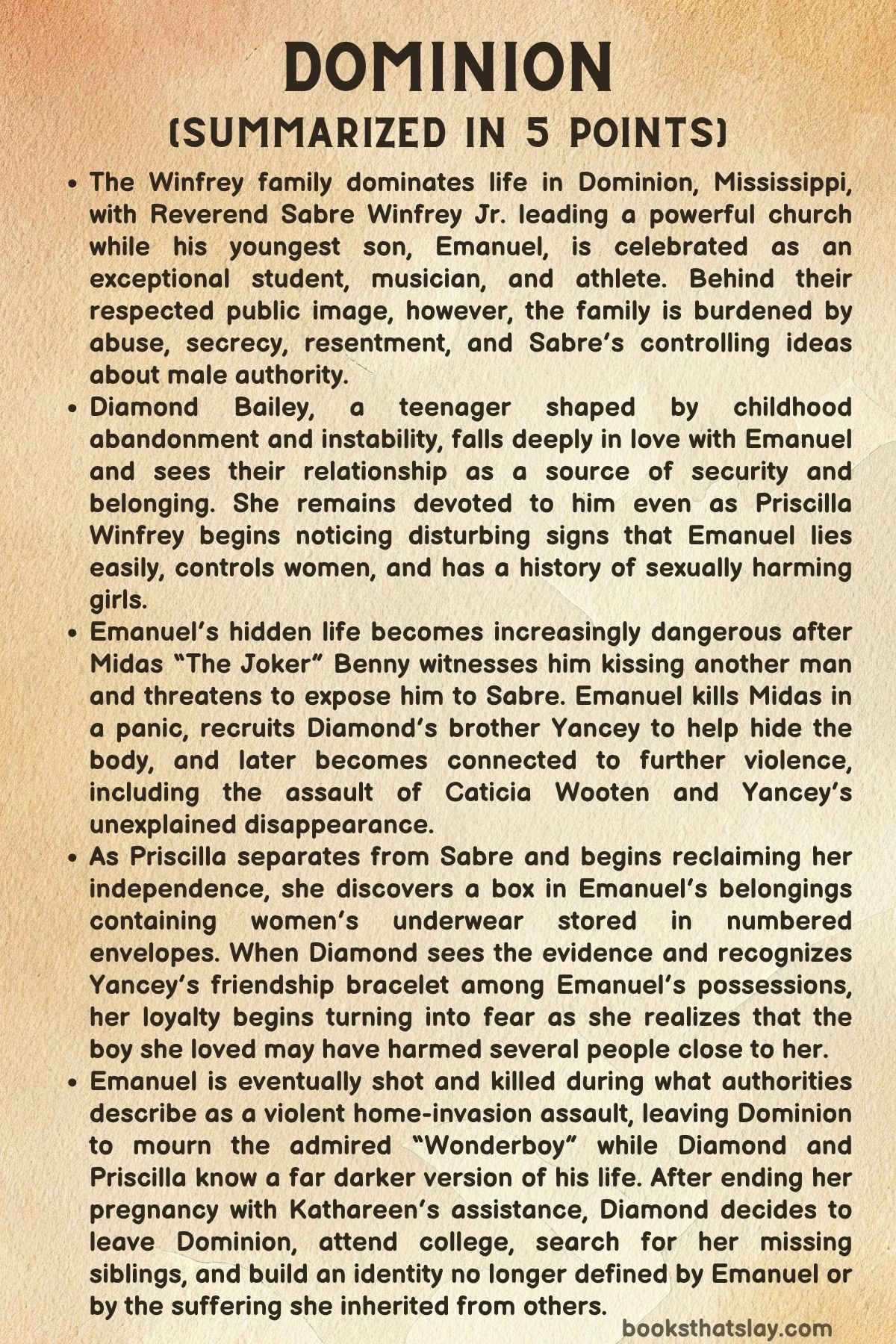
The Winfrey family occupies an almost untouchable position in Dominion, Mississippi. Reverend Sabre Winfrey Jr. leads the enormous Seven Seals Missionary Baptist Church, owns businesses and property, has coached successful football teams, and enjoys the authority that comes from being regarded as one of the community’s most accomplished Black men.
His wife, Priscilla, has spent years beside him performing the demanding role expected of a pastor’s wife. A childhood injury has left her with chronic pain, while the sacrifices of marriage and motherhood have gradually separated her from the ambitions and independence she once possessed.
Their five sons contribute to the family’s image of success, but the youngest, Emanuel, receives exceptional attention. Known as Manny and Wonderboy, he is handsome, academically gifted, musically talented, and an outstanding athlete, making him seem like the perfect continuation of Sabre’s legacy.
Seventeen-year-old Emanuel is dating Diamond Bailey, a girl whose childhood has been defined by instability and abandonment. Diamond grew up with siblings Cricket, Yancey, and Popeye, but her mother disappeared, the adults around the children failed them, and Diamond developed an intense fear that anyone she loved could vanish without warning.
Because Emanuel represents stability, status, affection, and the possibility of being chosen, Diamond attaches enormous emotional importance to their relationship. She interprets his attention as proof that someone as admired as he is can truly love someone from her difficult background.
Priscilla becomes disturbed by Emanuel after unexpectedly discovering him in a sexual situation with Diamond. What unsettles her most is not simply that her teenage son is sexually active but the emotional coldness she detects in him, which reminds her of Sabre’s attitudes toward sex, obedience, and male entitlement.
Her fear is justified by episodes from Emanuel’s earlier life. Long before Diamond understands who he is, Emanuel has assaulted and coerced girls, repeatedly treating their resistance as something he is entitled to overcome and presenting control as a natural part of masculinity.
Priscilla increasingly wonders how much of Emanuel’s behavior was learned from his father. Sabre has used religious ideas about male leadership to justify domination within his marriage, and Priscilla remembers both violence and sexual demands that left her feeling that her own wishes carried little importance.
Even Emanuel openly describes his father striking Priscilla and speaks about relationships in terms of controlling women. The concept of men having “dominion” becomes central to the destructive worldview that connects father and son.
Tension between Priscilla and Emanuel intensifies when her valuable emerald earrings disappear. She suspects Diamond, but Emanuel has actually taken the earrings and given them to his girlfriend, allowing Diamond to wear stolen property without knowing its origin.
When Priscilla later sees Diamond wearing them, she realizes that Emanuel has deliberately deceived her. The discovery becomes another sign that her youngest son can lie calmly while manipulating the people closest to him.
Diamond remains unaware of the larger danger. She sees Emanuel primarily as the boy she loves, even as her brother Yancey warns her that money and respectability do not automatically make powerful men safe.
Emanuel’s hidden life becomes much more dangerous after an encounter at Dominion Field. While training alone, he meets another athletic young man, and an unexpected kiss leaves Emanuel overwhelmed by panic, shame, and fear about what the experience could mean for the identity he has been taught to perform.
Midas Benny, a troubled local man known as the Joker, witnesses the encounter and threatens to expose Emanuel to Sabre. Terrified of humiliation and of his father discovering what happened, Emanuel attacks Midas and kills him.
Rather than report the death, Emanuel turns to Yancey for help. He pays him to assist with moving the body, cleaning the stadium, and hiding the corpse in the woods, then keeps Midas’s notebook while beginning to regard Yancey himself as another threat who may need to be eliminated.
Emanuel then seeks emotional reassurance from Diamond. Their sexual relationship deepens, and he asks her to promise that she will continue loving him regardless of anything she may hear about him.
His behavior toward other women, however, continues to reveal violence rather than vulnerability. Caticia Wooten later returns home injured and tells her father, Jimmy, that Emanuel assaulted her.
Jimmy brings Caticia to the Winfrey house and confronts the family. Emanuel responds with a calm alternative story that shifts blame toward Caticia, creating enough shame and uncertainty for Jimmy to leave without immediately involving law enforcement.
Priscilla does not accept Emanuel’s explanation so easily. Searching his room, she finds the Joker’s notebook and a locked box containing eight numbered envelopes, though fear prevents her from immediately opening them.
Emanuel decides that he must leave Dominion and asks Diamond to go with him. Because she equates loyalty with remaining beside him regardless of circumstances, Diamond agrees without knowing the full nature of the trouble from which he is running.
The two travel to the Mississippi Gulf Coast and briefly experience a freer life together. Diamond sees the beach for the first time, and for several days their escape seems capable of becoming the beginning of a new future.
Back in Dominion, Priscilla discovers that her son has disappeared. Her search for Sabre also exposes his affair with Kathareen, destroying another part of the marriage that Priscilla has spent years preserving despite humiliation and pain.
On the coast, Emanuel becomes increasingly unstable. After spending time drinking and using drugs with new acquaintances, Diamond later finds him unconscious after an overdose involving pills that belonged to Midas Benny.
A note reading “My apology” suggests that Emanuel may have intended to die. Diamond calls for emergency help and saves him, but while going through his belongings she discovers the Joker’s notebook and secretly keeps it.
At the hospital, Diamond remains fiercely loyal. When Emanuel wakes, he behaves strangely, mentions Diamond’s missing mother Sonja, and announces that Diamond is pregnant before she herself has confirmed it.
A pregnancy test later proves that he was correct. Diamond interprets the incident as evidence that Emanuel possesses an unusual spiritual sensitivity, reinforcing her desire to believe that something exceptional and meaningful exists within him.
Sabre responds to the family crisis by publicly confessing that he has abused his power and prioritized his own desires. He steps down from leadership at Seven Seals, acknowledging that his family has suffered while he maintained his position of authority.
Priscilla makes a more personal break. She leaves Sabre, gives up the identity of First Lady, and begins living alone in a small house, where she experiences independence for perhaps the first time in her adult life.
Meanwhile, hunters discover Midas Benny’s remains. Priscilla immediately remembers finding his notebook among Emanuel’s possessions, yet she still struggles to act on the terrible conclusions forming in her mind.
Diamond is now visibly pregnant, while Emanuel has transferred to Dominion Academy and has become emotionally distant. Still hoping for marriage and permanence, Diamond even approaches Kathareen for spiritual help that might cause Emanuel to love and marry her.
Kathareen refuses to participate in controlling another person and instead urges Diamond to create a life belonging to herself. That advice becomes increasingly important as both Diamond and Priscilla begin confronting the evidence they have avoided.
Priscilla finally opens Emanuel’s hidden box. Inside the numbered envelopes are women’s underwear that he has collected, transforming her suspicion into a recognition that Emanuel’s violence may involve multiple victims.
She invites Diamond to her new home and offers money for education, childcare, and a future independent of Emanuel. Diamond initially fears that the Winfreys want to take her baby, but Priscilla is attempting to protect her from the kind of dependency that has defined much of her own life.
Priscilla also tells Diamond about Caticia’s accusation and shows her the contents of Emanuel’s collection. Diamond is devastated because Emanuel had persuaded her to believe that their first sexual experience was equally new for both of them.
The most frightening discovery is a friendship bracelet that Diamond once made for Yancey. Her brother had been wearing it the last time she saw him, when Emanuel was also present.
Diamond begins to suspect that Yancey may be dead. No one she contacts has seen him since that period, and the possibility forces her to reconsider Emanuel not simply as an unfaithful or dishonest boyfriend but as someone who may have harmed her brother and several women.
After Thanksgiving, Jimmy Wooten receives an envelope containing Caticia’s underwear. Believing Emanuel has sent it as a cruel provocation, he arms himself and begins following the young man, determined to avenge his daughter even though Caticia begs him not to destroy himself.
Jimmy follows Emanuel through football games and private outings, eventually tracking him to an isolated wealthy house near Rena Lara. He considers violence himself but repeatedly hesitates when innocent people might be endangered.
From a distance, Jimmy sees another vehicle arrive at the house and then sees Emanuel suddenly run outside naked. Soon afterward, the public learns that Emanuel Winfrey has been shot and killed during what authorities describe as an attempted home-invasion rape and robbery.
The person who shoots him is not prosecuted because the circumstances indicate that Emanuel was committing a violent crime. His death at eighteen ends the life of Dominion’s celebrated Wonderboy while leaving the people around him to confront the enormous difference between his public reputation and private behavior.
Emanuel’s obituary preserves the version of him the town preferred to know: brilliant student, talented musician, championship athlete, church participant, volunteer, and promising football recruit. At his funeral, however, Diamond and Priscilla carry knowledge that makes that polished version impossible for them to accept without question.
Diamond privately admits that she helped create the chain of events that brought Emanuel to the place where he died. The story does not reduce her response to satisfaction or simple hatred, because she still mourns the boy she loved even while recognizing the violence he committed.
Seeing Emanuel in his coffin leaves Diamond trying to understand whether Wonderboy and the dangerous Emanuel were ever truly separate people. She finally accepts that she cannot build her future around trying to answer that question.
Diamond also decides that she cannot continue the pregnancy while attempting to escape the life Emanuel represented. With Kathareen’s private assistance, she ends the pregnancy and abandons the imagined future that had once seemed inseparable from love.
Her final decision is to leave Dominion, attend college, search for her missing siblings, and discover who she can become without defining herself through a romantic attachment. Remembering the Joker’s thoughts about taking on other people’s grief, Diamond refuses to make the accumulated pain of her family, Emanuel, and the town her permanent inheritance.
Characters
Diamond Bailey
Diamond is one of the emotional centers of Dominion, and her development is shaped by a lifelong fear of abandonment. Her mother’s disappearance, the instability of her childhood, separation from her siblings, and repeated experience of adults failing her teach Diamond to treat attachment as something that must be protected at almost any cost, which explains why her love for Emanuel survives warning signs that would otherwise seem impossible to ignore.
Her devotion should not be understood simply as foolishness, because Emanuel satisfies emotional needs created long before their relationship began. Being selected by Dominion’s celebrated Wonderboy allows Diamond to imagine that she has finally become valuable enough that someone will remain with her, but her eventual recognition of Emanuel’s violence forces her to distinguish loyalty from self-destruction.
By the ending, Diamond begins constructing an identity not based on whether another person wants her. Her decision to leave town, pursue education, search for her siblings, and reconsider what love should mean represents a rejection of the belief that surviving abandonment requires clinging to whoever stays.
Emanuel Winfrey
Emanuel is the most disturbing contradiction in Dominion because almost every admirable quality associated with him exists beside a capacity for coercion, manipulation, secrecy, and violence. He is intelligent, musically talented, athletically exceptional, attractive, and socially admired, yet those advantages strengthen his belief that he can control other people without facing consequences.
His violence toward girls predates the central events of the novel, making it impossible to explain his behavior entirely as a response to the killing of Midas or his fear after the kiss at the stadium. At the same time, his panic over that encounter reveals how thoroughly he has absorbed Sabre’s rigid ideas about masculinity, leaving him unable to process vulnerability or sexual uncertainty without experiencing them as threats to his identity.
Emanuel can seek tenderness from Diamond and still exploit others, fear his father while repeating his values, and experience despair while remaining dangerous. The complexity does not excuse his actions; instead, it shows how charisma, talent, pain, and victimhood can coexist with a willingness to victimize others.
Priscilla Winfrey
Priscilla undergoes one of the largest transformations in Dominion, moving from a woman trained to preserve appearances into someone willing to confront what those appearances have concealed. Her chronic pain, abandoned professional life, public duties, dependence on substances during an earlier period, and long marriage to an authoritarian husband have taught her to endure suffering while protecting the institutions responsible for it.
Emanuel forces Priscilla to confront the consequences of that pattern. She repeatedly sees signs of danger in him but hesitates because accepting the truth would require admitting that her beloved child has absorbed some of the values that damaged her own life.
Her eventual decision to leave Sabre and establish a separate home is therefore more than marital separation. Priscilla begins reclaiming moral and personal authority, and her offer to support Diamond’s education and independence shows that she wants the younger woman to possess choices that she herself surrendered.
Reverend Sabre Winfrey Jr.
Sabre represents institutional authority in Dominion, possessing influence through the church, business, property, football, family status, and a public reputation for leadership. His understanding of male authority extends into his marriage, where religious language becomes a justification for control, sexual entitlement, and violence rather than a principle requiring mutual responsibility.
His relationship with Emanuel reveals the consequences of teaching masculinity through dominance. Emanuel fears Sabre’s judgment, imitates his attitudes toward women, and measures manhood according to the standards his father has modeled, even though the younger man’s behavior eventually becomes more extreme.
Sabre is not completely incapable of self-recognition. His public confession and resignation from Seven Seals show an awareness that his desires and misuse of authority have harmed his family, but that recognition arrives only after years in which his status protected him from confronting the damage directly.
Yancey
Yancey occupies a smaller but crucial role in Dominion because his relationship with Diamond connects her damaged childhood to Emanuel’s secret violence. He lives precariously and uses drugs, yet his warning that wealthy or respectable men can also be dangerous proves far more perceptive than Diamond initially understands.
His decision to help Emanuel dispose of Midas’s body places him in terrible danger. Whether motivated by money, survival, fear, or some combination of these factors, Yancey becomes one of the few people who knows what Emanuel has done, and his later disappearance turns him from an unreliable brother into a possible victim.
The friendship bracelet recovered from Emanuel’s collection gives Yancey enormous symbolic importance. For Diamond, that object destroys the emotional separation between Emanuel’s violence against unknown girls and the people she personally loves.
Caticia Wooten
Caticia represents the human cost of Emanuel’s ability to manipulate reputation. After being assaulted, she returns home visibly injured and tells her father what happened, yet Emanuel counters her account with a story designed to introduce shame and doubt.
Her experience demonstrates why social power can make truth difficult to establish even when a victim speaks directly. Emanuel does not need to prove his innocence; he only needs to create enough uncertainty for the adults around him to hesitate.
Caticia also shows a different response to trauma from Jimmy. While her father becomes consumed by thoughts of retaliation, she wants him to remain alive and refuses to let what Emanuel did destroy the rest of their family.
Jimmy Wooten
Jimmy is defined by the conflict between protective love and destructive vengeance. His anger after seeing Caticia’s injuries is understandable, but the inability to secure immediate accountability pushes him toward surveillance, armed confrontation, and an obsession with personally punishing Emanuel.
His restraint at several moments is important because he still recognizes boundaries even while furious. When attacking Emanuel could endanger another young woman, Jimmy stops, showing that his anger has not completely erased concern for innocent people.
The arrival of Caticia’s underwear finally convinces him that Emanuel is deliberately humiliating the family. Emanuel’s later death does not provide Jimmy with simple closure, and his quiet attendance at the funeral suggests that vengeance, grief, and moral uncertainty can continue even after the person responsible for the original harm is gone.
Kathareen
Kathareen first appears partly through Priscilla’s jealousy and later becomes connected to Sabre’s infidelity, but her function eventually extends beyond that role. She is associated with spiritual practices outside the formal authority of Seven Seals, placing her in contrast with Sabre’s institutional religion.
Her most significant interaction is with Diamond, who asks for spiritual help making Emanuel love and marry her. Kathareen refuses because controlling another person would reproduce the very logic that has damaged so many relationships in the story.
Instead, she encourages Diamond to create a life that belongs to herself. Her later assistance when Diamond ends her pregnancy reinforces her position as someone who helps Diamond exercise personal choice rather than dictating what that choice must be.
Midas “The Joker” Benny
Midas is socially marginal, troubled, observant, and ultimately essential to the exposure of Emanuel’s hidden life. His attempt to blackmail Emanuel after witnessing the stadium kiss triggers the killing that accelerates Emanuel’s collapse.
Although Midas dies relatively early, his presence continues through his notebook, his medication, the discovery of his remains, and the ideas Diamond later remembers from his writing. He therefore becomes a voice that survives his physical absence.
His reflections on absorbing other people’s grief gain particular importance for Diamond. By the conclusion, she recognizes that compassion does not require making everyone else’s suffering part of her permanent identity.
Maggie
Maggie provides Diamond with a form of parental stability that contrasts with the abandonment of her earlier childhood. She worries about Diamond’s disappearance, reacts with anger because she is frightened for her safety, and remains involved when Diamond’s pregnancy forces her to make difficult decisions about adulthood.
Maggie cannot protect Diamond from Emanuel because Diamond has already invested tremendous emotional meaning in the relationship. Her importance lies instead in representing dependable care that does not require Diamond to surrender herself in exchange for being loved.
Themes
Power, Masculinity, and the Meaning of Dominion
The title Dominion points directly toward the story’s examination of authority, particularly the belief that men possess a natural right to rule women, families, institutions, and their own public narratives. Sabre builds his identity around leadership in the church, business, sports, and home, and his interpretation of male authority repeatedly places his desires above Priscilla’s autonomy.
Emanuel inherits this model without merely copying every detail of his father’s life. He converts entitlement into increasingly dangerous behavior, treating female resistance as something he can override and interpreting control as evidence of masculinity.
His reaction to the stadium kiss exposes another consequence of this worldview. Because his concept of manhood cannot comfortably contain uncertainty, vulnerability, or same-sex desire, he responds to the possibility of exposure with lethal violence.
The book therefore separates genuine strength from domination. Sabre and Emanuel appear powerful when others obey them, yet much of their destructive behavior comes from fear: fear of humiliation, loss of authority, sexual uncertainty, public judgment, and the possibility that people around them may refuse to accept the identities they have constructed.
Priscilla and Diamond gradually move toward a different understanding of power. Their growing independence comes not from controlling others but from making choices about their own homes, education, relationships, bodies, and futures.
Public Reputation and Hidden Violence
Dominion functions as a community where reputation can become almost as influential as truth. Emanuel’s public identity as Wonderboy is built from qualities everyone can celebrate: intelligence, athletic achievement, musical talent, church involvement, physical attractiveness, and family prestige.
That image gives him protection because accusations against him must compete with an established story about who the community believes he is. When Caticia identifies him as her attacker, Emanuel needs only to introduce an alternative version of events for doubt and shame to interfere with immediate action.
The contrast reaches its strongest form after his death. Emanuel’s obituary records the achievements that can be publicly verified and admired while excluding the experiences of the girls he harmed, the killing of Midas, the hidden collection Priscilla discovers, and Diamond’s growing fear about Yancey.
The novel does not suggest that Emanuel’s accomplishments are imaginary. Instead, it asks what happens when true achievements are allowed to erase other equally real parts of a person.
Diamond’s final uncertainty about where Wonderboy ended and the violent Emanuel began captures this tension. The frightening answer may be that there was never a clean division between the two, because the admired young man and the dangerous one occupied the same life.
Women, Autonomy, and Breaking Cycles of Dependence
Women in Dominion repeatedly confront social structures that teach them to measure their worth through men. Priscilla has spent much of her adult life serving as Sabre’s wife, raising his children, supporting his ministry, and maintaining a public identity shaped by his position.
Diamond experiences a younger version of the same danger. Because abandonment has defined her childhood, she interprets Emanuel’s attention as security and believes that loving him requires remaining loyal even when she does not understand his actions.
Both women begin changing when they recognize that dependence has distorted their ability to judge what is happening around them. Priscilla leaves Sabre, creates a home of her own, and offers Diamond financial support specifically so that pregnancy and motherhood will not force her to remain dependent on Emanuel.
Kathareen reinforces the same idea when Diamond asks for help controlling Emanuel’s love. Rather than promise a supernatural solution, she redirects Diamond toward building an independent identity.
Diamond’s final choices complete this movement. Ending the pregnancy, planning for college, leaving Dominion, and searching for her siblings allow her to imagine a future that is not organized around whether Emanuel loved her, betrayed her, or deserved her loyalty.
Inherited Trauma, Grief, and the Possibility of Refusing an Inheritance
Nearly every major character carries suffering that began before the central events of the story. Diamond’s abandonment anxiety originates in childhood, Priscilla’s emotional confinement develops across years of marriage, Emanuel grows within Sabre’s authoritarian model of manhood, and the wider community contains patterns of secrecy and pain that repeatedly pass from one person to another.
The novel shows that trauma can be transmitted without being consciously chosen. Emanuel learns ideas about domination from his father, while Diamond’s fear of abandonment makes controlling love feel safer than being alone.
Yet inheritance is not presented as destiny. Priscilla begins breaking the pattern when she stops protecting the family image at the expense of her own judgment, and Diamond does so when she realizes that understanding Emanuel does not require carrying his consequences forever.
Midas’s reflections about taking in the grief of others give the ending its emotional framework. Diamond has spent much of her life absorbing loss: her mother, siblings, childhood security, Emanuel, the future she imagined, and perhaps Yancey.
Her final refusal is therefore not a denial of grief but a boundary around it. She accepts that suffering belongs to her history while rejecting the idea that it must determine everything that comes afterward.