Eyes of Kings Summary, Characters and Themes
Eyes of Kings by Chloe Gong is a political fantasy centered on a kingdom collapsing under rival monarchs, revolutionary movements, returning gods, and the consequences of an ancient struggle that was deliberately erased from history.
The novel follows Calla Tuoleimi, Anton Makusa, August Shenzhi, and the people around them as their fight for T alin expands beyond a dispute over the throne. Divine power begins reappearing among mortals, suppressed histories return, and the crown that once defined royal legitimacy becomes increasingly dangerous. At its center is a conflict over whether power should belong to rulers, gods, rebels, provinces, or ordinary people. It’s the 3rd book of the Flesh and False Gods series.
Summary
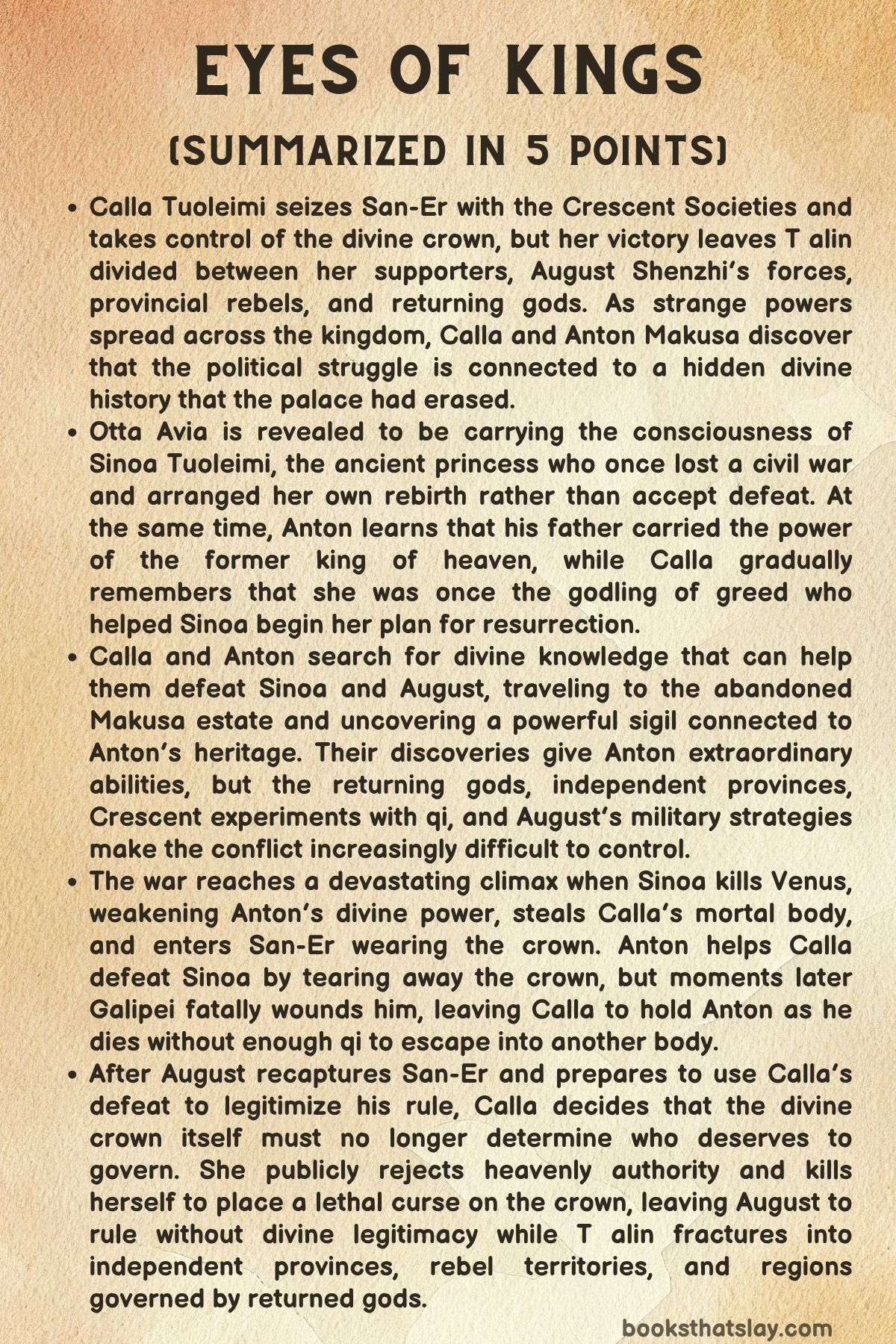
Eyes of Kings begins by revealing the forgotten origins of T alin’s present crisis. Long before Calla Tuoleimi’s era, Princess Sinoa Tuoleimi fought a civil war against her brothers after secretly causing her father’s death and claiming the divine crown for herself.
Unable to win despite the crown’s power, Sinoa refused surrender and accepted a forbidden offer from her patron godling. Through sacrifice and divine intervention, she arranged for herself to return in another age, while the godling who aided her was expelled from heaven and eventually reborn without her memories.
In the present, Calla has seized San-Er with the help of the Crescent Societies and wears the divine crown. Her victory has not brought stability, because August Shenzhi remains outside the capital with loyal troops while the Crescents regard Calla as a temporary instrument rather than the ruler they want.
Anton Makusa stays beside Calla, but the crown begins changing her relationship with him. She discovers that she can draw qi from Anton and use it to strengthen herself, while a strange golden light around him suggests that his abilities extend beyond those of an ordinary jumper.
Anton also learns that Bibi, a woman associated with provincial resistance and the Crescents, is his surviving sister. Their reunion gives him part of the family he believed he had lost in the Makusa massacre, although their loyalties immediately place strain on the relationship.
Elsewhere, Venus Hailira escapes imprisonment after an unexplained burst of power kills one of her captors. Similar incidents occur throughout the kingdom as people begin displaying abilities connected to forces long dismissed by San-Er as superstition.
The explanation soon becomes unavoidable: the old gods are returning. Heavenly qi is flowing again, and former divine beings who abandoned heaven for mortal bodies are regaining fragments of what they once possessed.
Calla nevertheless focuses first on August. Convinced that the crown makes her strong enough to overcome him, she leads an attack against his camp despite Anton’s warnings about Otta Avia, who has joined August and possesses terrifying supernatural power.
The assault ends disastrously. Otta overwhelms Calla, while Anton learns that his own family may have a connection to the gods and that his power is far greater than he understands.
August survives but recognizes that Otta has become a danger even to him. He gradually reaches the frightening conclusion that the consciousness inside his sister’s body is actually Sinoa Tuoleimi, returned after a century and pursuing the throne she once lost.
Galipei Weisanna, August’s devoted guard, awakens after severe injuries only to find August distancing himself. August dismisses him from his position, partly because he is angry that Galipei risked his life and partly because he fears losing him.
Otta approaches Galipei during this vulnerable period and tells him about three powerful godlings associated with qi, control, and greed. She gives him a sigil linked to the godling of control, placing an independent source of supernatural influence in his hands.
Calla returns to San-Er and discovers that the Crescent Societies have grown increasingly radical. They are experimenting with sigils and creating a citywide mechanism capable of blocking qi, because they view palace nobles, Weisannas, monarchs, and gods as different versions of the same oppressive hierarchy.
Their revolution is therefore fundamentally incompatible with Calla’s ambitions. She wants to replace the existing ruler and reform the kingdom under her own authority, while the Crescents want to destroy the entire political structure that makes monarchy possible.
San-Er also becomes vulnerable to attacks from returned gods. When one breaches the wall, Calla uses the crown to kill him, proving that even beings regarded as divine can die.
At the same time, Galipei secretly enters the palace, where Anton captures him. Calla later questions him and learns about a sigil supposedly hidden at the abandoned Makusa estate in Kelitu, connected to the former king of the heavens.
This information becomes crucial after Calla concludes that Anton’s father, Fen Makusa, was inhabited by a divine being. Anton may therefore carry heavenly power inherited through a man whose mortal identity concealed the presence of an ancient god.
Calla and Anton travel to Kelitu despite the danger of leaving San-Er. For Anton, the journey forces him to confront the site of his family’s destruction and reconsider everything he believed about his father and his childhood.
Inside the Makusa estate they discover religious imagery that once appeared decorative but now reveals Fen’s hidden identity. Anton activates the recovered sigil and gains the ability to project his qi across an extraordinary distance.
Using this power, Anton enters the body of someone traveling with August’s army and discovers that August is concealing troop movements. The revelation allows Calla and Anton to anticipate part of his strategy, but it also confirms that Anton’s abilities are becoming increasingly divine.
While this happens, Venus travels to Rincun as Calla’s representative. Instead of restoring San-Er’s authority there, she encounters a province already preparing to reclaim its independence.
Rincun’s leaders understand that the collapse of central authority has created an opportunity to recover the political identity they possessed before incorporation into T alin. Venus’s unexplained power also leads them to recognize that she carries the qi of a divine being.
Anton then enters Calla’s body to protect her during another dangerous operation and experiences fragments of memories hidden inside her. He discovers that Calla herself is connected to the godling who once helped Sinoa arrange her return.
Calla initially resists the conclusion, but buried memories gradually surface. She eventually remembers that she was the godling of greed, the divine figure who aided Sinoa during the ancient civil war and helped create the conditions for the present catastrophe.
This revelation changes the meaning of Calla’s entire struggle. Her confrontation with Sinoa is no longer merely a war between two royal claimants but the continuation of a relationship and betrayal stretching across lifetimes.
August, meanwhile, recognizes that military victory is becoming increasingly difficult. Gods are taking control of provinces, insurgents are operating independently, and the old palace institutions no longer possess unquestioned authority.
He proposes negotiations and suggests dividing the kingdom, echoing an earlier political order. Yet Sinoa continues pursuing her own plans and uses sigils connected to divine control, making genuine peace increasingly impossible.
The situation in San-Er becomes catastrophic when hostile supernatural forces attack while the Crescent qi block is active. Because the block suppresses friendly gods as well as enemies, Bibi convinces the wounded Crescent leader Tsosia that it must be destroyed.
Once the block collapses, heavenly qi floods back into the city. San-Er survives the immediate attack, but the destruction weakens the Crescents and leaves the capital exposed.
In the northern fighting, Anton activates the heavenly king’s sigil and briefly becomes extraordinarily powerful. Sinoa, however, kills Venus, who is revealed as the mortal vessel of the godling of qi.
Venus’s death destroys the divine connection that sustains Anton’s enhanced abilities. He abruptly loses the heavenly power protecting him and becomes vulnerable again.
Calla confronts Sinoa directly, but a larger deception is unfolding. August has divided his forces and used the fighting elsewhere to create an opening for his return to San-Er.
Sinoa also manages to take Calla’s mortal body, gaining access to the divine crown while Calla exists in her restored heavenly form. August reaches the capital first and orders his Weisannas to reclaim the palace from the weakened Crescents.
Sinoa enters San-Er in Calla’s body, intending to finish the war she lost a century earlier. Anton confronts her, still struggling with the knowledge that the woman he once knew as Otta was never wholly the person he believed her to be.
Calla arrives and battles Sinoa. Because Sinoa wears the crown and understands its power, she initially holds the advantage, but Anton attacks from behind and tears the crown from her head.
Calla returns to her mortal body and consumes Sinoa’s remaining qi, finally destroying her. The victory restores Calla’s memories and ends the ancient princess’s second attempt to rule T alin.
The triumph lasts only moments. Galipei appears behind Anton and drives a sword through him, carrying out the act necessary to secure August’s position.
Anton no longer has sufficient qi to escape into another body. As Calla holds him, he accepts that his death is final and tells her that he believes their qi may find one another again someday.
His death breaks Calla’s remaining attachment to victory. Galipei takes the crown, while Calla allows August’s guards to capture her after promising that both August and Galipei will answer for Anton’s death.
Galipei brings the crown to August and tells him that Sinoa and Anton are dead and Calla is imprisoned. August then asks the man he once dismissed to place the crown on his head and publicly names Galipei his king consort.
Calla learns that August intends to parade her before San-Er as proof of his restored authority. Chami secretly gives her a firearm containing a single bullet, offering Calla one final chance to determine how her story ends.
Before the assembled city, Calla rejects the principle that heaven should decide who rules. She announces that no mortal should possess divine legitimacy and declares that the crown will kill anyone who touches it.
To make that declaration real, Calla turns the weapon on herself and dies. Her sacrifice transforms the crown into a lethal object, and anyone attempting to touch it thereafter dies almost immediately.
August is left occupying a throne whose sacred foundation has been destroyed. Provinces such as Rincun and Actia reject central authority, gods establish new centers of power, and T alin begins separating into competing political regions.
August refuses to surrender his claim and decides to base his rule on San-Er’s wealth and strategic importance rather than divine approval. Galipei remains beside him as king consort, although his once unconditional loyalty has begun to change.
Calla’s final act therefore does not create a peaceful new order, but it permanently destroys the old certainty that monarchy possesses heavenly approval. The kingdom survives in name while its provinces, gods, rebels, and rulers begin determining what power will mean after the crown has lost its authority.
Characters
Calla Tuoleimi
Calla is the emotional and political center of Eyes of Kings, carrying several identities at once: princess, revolutionary monarch, crown bearer, former godling, lover, and eventually destroyer of the institution that defines royal legitimacy. Her greatest contradiction is that she despises the abuses of monarchy while repeatedly believing that she can use monarchic power more responsibly than those who came before her.
The crown magnifies both her physical abilities and her appetite for control. Her willingness to draw qi from Anton and her confidence that strength can solve political problems reveal how quickly extraordinary authority begins altering the principles she once used to judge others.
Her recovery of memories as the godling of greed forces her to face responsibility that extends beyond her mortal lifetime. She learns that she once helped Sinoa pursue resurrection and therefore contributed to the conflict now destroying T alin, but she refuses to let that older identity completely replace the person she has chosen to become.
Anton’s death removes the future Calla had only reluctantly allowed herself to imagine. Her final decision to curse the crown through her own death turns personal loss into a political act, destroying the idea that heaven can continue granting rulers unquestionable legitimacy.
Anton Makusa
Anton is driven by love, survival, memory, and a lifelong fear of being left helpless again. The destruction of the Makusa family shapes nearly every relationship he forms, because he approaches attachment with an intensity created by having already lost almost everyone he once considered his own.
His devotion to Calla becomes one of the defining bonds in Eyes of Kings. Anton understands that her ambitions and violence may eventually destroy him, yet he repeatedly chooses her because loving her matters more to him than preserving a safer version of himself.
The revelation that Fen Makusa carried the qi of the heavenly king destabilizes Anton’s understanding of his identity. His unusual jumping ability and enormous reserves of qi are no longer simply talents belonging to a gifted aristocrat; they become evidence that his life is connected to a divine history San-Er deliberately suppressed.
His final actions complete his development from survivor to willing sacrifice. Anton spends the last of his supernatural strength helping Calla defeat Sinoa, leaving himself unable to jump away when Galipei mortally wounds him, and accepts death while still imagining that some future form of their qi might reunite him with Calla.
August Shenzhi
August is defined by calculation and by his belief that power becomes legitimate when exercised through preparation, political knowledge, and institutional control. Unlike Calla, who often responds instinctively, August tries to anticipate every possible move and construct a path in which each sacrifice produces a predictable result.
That strength becomes one of his greatest weaknesses because the people closest to him learn how to read his patterns. Galipei directly identifies his predictability, while Calla frightens August precisely because she frequently acts outside the logic he expects other political players to follow.
August’s relationships reveal the personal cost of his ambition. Anton was once a genuine friend, and Galipei is far more than an assigned guard, but August repeatedly pushes intimacy away whenever it appears capable of interfering with his political objectives.
By the end of the book, August possesses San-Er and the title of king without the divine foundation that once gave the throne its symbolic authority. His determination to continue ruling shows both remarkable adaptability and an inability to imagine himself outside the pursuit of power.
Galipei Weisanna
Galipei begins as the ideal product of the Weisanna system: disciplined, loyal, trained from childhood to protect a ruler, and accustomed to defining his worth through service. His devotion to August is so complete that he is prepared to sacrifice himself without considering whether August wants that sacrifice.
His dismissal forces him to confront the emptiness created when duty is removed. Otta takes advantage of this vulnerability by introducing him to divine sigils, giving him the ability to act beyond the formal role that once limited his choices.
Galipei becomes one of the most consequential characters in Eyes of Kings because he learns to operate independently while still claiming that everything he does is for August. His cooperation with Calla, deliberate imprisonment, mastery of sigils, and eventual killing of Anton show that his loyalty has transformed from obedience into self-directed intervention.
Becoming king consort changes the relationship he spent his life serving. By the ending, he can challenge August more openly, and the first signs of doubt appear in a devotion that once seemed absolute.
Sinoa Tuoleimi
Sinoa is the ancient cause of the modern crisis and the clearest example of ambition refusing to accept mortality, defeat, or historical judgment. She begins as a designated heir who crosses increasingly severe boundaries after losing control of the succession, including causing her father’s death, taking the crown, sacrificing lives, and arranging her return in another era.
Her rebirth through Otta’s body allows her to pursue the same objective under new conditions. Rather than reconsider what her first civil war destroyed, she treats the present as an opportunity to correct a history she believes should have ended with her victory.
Sinoa’s use of sacred sigils is especially significant because she converts the language of worship into a system of domination. Gods who once received specific forms of devotion become resources whose powers she can imitate, command, or destroy.
Her conflict with Calla is therefore both political and intimate. Sinoa is fighting the reincarnated divine being who once enabled her survival, while Calla is confronting the consequences of compassion and loyalty offered without sufficient limits.
Otta Avia
Otta exists in a tragic space between individual identity and possession. Much of what Anton remembers about the woman he loved becomes uncertain once Sinoa’s presence inside her is revealed, leaving him unable to determine where Otta ended and the ancient princess began.
This uncertainty gives Otta unusual emotional importance despite Sinoa becoming the dominant force. Anton’s grief is not only for a past relationship but also for the possibility that the person he knew may have been disappearing long before anyone recognized what was happening.
Her body becomes the vehicle through which a century-old conflict returns. In that sense, Otta demonstrates the cruelty of body occupation more clearly than any political explanation can, because another consciousness uses her life, relationships, and physical existence to continue unfinished ambitions.
Bibi Makusa
Bibi expands Anton’s story beyond individual survival by revealing that the Makusa family was not entirely erased. Her reunion with him offers the possibility of rebuilding a familial bond, yet political circumstances prevent them from simply becoming brother and sister again.
She understands the Crescents without completely sharing their ideology. That position allows her to recognize both the justice behind their anger and the destructive consequences of treating every inherited institution as an enemy that must immediately disappear.
Her actions during the attack on San-Er are crucial. By persuading Tsosia to break the qi block, Bibi chooses practical protection of human lives over ideological consistency and helps prevent the rebels’ own defensive system from contributing to the city’s destruction.
Venus Hailira
Venus begins as a political figure associated with Rincun but becomes one of the most important examples of divinity returning through a person who does not understand what is happening to her. Her sudden ability to unleash extraordinary qi during captivity is initially experienced as terror rather than empowerment.
Her journey to Rincun changes her political understanding as well. She encounters people who see themselves not as subjects awaiting instructions from San-Er but as members of a province with its own history, institutions, and claims to independence.
The eventual revelation that Venus carries the godling of qi gives tragic meaning to her unexplained power. Her death at Sinoa’s hands does not merely remove an individual character; it destroys a divine connection whose existence supports Anton’s temporary access to heavenly strength.
Yilas
Yilas provides one of the strongest civilian perspectives in Eyes of Kings. While royal claimants and gods debate legitimacy, she experiences political collapse through shortages, damaged streets, frightened friends, changing work conditions, and the constant possibility that violence will enter ordinary homes.
Her relationship with Chami gives her story emotional stability while also placing her unexpectedly close to the divine conflict. Discovering that Chami possesses a hidden supernatural past forces Yilas to accept that even the person beside her may belong to a history far older than their shared life.
Yilas is practical without being emotionally detached. Her fear for Matiyu and Chami shows how national upheaval becomes personal long before ordinary people have any meaningful influence over the decisions producing it.
Chami
Chami initially appears to be an ordinary former palace attendant who has built a life with Yilas, but her recovered memories reveal that she is another divine survivor. Her long residence among mortals demonstrates how thoroughly the old gods surrendered their earlier identities when they fled the collapsing heavens.
Unlike Sinoa, Chami does not respond to recovered power by seeking rule. She values the mortal relationships she has formed and becomes increasingly concerned about the ways humans are manipulating sigils without understanding their original purpose.
Her final assistance to Calla is decisive. By giving Calla the hidden firearm, Chami helps make possible an act that permanently changes the meaning of the crown and gives Calla control over the manner of her own death.
Matiyu
Matiyu represents attachment to place rather than attachment to a ruler. Even as San-Er becomes dangerous, he refuses to leave because the city is his home, and his loyalty is directed toward its people, streets, work, and daily life rather than any claimant to the throne.
Being attacked does not transform him into a passive victim. After recovering, he helps strengthen the capital’s defenses and seeks weapons because he recognizes that ordinary residents cannot depend entirely on monarchs, rebels, or gods for protection.
His perspective exposes the distance between elite strategy and civilian necessity. Questions about food, shelter, physical safety, and whether neighborhoods will survive matter more to him than abstract claims of divine legitimacy.
Cleric Tsosia
Tsosia embodies the ideological force behind the Crescent Societies. She is committed to ending the structures that made hereditary monarchy, noble privilege, and enforced service appear natural, and she is willing to use extreme methods because she believes partial reform will simply recreate the same hierarchy.
The qi block captures both the strength and danger of that worldview. It offers a way to neutralize supernatural privilege, yet its indiscriminate effect leaves friendly divine beings powerless during a devastating attack.
Tsosia ultimately allows Bibi to destroy the mechanism, showing that she can place survival above ideological purity when the consequences become undeniable. The decision does not erase the Crescents’ radicalism, but it prevents their revolution from becoming completely detached from the people it claims to liberate.
Erwen
Erwen represents Rincun’s determination to recover political independence. Rather than seeing Calla as the rightful ruler who should inherit T alin after defeating August, Erwen treats her as a potentially useful ally whose goals overlap with Rincun’s only temporarily.
This creates an important challenge to Calla’s assumptions. Removing one king does not automatically grant another royal the right to determine the future of provinces that remember existing before the current kingdom.
Erwen therefore expands the political scale of the novel. The struggle is no longer merely about who should sit in San-Er but whether San-Er should continue possessing authority over every region at all.
Tenzen
Tenzen is one of the returned gods who remembers enough of the former divine world to recognize the scale of the transformation occurring across T alin. His perspective confirms that the reappearance of heavenly qi is not a temporary disturbance but the consequence of an older collapse.
Unlike characters who immediately see renewed divine power as an opportunity, Tenzen is tired. His desire for a quieter existence reflects the burden carried by gods who abandoned heaven precisely because they wanted to survive rather than continue participating in divine catastrophe.
His reluctance also provides an important contrast with Sinoa and Calla. Having power does not automatically create a desire to rule, and divinity itself does not produce a single political agenda.
Reanne
Reanne preserves crucial memories of the old pantheon and helps explain the role once played by the godling of qi. Through her recollections, divine society appears not as a perfect heavenly order but as a demanding hierarchy whose members were capable of exhaustion, failure, and disagreement.
Her concern for the missing godling of qi demonstrates the emotional bonds that existed among divine beings. The old gods are not merely supernatural functions; they remember duties, friendships, guilt, and losses that survived even after their powers faded.
Reanne also shows how incomplete memory shapes the returning divine community. The gods possess fragments of a shared past but often lack enough information to understand who has survived or which ancient relationships are reappearing around them.
Seiqi Weisanna
Seiqi reveals the internal culture of the Weisannas during August’s period of displacement. Her family has been trained to serve the throne, yet individual members compete fiercely for proximity to the ruler because service also determines status within their own hierarchy.
Galipei’s absence creates an opening that Seiqi recognizes, showing how even supposedly selfless loyalty exists within a competitive political structure. Her death during the failed attack on August’s camp demonstrates the human cost hidden beneath strategic discussions of troops and royal succession.
Joselie
Joselie functions as a keeper of knowledge that San-Er’s official history attempted to erase. Her conversations with Calla show that provincial traditions preserved fragments of Sinoa’s story and the old divine world even when the capital dismissed those beliefs as superstition.
Through Joselie, Calla begins understanding that her own name and identity carry meanings she never chose. The past has survived in stories, religious practices, and local memory, making historical suppression incomplete rather than successful.
Woya
Woya represents the practical military side of the Crescent occupation. Her involvement with improvised firearms and defenses shows that the movement does not depend entirely on supernatural power and is actively searching for technologies that might reduce the advantage possessed by Weisannas and gods.
Her interactions with Matiyu also expose the limits of revolutionary administration. The Crescents may possess a strong ideology, but ordinary residents still need competent protection, supplies, and functioning neighborhoods if the movement expects to retain public support.
Themes
Power, Legitimacy, and the Destruction of Divine Rule
Authority in Eyes of Kings repeatedly changes hands without producing lasting legitimacy. Calla possesses the crown, August possesses administrative experience, the Crescents possess popular anger, gods possess supernatural strength, and provincial leaders possess local loyalty, yet none of these advantages creates an uncontested right to govern.
The divine crown initially appears to solve that problem by presenting political authority as something approved by heaven. Its existence allows monarchy to transform possession of supernatural power into a sacred argument: the ruler is not merely stronger but supposedly chosen by forces beyond ordinary people.
Calla gradually recognizes how dangerous that reasoning is. Even when she believes she would use the crown better than August or Sinoa, she remains trapped inside a system where one exceptional individual can claim authority over millions because of access to a divine object.
Her final sacrifice attacks the principle rather than merely another claimant. By making the crown lethal to anyone who touches it, she removes the possibility that a future monarch can simply inherit its symbolic authority.
August survives this change and decides to rule through wealth, geography, political organization, and force instead. The ending therefore does not suggest that eliminating sacred legitimacy eliminates domination; it simply forces political power to reveal the worldly foundations that divine symbolism once concealed.
Identity, Memory, and Rebirth
Nearly every major conflict depends on the instability of identity. Bodies can be occupied, qi can move between vessels, gods can live as mortals, ancient personalities can return, and memories can disappear for decades before suddenly resurfacing.
Calla’s discovery that she was once the godling of greed raises the question of whether recovered memory should determine present identity. She possesses the history of a divine being who helped Sinoa, but she has also lived an entire mortal life as Calla Tuoleimi, making choices that cannot simply be reduced to what her earlier self once did.
Anton confronts a similar crisis through ancestry rather than reincarnation. Learning that the father he knew carried the qi of the heavenly king forces him to reconsider whether his abilities belong to him personally or are inherited remnants of a supernatural identity.
Otta’s fate presents the darkest version of the same question. Once Sinoa dominates her body, the boundaries between the woman Anton loved and the ancient princess become impossible to reconstruct, leaving even intimate memories uncertain.
The novel ultimately treats identity as something shaped by continuity, choice, relationship, and memory rather than by any single biological or supernatural source. Characters may recover former selves, but those revelations do not erase the people they became while living without that knowledge.
Love, Loyalty, and Sacrifice
Relationships in Eyes of Kings repeatedly become dangerous because affection and loyalty demand choices that conflict with survival or political calculation. Anton’s devotion to Calla is the clearest example: he understands her capacity for destruction, disagrees with her decisions, and recognizes the danger of the crown, yet still chooses to remain beside her.
His loyalty is neither simple obedience nor idealization. Anton argues with Calla, fears what power is doing to her, and occasionally questions whether she can still distinguish necessity from desire, but he continues choosing the relationship even when withdrawal would be safer.
Galipei’s devotion to August follows a darker parallel. He has been trained to make sacrifice the basis of his identity, and when August dismisses him, Galipei does not abandon that loyalty but begins acting independently in the name of protecting the person who no longer wants to be protected in the same way.
Bibi’s relationship with Anton introduces another form of love complicated by lost time. They recover one another as siblings only after political commitments and separate lives have made uncomplicated reunion impossible.
The deaths of Anton and Calla turn sacrifice into the final expression of their relationship. Anton gives away the power that might have saved him, while Calla continues long enough to complete the political destruction of the crown before choosing her own death.
Revolution, Freedom, and the Fragmentation of T alin
The collapse of central authority creates possibilities that different groups interpret in radically different ways. The Crescent Societies see the crisis as an opportunity to destroy hereditary hierarchy, while provinces such as Rincun interpret it as a chance to recover independence from San-Er.
These goals sometimes overlap with Calla’s rebellion but are never identical to it. Calla initially assumes that defeating August would place her in a position to reshape the kingdom, yet provincial leaders increasingly reject the premise that any person in San-Er should determine their future.
The old gods complicate liberation even further. Some communities willingly accept divine protectors because those figures provide material help or local security, while the Crescents see worship as another hierarchy that could reproduce the same forms of submission associated with monarchy.
Freedom therefore produces fragmentation rather than immediate unity. Once the palace loses the ability to enforce a single political order, competing communities begin creating systems based on regional identity, revolutionary ideology, divine allegiance, or practical survival.
The ending refuses to present this fragmentation as either simple liberation or simple catastrophe. T alin loses the certainty of centralized rule, but it also gains political possibilities that the crown once prevented people from imagining, leaving its future open, unstable, and no longer controlled by a single claim of heavenly authority.