Hate Me Take Me Summary, Characters and Themes
Hate Me Take Me by Laura Bishop is a contemporary romantic suspense novel centered on Amanda Bennett, a successful fashion professional whose emotional life has remained frozen since her husband disappeared eight years earlier. Combining second-chance romance, technological deception, covert operations, family conflict, and questions of consent, the book follows Amanda as an artificial-intelligence boyfriend unexpectedly becomes connected to a mysterious real man.
What initially appears to be a strange digital romance gradually exposes the unfinished marriage at the center of Amanda’s life, forcing both Amanda and Kade Steele to confront the difference between loving someone, protecting them, and respecting their right to make their own choices. It’s the 2nd book of the Obsessively Yours series.
Summary
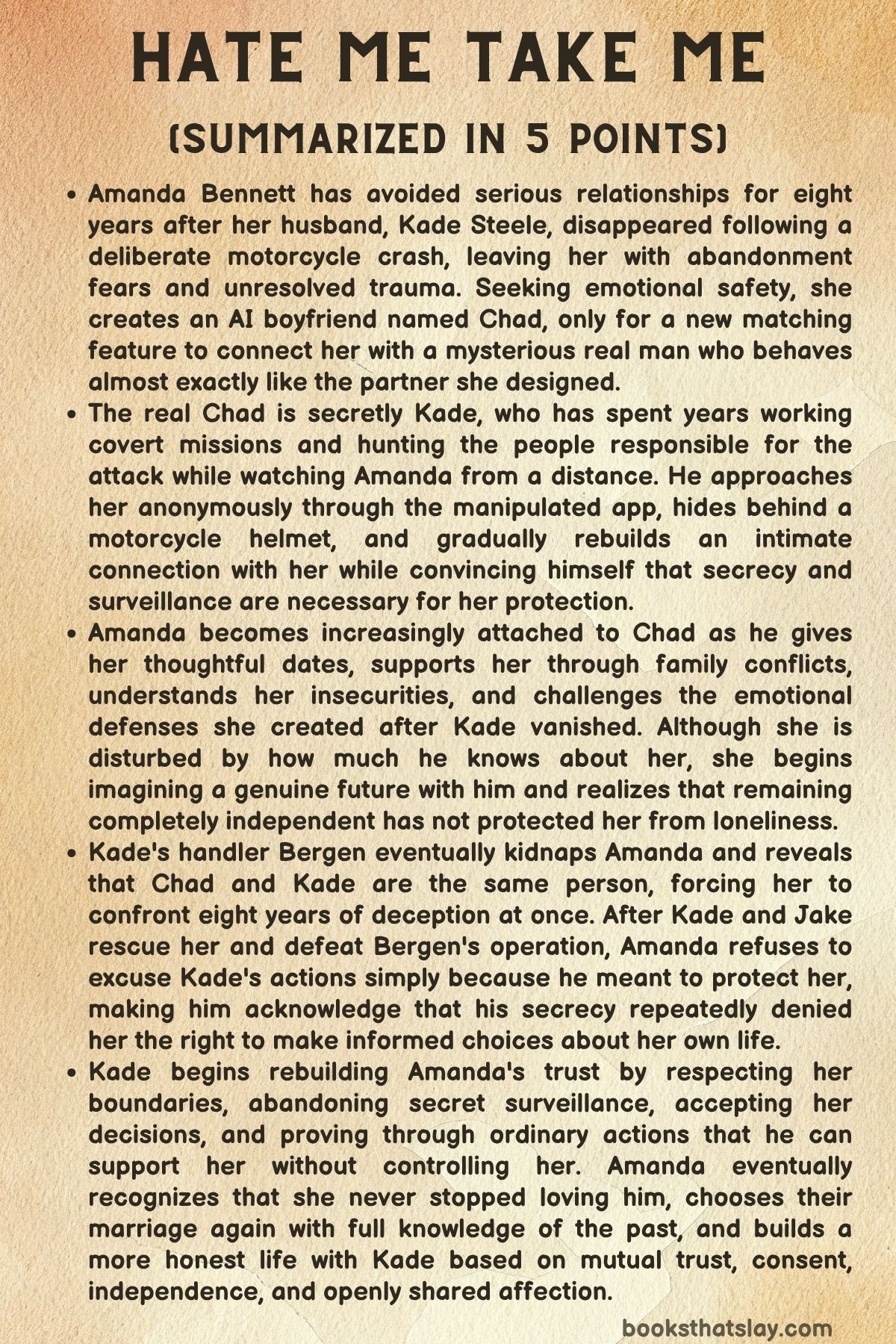
Amanda Bennett has built a life that looks confident, fashionable, independent, and successful, but much of that confidence protects an old emotional injury. Eight years earlier, her brief but intense marriage to Kade Steele ended after a deliberate motorcycle crash inside a tunnel left Amanda hospitalized and Kade mysteriously absent.
Amanda never receives an explanation for his disappearance. The experience leaves her with nightmares, anxiety around tunnels, and a deep conviction that depending on another person means giving that person the power to destroy her.
Instead of risking another human relationship, Amanda creates an artificial boyfriend named Chad through an AI application called Obsess AI. Chad is safe because Amanda controls the qualities he possesses, knows he cannot physically leave her, and can confide in him without facing the uncertainty of genuine intimacy.
Everything changes when the application introduces an experimental feature called Matched. It claims that a real person can be found whose personality resembles the artificial partner Amanda designed, and curiosity eventually convinces her to activate it.
The supposed match appears almost immediately. He accepts the name Chad, speaks with the confident and provocative style Amanda programmed into her artificial boyfriend, and rapidly becomes someone she cannot dismiss.
Amanda does not know that Chad is actually Kade. After disappearing from her life eight years earlier, Kade has spent years secretly monitoring her while working in a dangerous covert world connected to the men responsible for their crash.
Kade deliberately arranged Amanda’s access to the Matched feature so he could approach her without revealing himself. He convinces himself that the deception is temporary and necessary because he wants to eliminate the last people who could threaten her before returning openly.
Their early conversations blur the boundary between fantasy and reality. Amanda initially treats the real Chad almost like a more unpredictable extension of her artificial boyfriend, but every conversation introduces something the AI could never create: genuine consequences.
Chad remembers details, challenges her defenses, makes her laugh, and refuses to let her hide behind claims that she does not care. Amanda is attracted to him but increasingly troubled by how thoroughly he seems to understand her.
Her sister Raven and her best friend Izzy respond differently to the situation. Raven encourages Amanda not to let fear dictate every romantic choice, while Izzy worries about the obvious dangers of trusting a man who refuses to provide his name, face, or background.
Their concerns become more serious when Amanda discovers she cannot easily remove Chad through the Matched system. His ability to anticipate her actions also makes her wonder whether the app is doing far more than ordinary matchmaking.
Kade, meanwhile, watches Amanda from a distance and continues operating as Chad. He knows that his behavior violates boundaries, including secretly surveilling Amanda’s apartment, yet repeatedly justifies his actions as protection.
When Amanda finally agrees to meet Chad, he arrives on a motorcycle wearing a mirrored helmet. The motorcycle itself connects Amanda’s new relationship to the unresolved trauma of her marriage, although she does not yet understand why being around Chad sometimes feels strangely familiar.
Their meetings become increasingly intimate. Kade takes Amanda on carefully designed dates, remembers her favorite things, listens when she talks about her insecurities, and creates the experience of being deeply known.
One especially meaningful date involves a private showing of The Princess Bride, Amanda’s favorite film. The evening causes her to question whether emotional vulnerability is simply weakness or whether being capable of pain is also part of being capable of genuine love.
Amanda gradually stops thinking of Chad as an experiment. She wants his company during ordinary moments, imagines waking beside him, and begins wishing he would reveal himself because she wants a relationship with the actual man rather than the mystery.
Kade finds himself equally unable to maintain emotional distance. He intends to confess once his final enemies are eliminated, yet every additional day of secrecy makes the eventual revelation more dangerous.
Their growing attachment also forces Amanda to confront problems unrelated to romance. During a difficult dinner with her parents, she finally challenges her mother’s long-standing criticism and rejects the idea that her worth depends upon marriage, motherhood, or parental approval.
Chad supports her afterward without demanding that she explain everything. His ability to understand her pain intensifies Amanda’s attachment because he provides the kind of acceptance she rarely receives from her family.
Kade later takes her to a shooting range, an activity loaded with significance because he was the person who originally taught her to shoot. Amanda opens up about Kade, unknowingly discussing her missing husband with the man himself.
She explains how his disappearance convinced her that she had not been worth staying for. Kade finally understands that what he considered an act of protection became, from Amanda’s perspective, proof that she was disposable.
Amanda eventually becomes determined to discover Chad’s identity. When she asks Cal Knight, Izzy’s husband and a highly capable security specialist, for help, she discovers that Cal already knows who Chad is but refuses to reveal it.
The knowledge that Cal considers Chad safe reassures Amanda while also infuriating her. She resents being the only person apparently denied information about her own relationship.
As Amanda becomes more emotionally honest with Chad, Kade believes the time for revelation is approaching. Before he can confess, however, new intelligence shows that the criminal network he believed he had destroyed still contains a surviving threat.
Kade is ordered away from New York on another mission. The assignment turns out to be a deliberate diversion engineered by his handler, Bergen, who has manipulated Kade’s obsession with protecting Amanda for years.
While Kade is away, Amanda is kidnapped. She awakens restrained in a warehouse, where Bergen finally gives her the truth Kade withheld.
Amanda learns that Chad is Kade Steele. Suddenly every disturbing detail becomes understandable: Chad’s knowledge of her habits, his familiarity with her reactions, his ability to access her life, and the strange sense that her mysterious new lover already knew her.
The revelation devastates her because Kade has effectively made her fall in love with him twice while controlling the information necessary for her to make an informed choice. Bergen expects that knowledge to weaken both of them, but Amanda also realizes that he exploited Kade and helped prolong the violence surrounding their marriage.
Kade arrives at the warehouse, and Amanda assists in the confrontation instead of remaining a passive victim. Together with Jake, Kade defeats Bergen’s operation, finally ending the conspiracy that has controlled their lives.
Physical danger ends, but Amanda immediately turns her anger toward Kade. Holding her pink gun beneath his chin, she demands answers for eight years of silence and for the recent deception that allowed him to enter her life under another identity.
Kade explains that after the crash he believed anyone close to him would remain a target. Amanda refuses to accept that explanation as justification for his decision to remove her right to choose whether she was willing to face that danger with him.
She tells him that his disappearance made her question her own worth for years. Kade finally admits that protection became control because he repeatedly assumed he had the right to decide what Amanda could handle.
Amanda leaves with Cal and asks for space. Kade continues sending messages through the Chad account, but his tone gradually changes from persuasion to responsibility as he recognizes the specific harm caused by his choices.
Eventually he stops messaging and deactivates the Chad identity. For the first time, Amanda is given genuine control over whether communication between them continues.
Kade falls into despair and nearly makes a catastrophic decision before Cal intervenes. Cal tells him that reconciliation cannot be forced through dramatic acts and that respecting Amanda means accepting whatever decision she eventually makes.
A strange opportunity for ordinary contact appears when Kade begins working as an unpaid intern at Monarch. Amanda initially considers his presence another intrusion, but Kade’s behavior is noticeably different.
Instead of secretly directing events, he begins asking permission. He accepts rejection, respects boundaries, and learns that being protective does not require taking over Amanda’s life.
Amanda eventually agrees to start again under explicit conditions. She prohibits secret surveillance and manipulation, establishes limits on his behavior, and insists that she must be allowed to choose when and how their relationship progresses.
Kade accepts every rule. Their new relationship therefore differs from both their impulsive Vegas marriage and the deceptive Chad romance because Amanda now possesses information, boundaries, and the ability to refuse.
Their reconciliation deepens during an all-day date designed around the eight years they spent apart. Kade takes Amanda to locations connected to different stages of the life she built during his absence, showing that he knows what happened while also acknowledging that she became someone new without him.
The final part of the date returns symbolically to Las Vegas. Kade reveals that the dice responsible for their original marriage proposal had been loaded, meaning he intentionally arranged the result because he had already decided he wanted to marry Amanda.
Another test of Kade’s growth occurs when Amanda deals with Gerald Finley, a wealthy client known for inappropriate behavior. Kade desperately wants to intervene but respects Amanda’s request that she handle the situation unless she asks for assistance.
Gerald eventually crosses physical boundaries, but Amanda successfully confronts him. Kade’s decision to trust her rather than immediately taking control demonstrates that he is finally beginning to understand the difference between support and domination.
Amanda later finds Kade dealing with the emotional consequences of restraining his protective instincts. While tending his injured hands, she admits a secret of her own: she never legally stopped being Amanda Steele.
Keeping his surname reveals that part of her never accepted their marriage as truly finished. Amanda and Kade finally reunite physically with complete knowledge of each other’s identities, transforming their relationship from deception into mutual choice.
Amanda briefly panics afterward, but Kade does not disappear or pressure her. He stays, provides ordinary comfort, and proves that vulnerability does not automatically lead to abandonment.
Their reconciliation becomes complete when Kade presents the original wedding ring and asks Amanda to choose their marriage again. Although they never legally divorced, he wants her consent as the woman she is now rather than relying on a decision made during their reckless youth.
Amanda accepts. Six months later, they have built an unconventional but stable marriage in which danger, humor, work, domestic routines, and mutual trust coexist.
Kade has entered a legitimate role with the NYPD, while Amanda remains fiercely independent and capable. Their relationship has not restored the past exactly as it was; instead, they have created something based on honesty, boundaries, and the recognition that love cannot survive securely when one person controls the other’s choices.
Characters
Amanda Bennett Steele
Amanda is the emotional center of Hate Me Take Me, and nearly every major conflict reflects the tension between the person she presents to the world and the fears she keeps hidden. She appears bold, fashionable, humorous, sexually confident, professionally capable, and fiercely independent, but much of that identity also functions as protection against abandonment.
Kade’s disappearance fundamentally alters the way Amanda understands intimacy. She does not simply miss her husband; she interprets his unexplained departure as evidence that trusting another person eventually results in rejection, which explains why an artificial boyfriend initially feels safer than a human relationship.
Her humor is one of her strongest defenses. Whenever conversations become emotionally threatening, Amanda jokes, exaggerates, changes subjects, or turns the situation into something absurd because comedy allows her to regain a sense of control.
Her development depends on realizing that independence and emotional isolation are not the same thing. She gradually accepts that needing another person does not automatically diminish her strength, provided that the relationship respects her freedom and boundaries.
Amanda’s anger after discovering Chad’s identity is therefore essential rather than excessive. She loves Kade, but love does not cancel the fact that he denied her information and repeatedly made decisions on her behalf.
Her eventual reconciliation with him becomes meaningful because she establishes explicit rules first. Amanda does not return to the frightened young woman who waited for him to come home; she chooses him as an adult who understands both what he did wrong and what she requires from him now.
Kade Steele
Kade is the central romantic figure in Hate Me Take Me, but the book deliberately makes his devotion morally complicated. He loves Amanda with extraordinary intensity, yet his idea of love has been shaped by covert work, violence, secrecy, and the conviction that protecting someone sometimes requires controlling what they know.
His decision to disappear after the crash originates in genuine fear that Amanda will become a permanent target. The problem is that Kade never allows Amanda to participate in that decision, meaning his sacrifice also becomes an assertion that his judgment matters more than her autonomy.
The Chad deception repeats the same mistake in a different form. Kade believes that anonymously approaching Amanda gives him a controlled route back into her life, but he again manipulates circumstances so that she cannot make a fully informed choice.
His strongest character growth occurs only after his identity is exposed. He stops asking how he can win Amanda back and begins learning how to become someone she can freely choose.
This change is especially visible when he respects her boundaries around Gerald Finley. Remaining nearby without immediately interfering requires Kade to replace control with trust, something far more difficult for him than confronting physical danger.
By the conclusion, Kade remains intensely protective, but he is learning that partnership requires faith in Amanda’s competence. His redemption depends less on explaining why he behaved badly than on consistently behaving differently afterward.
Raven Bennett
Raven provides Hate Me Take Me with one of its most important supportive relationships because she understands Amanda without treating her as fragile. As Amanda’s sister, she knows the history with Kade, recognizes the defensive habits Amanda developed afterward, and understands that excessive caution can become another kind of prison.
Raven generally takes more risks than Izzy and is more willing to encourage Amanda’s curiosity about Chad. Her advice is not simply that Amanda should trust a mysterious stranger; she wants Amanda to examine whether every objection comes from reasonable concern or from an automatic refusal to risk emotional pain.
Her teasing personality also gives Amanda a relationship in which serious issues can be discussed without becoming unbearable. Raven can challenge her sister while still allowing humor to remain part of the conversation.
Later, Raven becomes particularly important when Amanda is deciding whether forgiveness is possible. She does not excuse Kade’s deception, but she separates forgiveness from forgetting and reminds Amanda that fear of another loss should not automatically decide the rest of her life.
Izzy
Izzy is one of the most grounded voices in Hate Me Take Me, functioning as Amanda’s best friend, emotional observer, and frequent source of practical caution. She recognizes almost immediately that Amanda’s interest in Chad is becoming serious even when Amanda continues pretending that the situation is merely entertaining.
Unlike Raven, Izzy gives greater weight to the obvious danger surrounding an anonymous man who hides his identity. Her suspicions help prevent the romance from being treated as harmless simply because Amanda is attracted to Chad.
Izzy also demonstrates the kind of secure relationship Amanda secretly wants. Her marriage to Cal repeatedly reminds Amanda that partnership can involve dependence without erasing individuality.
After Kade’s identity is revealed, Izzy continues supporting Amanda without demanding either reconciliation or permanent separation. Her friendship gives Amanda a place where anger, love, embarrassment, fear, and uncertainty can coexist without requiring an immediate decision.
Callahan “Cal” Knight
Cal occupies a distinctive role in Hate Me Take Me because he understands Kade’s world while remaining closely connected to Amanda through Izzy. His security expertise allows him to recognize Kade as dangerous in capability without automatically concluding that he is dangerous to Amanda.
His refusal to reveal Chad’s identity frustrates Amanda because it temporarily places him among the people withholding information from her. Even so, Cal later becomes one of the people who most strongly pushes Kade toward respecting Amanda’s choices.
Cal’s intervention during Kade’s lowest emotional moment is especially important. Rather than promising that Amanda will forgive him, he reminds Kade that genuine change requires accepting uncertainty and respecting whatever decision Amanda eventually reaches.
He becomes an informal mentor in ordinary relationships because Kade understands covert operations better than everyday partnership. Through Cal, Kade learns that rebuilding trust depends on repetitive, unremarkable acts of restraint and honesty rather than dramatic sacrifices.
Jake
Jake is Kade’s operational partner and also has a connection to Raven through their online gaming group. This dual position allows him to move between the dangerous world Kade inhabits and the ordinary social world Amanda believes is separate from it.
His involvement demonstrates how extensive the hidden network around Amanda has become. When she later discovers Jake’s connection to Kade, she understandably experiences it as another example of how much other people knew about her life while she remained uninformed.
Jake nevertheless offers valuable perspective after the truth emerges. He can confirm that Kade’s love for Amanda remained constant without claiming that love automatically justified the choices Kade made.
His presence also reinforces the idea that Kade’s years away were not emotionally empty. Jake has witnessed the obsession, loyalty, violence, and longing that defined Kade’s attempt to remove every threat before returning home.
Bergen
Bergen serves as the central human antagonist of Hate Me Take Me because he exploits Kade’s greatest weakness rather than merely confronting him physically. He understands that Amanda is the organizing force behind Kade’s decisions and manipulates that devotion to keep Kade useful.
His betrayal reveals that much of Kade’s eight-year campaign has been shaped by incomplete or deliberately misleading information. Bergen benefits from Kade’s willingness to obey dangerous orders whenever they are presented as necessary for Amanda’s safety.
Kidnapping Amanda is therefore both strategic and psychological. Bergen wants to weaponize the truth about Chad because he expects Kade’s deception to destroy the relationship precisely when Kade is most vulnerable.
Ironically, Bergen’s revelation also ends the cycle of secrecy. By exposing the truth, he removes Kade’s ability to postpone accountability and gives Amanda the information she should have possessed from the beginning.
Amanda and Raven’s Mother
Amanda’s mother represents a quieter but deeply influential source of emotional insecurity. Her criticism rarely appears as open hostility; instead, she repeatedly reframes achievements as insufficient and treats her daughters’ choices as evidence that they have failed to meet conventional expectations.
For Amanda, years of this behavior contribute to the belief that she must perform confidence before other people can question her worth. Her independence becomes partly a genuine personality trait and partly a response to constant evaluation.
The confrontation at the family dinner is therefore an important moment of development. Amanda finally refuses to let parental disappointment function as the standard by which she measures her adulthood.
Her later willingness to reconsider the relationship does not erase the harm caused by years of criticism. Instead, it shows that Amanda is becoming capable of setting boundaries without necessarily treating every damaged relationship as permanently beyond repair.
Daniel
Daniel is a comparatively minor character, but his presence at Monarch helps establish Amanda’s professional environment outside her romantic crisis. He witnesses some of her increasingly strange reactions to Chad’s messages and deliveries, providing an ordinary perspective on behavior Amanda has begun treating as normal.
His role also emphasizes how successfully Amanda has traditionally compartmentalized her life. Work is supposed to be the place where she remains efficient, polished, and controlled, making Chad’s repeated intrusion into that space especially significant.
Daniel never carries the emotional importance of Izzy, Raven, Cal, or Kade. His usefulness comes from representing the ordinary world against which Amanda’s increasingly extraordinary private life can be measured.
Gerald Finley
Gerald Finley functions less as a traditional antagonist than as a test of Amanda and Kade’s developing relationship. His inappropriate behavior toward women makes Kade’s protective instincts immediately understandable, but the situation forces Kade to confront whether protection gives him permission to override Amanda.
Amanda knows Gerald’s reputation and chooses to handle the professional encounter herself. When Gerald becomes physically invasive, she confronts him directly rather than waiting for Kade to rescue her.
The aftermath matters because Kade has respected her request despite his anger. Amanda recognizes this restraint as evidence that he is finally treating her as a capable equal rather than someone whose safety must always be controlled by him.
Gerald therefore becomes important not because of his personal complexity but because his behavior exposes the difference between the old Kade and the man attempting to rebuild his marriage.
Marko Petrov
Marko Petrov represents the enemy Kade spends years believing stands between him and a safe return to Amanda. His connection to the motorcycle attack transforms him into the focus of Kade’s long campaign of revenge and protection.
Killing Marko initially appears to close the violent period of Kade’s life. Kade believes that completing this final mission will finally permit him to reveal himself and reclaim an ordinary existence.
The later discovery that the threat remains active demonstrates the danger of Kade’s entire strategy. No amount of secret violence can create perfect safety, meaning he has sacrificed years with Amanda in pursuit of a certainty that never truly existed.
Jennifer
Jennifer appears briefly during Amanda and Raven’s volunteer fashion work, but the encounter reveals an important side of Amanda’s personality. Amanda is skilled at helping another woman see herself as worthy of attention, confidence, and attractive clothing without apology.
The contrast is revealing because Amanda can offer empowerment to someone else far more easily than she can accept emotional vulnerability in herself. She immediately understands that Jennifer should not shrink to satisfy other people’s judgments, yet she spends much of the novel allowing fear and abandonment to determine the limits of her own life.
Jennifer’s change in posture and confidence gives Amanda a small example of what reclaiming personal space can look like. The scene quietly supports Amanda’s larger movement toward choosing a life based on desire and self-respect rather than fear.
Themes
Love, Protection, and Control
The central romantic conflict in Hate Me Take Me develops from the dangerous similarity between protection and control when one person refuses to respect another person’s agency. Kade sincerely believes that disappearing after the crash saves Amanda from enemies who would otherwise use her against him, but the decision also assumes that he alone has the right to determine what risks Amanda may accept.
That pattern continues when he creates the Matched feature, secretly watches Amanda, enters her apartment, and approaches her as Chad. Kade repeatedly frames these actions as protective, yet Amanda experiences the consequences as exclusion from decisions about her own life.
The book gradually argues that intention cannot erase impact. Kade may act from love rather than cruelty, but love does not make manipulation harmless when Amanda is denied information necessary to make meaningful choices.
His development therefore requires restraint rather than greater strength. When Amanda deals with Gerald Finley, Kade’s most significant act is not attacking Gerald but trusting Amanda to handle the situation until she indicates otherwise.
Amanda also changes her understanding of protection. She learns that allowing someone to support her does not require surrendering control, just as independence does not require facing every problem alone.
Their reconciliation becomes possible only after these ideas meet. Kade can remain protective, and Amanda can accept care, but both must recognize that a healthy partnership depends upon consent, information, boundaries, and the freedom to say no.
Abandonment and the Fear of Vulnerability
Amanda’s emotional life is shaped by an unresolved disappearance that she interprets personally. Because Kade leaves without explanation, she does not understand his decision as a response to external danger; she understands it as evidence that the man she trusted eventually decided she was not worth staying for.
That belief changes the structure of her relationships. An artificial boyfriend becomes attractive because he offers emotional engagement without the unpredictable freedom possessed by a human partner.
Chad initially seems to preserve that balance because Amanda thinks she controls the relationship through an application. The moment he becomes real, however, she must confront the possibility that connection always includes uncertainty.
Her jokes, rigid routines, exaggerated self-confidence, and emotional detachment all function partly as methods of preventing another person from acquiring enough importance to hurt her. The irony is that these defenses prevent abandonment but also prevent intimacy.
Kade carries his own fear of vulnerability. He would rather fight criminals, conduct surveillance, and manipulate technology than stand in front of Amanda and risk hearing that she no longer wants him.
Both characters therefore avoid vulnerability through different forms of control. Amanda withdraws, while Kade secretly manages circumstances, and neither method allows them to build genuine trust.
Their healing begins when uncertainty is accepted rather than eliminated. Amanda chooses to risk loving someone who could hurt her, while Kade accepts that loving Amanda means giving her the freedom to reject him.
Identity, Performance, and Being Truly Known
Amanda’s personality contains both authentic exuberance and carefully constructed performance. Fashion, pink accessories, sarcasm, sexuality, gaming, beauty routines, and dramatic humor genuinely belong to her, but she also uses them to determine what other people see before they can examine the insecurities underneath.
Her mother has reinforced this pattern by making approval feel conditional. Amanda learns to project confidence partly because appearing unaffected is safer than admitting that criticism or rejection can hurt her.
Her attraction to Chad intensifies because he appears capable of recognizing the person behind the performance. He knows when jokes are avoidance, notices her routines, understands her preferences, and responds to emotions she has not explicitly named.
Once his identity is revealed, however, that feeling of being known becomes complicated. Kade’s knowledge is romantic in some circumstances but deeply invasive in others because much of it comes from surveillance and their previous marriage.
The story therefore distinguishes intimacy from information. Knowing someone’s habits does not automatically mean respecting that person, and observing someone closely is not the same as allowing them to reveal themselves willingly.
Amanda eventually becomes more integrated because she no longer needs confidence to function entirely as armor. Her humor and dramatic personality remain intact, but she becomes more willing to admit fear, longing, dependence, and love without treating those emotions as contradictions of her strength.
Second Chances and Rebuilding Trust
Hate Me Take Me treats reconciliation as something more demanding than rediscovering old attraction. Amanda and Kade never stopped loving each other, but that emotional continuity does not automatically repair eight years of absence, secrecy, surveillance, and deception.
The first stage of their relationship is based on impulsiveness. They meet, gamble, marry quickly, and build an intense connection before either has much time to understand what permanence requires.
The Chad relationship repeats that intensity under different circumstances. Kade creates elaborate experiences and Amanda becomes emotionally attached, but the relationship remains structurally unstable because one person possesses information the other does not.
Their real second chance begins only after Amanda learns the truth. Anger, separation, unanswered messages, workplace awkwardness, explicit rules, ordinary rides, and repeated acts of restraint become more important than dramatic romantic gestures.
Kade must accept that apology does not entitle him to forgiveness. His task is to demonstrate reliability while allowing Amanda to decide whether the evidence is sufficient.
Amanda likewise learns that forgiveness does not require pretending the injury never occurred. She can acknowledge what Kade did, demand different behavior, and still decide that the relationship is worth rebuilding.
The renewed proposal represents this changed foundation. They are already legally married, so the question is not whether a ceremony can restore them; it is whether Amanda, with complete knowledge of the past and the freedom to refuse, still chooses a future with Kade.
Her acceptance transforms their marriage from something preserved by memory into something actively chosen in the present. Their second chance succeeds because neither character can return to who they were before the crash, and the relationship only becomes sustainable once they stop trying to recover the past and begin constructing something more honest from what remains.