Heart of Glass Summary, Characters and Themes
Heart of Glass by Jennifer Hillier is a crime thriller about the long afterlife of violence, guilt, secrecy, and survival in the coastal town of Seaside, Washington.
At its center is journalist Barb Bonifacio, who has spent twenty-five years believing she helped cause the death of her best friend, Lorelei Glass. When a new murder, a missing reality star, and a documentary about convicted serial killer Samuel Figg begin exposing old contradictions, Barb is forced to examine what really happened. The novel moves between past and present while connecting several women whose lives have been shaped by predatory men, public judgment, buried trauma, and carefully maintained lies. It’s the 2nd book of the Wonderland series.
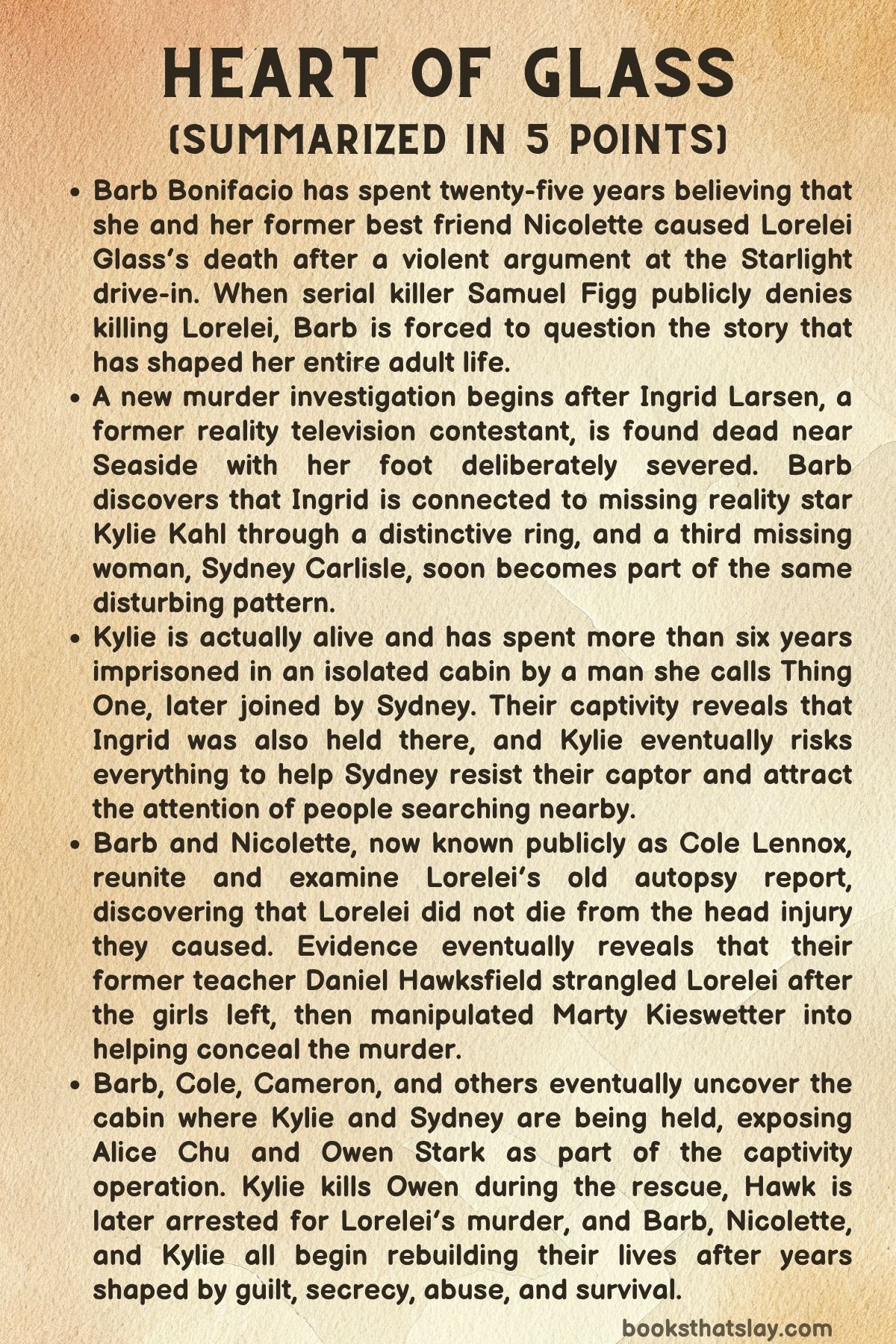
Summary
Twenty-five years after Lorelei Glass was murdered, Barb Bonifacio still lives in Seaside, Washington, working as a freelance reporter for the Chronicle. Her life has never fully moved beyond what happened when she, Lorelei, and their friend Nicolette Montes were fifteen, and the reopening of Wonderland amusement park makes the past feel newly present.
Barb is sent to Legacy Sands after twin sisters discover a severed foot and the body of a woman on the beach. The sight immediately reminds her of Seaside’s history of murdered and missing women, particularly because a documentary about serial killer Samuel Figg is about to air.
Figg confessed to murdering Lorelei and four other women in 2001. Barb, however, has privately doubted his responsibility for Lorelei’s death for years, and her doubts become more urgent when the documentary reveals that Figg himself now insists he killed only four women.
Barb has another reason to fear the program. Her estranged childhood friend Nicolette, now the famous reality television personality Cole Lennox, has agreed to appear in it despite a pact the two girls made after Lorelei’s death never to reveal what truly happened.
The new body is eventually identified as Ingrid Larsen, a former reality television contestant. Barb becomes suspicious because Ingrid was extremely thin, had breast implants, had a foot deliberately severed, and wore a ring that did not appear to belong to her.
Barb’s interest in Ingrid soon connects with her fascination with Kylie Kahl, a Trophy Wives cast member who disappeared six years earlier. Barb secretly writes recaps for the gossip site Reality Bitch and knows the show exceptionally well, although nobody there realizes that Cole Lennox is actually Nicolette, Barb’s former best friend.
Unknown to Barb, Kylie is alive. For more than six years she has been imprisoned in an isolated cabin by a man she calls Thing One, whose real identity she does not know.
Kylie has survived starvation, psychological control, physical abuse, and the constant threat of violence. She previously shared the cabin with Ingrid and witnessed Thing One chop off Ingrid’s foot after an escape attempt.
When another captive named Sydney is brought into the cabin, Kylie assumes a protective role. She teaches Sydney how to survive and begins considering whether they may have to kill their captor rather than wait for rescue.
Meanwhile, the Criminal Confessions documentary reopens Lorelei’s case. Samuel Figg publicly states that Lorelei was not one of his victims and explains that he confessed because prosecutors had enough evidence to convict him for four murders and offered to spare him the death penalty if he admitted to a fifth.
The claim terrifies both Barb and Cole because they know the official account of Lorelei’s final night was false. Their fear arises from something they have concealed since adolescence: they believe they caused Lorelei’s death.
Flashbacks gradually reveal what happened in 2001. Barb, Lorelei, and Nicolette met an older man named Sam at Wonderland, not yet understanding that he was Samuel Figg.
Lorelei flirted with Sam and later spent time with him at the Starlight drive-in. At the same time, Nicolette was hiding a far more dangerous secret: she was pregnant by Daniel Hawksfield, known as Hawk, the girls’ English teacher.
Nicolette had been involved sexually with Hawk despite being a minor and his student. She did not initially understand the full seriousness of his actions, while Hawk attempted to manage the pregnancy privately.
Inside the Starlight bathroom, Lorelei realizes that Nicolette is pregnant. Nicolette admits Hawk is the father, and Marty Kieswetter, another teenager working at the drive-in, overhears the revelation.
The confrontation becomes vicious as years of jealousy, insecurity, and resentment erupt between the three girls. Lorelei condemns Hawk’s behavior, while Barb initially defends the teacher because she idolizes him.
During the argument, Barb and Nicolette shove Lorelei. She falls, strikes her head, and becomes unconscious.
The terrified girls assume they have killed her. Hawk arrives and takes control, particularly because Nicolette is bleeding badly from what is later diagnosed as an ectopic pregnancy.
Hawk sends Barb and Nicolette to the hospital while telling them he will handle Lorelei. Marty remains behind with him, and Barb and Nicolette never see Lorelei alive again.
For the next twenty-five years, they believe Lorelei died from the fall. That belief shapes their lives in radically different ways.
Barb remains in Seaside, haunted by guilt and unable to complete the writing career she once imagined. She avoids intimacy, fears abandonment, and sabotages relationships before people can become close enough to discover her secret.
Nicolette escapes Seaside, changes her name to Cole Lennox, marries wealthy financier Jordan Lennox, and becomes a reality television celebrity. She builds a glamorous public identity that seems completely separate from the frightened girl she once was.
Yet Cole’s private life is collapsing. Jordan is suspected of financial wrongdoing, she suspects him of cheating, and her dependence on alcohol worsens as the documentary brings Lorelei back into public discussion.
After an emotional breakdown at RealityCon causes Cole to strike a teenage fan, she prepares to enter rehabilitation. Before doing so, she hires surveillance specialist Parker to gather evidence of Jordan’s suspected affair because their prenuptial agreement contains a financial provision for sexual infidelity.
Cole eventually discovers video proving Jordan is sleeping with their neighbor Annika. Around the same time, she returns to Seaside with fellow Trophy Wives cast member Cecily Monaco.
Her homecoming forces her to confront her brother Ray and her father Richard, whose violence defined much of her childhood. Richard has served time in prison and claims sobriety and incarceration changed him.
Richard also reveals that he once shared a prison cell with Samuel Figg. Figg repeatedly told him that Lorelei was not his victim, reinforcing the possibility that Barb and Cole have misunderstood the death for decades.
Barb’s current investigation is also producing major discoveries. She realizes that the ring found on Ingrid’s body resembles one once worn by Kylie, and police eventually confirm that the initials “KK” are engraved inside it.
The ring establishes a direct connection between Kylie and Ingrid. A third missing reality television participant, Sydney Carlisle, is soon added to the pattern.
Barb traces Sydney’s final movements and learns that she disappeared while traveling toward Seaside. She had been recognized at a rest stop by someone familiar with her television appearance, suggesting that the abductor targeted women associated with reality television.
As the evidence accumulates, Barb and Cole reluctantly reunite. Their first conversations are filled with resentment because they have spent decades interpreting the same tragedy in different ways.
Barb remained physically close to Lorelei’s memory, while Cole tried to survive by constructing an entirely different life. Both eventually begin reconsidering not only Lorelei’s death but also their relationships with Hawk.
They recognize that Hawk exploited their vulnerability as teenagers. After Lorelei died, Barb herself became sexually involved with him, showing that his predatory behavior extended beyond Nicolette.
The greatest change comes when Barb and Cole examine Lorelei’s original autopsy report. They discover that although Lorelei suffered a head injury, it did not kill her.
Lorelei died from asphyxiation. Someone killed her after Barb and Nicolette left the Starlight.
For the first time in twenty-five years, the women understand that their shove did not cause Lorelei’s death. Suspicion immediately shifts toward Hawk and Marty, the two people left behind.
Barb investigates Marty and discovers that he apparently vanished six years earlier, around the same time Kylie disappeared. His last known financial activity places him in Seattle, and his family history leads Barb toward a remote cabin associated with the Kieswetters.
Barb, Cole, and Detective Cameron Wallace travel there. The property initially seems ordinary, but they unexpectedly find Alice Chu, Barb’s police-department source, living there with a man she calls Owen Stark.
The situation becomes increasingly suspicious. Owen’s identity does not fit available records, and screams suddenly come from another structure on the property.
Those screams belong to Kylie and Sydney. Inside their prison, the women have realized visitors are nearby and decide to risk everything by making enough noise to be heard.
Alice then reveals herself as an active participant in the captivity operation. She attacks Cole and attempts to prevent Barb from escaping while Owen is exposed as the man Kylie knows as Thing One.
Cameron intervenes, and the confrontation turns violent. Kylie finally gains access to a fireplace poker and kills Owen after six years of imprisonment and terror.
Kylie and Sydney are rescued, while Alice is arrested. Investigators discover that the real Marty Kieswetter had disappeared years earlier and that Owen appears to have taken over the cabin and its secrets.
The most important evidence, however, comes from journals Marty left behind. Kylie had already discovered them while imprisoned, and one contains Marty’s account of Lorelei’s final night.
Marty wrote that Lorelei regained consciousness after Barb and Nicolette left. She was alive, able to speak, and had survived the bathroom injury.
Hawk later strangled her. He then forced Marty to help move her body to the cranberry field, threatening to expose disturbing photographs Marty had taken and use them to make Marty appear responsible for the murder.
The revelation finally separates several crimes that had been falsely combined for decades. Samuel Figg murdered four women but not Lorelei, Marty was disturbed and obsessed with Lorelei but did not kill her, and Barb and Nicolette injured their friend but did not cause her death.
Daniel Hawksfield was Lorelei’s actual murderer. He exploited his authority as a teacher, concealed his sexual involvement with students, killed Lorelei after she threatened the secrecy surrounding him, and manipulated vulnerable teenagers into protecting him.
Hawk is arrested for Lorelei’s murder, while additional former students report abusive or inappropriate relationships with him. Figg is formally cleared of Lorelei’s murder, although his convictions for four other killings remain intact.
Kylie begins rebuilding her life after captivity. She is reunited with her husband Freddie Tan, whose devotion survived the years she was missing, and with her younger sister Kaycie, from whom she had long been estranged.
Her sentimental ring is returned to her, completing the chain of evidence that helped Barb connect Kylie to Ingrid. The object that once represented family affection ultimately contributed to exposing the women’s captor.
Barb also begins changing. She finishes her novel, reconnects with Cameron instead of retreating from intimacy, and prepares for a renewed friendship with Nicolette after both women finally understand the truth about Lorelei.
At her last appointment with Dr. Leto before he moves away, Barb realizes she is more capable of living without the structures that once protected her. She even adopts his elderly cat, Marvelous, as another small sign that her life is no longer organized entirely around loss.
The completed documentary eventually reports Hawk’s arrest and Figg’s death from lung cancer shortly after his final interview. The past cannot be undone, but Barb is finally able to see that surviving Lorelei did not make her responsible for Lorelei’s murder.
For decades, she and Nicolette lived according to a false version of one terrible night. By discovering what actually happened, they do not erase their mistakes, but they recover the possibility of relationships, responsibility, and futures that are not controlled by the secret they carried as frightened teenagers.
Characters
Barb Bonifacio
Barb Bonifacio is the emotional and investigative center of Heart of Glass, a woman whose adulthood has been shaped by the belief that she helped kill Lorelei when she was fifteen. She remains in Seaside, works as a journalist, and repeatedly turns toward other people’s mysteries because investigating them gives her a sense of control that her own past never allowed.
Her fear of abandonment affects nearly every relationship she has. Her father’s gradual disappearance from her childhood, her mother’s death, Dr. Leto’s eventual retirement, and her terror of anyone discovering the truth about Lorelei contribute to a pattern in which Barb distances herself before another person can leave her.
Her relationship with Cameron reveals this pattern most clearly. She wants closeness but ghosts him after their relationship becomes emotionally meaningful, later regretting her choice when Megan begins dating him.
Barb is also morally complicated because she anonymously writes harsh reality television coverage, particularly about Cole, despite knowing that Cole is really Nicolette. Her writing becomes an indirect way of expressing jealousy, anger, fascination, and unresolved attachment toward the friend she cannot confront directly.
As an investigator, however, Barb is persistent, observant, and capable of identifying connections that authorities initially overlook. Her recognition of Kylie’s ring on Ingrid, her reconstruction of Sydney’s disappearance, and her investigation into Marty all become essential to finding Kylie and Sydney alive.
Her final development comes from accepting that guilt and responsibility are not identical. Barb did hurt Lorelei and participated in hiding the truth, but learning that Hawk murdered Lorelei gives her the opportunity to judge her fifteen-year-old self with greater accuracy rather than treating herself as a secret murderer.
Nicolette Montes / Cole Lennox
Nicolette Montes, later known as Cole Lennox, represents reinvention as both survival and concealment in Heart of Glass. Growing up with an abusive father and becoming sexually involved with her teacher leaves her desperate to escape Seaside and everything associated with vulnerability.
As a teenager, Nicolette is competitive, image-conscious, insecure, and frequently jealous of Lorelei’s effortless confidence. Her pregnancy by Hawk intensifies her emotional volatility because she is trying to manage a frightening adult situation without the maturity or support required to understand how thoroughly Hawk has exploited her.
After Lorelei dies, Nicolette leaves Seaside and constructs Cole Lennox. Wealth, celebrity, fashion, television, and marriage allow her to create a public self that appears completely removed from Richard Montes’s frightened daughter.
Cole understands performance exceptionally well. Reality television teaches her that apparently spontaneous events can be manipulated, edited, staged, and monetized, which makes her skilled at controlling what audiences believe about her.
The problem is that performance cannot create emotional security. Jordan’s infidelity, her drinking, her career fears, and the documentary eventually expose how fragile her carefully managed life has become.
Returning to Seaside gradually reconnects Cole with Nicolette rather than simply destroying the identity she created. She begins reconsidering Hawk’s abuse, her resentment toward Barb, her relationship with her father, and the guilt she has carried since Lorelei’s death.
Lorelei Glass
Lorelei is physically absent from most of Heart of Glass, yet nearly every major relationship is organized around her death. The people who survive her remember different versions of her, making her simultaneously a beloved friend, a source of jealousy, a murder victim, and a symbol onto which others project their guilt.
As a teenager, Lorelei is confident, magnetic, impulsive, and comfortable attracting attention. Her flirtation with Sam reflects her attraction to danger and validation, but it also emphasizes how vulnerable even confident teenagers can be when predatory adults enter their lives.
Lorelei can be cruel during arguments, particularly when she identifies other people’s insecurities. Her conflict with Barb and Nicolette becomes vicious because all three girls know exactly how to hurt one another emotionally.
At the same time, Lorelei recognizes Hawk’s conduct more clearly than either Barb or Nicolette initially does. She understands that an adult teacher sleeping with and impregnating a student is exploiting that student, regardless of how Nicolette interprets the relationship.
Lorelei’s murder eventually demonstrates how completely a dead person can be reduced to the circumstances of death. Barb remembers her ordinary preferences, jokes, habits, and flaws precisely because she fears the public has forgotten that Lorelei was a person before she became a famous victim.
Kylie Kahl
Kylie Kahl is one of the strongest survival figures in Heart of Glass. Her six years of captivity transform her, but they do not eliminate her humor, anger, observational ability, or capacity to care for another person.
She survives Thing One by learning his routines and controlling how much resistance she displays. Sarcasm becomes a form of psychological independence because even when he controls her movement, food, body, and environment, she can still refuse to let him completely determine how she thinks.
Kylie carries substantial regret about her family, especially her separation from her younger sister Kaycie. When Sydney arrives, protecting her partly becomes a way for Kylie to act on the protective instincts she wishes she had been able to express toward her sister.
Her relationship with Ingrid is also crucial. Kylie gives Ingrid the ring originally connected to Kaycie, and that act of affection later produces the physical clue that allows Barb to connect Ingrid’s murder to Kylie’s disappearance.
Kylie’s killing of Owen is the final reversal of power between captive and captor. The act is not presented as an uncomplicated victory because she emerges from the cabin carrying years of psychological and physical damage, but she is finally able to act rather than simply endure.
Daniel “Hawk” Hawksfield
Daniel Hawksfield is the central hidden antagonist of Heart of Glass because his respectable public identity conceals a pattern of predation and manipulation. As a teacher, he gains the trust of teenagers who view him as intelligent, supportive, and emotionally significant.
His relationship with Nicolette is not a romance between equals. He is an adult teacher having sex with a minor student, and the pregnancy exposes the consequences of that imbalance even before Lorelei confronts him.
Hawk also becomes involved with Barb after Lorelei’s death. Barb spends years reframing the relationship because admitting that he exploited her would require her to reconsider one of the adults she believed had cared about her.
Lorelei threatens Hawk because she recognizes what he is doing and is unlikely to remain silent. His decision to strangle her transforms his sexual misconduct into murder, while his manipulation of Marty demonstrates his ability to exploit another vulnerable young person to protect himself.
For decades, Hawk remains a respected teacher, husband, father, and mentor. That contrast between public reputation and private behavior explains how abuse can remain hidden when communities are more comfortable trusting an admired adult than examining what happened to young people around him.
Cameron Wallace
Cameron Wallace is a detective who becomes both Barb’s investigative ally and potential romantic partner. He initially reacts angrily to Barb because she ghosted him after they became intimate, showing that he is personally hurt even while attempting to maintain professional boundaries.
Unlike many people in Barb’s life, Cameron does not simply accept her theories without evidence. He is skeptical about the connection between Ingrid and Kylie until Barb produces convincing details, after which he takes the possibility seriously and shares information that helps advance the investigation.
His steadiness contrasts with Barb’s tendency to retreat from emotional risk. By the end, her willingness to reconnect with him signals that she may finally be capable of experiencing intimacy without immediately assuming it will lead to abandonment or exposure.
Alice Chu
Alice initially appears timid, nervous, and slightly starstruck, making her eventual revelation one of the story’s most significant reversals. She works within the Seaside Police Department and secretly provides Barb with restricted information, allowing Barb to see her as a useful if anxious ally.
Her enthusiasm for reality television also seems harmless at first. In retrospect, that interest becomes far more disturbing because she is directly connected to the imprisonment of women who gained public attention through reality programs.
Alice’s partnership with Owen demonstrates that violence does not always fit the assumptions victims or investigators make about perpetrators. Kylie and Sydney assume both people involved in their captivity are men, making the discovery of Alice’s role especially shocking.
Her willingness to attack Cole and kill Barb to preserve the secret shows that she is not merely a passive companion manipulated by Owen. She actively protects the system of captivity and becomes dangerous the moment exposure threatens the life she has built.
Owen Stark
Owen is the man Kylie calls Thing One and the immediate controller of the hidden prison. He imposes routines, controls food and hygiene, monitors his captives’ bodies, and uses both physical violence and psychological unpredictability to make resistance seem useless.
His connection to the Kieswetter property initially creates confusion about whether he is Marty. Evidence eventually indicates that the real Marty disappeared and Owen later took control of the cabin.
Owen’s treatment of Ingrid illustrates the extreme violence underlying his seemingly calm routines. Chopping off her foot after an escape attempt turns bodily mutilation into a warning for anyone else who might challenge him.
Kylie ultimately kills him with the fireplace poker. His death ends his direct control over her, although the psychological consequences of what he did will remain long after she leaves the cabin.
Marty Kieswetter
Marty is deliberately difficult to categorize because he displays disturbing behavior without ultimately being Lorelei’s murderer. As a teenager, he is socially detached, emotionally unusual, and obsessed with Lorelei.
His photography of his stepsister and his fixation on Lorelei show serious boundary violations. Lorelei herself recognizes that something about Marty’s emotional responses differs from those of the people around him.
Yet Marty is also manipulated by Hawk. After Lorelei survives the bathroom injury, Hawk kills her and then threatens Marty with exposure and false accusation unless he helps move the body.
Marty’s journals eventually become the evidence that clears Barb and Nicolette of causing Lorelei’s death and identifies Hawk as the killer. His role therefore demonstrates that a disturbing person can still be coerced, victimized, and wrongly suspected of a crime he did not commit.
Samuel Figg
Samuel Figg is a convicted serial killer responsible for four murders, but his presence in Lorelei’s story demonstrates the danger of assuming that a guilty person must be guilty of every crime associated with him. The Polaroid found in his car and his contact with Lorelei made him an easy suspect once investigators had already connected him to other murdered women.
Figg confesses to Lorelei’s murder to avoid a possible death sentence. His later insistence that he killed four women rather than five initially sounds like manipulation until other evidence supports his account.
His role complicates the idea of innocence because being falsely convicted of Lorelei’s murder does not make him morally innocent overall. He remains a serial murderer while simultaneously telling the truth about one killing he did not commit.
Richard Montes
Richard is Nicolette and Ray’s abusive father, whose violence shapes both children long after they become adults. Nicolette associates him with fear, unpredictability, and the feeling that home can become dangerous without warning.
After prison and sobriety, Richard presents himself as changed. Ray believes that transformation is genuine, while Nicolette remains skeptical because his present calm cannot erase what he did during her childhood.
His prison connection with Samuel Figg unexpectedly makes him important to the investigation. By revealing Figg’s repeated denial of killing Lorelei, Richard helps push Barb and Nicolette toward examining the evidence they avoided for decades.
Ray Montes
Ray is Nicolette’s older brother and one of Barb’s oldest emotional connections. Barb has carried feelings for him since childhood, although their relationship largely settles into friendship.
His adult life contains significant loss, including the death of his wife from complications related to cystic fibrosis. Returning to the family home and maintaining contact with Richard suggest that Ray has processed their childhood differently from Nicolette.
Ray also functions as a bridge between Barb and Cole because he remains connected to both women. His presence makes it increasingly difficult for them to preserve the complete separation they maintained for twenty-five years.
Cecily Monaco
Cecily is Cole’s fellow Trophy Wives cast member and public rival, although their relationship is more complicated than their television conflict suggests. She originally helps Cole navigate wealthy social circles and later encourages her to enter reality television.
Their supposed hostility demonstrates how television turns interpersonal conflict into entertainment. Cole understands that audiences are encouraged to see exaggerated versions of relationships that may be far more complicated away from cameras.
Cecily’s decision to accompany Cole toward Seaside also shows that she is more than a professional antagonist. She remains present during a period when Cole’s marriage, career, sobriety, and emotional stability are all deteriorating.
Jordan Lennox
Jordan is Cole’s wealthy husband and a major part of the sophisticated life she constructs after leaving Seaside. His social and financial position initially appears to provide the stability that Nicolette lacked while growing up.
Their marriage, however, becomes increasingly hollow. Television continues presenting them as an enviable couple even after genuine intimacy has largely disappeared.
Jordan is eventually cleared of the embezzlement allegations against him, but Cole’s surveillance proves that he is having a sexual affair with Annika. The discovery destroys the remaining illusion that wealth and social success guaranteed Cole the secure personal life she spent decades trying to create.
Sydney Carlisle
Sydney is the newest woman brought into captivity and initially represents the terror Kylie experienced years earlier. She is frightened, struggles to eat, and has not yet developed the survival habits Kylie learned over six years.
Her arrival gives Kylie someone to protect and also changes the emotional balance in the cabin. Sydney refuses to accept passive survival indefinitely and argues that the women may have to kill their captor.
Her willingness to scream with Kylie when they hear possible rescuers outside is decisive. Together they abandon the routines designed to keep them obedient and actively create the opportunity for discovery.
Ingrid Larsen
Ingrid is dead before Barb begins investigating her, but her body becomes the central clue that connects several disappearances. Like Kylie and Sydney, she has appeared on reality television and falls into the orbit of the same captivity operation.
Her severed foot reveals the brutality of the cabin long before investigators know what happened there. Kylie witnessed the mutilation after Ingrid attempted to escape, making Ingrid’s fate a permanent warning inside the prison.
The ring Kylie gave her becomes especially important. Because Ingrid still possesses it when her body reaches Legacy Sands, the jewelry creates the direct evidentiary connection that ultimately helps expose what happened to both women.
Freddie Tan
Freddie is Kylie’s husband and is widely suspected after her disappearance because spouses frequently become the focus of missing-person investigations. Cole, however, never believes he killed Kylie because she saw genuine affection between them.
His reunion with Kylie confirms that his attachment survived the six years she was missing. He does not react to how captivity changed her appearance; his first response is simply relief, grief, and regret that he could not find her sooner.
Kaycie Kahl
Kaycie is Kylie’s younger sister and represents one of Kylie’s deepest sources of regret. Kylie’s strict family environment caused her to leave home, and Kaycie begged her to stay.
Their estrangement remains unresolved throughout Kylie’s captivity, making thoughts of Kaycie emotionally central to her survival. Protecting Sydney partly allows Kylie to express the protective love she still feels for her sister.
Their reunion at the hospital offers Kylie a relationship she feared had been permanently lost. The return of the ring connected to Kaycie reinforces that recovery includes reclaiming family attachments as well as physical freedom.
Dr. Leto
Dr. Leto has treated Barb for years and understands her fear of abandonment better than she initially realizes. His decision to retire and move to Portugal unsettles her because she experiences even ordinary separation through the emotional framework created by earlier losses.
He discourages Barb from seeking emotional closure from Samuel Figg because he understands that a serial murderer cannot be trusted to provide healing. At their final meeting, however, Barb no longer needs him to resolve her past for her.
His departure therefore becomes a test of Barb’s growth rather than another abandonment. Her adoption of his cat Marvelous adds a gentle continuity to a relationship that is changing without being emotionally erased.
Megan Lyle
Megan is Barb’s friend and briefly dates Cameron after Barb has already withdrawn from him. Her relationship with Cameron hurts Barb, but Megan has not betrayed her because Barb was the one who ended the romantic connection.
Megan’s role forces Barb to confront the consequences of emotional avoidance. She cannot repeatedly push people away while also expecting their lives to remain unchanged until she feels ready to return.
Jana Jones
Jana is the producer behind Criminal Confessions and serves as an external force disturbing the silence surrounding Lorelei’s death. Her persistent interviews and requests for records create anxiety for Barb and Cole because professional curiosity threatens secrets they believed were safely buried.
Although they perceive the documentary as dangerous, Jana’s investigation helps create conditions in which the false official narrative can no longer remain unquestioned. Her work becomes one of several pressures forcing Seaside to confront a version of the past it had accepted too easily.
Lorelei’s Friends as a Group
Barb, Nicolette, and Lorelei form a friendship shaped by affection, competition, insecurity, and the emotional intensity of adolescence. None of the girls understands how dramatically adult exploitation is affecting their lives until the consequences become irreversible.
Their final argument is terrible, but it does not make Barb and Nicolette Lorelei’s killers. The tragedy is intensified by the fact that ordinary teenage cruelty, jealousy, and impulsiveness are manipulated afterward by adults who possess far greater power and responsibility.
Themes
Guilt, Responsibility, and the Stories People Tell Themselves
Guilt controls Barb and Nicolette because both women mistake emotional certainty for factual truth. They remember pushing Lorelei, seeing her fall unconscious, and leaving Hawk to handle the situation, so they construct the conclusion that they killed their friend even though neither ever verifies the actual cause of death.
That belief becomes more powerful with time because it explains everything that follows. Barb sees her stalled ambitions, failed relationships, fear of intimacy, and inability to leave Seaside through the lens of secret punishment, while Nicolette reacts by escaping geographically and psychologically.
Heart of Glass distinguishes responsibility from total blame. Barb and Nicolette did behave cruelly during the argument, physically shoved Lorelei, lied about what happened, and allowed a trusted adult to take control, but they were also frightened fifteen-year-olds dealing with circumstances created largely by predatory adults.
The autopsy report radically changes their understanding because it introduces a fact that memory and guilt could not supply. Lorelei survived the injury and was later killed by Hawk, meaning the women have spent twenty-five years sentencing themselves for a murder they did not commit.
The revelation does not erase what they did. Instead, it makes accountability more precise, allowing them to acknowledge their real failures without accepting responsibility for Hawk’s deliberate act.
Kylie experiences a related form of misplaced guilt after her rescue. Because she traveled to Seaside while investigating Cole’s past, she begins imagining that her own choices caused her kidnapping, but Cole reminds her that responsibility belongs to the person who chose to imprison and abuse her.
Across both storylines, healing begins when characters stop treating suffering as proof of guilt. Understanding what actually happened allows them to replace a self-punishing narrative with a more accurate recognition of choice, power, intention, and responsibility.
Reinvention, Performance, and the Instability of Identity
Nicolette’s transformation into Cole Lennox shows how identity can become a carefully managed construction. She changes her name, leaves Seaside, enters wealthy social circles, marries Jordan, and becomes famous through television, creating a public identity almost completely separated from the frightened teenager she once was.
Reality television strengthens this transformation because Cole learns that audiences rarely encounter an unfiltered person. Scenes are arranged, conflicts are emphasized, appearances are managed, and apparently spontaneous moments can be planned long before cameras begin recording.
Yet performance does not eliminate the past. Returning to Seaside causes Cole to accidentally introduce herself as Nicolette, react emotionally to childhood locations, and rediscover relationships that exist independently of her television persona.
Her marriage provides another example of appearance becoming mistaken for reality. Viewers see Cole and Jordan as a glamorous couple even though their emotional relationship has largely deteriorated, and surveillance eventually exposes the sexual betrayal hidden beneath their public image.
Barb also performs versions of herself. She is a serious local journalist, an anonymous sarcastic entertainment writer, a loyal keeper of Lorelei’s memory, and a woman who repeatedly hides her vulnerability by pretending she does not need intimacy.
Even Seaside participates in reinvention. Wonderland is renovated, businesses become fashionable, tourism returns, and the town attempts to market a new identity without fully addressing the violence associated with its past.
The novel ultimately suggests that reinvention can be useful without being complete. Cole does not need to destroy the identity she created, but she must accept that Nicolette still exists within it, while Barb must recognize that remaining physically close to the past has not necessarily made her more truthful about herself.
Predation, Power, and the Failure of Respectable Appearances
The danger surrounding the girls does not come only from the obvious serial killer. Samuel Figg appears threatening in retrospect because the world knows what he became, but Daniel Hawksfield demonstrates how predation can operate behind admiration, education, mentorship, and community respectability.
Hawk is trusted precisely because he does not look like the conventional image of danger. He is a teacher who encourages students, supports young writers, builds a family, and remains respected for decades.
That reputation gives him access to vulnerable teenagers. Nicolette initially interprets their sexual relationship through the language of romance and choice, but the unequal power structure becomes clearer as she grows older and understands that Hawk was the adult responsible for maintaining boundaries.
Barb’s later relationship with him reinforces that his conduct was patterned rather than accidental. He recognizes emotionally vulnerable girls and allows them to believe they share a special connection with him.
Lorelei becomes dangerous to Hawk because she names his behavior more accurately than the others do. Her refusal to treat the pregnancy as evidence of forbidden romance threatens the secrecy that protects his position, eventually contributing to his decision to kill her.
Heart of Glass repeats this examination of deceptive appearances through Owen and Alice. Owen controls women through direct captivity, while Alice initially seems timid, harmless, and even helpful because she works within the police department and enthusiastically discusses reality television.
The contrast between these perpetrators emphasizes that danger cannot always be identified through obvious social signals. Authority, charm, awkwardness, professional respectability, gender, and apparent kindness can all mislead people when behavior itself is ignored.
The later reports from additional former students finally dismantle Hawk’s protected reputation. His arrest shows how long abuse can remain hidden when communities preserve the image of a trusted adult more carefully than they investigate the experiences of vulnerable young people.
Survival, Connection, and Reclaiming a Future
Survival in the story involves far more than remaining physically alive. Kylie survives captivity for six years through observation, controlled resistance, humor, patience, and the ability to adapt without completely surrendering her sense of self.
Her relationship with Sydney changes survival from an individual process into a shared one. Kylie teaches her how to eat, conserve strength, interpret their captor, and endure the early psychological collapse that comes with realizing escape may not arrive quickly.
Sydney also changes Kylie. After years of caution, another captive gives her a reason to consider resistance again, and their decision to scream when strangers arrive near the property becomes a collective rejection of the silence imposed on them.
The ring connecting Kylie, Kaycie, Ingrid, and Barb’s investigation turns human connection into literal evidence. Kylie gives it to Ingrid out of affection, Ingrid carries it beyond captivity, Barb recognizes it, and the object eventually helps investigators establish that the missing women are connected.
Barb’s survival has been quieter but similarly shaped by isolation. She remains alive and functional for twenty-five years, yet much of her emotional life is frozen around Lorelei’s death because she believes happiness would be incompatible with what she did.
Discovering the truth makes a future possible because it allows Barb and Nicolette to reconnect without the false belief that they murdered their best friend. Their friendship cannot simply return to adolescence, but it can become something new based on a more truthful understanding of what happened.
Kylie’s reunion with Freddie and Kaycie follows the same principle. Rescue does not instantly repair six years of trauma, but it restores relationships and choices that captivity had taken from her.
The closing movement therefore treats recovery as permission to continue rather than proof that pain has disappeared. Barb finishes her novel, reconnects with Cameron, prepares to rebuild her friendship with Nicolette, and faces Dr. Leto’s departure without interpreting it as the end of her ability to function.
Kylie leaves the hospital surrounded by people she feared she had lost forever. Neither woman receives an untouched life back, but both recover the ability to decide what their lives might become next.