Lost and Found Summary, Characters and Themes
Lost and Found by Tarah DeWitt is a contemporary romance about grief, second chances, chosen family, parenthood, and the difficult work of allowing happiness back into a life changed by loss.
At its center are Bea Marshall and Silas Byrd, two people whose attraction has survived years of missed opportunities, guilt, trauma, and emotional distance. Bea is preparing to become a mother using the frozen eggs left to her by her late best friend, while Silas is still living with the physical and psychological effects of a devastating wildfire. Their renewed friendship gradually becomes a shared process of learning how to carry the past without surrendering the future. It’s the 3rd book of the Spunes, OR series.
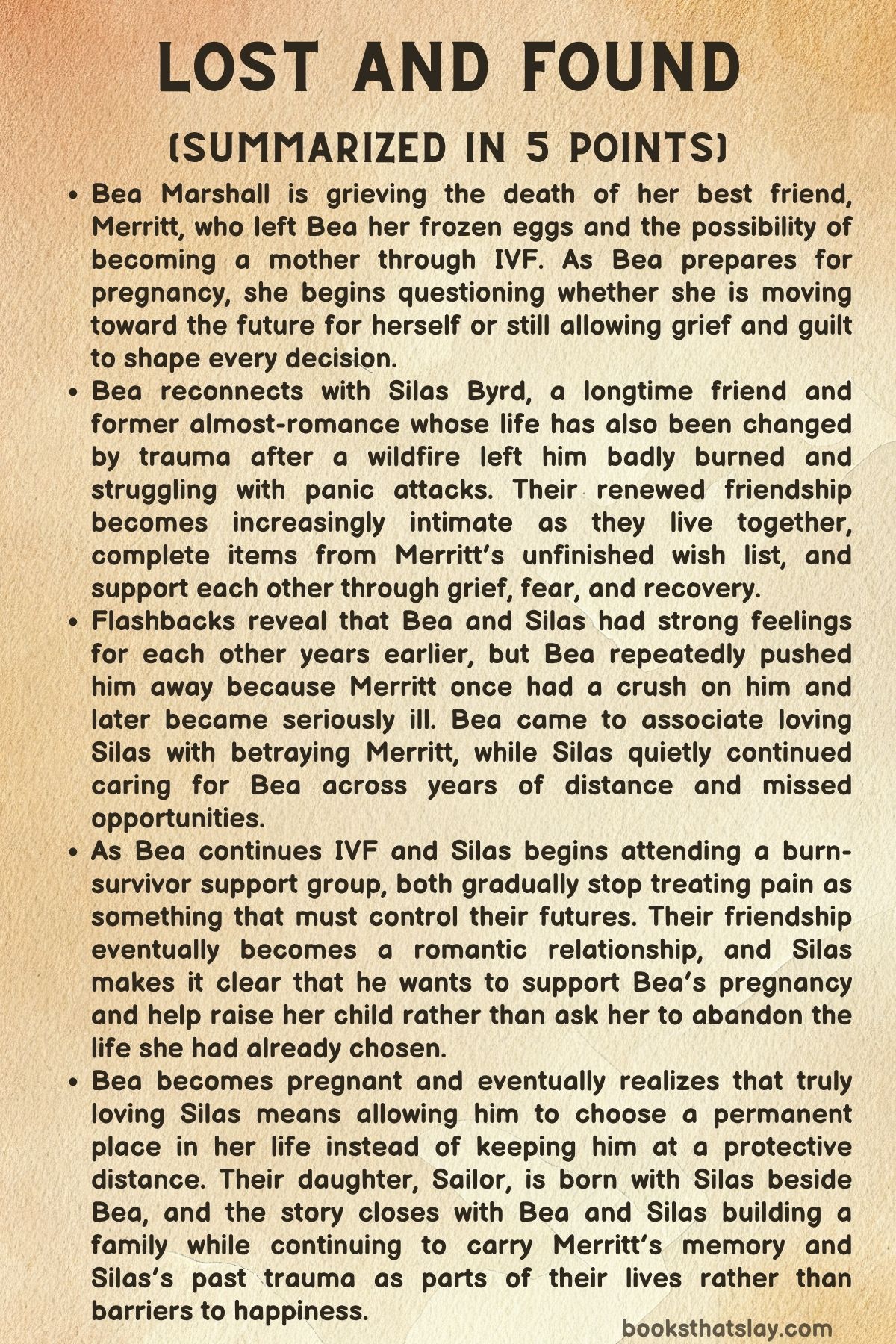
Summary
A year before the main events of Lost and Found, Bea Marshall is still reeling from the death of her closest friend, Merritt Young, who died of breast cancer. Bea learns that Merritt froze her eggs before treatment and left them to Bea, accompanied by a letter explaining that Bea should feel no obligation but acknowledging the future they had once imagined raising children together.
Merritt’s gift gives Bea something concrete to focus on after an unbearable loss. During the following year, Bea works relentlessly, moves into her mother Leslie’s guesthouse, saves money for IVF, and organizes her life around the possibility of carrying a child conceived from Merritt’s eggs.
Leslie becomes increasingly concerned that Bea has transformed the IVF plan into a way of avoiding grief. Their disagreement becomes sharper when they attend the remarriage ceremony of Wren and Ellis Byrd, where Bea unexpectedly reconnects with Silas Byrd, a man whose history with her stretches back more than a decade.
Silas has always known how to provoke Bea into feeling something when she would rather shut down. He makes her laugh, annoys her, allows her to cry without embarrassment, and speaks during the ceremony about bravery as hope transformed into action, an idea that stays with Bea.
At the reception, Bea is overwhelmed when a song associated with Merritt begins playing. Silas quietly shields her from the crowd and gives her space to grieve, establishing the emotional pattern that will become central to their renewed relationship: he does not try to erase her pain, but he remains beside her while she experiences it.
Silas is carrying his own wounds. A wildfire nearly killed him and left significant burns across his body, and although he has returned to firefighting, he experiences panic attacks and remains deeply self-conscious about his scars.
Bea reacts fiercely when Leslie makes an insensitive comment about Silas’s appearance. Her instinctive defense affects him because he has spent years believing that his altered body has made him less desirable and perhaps less worthy of the life he once expected.
During the drive home, Bea explains that Leslie believes the IVF plan may be keeping her trapped in her relationship with Merritt. Silas does not dismiss Leslie’s worries, but he also refuses to treat Bea’s grief as evidence that she cannot make decisions about motherhood.
Instead, he describes grief as something like strength training: the weight may remain heavy, but the person carrying it can grow stronger. He also offers Bea a room in his house when he learns how financially strained she has become.
Their present-day closeness is complicated by a long history of attraction. Years earlier, Silas asked Bea to prom, but Bea rejected him because Merritt had a crush on him and Bea could not tolerate the possibility of hurting her best friend.
Their single dance at prom made the attraction between them impossible to deny. When Merritt saw them together and fled in tears, Bea formed a lasting association between wanting Silas and betraying Merritt.
Several years later, Bea and Silas met again while Bea was at college. They spent an intensely personal night together, kissing and nearly having sex before Silas stopped because both had been smoking marijuana and he wanted any further intimacy to happen when they were completely clearheaded.
Instead of ending there, the night became more emotionally significant. They shared memories about family, childhood, loss, their hopes for the future, and their insecurities, discovering a level of trust that neither had expected.
The following morning, just as they were moving toward intimacy again while sober, Bea discovered nineteen missed calls from Merritt. Merritt had found a lump in her breast, beginning the medical crisis that eventually became cancer.
Although there was no rational connection between Bea being happy with Silas and Merritt becoming ill, Bea linked the two emotionally. She pushed Silas away, lied to Merritt about spending the night with him, and devoted herself to supporting Merritt through treatment.
Over the following years, Bea and Silas continued crossing paths. Their attraction never disappeared, but Bea repeatedly treated her feelings for him as something she had no right to pursue, especially because Merritt had once liked him.
In the present, Bea finally begins questioning whether she has truly processed Merritt’s death. She rereads her friend’s letter and focuses on Merritt’s list of ordinary regrets, including never adopting a pet, learning to bake bread, going deep-sea fishing for halibut, and leaving her name permanently somewhere.
Bea decides to postpone part of her IVF timetable briefly while working through those wishes. When Leslie forces Bea to leave the guesthouse in an effort to make her establish an independent life, Bea accepts Silas’s offer and moves into his home.
Living together quickly produces a strange mixture of domestic comfort and unresolved attraction. They cook, joke, unpack, experiment with bread, and begin completing Merritt’s list while insisting that they are only friends and that neither wants a romantic relationship.
Silas’s struggles become harder to conceal when smoke from a cooking accident triggers a severe panic attack. Bea, who has researched panic attacks after learning about them, calmly grounds him until he can breathe normally again.
The incident pushes Silas toward acknowledging that ignoring his trauma is no longer enough. After several failed attempts, he finally enters a support group for burn survivors and discovers a community where pain does not have to be justified through comparison.
Cap, one of the members, challenges Silas’s belief that surviving something terrible must produce a meaningful lesson. She helps him understand that the wildfire did not need to happen for a reason and that continuing to live fully is enough.
At the same time, Bea proceeds with IVF. When she cannot give herself her first injection, she asks Silas for help, allowing him into one of the most private aspects of her plan to become a mother.
Silas tells Bea that her future child will be extraordinarily lucky because few people are wanted so deliberately before they even exist. His participation in the injections begins changing the emotional meaning of Bea’s pregnancy plan, because he no longer feels like someone standing outside her imagined future.
Bea and Silas also adopt an orange cat, eventually named Calcifur. The animal initially distrusts Bea and prefers Silas, teaching Bea another unexpected lesson: love is not valuable only when affection is immediately returned.
Their attraction eventually breaks through their boundaries during a spontaneous kiss. Although both briefly consider treating it as meaningless physical release, Silas stops because he cannot pretend anything involving Bea is casual.
They later discuss what happened and agree to remain friends. Their decision becomes increasingly unrealistic as they continue relying on each other, sharing family events, making plans, and becoming integrated into each other’s daily lives.
The Byrd family welcomes Bea easily, and Silas repeatedly imagines her belonging permanently within the family. Watching his pregnant sister Sage celebrate with everyone around her also reminds him how badly he wants a future rather than simply surviving from one emergency to the next.
Bea completes one of Merritt’s wishes on a deep-sea fishing trip arranged for Silas’s birthday. She catches an enormous halibut while Silas supports her without taking control, symbolizing the kind of partnership they are gradually developing.
Afterward, Ellis confronts Silas about his obvious love for Bea. Silas argues that he does not want to burden or pressure her while she is grieving and preparing for motherhood, but Ellis points out that Silas is deciding on Bea’s behalf rather than allowing her to choose him.
That night, Bea celebrates Silas’s birthday at home. When he calls his unscarred hand his “good” hand, she rejects the implication that the scarred hand is somehow bad, reminding him of everything it still does and everything it has survived.
Silas then reveals that an exercise Bea gave him eight years earlier—listing eight favorite things to replace a painful birthday memory—helped him endure the worst moments of the wildfire. Bea realizes that she has mattered to him even during the years when they barely spoke.
Their emotional defenses finally collapse. Silas shows Bea the scars he has spent years hiding, and she responds with desire and acceptance rather than pity, helping him understand that his body does not need to resemble its former state to be loved.
They confess that they love each other. More importantly, Silas makes clear that he does not want Bea to postpone IVF for him and that he can imagine helping raise her child regardless of biology.
The embryo transfer proceeds successfully. Silas accompanies Bea when Bonnie becomes ill, holds her hand through the procedure, and increasingly behaves not as an outsider supporting Bea’s independent plan but as someone already emotionally committed to the family she is building.
An early pregnancy test comes back positive. Their happiness is enormous, yet the moment also exposes unresolved insecurity when Bea takes the test alone and Silas wonders whether she truly considers him part of the pregnancy.
Fire season soon separates them for long periods, intensifying Silas’s fear that he is merely an optional addition to Bea’s predetermined future. Bea misreads his anxiety and exhaustion as regret about committing to her.
Her eventual reconciliation with Leslie helps her recognize the pattern beneath her behavior. Leslie admits that many of her controlling choices came from fear of loss, and Bea realizes that she has done something similar by withholding parts of herself from Silas in anticipation of eventually losing him.
Bea decides that loving Silas requires allowing him to make his own choices. When he returns home, she reveals that she has been moving more belongings into his house and wants it to become their shared home.
She also presents plans for Silas to legally adopt the baby after birth. Bea tells him that she wants him to be the child’s father not merely because they are romantically involved, but because she trusts and chooses him for the role.
Silas is overwhelmed because Bea is finally offering him the permanence he was afraid to request. He imagines an ordinary lifetime of children, aging, shared rooms, the cat, changing bodies, and everyday companionship, and Bea makes clear that she wants the same future.
Silas then reveals that eight years earlier, after Bea disappeared from his life, he made a wish using the gold chain that had belonged to his mother. He wished that he and Bea would somehow end up together, that Bea would receive what she hoped for, and that Merritt would recover.
Although not every wish came true, Bea realizes that the final item on Merritt’s list can be completed through the town’s wishing canoe. Merritt’s name is permanently painted onto it, turning a local symbol of hope into a memorial that fits the way Bea wants to remember her.
The months that follow show Bea and Silas building lives that include grief rather than trying to remove it. Silas forms genuine friendships through the burn-survivor group, Bea reconnects with family, and both continue preparing for the baby.
A confrontation with Merritt’s sister Devin tests Bea’s progress. Devin angrily argues that Bea has received everything Merritt lost, including motherhood and Silas, but Bea no longer accepts another person’s grief as proof that her own happiness is wrong.
By the following spring, Bea goes into labor. Silas remains beside her through the exhausting process, comforting her, joking with her, and giving her something familiar to focus on when the pain becomes overwhelming.
Their daughter is finally born into Silas’s hands before he places her on Bea’s chest. They name her Sailor Byrd, completing Bea’s transformation from someone building a future around the fear of losing the past into someone willing to love what comes next.
The closing perspective returns to Merritt and reveals that, shortly before dying, she secretly asked Silas to take care of Bea after she was gone. She understood more about their connection than Bea realized and wanted her friend to choose someone capable of understanding how much she deserved.
Years later, Bea and Silas marry and have another child. Sailor also helps repair Bea’s relationship with Devin, while the couple’s children eventually treat Silas’s scars with such natural affection that the marks he once hated become simply another part of their father.
The ending of Lost and Found therefore does not suggest that grief disappears when life improves. Bea still carries Merritt, and Silas still carries the wildfire, but neither allows loss to become the only force determining what happens next.
Characters
Bea Marshall
Bea is the emotional center of Lost and Found, and much of her development concerns the difference between honoring someone who has died and allowing that loss to govern every future decision. Her devotion to Merritt is genuine and extraordinary, but after Merritt’s death, loyalty becomes tangled with guilt until Bea begins treating personal happiness almost as though it requires permission from someone who is no longer there.
Her decision to pursue motherhood through Merritt’s frozen eggs initially appears completely certain, yet the book gradually reveals the fear beneath her determination. Bea has researched medications, reorganized her finances, altered her living arrangements, and built a detailed plan because planning gives her a sense of control over something emotionally unpredictable.
That same desire for control shapes her relationship with Silas. She has loved him in some form for years, but she repeatedly pushes him away because she believes that avoiding the relationship protects Merritt, protects herself, and eventually protects Silas as well.
Bea’s growth occurs when she recognizes that protection can become another form of fear. Completing Merritt’s unfinished wishes, reconnecting with family and friends, adopting Cali, pursuing pregnancy, and finally choosing Silas all teach her that continuing to live does not reduce the importance of the person she lost.
By the end, Bea can experience motherhood, romantic love, friendship, anger, memory, and grief simultaneously. Her emotional maturity lies not in leaving Merritt behind but in accepting that the life Merritt influenced can continue expanding.
Silas Byrd
Silas is the romantic lead of Lost and Found, but his role extends beyond being Bea’s supportive partner. His story is also about trauma, survivor guilt, damaged self-image, and the tendency to make himself useful to others while denying that he has needs of his own.
The wildfire has changed both his body and his understanding of himself. Although he returns to firefighting, he experiences panic attacks, hides his scars, compares his suffering unfavorably with people who were injured more severely, and repeatedly questions whether he deserves to regard himself as traumatized.
His relationship with Bea challenges these beliefs because she never treats his scars as defects requiring consolation. When she rejects his description of his unscarred hand as the “good” one, she forces him to consider how casually he has accepted the idea that surviving made part of him inferior.
Silas is also deeply afraid of selfishness. His childhood memory of refusing to leave his dying mother and his later desire to remain in Bea’s life feed his fear that wanting people for himself somehow harms them.
That fear causes him to suppress his desire for Bea even after it becomes obvious that friendship is no longer emotionally sufficient. His eventual progress depends on recognizing that respecting another person does not mean making choices on that person’s behalf.
Silas’s support-group journey is equally important. By accepting that pain does not need to be justified, measured, or transformed into a lesson, he begins building friendships and a life that exists beyond work and crisis response.
Merritt Young
Merritt remains one of the most influential figures in Lost and Found despite dying before most of the main timeline. Her presence survives through memories, frozen eggs, letters, unfinished wishes, family tensions, and the emotional habits Bea formed during years of loving and caring for her.
She is remembered as funny, irreverent, impulsive, affectionate, sometimes difficult, and deeply important to the people around her. These qualities keep her from becoming an idealized symbol of tragedy; she remains recognizable as a complete person whose relationships contained jealousy, arguments, secrets, humor, and intense loyalty.
Merritt’s early crush on Silas becomes a major source of Bea’s guilt. Yet the later revelation that Merritt asked Silas to care for Bea shows that Merritt herself had grown beyond the teenage rivalry Bea continued treating as morally binding.
Her decision to leave her eggs to Bea is especially significant because she explicitly refuses to turn the gift into an obligation. Merritt gives Bea a possibility rather than a command, but Bea initially struggles to preserve that distinction.
The epilogue changes the interpretation of Merritt’s role even further. She does not want Bea to remain emotionally frozen around her death; she wants Bea protected, loved, challenged, and fully alive.
Leslie
Leslie occupies a complicated maternal role in Lost and Found because many of her harmful choices originate in love rather than indifference. She sees Bea’s obsessive focus on IVF and worries that her daughter is trying to turn Merritt’s death into a project that can be completed or controlled.
Her concerns contain genuine insight. Bea has spent much of the year avoiding other parts of life, and Leslie recognizes earlier than Bea does that grief is influencing the speed and intensity of her decision-making.
However, Leslie responds by trying to control Bea rather than trusting her. Forcing Bea out of the guesthouse threatens a carefully constructed financial plan and causes a major rupture between them.
Leslie later understands that this behavior reflects a lifelong pattern. After raising Bea as a young single mother, she became so afraid of exposing her daughter to further loss that she limited Kurt’s parental role and repeatedly tried to reduce risk through control.
Her reconciliation with Bea becomes important because Leslie finally admits that love cannot guarantee safety. That admission helps Bea recognize the same habit in herself, especially in the way she has excluded Silas from certain emotional parts of the pregnancy.
Devin Young
Devin represents one of the most painful consequences of Merritt’s death in Lost and Found because her grief develops in a direction very different from Bea’s. As Merritt’s sister, she has her own claim to loss, memory, anger, and unresolved questions about the future Merritt was denied.
Bea’s pregnancy becomes especially difficult for Devin because the child originates from Merritt’s eggs. What Bea experiences as an act of love and continuity can also appear to Devin as evidence that Bea has been given a version of Merritt’s unrealized future.
Her eventual accusation that Bea has received everything Merritt lost reveals how grief has become mixed with resentment. Motherhood, Silas, and a continuing future all seem to Devin like possessions unfairly transferred from her dead sister to Bea.
The importance of Bea’s response is that she no longer converts Devin’s anger into proof of personal wrongdoing. She can recognize the pain underneath the accusation without accepting the idea that suffering creates ownership over another person’s life.
The later indication that Sailor helps repair the relationship offers Devin a path beyond resentment. Her importance lies partly in showing that grief does not produce one morally simple response and that healing between survivors may require years rather than one decisive conversation.
Wren
Wren becomes an important example of friendship after loss. Bea initially exists in social relationships that are heavily defined by Merritt, but her growing friendship with Wren teaches her that forming new connections does not replace or diminish the dead.
Wren is perceptive about both Bea and Silas. She respects Bea’s privacy while recognizing how much emotional significance exists between the two roommates, and she warns Bea that Silas has a habit of giving too much of himself away.
Her discussion with Bea during the fishing trip is particularly valuable. By comparing motherhood and grief as permanent conditions that become part of a person without becoming that person’s entire identity, Wren gives Bea a framework for understanding how Merritt and the baby can coexist emotionally.
Ellis Byrd
Ellis serves as Silas’s older brother, protector, and occasional source of uncomfortable clarity. Because Silas lost his parents young, Ellis became one of the stabilizing figures in his life and remains someone capable of confronting him when his self-sacrificing instincts become unhealthy.
His most important intervention occurs when Silas insists that avoiding romance with Bea is the honorable choice. Ellis points out that Silas is framing the situation entirely around whether he deserves Bea instead of asking whether he is willing to participate honestly in a demanding relationship.
This shifts the question from worthiness to responsibility. Ellis understands that love is less about proving oneself morally acceptable and more about repeatedly choosing communication, effort, and care.
Sage Byrd
Sage combines protectiveness with blunt insight. Early on, she warns Silas not to pursue Bea simply because Bea is grieving, demonstrating her awareness that vulnerability can complicate romance even when the attraction is genuine.
Her pregnancy later becomes emotionally significant for both Bea and Silas. For Silas, it emphasizes the expansion of the Byrd family and everything he survived long enough to witness; for Bea, it creates another encounter with motherhood while her own outcome remains uncertain.
Sage’s place within the family also reinforces the atmosphere Bea gradually enters. The Byrds are chaotic, affectionate, intrusive, funny, and intensely loyal, offering Bea a model of family life that includes rather than excludes her.
Fisher
Fisher is less central individually, but his relationship with Sage contributes to the novel’s broader portrayal of partnership and family growth. His presence within the Byrd family helps create the ordinary communal life that increasingly attracts Bea.
He also participates in the comic family dynamic surrounding Silas. Those interactions prevent Silas’s trauma from defining every family scene and remind both Silas and the reader that he belongs within relationships where teasing, affection, conflict, and support can exist at the same time.
Kurt
Kurt functions as a quietly supportive parental figure whose limitations were imposed more by Leslie’s fear than by his own lack of affection. Bea recognizes him as loving, even though Leslie never fully allowed him to occupy the role of father.
His conversation with Bea helps reinterpret Leslie’s behavior without excusing it. Kurt explains that Leslie repeatedly tried to protect Bea from potential abandonment, providing crucial context for the controlling choices that damaged their relationship.
He also directly affirms Bea’s ability to become a mother. Having watched her care for Merritt through illness and death, he sees evidence of endurance, responsibility, and love where Bea sometimes sees only doubt.
Bonnie Young
Bonnie provides an important connection between Bea’s present life and Merritt’s family. Unlike Devin, she is able to view Bea’s IVF journey primarily through love and possibility rather than through resentment.
Her acceptance helps reassure Bea that carrying a child created from Merritt’s eggs does not automatically constitute exploitation of Merritt’s memory. At the same time, Bonnie’s place in Bea’s original transfer plan demonstrates how strongly Bea still connects the pregnancy to Merritt’s family.
When illness prevents Bonnie from attending the embryo transfer, Bea realizes that she wants Silas there. That realization marks a subtle but important emotional shift from constructing the pregnancy entirely around Merritt toward allowing her present partner into its defining moments.
Cap
Cap plays a relatively small role in terms of page time but has a major effect on Silas’s recovery. As a member of the burn-survivor group and the widow of a firefighter killed in the line of duty, she speaks from direct experience with trauma and loss.
Her central insight is that terrible events do not need to become meaningful in order for survivors to justify continuing their lives. Silas has spent years measuring his injuries against those of others and searching for some purpose that would make his suffering acceptable.
Cap rejects that framework. Her influence helps Silas stop treating pain as a moral competition and begin participating in the support group as someone who deserves community simply because he needs it.
Calcifur
Calcifur, usually called Cali, has a small but symbolically important role. Bea expects adopting a pet to be one of the simpler ways to honor Merritt’s unfinished wishes, but Cali immediately refuses to cooperate with that expectation.
The cat distrusts Bea, causes trouble, and initially prefers Silas. Bea eventually realizes that caring for another living being cannot depend on receiving instant affection in return, making Cali an early test of the kind of patient, unconditional care Bea hopes to offer as a mother.
Cali also becomes part of the domestic life Bea and Silas create together. Silas taking responsibility for the litter box because of pregnancy risks is one of many ordinary acts through which Bea begins imagining him as a parent before either openly defines him that way.
Themes
Grief as an Ongoing Form of Love
Grief in Lost and Found is not presented as a temporary condition that disappears after sufficient time has passed. Bea’s relationship with Merritt continues through memories, habits, photographs, guilt, IVF, unfinished wishes, family relationships, and the countless moments when Bea instinctively wants to tell her something.
The crucial change is therefore not that Bea becomes less devoted to Merritt. Instead, she stops assuming that devotion must be demonstrated through self-denial, emotional paralysis, or permanent loyalty to choices made when Merritt was still alive.
Silas’s experience reinforces the same idea from another direction. He has lost his mother, survived the wildfire, lost confidence in his body, and become estranged from parts of his old social life, yet he initially believes he must either find meaning in those losses or minimize them.
Both characters gradually learn that grief can remain painful without remaining controlling. Bea can miss Merritt while loving Silas, carrying a baby, building new friendships, and repairing family relationships, just as Silas can remember his mother and fear fire while still returning to work, joining a support community, and imagining old age.
The novel therefore treats remembrance and forward movement as compatible rather than opposing choices. Continuing to live is not evidence that someone mattered less; in many cases, the capacity to keep loving is one of the strongest signs that the lost relationship still matters.
Fear, Control, and the Illusion of Protection
Many of the story’s major conflicts grow from attempts to prevent future pain. Bea avoids Silas because she believes distance protects Merritt, then later believes emotional independence protects herself and her unborn child from the possibility of losing Silas.
Leslie behaves similarly as a mother. She limits Kurt’s parental role, questions Bea’s IVF plans, and eventually forces Bea out of the guesthouse because she repeatedly tries to reduce uncertainty before uncertainty can hurt her daughter.
Silas also participates in this pattern. He decides that pursuing Bea would be selfish, suppresses his emotional needs, and assumes he should accept whatever place Bea gives him rather than risk asking for more.
These actions appear selfless on the surface, but the story gradually exposes their controlling element. Bea, Leslie, and Silas all make choices on behalf of people they love without allowing those people to participate fully in the decision.
Real trust begins when they surrender the fantasy that enough caution can eliminate pain. Bea cannot guarantee Silas will always remain with her, Silas cannot guarantee that loving Bea will never hurt either of them, and Leslie cannot design a life in which Bea is protected from every future loss.
Their relationships improve when protection becomes communication rather than control. Choosing another person requires accepting that vulnerability is part of the choice, not evidence that the choice itself is a mistake.
The Body, Trauma, and Self-Worth
Silas’s scars make the relationship between physical survival and personal identity especially visible. The wildfire leaves permanent marks across his body, and even after he physically recovers enough to return to firefighting, he continues dividing himself into damaged and undamaged parts.
His description of his unscarred hand as the “good” hand reveals how deeply he has absorbed that judgment. The language seems casual, but Bea immediately understands that it reflects a larger belief that the scarred version of himself is somehow a lesser version.
Her response matters because she refuses both disgust and sentimental pity. She identifies what the scarred hand actually does: it works, comforts, helps, touches, cares for the cat, gives injections, and belongs to a man she values.
The burn-survivor group expands this lesson beyond romantic acceptance. Silas has avoided entering partly because he thinks other survivors have suffered more visibly and therefore possess a stronger claim to trauma.
Cap dismantles this hierarchy by rejecting the idea that suffering must be ranked. Silas does not need to prove that his injuries are severe enough to experience fear, shame, anger, or grief.
His eventual ability to let Bea see and touch his scars, participate openly in the group, and later allow his children to color over them shows a major change in perspective. The scars remain, but their meaning changes because Silas no longer uses them as evidence against his own worth.
Hope, Choice, and Building a Future
Hope in Lost and Found is repeatedly portrayed as an action rather than a passive feeling. Bea’s IVF process, Silas’s attempts to enter the survivor meeting, their completion of Merritt’s wishes, and their eventual decision to build a family all require them to act despite knowing that favorable outcomes are never guaranteed.
Bea’s pregnancy journey makes this especially clear. Every injection, medical appointment, embryo update, transfer, and pregnancy test contains uncertainty, yet she continues because wanting motherhood matters enough to accept the possibility of disappointment.
Silas follows a parallel path. Entering a support group cannot erase the wildfire, returning to firefighting cannot make him fearless, and loving Bea cannot guarantee permanence, but he eventually understands that uncertainty does not make those choices pointless.
The wishing canoe becomes an effective symbol because its wishes are not promises. Silas once sacrifices something deeply valuable while hoping for Bea, Merritt, and a future he cannot control, and years later the canoe becomes the place where Merritt’s name is preserved.
By the end, both Bea and Silas have stopped waiting for certainty before committing themselves to life. Their family does not prove that suffering had a hidden purpose, and their happiness does not compensate for Merritt’s death or Silas’s injuries.
What changes is their willingness to choose what matters while knowing it can be lost. Hope becomes courage expressed through ordinary decisions: asking for help, allowing love, accepting family, making friends, having a child, and trusting that a meaningful future can be built without requiring the past to disappear.


